Appendix E
“A never writer, to an ever reader. News.” The heading of the address prefixed to some copies of Troilus and Cressida in 1609 is an extremely cryptic message. The heading sets a “never writer” against an “ever reader”; the address immediately turns the latter into an “Eternal reader.” The opposition invites several readings, including the concealed-name possibility explored here. The first sentence extends the puzzle:
Eternal reader, you have here a new play, never staled with the stage, never clapper-clawed with the palms of the vulgar. — Troilus and Cressida, address to the reader (1609), sig. ¶2r.1
The proposed Neville pun lies in never: a concealed play on the name of a man whose writing appeared under another name. Read that way, the heading presents the paradox of a writer who is publicly no writer at all.
Two title pages
The 1609 quarto survives with two different title pages. One calls it The Historie of Troylus and Cresseida and advertises performance “As it was acted by the Kings Majesties servants at the Globe.” Copies in this state have no “never writer” address. The other title page calls it The Famous Historie of Troylus and Cresseid, describes the lovers and Pandarus’s wooing, and omits the Globe and the King’s Men. This is the state with the additional address. Both title pages name William Shakespeare and date the printing to 1609.2
The change is striking: the first title page sells a performed play, while the added address offers one supposedly untouched by the stage and the applause of the crowd. Bibliographically, these are different states of the same quarto, with a replacement title leaf and an added leaf containing the address on both sides. The reasons for the change remain disputed; it does not establish that the play had never been performed. Nor should every surviving copy with the revised title automatically be assumed to retain its address: H. P. Stokes also recorded copies with that title but without the prefatory leaf.3
The following pages reproduce the title and opening address together. George Eld printed the book for Richard Bonian and Henry Walley. In the same year Eld also printed Shake-speares Sonnets, with its equally enigmatic dedication, for Thomas Thorpe.4
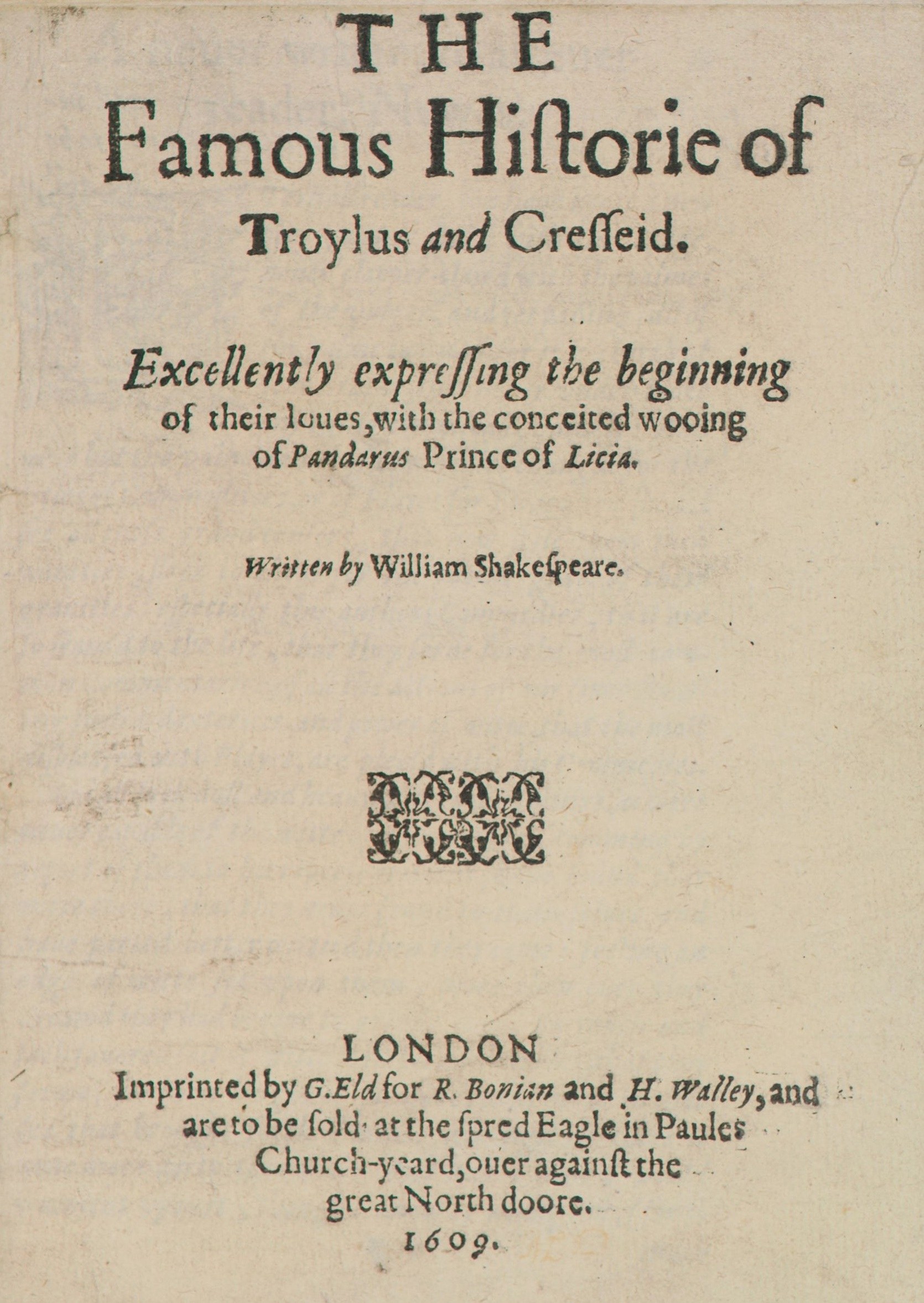
The Famous Historie of Troylus and Cresseid (1609), title page of the state containing the address. The Huntington Library, 56669 (Shakespeare Census 1552), photographed original quarto.
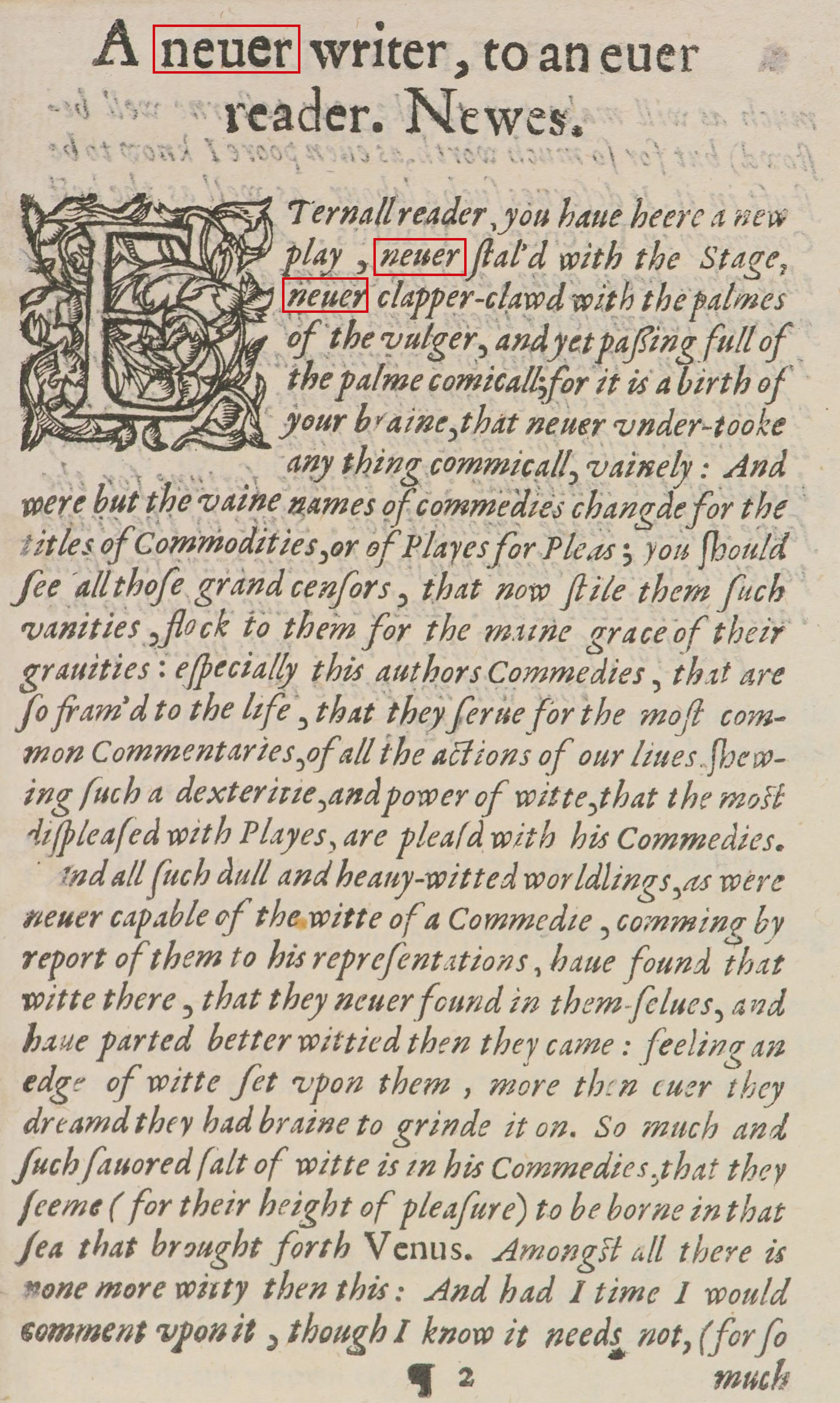
“A neuer writer, to an euer reader. Newes.” The first page of the address, sig. ¶2r, from the same Huntington copy. The original spelling makes the printed neuer / euer pairing visible. Red outlines mark neuer in the heading and twice in the opening passage.
Leonard Digges: “never, never” and “never die”
James Leyland draws attention to another example: Leonard Digges’s repeated “never, never” in a note of about 1613 mentioning Shakespeare and his sonnets. Digges wrote it on the flyleaf of Lope de Vega’s Rimas (Madrid, 1613), a book of Spanish poetry that James Mabbe was sending to Will Baker. The copy survives at Balliol College, Oxford. Digges compares Lope’s standing in Spain with Shakespeare’s in England, then closes his recommendation:
[…] as in England we should of our Will Shakespeare. I could not but insert thus much to you, that if you like him not, you must never, never read Spanish poet.5
Here the doubled never occurs in a private note explicitly discussing Shakespeare’s poetry, four years after the “never writer” address. Leyland’s observation adds a manuscript example to the proposed never / Neville wordplay. Digges’s immediate point is that a reader who dislikes Lope should give up Spanish poetry; the suggested Neville allusion would be a second meaning carried by that emphatic repetition.
Ten years later, the same Leonard Digges closes his First Folio tribute with “never die”:
Be sure, our Shakespeare, thou canst never die,
But crowned with laurel live eternally.
— Leonard Digges, “To the Memory of the Deceased Author Master W. Shakespeare” (1623), closing couplet.6

Leonard Digges, First Folio (1623), closing couplet. Boston Public Library, G.174.1. Red outline marks “never.”
In the poem, never is paired with “live eternally,” returning to the language of the “ever” and “Eternal” reader in the 1609 address.
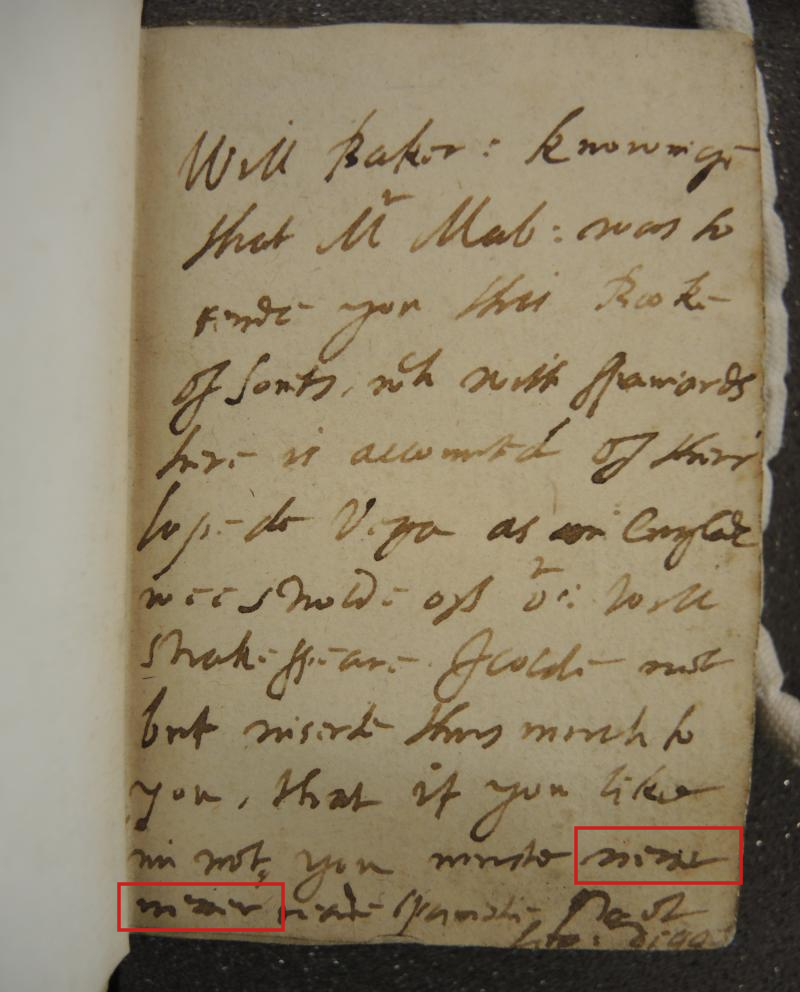
Leonard Digges’s note on the flyleaf of Lope de Vega’s Rimas (1613). The closing lines repeat “neuer,” once at the end of a line and again at the beginning of the next. Red outlines mark the two occurrences. Balliol College, Oxford, 30 a 152, via Shakespeare Documented.
Hugh Holland’s “never”
Hugh Holland supplies another example in the First Folio’s preliminary poems. He ends his sonnet:
For though his line of life went soon about,
The life yet of his lines shall never out.
— Hugh Holland, “Upon the Lines and Life of the Famous Scenic Poet, Master William Shakespeare” (1623), closing couplet.6

Hugh Holland, First Folio (1623), closing couplet. Boston Public Library, G.174.1. Red outline marks “never.”
Like Digges, Holland places never in his final assurance of the author’s survival through his works, setting the end of a life against the continuing life of the lines. The proposed wordplay lets never carry a second association with Neville within that promise of survival. Literary immortality supplies a complete ordinary meaning for both couplets; the Neville reading proposes an additional personal allusion. It is a possible pun, not an explicit naming of Neville.
How common is a “never” ending?
A survey of prefatory poems in books printed between 1615 and 1635 found 50 of 1,280 probable distinct poems (3.91%) with a form of never in their final two lines. The First Folio has two such endings among its five prefatory poems (40%): Holland’s last line and Digges’s penultimate line. Its observed proportion is about ten times the comparison rate.7
“Never” in the final two lines of prefatory poems
| Group | Qualifying poems | Observed proportion |
|---|---|---|
| Comparison poems, 1615–1635 | 50 / 1,280 | 3.91% |
| First Folio, 1623 | 2 / 5 | 40% |
The same two-line definition is used for both groups. The Folio count includes Jonson’s portrait verse as well as the four poems praising Shakespeare.
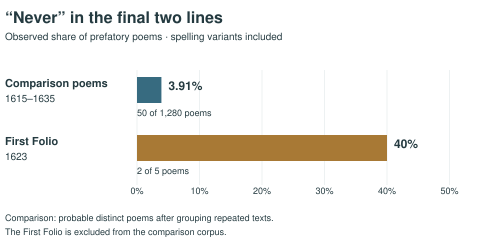
The concentration remains conspicuous when the comparison is narrowed to poems of praise: 18 of 375 (4.80%) have a never ending. This was an uncommon but established way to close a poem. Promises of lasting fame occur elsewhere: in Thomas Powell’s Direction for Search of Records (1622), a prefatory poem ends “But mine shall never die, while we are living.” The result shows how concentrated the wording is in the Folio’s small group; it does not establish a Neville allusion. A separate comparison with memorial poems would be needed to distinguish the Folio’s subject from a possible personal allusion.8
“Ne’er so vile” in Henry V
Mark Bradbeer and John Casson identify a related possibility within Henry V itself. In the St. Crispin’s Day speech, the 1600 quarto and the 1623 Folio give different words:
Shall be my brother; be he ne’er so base,
— Henry V, 4.3, quarto (1600).
Shall be my brother; be he ne’er so vile,
— Henry V, 4.3, Folio (1623).
Bradbeer and Casson suggest that “Ne’er so vile” contains “Ne’vile.” They also note that “vile” breaks the surrounding alliteration in “band of brothers,” “blood,” “brother” and “base.” The proposed name-play links the phrase with Neville’s motto, Ne vile velis, and the “vile” wording of Sonnet 121.9 Chapter 22 examines the speech’s address to Westmoreland, Neville’s ancestor.
Notes
Notes and sources
William Shakespeare, The Famous Historie of Troylus and Cresseid (London: G. Eld for R. Bonian and H. Walley, 1609), sig. ¶2r. Title and address photographed from the original quarto, The Huntington Library, 56669, STC 22332, Shakespeare Census 1552: Census record; Huntington title page; opening address. Quotations in the prose use modernized spelling; images retain the printed spelling. This is an address to the reader, rather than a dedication to a named patron.↩︎
W. L. Godshalk, “The Texts of Troilus and Cressida,” Early Modern Literary Studies 1.2 (1995), §2, items 3–5, and §3, item 4a, article; Barbara A. Mowat and Paul Werstine, “An Introduction to This Text,” Folger Shakespeare Library. For photographs of the alternative title pages, see British Library 163.i.12, Shakespeare Documented, and Folger Shakespeare Library STC 22332, Shakespeare Documented. The latter site’s “first edition” and “second edition” labels should be distinguished from the more precise account of quarto states in Godshalk and the Folger textual introduction.↩︎
H. P. Stokes, introduction to William Griggs, Troilus and Cressida: The First Quarto, 1609. A Facsimile in Photo-Lithography (London, 1886), p. v n. 2; scan. Stokes distinguishes the revised title with and without the address, the Globe title, and a Huth copy reported to contain both titles. His explanation of the publishers’ motives is not needed to establish those reported physical differences.↩︎
Shake-speares Sonnets (London: G. Eld for T. T., 1609), title page; Folger Shakespeare Library, Shakespeare Documented. The books share a printer, not the same named publishers.↩︎
Alan H. Nelson, “Rimas de Lope de Vega Carpio: Leonard Digges praises Shakespeare’s Sonnets,” Shakespeare Documented, Balliol College, Oxford, 30 a 152 (formerly 700.a.14), flyleaf, dated c.1613. Quotation follows the institutional semi-diplomatic transcription, with spelling and punctuation modernized; the opening ellipsis marks an excerpt. Image: Balliol College. Paul Morgan first published the document in “‘Our Will Shakespeare’ and Lope de Vega: An Unrecorded Contemporary Document,” Shakespeare Survey 16 (1963), 118–120, DOI.↩︎
Hugh Holland and Leonard Digges, preliminary verses in Mr. William Shakespeares Comedies, Histories, & Tragedies (London: Isaac Jaggard and Edward Blount, 1623), unpaginated preliminary poems; Boston Public Library copy, G.174.1, Holland and Digges. “Never” falls in Holland’s last line and Digges’s penultimate line, rather than being either poem’s final word.↩︎
Analysis of the EarlyPrint / EEBO-TCP XML corpus, 1615–1635, completed 18 September 2026. The source census covered 4,321 book records; eligible English prefatory verse supplied 1,311 comparison poem witnesses, reduced by exact and probable near-duplicate grouping to 1,280 poems. The First Folio (TCP A11954) was excluded from the baseline. A hit is a standalone form of never anywhere in the final two encoded verse lines, not necessarily the last word. Original spellings and contractions were included, with ambiguous near/never forms adjudicated in context. Counting edition witnesses gives 55/1,311 (4.20%); using the final four lines gives 74/1,280 distinct poems (5.78%). These are observed corpus proportions, not estimates that a Neville allusion is true or false. Coverage and poem boundaries depend on the available transcriptions. The five Folio poems are Jonson’s “To the Reader,” his longer encomium, Holland’s sonnet, Digges’s tribute and the poem signed I.M.; First Folio preliminaries.↩︎
Thomas Powell, Direction for Search of Records Remaining in the Chancerie, Tower, Exchequer, with the Limnes Thereof (London, 1622), prefatory poem to William Noy, signed “Tho. Powell,” final couplet; TCP A09904. Spelling and punctuation modernized. The 375-poem subset consists of encoded encomia, not a separately classified sample of memorial or immortality poems. The five Folio poems are not treated as independent random draws, and no chance probability is assigned to their concentration.↩︎
Mark Bradbeer and John Casson, Sir Henry Neville, Alias William Shakespeare: Authorship Evidence in the History Plays (Jefferson, NC: McFarland, 2015), “Henry V (1413–1422),” subsection “Word Play: A Neville Line,” Kindle locs. 1463–1485. For the quarto reading, see Internet Shakespeare Editions, scene 12, line 36; both readings are reproduced in William George Clark and William Aldis Wright, eds., The Works of William Shakespeare, IV (Cambridge: Macmillan, 1864), Henry V 4.3.62 and the quarto text, p. 643. Quotations use modernized spelling. The different readings do not by themselves establish the direction of authorial revision.↩︎