Henry Savile
Topic: Henry Savile
Source-Control Summary
Savile as transmitter of Neville's 26 February 1612/13 letter
State Papers Online images now control a material transmission sequence in SP 14/72. Savile's same-day letter to Dudley Carleton is SP 14/72 f.112, Gale `MC4323682145`. The following letter, SP 14/72 f.113, Gale `MC4323682146`, has a body subscribed Henry Nevill and an address to Carleton at Venice. The user's human palaeographic control identifies the f.113 address as Savile's hand and the rotated recipient-side note as Carleton's docket, reading Sr H: Savile.
John O'Donnell's complete diplomatic transcription of f.113 was received on 1 September 2026 and is now canonical corpus v25 letter_177_odonnell_1613_02_26_carleton. It confirms Neville's references to Savile's and Margaret Savile's health and to Savile's proceedings concerning his daughter. This textual evidence strengthens the household context without altering the transmission conclusion: Savile's role as enclosure sender or companion carrier remains a strong inference from hand, docket, sequence, and same-day dispatch, not a literal statement in either letter.
The best present explanation is that Neville's separately signed and sealed letter was enclosed with, or transmitted as a companion to, Savile's f.112. Savile's covering body does not mention the Neville letter, so this remains a strong inference from handwriting, docketing, physical adjacency, and date—not an explicit covering-letter statement. Gale's Savile title therefore preserves outer transmission evidence but misidentifies the writer of the f.113 body; the subscription and printed CSPD entry correctly identify Neville.
An audit of all 63 State Papers Online manuscripts indexed as Savile to Carleton through Neville's lifetime found no second hidden Neville body. Full ledger: DUDLEY CARLETON NEVILLE CORRESPONDENCE CLUSTER DEEP AUDIT 2026 09 01.
Return to England and the 1583 calendar consultation
John Dee's printed diary now supplies a firmer return control than the usual modern wording “autumn” or “late” 1582. On 3 February 1583 Dee records Mr. Savile, Mr. Powil the yonger, travaylors visiting him. This is the earliest currently controlled English-side post-tour witness for Henry Savile. It proves return by that date, not the day or port of his Channel crossing.
On 26 February Dee delivered his Playne Discourse on calendar reform to Burghley. Burghley then consulted Thomas Digges, Savile, and Mr Chambers (identified as John Chamber) on the mathematics. Dee initially wanted eleven days removed to restore the calendar to the birth of Christ; the assessors thought eleven the better correction but accepted ten days to align England with neighbouring countries without manifest error. The surviving source language supports consultation or expert review; no checked appointment instrument yet proves a formal commission. See the dedicated John Dee calendar-reform topic.
This evidence is Savile-specific. It does not prove that Henry Neville returned with him, and no calendar-reform document checked in this pass names Neville.
Dr Richard Field: a directly documented Windsor–Eton–Neville companion
Nathaniel Field's Some Short Memorials (1716–17), printed p. 12, places Sir Henry Savile and Sir Henry Neville consecutively in the Windsor social life of Dr Richard Field, the theologian and Windsor prebendary:
When he was at Windsor, he often visited Sir Henrie Savill his Neighbour at Eaton College, who was his intimate Acquaintance, and one that entirely loved him. He also often visited Sir Henrie Nevill, who lived not far from Windsor...
Nathaniel then reports an unnamed Neville daughter saying that her father “rejoiced in no Mans Companie more” than Dr Field's and was “in a manner overjoyed” when Field came to his house. The complete quotation, page-image control, clerical biography, and identity separation from Richard Field the London printer are in richard field cleric neville friendship.
The paragraph does not prove that Savile and Neville received Field together, but it does establish a single learned visitor moving repeatedly between Savile at Eton and Neville near Windsor. It therefore adds a concrete personal route to the broader Savile–Neville scholarly network.
- Treat Savile as a hub for several separately controlled lanes: continental travel with Neville/Sidney/Carew, Savile-to-Neville cousin correspondence, post-Essex Hatfield/Cecil support letters, BRO correspondence, estate/will trust evidence, Tacitus, Chrysostom, Euclid/Merton mathematics, and the Carleton/Winwood/Bodley scholarly network.
- The safest direct Neville controls are the Sidney-family correspondence route, Savile's own MegaLetters subscriptions to Neville, the Hatfield/Cecil Savile letters about Neville after the Essex offense, BRO drafts/letters, the Neville IPM/probate-will packets, and local source-image packets. ODNB, Duncan, Waszink, Goulding, Quantin, Shuger, Mandelbrote, Philo, and Feingold are valuable secondary controls, not replacements for those direct witnesses.
- Keep the people separated: Henry Savile is the scholar, cousin/correspondent, Merton/Eton/Chrysostom/Tacitus figure; Thomas Savile/Savell is the Blotius/Tycho/newsletter source-acquisition addressee; Savile junior belongs to the later Sonning/court-rumor lane.
- The Hatfield/Cecil Widdrington and Merton parsonage materials are especially important because they show Savile acting for Neville after the Essex crisis. Use the fuller manuscript/HMC quote controls below, while preserving the caveat that the Merton letter is not safely autograph and still needs a specialist paleographic pass.
Gresham College and the Savilian institutional bridge, 2026-07-19
Savile belongs at two different points in the history connecting Gresham College, Oxford mathematics, and Henry Neville. The evidence levels are not the same and should not be blended.
The reported 1576/7 approach to Gresham
When Sir Thomas Gresham asked the Mercers in February 1576/7 to contribute to a proposed college at Oxford or Cambridge, Oxford reportedly became interested and Savile allegedly approached Gresham to encourage an Oxford foundation. The timing is important: Neville entered Merton in December 1577, came under Savile's instruction, and travelled with him from 1578. The report therefore places Neville's maternal great-uncle and his future tutor in the same educational-foundation story immediately before Neville's Oxford education.
The source is not a surviving contemporary Savile-to-Gresham letter. Ian Adamson explicitly calls it an “alleged approach” and traces the report to Francis Wise's eighteenth-century communication to John Ward, British Library Add MS 6209, f. 86. Thomas Baker's letter to Ward of 10 July 1733 in the same manuscript separately reported Oxford evidence for Gresham's promise of £500. Until the Ward/Wise folio is inspected, this remains a valuable institutional-history lead rather than direct contemporary correspondence.
Briggs moves from Gresham to Savile's Oxford foundation
The later bridge is securely documented. Savile founded the Oxford chairs of geometry and astronomy in 1619 and personally appointed Henry Briggs, Gresham College's first geometry professor, to the Savilian geometry chair. New College's institutional history says:
“Briggs came to Oxford from Gresham College in London, where he had worked
in the same field.”
The personnel corridor continued through Merton. Peter Turner followed Briggs as Gresham geometry professor and later succeeded him as Savilian professor; John Greaves followed Turner at Gresham and subsequently entered the Savilian succession. Robert Goulding's 2025 history confirms Savile's first appointments of Briggs and John Bainbridge and the later presence of former Gresham geometry professors Turner and Greaves.
This happened after Neville's death and is not a Neville action. Its proper use is institutional and network history: Neville's tutor, continental companion, estate trustee, and named executor established an Oxford mathematical foundation by recruiting the first Gresham geometry professor. The older report, if ultimately substantiated, would place Savile at the Oxford end of Gresham's proposed foundation in the 1570s; the appointments place him at the Oxford end of a demonstrable transfer from Gresham College four decades later.
Public sources and controls:
- New College, Oxford,
- Robert Goulding, “Sir Henry Savile and the early professors,” in *Oxford's
- Ian Adamson, So Noble a Design (Brill, 2023), chapters 1 and 5,
- Full synthesis:
“The Savilian Professorships — A History”.
Savilian Professors of Astronomy: The First 400 Years* (Oxford University Press, 2025), DOI.
GRESHAM COLLEGE NEVILLE FAMILY DEEP DIVE 2026 07 19.
2026-07-14: Scaliger's Circle-Quadrature Controversy
Savile's dispute with Joseph Scaliger over the 1594 Cyclometrica is now a separately documented evidence packet: henry savile scaliger squaring the circle.
The episode is controlled at four distinct levels:
- Scaliger's complete
1594printed book is publicly scanned. - The
1595correspondence documents Scaliger asking for Savile's critical notes and Savile explaining his disagreement. - The Bodleian identifies Scaliger's presentation copy to Savile as
Savile Ee 1(5). - Aubrey later records John Wallis's report that Savile refuted Scaliger in the margins, including the phrase
Et dominatio vestra est asinus ex constructione. That exact marginal reading remains unresolved until the Bodleian copy is imaged and the hand controlled.
Casaubon's letter MXLIX to Savile, 9 December 1611 English Old Style (19 December Gregorian), supplies a direct printed continuation. Casaubon writes:
“Erravit Scaliger, & fortasse consultius fecisset, si abstinuisset. Solebat Vieta dicere, non esse cujusvis errare cum Scaligero.”
Translation:
“Scaliger erred, and perhaps he would have acted more wisely if he had abstained. Viète used to say that it is not given to everyone to err with Scaliger.”
This is useful evidence of Savile's working identity as a mathematical critic inside the European republic of letters. It does not establish Neville's participation in the quadrature dispute.
Casaubon's diary now adds a fully dated travel and hospitality sequence. He set out for Savile and arrived at Eton on 12 April 1611 New Style (2 April English Old Style), visited Windsor the next day, returned to Savile at Eton on 17 May 1613 New Style, and on 18 May travelled twenty-seven miles in Savile's carriage to Oxford. Savile lodged him initially at Merton. Casaubon remained at Oxford until 4 June, working through Greek patristic texts, Hebrew and Talmudic study, disputations, and the Bodleian, then returned through Eton to London on 5 June New Style. EMLO also identifies six direct Savile–Casaubon letters in 1611, five from Savile and one from Casaubon. The complete itinerary, quotations, and public source routes are in isaac casaubon in england 1610 1614.
Completion Audit And Research Architecture
This packet is ready as a hub, not as a claim that every Savile-related object is fully resolved. The 2026-07-09 audit rechecked the complete local scholarship set named in this packet—Goulding/ODNB, Shephard and Kinnamon, Waszink, Gajda, Quantin, Roebuck, Mandelbrote, Philo, Todd, Goulding on Euclid, and the principal Savile/Carleton image packet—and documented page counts, SHA-256 duplicate groups, and evidential roles in BIOGRAPHICAL NETWORK CLUSTER SOURCE PASS 2026 07 09.
The audit found multiple exact file copies of the same scholarship. These are duplicate storage witnesses, not independent corroboration: four exact copies of Gajda's article, four of Quantin's, three of Mandelbrote's, and duplicate copies of Waszink and the 1603 Savile-to-Carleton image PDF. The alternate Gajda file has the same article text and pagination but a different binary hash. The project-generated Savile/Shakespeare marginalia report was excluded from independent verification.
For future books and research, the evidence should be organized by function:
| Lane | Best present controls | What it establishes | What it does not establish |
|---|---|---|---|
| Tutor and continental companion | Sidney correspondence; Kuin/Feuillerat; Waszink; Todd; Hagecius/Dudith | a documented Neville-Savile-Sidney/Carew travel and education environment | transfer of a specific Shakespeare source |
| Cousin and correspondent | Doc_26, Doc_35, cousin subscriptions, BRO D/EN/F6/3/5 | long-duration family correspondence, practical business, news, and friendship | literary collaboration or co-authorship |
| Post-Essex protector | Widdrington and Merton-parsonage letters to Cecil; HMC and local manuscript images | Savile sought to protect Neville's property interests after the offense | exoneration of Neville or control of the Essex prosecution |
| Estate and trust | 1615 IPM and will packets | Savile belonged to Neville's settlement/executor/trust structure | final resolution of the executor-renunciation conflict |
| Historical and political reading | Tacitus edition; Waszink; Philo; Cuffe evidence | court-oriented reading and a Savile-Pinelli-Cuffe manuscript corridor | Neville's participation in the 1597 Italian Tacitus work |
| Manuscript editing and source acquisition | Chrysostom, Bradwardine, Euclid, Rerum, Dudley Carleton instructions | a demonstrable practice of collecting, collating, editing, and publishing learned texts | ownership or handling of Shakespeare manuscripts |
| Literary afterlife | Jonson epigram and Jonson-library controls | Savile's standing in early Stuart learned/literary culture | a hidden authorship network |
This architecture is deliberately more expansive than a biography summary. It makes Savile useful for separate future studies of pedagogy, travel, source acquisition, editorial method, political reading, kinship, estate trust, and learned sociability. Detailed annotation-hand claims at Audley End remain in their own excluded/lead packets and are not required to establish this documented Savile-Neville relationship.
Bottom-Line Evidential Weight
The direct relationship is unusually well supported: Neville and Savile travelled in the same continental company, corresponded as cousin, remained deare friends in the post-Essex property evidence, exchanged later letters around Merton and Sonning, and were connected in Neville's estate arrangements. The intellectually relevant context is equally strong: Savile demonstrably worked through books, manuscripts, comparison, translation, critical editing, and international scholarly agents.
The missing step is equally clear. No checked document says that Savile supplied Neville with a Shakespeare source, handled Shakespeare manuscripts, or participated in a concealed authorship arrangement. The packet is ready because it now states both the rich positive relationship and that negative boundary.
Overview
Henry Savile (1549-1622) is one of the central scholarly figures in the Neville corpus. The strongest current evidence does not depend on treating him simply as “Neville’s tutor,” but on a broader documented profile: he travelled on the continent with Henry Neville, remained connected to Neville’s circle for decades, stood near Henry Cuffe and John Hales in important intellectual corridors, edited major historical, patristic, mathematical, and theological works, and appears in both Jonson’s epigrams and Jonson’s library. This packet is a hub. The detailed Savile evidence should mostly live in the dedicated Tacitus, Chrysostom, Rerum, Bradwardine, and travel packets.
ODNB source-control position: odnb 9780198614128 e 1010181 is a Sir Henry Savile portrait/image page. The full ODNB biography is R. D. Goulding's odnb 9780198614128 e 24737, useful as T2 context for Savile's continental travel with Henry Neville, Robert Sidney, and George Carew; his Tacitus/Cuffe/Essex lane; Chrysostom; John Chamber and Barlaam's Logistica; and Euclid/Savilian-professorship material. It does not replace the project controls for direct Neville claims: Savile-Neville letters, Sidney correspondence, ONB/Blotius witnesses, HMC/Hatfield, BRO, and printed editions remain primary for book prose.
Source-Control Position: Cousin and Newsletter Controls
- The Savile/Neville "cousin" point is no longer a missing direct-witness problem. The Savile / Blotius / Tycho source-image packet stages local signature images for Henry Savile to Henry Neville,
21 Feb. 1599/1600, subscribedYo.r very loving cousin / Henry Savile, and10 May 1600, subscribedyo.r very lovinge cosen H: Savile. - Keep the distinction sharp: Henry Savile is the cousin/correspondent and major scholarly hub; Thomas Savile/Savell is the Blotius/Tycho/newsletter addressee and source-acquisition node. The two lanes belong in the same Savile family/source-network ecology, but they should not be collapsed into one person or one claim.
- The newsletter provenance note supplies the controlling route for the
1591Italian-newsletter dossier:PRO 30/50/70/2, local newsletter transcriptions, MegaLettersDoc_101-Doc_115, Henry Savile cousin controls, and the reverse-side Killigrew/Alibech witness. - For this Henry Savile hub, the newsletter route matters as context for the Savile/Neville family paper network. The Othello procedural argument belongs in venice newsletters and othello, not here.
Carleton / Savile Step-Family Source-Control Position
- BHO/VCH Hurst now improves the Dudley Carleton step-family lane from DNB/HOP/Gajda level to monument/arms control. The Hurst page describes Margaret Lady Savile as married first to George Garrard and thirdly to Sir Henry Savile, and identifies Anne Viscountess Dorchester as
Lady Savile's eldest daughter by her first husband, with Carleton/Garrard of Dorney arms. - This supports the precise relationship wording used throughout the Carleton packets: Dudley Carleton married Henry Savile's stepdaughter Anne Garrard/Gerrard, not Savile's biological daughter.
Margaret Lady Savile, Neville, and Mayerne
Two independent letters now extend the Savile-Neville relationship into Margaret Lady Savile's own correspondence. John Chamberlain wrote to Dudley Carleton on 4 August 1614 (SP 14/77/75; McClure, vol. 1, p. 555):
"I receved a ring the last weeke by Sir Henry Nevile from the Lady Savile"
The date identifies the carrier as the ambassador. This is direct evidence of Margaret entrusting Neville with a personal object for transmission into the Chamberlain-Carleton correspondence route.
A later letter from Margaret at Hurst to Secretary Dorchester, 17 January 1630/31, is calendared as warning Dorchester away from Mayerne because Sir Henry Neville and her nephew Levingstone believed Mayerne's physic had shortened their days. The same entry says Dorchester was pleased with a picture of her husband, Sir Henry Savile, who living so much respected him. The modern manuscript route is SP 16/182/64; it has not yet been imaged. Both the ambassador, who died in 1615, and his same-named son, who died in 1629, remain chronologically possible, though the 1614 ring supplies a direct Margaret-to-elder-Neville connection. See margaret lady savile mayerne and sir henry nevilles final illness.
Beaumont Papers: Country Sociability in 1606
W. D. Macray's Beaumont Papers, printed from originals in the Bodleian Library, adds a compact social witness immediately after a letter from Henry Neville at Billingbear. On 8 October 1606, Sir Henry Savile asks Sir Richard Beaumont to leave London for a while and come and live with Sir H. Nevill and mee in the countree. He urges Beaumont to leave physic and the city so that wee wilbe merry in the countree.
The complete page-image-checked printed transcription reads:
Sir,
I have receyved the money from your man. I wrote to you once this weeke, and now agayn doe renew my request, that you would bee pleased to leave London for a while and come and live with Sir H. Nevill and mee in the countree. Truely you will spoile your selfe there both for lacke of fresh ayer and with too much phisicke, beside that the choice of your phisitian is not, as I heare, the best. But pray you come, and leave physicke and citty, and wee wilbe merry in the countree, where at this present Mr. Carlton and I have a great misse of you for a present exploit of fishing a bottomlesse pond. And therefore I pray you make hast and come hither. In the meane, wishing you health and your heartes desire, I commit you to God. Eaton, this 8 Octob. 1606.
Your assured loving cosen,
Hen. Savile.
Addressed,—To the right worshipfull his very loving cosen Sir Richard Beaumont, knight, at the Woll-stable in Westminster.
The syntax and geography reinforce one another. Savile directly names himself and Neville as the country companions with whom Beaumont is invited to live, and he writes from Eton, near Neville's Billingbear estate. The later clause Mr. Carlton and I have a great misse of you directly groups Savile and Carlton for the fishing exploit. The pond and Carlton's identity remain unresolved, but those separate questions do not qualify Neville's explicit place beside Savile in the country invitation.
The complete source control, transcription, and interpretive guardrails are in Henry Savile to Richard Beaumont: Neville, Country Air, and the Bottomless Pond. Public page images: printed p. 14 / Archive leaf n53 and printed p. 15 / Archive leaf n54.
- BHO/VCH Stoke Poges and TNA
C 142/286/173separately control Anne's Walter Tredway widow/property lane. They are useful for Anne's marital/property chronology but should not be used alone to prove the Savile stepdaughter relationship. - Tredway retrieval lead: a private Treadway Web transcript of Sir Walter Tredway's
21 Jan 1603/4will names Lady Ann, George Gerrard, and Henry Savile in one testamentary context, including afather in lawanchor for Henry Savile. This is a retrieval lead only until an original probate, record-office, or court-copy image is located.
Archive.org / Hatfield Calendar Notes
- Archive.org item
calendarofmanusc11grea, HMC Salisbury/Hatfield vol. 11, adds two underused printed-calendar leads for Savile's practical support role after Neville's Essex offense. - In the first, Henry Savile asks Cecil to help protect the Widdrington/tithes/corn matter, especially the cause concerning Sir H. Nevill, who after his "late unfortunate offence" and Elizabeth's displeasure needed his own goods to best advantage.
- In the second, Henry Savile, Warden of Merton, explains that an Earl of Essex assignment involving Merton parsonage leases had been made to Savile's "dear and now unfortunate friend," Sir Henry Nevill, because Savile could not take the assignment directly as Warden/lessor.
- The Archive.org page images have now been rendered and staged in SOURCE NOTES: printed p.
564for the Widdrington/tithes item and printed p.570for the Merton parsonage item. - These leads strengthen the Savile/Neville/Essex/Merton property and patronage lane. They do not prove a Shakespeare-source transmission. Treat the HMC images as printed-calendar controls until the original Hatfield/Cecil manuscript images are obtained.
Hatfield/Cecil Manuscript Notes
- The original manuscript PDFs for the two HMC vol. 11 Savile/Cecil leads have now been added locally and rendered into a source-image packet: SOURCE NOTES.
- A working transcription/collation report is staged at README.
- The Widdrington/tithes/corn letter matches HMC's
Holographnote: the body andHenry Savilesignature appear continuous in Savile's autograph hand. It includes the crucial post-Essex phrase that Neville, after his late unfortunate offence and the Queen's displeasure, needed his own goods/interests to best advantage. - The Merton parsonage letter is not safely autograph. It is unsigned, written in a compact secretary hand, and identified through docket/calendar evidence. It still supplies a strong Savile/Neville support witness because the visible text and HMC control agree on the phrase that the assignment was made to Savile's "deare and nowe vnfortunate frende," Sir Henry Nevill, since Savile as Warden/lessor could not take it directly himself.
- AGY/Gemini was attempted for a second-pass transcription, but the local AGY CLI could not start in the research environment because restricted research runtime binding is blocked. The audit logs are preserved in the source packet. The Merton letter still needs a specialist paleographic pass for the full dense legal sentence.
Feingold OCR Source Notes
- A local OCR/source-image packet for Mordechai Feingold's The Mathematicians' Apprenticeship is staged at SOURCE NOTES.
- A chapter-by-chapter digest of the book is staged at FEINGOLD BOOK SUMMARY 2026 06 21.
- The dedicated topic for Feingold's Henry Neville / Euclid / Merton geometry lead is henry neville euclid savile merton geometry.
- The packet preserves the Desktop source PDF, a new searchable OCR PDF, a sidecar text file, the original Desktop images, and normalized page images.
- Feingold is useful here because he gives a compact scholarly control for Henry Savile's mathematical reputation, his Oxford lecture notebooks, the Almagest/Copernicus frame, the Merton/Neville Euclid lead, and Savile's role in a university-linked scientific network. It should be used as secondary scholarship and as a route back to the Bodleian
MSS Savilewitnesses, not as a substitute for inspecting the manuscripts.
Quoted Source Passages
Continental Companionship
- Source: Robert Shephard and Noel J. Kinnamon, "The Sidney Family Correspondence during Robert Sidney's Continental Tour, 1579-1581," Sidney Journal 25.1-2 (2007), document witnesses sidney family correspondence.
Quotation: "fallen into consort and fellowship with Sir Harry Neville's son and heir, and one Master Savile." What it proves: A Sidney-family source layer places Neville's son and Savile together in Robert Sidney's continental-tour company. Limits: This is an edited scholarly article quoting/using Sidney correspondence; the Penshurst manuscript remains the higher witness for final diplomatic quotation.
- Source: Philip Sidney to Robert Sidney, 18 October 1580, as cited through the Sidney correspondence lane and Kuin/Feuillerat controls.
Quotation: "Master Neville, Master Savile, and honest Harry Whyte." What it proves: Philip Sidney's correspondence independently names Neville and Savile together in the same continental company. Limits: The greeting proves social/proximate contact, not that Savile transmitted any specific Shakespeare source to Neville.
Savile-to-Neville Cousin Subscriptions
- Source: Henry Savile to Henry Neville,
21 Feb. 1599/1600, MegaLettersDoc 26 PRO 077 079; copied signature images in savile_blotius_tycho_1590_2026-06-20.
Quotation: "Yo.r very loving cousin / Henry Savile." What it proves: The Savile/Neville cousin relationship is directly visible in a Henry Savile letter-subscription during Neville's France-embassy period. Limits: The copied signature controls sender/relationship language; the full letter still needs diplomatic collation before every body reading is final.
- Source: Henry Savile to Henry Neville,
10 May 1600, MegaLettersDoc 35 PRO 099 100; same Savile image-control packet.
Quotation: "yo.r very lovinge cosen H: Savile." What it proves: A second Savile-to-Neville letter independently repeats the cousin subscription. Limits: The subscription proves relationship/correspondence, not authorship collaboration or literary source transfer.
Hatfield/Cecil Support After the Essex Offense
- Source: Henry Savile to Sir Robert Cecil, Widdrington/tithes/corn letter,
[1601]; HMC Salisbury/Hatfield vol. 11, p.564, item(90.156.); manuscript/image packet SOURCE NOTES; working transcription README.
Quotation:
"whereuppon in a man of his powerfulnes in a country of that quality will follow that no man shall dare to ... carry it out of the field, or giue it roome in his barnes ... to thresh it, or offer any mony for it"
Quotation:
"especially in cause concerninge a man, who vpon his late [vnfor]-tunate offence and her Ma^ties displeasure hath neede of his owne to the best advantage"
What it proves: Savile was asking Cecil to protect Neville's material interests after Neville's late offense and Elizabeth's displeasure, and he framed the Widdrington/tithes problem as one that could make the goods practically "worth nothing." Limits: The working transcript is research-grade, not a final paleographic edition, but the HMC calendar and visible manuscript both control the Neville identification.
- Source: Henry Savile, Warden of Merton College, to Sir Robert Cecil, Merton parsonage letter,
[1601?]; HMC Salisbury/Hatfield vol. 11, p.570, item(139.213.); same manuscript/image packet and working transcription.
Quotation:
"[the Earle of Essex] made an offer of it to me paying a hundreth and ten pounds to the Colledge ... which I did I protest more to saue the poore colledge from a brablinge tenant than for any great profit"
Quotation:
"[the assignment / lease] was made to a deare and nowe vnfortunate frende, Sir Henry Nevill, [because] I could not take [it] directly to my selfe, being Warden and in construction of lawe the lessor."
What it proves: The post-Essex Merton parsonage witness presents Sir Henry Nevill as Savile's "deare and nowe vnfortunate frende" and ties the Neville assignment to a practical legal/property problem involving Savile's Merton office. Limits: The Merton letter is unsigned, not safely autograph, and still needs a specialist paleographic pass for the full dense legal sentence. The HMC quotation controls the key phrase.
Carleton, Greek Letters, and Chrysostom
- Source: British History Online,
James I: Volume 38, December, 1608, Calendar of State Papers Domestic: James I, 1603-1610, pp.472-478; local BHO capture and Archive image controls in DUDLEY CARLETON SAVILE CHRYSOSTOM PAGE IMAGE FOLLOWUP 2026 06 28.
Quotation: "Has been plodding with his father Savile among his Greek letters." What it proves: Dudley Carleton was in Savile's Eton/Greek scholarly household world after his marriage to Savile's stepdaughter. Limits: The phrase "father Savile" is household/father-in-law language, not proof that Anne Garrard/Gerrard was Savile's biological daughter.
- Source: British History Online,
James I: Volume 43, January-February, 1609, Calendar of State Papers Domestic: James I, 1603-1610, pp.484-495; same BHO/Archive follow-up.
Quotation: "Has begun the great work of St. Chrysostom with the new year." What it proves: Dudley Carleton was directly connected to Savile's Chrysostom enterprise by January 1609. Limits: The calendar item does not by itself specify the exact labor performed; pair it with the 1610 instructions before describing acquisition or collation.
- Source: British History Online,
James I: Volume 57, August-October, 1610, Calendar of State Papers Domestic: James I, 1603-1610, pp.627-639; same BHO/Archive follow-up.
Quotation: "purchase of books, collation of MSS., relating to St. Chrysostom, at Paris and in Italy." What it proves: Sir Henry Savile used Dudley Carleton in a practical book-acquisition and manuscript-collation mission for the Chrysostom project. Limits: This remains a printed-calendar witness; the underlying probable manuscript route SP 14/57/38 still needs retrieval.
1. Verified Sourced Facts
A. Continental companionship and Neville’s early scholarly orbit
- Robert Shephard and Noel J. Kinnamon write of Robert Sidney’s continental tour that Sir Henry Sidney was glad Robert had:
“fallen into consort and fellowship with Sir Harry Neville’s son and heir, and one Master Savile”
- Mark Greengrass's ODNB entry for Henry Neville states that Neville's Merton tutor was Henry Savile and that Neville and Savile went on a continental tour in
1578, spending part of the journey with Philip Sidney and visiting Padua, Venice, and Prague. This is a compact secondary citation for the tutor/travel claim, but Shephard and Kinnamon explicitly correct the travel-companion wording: the direct Sidney correspondence evidence concerns Robert Sidney, while Philip Sidney appears as correspondent and greeting-sender.
- The same article identifies
Master Savileas:
“Henry—later Sir Henry Savile”
- The same article quotes Philip Sidney sending greetings to:
“Master Neville, Master Savile, and honest Harry Whyte”
- Sidney letter image control: photographs from Roger Kuin's Correspondence of Sir Philip Sidney, volume II, add a local visual witness for Philip Sidney's
18 October 1580letter to Robert Sidney. The edition names the manuscript source asCKS Penshurst Papers, U 1475 C 7/8; the visible text has Philip recommending Savile's company to Robert and placing Neville in the same active training environment.
- Kuin's notes identify
M[r] Sauellas Henry Savile andM[r] Neuellas Henry Neville of Billingbear. The Neville note states that Neville had been Savile's student and was accompanying him on the continental journey. This is now one of the cleanest compact citations for the Savile/Neville tutor-companion relationship, though the Penshurst manuscript itself remains the higher-level target.
- Duncan integration note: Duncan's dissertation is useful for gathering Savile references across Neville's education, continental travel, French-embassy correspondence circle, Cuffe/Winwood links, and later trust/executor network. It is not the strongest source for any one Savile claim now that this project has direct Sidney, Dudith/Hagecius, ONB, BRO, MegaLetters, IPM, Rerum, Bradwardine, and Chrysostom lanes. Use Duncan as a source map and continuity check.
- Jan Waszink writes that on Savile’s European tour in
1578:
“His travel companions included Robert Sidney (Philip’s brother), the astronomer George Carew and one of his own pupils, the future obnoxious diplomat Henry Neville.”
- The Sidney-family correspondence independently places
Master NevilleandMaster Saviletogether in Robert Sidney’s company during the same continental setting, reinforcing the tutor-companion picture preserved more explicitly in Waszink’s wording.
- Shephard and Kinnamon conclude that Savile and Neville had embarked on their own continental tour in
1578and that the Savile/Neville group and Robert Sidney's group:
“joined forces in 1580 for the journey through Germany to Prague.”
- The same article adds that Robert Sidney's interest in Tacitus, including his later ownership and annotation of Justus Lipsius's edition, may have dated from this travel period with Savile and Neville.
- Waszink further traces that tour through:
- Paris
- Altdorf
- Breslau
- Prague
- Vienna
- Padua
- Venice
- Rome
- Waszink's Savile/Tacitus argument is also a caution against reducing Savile's intellectual life to Essex politics. He argues that Savile's Tacitus should be read through Leicester, Hotman, Lipsius, and continental Low Countries politics, with Essex as a later and more limited part of the story.
- Robert B. Todd independently places Henry Savile on the continent and identifies him in September
1580at Nuremberg in company with George Carew, Henry Neville, and Robert Sidney. This strengthens the continentally documented Savile/Neville/Sidney companionship line beyond Waszink alone.
- The 1581 Hagecius / Hajek comet book adds a direct printed Central European witness to this itinerary. In the preliminary matter, Andreas Dudith describes Henry Savile as an Englishman outstanding in philosophy, mathematics, other learned disciplines, and languages, and asks Hagecius to greet Robert Sidney and Henry Neville as noble English youths outstanding in learning and morals.
- Hagecius's own address to Dudith says Savile came to him while he was writing on the comet, saw the work, discussed it with him, and could report more fully to Dudith because he already knew the material. This strengthens Savile's mathematical and astronomical continental profile, while not proving that Neville owned or read the printed book.
- The Pinelli correspondence lane is now more sharply controlled. Todd reports that Savile wrote to Gian Vincenzo Pinelli from Nuremberg on
15 May 1582, citing Maccagni-Derenzini, "Libri Apollonii," p.691. The underlying manuscript has not yet been inspected, so this is a strong retrieval lead for Savile's return route and Padua/Nuremberg scholarly network, not direct Neville evidence unless the letter itself names Neville.
- The 2019 Dudith edition provides adjacent cross-control for Savile-Pinelli material: Dudith to Savile, January
1582, no.1117, survives as a fragment in a Savile-to-Pinelli letter written at Padua on17 February 1582, cited to Milan, Biblioteca Ambrosiana,cod. D 243 inf., f.34r.
- Source-control position: direct ONB images now confirm Henry Savile to Hugo Blotius, London,
12 Mar. 1588,Cod. 9737z14-18, IV, ff. 22-23. Savile introduces his brother and writes that Sidney andNeuillius/Nevilliusgreet and love Blotius. This is direct manuscript evidence that Savile's Blotius correspondence remained connected to the Sidney-Neville circle after the continental itinerary. It is not a Henry Neville-authored letter and should not be cited as proof that this folio mentions Dudith.
- The same ONB pass confirms three Thomas Savile-to-Blotius Padua letters in
1589-1590, plus Monau, Zundelin, Deidricius, and Wotton support witnesses. These belong mainly in hugo blotius vienna library source acquisition, but they matter here because they show the Savile/Blotius relationship functioning as a practical copying, courier, source-request, and manuscript-comparison network.
- The local Neville letters corpus includes a letter with recipient field:
recipient="Henry Savile"
- Source-control position: the redone transcription of Henry Neville's 1615 inquisition strengthens Savile's estate-network role. The IPM recites the
31 May 1605and20 February 1609/10settlement structures in which Sir Henry Savile appears with George Burnell and Sir William Killigrew as a feoffee/trustee.
- The same redone IPM transcription restores an English will recital naming "Sir Henry Savile knight Warden of Merton Colledge in Oxon" alongside Dame Anne Neville, Sir John Bourchier of London, and Thomas Windebank. The IPM says they took upon them the burden of execution and were seised of estate premises for the 21-year term.
- This is direct IPM evidence for Savile's place in Neville's estate trust network, but it must be reconciled with the located probate-will packet, whose current v3 transcription names Anne Neville and Sir Henry Savile as executors and records their renunciation.
- MegaLetters correction and image control: Doc 26 PRO 077 079 and Doc 35 PRO 099 100 should be treated as Henry Savile letters, not Anne Neville letters. The earlier Anne attribution came from unreliable rough transcription/endorsement reading. The copied signature images now control the Henry Savile sender and cousin-subscription point; full diplomatic collation of the entire letters remains a separate task.
- Correction,
2026-06-24: Doc 30 PRO 088 089 should no longer be carried in the Savile correspondence lane. The current file summary and image note identify the signature asH: Killigrew, making it Henry Killigrew to Sir Henry Neville, London,6 March 1599/1600. It belongs in the Killigrew/Neville family-diplomatic lane.
- The MegaLetters Savile letters currently visible as a cluster are therefore:
Doc_26: Henry Savile to Neville,21 Feb. 1599/1600, accounts, John Chamber, Winwood, copied letters, and the Greek wordδυσκολώτερας.Doc_35: Henry Savile to Neville,10 May 1600, allowance during the treaty service, nephew H. Savile in France, Ormonde/Carew Irish news, and John Chamber.
- This cluster strengthens the ordinary-correspondence side of the Neville/Savile relationship: it is not just youthful travel, books, or later executorship. Savile is actively writing to Neville during the French embassy about household, financial, diplomatic, family, and news matters. The Killigrew correction strengthens a separate family-in-law correspondence route rather than weakening the Savile evidence.
- BRO/Royal Berkshire source control:
Doc 04e D EN F6 3 5preserves a signed14 September 1608letter from Sir Henry Neville at Billingbear to Sir Henry Savile at Merton College, Oxford. Neville sends his prospective son-in-law Sir Richard Brooke to confer with the dean of Christ Church about renewing a lease and asks Savile to inspect the lease copy, help Brooke assess which course is more beneficial, and discover the institution's demand without allowing an immediate conclusion. The address panel namesS^r Henry Savile knight at Merton Colledge in Oxford. This is a direct witness to Savile functioning as a trusted legal-financial intermediary in the Katherine Neville–Brooke marriage-settlement sequence. The hand is not independently authenticated, and the precise leasehold remains unidentified.
- The same BRO pass adds
Doc 28 D EN O 12, a24 December 1608letter from
Sir Henry Savile junior to Neville about the manor of Sonning. The exact RBA item identifies the younger knight; the hand and subscription agree with the controlled 1613 junior Savile correspondence. This item must therefore be separated from the scholar's letter lane. It says Sonning was not to be sold because the late mortgaged lands had been put into the royal entail as the King's best lands. The adjacent Caesar-Neville survey sequence identifies Mr Chancellor as Sir Julius Caesar, Chancellor of the Exchequer, rather than the Lord Chancellor.
Doc 16a D EN F44 Savile junior 1613is now a four-image, original-resolution controlled partial. The writer is Sir Henry Savile of Methley, the scholar's nephew:Jun:rappears in the contemporary docket, McClure's Chamberlain edition independently explains the elder/younger naming collision, and the Beaumont Papers print a same-month Methley letter by the younger man. He tells Neville when the Lord Chancellor can be approached about Sonning; analyzes a changed Crown-land sales scheme; reports northern, western and Sherborne transactions; and transmits aflyinge rumorthat Essex and Henry Howard might end questions otherwise disputed by theDevynes & Civilyans. The item belongs in a distinct Savile-of-Methley/Sonning/court-intelligence lane, not the scholar's biography. At least one middle leaf is absent from the photo set.
B. Savile’s major scholarly profile
- Waszink states that Savile:
“first specialised in mathematics and astronomy; later he also turned to theology, history, patristics, the history of mathematics, English history and other fields”
- Robert Goulding writes that Savile began his mathematical career in
1570with lectures on Ptolemy's Almagest and later used Euclid as a central teaching text at Merton and Oxford. Goulding also notes thatMS Savile 30, catalogued as part of Savile's lectures, is actually by Savile's student John Chamber.
- Goulding argues that Savile's Euclid annotations reveal informal mathematical education at Merton and connects Savile's annotated Euclid to John Chamber's own copy. This is useful for the Savile/Chamber/Gresham intellectual corridor.
- Jean-Louis Quantin writes of Savile’s Chrysostom edition:
“Henry Savile wrote a critical dissertation on Chrysostom’s biographers for inclusion in the eighth volume of his edition of Chrysostom’s works in Greek.”
- Quantin also writes:
“He preferred therefore to suppress his dissertation altogether”
- Quantin's article strengthens the Savile hub because it shows what Savile's scholarship looked like in practice: a decade-long, Europe-wide attempt to recover and evaluate Chrysostom life-witnesses; use of amanuenses, correspondents, and library catalogues; explicit ranking of older and later sources; and a last-minute self-censorship decision when the
Admonitiorisked turning the edition into an anti-papal controversy.
- The concrete issue was not abstract theology. Savile's suppressed dissertation challenged the authenticity of letters surrounding Pope Innocent I's alleged excommunication of Emperor Arcadius and Empress Eudoxia, a story used by defenders of papal authority over rulers. Quantin therefore makes the Chrysostom edition relevant to Savile's political theology and publication prudence, not just to Greek patristics.
- Quantin also places John Hales inside the Chrysostom enterprise more specifically: Savile included a short Hales note in the
Admonitioon the problem of the two Palladii. This should be carried mainly in john chrysostom and john hales.
- Quantin source-image controls: the Chrysostom packet now has rendered article-page controls for the bibliographical anomaly, Palladius search, Hales/two-Palladii note, Arcadius/Eudoxia/Innocent controversy, and Bellarmine/Index aftermath. Use those rendered pages through the Chrysostom packet rather than re-arguing the whole case here.
- Shuger source-image controls: Shuger separately names Savile as editor of Tacitus and Chrysostom while building the Lear/Coriolanus patristic-social-thought argument. Route that literary-critical use through chrysostom and shakespeare; it does not convert the Savile edition into proof that Shakespeare read Chrysostom directly.
- Thomas Roebuck states:
“In 1596, Henry Savile (1549-1622) published an edition of five medieval historians, mainly writers of the twelfth century, under the title Rerum Anglicarum scriptores post Bedam”
- Roebuck also states:
“in November 1596, Rowland Whyte bought a copy of ‘Mr Saviles storie of England’”
- The updated Billingbear transcription gives a direct local catalog line at
IMG 8160:
“Rerum Anglicarum Scriptores _____ Lond. 1596”
- Direct PNG inspection by Codex on
2026-04-21confirms that theRerum Anglicarum Scriptores ... Lond. 1596line is visible inIMG 8160. This belongs in the Rerum sub-packet as primary source-book evidence, but it is important enough to mention in this hub packet.
- The Audley End pre-
1616books list / email record adds a separate house-library copy lead: ID number88072699, date made1596, titleRerum Anglicarum Sciptores, current locationAUDLEY END HOUSE,FR/19 Library, Case S, Shelf 10. This should be carried mainly in the Rerum packet.
- Scott Mandelbrote's Bradwardine article adds a late Savile theological-scholarship lane. Savile's
1618edition of Thomas Bradwardine's De causa Dei belonged to the King's Printer / Archbishop Abbot / Synod of Dort context and shows Savile working through Merton, New College, Cambridge, Lambeth/Bancroft-Abbot, and Vatican manuscript witnesses.
- Mandelbrote identifies Merton College MS 71 as fundamental to the edition and concludes that Savile normally followed the Merton manuscript while recording variants from New College and other witnesses in the margin. This strengthens the picture of Savile as a manuscript editor, not just a court-connected polymath.
- Carleton/Sarpi follow-up tightens one Mandelbrote sub-lane: Dudley Carleton's embassy network, Sarpi's Trent history, George Carleton's 1613 Consensus, John Bill, and TNA routes
SP 14/92, fol. 90r/SP 14/93, fol. 95rnow have a source pass and a direct Archive title-page image for Consensus. This belongs to Savile's late scholarly/publication network, not to direct Henry Neville evidence.
B2. The King James Bible: the Second Oxford Company, 2026-08-19
Controlling packet: henry savile king james bible second oxford company. Summary only here.
- Savile sat on the Second Oxford Company, headed by Thomas Ravis and assigned the four Gospels, Acts and Revelation. The company met in Savile's own lodgings at Merton, and he took a leading role after Ravis died in
1609. Compiled-source level: the six-company division and the membership list rest on standard scholarship, not on a record inspected here, and the surviving records do not assign verses to named hands.
- A full verse-aligned collation of Geneva (
A10675), the Bishops' 1568 (A10708) and the 1611 KJV —27,311verses, grouped by company — shows Savile's section was the most conservative of the six:86.77%token retention from the Bishops' and12.98%of verses word-for-word identical, leading at every verse-length band.
- Where it does revise, it revises toward the Greek. 75 preterite-to-historic-present reversions in the Gospels and Acts against 3 in the entire rest of the Bible (said > saith 45, came > cometh 18); participial density up
43%, the largest rise of any company; and ἀρχιερεῖς split into singular "high Priest" and plural "chiefe Priests" (Geneva82/23, Bishops'80/24, KJV42/64).
- Correction to the Blot-Blood report. The claim that Savile's company "introduced blot out" at Acts 3:19 and Revelation 3:5 does not survive inspection of the base text the companies actually revised — the 1602 folio, not the 1568 that EEBO-TCP transcribes. In the Bodleian's annotated working copy, Arch. A b.18, Acts 3:19 (fol. 441v), Colossians 2:14 (fol. 474r) and Revelation 3:5 (fol. 491r) already print "blot(ted) out", unannotated. Savile's company introduced nothing at either of its two verses. The eleven surviving manuscript "blot" corrections all belong to the First Westminster and First Cambridge companies, including the much-quoted Psalm 51:1 "Blot out my transgressions" — which is not Savile-adjacent evidence and must not be cited as such.
- Two of the report's negative findings survive and are strengthened: "wipe away" occurs exactly three times in each of the three versions and is always tears; the noun "blot" occurs only at Job 31:7 and Proverbs 9:7 and never in the New Testament. The Savile / Grenewey / Shakespeare / Neville phrase therefore has no biblical model at all.
- All corpus-linkage tests are null. Nothing connects the 1611 revisions in Savile's books to his own Tacitus, Grenewey's Tacitus, Neville's letters or Shakespeare. Savile's Tacitus scores
+0.021on his own section, while the only significant positive there belongs to a control corpus (Wotton's letters,+0.253). Savile's Tacitus also uses anon at18.9xthe period rate — the very word his company's Bible removed.
- Evidence images: SOURCE NOTES. Reports: Savile KJV Collation and Blot Corrections 1602.
C. Savile, Cuffe, Hales, and the scholarly corridor around Neville
- C. D. Philo writes that the Tacitus translations in Pinelli’s papers:
“were undertaken, this essay argues, as a collaborative effort between Savile’s former student, Henry Cuffe (1562/3–1601), and Pinelli himself.”
- Philo also writes:
“Savile, Pinelli, and Cuffe were each reading Tacitus as a guide to life at court”
- Philo reconstructs the Italian manuscript afterlife of Savile's Tacitus more specifically: Savile's English commentary circulated into Gian Vincenzo Pinelli's Padua/Milan scholarly world, where portions were translated into Latin and Italian and answered in an Italian response to Savile's reading of Tacitus. This matters because it shows Savile's scholarship moving through a living continental humanist network, not merely sitting as an English printed book.
- Philo's Cuffe argument is not just name-association. He notes that Cuffe travelled to Italy in
1597on Essex business, matriculated at Padua, worked with Pinelli on Photius, helped with classical editorial work in Florence, and is the more plausible translator/collaborator than Thomas Savile because the Ambrosiana translations use the printed1591edition after Thomas had left Italy.
- For this hub packet, the safest formulation is: Philo strongly supports a Savile-Cuffe-Pinelli Tacitus corridor in
1597Italy; it does not prove Henry Neville was involved in that specific Padua manuscript work.
- The
1598calendar item records:
“H[enry] C[uffe] to Henry Savell, or in his absence Edward Reynolds, secretary to the Earl of Essex.”
D. Savile, Carleton, Winwood, and Bodley
- DNB's Dudley Carleton entry has an erratum correcting the common statement that Dudley married Savile's daughter. It correctly makes Anne Gerrard/Garrard the daughter of George Gerrard of Dorney and Margaret, but its
second husbandwording is incomplete: the Hurst monument sequence says Margaret married first George Garrard, second John Smith of Essex, and third Henry Savile. - Alexandra Gajda treats Dudley Carleton as Savile's son-in-law and notes that Savile advised Carleton to cultivate Secretary Winwood as his:
“surest and most usefull frende in court”
- Normalize the relationship as step-son-in-law: Dudley married Anne Garrard/Gerrard, Savile's stepdaughter, not Savile's biological daughter. This makes Dudley Carleton part of Savile's step-family and correspondence network, not merely a remote diplomatic correspondent.
- The edge-by-edge calculation is: Anne was Margaret's daughter by George Garrard; Margaret later married Savile; Anne married Dudley. Therefore Anne was Savile's stepdaughter and Dudley was Savile's step-son-in-law. This conclusion does not require treating the calendared
father Savilephrase as literal paternity. - A local State Papers image controls Henry Savile writing to Dudley Carleton on
17 October 1603,SP 14/4 f.43, GaleMC4323580718; the address leaf readsTo my very loving friend Mr Dudley Carleton at Court. - Partial-body controls: stable crops now support short body anchors including
The Edict is a pretty knacke of knavery, a bearer carrying a letter from Savile'sbrother of the Exchequer, and Savile asking Dudley to direct the bearer to Dudley'shonorable Lord and master. This strengthens the pre-1607 Savile/Dudley court-document corridor, but it is not a full diplomatic transcription. - BHO/CSPD James I calendars a
11 December 1608Dudley-to-Chamberlain letter from Eton saying Dudley had beenplodding with his father Savile among his Greek letters. This is useful evidence for household closeness after Dudley's marriage to Savile's stepdaughter, but it should not be converted into biological daughterhood. - BHO/CSPD James I calendars a
3 January 1609Dudley-to-Sir Walter Cope letter saying Dudley had begun thegreat work of St. Chrysostomwith the new year. - BHO/CSPD James I calendars
August 1610instructions from Sir Henry Savile to Sir Dudley Carleton about purchase of books and collation of St Chrysostom manuscripts at Paris and in Italy. This gives the Savile/Carleton relationship a concrete book-acquisition and manuscript-collation function. - Page-image controls: the three Dudley/Savile/Chrysostom CSPD entries now have checked Archive.org page-image controls at printed p.
474/n487, p.484/n497, and p.630/n643. The underlying manuscript targets remain probableSP 14/38/22,SP 14/43/3, andSP 14/57/38. - BHO/VCH Hurst now supplies a public monument/arms control for the stepdaughter relationship: Anne Viscountess Dorchester is identified as Margaret Lady Savile's eldest daughter by her first husband, George Garrard, before Margaret's later marriage to Sir Henry Savile.
- The
2026-06-28cousin/Tredway follow-up adds a will-transcript lead for the same step-family lane: Sir Walter Tredway's will, as privately transcribed online, names Lady Ann, George Gerrard, and Henry Savile. Keep this below BHO/VCH and TNA controls until the original image is found.
- Source-control check of the PDF shows that this was a Paris intelligence letter dated
July 26 / Aug. 5 1598, not just a bare correspondence notice. Cuffe describes conveying sensitive Italian intelligence toward Essex through Savile or Edward Reynolds and mentions parallel communication to Southampton.
- Nancy E. Scott states of John Hales:
“the prodigious pregnancy of his parts being discovered by Hedge beaters of Sir Henry Savile, he was encouraged to stand for a Fellowship at Merton.”
- Scott also states of Hales:
“he whom he chose to help him in his great work of editing the eloquent Greek Father.”
- Daniel Blank writes:
“Hales was also recruited as a Fellow to Merton College by the erudite polymath Henry Savile”
- Blank also writes:
“Eventually Savile offered him a position at Eton”
- Source-control check of the Hales PDFs clarifies why Hales matters for the Savile hub. Hales was not merely a later Shakespeare anecdote figure; he was a Savile-recruited Merton/Eton scholar, a collaborator on the Chrysostom edition, and probably the owner/scribe of a large Eton scholarly shelflist that included Savile's Chrysostom.
- The Hales packet also gives the Savile circle a later Shakespeare-reception lane. Blank argues that Hales's famous Shakespeare judgment belongs inside a wider early university process of "classicizing" Shakespeare; Freehafer warns that Dryden's early report is credible but later Eton "trial of skill" elaborations are unreliable.
D. Jonson and Savile’s later literary afterlife
- The
1616Archive.org witness of Jonson’s folio includes an epigram headed:
“To Sir Henry Savill”
- David McPherson’s catalog of Jonson’s library states that Jonson owned:
“Rerum Anglicarum Scriptores, ed. Sir Henry Savile (No. 161)”
- McPherson's evidence should be used with copy-specific care: Jonson ownership of Savile's Rerum is strong, but the annotation evidence differs by surviving copy. The Oxford copy is the stronger possible Jonson-annotation witness; McPherson treats the Stratford text annotations as not Jonson's despite Jonson-like ownership marks.
E. Continental correspondence around books
- The local Verona letter witness is headed:
“Alvise Lullini to Henry Savile.”
- The local Rome/Pallavicino witness is headed:
“Gio. Bat. Raimundo and G. V. P. (Pallavicino) to Sir Hen. Saville; about books they were….”
- The calendar version identifies that item as:
“April 22 and May 9 1582”
These letter witnesses are valuable because they show Savile in direct continental book correspondence at the end of the same larger European period in which Neville appears beside him.
2. Ken Feinstein Twitter and Blog Information
- A Ken Feinstein blog post on Richard Grenewey and Tacitus states:
“Savile served as Neville's Oxford tutor and they traveled together in Europe.”
- A Ken Feinstein blog post on the Audley End annotations states:
“Savile, Neville's tutor at Merton College Oxford and his European travel companion”
- The same Audley End blog post states:
“The annotations demonstrate that Neville and Savile were both engaging with the same Roman historical material”
These remain useful project claims, but the tutoring and shared-annotation formulations should stay in the Feinstein layer unless extracted more directly from independent scholarship or archival witnesses.
- The Audley End
Roman Antiquitieslead concerns a1546copy of Roman Antiquities by Dionysius of Halicarnassus. Related Audley End packets also report a bound volume combining Appian's Roman History (1551) with Dionysius of Halicarnassus' Roman Antiquities (1548), but the Billingbear list line inspected so far readsDionis Romana Historia. Folger and National Trust catalog records for the1551Robert Estienne Xiphilinus epitome make Cassius Dio / Dio Cassius the likely identification of thatDionisline. These volume identifications should be carried by the Audley End packets, not left as an unnamedRoman Antiquitiesclaim in Savile proper.
3. Quoted Source Text
Sidney correspondence / continental travel
- “fallen into consort and fellowship with Sir Harry Neville’s son and heir, and one Master Savile”
- “Henry—later Sir Henry Savile”
- “Master Neville, Master Savile, and honest Harry Whyte”
- “joined forces in 1580 for the journey through Germany to Prague”
- “His travel companions included Robert Sidney (Philip’s brother), the astronomer George Carew and one of his own pupils, the future obnoxious diplomat Henry Neville.”
- “Continental politics and political thought is crucial to Savile’s Tacitus”
- “Philosophiae, Mathematicarum, aliarumque elegantium disciplinarum”
- “Dn. Robertum Sidnaeum, ac Dn. Henricum Neuellum”
- “cum de hoc cometa commentarer”
- “Sidneus et Neuillius/Nevillius te, tuosq[ue] omnes salutant et amant plurimum”
- “De Savello multa laudabilia scribit”
- “His tutor was Henry Saville”
- “They both went on a continental tour in 1578”
- “To ... S^r Henry Savile knight at Merton Colledge in Oxford”
- “from Billingbeare the 14^th of September 1608”
- “for the mannor of Sonning”
- “from S^r H: Savile”
- “Sir Henry Savile knight Warden of Merton Colledge in Oxon”
- “tooke upon them the burthen of the execution”
Savile’s scholarly profile
- “first specialised in mathematics and astronomy; later he also turned to theology, history, patristics, the history of mathematics, English history and other fields”
- “Henry Savile began his long mathematical career in 1570”
- “Henry Savile wrote a critical dissertation on Chrysostom’s biographers”
- “He preferred therefore to suppress his dissertation altogether”
- “The suppressed Admonitio was the fruit of a decade of research”
- “plodding with his father Savile among his Greek letters”
- “The Edict is a pretty knacke of knavery”
- “This bearer hath a letter from my brother of the Exchequer to your honorable Lord and master”
- “Has begun the great work of St. Chrysostom with the new year”
- “purchase of books”
- “collation of MSS.”
- “In 1596, Henry Savile (1549-1622) published an edition of five medieval historians”
- “Rerum Anglicarum Scriptores _____ Lond. 1596”
ID Number: 88072699- “Savile normally followed the Merton manuscript”
Cuffe / Hales corridor
- “were undertaken ... as a collaborative effort between Savile’s former student, Henry Cuffe ... and Pinelli himself”
- “Savile, Pinelli, and Cuffe were each reading Tacitus as a guide to life at court”
- “Over a decade after Henry Savile’s journey to Padua, Henry Cuffe followed in his mentor’s footsteps”
- “undertaking a series of translations into Italian and Latin of Savile’s commentary on Tacitus”
- “H[enry] C[uffe] to Henry Savell”
- “the prodigious pregnancy of his parts being discovered by Hedge beaters of Sir Henry Savile”
- “he whom he chose to help him in his great work of editing the eloquent Greek Father”
- “Eventually Savile offered him a position at Eton”
Jonson / library afterlife
- “To Sir Henry Savill”
- “Rerum Anglicarum Scriptores, ed. Sir Henry Savile (No. 161)”
- “Two copies”
- “not Jonson's”
4. Citations
- Macray, W. D., ed. Letters Relating to the Family of Beaumont, of Whitley, Yorkshire, from the Fifteenth to the Seventeenth Centuries (Beaumont Papers). London: Roxburghe Club, 1884, pp.
13-15, especially Sir Henry Savile to Sir Richard Beaumont, Eton,8 October 1606. Internet Archive item beaumontpapersle00roxb, printed p. 14, and printed p. 15. - Neville Letters Corpus. Canonical version 25, 169 letters and 3 documents; SHA-256
8e2f0c93a8ba662d50f45af114d04c875f49a48f5b1368492488b5f8f058a272. This computational corpus is a discovery and cross-reference control; John O'Donnell's diplomatic transcription and theSP 14/72 f.113manuscript image control the new Carleton letter's text and identity. - Waszink, Jan. “Henry Savile’s Tacitus and the English role on the Continent: Leicester, Hotman, Lipsius.” document witnesses: Waszink Savile Tacitus Continental 2016.
- Quantin, Jean-Louis. “Historical Criticism, Confessional Controversy, and Self-Censorship: Henry Savile and the Lives of John Chrysostom.” document witnesses: Quantin Savile Chrysostom 2021.
- Quantin source-image packet and research pass: SOURCE NOTES; JOHN CHRYSOSTOM QUANTIN RESEARCH PASS 2026 06 20.
- Shuger source-image packet and Chrysostom/Shakespeare hub: SOURCE NOTES; chrysostom and shakespeare.
- Shephard, Robert, and Noel J. Kinnamon. “The Sidney Family Correspondence during Robert Sidney’s Continental Tour, 1579-1581.” document witnesses: sidney family correspondence.
- Kuin, Roger, ed. The Correspondence of Sir Philip Sidney. Vol. II. Oxford: Oxford University Press, 2012, pp. 1005-1010. image witnesses batch and notes: SIDNEY IMAGE BATCH INDEX AND NOTES.
- Gajda, Alexandra. “Henry Savile and the Elizabethan Court.” Erudition and the Republic of Letters 6 (2021): 32-60. DOI:
10.1163/24055069-06010001. document witnesses: Gajda Savile Elizabethan Court 2021. Root upload duplicate: [24055069 - Erudition and the Republic of Letters] Henry Savile and the Elizabethan Court. - Sir Henry Savile to Dudley Carleton,
SP 14/4 f.43,17 October 1603, GaleMC4323580718. document witnesses: savile to carleton SP14 1603. Stable source-image manifest: SOURCE NOTES. Partial-body follow-up: DUDLEY CARLETON SAVILE 1603 MANUSCRIPT PARTIAL TRANSCRIPTION 2026 06 28. - British History Online,
James I: Volume 38, December, 1608, Calendar of State Papers Domestic: James I, 1603-1610, https://www.british-history.ac.uk/cal-state-papers/domestic/jas1/1603-10/pp472-478. - British History Online,
James I: Volume 43, January-February, 1609, Calendar of State Papers Domestic: James I, 1603-1610, https://www.british-history.ac.uk/cal-state-papers/domestic/jas1/1603-10/pp484-495. - British History Online,
James I: Volume 57, August-October, 1610, Calendar of State Papers Domestic: James I, 1603-1610, https://www.british-history.ac.uk/cal-state-papers/domestic/jas1/1603-10/pp627-639. - CARLETON SAVILE CHRYSOSTOM FOLLOWUP 2026 06 27, follow-up ledger for Savile-to-Dudley manuscript and Chrysostom book/MSS calendar controls.
- DUDLEY CARLETON SAVILE CHRYSOSTOM PAGE IMAGE FOLLOWUP 2026 06 28, page-image follow-up for the 1608, 1609, and 1610 CSPD/Archive/TNA Chrysostom controls.
- Stable Chrysostom page-image manifest: SOURCE NOTES.
- British History Online. "Parishes: Hurst." A History of the County of Berkshire, vol. 3, pp. 247-260. https://www.british-history.ac.uk/vch/berks/vol3/pp247-260. Local capture: bho_vch_berks_hurst_pp247_260.html.
- British History Online. "Parishes: Stoke Poges." A History of the County of Buckingham, vol. 3, pp. 302-313. https://www.british-history.ac.uk/vch/bucks/vol3/pp302-313.
- CARLETON MCCLURE MAYFIELD GARRARD FOLLOWUP 2026 06 28, follow-up ledger preserving the BHO/VCH Hurst stepdaughter control, Stoke Poges property control, TNA
C 142/286/173retrieval route, CCEd Mayfield controls, and McClure/Google Books accessible text. - CARLETON COUSIN TREDWAY FOLLOWUP 2026 06 28, follow-up ledger preserving the Tredway will-transcript lead, TNA retrieval controls, JSTOR Sarpi control, and Carleton same-name guardrails.
- CARLETON SARPI CONSENSUS FOLLOWUP 2026 06 28, follow-up ledger for Mandelbrote's Sarpi/George Carleton Consensus route, George Carleton's 1613 Consensus Archive title-page witness, and the
SP 14/92/SP 14/93manuscript targets. - Roebuck, Thomas. “Politics, Patronage and Medieval Scholarship: Henry Savile’s Rerum Anglicarum scriptores post Bedam (1596) in Context.” Erudition and the Republic of Letters 6 (2021): 61-115. DOI:
10.1163/24055069-06010005. document witnesses: Roebuck Savile Rerum Anglicarum 2021. Root upload duplicate: article p61 61. - Mandelbrote, Scott. “Calculators in Divinity: Henry Savile and Thomas Bradwardine.” Erudition and the Republic of Letters 6 (2021): 116-137. DOI:
10.1163/24055069-06010002. document witnesses: Mandelbrote Savile Bradwardine 2021. Root upload duplicate: [24055069 - Erudition and the Republic of Letters] Calculators in Divinity_ Henry Savile and Thomas Bradwardine. - Audley End pre-
1616books email/list record,ID Number: 88072699,Rerum Anglicarum Sciptores. Local text witness: pre 1616 books Feb 2010 Audley End from 2023 thread. - Billingbear Book List Transcription,
IMG 8160. Working local transcription: Billingbear Book List Transcription. Page image: IMG 8160. - Philo, John-Mark. “Henry Savile’s Tacitus in Italy.” document witnesses: Philo Henry Savile Tacitus in Italy 2018.
- Scott, Nancy E. “The Ever Memorable Mr. John Hales.” document witnesses: Scott Ever Memorable John Hales 1917.
- Blank, Daniel. “‘Our Fellow Shakespeare’: A Contemporary Classic in the Early Modern University.” document witnesses: Blank Our Fellow Shakespeare Early Modern University 2020.
- Greengrass, Mark. “Neville, Sir Henry (1561/2–1615).” Oxford Dictionary of National Biography. Staged PDF: Greengrass HenryNeville ODNB 2014.
- Todd, Robert B. “Henry and Thomas Savile in Italy.” Bibliothèque d'Humanisme et Renaissance, vol. 58, no. 2, 1996, pp. 439-444. Staged PDF: Todd HenryAndThomasSavileInItaly 1996.
- Duncan, Owen Lowe, Jr. The Political Career of Sir Henry Neville: An Elizabethan Gentleman at the Court of James I. Ph.D. dissertation, The Ohio State University,
1974. Local transcription: DUNCAN OL 1974 7424317 combined. Local mining dossier: DUNCAN DISSERTATION MINING DOSSIER 2026 06 09. - Hagecius ab Hayck, Thaddaeus. Apodixis Physica et Mathematica de Cometis. 1581. document witnesses: Hagecius Apodixis Physica Mathematica Cometis 1581. Dedicated packet: hagecius apodixis 1581 sidney neville savile.
- Andreas Dudithius, Epistulae. Pars VII: 1581-1589. Ed. Nicolaus Szymanski and Ida Radziejowska. Budapest: Reciti, 2019. document witnesses: Dudithius Epistulae Pars VII 1581 1589 2019.
- Pinelli / Savile Nuremberg 1582 retrieval brief: PINELLI SAVILE NUREMBERG 1582 RETRIEVAL BRIEF.
- Henry Savile to Hugo Blotius, London,
12 Mar. 1588, Austrian National Library / ONB object10001CD3,Cod. 9737z14-18, IV, ff. 22-23. Local source note: HENRY SAVILE TO HUGO BLOTIUS 1588 NEVILLIUS SOURCE NOTE. PDF packet: HENRY SAVILE TO BLOTIUS 1588 NEVILLE LETTER PACKET. - hugo blotius vienna library source acquisition, controlling packet for the ONB Blotius source-acquisition network.
- thomas savile blotius and italian newsletters, controlling packet for Thomas Savile's ONB/Blotius letters and the
1591Italian-newsletter addressee problem. - Goulding, Robert. “Henry Savile Reads His Euclid.” Staged PDF: Goulding HenrySavileReadsHisEuclid 2016.
- McPherson, David. “Ben Jonson’s Library and Marginalia: An Annotated Catalogue.” document witnesses: McPherson BenJonsonsLibrary 1974.
- Jonson, Ben. The workes of Beniamin Ionson. London, 1616. Archive.org witness, p. 796, https://archive.org/details/workesofbeniamin00jons/page/796/mode/2up.
- Cuffe to Savile 1598, local calendar witness.
- Lullini to Savile Verona 1582, local Verona letter witness.
- Raimundo Pallavicino to Savile 1582 calendar, local calendar witness.
- Henry Savile to Sir Henry Neville,
21 Feb. 1599/1600: Doc 26 PRO 077 079. - Henry Killigrew to Sir Henry Neville,
6 Mar. 1599/1600, formerly misrouted here as Savile and now moved to the Killigrew lane: Doc 30 PRO 088 089. - Henry Savile to Sir Henry Neville,
10 May 1600: Doc 35 PRO 099 100. - Savile / Blotius / Tycho source-image packet, including copied Henry Savile-to-Neville cousin-subscription images: SOURCE NOTES.
- Savile / Neville Italian-newsletter provenance source note,
2026-06-21: SAVILE NEWSLETTERS PROVENANCE SOURCE NOTE 2026 06 21. - Reverse-side newsletter provenance image packet,
2026-06-21: SOURCE NOTES. - HMC Salisbury/Hatfield vol. 11, Archive.org item
calendarofmanusc11grea: https://archive.org/details/calendarofmanusc11grea. Local cached OCR finding aid: calendarofmanusc11grea 0 djvu. - Archive.org source-discovery comparison report,
2026-06-21: ARCHIVE ORG SOURCE DISCOVERY COMPARE 2026 06 21. - HMC Salisbury / Hatfield page-image packet,
2026-06-21: SOURCE NOTES. - MegaLetters source-routing dossier: megaletters pro 30 50 source dossier.
- Sir Henry Neville to Sir Henry Savile at Merton,
14 Sept. 1608,D/EN/F6/3/5: Doc 04e D EN F6 3 5. - Sir H. Savile to Sir Henry Neville, Sonning,
24 Dec. 1608,D/EN/O12/49: Doc 28 D EN O 12. - H. Savile junior to Sir Henry Neville, Sonning / Essex-Henry Howard rumor,
26 Aug. 1613,D/EN/F44/3: Doc 16a D EN F44 Savile junior 1613. - bro transcriptions source dossier, source map for the BRO/Royal Berkshire transcription corpus.
- Redone inquisition transcription,
C 142/356/123/005, added2026-05-27: C 142 356 123 005. - neville inquisition 1615, controlling IPM packet.
- henry neville will 1615, probate-will packet and IPM/probate reconciliation note.
- henry saviles tacitus and the essex connection
- henry saviles rerum anglicarum scriptores 1596
- henry savile bradwardine de causa dei 1618
- john chrysostom
- robert sidney henry neville and henry savile
- ben jonsons library and henry savile
5. Notes on Access
1620 Bodleian gift and the posthumous Neville circle
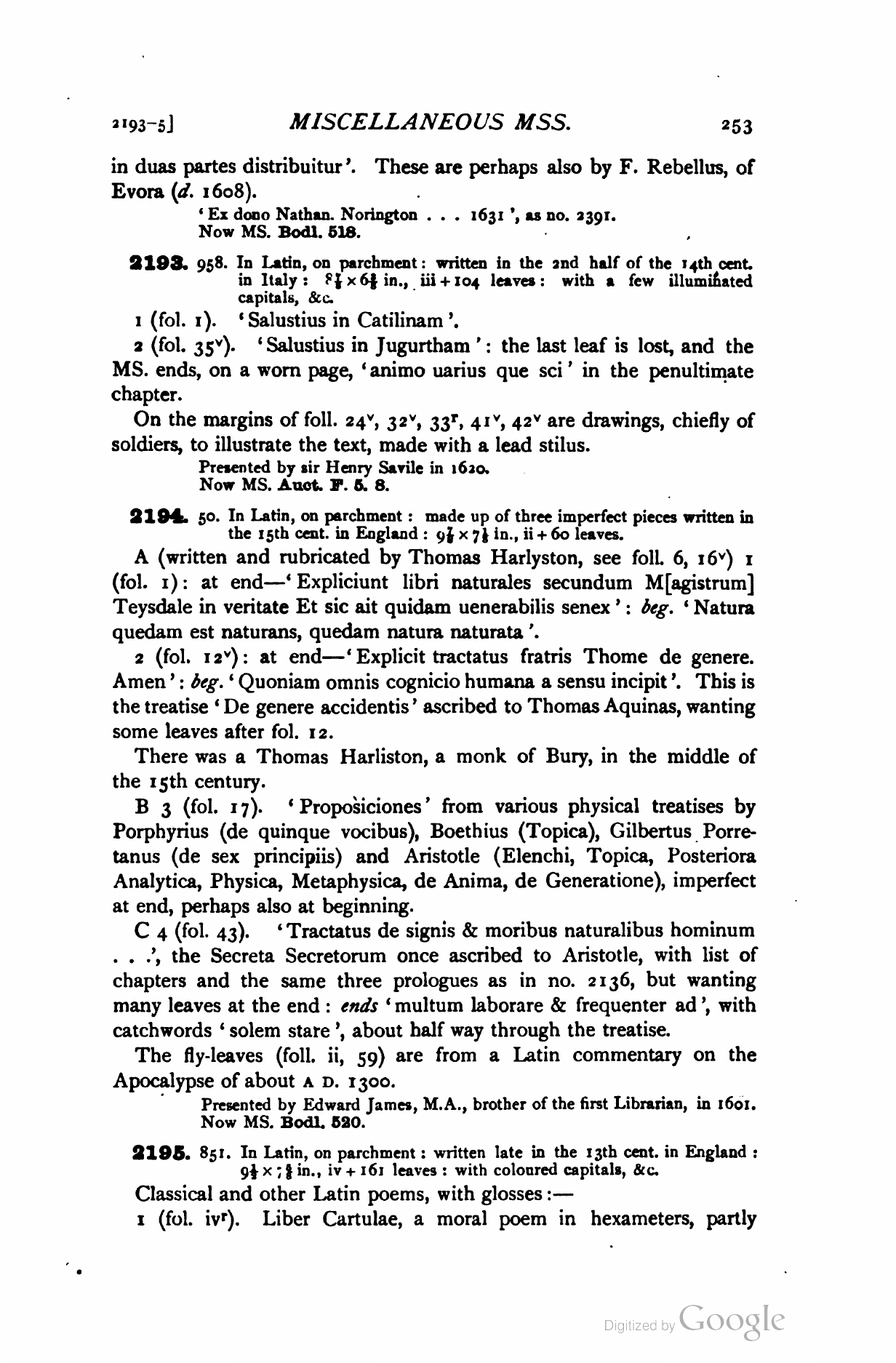
The Bodleian Summary Catalogue, vol. 2, part 1, entry 2193, records that Sir Henry Savile presented the library with a fourteenth-century manuscript of Sallust's Catiline and Jugurtha in 1620, now MS. Auct. F. 5. 8.
This becomes more informative beside a new adjacent-circle discovery: William Symondson, the Merton fellow who tutored Neville's son and is the leading identification for Willm Simonson in Neville's registered will, donated a manuscript of Villeroy's political memoirs in 1624. Two men in Neville's immediate 1615 will circle therefore gave political-historical manuscripts to the Bodleian within nine years of Neville's death. This documents their manuscript culture; it does not show that either book came from Neville's library or that the gifts were coordinated. See william symondson neville tutor will circle villeroy manuscript.
- This packet is now a hub packet. The detailed Savile arguments should be carried by the dedicated sub-packets for Tacitus, Chrysostom, Rerum, Bradwardine, travel, and Jonson’s library.
- MegaLetters correction and image control:
Doc_26andDoc_35were previously misclassified in the working triage as Anne Neville letters. User correction identifies them as Henry Savile letters, and the copied signature images now control the cousin-subscription point. Do not cite those files in the Anne Neville packet; route them through this Savile hub or a future Savile correspondence packet. - BRO source-control position: distinguish the two Savile lanes precisely.
Doc_04eis Neville writing to Sir Henry Savile the scholar at Merton. Exact RBA itemD/EN/O12/49identifiesDoc_28as Sir Henry Savile junior, andDoc_16ais likewise Savile junior rather than the scholar; the latter supersedes the oldDoc_17path. - The strongest direct companionship evidence remains the Sidney correspondence plus Waszink’s travel reconstruction.
- The
2026-05-10Kuin image batch gives a local visual witness to the Philip Sidney letter and its printed apparatus. It should be treated as a strong printed-edition witness for the Savile/Neville training-travel context, not as a replacement for the underlying Penshurst manuscript. - In practice, the combination of Waszink’s explicit
one of his own pupilswording with the Sidney-family correspondence is strong enough to treat the Savile–Neville tutor-companion relationship as part of the sourced core of this packet. The companion to name from the travel correspondence is Robert Sidney, not Philip Sidney. - Source-control position: this hub should cite Waszink primarily for two things: the Neville/Savile/Sidney continental companionship and the corrective that Savile's Tacitus is broader than an Essex-rebellion instrument. Detailed Essex/Tacitus argument belongs in henry saviles tacitus and the essex connection.
- Greengrass now makes the tutor claim explicit in a compact reference source, while Todd adds a separate continental companionship witness for Savile, Neville, Robert Sidney, and George Carew at Nuremberg in
1580. - Duncan source-map note: Duncan is best used in this hub as a connective source map across the Savile/Neville relationship. Do not let it outrank the dedicated direct-source packets for travel, correspondence, books, and estate records.
- Hagecius / Hajek adds a direct 1581 printed witness from the same Central European scholarly itinerary. Use it as evidence for the Dudith-Hagecius-Wittich-Savile mathematical network and for Neville/Sidney visibility in that network, not as a claim that Neville owned the printed book.
- Pinelli retrieval position: the
15 May 1582Nuremberg letter is now a controlled retrieval lead through Todd and Maccagni-Derenzini, while the Dudith edition independently confirms adjacent Savile-to-Pinelli material at AmbrosianaD 243 inf., f.34r. Keep this in the Savile correspondence/source-acquisition lane unless the actual letter names Neville. - ONB Blotius source position: the Henry Savile-to-Blotius 1588 letter is now the strongest manuscript bridge between Savile's later correspondence and the Sidney-Neville circle. Keep the claim precise: it names Sidney and Neville in a Savile letter to Blotius; it does not make Henry Neville the writer and does not solve the separate Dudith/Blotius/Neville source problem.
- Newsletter provenance route: use the new consolidated newsletter source note for the Thomas Savile/Savell
PRO 30/50/70/2dossier and reverse-side Killigrew/Alibech witness. Use this hub only for the Henry Savile cousin/correspondence relation and the wider Savile-family network. - Goulding strengthens Savile's intellectual profile but should not be overread as direct Neville evidence; its relevance is Savile's scholarly method, mathematical training, Merton pedagogy, and John Chamber connection.
- Source-control position: Quantin strengthens the Chrysostom lane by showing Savile's source-critical method in action and by making the suppression of the
Admonitioa concrete publication-risk case. It should be used for Savile's historical criticism, witness-ranking, Europe-wide manuscript search, and confessional self-censorship, not as a direct Shakespeare-source claim. - Carleton/Chrysostom source position: the Dudley Carleton connection is now more than a corrected step-family relationship. The
1603State Papers image and1608-1610CSPD entries place Dudley inside Savile's Greek-letter, Chrysostom, book-purchase, and manuscript-collation network. Keep the family wording precise: Dudley married Savile's stepdaughter Anne Garrard/Gerrard. - Savile/Dudley manuscript position: the
1603State Papers image now has a stable source-image packet and partial-body anchors. It shows Savile using Dudley as a court-facing correspondent before the step-family marriage; quote only the short controlled anchors until the full body is transcribed. - Carleton/Chrysostom page-image controls: the
1608-1610CSPD entries have now been checked against Archive page images and routed to probable SP manuscript item targets. This improves citation quality but still does not supply manuscript images. - Carleton/step-family source position: BHO/VCH Hurst adds a monument/arms control for that precise stepdaughter wording: Anne Viscountess Dorchester was Margaret Lady Savile's eldest daughter by her first husband, George Garrard. Probate, settlement, or will images would still be a further upgrade.
- Carleton/step-family source position: the Tredway Web will transcript now supplies a targeted retrieval lead for a direct testamentary witness naming Lady Ann, George Gerrard, and Henry Savile. Do not cite it as final evidence until the original will/probate or court-copy image is located.
- Source integration,
2026-06-09: Mandelbrote's Bradwardine article adds the parallel theological/manuscript-critical lane. Use it for Savile's Merton identity, manuscript collation habits, King's Printer publication context, Abbot/Dort setting, and Hales/Carleton network; do not treat it as direct Henry Neville evidence without a separate Neville witness. - The strongest direct Cuffe/Savile result is now the combination of:
- the
1598Cuffe-to-Savile item - Philo’s reconstruction of the Savile–Pinelli–Cuffe Tacitus corridor
- Source-control position: Philo upgrades the Savile-Cuffe lane from general intellectual association to a specific manuscript-and-translation corridor: Ambrosiana copies of Savile's Tacitus commentary, Pinelli's corrections/response, Cuffe's
1597Padua/Florence scholarly work, and court-politics reading around Tacitus. Keep Neville out of the specific1597Padua claim unless a separate Neville witness is added. - Source-control position: the
1598Cuffe-to-Savile item should be described as an intelligence-correspondence witness, not merely a name-link. It connects Cuffe, Savile/Reynolds, Essex, Southampton, and Italian diplomatic intelligence from Paris. - Source-control position: the Hales PDFs strengthen the Savile-Hales lane. Scott and Blank establish Savile's role in recruiting and placing Hales; Quantin adds a narrow textual trace in the suppressed Chrysostom
Admonitio; Poole makes the Eton scholarly-library context concrete; Blank and Freehafer show Hales as a later learned witness to Shakespeare's status, with proper caution about embellished anecdote versions. - The remaining issue is now mostly citation strategy and phrasing, not whether the relationship itself is real.
- The blog-derived Audley End annotation claims remain preserved in the Feinstein tier rather than being restated here as resolved fact.
- Source-control position: McPherson supports the Jonson-afterlife lane, but only copy-specifically. This hub can mention Jonson owned Savile's Rerum; detailed ownership/annotation cautions belong in ben jonsons library and henry savile.
- The
Roman Antiquitiesbook named in the Audley End annotation lead is Dionysius of Halicarnassus' Roman Antiquities. The1546Dionysius Billingbear-list line is now supported by direct PNG inspection. The later Appian /Dionis Romana Historialine is likely Cassius Dio / Dio Cassius, probably in the1551Robert Estienne/Xiphilinus form, and should not be collapsed into the blog's Appian-Dionysius bound-volume claim. See audley end part8 roman antiquities, audley end part2 book annotations, and audley end part4 discovery of henry saviles handwriting.
6. Evidence Images
HMC Salisbury / Hatfield vol. 11 Savile controls
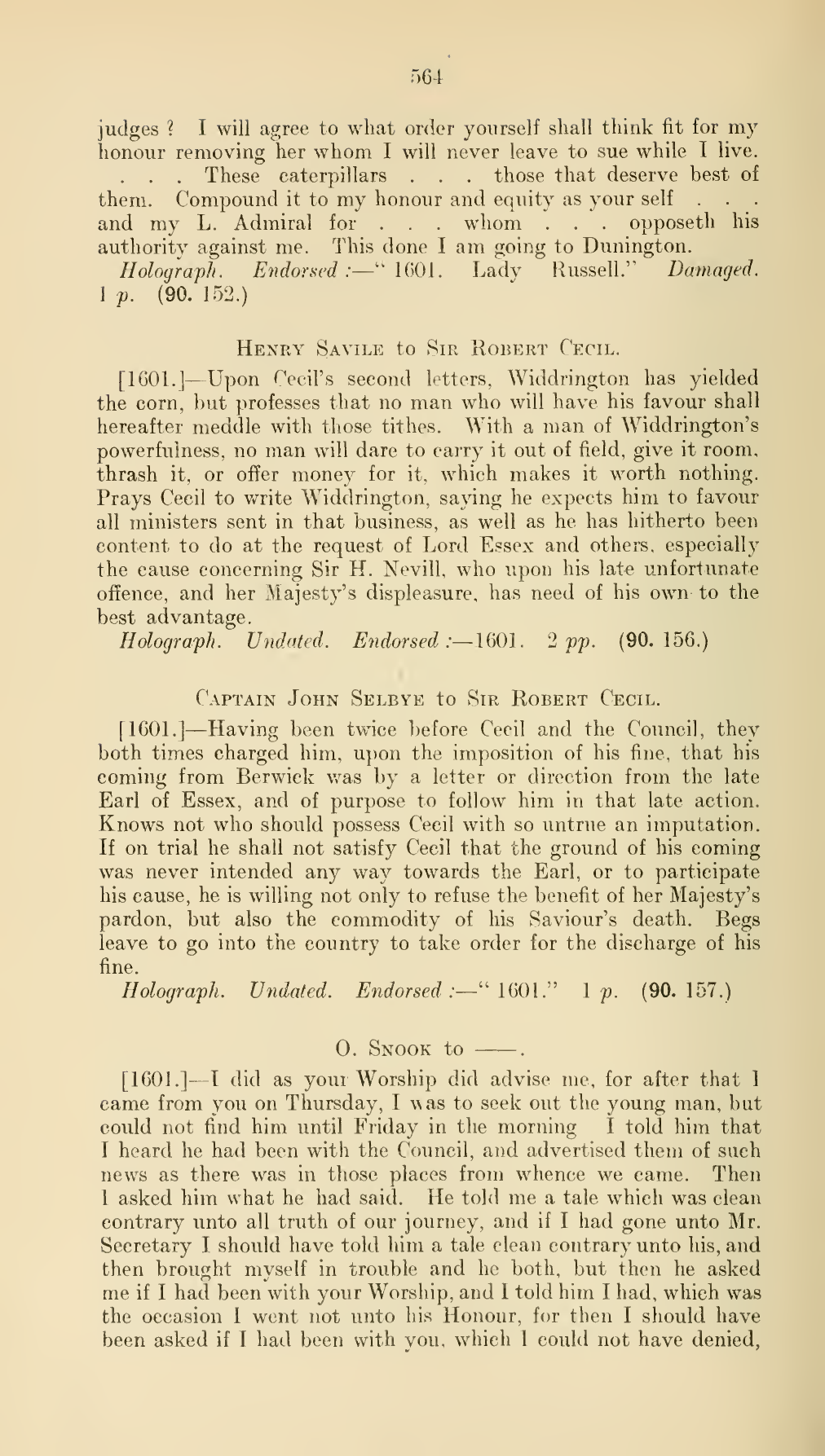
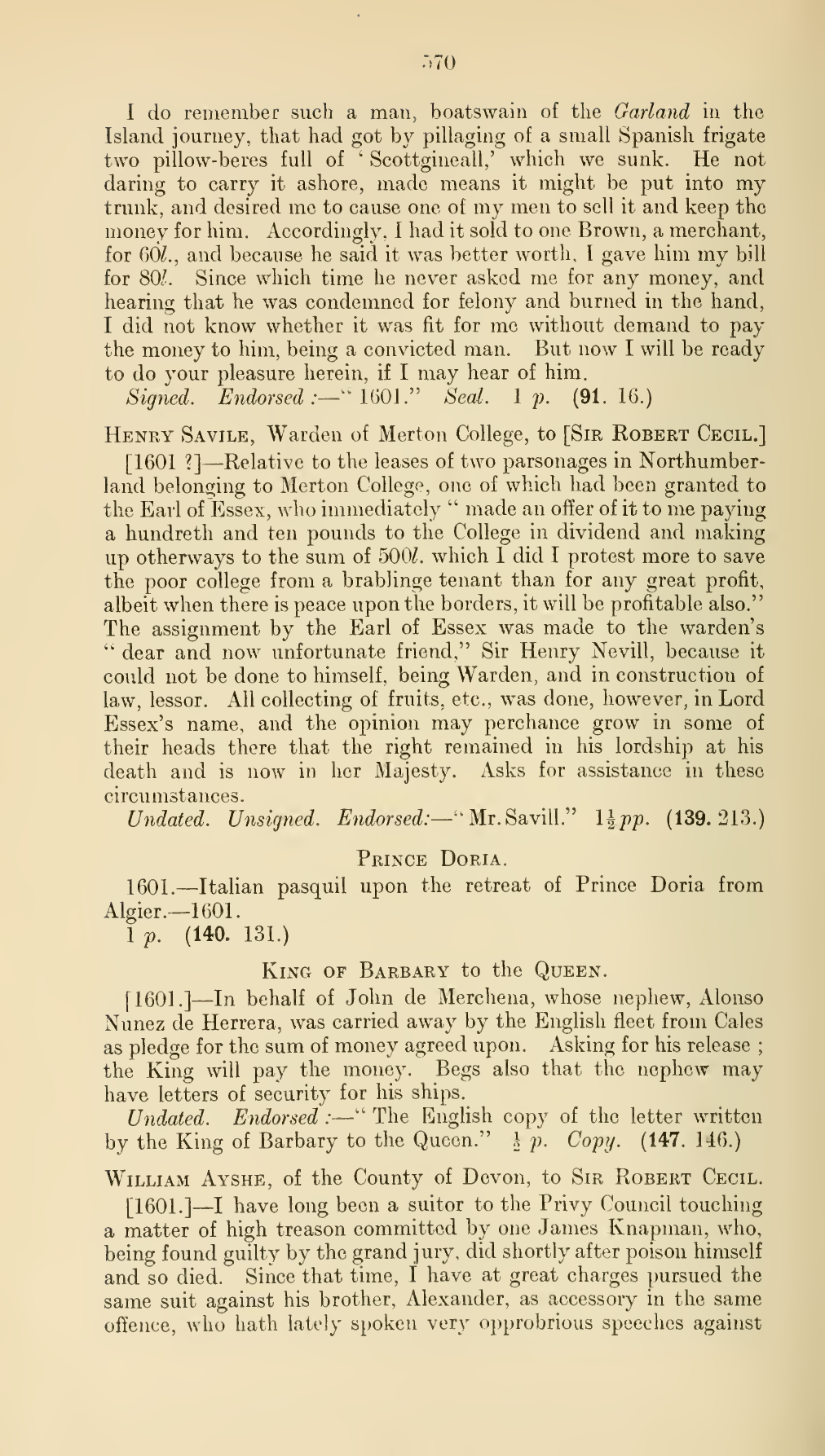
Henry Savile cousin subscriptions
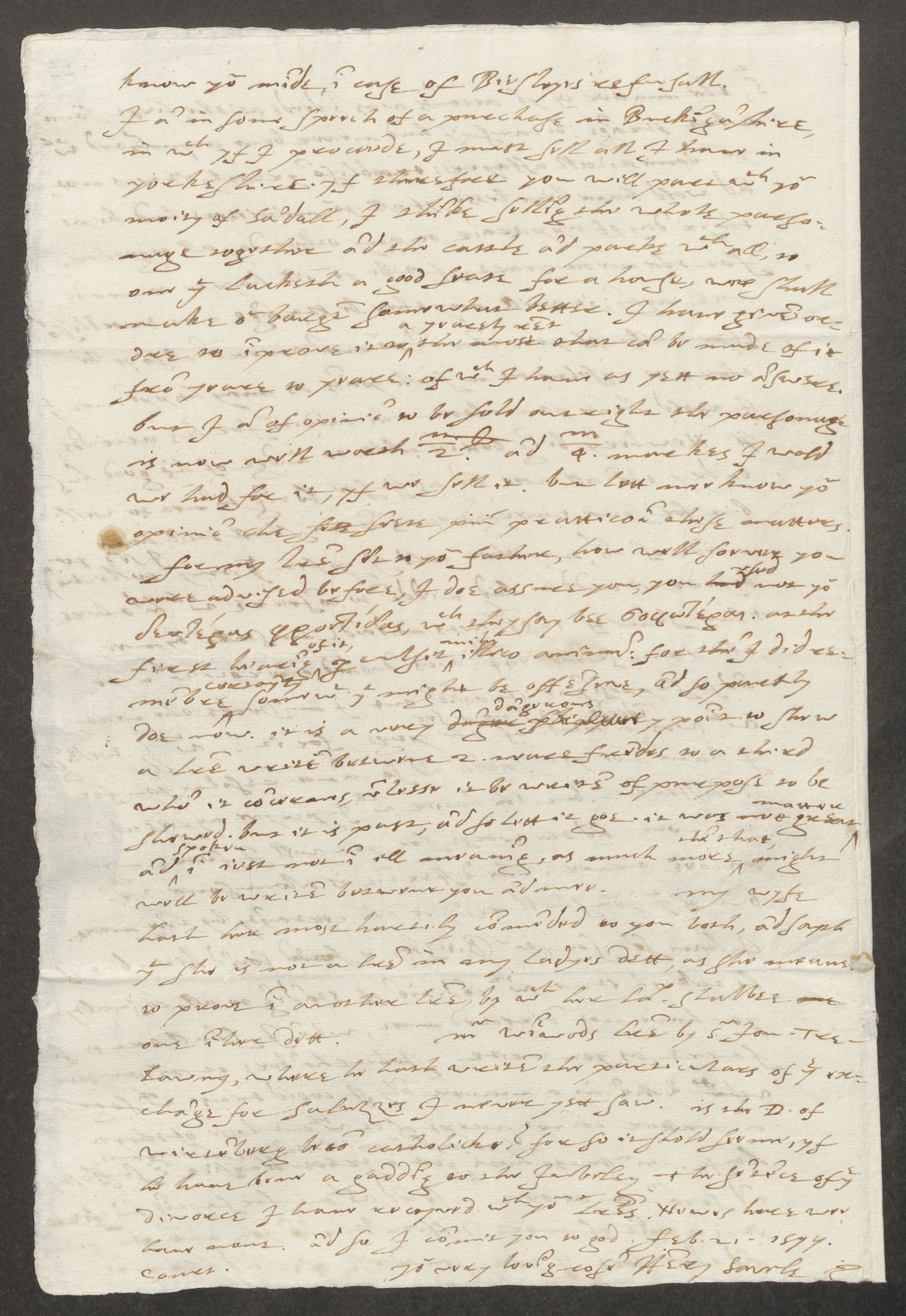
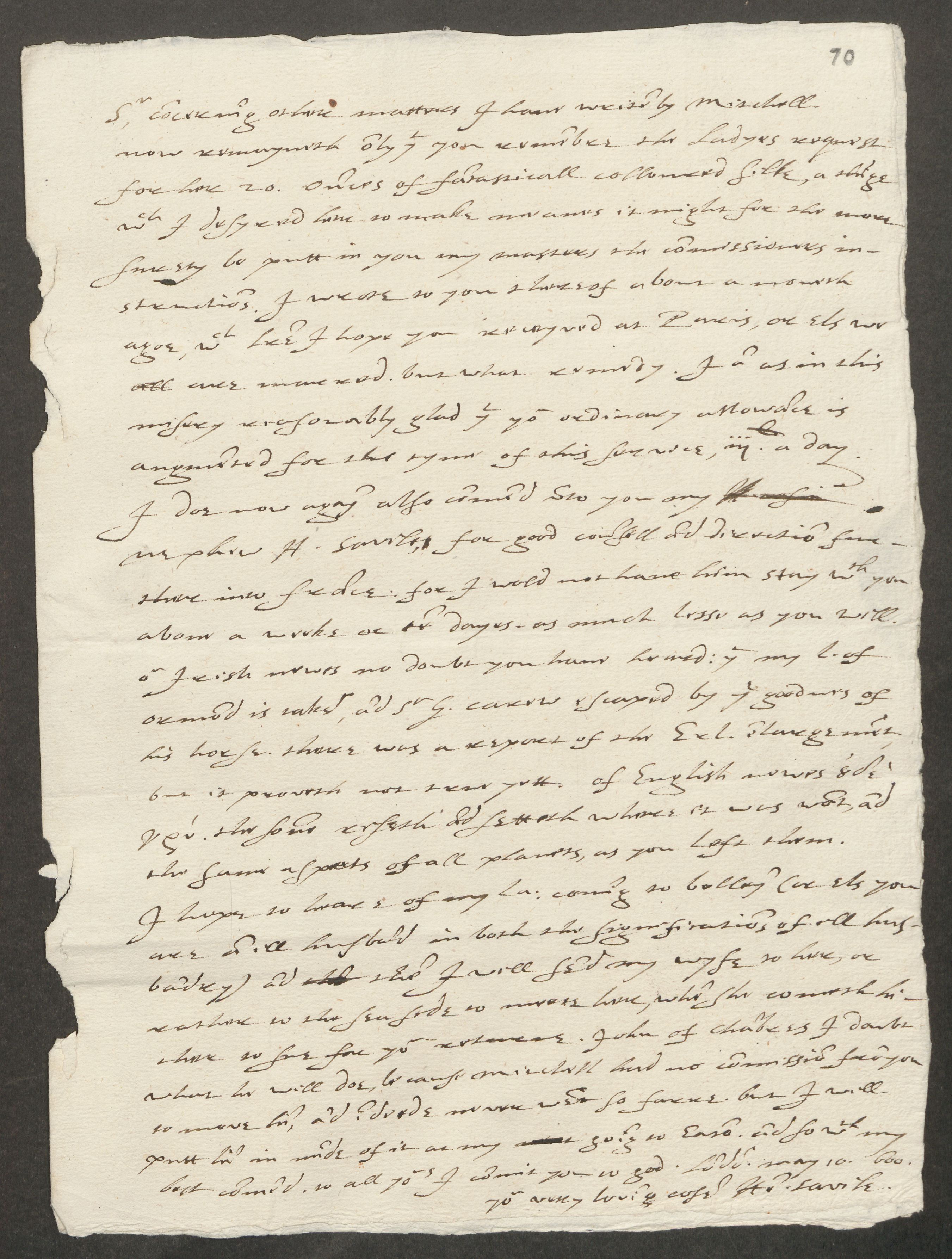
Additional Fact-Source Notes
- The Savile packet is already a hub rather than a single claim. The strongest direct Neville-relevant controls remain Savile-to-Neville local letters, cousin subscriptions, HMC Salisbury/Hatfield extracts, and the ONB/Blotius source-acquisition material.
- This pass did not add a stronger general web source than the staged Digital Bodleian, HMC, ONB, and image witnesses materials already integrated across the Savile subpackets.
- Book use: keep Savile as a learned-family and source-acquisition actor. Do not use unrelated Euclid/Savile material as Neville evidence unless a document directly links Neville to the object or annotation.