John Chrysostom
Topic: John Chrysostom
Source-Fact Audit — 7 August 2026 (Round 4)
- The printed edition, its title-page claims, named editor, language, date, and prefatory matter are direct bibliographical facts when checked in the edition itself.
- Henry Savile's editorial work and the Admonitio should be quoted from the printed witness or a controlled transcription, with edition and page specified.
- A documented Neville–Savile relationship does not prove that Neville owned, read, annotated, or helped prepare this Chrysostom edition.
- Verbal or thematic comparisons with Shakespeare belong in a separately sourced comparison lane and do not alter the bibliographical facts.
- Claims about reception, influence, or intellectual significance remain interpretations unless tied to contemporary reading, ownership, or correspondence evidence.
Overview
This packet matters first as a Savile packet. The strongest evidence here concerns Savile’s monumental Chrysostom edition and the suppressed Admonitio. The later Lear/Coriolanus material now has its own hub in chrysostom and shakespeare, so this packet should mainly provide the Savile/Chrysostom documentary base.
Source Controls
- Re-read the local Quantin PDF with layout extraction and rendered the key article pages into a source-image packet: SOURCE NOTES.
- The strongest book-facing use is now sharper: this is evidence for Savile's source-critical method and publication prudence, not for a direct Shakespeare/Chrysostom source claim.
- The rendered pages support seven distinct claims: bibliographical anomaly, last-minute suppression, distribution without the
Admonitio, decade-long Palladius search, European library-catalogue method, John Hales's two-Palladii note, and Arcadius/Eudoxia/Innocent as a papal-authority controversy that led to self-censorship and Index trouble. - Open Library gives useful edition metadata for S. Ioannis Chrysostomi Opera Graece but no usable page-image witness for the actual Savile volumes in this pass. Keep the direct volume-eight/Admonitio page-image gap open.
- Created a separate Chrysostom/Shakespeare source-image packet for Shuger's Lear and Coriolanus material: SOURCE NOTES. This keeps the literary-critical bridge visible without confusing it with Savile-edition proof.
Source Controls
- The Carleton/Savile follow-up adds a practical acquisition-and-collation trail for Savile's Chrysostom work. BHO/CSPD calendars Dudley Carleton beginning the
great work of St. Chrysostomon3 January 1609. - BHO/CSPD also calendars
August 1610instructions from Sir Henry Savile to Sir Dudley Carleton about purchase of books and collation of MSS relating to St Chrysostom at Paris and in Italy. - Use these items to strengthen the documentary base for Savile's European book/MSS method. They do not turn Chrysostom into direct Shakespeare source evidence, and they do not resolve the separate Dudley/George Carleton cousin path.
Source Controls
- The Carleton/Savile CSPD entries now have checked Archive page-image controls:
3 January 1609is printed p.484/ Archiven497;August 1610is printed p.630/ Archiven643. - The associated TNA manuscript retrieval routes are probable
SP 14/43/3andSP 14/57/38. Item-level API checks returned no assets, and parent volumesSP 14/43andSP 14/57are not digitised. - This improves the Savile/Chrysostom documentary base from BHO text-only to page-image-checked printed-calendar evidence, but it still does not obtain the underlying manuscript instructions.
1. Verified Sourced Facts
A. Savile’s edition and the suppressed Admonitio
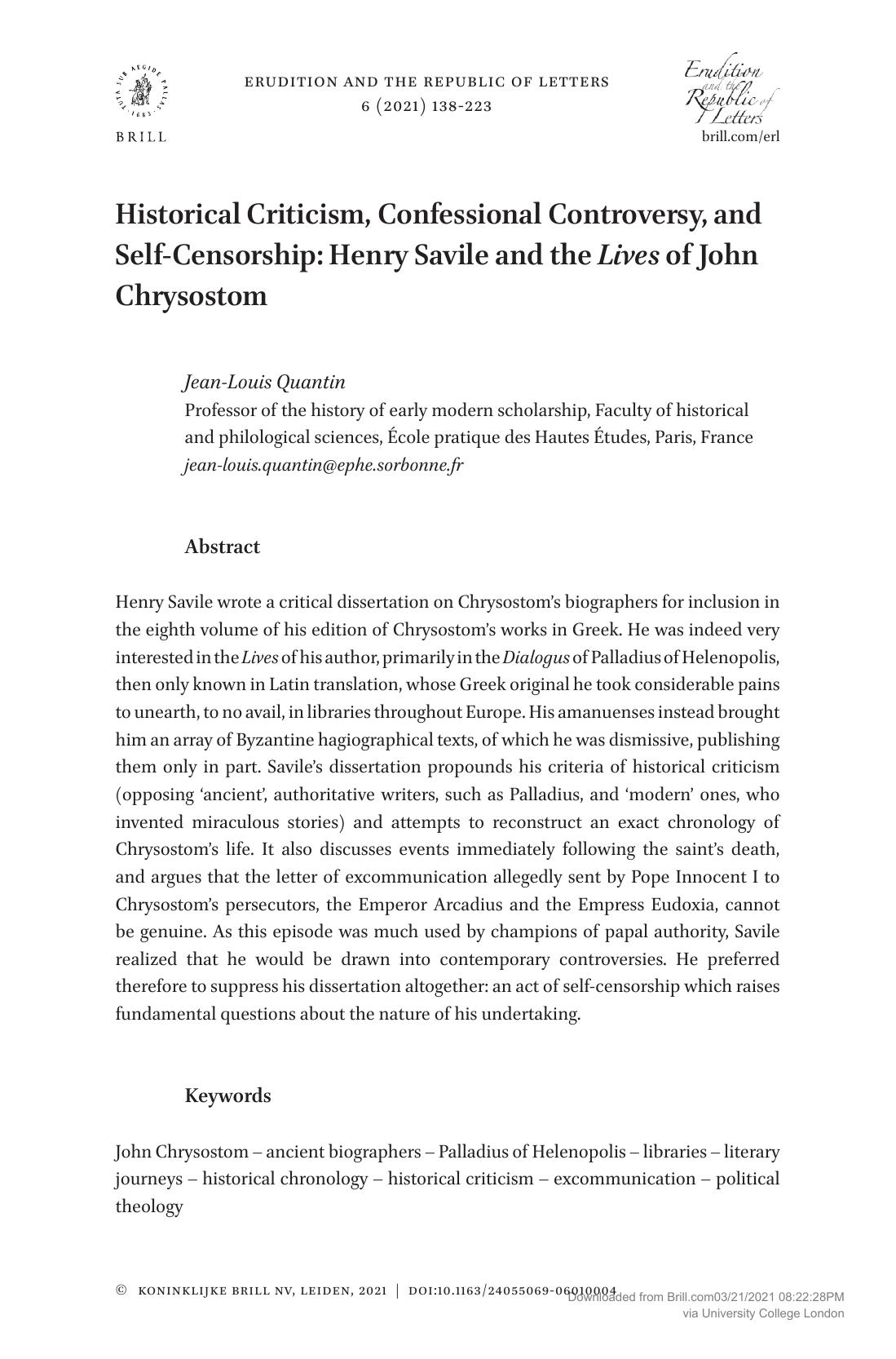
- Jean-Louis Quantin writes:
“Henry Savile wrote a critical dissertation on Chrysostom’s biographers for inclusion in the eighth volume of his edition of Chrysostom’s works in Greek.”
- Quantin also writes:
“He preferred therefore to suppress his dissertation altogether”
- Quantin states:
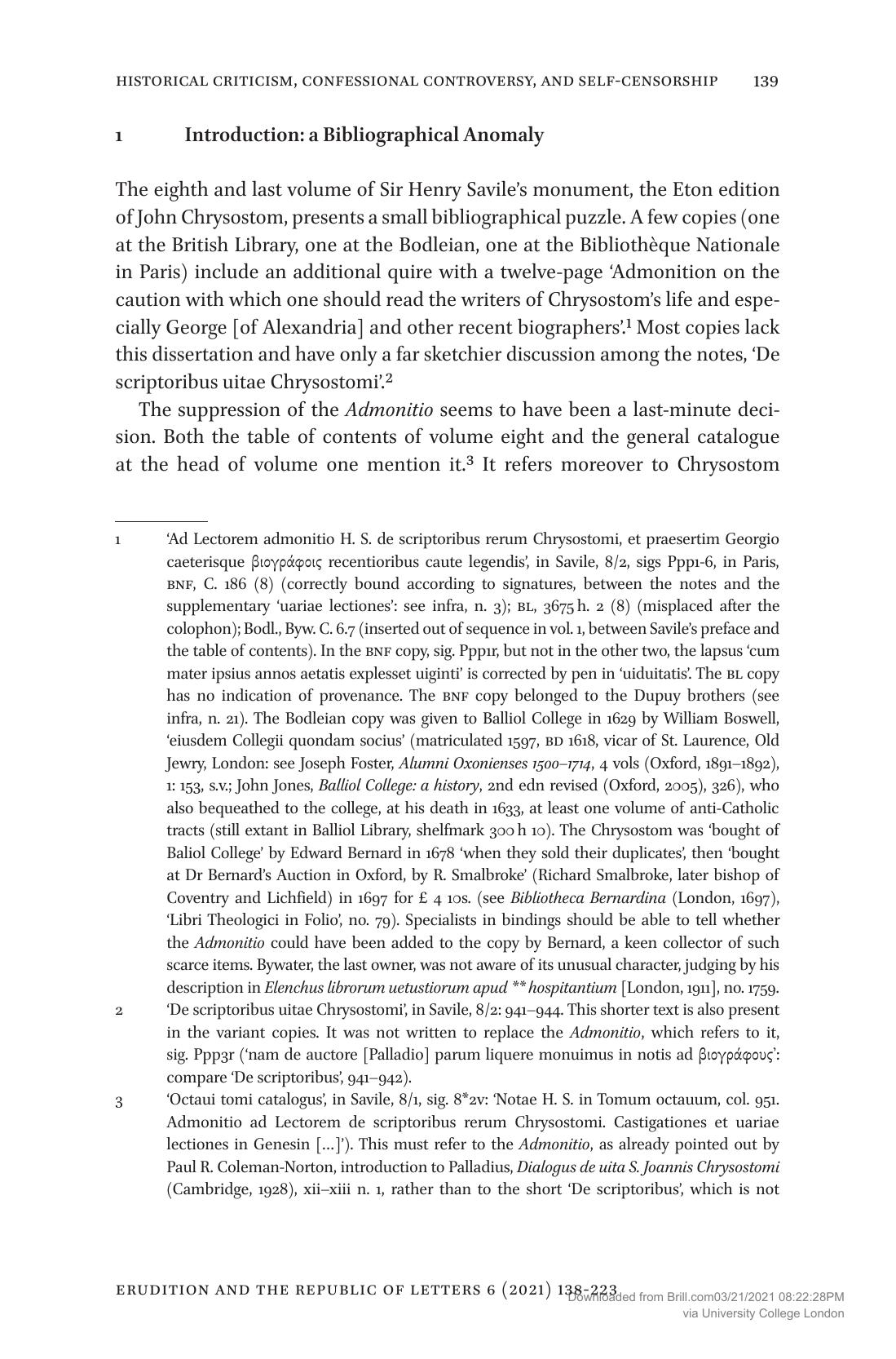
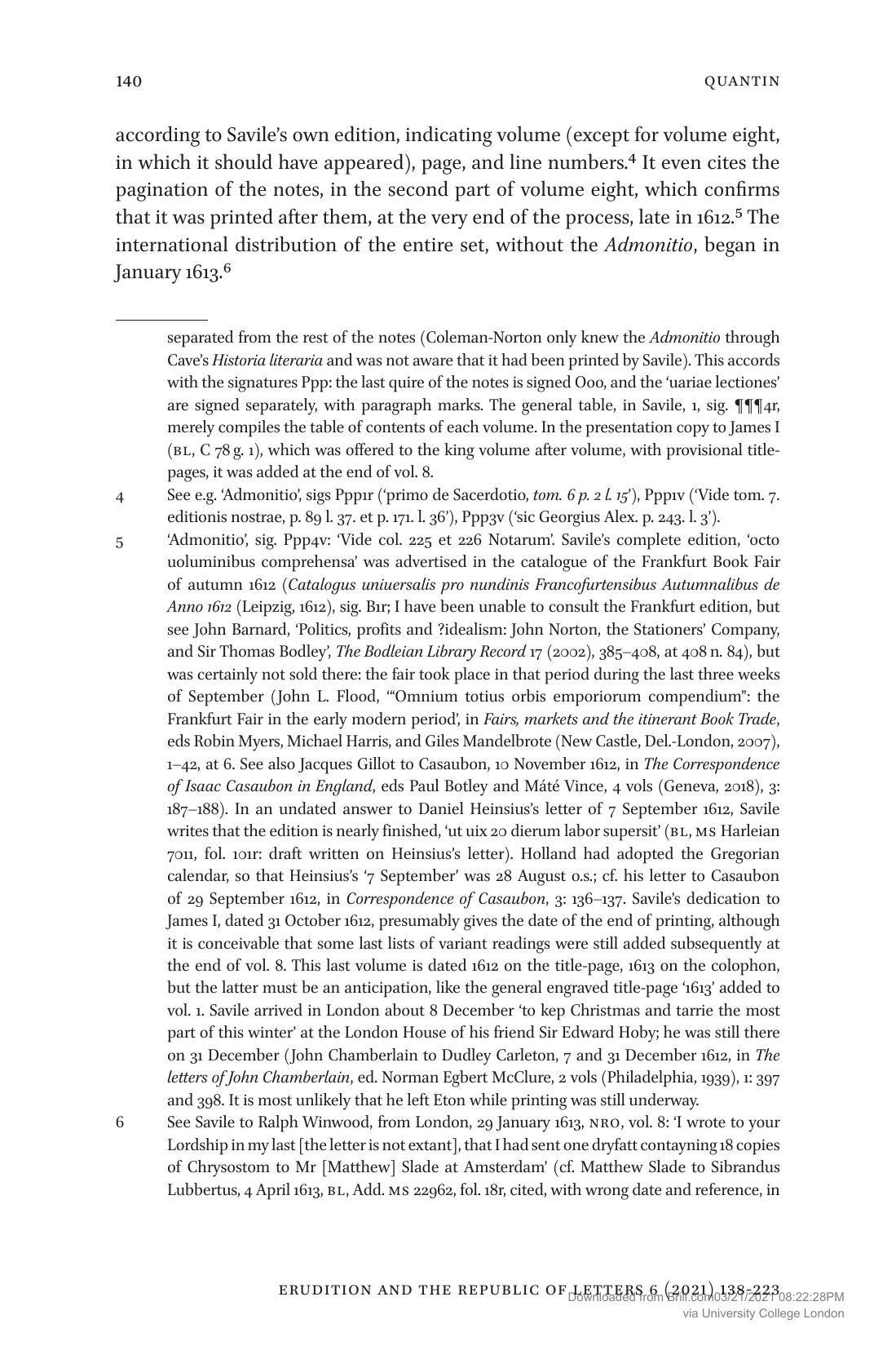
“The suppression of the Admonitio seems to have been a last-minute decision.”
- Quantin further states:
“The international distribution of the entire set, without the Admonitio, began in January 1613.”
- Quantin identifies the bibliographical anomaly precisely: a few copies of volume eight, including copies at the British Library, the Bodleian, and the Bibliothèque Nationale in Paris, preserve an additional twelve-page
Admonitio, while most copies do not. The table of contents and general catalogue still mention theAdmonitio, which is why Quantin treats the suppression as last-minute.
- Quantin reconstructs the
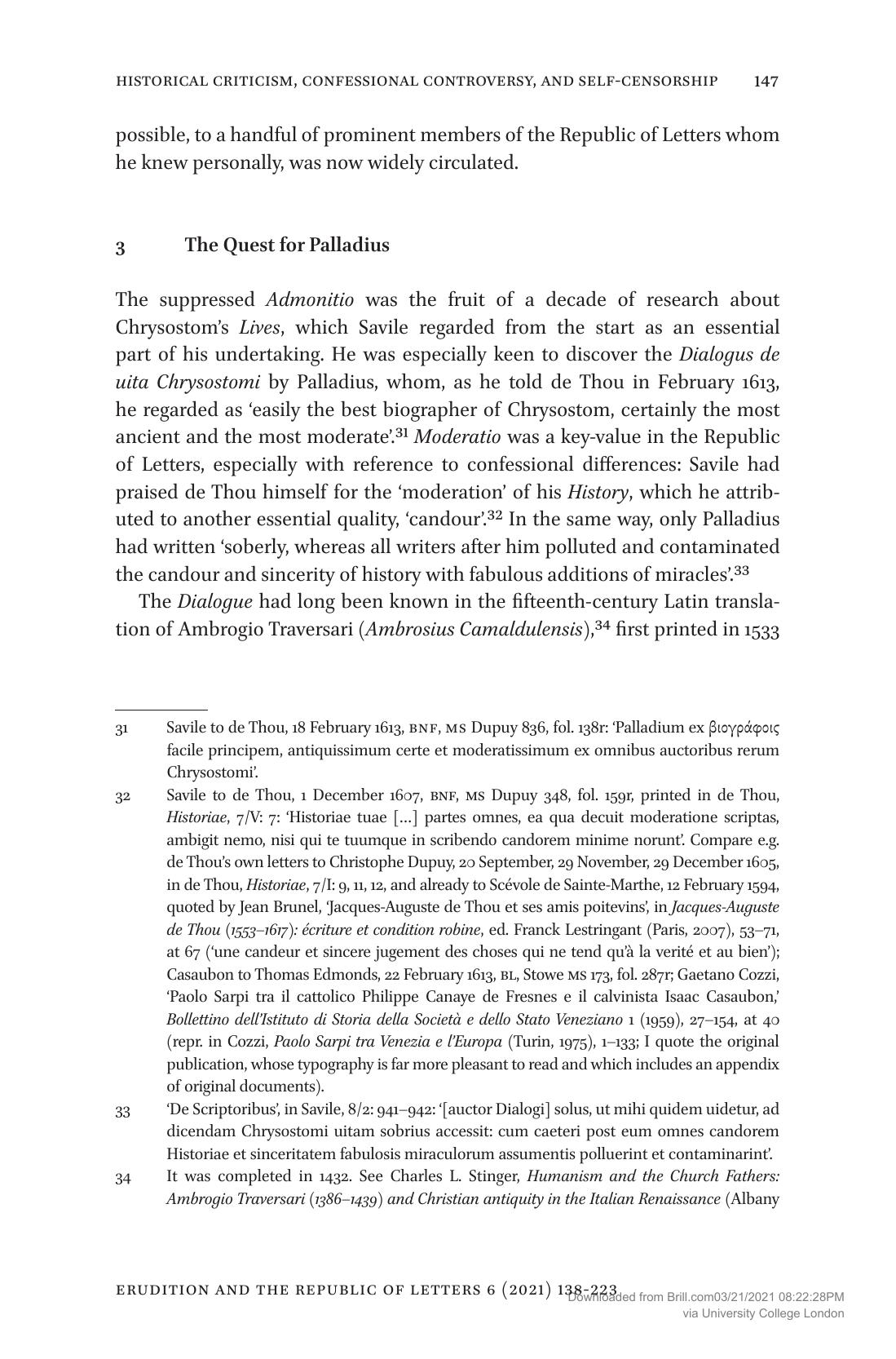
Admonitioas the result of roughly a decade of work on Chrysostom's Lives. Savile especially wanted the Greek original of Palladius of Helenopolis's Dialogus de vita Chrysostomi, then known only in Latin translation. He searched for it through amanuenses, correspondents, and library catalogues across Europe, but did not find it.
- Savile's method, as Quantin presents it, was historical-critical rather than merely editorial. He distinguished older and more authoritative witnesses such as Palladius from later biographers who multiplied miraculous stories, and he tried to reconstruct a precise chronology of Chrysostom's life and aftermath.
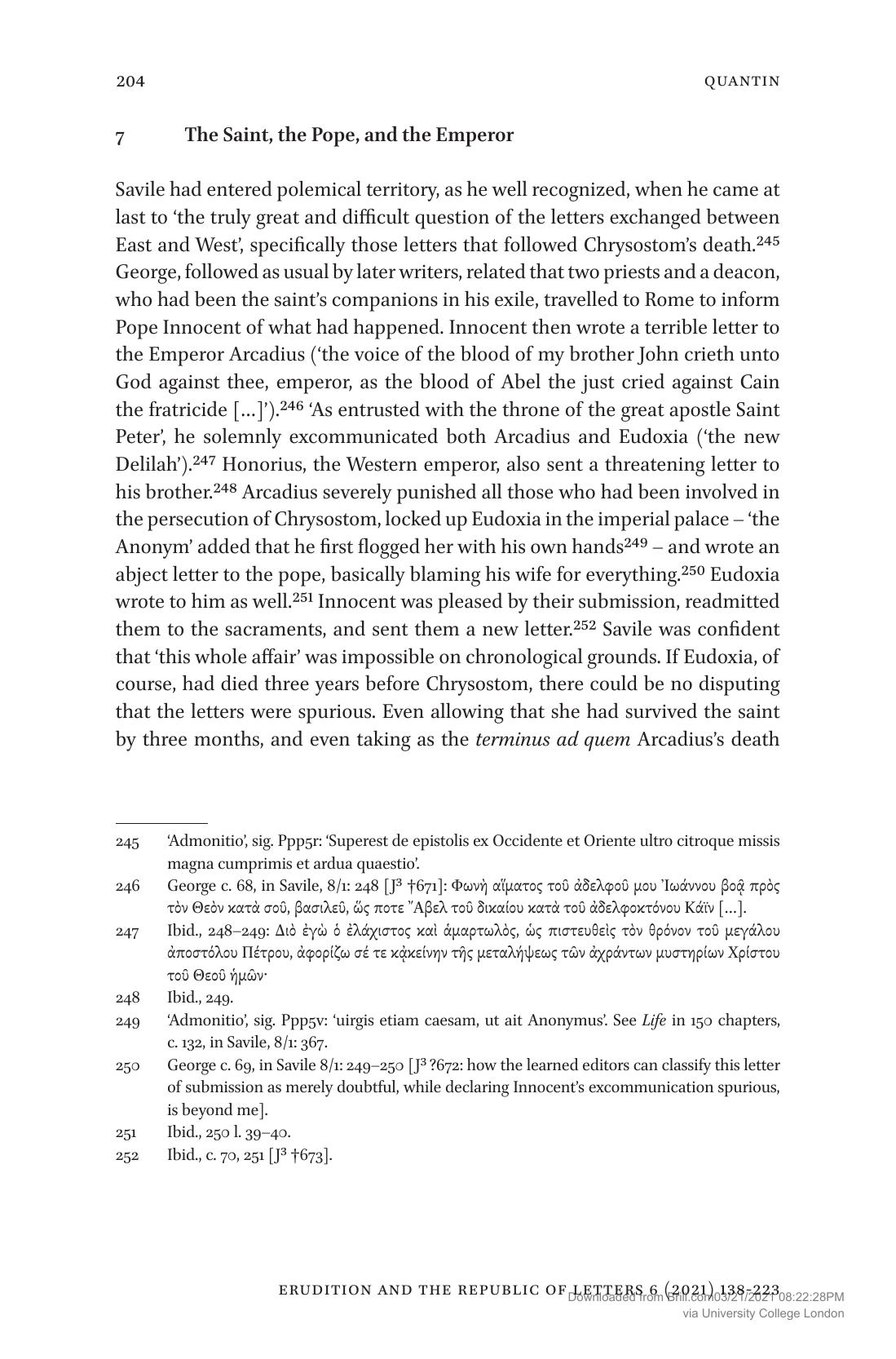
- Quantin explains that the suppressed dissertation mattered because letters attributed to:
- Arcadius
- Eudoxia
could not be treated as genuine, and because the controversy touched arguments:
- “much used by champions of papal authority”
- The hottest point was the alleged excommunication of Emperor Arcadius and Empress Eudoxia by Pope Innocent I after Chrysostom's death. Quantin shows that Savile attacked the episode by chronology, by comparison of witnesses, and by argument from silence. Because this episode had long been used as evidence for papal authority over emperors, Savile realized the
Admonitiowould be read confessionally.
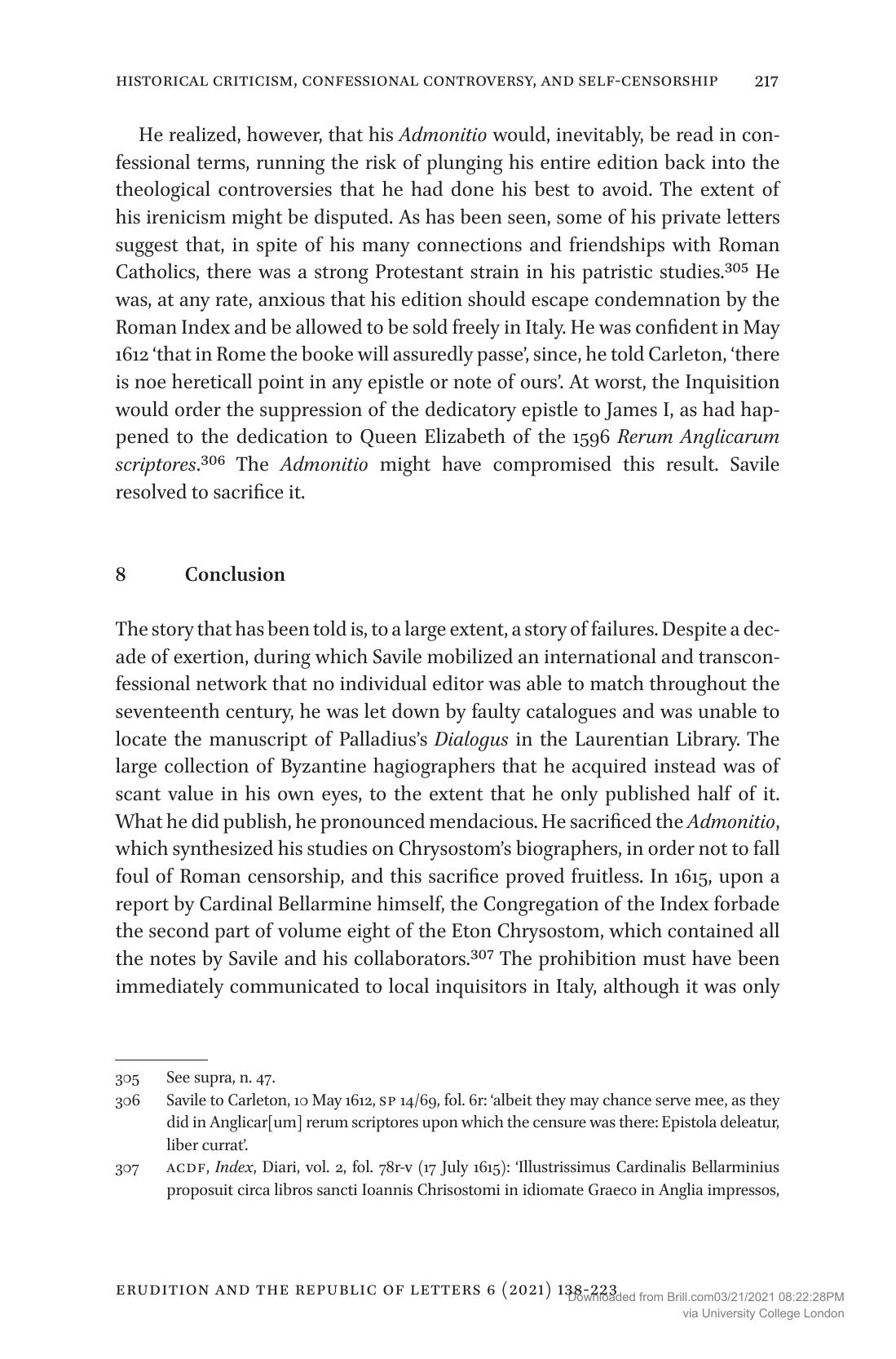
- Quantin's conclusion is especially important for source temperature: Savile suppressed the
Admonitioto avoid dragging the whole Eton Chrysostom edition into theological controversy and Roman censorship. The strategy failed in part. In1615, after a report by Cardinal Bellarmine, the Congregation of the Index forbade the Latin notes at the end of volume eight; the prohibition remained until the Index itself was suppressed in1966.
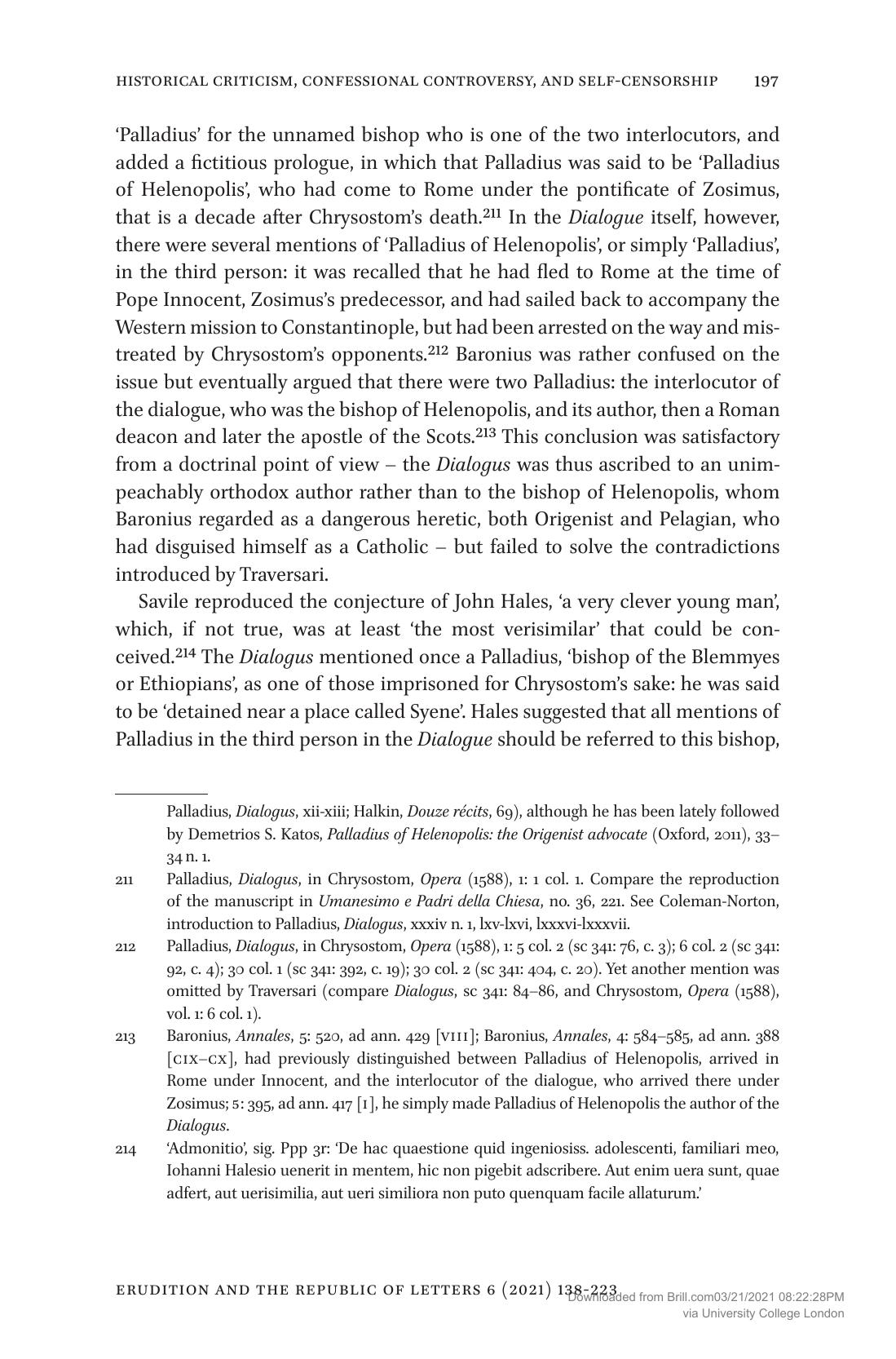
- Quantin also records a direct John Hales connection inside the
Admonitio: a conjecture about two Palladii was included by Savile as a short note by John Hales. This gives the Savile-Hales Chrysostom corridor a more specific documentary point than a generic assistant/editor relationship.
- Re-rendered page control,
2026-06-20: the John Hales point is carried by Quantin's printed pp.197-198, now rendered in the source-image packet. Use this as a narrow textual collaboration fact, not as a general Hales/Neville inference.
B. Bibliographic identity of the edition
- BHO/CSPD's
3 January 1609Dudley Carleton-to-Sir Walter Cope entry says Dudley had begun thegreat work of St. Chrysostomwith the new year. This provides a pre-publication calendar witness to the active work of the edition. - BHO/CSPD's
August 1610entry calendars Sir Henry Savile's instructions to Sir Dudley Carleton for purchase of books and collation of MSS relating to St Chrysostom at Paris and in Italy. This supplies a concrete source-acquisition lane behind the edition.
- Quantin identifies the edition as:
“the Eton edition of John Chrysostom”
- The Open Library record identifies the work as:
“S. Ioannis Chrysostomi Opera Graece”
- The same record states:
“Vol. 1-8 each have special t.p. in Greek, dated 1612 and with vignette depicting royal arms.”
- The same record gives:
“STC 14629a”
- The individual volumes of the Savile Chrysostom were not all dated 1612. Volumes were issued across several years: early volumes carry dates of 1610 and 1611; volume 7 is dated 1612; volume 8 (the final volume, in which the suppressed
Admonitiowas planned to appear) is dated 1613. The Open Library catalog records 1612 as the principal date for the special title pages, but the edition spans 1610–1613.
- The edition was printed by Melchisedec Bradwood. Bradwood is not named in the Open Library catalog record but is documented in bibliographic studies of the Eton press.
- The engraved title page of the edition was the work of Leonard Gaultier, a French engraver. This is a minor bibliographic detail but relevant if the edition's physical form is ever described in the book.
- Web/source-control check,
2026-06-20: the Open Library record confirms the edition as an edition of S. Ioannis Chrysostomi Opera Graece: octo voluminibus with publication date1613, Eton publisher statement, special title pages, Savile as compiler/editor, Bradwood/Norton printing detail, colophon-date spread, andSTC 14629a. It does not supply usable page images of the Savile copy.
C. Later Shakespeare-critical relevance
- Debora K. Shuger writes:
“the immense popularity of the Greek Fathers during the Renaissance is not without political significance”
- She also writes:
“From the later Middle Ages through the Renaissance, Chrysostom ... was one of the most popular of the Greek Fathers”
- Shuger gives useful scale for Chrysostom's Renaissance availability: she states that at least
17complete editions of Chrysostom were published between1500and1600, and that before1642English printers published18Chrysostom items,11of them in English translation.
- Shuger explicitly cautions that her argument is not a direct-source claim:
“I do not intend to argue that Shakespeare, in fact, studied the writings of the Church Fathers.”
- Shuger further writes:
“Lear’s prayer for the poor naked wretches (3.4.28-36), the ragged madness of Poor Tom, the bread riot in Coriolanus ‘feel’ radical”
- She adds:
“But Lear’s naked wretches haunt Chrysostom in Antioch”
- And:
“Like the plebeians in the first scene of Coriolanus, Chrysostom blames the hunger of the poor on hoarding patricians rather than the gods”
- Shuger names Henry Savile directly as an editor of both Tacitus and Chrysostom. This reinforces the Savile packet's double lane: Roman political historiography and Greek patristic scholarship.
- Source-control correction: the older Coriolanus packet carried a Dell-label note for this Chrysostom passage. The photographed text matches Shuger printed p.
49; the verified Dell material found locally concerns Merry Wives and image magic, not the Chrysostom/Coriolanus comparison.
- EarlyPrint control,
2026-06-20: six English Chrysostom records before or at1609appear in the EarlyPrint metadata, but focused FTS checks did not verify the exact Shuger poor-man or corn-hoarding passages in those early English items. This supports general availability without upgrading the Lear/Coriolanus material into a direct passage-source claim.
These later claims are useful as secondary Shakespeare context, not as direct evidence about Neville.
1A. Structured Quoted Source Passages
1. Savile's Suppressed Admonitio Was a Source-Critical Project
- Source: Jean-Louis Quantin, "Historical Criticism, Confessional Controversy, and Self-Censorship," rendered source packet pp. 138-140.
- Quoted anchors:
"critical dissertation"
"suppress his dissertation altogether"
- What it proves: the Savile Chrysostom packet is not just a bibliographical curiosity. Quantin presents the suppressed
Admonitioas a serious historical-critical dissertation that Savile withheld. - Limits: this supports Savile's scholarly method and prudence. It does not prove a direct Shakespeare source claim.
2. The Suppression Was Late and Affected Distribution
- Source: Quantin, rendered source packet p. 140.
- Quoted anchors:
"last-minute decision"
"January 1613"
- What it proves: the table-of-contents/catalogue anomaly and distribution history belong to the edition's physical history, not just later interpretation.
- Limits: this does not tell us who read the rare
Admonitiocopies, nor does it create a direct Neville route.
3. The Hales Point Is Concrete but Narrow
- Source: Quantin, rendered source packet pp. 197-198.
- Quoted anchors:
"John Hales"
"Palladius"
- What it proves: Hales has a specific textual role in the suppressed
Admonitioproblem, strengthening the Savile-Hales learned-collaboration corridor. - Limits: the point is about Chrysostom biography and Palladius, not Shakespeare reception.
4. Carleton's Calendar Entries Supply the Practical Acquisition Trail
- Source: BHO/CSPD entries checked against Archive page images, routed through the 2026-06-27 and 2026-06-28 Chrysostom follow-ups.
- Quoted anchors:
"great work of St. Chrysostom"
"collation of MSS."
- What it proves: Dudley Carleton is calendared in connection with Savile's active Chrysostom work and with book purchase / manuscript collation abroad.
- Limits: these are printed-calendar controls, not underlying manuscript images. They strengthen the Savile editorial route but do not identify a Shakespeare source path.
2. Ken Feinstein Twitter and Blog Information
- No discrete Ken Feinstein Twitter/blog layer is isolated in this packet at present.
3. Quoted Source Text
Quantin
- “Henry Savile wrote a critical dissertation on Chrysostom’s biographers”
- “He preferred therefore to suppress his dissertation altogether”
- “The suppression of the Admonitio seems to have been a last-minute decision.”
- “The international distribution of the entire set, without the Admonitio, began in January 1613.”
- “The suppressed Admonitio was the fruit of a decade of research”
- “all writers after him polluted and contaminated the candour and sincerity of history”
- “the truly great and difficult question of the letters exchanged between East and West”
- “running the risk of plunging his entire edition back into the theological controversies”
Bibliographic record
- “S. Ioannis Chrysostomi Opera Graece”
- “Vol. 1-8 each have special t.p. in Greek, dated 1612”
STC 14629a- “Has begun the great work of St. Chrysostom with the new year”
- “purchase of books”
- “collation of MSS.”
- “St. Chrysostom”
Shuger
- “the immense popularity of the Greek Fathers during the Renaissance”
- “I do not intend to argue that Shakespeare, in fact, studied the writings of the Church Fathers.”
- “Lear’s naked wretches haunt Chrysostom in Antioch”
- “Like the plebeians in the first scene of Coriolanus”
4. Citations
- Quantin, Jean-Louis. “Historical Criticism, Confessional Controversy, and Self-Censorship: Henry Savile and the Lives of John Chrysostom.” document witnesses: Quantin Savile Chrysostom 2021.
- Quantin article DOI and rendered source-image packet: https://doi.org/10.1163/24055069-06010004; SOURCE NOTES.
- John Chrysostom / Quantin research pass,
2026-06-20: JOHN CHRYSOSTOM QUANTIN RESEARCH PASS 2026 06 20. - Chrysostom, John. S. Ioannis Chrysostomi Opera Graece. Edited by Sir Henry Savile, 8 vols., Eton, 1612-1613.
STC 14629a. Open Library record: https://openlibrary.org/works/OL622548W/S._Ioannis_Chrysostomi_Opera_Graece. - British History Online,
James I: Volume 43, January-February, 1609, Calendar of State Papers Domestic: James I, 1603-1610, https://www.british-history.ac.uk/cal-state-papers/domestic/jas1/1603-10/pp484-495. - British History Online,
James I: Volume 57, August-October, 1610, Calendar of State Papers Domestic: James I, 1603-1610, https://www.british-history.ac.uk/cal-state-papers/domestic/jas1/1603-10/pp627-639. - CARLETON SAVILE CHRYSOSTOM FOLLOWUP 2026 06 27, follow-up ledger for Dudley Carleton, Savile, and the Chrysostom book/MSS calendar controls.
- DUDLEY CARLETON SAVILE CHRYSOSTOM PAGE IMAGE FOLLOWUP 2026 06 28, page-image follow-up for the 1608, 1609, and 1610 CSPD/Archive/TNA Chrysostom controls.
- Stable Chrysostom page-image manifest: SOURCE NOTES.
- Shuger, Debora K. “Subversive Fathers and Suffering Subjects: Shakespeare and Christianity.” document witnesses: subversive fathers and suffering subjects shakespeare and christianity.
- Shuger source-image packet and dedicated hub,
2026-06-20: SOURCE NOTES; chrysostom and shakespeare. - henry savile
- john hales
- play king lear
- play coriolanus
5. Evidence Images
6. Notes on Access
- Quantin is the core witness for this packet. It is acceptable that the packet depends heavily on that article so long as it says so clearly.
- The main direct result is not “Shakespeare read Chrysostom,” but that Savile produced a major edition whose suppressed
Admonitioreveals a specific form of historical criticism and self-censorship. - Source-control position: Quantin should be used for four distinct claims, not one vague claim: Savile's editorial monument at Eton; his Europe-wide search for Palladius and other Chrysostom life-witnesses; his historical-critical separation of older witnesses from later miracle-heavy biographers; and his self-censorship when the Innocent/Arcadius/Eudoxia material threatened to become a papal-authority controversy.
- Source-control position: use the rendered Quantin pages as the source-image layer. They make the direct evidentiary chain much stronger than a general PDF citation alone.
- Source-control position: use the Dudley Carleton/CSPD items as a practical pre-publication book and manuscript acquisition trail for the edition. The
1610instructions are especially important because they name both book purchase and manuscript collation at Paris and in Italy. - The
Admonitiodoes not prove a direct Shakespeare source. It proves Savile's high-level scholarly method and shows how one of Neville's closest intellectual associates handled chronology, witness-ranking, textual criticism, confessional danger, and publication risk. - The Shuger material is preserved because it explains why Chrysostom matters later in the Shakespeare packets, but it should remain visibly secondary.
- Source-control position: the Shuger PDF strengthens the Renaissance-popularity and Shakespeare-critical context for Chrysostom, including concrete publication-scale figures and the Lear/Coriolanus social-justice parallels. Its explicit limitation is equally important: Shuger is not claiming that Shakespeare directly studied patristic texts. Use it as cultural/intellectual context, not as a direct access proof.