King Lear
Topic: King Lear
Chamber–Jensen interpretive correction and full-corpus comparison — 8 August 2026
The expanded Chamber study confirms that Lear 1.2 is the strongest Shakespearean analogue to Chamber's anti-compulsion argument, but it also corrects the older binary reading. Phebe Jensen, “Causes in Nature: Popular Astrology in King Lear” (Shakespeare Quarterly 69.4, 2018), places Chamber's 1601 attack beside Christopher Heydon's 1603 defence and shows that the play stages a contested field. Many orthodox thinkers allowed celestial bodies to incline temperaments or operate as secondary natural causes without forcing the will. Gloucester's eclipse interpretation resembles almanac prognostication; Edmund's claim that such influence is wholly fictitious is therefore not simply the period's neutral rational position.
The Chamber relationship remains unusually close at the level of argumentative sequence. Chamber says astrologers make people neglect their actions “as being forced by the stars” and reports Augustine's satire: the man denied “that his own will committed adultery, but Venus” and “that his own will committed murder, but Mars.” Edmund moves through necessity, heavenly compulsion, spherical predominance, thieves, adulterers, enforced planetary influence, his parents' sexual act, and the charge of a star. The correspondence is strongest as a shared controversy grammar, not as an exact n-gram.
The whole-book analysis also connects Lear beyond 1.2. Chamber's appendix insists that celestial causes are altered by parents, conception, nourishment, education, custom, laws, advice, and will; the tragedy repeatedly tests whether disposition, household formation, political action, and “hard hearts” can be assigned to nature, stars, gods, or human decisions. Chamber's discussions of providence and the limited intelligibility of causes form a better frame for the storm and final act than a simple slogan that the play “rejects astrology.”
Quantitatively, the relevant Chamber wording does not appear as an exact quotation in Lear. “Heavenly compulsion” is confined to the two indexed Lear witnesses in the EarlyPrint search, while “planetary influence” occurs in dozens of documents. The rare shared form “astronomical” links Chamber's technical prose and Edgar's joke “sectary astronomical,” but its document frequency and generic technical status prevent source attribution. These results strengthen the historical-conceptual case while limiting the lexical claim.
Full dossier: JOHN CHAMBER SHAKESPEARE ASTROLOGY EXTREME DEEP DIVE 2026 08 08.
Round 8 direct-text integration — 8 August 2026
The astrology comparison is now organized as source, network, and play rather than as a single influence claim. John Chamber's 1601 treatise says people may abandon responsibility as being forced by the stars, which they cannot resist. Chamber later named Neville and Henry Savile as executors, and he had travelled with Neville's French embassy; those are the documentary network facts.
Edmund's reply to Gloucester states:
EDMUND This is the excellent foppery of the world, that
when we are sick in fortune (often the surfeits of
our own behavior) we make guilty of our disasters
the sun, the moon, and stars, as if we were villains
on necessity; fools by heavenly compulsion; knaves,
thieves, and treachers by spherical predominance;
drunkards, liars, and adulterers by an enforced
obedience of planetary influence
This is a conceptual and controversy-level correspondence, not an exact phrase match: Chamber's forced by the stars and the play's heavenly compulsion use different wording. Chamber cites Augustine, and other printed anti-astrological arguments survive. The packet may trace access, date, and argumentative structure, but no source presently shows the treatise passing through Neville to the play.
2026-07-13 Annesley Analogue Packet Added
The famous Brian Annesley case — the old Kentish knight whose eldest daughter and her husband (Grace and Sir John Wildgoose of Iridge, Sussex) moved in 1603 to have him declared unfit while his youngest daughter Cordell resisted through Sir Robert Cecil, later marrying Southampton's stepfather Sir William Hervey (5 Feb 1608; Hervey had been the will's first-named overseer since 1600) — was previously absent from this corpus. It is now documented in brian annesley cordell king lear hervey southampton, with: a checked transcript witness of the will (TNA PROB 11/104/286; Cordell sole executrix); the three dispute letters calendar-checked in BHO Cecil Papers vol. 15 (CP 101/163, 101/166, 187/119); a scholarship register built from read witnesses (Stopes 1922 pp. 274-5, the earliest printing of Cordell's letter, full text staged; Halio's New Cambridge introduction, staged excerpt, whose n. 1 names G.M. Young 1948, Sisson 1963, Bullough vii.270-1, and Akrigg 1968 — logged as named-only retrieval targets, not yet citable); and the contested-interpretation guardrail (analogue reading vs. Nina Green's "unfounded"). Use that packet's register and guardrails before citing the case in Lear prose; do not cite Young/Sisson/Bullough/Akrigg from memory.
2026-07-10 Chamber / Astrology Research Expansion
A new dedicated packet now documents the astrology dispute in 1.2: john chamber greenwey tacitus king lear astrology debate. This adds a previously missing Neville-side context to the play packet.
John Chamber, who travelled in Neville's 1599 embassy party and later named Neville and Henry Savile as executors, attacked the claim that human actions were compelled by stars in his 1601 Treatise against iudicial astrologie. He writes that astrologers make people abandon responsibility for their actions "as being forced by the stars" and quotes Augustine's example of a man claiming that adultery was committed not by his own will but by Venus. Lear 1.2 stages the same controversy through Gloucester's eclipse prediction and Edmund's language of "necessity," "heavenly compulsion," "planetary influence," adultery, and laying one's disposition "on the charge of a star."
This is not a claim that Edmund represents Chamber or that the play simply repeats Chamber's position. Edmund is a deceiver who deploys a recognizable free-will criticism while manipulating Gloucester's credulity. The packet documents that dramatic transformation and keeps the character question separate from the history of the argument.
The public EarlyPrint sweep also supplies context. A lemma-near search for actions depending on stars returned 12 hits in 11 documents, including pre-Lear witnesses in Hyperius (1581), Greenwey's Tacitus (1598), and Chamber (1601). By contrast, "heavenly compulsion" and "villain(s) on/by necessity" each returned only the two indexed Lear witnesses, while "planetary influence" returned 44 hits in 36 documents. Raw results and exact CQL are preserved in chamber_lear_astrology_2026-07-10.
The 1581 Hyperius hit has now been page-image checked. Robert Vaux's English translation argues that if actions depended on stars, "Theeves shall not be executed" because their birth constellation "did inforce them to doe wickedly" (printed p. 62 / Archive leaf n61). This is an important precedent for Edmund's sequence of villains attributed to necessity and knaves and thieves attributed to spherical predominance. It shows a defined theological and legal argument in English more than two decades before Lear, while Chamber supplies a later version inside Neville's documented personal circle.
1. Verified Sourced Facts
- The local wiki page covers
King Lear. - The same page includes content headings for
References to DoverandReferences to Hunting and Hawking. - The page points to the
1.3hunting line and to aChrysostom Source Note (OCR-verified)section. - The same page includes a
Chrysostom Source Note (OCR-verified)section. - The direct Folger text witness confirms the hunting line in
1.3. - The same witness contains repeated Dover references in
3.1,3.6,3.7, and4.1. - The same witness contains metal, military, and projectile imagery in
4.6and4.7. - The same witness contains Lear’s
wheel of fire/molten leadpassage in4.7. - Misha Teramura argues that the Fool's cryptic prophecy in the Folio King Lear has a main source in a six-line Chaucer/Merlin verse tradition and traces its early modern circulation and emendation history. This strengthens the packet's source-tradition layer, though it is not direct Neville evidence.
- The Lear/Chrysostom lane is now controlled through the dedicated Shuger source-image packet rather than only through the older OCR-verified image witnesses.
2. Ken Feinstein Twitter and Blog Information
- No Ken Feinstein Twitter/blog material is isolated in this packet at present.
3. Dating and Historical Context
- The current wiki page does not provide a separate dating section.
- Teramura's article should be treated as source scholarship for Lear's Fool prophecy, separate from the Neville-letter alignment evidence and separate from the Chrysostom/Shuger lane.
4. Cannon References
- The direct Folger witness does not provide a clean cannon or ordnance cluster comparable to
Henry VorTwelfth Night. - The closest martial projectile language appears in
4.6:
“Bring up the brown bills.”
5. Hunting and Hawking References
- In
1.3, Goneril says:
“When he returns from hunting, I will not speak with him.”
- In
3.6, the Fool sings:
“Mastiff, greyhound, mongrel grim”
- In
4.6, Lear says:
“That fellow handles his bow like a crowkeeper.”
- The same speech also includes:
“O, well flown, bird!”
6. Metallurgy, Iron, Furnace, or Forge References
- In
4.7, Lear says:
“Upon a wheel of fire, that mine own tears / Do scald like molten lead.”
- In
4.6, Lear says:
“there is the sulphurous pit”
7. Other Relevant Historical or Local References
- The page’s OCR-verified note states:
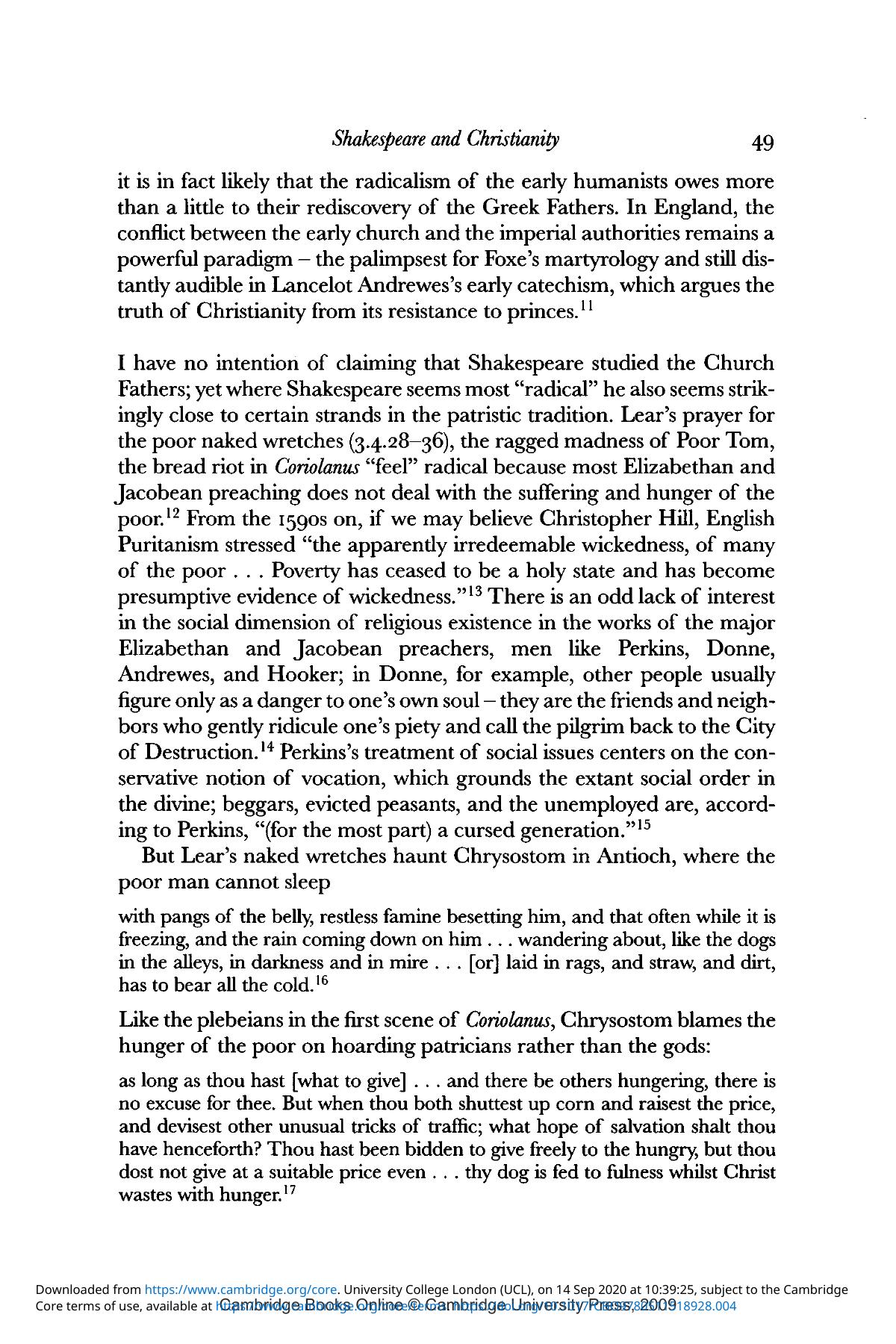
“But Lear's naked wretches haunt Chrysostom in Antioch...”
- Debora K. Shuger writes:
“Lear’s prayer for the poor naked wretches (3.4.28-36), the ragged madness of Poor Tom ... ‘feel’ radical”
- The same note quotes Chrysostomic language:
“...restless famine besetting him... wandering about, like the dogs in the alleys, in darkness and in mire... [or] laid in rags, and straw, and dirt.”
- Source-control check of Shuger confirms that her Lear argument is about a shared Christian/patristic structure of attention to suffering bodies, poverty, nakedness, and injustice. It is not a claim that Shakespeare directly read Chrysostom.
- Shuger explicitly cautions:
“I do not intend to argue that Shakespeare, in fact, studied the writings of the Church Fathers.”
- The page says this should be treated as:
“a documented modern scholarly source for the Lear-Chrysostom connection.”
- Source-control position: Shuger printed p.
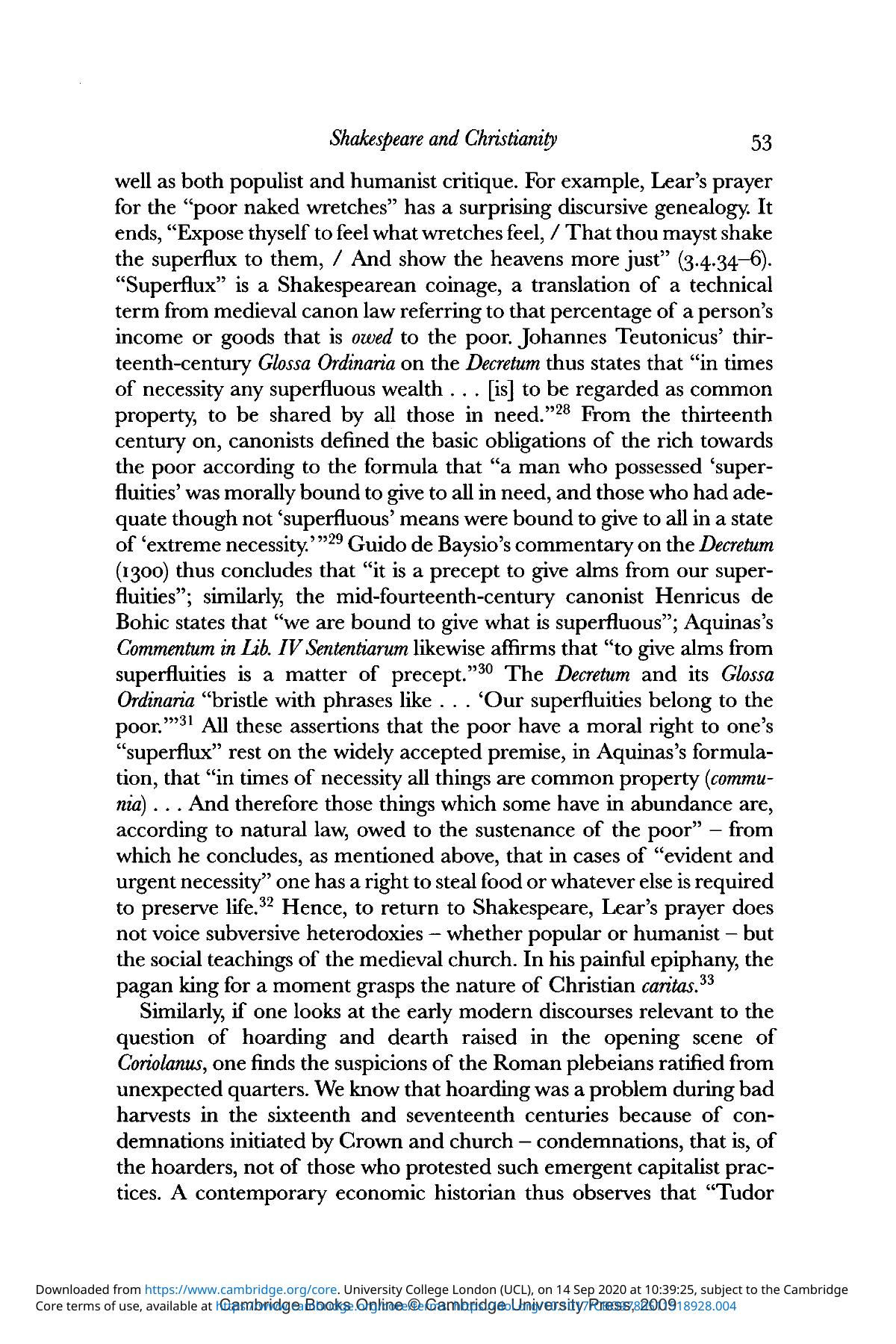
49is now rendered as a clean source image. It is the controlling witness for the Lear/Chrysostom bridge and supersedes the older phone photograph[local source path removed]. - The broader Lear case is stronger than one highlighted line. Shuger printed p.
53develops Lear'ssuperfluxlanguage through surplus, necessity, and medieval canon-law social teaching. - CCEL's public-domain NPNF text confirms the Chrysostom poor-man passage behind Shuger's note 16 in Homilies on the Epistles of Paul to the Corinthians. The text-control target is NPNF volume XII, p.
63; a clean page image still needs to be downloaded when network access allows. - The direct play text has a strong Dover cluster:
“To make your speed to Dover”
“To Dover.”
- The direct witness also reinforces the storm-and-suffering material through Cordelia’s line:
“To stand against the deep dread-bolted thunder”
8. Neville Letter Alignments
- The close-reading compilation links
1.4(“abatement of kindness”) to Neville’sletter_057(2 Apr. 1600to Robert Cecil), which discusses “abatement of customs.” - The same evidence bank links
1.4(“all-licensed Fool”) to Neville’sletter_001_1590, where he complains that he “should have no license unless I would give” a bribe. - The strict Tier A summary also lists
repealas a repeated manual-PASS lemma forKing Lear, though the detailed close-reading packet used here gave stronger immediate context forabatementandlicense.
9. Quoted Source Text
Source scholarship
- “Prophecy and emendation: Merlin, Chaucer, Lear’s Fool”
- “the Fool’s cryptic prophecy”
- “six lines of verse”
- “I do not intend to argue that Shakespeare, in fact, studied the writings of the Church Fathers.”
- “Lear’s naked wretches haunt Chrysostom in Antioch”
Direct play text (Folger)
1.3: “When he returns from hunting, I will not speak with him.”3.1: “To make your speed to Dover”3.6: “Mastiff, greyhound, mongrel grim”3.7: “To Dover.”4.6: “That fellow handles his bow like a crowkeeper.”4.6: “Bring up the brown bills. O, well flown, bird!”4.6: “there's darkness, there is the sulphurous pit”4.7: “Upon a wheel of fire, that mine own tears / Do scald like molten lead.”4.7: “To stand against the deep dread-bolted thunder”
10. N-gram Research
- In the
codex-neville-ngram-reportrare-bigram ranking, King Lear ranks37with138shared rare bigrams. - In the same folder’s rare-trigram ranking, the play ranks
29with229shared rare trigrams; in the Jaccard-normalized trigram table it ranks46with a Jaccard score of0.006079915040488517. - The selected exact-overlap DOCX preserves two longer shared phrases for this play:
“the king of france is”, paired there with Neville’s28 July 1599letter to Robert Cecil and King Lear4.3“i have received a letter”, paired there with Neville’s1 June 1600letter to Robert Cecil and King Lear3.3
11. Citations
- “King Lear.” Henry Neville Research Wiki, 11 Oct. 2019, http://nevilleresearch.com/index.php?title=King_Lear.
- wiki king lear, local preservation of the wiki page.
- chrysostom and shakespeare, dedicated hub for the Lear/Coriolanus Chrysostom connection.
- john chrysostom, related packet for the Savile/Chrysostom source environment.
- Shuger, Debora K. “Subversive Fathers and Suffering Subjects: Shakespeare and Christianity.” In Shakespeare and Christianity, Cambridge University Press, 2009, pp. 46-107. DOI: https://doi.org/10.1017/CBO9780511518928.004. Local copy: subversive fathers and suffering subjects shakespeare and christianity.
- Shuger source-image packet,
2026-06-20: SOURCE NOTES; manifest. - Teramura, Misha. “Prophecy and emendation: Merlin, Chaucer, Lear’s Fool.” Staged PDF: Teramura ProphecyEmendation MerlinChaucerLear 2019.
- Evidence Bank AllPlays PASS, research database manual-PASS evidence compilation.
- Top10 Letter Affinity CloseReading Draft, research database close-reading synthesis.
- CrossPlay Strict TierA, research database strict Tier A summary.
- neville rare bigrams vs plays 1590 1615, research database rare-bigram play ranking.
- neville rare trigrams vs plays 1590 1615, research database rare-trigram play ranking.
- neville rare trigrams jaccard vs plays 1590 1615, research database Jaccard-normalized trigram ranking.
- neville_shakespeare_ngram_matches.docx, research database selected
4–7gram overlaps. - Neville Letters Corpus v17, historical computational witness used for
letter_001_1590andletter_057; corpus-wide counts require a v22 rerun, and exact manuscript-derived wording still requires the packet's identified human/image controls. - Shakespeare, William. King Lear. Folger Shakespeare Library text witness:
- front matter
- act 01 scene 03
- act 03 scene 01
- act 03 scene 06
- act 03 scene 07
- act 04 scene 01
- act 04 scene 06
- act 04 scene 07
12. Notes on Access
- This packet has now been upgraded from direct scene-by-scene reading of the Folger text witness.
- The Chrysostom note is now supported by the direct Shuger chapter citation as well as the local wiki summary.
- Source-control position: Shuger supports the Lear/Chrysostom contextual analogy through suffering bodies, poverty, nakedness, and radical Christian social thought. The packet should not use Shuger as proof of Shakespeare's direct reading of Chrysostom.
- Source-control position: the Shuger page images and CCEL text controls make this a priority Chapter 10 lane. Use chrysostom and shakespeare as the hub.
- Teramura adds source-tradition support for the Fool's prophecy. It should not be used as a Neville-access claim unless later paired with source-book or manuscript evidence.
13. Evidence Images
14. Additional Fact-Source Notes
- The source/background lane is now separated from Neville evidence. EarlyPrint controls are Holinshed
A68202, King LeirA05206, HarsnettA02750, and Sidney's Arcadia witnessesA12229andA12231. - Shuger remains useful for Lear's "superflux"/poverty/social-theology context, but her argument is explicitly contextual rather than a direct-source claim.
- Dover, hunting, thunder, and suffering-body lines remain strong play-text anchors. They should not be presented as Neville proof unless later paired with a letter, manuscript, source-book, or ownership bridge.
- Book-safe formulation: King Lear has a rich verified source environment; the Neville claim still depends on separate documentary or source-access evidence.
15. Book Integration Update — 2026-08-31
- Chapter 34 credits Holinshed, King Leir, Sidney's Arcadia, and Harsnett before assessing Neville evidence.
- The retained Neville system joins without the form of justice, commission, letter delivery and answer, paper intelligence, staged sword evidence, treason, apprehension, and punishment traveling through a family.
- Without the form of justice is an exact legal-formula comparison, not a rare signature.
Intelligent partyis not claimed as Neville's phrase. - The evidentiary point is the concentration of these documentary and forensic operations in Neville's 1599–1601 public record, including instruments he used and instruments used against him.
- Current weight: medium-high documentary and forensic system.