Chrysostom and Shakespeare
Topic: Chrysostom and Shakespeare
Overview
This is now the main hub for the Chrysostom-Shakespeare connection. The strongest current case is not that Shakespeare directly read Chrysostom. The strongest case is that Debora K. Shuger gives a direct modern scholarly bridge from Chrysostomic social thought to King Lear and Coriolanus, while also stating the limit: she is not making a direct-source claim.
The book-facing use should be careful but prominent. Savile's Chrysostom edition proves that Chrysostom belongs inside the Neville/Savile intellectual environment. Shuger explains why Chrysostom matters for Shakespearean suffering bodies, poverty, nakedness, dearth, and elite hoarding.
Source Controls
- Rendered the key Shuger pages into a dedicated source-image packet: SOURCE NOTES.
- Created the research pass: CHRYSOSTOM SHAKESPEARE RESEARCH PASS 2026 06 20.
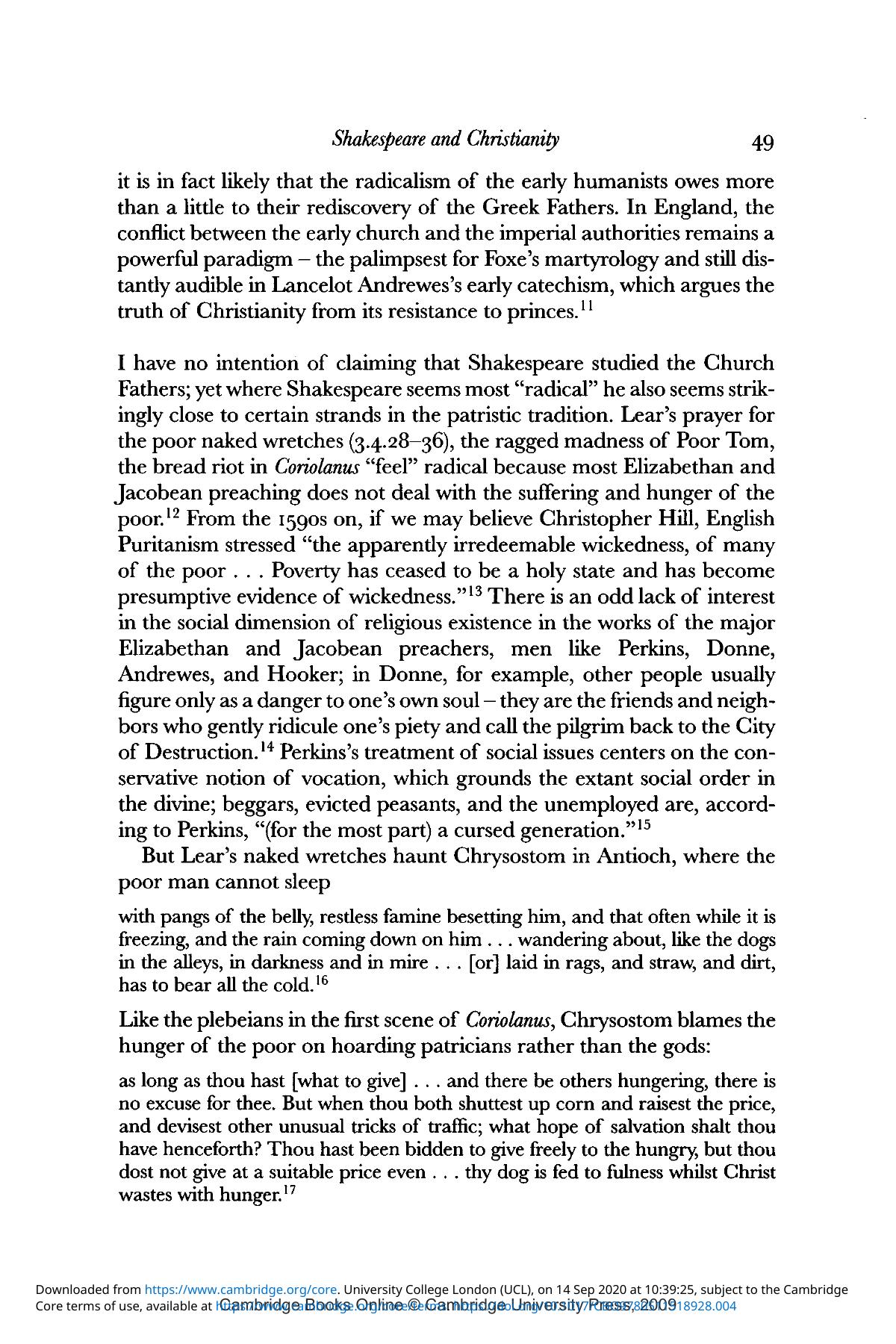
- Corrected the old Coriolanus/Dell ambiguity: the known photographed Chrysostom page matches Shuger printed p. 49, not the Dell Merry Wives/image-magic chapter.
- Checked CCEL's public-domain NPNF text for the two Chrysostom passages Shuger uses. The text confirms the poor-man passage and the corn-hoarding passage.
- Ran a focused EarlyPrint metadata and FTS control. The corpus contains six English Chrysostom items dated
1542,1544,1550,1588,1597, and1609, but this pass did not verify the exact Shuger poor-man or corn-hoarding passages in those early English items. - The shell could not resolve external hosts, so no fresh Archive.org or CCEL page images were downloaded in this pass. document witnesses-rendered images are now the image layer.
1. Verified Sourced Facts
A. Shuger is the controlling bridge source
- Shuger's chapter is titled "Subversive Fathers and Suffering Subjects: Shakespeare and Christianity."
- The chapter's main claim is that some Shakespearean passages treated by modern critics as radical belong within older Christian and patristic social thought.
- Shuger specifically names the Greek Fathers and then turns to Chrysostom as a major example of demystifying social hierarchy and privilege.
- The rendered source packet now gives clean images for the relevant printed pages.
B. The explicit limitation
- Shuger states that she has "no intention" of claiming Shakespeare studied the Church Fathers.
- This sentence should control the whole packet. The evidence supports a cultural, intellectual, and scholarly analogy, not a direct proof of reading.
C. King Lear
- Shuger links Lear's "poor naked wretches," Poor Tom, and the storm-heath suffering-body material to Chrysostom's Antioch poor-man passage.
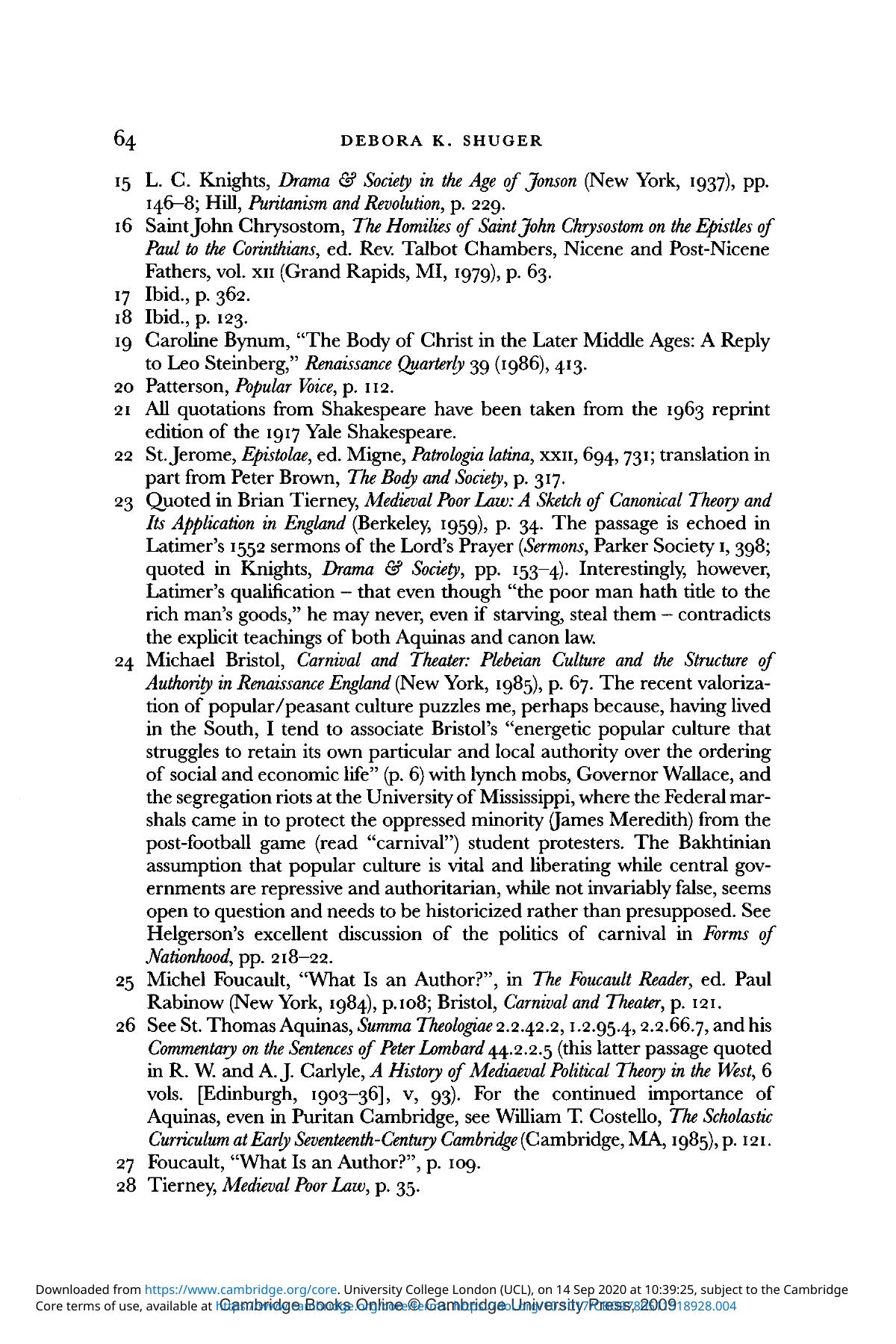
- Shuger cites Chrysostom's Homilies on the Epistles of Paul to the Corinthians, NPNF volume XII, p. 63.
- CCEL's public-domain NPNF text contains the relevant Chrysostom passage around lines 795-797: the poor man suffers hunger, cold, darkness, mire, rags, straw, and dirt.
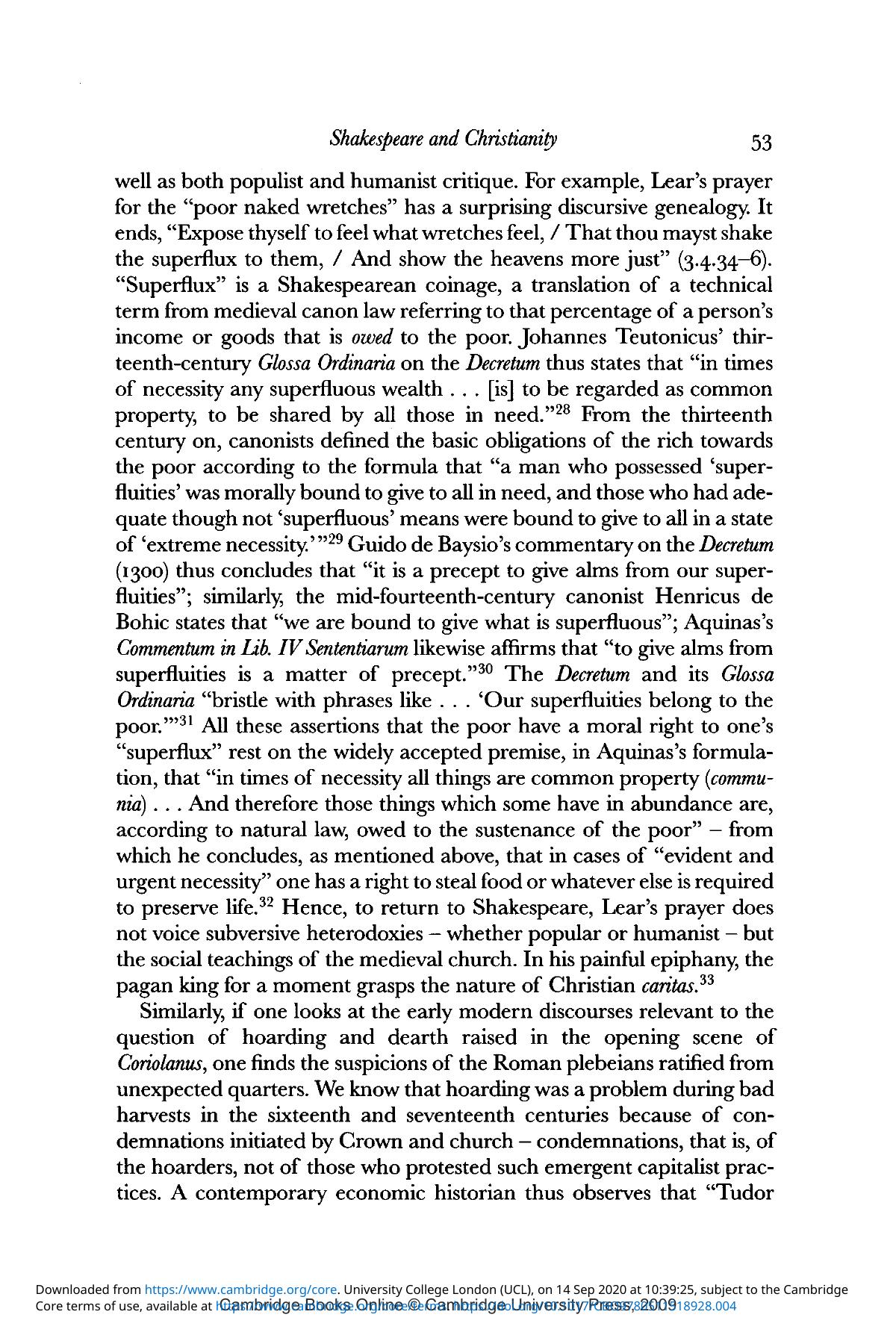
- Shuger develops the Lear case further through "superflux," surplus, necessity, and medieval canon-law social teaching.
D. Coriolanus
- Shuger links the opening hunger politics of Coriolanus to Chrysostom's attack on hoarding and price manipulation.
- Shuger cites NPNF volume XII, p. 362 for the corn-hoarding passage.
- CCEL's public-domain NPNF text contains the relevant Chrysostom passage around lines 4570-4571: those with something to give, others hungering, corn being shut up, and prices being raised.
- Shuger develops the Coriolanus case further through early modern English anti-hoarding controls, including official and ecclesiastical condemnation of corn engrossers and charitable-price rhetoric.
E. Savile's role
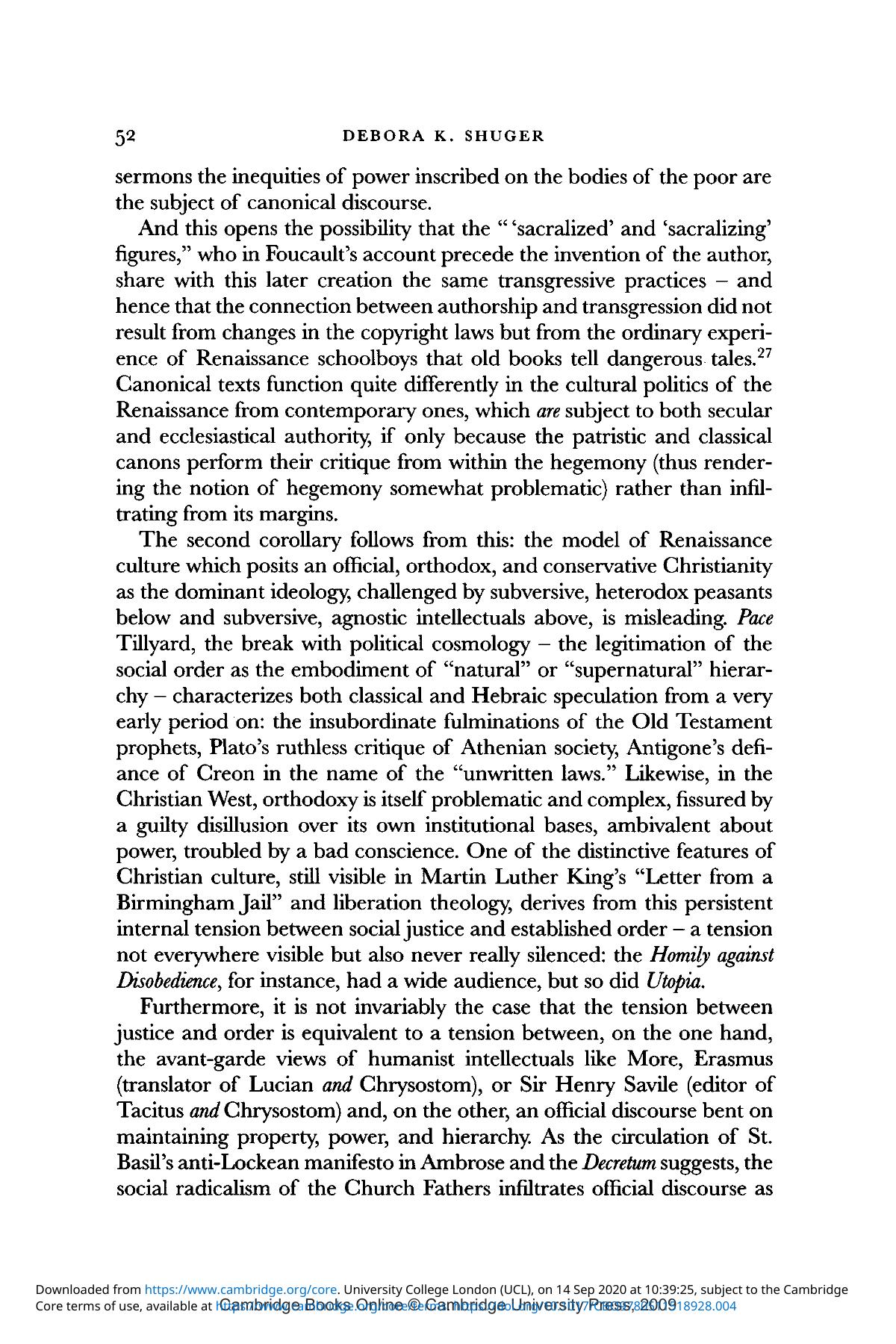
- Shuger names Sir Henry Savile as an editor of Tacitus and Chrysostom on printed p. 52.
- This matters because it joins two major routes already present in the Neville project: Roman political historiography and Greek patristic scholarship.
- CCEL's NPNF front matter says the English translation's text used the Benedictine text corrected in many places by Savile. This is later transmission context, not direct Shakespeare evidence.
- Quantin remains the direct source for Savile's Eton Chrysostom edition, the suppressed
Admonitio, and Savile's historical-critical method.
F. EarlyPrint availability control
- A local
EarlyPrint corpus databasetitle/author query forchrysost/chrisostfound six English Chrysostom records before or at1609: A04512(1542), Lupset translation of Chrysostom's sermon that no one is hurt but by himself.A04510(1544), Cheke/Chaloner homily on the dead who sleep.A04511(1550), sermon of patience, the end of the world, and last judgment.A04501(1588), An excellent treatise touching the restoring againe of him that is fallen.A04506(1597), A godly exhortation made unto the people of Antioch.A04503(1609), another English printing of An excellent treatise touching the restoring againe of him that is fallen.- Focused FTS checks against those six TCP IDs for
hungr,poore/poor,famine/dearth, andcorn/pricefound only general or incidental hits. This supports English-print availability of Chrysostom, but it does not yet prove English-print availability of the exact passages Shuger uses for Lear or Coriolanus*. - This makes Shuger's footnote and the CCEL/NPNF text controls more important for the specific poverty/dearth passages.
1A. Structured Quoted Source Passages
1. Shuger Is a Thematic Bridge, Not a Direct-Source Claim
- Source: Debora K. Shuger, "Subversive Fathers and Suffering Subjects," rendered source packet printed p. 49.
- Quoted anchors:
"no intention"
"Greek Fathers"
- What it proves: Shuger makes Chrysostom and the Greek Fathers relevant to Shakespearean social thought while explicitly refusing a direct-reading proof.
- Limits: cite this as a conceptual and historical-context bridge, not as proof that Shakespeare read Chrysostom.
2. The Lear Connection Runs Through Poverty, Nakedness, and Suffering Bodies
- Source: Shuger rendered source packet printed p. 49, with CCEL/NPNF Corinthians text control.
- Quoted anchors:
"Lear's naked wretches"
"restless famine"
- What it proves: the Lear comparison has a specific patristic poverty/suffering-body target, not merely a vague religious atmosphere.
- Limits: the packet still lacks an early modern English witness for the exact passage Shuger uses.
3. The Coriolanus Connection Runs Through Hoarding and Price Manipulation
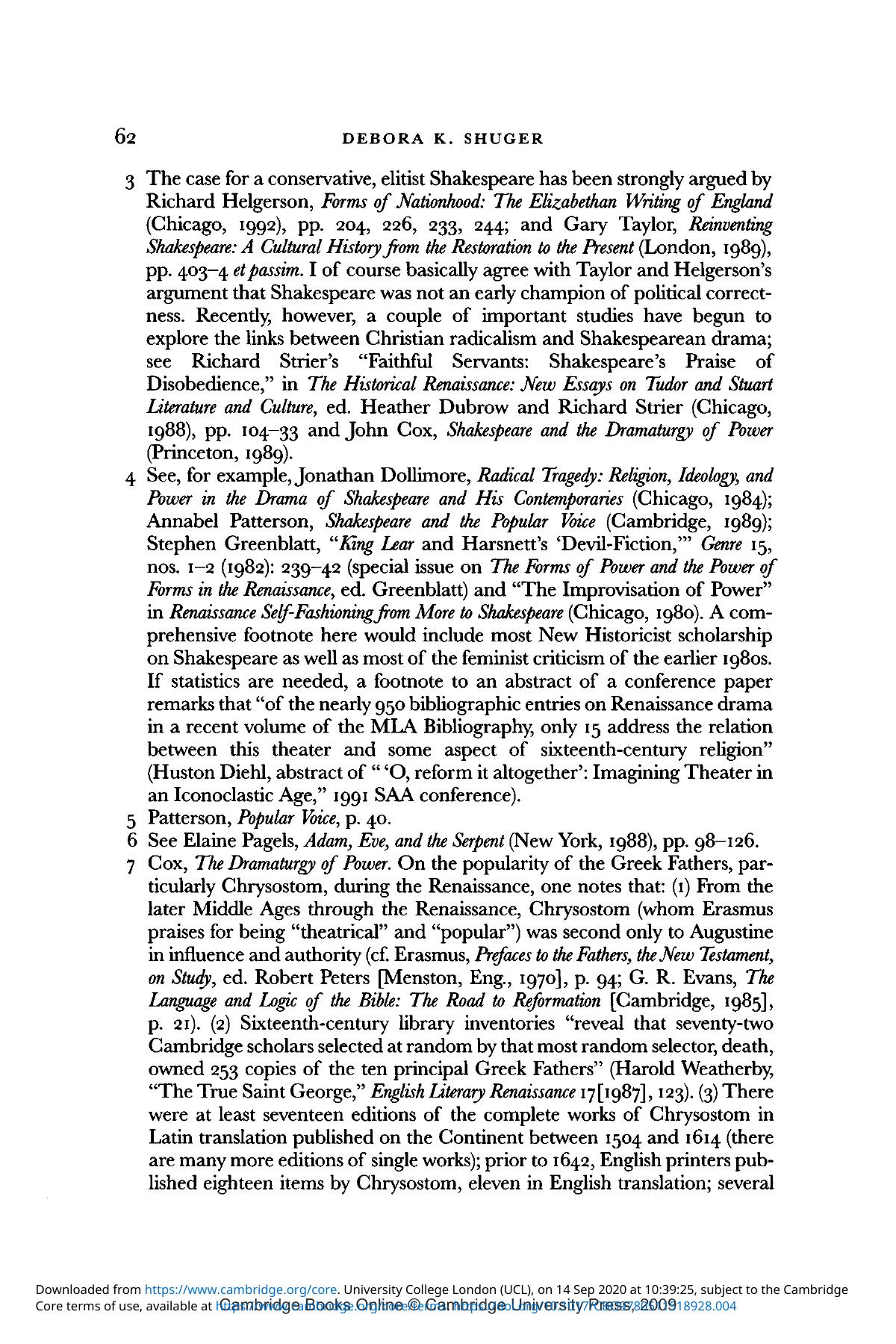
- Source: Shuger rendered source packet printed pp. 49, 53, and 64, with CCEL/NPNF Corinthians text control.
- Quoted anchors:
"hoarding patricians"
"raisest the price"
- What it proves: the Coriolanus comparison is anchored in hunger politics, corn-hoarding, and elite manipulation of scarcity.
- Limits: this remains a strong interpretive parallel controlled by Shuger and NPNF; it is not yet an early modern transmission proof.
4. Savile Makes the Topic Relevant to the Neville/Savile Source Environment
- Source: Shuger rendered source packet printed p. 52; Quantin controls the edition history.
- Quoted anchors:
"Sir Henry Savile"
"Tacitus and Chrysostom"
- What it proves: Shuger herself names Savile at the intersection of Roman historical and Greek patristic scholarship, aligning with two major Neville-project source lanes.
- Limits: this is environmental relevance. It does not show Shakespeare or Neville using Savile's Chrysostom.
2. Ken Feinstein Twitter and Blog Information
- No separate Ken Feinstein Twitter/blog layer is isolated for this hub yet.
- The older image witnesses chrisostom appears to be a phone photograph of Shuger printed p. 49. It should be treated as provenance for the older OCR note, not as the best current image witness.
3. Quoted Source Text
Shuger
- "no intention" of claiming Shakespeare studied the Church Fathers
- "Lear's prayer for the poor naked wretches"
- "the bread riot in Coriolanus"
- "Lear's naked wretches haunt Chrysostom"
- "Like the plebeians in the first scene of Coriolanus"
- "Sir Henry Savile (editor of Tacitus and Chrysostom)"
CCEL / NPNF controls
- "restless famine"
- "shuttest up corn and raisest the price"
- "corrected however in many places by that of Savile"
4. Citations
- Shuger, Debora K. "Subversive Fathers and Suffering Subjects: Shakespeare and Christianity." In Shakespeare and Christianity, Cambridge University Press, 2009, pp. 46-107. DOI: https://doi.org/10.1017/CBO9780511518928.004. document witnesses: subversive fathers and suffering subjects shakespeare and christianity.
- Shuger source-image packet,
2026-06-20: SOURCE NOTES; manifest. - Chrysostom/Shakespeare research pass,
2026-06-20: CHRYSOSTOM SHAKESPEARE RESEARCH PASS 2026 06 20. - CCEL. NPNF1-12. Saint Chrysostom: Homilies on the Epistles of Paul to the Corinthians: work page; Unicode text; scanned page index.
- EarlyPrint controls:
[local source path removed]title/author query forchrysost/chrisost;[local source path removed]FTS checks againstA04512,A04510,A04511,A04501,A04506, andA04503. - Quantin, Jean-Louis. "Historical Criticism, Confessional Controversy, and Self-Censorship: Henry Savile and the Lives of John Chrysostom." document witnesses: Quantin Savile Chrysostom 2021.
- john chrysostom
- play king lear
- play coriolanus
- henry savile
5. Evidence Images
6. Notes on Access
- Use this hub for the literary-critical Chrysostom/Shakespeare connection.
- Use john chrysostom for Savile's edition and the suppressed
Admonitio. - Use play king lear and play coriolanus for play-specific routing.
- The key presentation boundary is: strong thematic/intellectual bridge, weak or absent direct-source proof.