Coriolanus
Topic: Coriolanus
Hadfield/Muir Foure Paradoxes lead — 31 August 2026
Andrew Hadfield's “Shakespeare and the Digges Brothers,” read in full, revives a source proposal he attributes to Kenneth Muir: Dudley Digges's two contributions to Foure Paradoxes (1604), especially the fourth paradox that war may be less harmful than peace in a well-governed state, resemble the play's arguments about martial virtue, luxurious idleness, effeminacy, wounds, service, and civic dependence on the soldier. Hadfield quotes Dudley's contrast between blood shed for king, country, and reputation and “sorded sparing, lazie living,” then compares it with Menenius, Cominius, Coriolanus, and Volumnia.
Status: useful source-hypothesis lead, not yet promoted into Chapter 29. The 1604 printed text and Muir's original discussion must be read and independently compared with the Folger play before any expansion. Hadfield himself concludes only that Shakespeare “may—or may not—have read” Foure Paradoxes.
Citation: Andrew Hadfield, “Shakespeare and the Digges Brothers,” Reformation 25, no. 1 (2020): 2–17, especially 15–17, DOI 10.1080/13574175.2020.1743554.
Book integration update — 31 August 2026
Chapter 29 now subtracts North's Plutarch before organizing the affirmative case around three leading formations: Cuffe's bodily pairing of leanness and nutritive superfluities, transformed into the class physiology of 1.1; Neville's 27 June 1599 intelligence sequence from division and contention to great heat and foreign opportunity; and his performed treaty practice involving conditions, delegated powers, subscription, and seals. Neville's later Tacitean analysis of merit interpreted through hatred functions as retrospective political-method evidence.
The Dionysius volume is treated as source ecology within the later Billingbear–Audley End book history. In accordance with the project's publication boundary, the chapter does not quote, translate, count, locate, or describe individual annotations. New River, wounds and service, and parliamentary voices remain supporting rather than leading evidence. Neville letter quotations are controlled against canonical corpus v22 and public witnesses; Shakespeare quotations follow Folger lineation.
Quoted Source Passages
1. Dearth, Patricians, and Hoarded Grain
- Source: Folger Coriolanus, act 01 scene 01:109.
- Quotation:
For the dearth,
The gods, not the patricians, make it
Suffer us to famish, and their
storehouses crammed with grain
- What it proves: the play opens with hunger politics, elite responsibility, dearth, and grain storage as its civic crisis.
- Limits: this is the play-side social-political structure. It does not, alone, prove a New River or Chrysostom source.
2. Shuger / Chrysostom Analogue with Caveat
- Source: Shuger local layout extraction, Shuger Subversive Fathers Suffering Subjects layout:152 and Shuger Subversive Fathers Suffering Subjects layout:177.
- Quotation:
I have no intention of claiming that Shakespeare studied the Church
Fathers
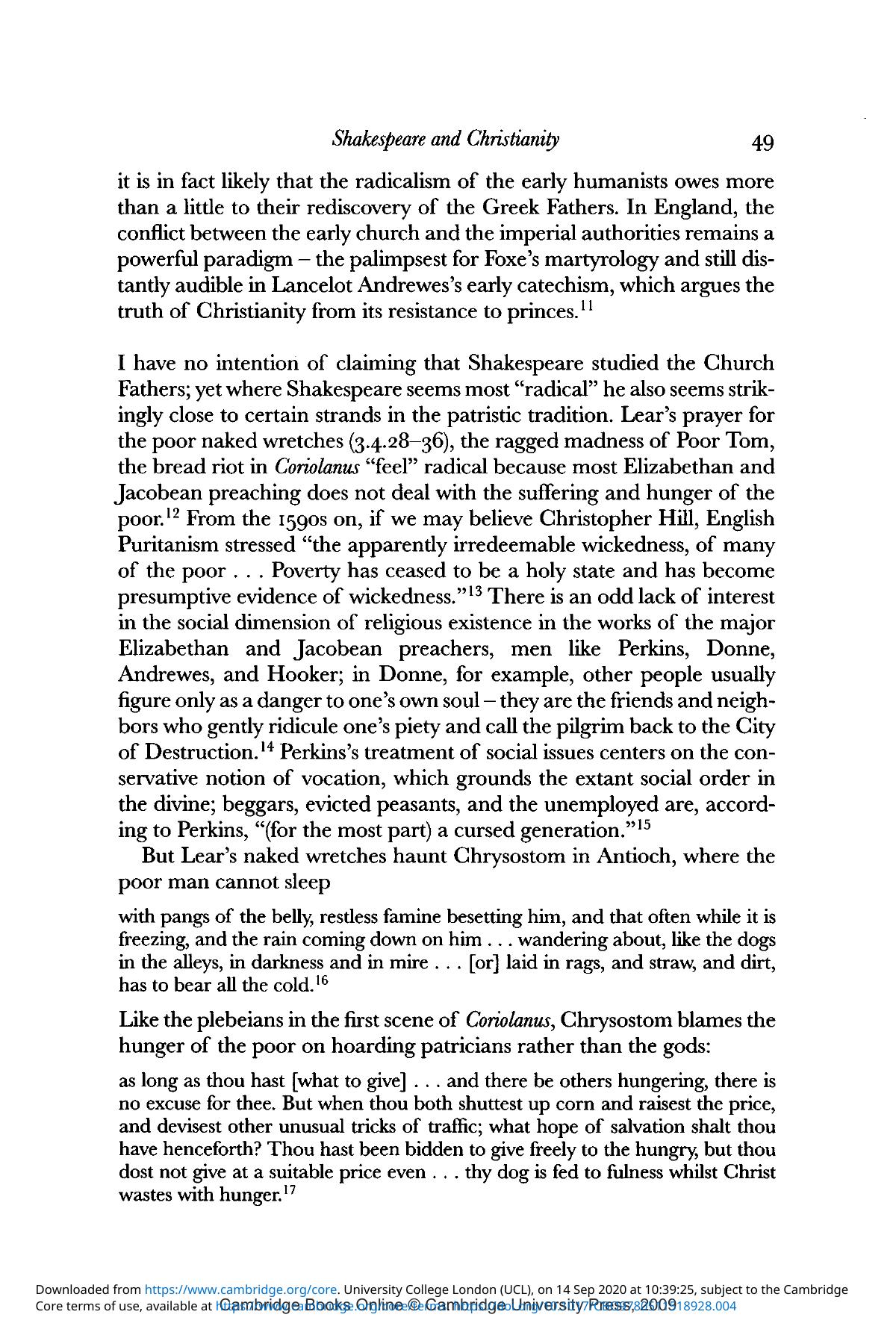
Like the plebeians in the first scene of Coriolanus, Chrysostom blames the
hunger of the poor on hoarding patricians rather than the gods
- What it proves: Shuger supplies a controlled modern social-thought comparison for Coriolanus and explicitly bars a direct-source claim.
- Limits: cite this as patristic/social analogy and intellectual context, not as evidence that Shakespeare read Chrysostom.
3. Mutineers, Temporizing, and Pretext
- Source: Folger Coriolanus, act 01 scene 01:407, act 04 scene 06:39, and act 05 scene 06:46.
- Quotation:
Worshipful mutineers
He could have temporized.
And my pretext to strike at him
- Neville-side sources:
letter_057andletter_012, letter 057:132 and letter 012:127. - Neville-side quoted anchors:
the King temporized
served rather for a pretext to his officers, to extort by wrong and violence upon our merchants
- What it proves: the play's political vocabulary has plausible Neville-letter counterparts in mutiny, temporizing, and pretext/extortion contexts.
- Limits: these are vocabulary alignments that require control counts and sense checks; do not present them as independent proof.
4. New River Documentary Context
- Source: new river project:28.
- Quotation:
Sir Henry Nevill of Billingsbear in the countie of Berks Knight
is and hathe beene an adventurer in the said worke
two full and intire six and thirtieth partes
- What it proves: the New River lane has a concrete 1612 documentary basis for Sir Henry Neville's investment in a civic waterworks project.
- Limits: this is infrastructure/business context for a later civic-politics reading. It does not prove that Neville debated the New River in Parliament or that Coriolanus alludes to the project.
5. Tacitus, Public Hatred, and the Interpretation of Virtue
- Neville source: his parliamentary Advice of about
1613, Neville Advice Review, concluding its warning about projects undertaken while the King and Parliament remain estranged:
seu bene seu male facta premunt
- Tacitus source: Histories I.7 in the first Lipsius edition of 1574:
et inviso semel principe; seu bene seu male facta premunt
- Folger Coriolanus, act 04 scene 07:56:
For I dare so far free him--made him feared,
So hated, and so banished. But he has a merit
To choke it in the utt'rance. So our virtues
Lie in th' interpretation of the time,
And power, unto itself most commendable,
Hath not a tomb so evident as a chair
T' extol what it hath done.
- What it documents: Neville's political counsel and Aufidius's analysis address the same Tacitean problem: once a public man is hated, merit and virtue are reinterpreted through the prevailing time and reputation. Neville uses the maxim about James and Parliament; the play dramatizes it in Coriolanus's banishment.
- Limits: this is a political-concept and source-history avenue, not an exact English phrase match. Its importance is strengthened by the surviving Audley End
1574Tacitus object81038208, which is now a precise page-inspection target.
1. Verified Sourced Facts
- The local wiki page covers
Coriolanus. - The same page links the play to the
New River Projectwiki page. - The New River context packet now has a verified
1612source: Rudden's printed appendix records a share issue between Hugh Middleton andSir Henry Nevill of Billingsbear, granting Neville two thirty-sixths of the waterworks and related profits. - Leslie Tomory's water-industry history independently summarizes the same early New River share document as a sale of two shares to Sir Henry Neville in
1612for£100each. - The New River packet's
2026-05-29revision narrows the evidence: the checked sources prove Neville's investment/payment lane, but do not yet prove that Neville debated or advocated the New River project in Parliament. - The same page preserves an OCR note connecting the play's opening hunger politics to Chrysostom;
2026-06-20audit corrects the controlling source from Dell to Shuger. - The direct Folger text witness contains repeated grain, dearth, and garners language in
1.1. - The same witness contains a direct hunting comparison in
1.1. - The same witness contains artillery or battery language in
5.4. - The same witness contains sulfur-and-bolt language in
5.3.
2. Ken Feinstein Twitter and Blog Information
- No Ken Feinstein Twitter/blog material is isolated in this packet at present.
3. Dating and Historical Context
- The current local wiki page is a stub and does not provide a separate dating section.
- The local page frames the play mainly through its relation to the
New River Projectpage and through an older Chrysostom comparison note now corrected to Shuger.
4. Cannon References
- In
5.3, Volumnia says:
“To tear with thunder the wide cheeks o' th' air / And yet to charge thy sulfur with a bolt / That should but rive an oak.”
- In
5.4, Menenius says of Martius:
“his hum is a battery.”
5. Hunting and Hawking References
- In
1.1, Menenius says of Caius Martius:
“He is a lion / That I am proud to hunt.”
- In
1.6, Cominius compares Coriolanus to:
“a fawning greyhound in the leash”
6. Metallurgy, Iron, Furnace, or Forge References
- In
1.5, Martius dismisses low-value spoils including:
“Irons of a doit”
- In the direct scene-by-scene reading completed for this packet, no fuller furnace or forge cluster comparable to the Mayfield or Henry V materials was identified.
7. Other Relevant Historical or Local References
- In
1.1, the opening citizen scene includes:
“Let us kill him, and we'll have corn at our own price.”
- The same scene includes:
“For the dearth, / The gods, not the patricians, make it”
- The citizens reply:
“Suffer us to famish, and their storehouses crammed with grain”
- Menenius also says:
“Because I am the storehouse and the shop / Of the whole body.”
- Debora K. Shuger writes:
“Like the plebeians in the first scene of Coriolanus, Chrysostom blames the hunger of the poor on hoarding patricians rather than the gods”
- The same passage quotes Chrysostom attacking those who:
“shuttest up corn and raisest the price”
- Source-control check of Shuger confirms that this is a contextual analogy between Coriolanus and patristic social criticism, especially hunger, hoarding, and elite responsibility. It is not a direct-source claim that Shakespeare read Chrysostom.
- Shuger explicitly cautions:
“I do not intend to argue that Shakespeare, in fact, studied the writings of the Church Fathers.”
- The same act later includes:
“The Volsces have much corn”
- Source-control position: Shuger printed p.
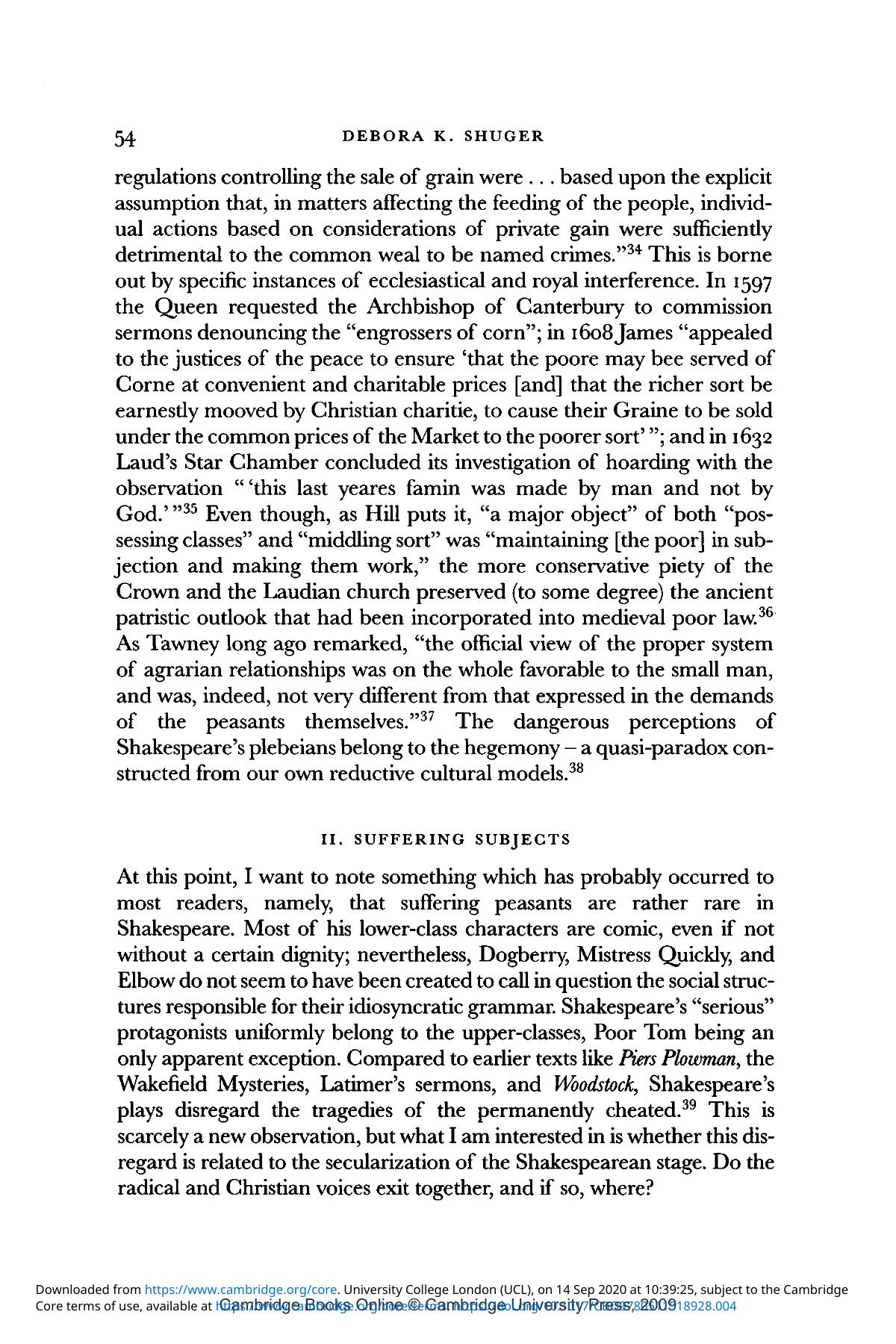
49is now the controlling page image for the Coriolanus/Chrysostom comparison; Shuger printed pp.53-54then develops the early modern dearth/hoarding frame. - CCEL's public-domain NPNF text confirms the Chrysostom corn-hoarding passage behind Shuger's note 17 in Homilies on the Epistles of Paul to the Corinthians. The text-control target is NPNF volume XII, p.
362; a clean page image still needs to be downloaded when network access allows. - The earlier Dell label in the local wiki note should not be used as a Coriolanus/Chrysostom citation unless a separate Dell passage is later found. The verified Dell material currently found locally concerns Merry Wives and image magic.
8. Neville Letter Alignments
- The evidence bank links
1.1(“Worshipful mutineers”) to Neville’sletter_057(2 Apr. 1600), which says French forces hoped to “reduce the mutineers.” - The close-reading compilation links
5.6(“my pretext”) to Neville’sletter_012(13 July 1599), where he says royal officers used a “pretext” to extort merchants. - The same evidence bank also links
4.6(“temporized”) toletter_057, where Neville writes that “the King temporized.” - The strict Tier A summary lists
repealas a manual-PASS lemma forCoriolanus, though the fuller close-reading packets used here supplied stronger context formutineers,pretext, andtemporized.
9. Quoted Source Text
Direct play text (Folger)
1.1: “Let us kill him, and we'll have corn at our own price.”1.1: “For the dearth, / The gods, not the patricians, make it”1.1: “Suffer us to famish, and their storehouses crammed with grain”1.1: “Because I am the storehouse and the shop / Of the whole body.”- Shuger: “Like the plebeians in the first scene of Coriolanus”
- Shuger: “I do not intend to argue that Shakespeare, in fact, studied the writings of the Church Fathers.”
- Rudden: “Sir Henry Nevill of Billingsbear in the countie of Berks Knight”
- Rudden: “two full and intire six and thirtieth partes”
1.1: “He is a lion / That I am proud to hunt.”1.5: “Irons of a doit”1.6: “a fawning greyhound in the leash”5.3: “charge thy sulfur with a bolt / That should but rive an oak.”5.4: “his hum is a battery.”
10. N-gram Research
- In the
codex-neville-ngram-reportrare-bigram ranking, Coriolanus ranks12with175shared rare bigrams. - In the same folder’s rare-trigram ranking, the play ranks
20with254shared rare trigrams; in the Jaccard-normalized trigram table it ranks34with a Jaccard score of0.006537125209110797. - No separate exact
4–7gram phrase dossier for Coriolanus has yet been identified in the current report folders. The current n-gram evidence for this play is ranking-based rather than an extracted exact-phrase packet.
11. Citations
- “Coriolanus.” Henry Neville Research Wiki, 1 Oct. 2020, http://nevilleresearch.com/index.php?title=Coriolanus.
- wiki coriolanus, local preservation of the wiki page.
- Evidence Bank AllPlays PASS, research database manual-PASS evidence compilation.
- Top10 Letter Affinity CloseReading Draft, research database close-reading synthesis.
- CrossPlay Strict TierA, research database strict Tier A summary.
- neville rare bigrams vs plays 1590 1615, research database rare-bigram play ranking.
- neville rare trigrams vs plays 1590 1615, research database rare-trigram play ranking.
- neville rare trigrams jaccard vs plays 1590 1615, research database Jaccard-normalized trigram ranking.
- Neville Letters Corpus v8, direct local letter corpus witness for
letter_012andletter_057. - Shakespeare, William. Coriolanus. Folger Shakespeare Library text witness:
- front matter
- act 01 scene 01
- act 01 scene 05
- act 01 scene 06
- act 05 scene 03
- act 05 scene 04
- john chrysostom, related packet for Savile's Chrysostom edition and source environment.
- chrysostom and shakespeare, dedicated hub for the Lear/Coriolanus Chrysostom connection.
- new river project, related packet for the verified 1612 New River share issue involving Sir Henry Nevill of Billingbear.
- Shuger, Debora K. “Subversive Fathers and Suffering Subjects: Shakespeare and Christianity.” In Shakespeare and Christianity, Cambridge University Press, 2009, pp. 46-107. DOI: https://doi.org/10.1017/CBO9780511518928.004. Local copy: subversive fathers and suffering subjects shakespeare and christianity.
- Shuger source-image packet,
2026-06-20: SOURCE NOTES; manifest.
12. Notes on Access
- The wiki points back to the local
New River Projectconnection. - This packet was built from direct scene-by-scene reading of the Folger text witness, not only from keyword searching.
- The earlier Dell attribution is preserved only as a local note-history issue in
wiki coriolanus; it should not control the Chrysostom/Coriolanus argument. - The Chrysostom comparison is now also backed by the direct Shuger chapter citation.
- Source-control position: Shuger strengthens the opening hunger-politics packet because she maps Coriolanus to Chrysostom's attack on hoarding patricians and price manipulation. The limitation should remain explicit: this supports a cultural/patristic analogy, not direct source access.
- Source-control position: the Shuger page images and CCEL text controls make this a priority Chapter 10 lane. Use chrysostom and shakespeare as the hub.
- Source-control position: the New River context is now backed by Tomory and Rudden rather than only the local wiki stub. This supports a real Neville-family infrastructure/company context, but it does not by itself date or source Coriolanus.
- Source-control position: the New River context should be stated as investment/payment evidence only. BRO
Doc_47ddirectly supports the Chadwell/Amwell-to-London New River payment lane; BRODoc_47bandDoc_47care related Sarum/Salisbury waterworks material and should not be cited as New River evidence.
13. Evidence Images
14. Additional Fact-Source Notes
- Source-book control is now explicit: EarlyPrint identifies North's Plutarch as TCP
A09802(1579) and Camden's Remaines asA17848(1605). These govern the Coriolanus source-book lane; Archive.org item plutarchnorthlives provides a public image witness for North. - The Archive.org variant sweep adds two additional public witness routes: plutarchnorthlives2ed, the
1595second edition of North's Plutarch, and nby_704536-2, a single-life image witness for The Life of Caius Martius Coriolanus. Treatnby_704536-2as an image witness only unless reliable text/OCR is separately extracted. - Shuger remains the controlling modern Lear/Coriolanus/Chrysostom comparison, but the limitation matters: she uses Chrysostom for social and theological context and explicitly does not argue direct Shakespearean source use.
- Keep the New River material as Neville infrastructure/investment context only. This pass did not add a direct parliamentary, textual, or source-transmission bridge from New River documents to Coriolanus.
- Book-safe structure: three separate lanes should stay separate: source-book controls (North/Camden), social-thought context (Shuger/Chrysostom), and Neville context (New River investment and letters).