Henry Neville's Tacitus Textual Fingerprints: 1599, 1601, 1606, and 1613
Topic: Henry Neville's Tacitus Textual Fingerprints: 1599, 1601, 1606, and 1613
Source-Fact Audit — 7 August 2026 (Round 3)
- Each proposed Tacitus “fingerprint” is now treated as a three-part record: the Neville witness, the Tacitus passage/edition, and the verbal or conceptual comparison.
- The 1599 and 1601 items belong to Neville's diplomatic or political writings only where sender and text are independently controlled; dates and attributions must not be inferred from later arrangement.
- The 1613 Advice is well attested as Neville's composition: Samuel Rawson Gardiner prints it in full as An Advice [by Sir Henry Neville] Touching the Holding of a Parliament, History of England, vol. II (1863), Appendix V, pp. 389-394, from
SP 14/74 no. 44. Gardiner's brackets are editorial supply of an absent title-attribution, not doubt, and the later Gale heading's question mark applies to a 1640 copy, not to the work. *The correct caution is narrower than earlier passes stated: no autograph manuscript of the Advice survives, so it is not a handwriting witness. That does not qualify it as a witness to Neville's reading, which is what the Tacitus argument needs.* - A quotation, paraphrase, commonplace, or Tacitean political concept are different kinds of dependence and are labelled separately.
- Similarity establishes a comparison for further source history; it does not by itself show which edition was read, when it was read, or who composed another work.
Source-Control Summary
Henry Neville's engagement with Tacitus can now be documented as a repeated practice rather than a single quotation:
- On
24 September 1599O.S., in a diplomatic dispatch to Robert Cecil, Neville quotes Annals IV.18 in Latin and explicitly calls it “the Saying of Tacitus.” - In his
2 March 1601confession, Neville says an Essex proposal was the kind of action which “as Tacitus sayth non laudantur nisi peracta.” The source is securely identified as Histories I.38.1, where Otho tells the praetorians that there is no room for delay in a planquod non potest laudari nisi peractum. Neville compresses the syntax, pluralizes the maxim, and adds that the action “would be interpreted by the successe.” - On
11 March 1605O.S. (1606), writing to Ralph Winwood about the Earl of Dunbar's withdrawal from court, Neville closes with an unattributed Latin sentence:an hoc [hos] satias ceperit cum omnia acceperint, an illos cum omnia tribuerint?This was identified on22 August 2026as Tacitus, Annals III.30, adapted rather than quoted. It is the only one of the four that Neville does not name and the only one he reworks. - At the end of his parliamentary Advice of about
1613, Neville usesseu bene seu male facta premunt, an exact wording printed in the first Lipsius Tacitus edition of1574.
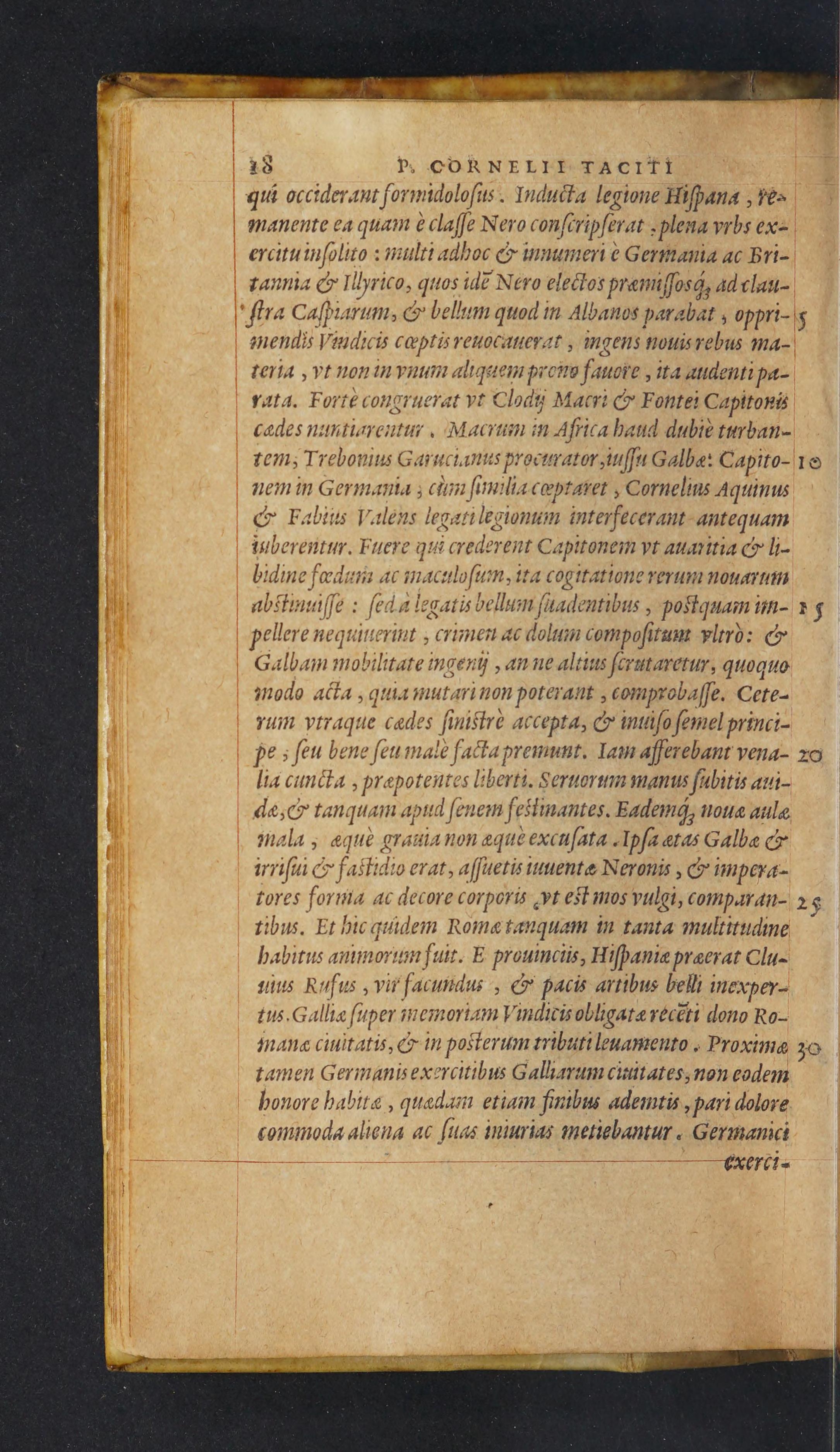
The fourth item is especially important because the surviving Audley End library contains a 1574 Tacitus Opera, object 81038208. The complete public scan of the same first Lipsius edition prints the identical form at Histories I.7. The locally preserved photograph of the Audley End copy has now been found: printed p. 18 is the left page in TACITUS 1574 P019 MARG UNLIN IMG 5264 result, and the complete sentence containing Neville's words is visibly underlined across its two printed lines. This does not by itself prove that Neville copied from the surviving object or identify the annotating hand, because the reading circulated in other editions and the page contains many other marks. It does establish a direct conjunction that was previously only a proposed test: Neville later quoted a sentence that is marked in the surviving Audley End copy of the same edition.
Quoted Source Passages
The controlled quotations are presented in their full documentary contexts below: Neville's 1599 Annals quotation, the 1601 confession attribution, the unattributed 1606 Annals III.30 adaptation, the 1613 Histories tag, the 1574 Lipsius running text, Grenewey's 1598 and Savile's 1591 English renderings, and exact Folger passages from Timon of Athens and Coriolanus.
1. The 1599 Diplomatic Letter: Tacitus Applied to Franco-English Relations
Correct letter identity
The existing book-draft and topic tradition sometimes assigns the Annals quotation to letter_014. That is incorrect. letter_014 is dated 18 July 1599 O.S. and concerns the treaty of Blois; it does not contain the Tacitus sentence.
The quotation occurs in:
- Corpus ID:
letter_030 - Date:
24 September 1599O.S. (4 OctoberN.S.) - Sender/recipient: Henry Neville to Robert Cecil
- Printed witness: Winwood, Memorials, vol. I, Book II, pp.
106-108; the quotation appears on printed p.108.
Neville is warning that Henry IV's ministers may work on a king who leaves affairs to them and may turn him away from Elizabeth. He then writes:
“Befydes your Honor remembreth the Saying of Tacitus, beneficia eo usque laeta sunt dum videntur exolvi posse; ubi multum antevenêre, pro gratia odium redditur.”
The Latin is Tacitus, Annals IV.18: benefits remain welcome while repayment seems possible; when they exceed repayment, hatred is returned in place of gratitude. Neville is not decorating the dispatch with a detached tag. He uses the passage to interpret the psychological danger inside a relationship between allied monarchs.
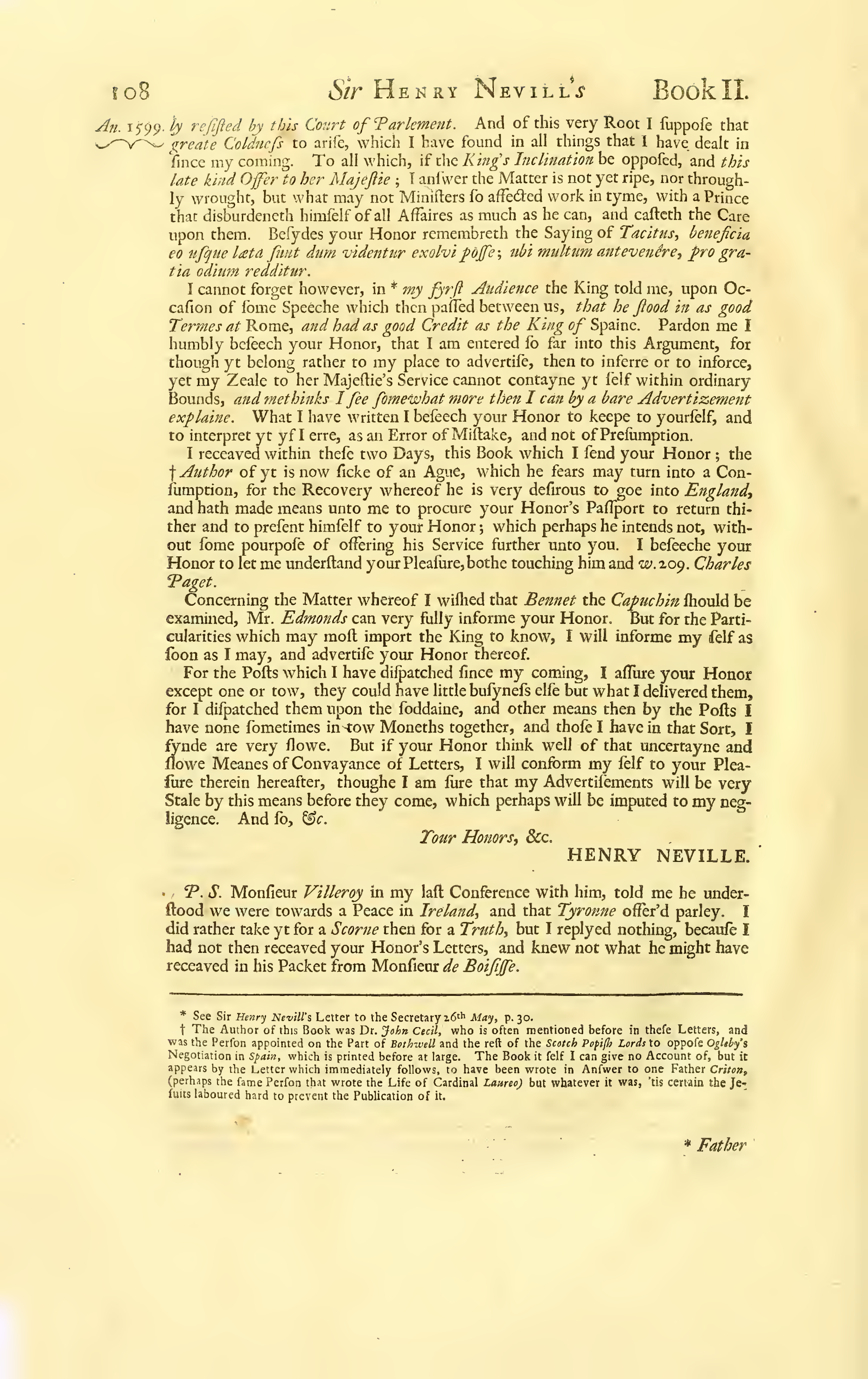
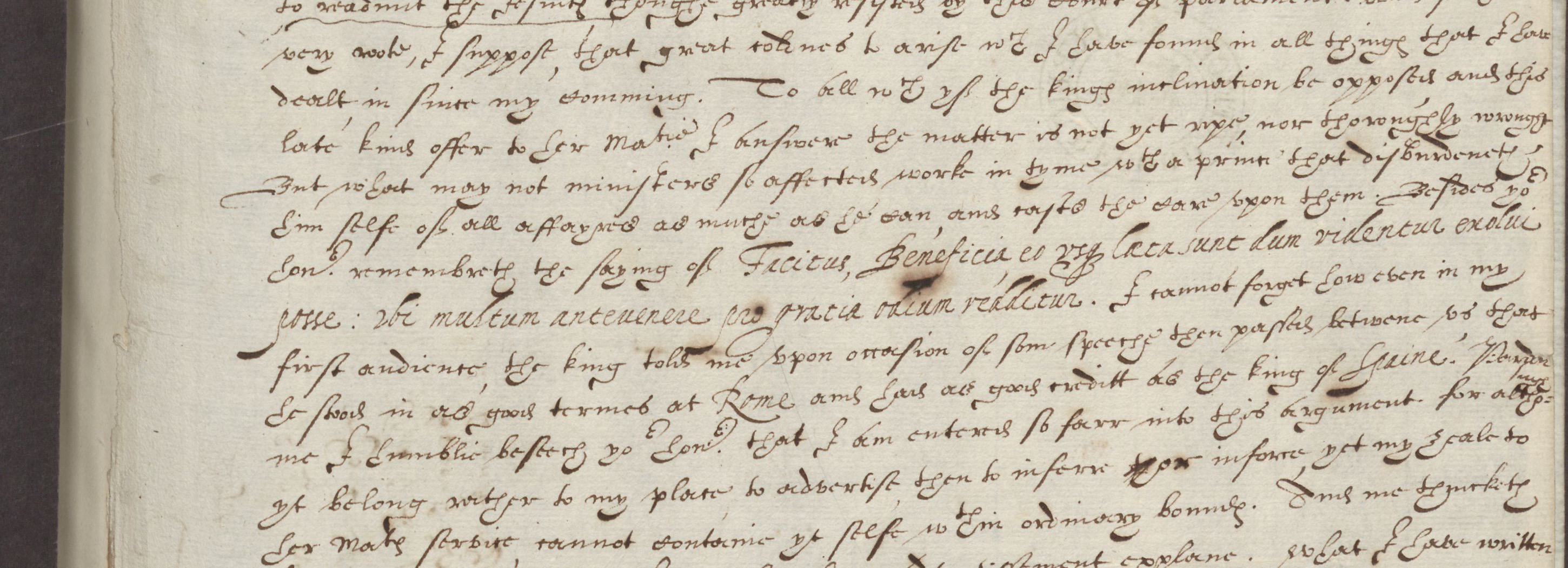
The autograph letter page and the marked Audley End passage
The manuscript collation is now complete at page level. The quotation appears on the final recto of the SP 78/43 letter image letter 022 04, the same page that carries Neville's date, closing, postscript, and signature. Neville introduces the sentence as the saying of Tacitus and writes:
beneficia eo usque laeta sunt dum videntur exolui posse: ubi multum anteuenere, pro gratia odium redditur
The apparent manuscript spelling exolui should be retained as an observed reading until the highest-resolution archival image is rechecked; the 1574 book prints exsolui.
The corresponding passage in the Audley End Tacitus is on printed p. 340, the left page of P341 / IMG_5430. A large left-margin bracket encloses the complete maxim from Nam beneficia through redditur, and several words or segments within it are additionally underlined. A numerical or reference notation appears beside the bracket.
The clear comparison image comes from the public 1574 scan, Archive leaf n352. Its OCR incorrectly reads the page number as 240; the image itself clearly reads 340:
Nam beneficia eo usq; laeta sunt, dum videntur exsolui posse: ubi multum anteuenere, pro gratia odium redditur.
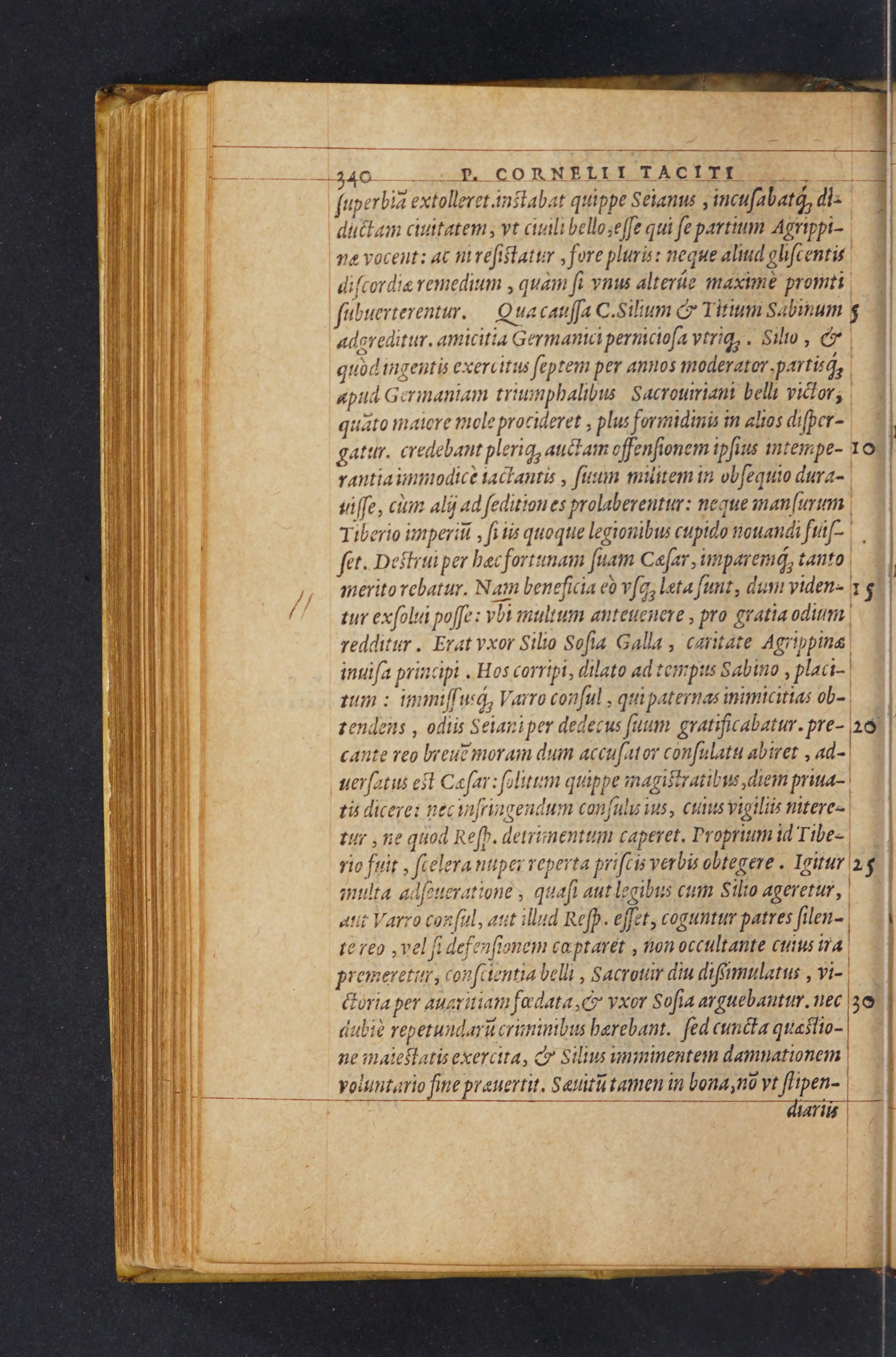
This produces a second page-specific conjunction in the same surviving book. Neville quotes Annals IV.18 in 1599, and that complete maxim is bracketed and partly underlined on p. 340; he quotes Histories I.7 in about 1612-13, and that complete sentence is underlined on p. 18.
Printed p. 18 re-verified directly, 22 August 2026. The opening TACITUS 1574 P019 MARG UNLIN IMG_5264 was reopened and read at magnification. The 1574 text runs Ceterum vtraque cædes ſiniſtrè accepta, & inuiſo ſemel principe, ſeu bene ſeu male facta premunt. A ruled underline runs beneath it across three printed lines and stops exactly at premunt., at the sentence end. The same γ. ω. Greek-letter tag that stands beside Annals III.30 on p. 310, Annals IV.18 on p. 340, and Histories I.38 on p. 33 also stands in the margin here, at the head of the pe, ſeu bene ſeu male facta premunt line. All four of Neville's Tacitus passages are therefore marked by one hand using one system. The 1574 reading facta premunt is itself the point of the match: the modern critical text reads facta parem invidiam adferebant, verified against The Latin Library's Historiae I.
2. The 1601 Confession: A Second Claimed Tacitus Quotation
When Southampton and Charles Danvers describe the proposed armed entry into court, Neville says he answered:
“That this was an action of the nature of those which as Tacitus sayth non laudantur nisi peracta & would be interpreted by the successe.”
This is a close adaptation of Tacitus, Histories I.38.1. At the climax of Otho's address to the praetorians, Tacitus writes:
Nullus cunctationis locus est in eo consilio quod non potest laudari nisi peractum.
“There is no room for delay in a plan which cannot be praised unless it has been carried through.”
Otho immediately orders the armoury opened; Galba and Piso are then killed. The quotation is therefore not a detached maxim in Tacitus's own approving voice. It is coup rhetoric spoken by a usurper to mutinous troops. Otho uses the completion-only logic to eliminate delay. Neville reverses it into an objection: an enterprise that can be praised only after completion is one whose political name depends upon victory.
Neville changes a single consilium and singular peractum into a class of actions and neuter-plural peracta; he also compresses quod non potest laudari to non laudantur. His English continuation—“would be interpreted by the successe”—does not translate a Latin successus. It is his own exact explanation of the retrospective legitimation implicit in Otho's words.
The first Lipsius Tacitus of 1574 prints the sentence on p. 33. The surviving Audley End copy of that edition preserves Otho's speech across pp. 32-33 with underlining, braces, reference marks, and the probable heading Othonis ad milites. The exact sentence falls within the marked speech. As with the other Audley End conjunctions in this packet, the physical fact is strong but the attribution must remain narrow: the photograph does not identify who made the marks or when.
Henry Savile's 1591 English rendering is also close and memorable:
“No delay in that enterprise is to be vsed, which neuer is commended, before it be ended.”
It is plausible that Neville knew both Latin Tacitus and Savile's translation, but the evidence does not identify his immediate route of recall. Public controls: Tacitus, *Histories* I.38; Lipsius 1574, p. 33; Savile 1591, p. 22.
The phrase's political afterlife has now been documented in a separate illustrated packet. The Gunpowder indictment tradition uses quae non laudantur nisi peracta for treasons to be avowed after successful execution and then describes the plotters' oaths. EarlyPrint witnesses from 1616-1635 apply variants to secret policy, fortunate injustice, massacre, Powder Treason, and actions excused only after performance. Macbeth 1.7 supplies an exact Folger-controlled dramatic comparison in its attempt to imagine an assassination that can catch / With his surcease success and end consequence. The packet now stages the Neville manuscript, the public calendar, Lipsius's Latin page, Savile's English page, and the associated marked 1574 witness as context-and-detail image pairs. See non laudantur nisi peracta neville gunpowder macbeth.
The same confession now supplies a second, independently recoverable historical-reading trail. Neville required the proposed Essex undertakers to take a solemn oath protecting Elizabeth's person and estate, “as they had don in the enterprise of Amboise,” a precedent he said could be seen “in the storie.” Jean de Serres's 1598 An historical collection prints the corresponding Amboise procedure: participants must sweare, and solemnely vowe to God not to act against the king's authority, person, or the state of France. The Billingbear list also records La Popeliniere's two-volume 1581 L'Histoire de France, whose relevant books cover 1558-1560. See henry neville amboise oath julius caesar for the source chain and the exact Folger oath debate in Julius Caesar 2.1.
3. The 1606 Letter to Winwood: An Unattributed, Adapted Annals III.30
Identified 22 August 2026. See TACITUS ANNALS III30 1606 LETTER MARKED PASS 2026 08 22.
The Neville witness
- Corpus ID:
letter_088 - Date:
11 March 1605O.S. =1606;21 March 1606N.S. - Sender/recipient: Henry Neville to Ralph Winwood, then ambassador at The Hague
- Printed witness: Winwood, Memorials of Affairs of State, ed. Edmund Sawyer (London,
1725), - Exact-text status: controlled to the
1725print, not to a diplomatic manuscript transcription
vol. II, printed p. 198
Neville is reporting court news. George Home, Earl of Dunbar — the most powerful of the Scots who came south with James in 1603 — has gone into Scotland and is dismissing his household:
“Our grandees in court continue the same; only my Lord of dunbar is gone into Scotland, and hath
already put away some of his officers, and intends to put away the rest, as it is thought with a
purpose to retire wholly, *an hoc ſatias ceperit cum omnia acceperint, an illos cum omnia
tribuerint?* And thus Sir, having almost ſpent my eyes which were bad before I will end somewhat
abruptly…”
Sawyer prints no attribution, no quotation marks and no name. Nothing on the page marks the words as anyone's but Neville's.


The source
Tacitus, Annals III.30, closing the obituary of Sallustius Crispus — Maecenas's successor as the confidential man of business of Augustus and then Tiberius:
`idque et Maecenati acciderat, fato potentiae raro sempiternae, an satias capit aut illos cum
omnia tribuerunt aut hos cum iam nihil reliquum est quod cupiant.`
“— and the same had happened to Maecenas: whether by the destiny that makes power rarely
everlasting, or because satiety takes hold, either of those men when they have given everything,
or of these when there is nothing left for them to want.”
The adaptation
| Tacitus, Annals III.30 | Neville, 11 March 1605/6 | Change |
|---|---|---|
an satias capit | an hoc [hos] satias ceperit | present indicative becomes perfect subjunctive: a real question about one man, not a general law |
aut illos … aut hos | an hoc [hos] … an illos | Tacitus's disjunction becomes a double interrogative; Neville is asking, Tacitus is explaining |
illos (givers) first, then hos (receivers) | hoc [hos] (receivers) first, then illos (givers) | the two limbs are reversed, so that Dunbar the recipient of James's bounty comes first |
cum iam nihil reliquum est quod cupiant | cum omnia acceperint | the long relative clause is compressed into two words that mirror cum omnia tribuerint exactly, turning an asymmetrical sentence into a balanced antithesis |
omnia tribuerunt | omnia tribuerint | perfect indicative becomes perfect subjunctive, agreeing with the new ceperit |
This is the only one of Neville's four Tacitus passages that he neither attributes nor reproduces. He has the sentence well enough to re-inflect it, invert its limbs and compress its second clause into an exact mirror of its first.
Sawyer's hoc
Sawyer prints an hoc satias ceperit cum omnia acceperint. hoc cannot be right: acceperint is plural and the sentence requires the accusative plural hos that stands in Tacitus. In a secretary hand a terminal s and a c are readily confused. This is an inference from the printed page, not a manuscript collation; the autograph, if one survives, has not been checked.
Grenewey excluded
Richard Grenewey's English Annales (1598) renders the passage:
“Euen so fell it out with Maecenas; either so by the course of the heauens decreed, that Princes
fauour is seldome euerlasting; or bicause both haue their fill: those when they haue giuen all
they can; these when there is nothing left to desire.”
Grenewey keeps Tacitus's order (givers first) and leaves the final clause uncompressed. Neville does neither. Whatever he had in front of him or in memory, it was the Latin.
Method note: a null EEBO-TCP result proves nothing here
An EEBO-TCP full-text search on Neville's wording returns nothing, and that is not evidence of anything. EEBO-TCP indexes English printed books, so a Latin sentence that has been re-inflected and re-ordered has no reason to appear there. The identification was made against the Latin Annales directly. Recorded because the same trap will recur with any further Latin tag.
The marked Audley End page
The passage falls on printed p. 310 of the surviving Audley End 1574 Lipsius Tacitus, object 81038208. A large curly brace in the left margin spans exactly the sentence, which is underlined across all three of its lines, with the recurring small looped symbol beside the brace. The 1574 running text reads:
`Agrippæ conſcius, ætate prouecta ſpeciem magis in amicitia principis quàm vim tenuit. idq̃ &
Mæcenati acciderat: fato potentiæ raro ſempiternæ, an ſatias capit, aut illos cùm omnia
tribuerunt, aut hos, cùm iam nihil reliquum eſt quod cupiat.`
Two readings to record: the 1574 text has cupiat where modern critical texts have cupiant; and the marginal heading on the facing printed p. 309 reads Obitus L. Volusii et Sallustii Crispi, so the annotator had already labelled the obituary before reaching the sentence that closes it.
Local control: [local source path removed] (the photograph is an opening; printed p. 310 is the left page).
As with every other conjunction in this packet, the physical claim is narrow: the sentence is marked; the photograph does not identify who marked it or when. No handwriting comparison was carried out. See section 5 and audley end tacitus and henry neville.
Corroboration of the 1601 page while re-checking
Printed p. 33 was re-examined in the same pass. The maxim Nullus contationi locus est in eo conſilio, quod non poteſt laudari niſi peractū is underlined across both its lines, with a brace, the cross-reference numerals 159, 12, and the same looped symbol. The double commas running down the margin are the printer's own sententia marks, a reminder that the 1574 edition itself flagged many of these sentences as quotable.
Histories I.38 was also re-verified independently against the Latin Library text of Historiae I, confirming by a second route the identification made in NON LAUDANTUR TACITUS SOURCE RESOLUTION RESEARCH PASS 2026 08 10.
4. The 1613 Advice: An Edition-Compatible Reading from Histories I.7
Neville ends his discussion of public dislike and royal projects with:
seu bene seu male facta premunt
The immediate meaning is that while dislike continues, actions press upon an already unpopular ruler whether they are well or badly done.
The 1574 first Lipsius edition
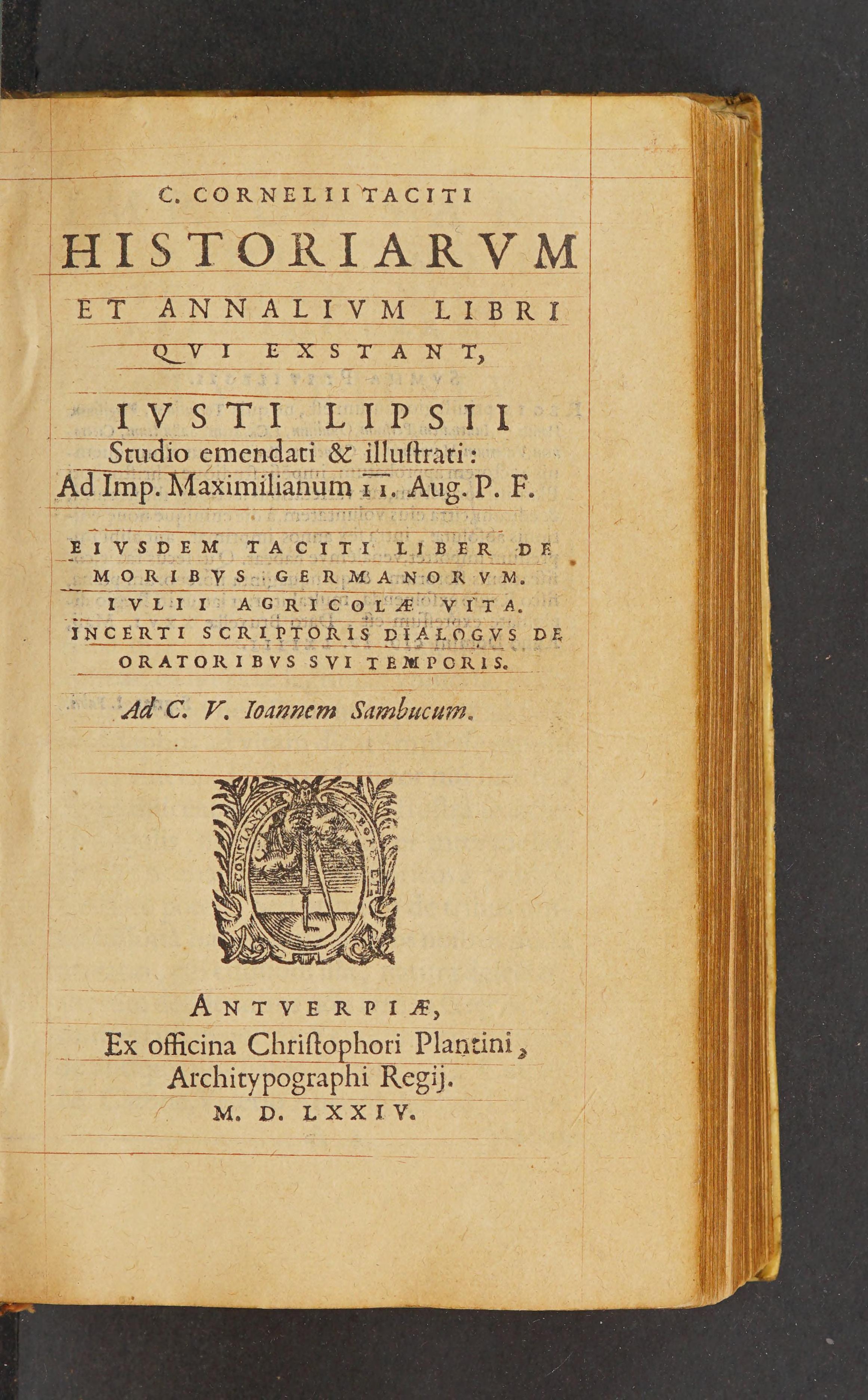
The complete Internet Archive scan bib_fict_4911588 is the first Lipsius edition, first issue:
- C. Cornelii Taciti Historiarum et annalium libri qui exstant
- edited by Justus Lipsius
- Antwerp: Christopher Plantin,
1574 - octavo, 762 pages plus associated matter
- public scan: Internet Archive item `bib_fict_4911588`
At printed p. 18, Histories I.7 reads:
et inviso semel principe; seu bene seu male facta premunt.
Neville preserves the second half exactly. Lipsius's commentary later proposes a grammatical adjustment—Inuisom semel principem ... premunt—but the running text has the form Neville uses.
Why the textual form matters
The current Perseus-derived critical text instead prints:
et inviso semel principi seu bene seu male facta parem invidiam adferebant
Henry Savile's 1591 English version renders the thought:
“as in a prince once in obloquie, doe he wel doe he ill, al is ill taken.”
Neville did not quote Savile's English. He used the short Latin form printed in the early-modern editions. The evidence therefore concerns direct Latin reading and textual state, not merely familiarity with Savile's translation.
Paris 1599 entry verified, 22 August 2026. The Billingbear line C. Cornelii Taciti Opera ad exemplar Lipsii — Paris 1599 was tested against the printed record and is accurate: the edition is C. Cornelii Taciti Opera quae exstant. Ad exemplar quod I. Lipsius quintum recensuit (Paris: apud Ambrosium Drouart, 1599), whose own sectional title reads hac editione Parisinâ. It is Lipsius's fifth recension, a different state of the text from the 1574 first edition at Audley End. The catalogue is c. 1780, so the entry does not place the book at Billingbear in Neville's lifetime. Full packet, with page images of both the catalogue entry and the title leaf: tacitus paris 1599 lipsius billingbear.
Edition survey, 22 August 2026 — how far does facta premunt extend?
Corrective finding. facta premunt is the reading of the whole early printed tradition, not a peculiarity of the 1574 Lipsius. The passage was read directly in other editions:
| Witness | Reading at Histories I.7 |
|---|---|
1551 (bub_gb_9IjCTEhA1Q4C) | Cæterum utraque cædes ſiniſtre accepta. Et inuiſo ſemel principe ſeu bene ſeu male facta premunt. |
1559 (bub_gb_X3wwQGAW13AC) | same wording |
1574 Lipsius — the Audley End copy, printed p. 18 | Ceterum vtraque cædes ſiniſtrè accepta, & inuiſo ſemel principe, ſeu bene ſeu male facta premunt. |
1621, ex recensione I. Lipsii (ned-kbn-all-00002688-001) | Ceterum vtraque cædes ſiniſtre accepta: & inuiſo ſemel principe, ſeu bene ſeu male facta premunt. |
1826, Latin edition of the Histories (fivebookshistor00willgoog) | Ceterum utraque caedes sinistre accepta: et inviso semel Principe, seu bene, seu male facta premunt. |
| modern critical text | et inviso semel principi seu bene seu male facta parem invidiam adferebant |
The divide is therefore early-modern printed tradition versus modern critical text, not this edition versus other editions. Any period Latin Tacitus would have given Neville these four words.
What this costs and what it does not. It removes the sub-claim that the Advice tag points specifically to the surviving Audley End volume; it does not touch the facts that Neville used the passage and that the sentence is underlined with the γ. ω. tag on printed p. 18. Compatibility, not diagnosis.
Negatives in the same scan for the 1600, 1606, 1648, 1653, 1673 and 1685 editions are OCR failures on poor scans and are not recorded as evidence of absence.
5. The Surviving Audley End Object
The local combined BRO/Audley End spreadsheet identifies:
- Object number:
81038208 - Title: Opera
- Author: Tacitus
- Date:
1574 - Collection status:
PERMANENT COLLECTION
The spreadsheet calls the binding half calf and gives the format as 8vo. The visible photographed opening looks substantially larger than a typical octavo, so the format should be settled from the current English Heritage catalogue or physical collation rather than harmonized from secondary descriptions.
The photograph shows more than one marking form, but this packet does not assign any of them to a named reader. The new facta premunt connection does not require a hand attribution: it identifies a precise sentence in the surviving volume for controlled inspection.
The newly located Audley End page
The complete image witnesses sequence is stored on the Externalities drive. The filename P019 describes the right-hand printed page, but the photograph is an opening and therefore also contains printed p. 18 on the left. On that left page, at Histories I.7, the book prints:
Ceterum utraque caedes sinistre accepta, & inviso semel principe; seu bene seu male facta premunt.
The whole sentence is visibly underlined, including the clause seu bene seu male facta premunt on the second line. There is also a small marginal sign beside this part of the text. The photograph is soft and the page is densely worked: neighboring passages have underlining, braces, and reference signs. No continuous verbal gloss can safely be read as attached specifically to the sentence. The physical claim should therefore be stated narrowly: the sentence is marked; the photograph does not by itself identify who marked it or when.
Local audit controls:
- Original HEIC: TACITUS 1574 P019 MARG UNLIN IMG_5264.HEIC.
- Processed JPEG: TACITUS 1574 P019 MARG UNLIN IMG 5264 result.
- Existing annotation ledger: tacitus annotation ledger, row for
P019 / IMG_5264.
6. Shakespeare Research Avenues
Timon of Athens: benefits, inability to repay, ingratitude, and hatred
Neville's 1599 Tacitus quotation concerns benefits that exceed the recipient's power to repay and produce hatred instead of gratitude. Timon first idealizes giving:
TIMON O, no doubt, my good friends, but the gods
themselves have provided that I shall have much
help from you. How had you been my friends else?
Why have you that charitable title from thousands,
did not you chiefly belong to my heart?
We are born to do benefits. And what better or
properer can we call our own than the riches of
our friends?
The play then turns unreturned bounty into ingratitude and growing hatred:
And grant, as Timon grows, his hate may grow
To the whole race of mankind, high and low!
This is not merely a one-word resemblance. It is the same moral sequence Neville extracts from Tacitus in 1599: benefits, expected reciprocity, failure of repayment or gratitude, and conversion into hatred. North, Painter, and Lucian remain the required Timon source controls; the Tacitus passage supplies an additional conceptual source avenue.
Later in Timon, the collapse is named directly:
POET  Sir,
Having often of your open bounty tasted,
Hearing you were retired, your friends fall'n off,
Whose thankless natures--O, abhorred spirits!
Not all the whips of heaven are large enough--
What, to you,
Whose starlike nobleness gave life and influence
To their whole being? I am rapt and cannot cover
The monstrous bulk of this ingratitude
With any size of words.
Folger local chunk, Timon of Athens 5.1, lines 92-101. This passage makes the benefit-to-ingratitude structure explicit: the speaker recalls Timon's open bounty, calls the recipients thankless, and names the result this ingratitude.
King Lear: benefits converted into contempt
Lear's curse joins benefits, contempt, and the pain of a thankless recipient in one continuous Folger passage:
LEAR  It may be so, my lord.--
Hear, Nature, hear, dear goddess, hear!
Suspend thy purpose if thou didst intend
To make this creature fruitful.
Into her womb convey sterility.
Dry up in her the organs of increase,
And from her derogate body never spring
A babe to honor her. If she must teem,
Create her child of spleen, that it may live
And be a thwart disnatured torment to her.
Let it stamp wrinkles in her brow of youth,
With cadent tears fret channels in her cheeks,
Turn all her mother's pains and benefits
To laughter and contempt, that she may feel
How sharper than a serpent's tooth it is
To have a thankless child.--Away, away!
Folger local chunk, King Lear 1.4, lines 429-444. Tacitus's maxim concerns benefits so great that the recipient cannot repay them and returns hatred; Lear dramatizes a closely related perception in kinship, where benefits are answered with laughter and contempt and the giver experiences the recipient as thankless.
Coriolanus: a hated public man and the interpretation of virtue
The Histories I.7 maxim says that once a prince is hated, good and bad deeds alike count against him. Aufidius describes the banished Coriolanus in closely related political terms:
For I dare so far free him--made him feared,
So hated, and so banished. But he has a merit
To choke it in the utt'rance. So our virtues
Lie in th' interpretation of the time,
And power, unto itself most commendable,
Hath not a tomb so evident as a chair
T' extol what it hath done.
The shared problem is reputational interpretation: merit or virtue cannot escape the judgment generated by prior hatred. Neville applies the Tacitean maxim to James and Parliament; Coriolanus dramatizes it in the reputation and banishment of a martial political figure.
7. Citations and Local Witnesses
- Tacitus/Lipsius 1574 source packet: SOURCE NOTES.
- Internal object-study controls: JFDE Audley End Annotations 2023 and JFDE Audley End Annotations 2023. These are retained for local checking and are not substitutes for the Audley End photographs.
- Neville Advice Review, working text of the Advice.
- letter 030, direct local packet for the 24 September 1599 dispatch, including manuscript and Winwood images.
- Nevill to Cecil 1601 03 02 ODonnell transcription, confession text.
- Savile, Henry, trans. The ende of Nero and beginning of Galba. London,
1591,TCP A13331; EarlyPrint database and raw XML control. - Folger local chunks: act 01 scene 02:128, act 04 scene 01:35, and act 04 scene 07:56.
- Annals IV.18 image/source control: SOURCE NOTES.
- Annals III.30 image controls (
22 August 2026): tacitus_annals_iii30_2026-08-22, and the illustrated report at[local source path removed]. - letter 088, local packet for the 11 March 1605/6 letter to Winwood.
- Latin Annales and Grenewey's 1598 English, local plaintext:
[local source path removed]. - Historiae I Latin control: The Latin Library, used to re-verify Histories I.38.
- Additional Folger controls: act 05 scene 01:92 and act 01 scene 04:429.
8. Next Research
The page-specific inspection question has now been answered for all four passages: the sentences behind seu bene seu male facta premunt (p. 18), Annals IV.18 (p. 340), Histories I.38 (p. 33) and Annals III.30 (p. 310) are each marked in the Audley End copy. The next steps are:
- sharper, square-on photographs of pp.
18,33,310and340, and sequence-level comparison of ink and mark forms, to establish whether these belong to one marking campaign and how it relates to the volume's other systems. This should not begin by presuming the identity of the hand; - tracing the marginal cross-reference numerals (
270at p.340,159, 12at p.33,141, 24and175, 30elsewhere), whose page-and-line form suggests a key into another volume or a commonplace book; - a systematic sweep of the remaining letters and the Advice for further unattributed Latin, run against the Latin Annales, Historiae, Agricola and Germania rather than against English-text corpora. The 1606 case shows that an adapted Latin tag is invisible to EEBO-TCP search and was missed for that reason.
Notes on Access
- The 1574 comparison is page-image controlled through the public Internet Archive scan.
- The 1599 quotation is now page-image controlled in both Winwood's printed edition and the SP 78/43 manuscript image
letter 022 04; exact modern folio/item numbering remains to be reconciled. - The Audley End object is controlled through the local combined inventory and the local photographs
P019 / IMG_5264(p.18),P033 / IMG_5271(p.33),P311 / IMG_5414(p.310) andP341 / IMG_5430(p.340). A current English Heritage catalogue page and sharper square-on photographs have not yet been obtained. - The 1606 quotation is page-image controlled in Winwood's printed edition (vol. II, p.
198) only. No manuscript witness has been located, soan hocversusan hoscannot yet be settled. - The Shakespeare quotations use the Folger chunks and preserve Folger speech prefixes and line breaks.
2026-07-14 Deep Research: how rare were the two Latin fingerprints in English print?
A phrase search of the EarlyPrint word stream separates the two Tacitean maxims sharply.
seu bene seu male facta premunt
The exact phrase facta premunt produced one indexed English-print witness before 1630: Essaies politicke, and morall. By D. T. Gent (1608), TCP A14087. Its English application is explicit:
Invisum semel principem, saith Tacitus, seu benè, seu malè facta premunt.A prince who has once incurred his subjects' hatred will find even the glory of later enterprises interpreted against him.
That is significant circulation evidence. The phrase was not unique to Neville, but neither does the current corpus show it as a commonplace scattered across dozens of English books: one indexed English-print witness before 1630.
Correction, 22 August 2026. An earlier version of this section had the two maxims crossed. seu bene seu male facta premunt is the tag closing the Advice of about 1612-13 (Histories I.7); beneficia ... pro gratia odium redditur is the 24 September 1599 dispatch to Cecil (Annals IV.18). The dates attached to each below have been corrected accordingly.
Note on the 1608 witness. A14087 prints Invisum semel principem, saith Tacitus, seu benè, seu malè facta premunt — with the accusative Invisum ... principem. That is not the form in Lipsius's running text, which reads inuiſo ſemel principe. It is the conjecture Lipsius proposed in his own note on the passage in the 1574 edition: Legerim, Inuiſum ſemel principem ſeu b. ſ. m. f. premunt. Lipsius's marginal proposal was therefore circulating in English print by 1608. Neville quotes only the four words common to both forms, so his wording does not discriminate between them; the transmission trail is nevertheless untraced and worth following.
beneficia ... pro gratia odium redditur
The benefits/hatred maxim had a broader afterlife in court literature. EarlyPrint recovers it in Ars aulica, or The courtiers arte (1607), TCP A20899, which prints both Latin and English: good turnes are so far acceptable, as there is possibility of requital; when they grow greater, in stead of thanks, hatred is returned. Later witnesses include Pierre Matthieu's History of Lewis the Eleventh (1614), Denys de Refuges's Treatise of the Court (1622), and Matthieu's Powerfull Favorite (1628).
The contrast improves the fingerprint argument. The 1612-13 Advice tag facta premunt belongs to a relatively thin English print trail; the 1599 benefits maxim belongs to a recognizable European court-advice tradition increasingly available in English. Neither phrase is authorship evidence by itself. Together they show a sustained habit of selecting Tacitean sentences about how rulers reinterpret actions and obligations under pressure.
Queries were run against [local source path removed], with contextual text checked in EarlyPrint corpus database. OCR variants mean these are minimum recovered counts, not proof of total absence.
2026-08-28 Chapter 19 Public-Book Synthesis
Chapter 19, “Tacitus, Grenewey, and the Language of State,” now treats the four Neville passages as one durable but internally differentiated reading habit:
| Date | Locus | Mode | Public-book conclusion |
|---|---|---|---|
| 24 Sept. 1599 O.S. | Annals 4.18 | named close quotation | applied to Anglo-French benefits, repayment, and hostility |
| 2 Mar. 1601 | Histories 1.38 | named compression and pluralization | applied to an undertaking interpreted by successful completion |
| 11 Mar. 1605 O.S. / 1606 N.S. | Annals 3.30 | unattributed grammatical adaptation | Latin order, inflection, and balance reworked for court patronage |
| c.1613 | Histories 1.7 | unattributed portable tag | applied to the reputational trap surrounding an already hated ruler |
Required source controls
- Sawyer's 1725 print reads
an hoc satias ceperit; reader-facing work must seu bene seu male facta premuntbelongs to the wider early printed Latin- Savile's 1591 Histories/Agricola and Grenewey's 1598 Annales are public
- The Paris 1599 Tacitus later listed at Billingbear is a place-and-year
print hoc [hos] or otherwise show the restoration. hos is grammatically required by acceperint and agrees with Tacitus, but no manuscript collation presently authorizes silent correction.
tradition. It is compatible with the 1574 Lipsius witness but does not diagnose that edition or any surviving copy.
chronological and access routes. Neville's 1605/6 adaptation does not follow Grenewey's English order and strongly indicates Latin handling.
conjunction and provenance lead, not proof of Neville's purchase or lifetime ownership.
Shakespeare-source ranking adopted for the book
- 3 Henry VI / Histories 3.25: strongest reviewed circumstantial narrative
- Henry V / Annals 2.13: plausible, closely dated, and structurally precise,
- Richard II / Vitellius: suggestive spectacle-and-degradation analogy.
- Macbeth / Otho's death: weak general moral analogy, kept separate from the
- Richard III: Tacitean historiographic-method argument, not verbal source
source case; seven-part cluster after parricide commonplaces are subtracted; no verbal borrowing.
but weakened by the existing dramatic convention of the disguised commander's night round.
stronger Neville 1601 completion/success document.
proof.
Conceptual comparisons with Macbeth, Timon of Athens, King Lear, and Coriolanus are separately labelled as such and are not promoted into direct borrowings. The strongest affirmative contribution is the conjunction between Neville's independently documented applied Tacitean habit, his lifelong Savile formation, and the independently established Shakespeare source literature.
Public[local source path removed] boundary
Reader-facing work may state that the 1574 Lipsius Tacitus survives at Audley End and contains evidence of historical reading. It must not quote, enumerate, describe, illustrate, or infer from individual nonpublic annotations. Chapter 19 does not require any such detail.