The Paris 1599 Lipsian Tacitus on the Billingbear Book List
Topic: The Paris 1599 Lipsian Tacitus on the Billingbear Book List
Why this packet exists
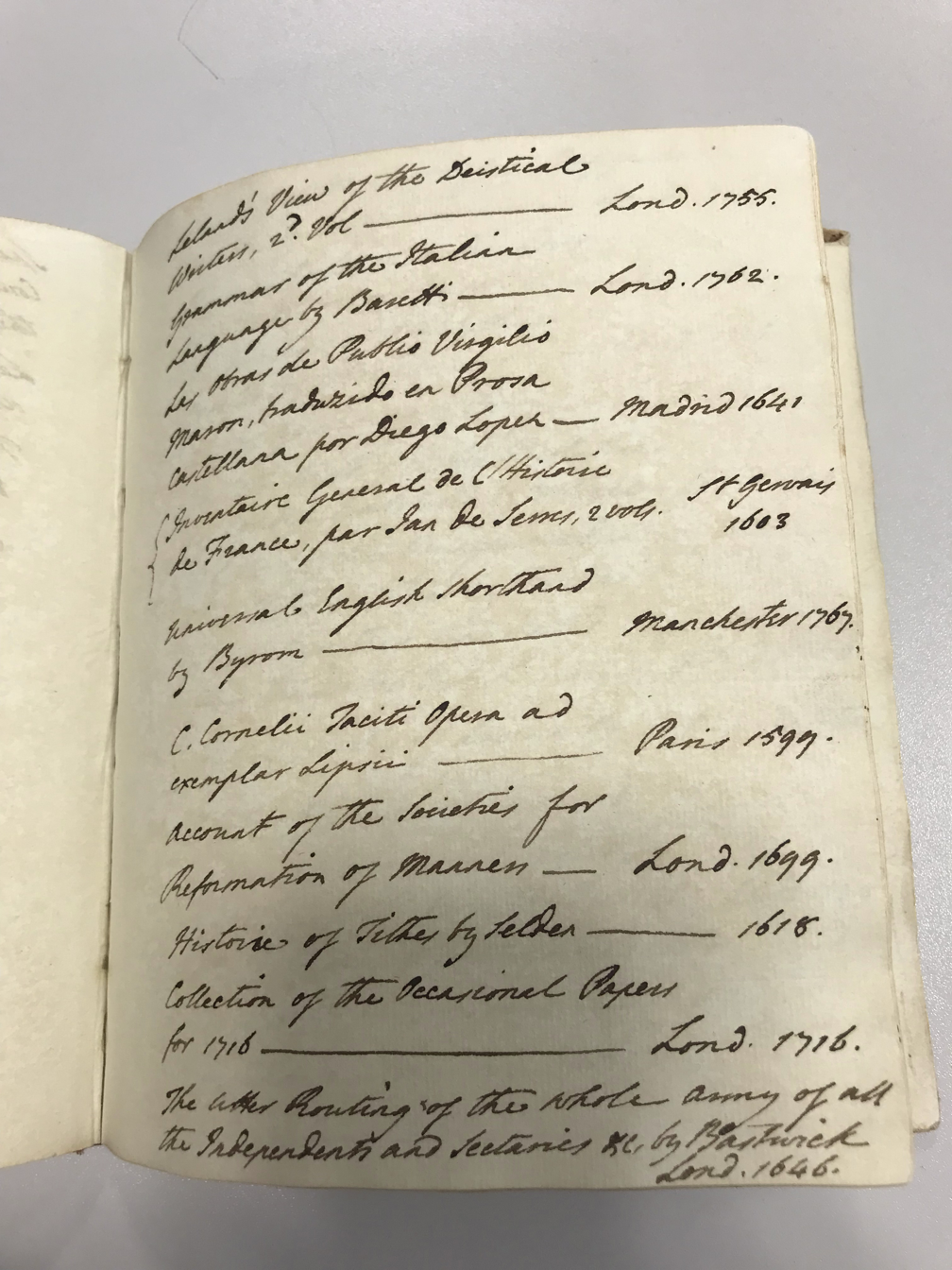
The Billingbear book list records a Tacitus printed at Paris in 1599 "ad exemplar Lipsii". The entry was questioned on 22 August 2026 — the suggestion being that the compiler might have garbled the place or date. The entry is accurate. An edition answering that description exists, and the transcription is a faithful abbreviation of its title page.
1. Verified Sourced Facts — the catalogue entry
The manuscript list reads, in two lines with the usual dash rule and the place-and-date column at the right:
C. Cornelii Taciti Opera ad
exemplar Lipsii ________________ Paris 1599.

Local control: project photograph IMG_8187 of the book list, in [local source path removed]; transcription at [local source path removed], line 721. The photograph is stored rotated ninety degrees; the image above and below are rotated upright.
Dating control from the same page
The entry cannot be read as a Neville-era shelf record. The surrounding entries on the same page are:
| Entry | Place and date |
|---|---|
| Leland's View of the Deistical Writers, 2nd vol. | Lond. 1755 |
| Baretti, Grammar of the Italian Language | Lond. 1762 |
| Diego López, Las Obras de Publio Virgilio Maron | Madrid 1641 |
| de Serres, Inventaire General de l'Histoire de France, 2 vols. | St Gervais 1603 |
| Byrom, Universal English Shorthand | Manchester 1767 |
| C. Cornelii Taciti Opera ad exemplar Lipsii | Paris 1599 |
| Account of the Societies for Reformation of Manners | Lond. 1699 |
| Selden, History of Tithes | 1618 |
| Collection of the Occasional Papers for 1718 | Lond. 1716 |
| Bastwick, The utter Routing of the whole army… | Lond. 1646 |
The 1767 Byrom two entries above the Tacitus puts the compilation after that year, consistent with the c. 1780 dating used elsewhere in this corpus for the Billingbear catalogue. The entry records that the book was at Billingbear in the later eighteenth century. It does not place the book there in Neville's lifetime.
2. The edition exists, and the transcription is faithful
Internet Archive item bub_gb__VYqCIg8FHoC:
- Title: C. Cornelii Taciti Opera quae exstant. Ad exemplar quod I. Lipsius quintum recensuit.
- Publisher:
apud Ambrosium Drouart - Date:
1599 - Language: Latin;
623images in the scanned volume
Seorsim excusi commentarii eiusdem Lipsi meliores pleniorèsque cum curis secundis, & auctariolo non antè adiecto. Guil. Barclayus praemetia quaedam ex vita Agricolae libauit, … Adiecti sunt indices.
The book confirms its own place of printing. The sectional title of the commentary reads:
`IVSTI LIPSI AD ANNALES COR. TACITI LIBER COMMENTARIVS, Variis in locis vtiliter auctus, & hac
editione Parisinâ indice vberiori ditior.`
— "and in this Paris edition enriched with a fuller index."
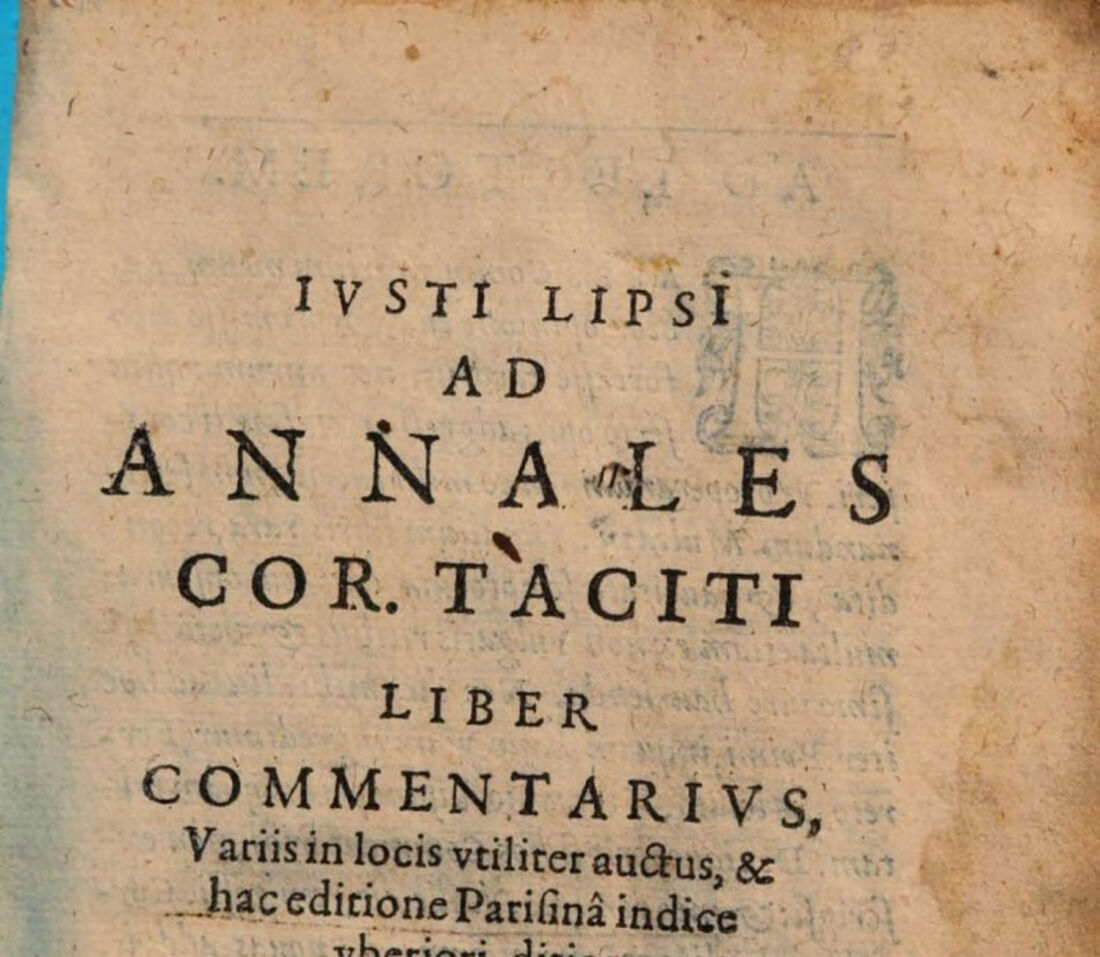
The catalogue's ad exemplar Lipsii is therefore a sensible shortening of Ad exemplar quod I. Lipsius quintum recensuit, and Paris 1599 is exactly right. No error by the compiler. Whoever made the list had the book in hand and read its title page correctly.
3. What the edition is
This is Lipsius's fifth recension, not the 1574 first edition. The Billingbear Tacitus and the annotated Audley End Tacitus (English Heritage object 81038208, Lipsius 1574) are therefore two different states of Lipsius's text, twenty-five years apart. If both were in the family library at any point, that is two Lipsian Tacituses, which bears on any discussion of what stood on those shelves.
The volume also carries William Barclay's praemetia from the Agricola, noted on the title page.
4. A dated conjunction, recorded as a lead and not as evidence
Henry Neville was resident ambassador in Paris through 1599. His dispatch to Sir Robert Cecil of 24 September 1599 — the letter that quotes Annals IV.18 and names "the Saying of Tacitus" — was written from Paris. A Tacitus printed at Paris in 1599 later appears on the Billingbear list.
This is a coincidence of place and year, nothing more, and must not be presented as anything more. The catalogue is c. 1780; the book could have entered the library at any point in the intervening century and a half, by purchase, inheritance, or gift. What makes it worth pursuing rather than dismissing is that the two independent facts — an ambassador reading and quoting Tacitus in Paris in 1599, and a Paris 1599 Tacitus in his family's library — are the sort of pair that a provenance record could convert into evidence. No such record has been found.
5. Limitation on the textual check
A collation of this edition at Histories I.7 was attempted on 22 August 2026 and could not be completed. The Internet Archive copy is the separately printed commentary volume — the title itself says Seorsim excusi commentarii — and the running text of the Histories is not in it. Searches of the volume return Lipsius's notes but not the passage. The text volume of the Paris 1599 must be found elsewhere before its reading can be recorded.
This matters because the 1599 Paris edition is the only Tacitus with any direct claim on the Neville family library, and so the only one where a reading at the four passages Neville uses would mean more than the printed tradition at large. On present evidence seu bene seu male facta premunt is the reading of the whole early printed tradition — verified in 1551, 1559, 1574, 1621 and still 1826 — so a hit here would be expected and would not by itself single the volume out. See henry neville tacitus textual fingerprints.
6. Other Tacitus entries on the same list
The Billingbear list carries at least two further Tacitus items, neither of which is the surviving Audley End 1574 copy:
Tacitus et Paterculus (in uno) _______ Paris 1608.Annals and History of Tacitus _______ Lond. 1698.
The 1574 Lipsius that survives at Audley End remains unattested on this list. Its proposed Billingbear provenance rests on handwriting and associated-volume arguments, not on a catalogue line.
Quoted Source Passages
Billingbear book list, entry as written
C. Cornelii Taciti Opera ad exemplar Lipsii — Paris 1599.
Paris 1599, sectional title of the commentary
IVSTI LIPSI AD ANNALES COR. TACITI LIBER COMMENTARIVS, Variis in locis vtiliter auctus, & hac
editione Parisinâ indice vberiori ditior.
Citations
- Billingbear book list, project photograph
IMG_8187; working transcription - C. Cornelii Taciti Opera quae exstant. Ad exemplar quod I. Lipsius quintum recensuit (Paris:
- Image controls:
source_images/tacitus_paris_1599_billingbear_2026-08-22/.
Billingbear Book List Transcription, line 721.
apud Ambrosium Drouart, 1599). Internet Archive item `bub_gb__VYqCIg8FHoC`.
Notes on Access
- The catalogue entry is page-image controlled from the project's own photograph of the list.
- The edition is page-image controlled through the public Internet Archive scan, whose sectional
- The physical Billingbear/Audley End survival of this volume has not been checked, and no object
- The reading at Histories I.7 in this edition is unchecked; the digitised copy is the
title states the Paris imprint in the book's own words.
number has been sought.
commentary volume only.