Non Laudantur Nisi Peracta: Neville, Gunpowder Treason Discourse, and Macbeth
Topic: Non Laudantur Nisi Peracta: Neville, Gunpowder Treason Discourse, and Macbeth
Source-Control Summary
Henry Neville's 2 March 1601 confession applies non laudantur nisi peracta to the proposed Essex court enterprise and immediately glosses its political meaning: the action “would be interpreted by the successe.” The source is now securely identified. Neville is compressing Tacitus, Histories I.38.1, in Otho's speech urging the praetorian soldiers to complete his coup against the reigning emperor Galba: nullus cunctationis locus est in eo consilio quod non potest laudari nisi peractum—“there is no room for delay in a plan which cannot be praised unless it has been carried through.” Standard scholarly numbering is I.38.1; a few digital segmentations misleadingly place the paragraph under I.39.
The identification alters the political interpretation. These are not neutral words of wisdom endorsed in Tacitus's narrative voice. Tacitus places them in the mouth of a usurper who has already been acclaimed by mutinous troops. Otho uses the maxim to abolish hesitation; he immediately orders the armoury opened, and Galba and Piso are soon killed. Neville reverses the maxim's force. Instead of using it to accelerate the enterprise, he cites it as his first objection: a plan defensible only after success is precisely a plan whose present character cannot safely be defended.
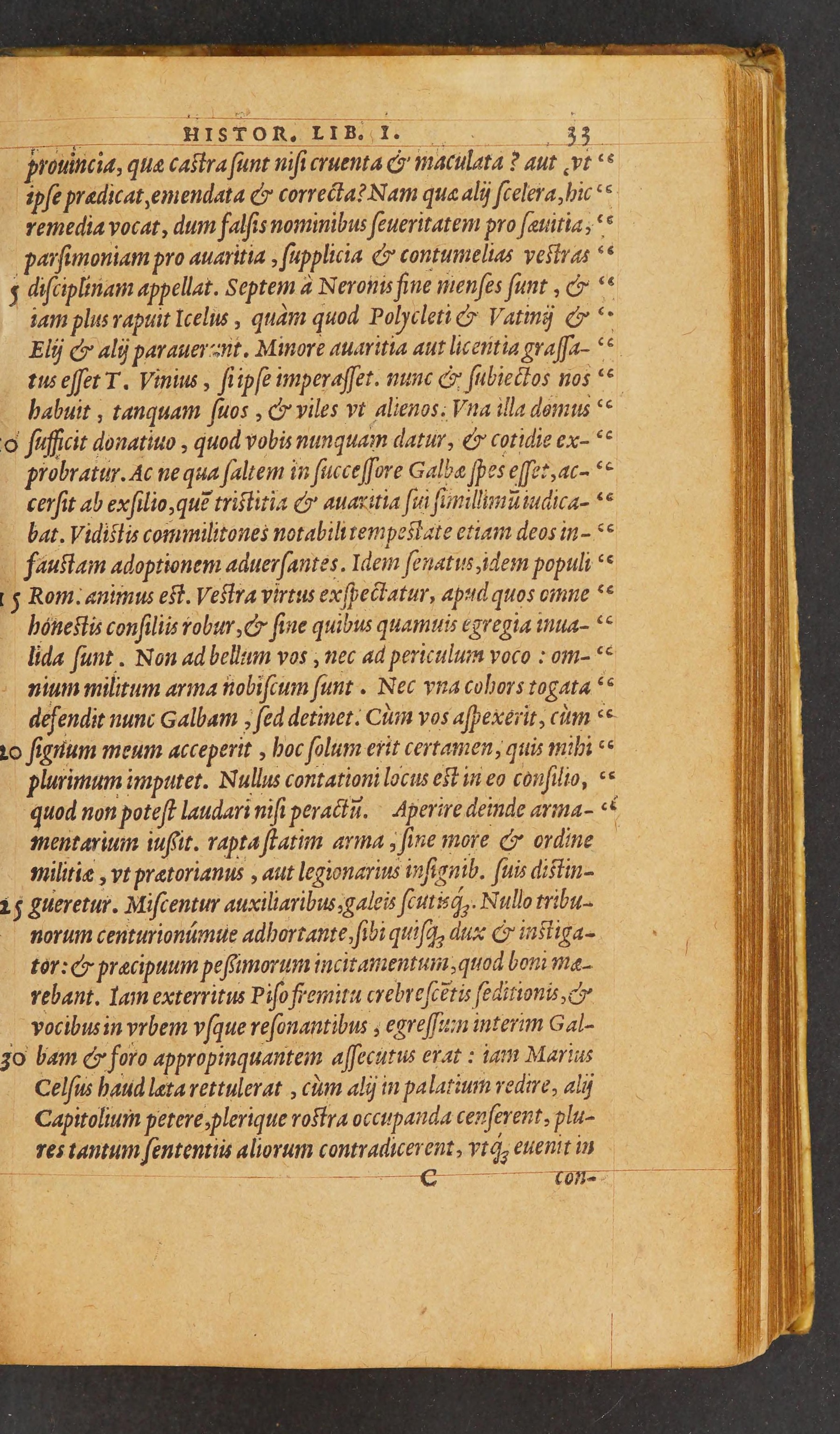
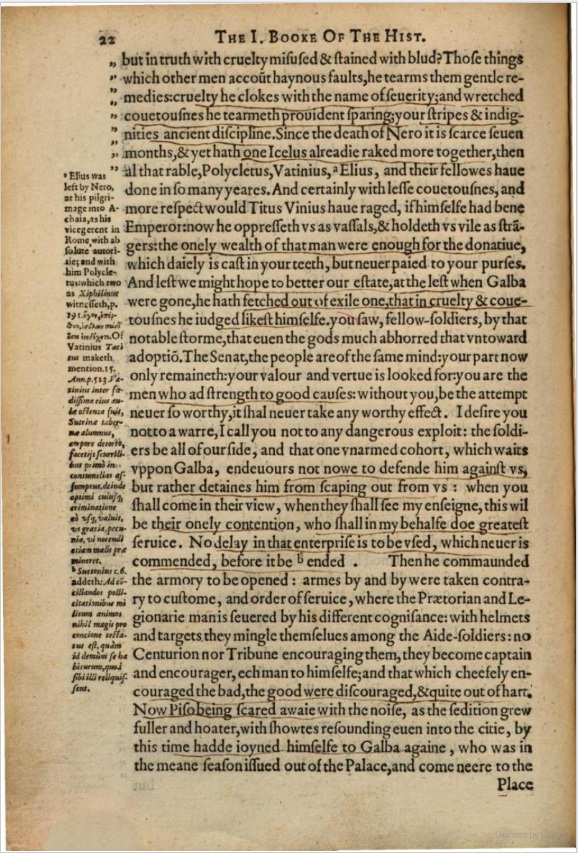
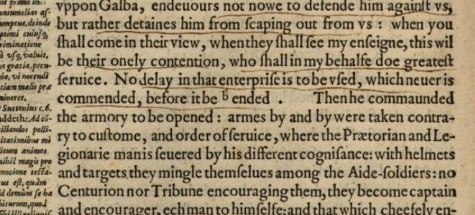
The textual history is unusually concrete. Henry Savile's 1591 English Tacitus renders the sentence, “No delay in that enterprise is to be vsed, which neuer is commended, before it be ended.” The first Lipsius Tacitus of 1574 prints the Latin on p. 33. The surviving Audley End copy of that same edition preserves Otho's speech across pp. 32-33 with underlining, braces, reference marks, and the probable marginal heading Othonis ad milites. The exact maxim falls within the marked speech. The marks are highly relevant, but their hand and date remain unresolved: they do not prove that Neville marked the book or copied this sentence from that physical object.
The phrase has a consequential political afterlife. The Gunpowder Plot indictment tradition uses the expanded form quae non laudantur nisi peracta for treasons the plotters would avow only after successful execution. The indictment then describes their corporal oaths of secrecy and commitment. Later printed writers repeatedly apply the same maxim to secret policies, desperate facts, Powder Treason, massacres, and actions justified only after completion.
This makes the phrase a Tacitean coup maxim with a later conspiracy afterlife rather than an isolated scrap of Latin. It also gives a focused Shakespeare comparison. Macbeth 1.7 turns on whether an assassination can contain its own consequences and catch / With his surcease success. Neville's prose says the enterprise would be interpreted by success; Macbeth imagines a deed whose hoped-for success would end judgment, then recognizes that judgment and consequence return upon the inventor.
1. Neville's 1601 Use
In the conference with Southampton and Sir Charles Danvers, Neville says he raised practical objections to the proposed armed approach to Elizabeth. His first characterization is:
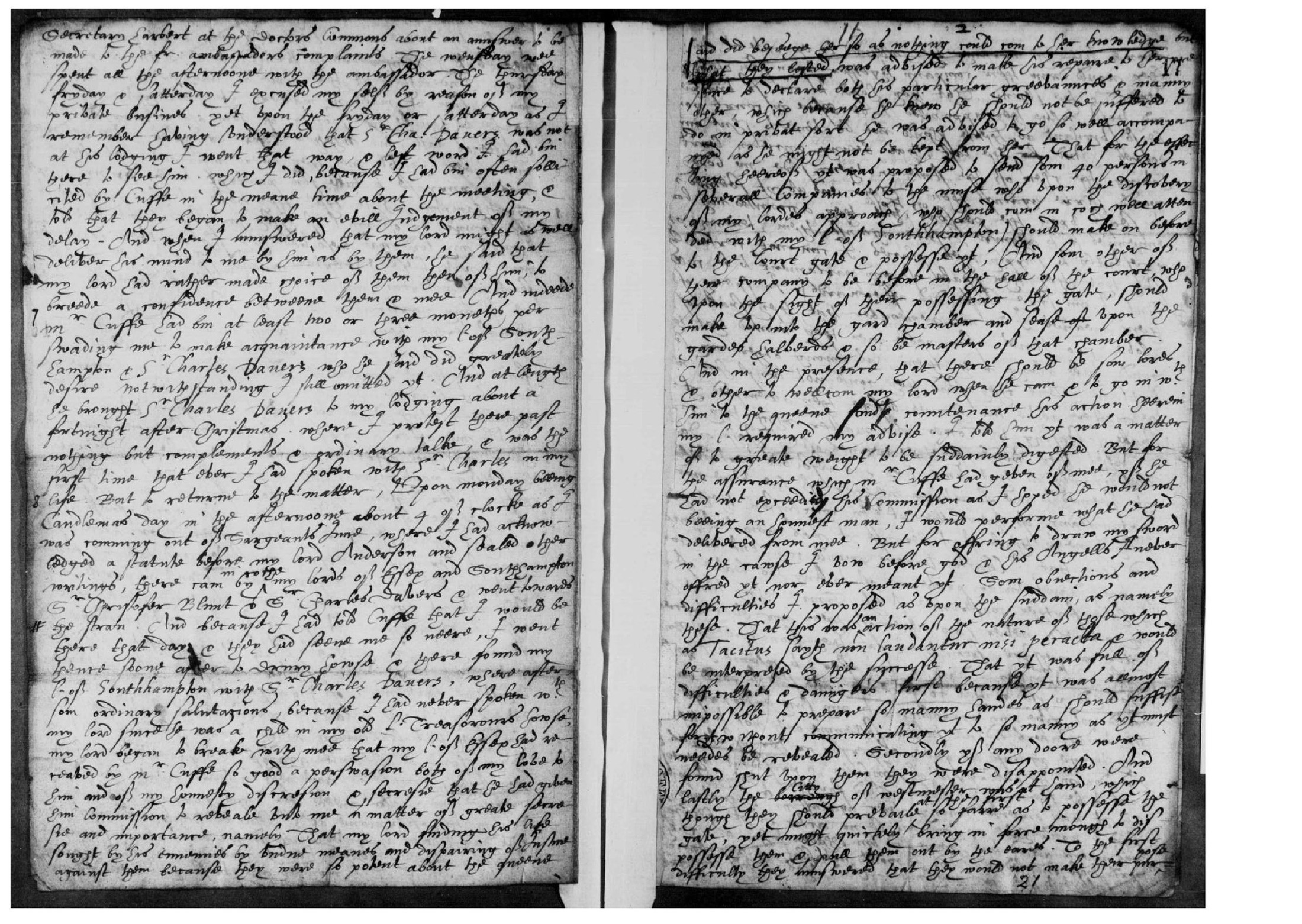
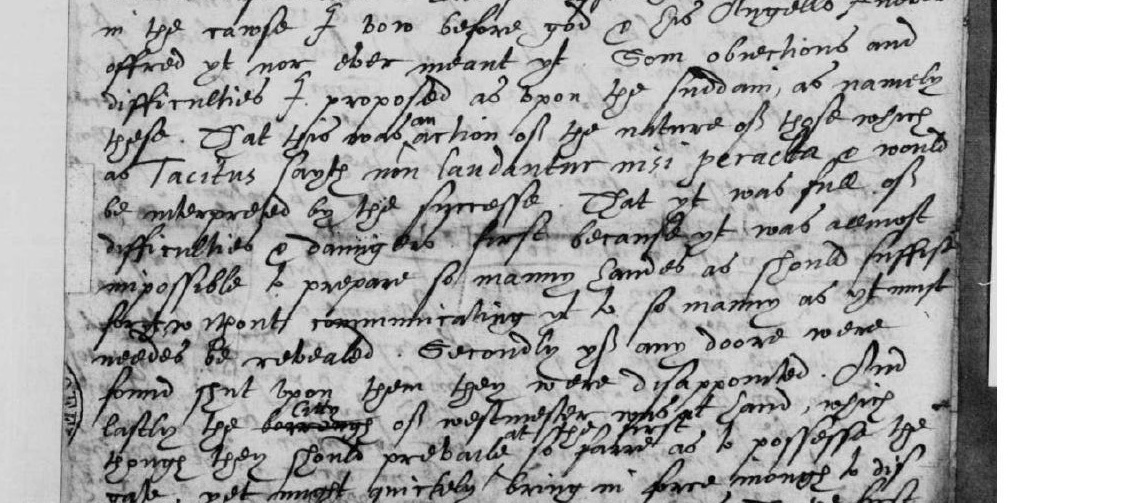
“That this was an action of the nature of those which as Tacitus sayth non laudantur nisi peracta & would be interpreted by the successe.”
The sentence joins three things:
- a claimed Tacitean maxim;
- the completion of a dangerous political act;
- retrospective interpretation through success.
Neville does not present the Latin as a detached moral quotation. He uses it to describe an action whose political name—redress, enterprise, rebellion, or treason—would be fixed by its outcome.
The surrounding confession makes the application exact. The proposal was to send forty men to the Mews, seize the Court Gate and the guards' halberds, occupy the guard chamber, and bring Essex and Southampton into Elizabeth's presence. Neville's quoted maxim is his first stated answer. It is followed by practical objections about the gate, guards, weapons, access, resistance, and the danger to the queen. The quotation therefore diagnoses a coup mechanism before judging its likelihood.
2. Exact Source: Tacitus, Histories I.38.1
Tacitus places the sentence at the climax of Otho's address to the praetorians:
Nullus cunctationis locus est in eo consilio quod non potest laudari nisi peractum.
A deliberately close translation is:
“There is no room for delay in a plan which cannot be praised unless it has been carried through.”
Public text control: Tacitus, *Histories* I.38.
The coup context
Otho has been passed over when Galba adopts Piso. He cultivates disaffected praetorians, is hailed as emperor by a tiny armed nucleus, and is carried to the camp. Some soldiers join knowingly, others from excitement, and others remain silent, ready to take their cue from the result (animum ex eventu sumpturi, I.27). After the troops swear to him, he argues that their safety is now inseparable from his. His closing sequence says that all armed strength is already on their side, that Galba's cohort is detaining rather than defending him, and that delay is impossible in a plan justifiable only through completion. He then orders the armoury opened.
Tacitus immediately darkens the maxim's moral color. The troops seize mixed equipment in disorder without tribune or centurion, each man inciting himself. The narrator adds: et praecipuum pessimorum incitamentum, quod boni maerebant—the chief encouragement of the worst men was the grief of the good. Galba and Piso are killed within the next few chapters. The sentence is therefore an expertly placed specimen of criminal self-authorization, not a proposition Tacitus straightforwardly recommends.
Elizabeth Keitel's analysis of Otho's exhortations supports this rhetorical reading. Tacitus binds Otho's early speeches together with features of a general's pre-battle harangue, although they are not formally battlefield exhortations; the extended speech at I.37-38 has no equivalent in Plutarch and differs markedly from Suetonius's brief notice. The maxim belongs to Tacitus's crafted representation of a coup leader turning mutiny into something that sounds like public and military necessity. See Elizabeth Keitel, “Otho's Exhortations in Tacitus' *Histories*”, Greece & Rome 34.1 (1987), 73-82.
Neville's exact adaptation
| Tacitus, Histories I.38 | Neville, 2 March 1601 | Effect of Neville's change |
|---|---|---|
in eo consilio | “an action of the nature of those” | One particular plan becomes a class of dangerous political undertakings. |
quod non potest laudari | non laudantur | The relative clause and modal potest are compressed into an aphoristic finite plural. |
nisi peractum | nisi peracta | Singular neuter becomes neuter plural: “things/undertakings carried through.” |
| no word for success | “would be interpreted by the successe” | Neville adds an explicit political interpretation of the maxim. |
Lexically, laudari means to be praised, approved, or commended; peractum, from perago, means carried right through, fully executed, completed. In this context nisi is logically “unless” but pragmatically approaches “not until.” Consilium is not merely an opinion: it is the design or plan of action. Neville's peracta is best taken as an elliptical neuter plural—“things” or “undertakings”—not as an attempted agreement with feminine Latin actiones.
The phrase “interpreted by the successe” is not a loose translation of a missing Tacitean successus. It is Neville's gloss. It names the retrospective mechanism implicit in Otho's words: success can cause treason to be redescribed as remedy, necessity, or deliverance. “The ends justify the means” is too broad and too modern a paraphrase. The sharper meaning is: the deed has no defensible public name in advance; successful completion will decide whether people dare to praise, avow, or excuse it.
Neville's inversion of Otho
Otho: because the deed will be praisable only when completed, do not hesitate.
Neville: because the deed will be praisable only when completed, its advocates are asking us to enter an action whose meaning depends on victory.
That reversal fits the confession's apologetic purpose, but it is also intellectually exact. Neville recognizes the kind of argument being made and answers it with its Tacitean anatomy. He places himself in the role of the reader who knows what follows Otho's stirring words: opened armouries, dissolved command, and the murder of a ruler.
3. Sixteenth-Century Texts Available to Neville
Lipsius, 1574
The first Lipsius edition, C. Cornelii Taciti Historiarum et annalium libri qui exstant (Antwerp: Christopher Plantin, 1574), prints the sentence on p. 33, ending the paragraph with abbreviated peractū (= peractum). Public page image: 1574 Lipsius Tacitus, p. 33.
The surviving Audley End copy of this edition is especially important. On the photographed pp. 32-33 opening, the speech is visibly worked: the left margin probably labels it Othonis ad milites (“Otho to the soldiers”), and underlining, braces, and reference signs continue through the speech and arming passage. The sentence Neville later recalls lies inside that marked unit. This establishes a page-specific conjunction between Neville's confession and a marked passage in a surviving Tacitus from the associated library. It does not establish who made the marks, when they were made, or that Neville's memory came from this physical copy.
Savile, 1591
Henry Savile's first English Tacitus translates the sentence:
“No delay in that enterprise is to be vsed, which neuer is commended, before it be ended.”
The next sentence begins, “Then commaunded the armory to be opened.” Public page image: Savile's 1591 *Histories*, p. 22.
Savile's strongly balanced “commended ... ended” makes the aphorism memorable, while Neville retains Latin vocabulary and syntax close to Tacitus. It is plausible that the English rendering reinforced Neville's memory, but the evidence does not select a single copy or route. On the political setting and disputed Essex associations of Savile's Tacitus, see J. H. Waszink, “Henry Savile's Tacitus and the English Role on the Continent”, and Mordechai Feingold, “Scholarship and Politics: Henry Savile's Tacitus and the Essex Connection”.
Illustrated source chain
Neville's confession: full opening and decisive detail
The manuscript witness is The National Archives, SP 12/279, Neville's declaration or confession of 2 March 1601. The quotation appears in the lower part of the right-hand page. The first image preserves the opening; the second isolates the Tacitus sentence without detaching it from Neville's English gloss about success.
Public calendar control
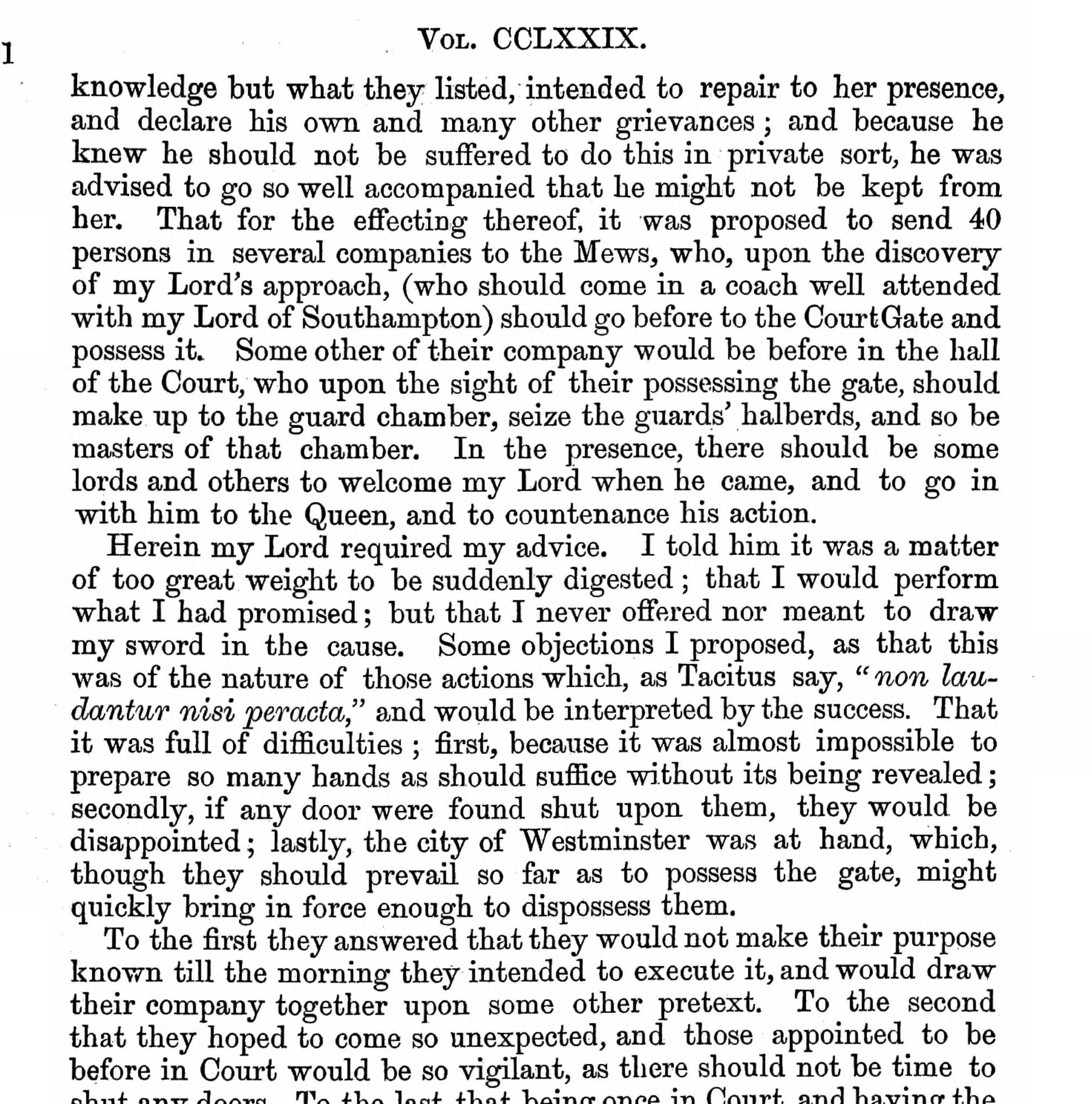
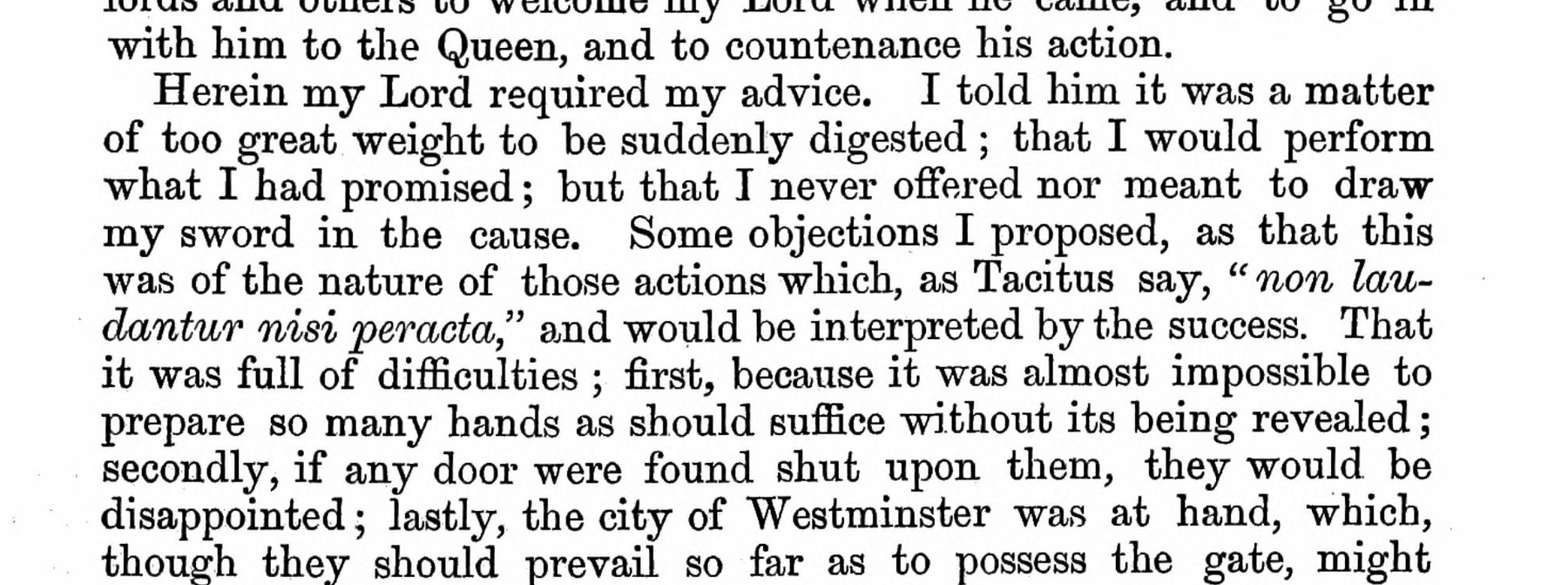
The printed calendar keeps the proposed court action, Neville's objection, the Latin, and “interpreted by the success” together on p. 7. Public scan: *Calendar of State Papers, Domestic: Elizabeth*, 1601-1603, vol. CCLXXIX, no. 11, p. 7.
Lipsius's 1574 Latin Tacitus
Printed p. 33 supplies both the source maxim and its immediate narrative consequence. The sentence ends with abbreviated peractū; the very next words are Aperire deinde armamentarium iussit—Otho then ordered the armoury opened. Public scan: Lipsius's 1574 Tacitus, p. 33.

Savile's 1591 English Tacitus
Savile's page preserves the same adjacency in memorable English: “No delay in that enterprise is to be vsed, which neuer is commended, before it be ended. Then he commaunded the armory to be opened.” Public controls: Google Books page image and EarlyPrint TCP A13331.
A close classical parallel that is not the source
Quintilian, Institutio oratoria XII.9.4-5, writes quae omnia non dum fiunt laudantur, sed cum facta sunt and later nec est orationis vera laus nisi cum finita est: such things are praised not while they are being done but when done; a speech receives its true praise only when finished. This demonstrates that completion-before-praise could take proverbial form in classical rhetoric, but it is not needed to explain Neville's sentence. Tacitus I.38 supplies the precise vocabulary, political mechanism, and claimed author.
4. The Gunpowder Plot Indictment Tradition
The Latin text of the Gunpowder indictment includes:
quae non laudantur nisi peracta
The surrounding charge says that the conspirators would acknowledge and approve the crimes only after accomplishment. English State Trials versions render the category as acts “not to be commended before they be done.”
The next portion of the indictment describes the conspirators agreeing to swear separate corporal oaths on the Gospels, receive the Eucharist, conceal the treason, and not abandon its execution without the consent of three conspirators.
That adjacency is important to the Neville project. Neville's confession contains both:
non laudantur nisi peractaand interpretation by success; and- a debate over requiring a collective oath before a political enterprise.
The Gunpowder prosecution likewise joins:
quae non laudantur nisi peractaas a description of treason justified after success; and- conspirators' oaths of secrecy and continued execution.
This does not show that one document borrowed from the other. It shows that Neville's language belongs to a recognizable early-Jacobean legal and political vocabulary for clandestine action, success, avowal, oath, and execution.
5. Printed Afterlife in EarlyPrint
EarlyPrint FTS searches recover the following exact or expanded variants:
| Date | TCP | Work | Immediate use |
|---|---|---|---|
1616 | A01883 | Godfrey Goodman, The fall of man | secret policy whose rules are concealed and whose actions receive a plausible excuse only after performance |
1623 | A11075 | Francis Rous, Oile of scorpions | desperate treason and religious violence discussed differently after defeat |
1626 | A02487 | G. H., A comparison betweene ... Purim and ... Powder treason | designs that would have been applauded if the plot had taken effect |
1627 | A02484 | George Hakewill, An apologie of the power and providence of God | unjust attempts called virtues when fortunate in the event |
1632 | A13078 | William Struther, A looking glasse for princes and people | Gunpowder success defined as the blow itself; acts praised when done and condemned when frustrated |
1635 | A16342 | Robert Bolton, Two sermons | the Powder Plot called the kind of act quae nunquam laudantur nisi peracta, expressly attributed to Tacitus |
Goodman's 1616 context is especially clear:
“the actions cannot be iustified non laudantur nisi peracta ... being once performed then they will finde out some probable colour to excuse the offence”
Hakewill's 1627 formulation supplies the success gloss independently:
“vnjust attempts if they be fortunate in the event are called vertues”
The printed sequence documents how the maxim functioned: not simply “finish what you start,” but “completion and fortune allow a disputed act to be renamed, praised, or excused.” That is very close to Neville's own explanation that the proposed action would be interpreted by its success.
6. Macbeth 1.7: Assassination, Consequence, and Success
Macbeth begins his soliloquy by trying to imagine an assassination that ends with its performance:
MACBETH
If it were done when 'tis done, then 'twere well
It were done quickly. If th' assassination
Could trammel up the consequence and catch
With his surcease success, that but this blow
Might be the be-all and the end-all here,
But here, upon this bank and shoal of time,
We'd jump the life to come.
He immediately reverses the fantasy of a self-contained successful deed:
But in these cases
We still have judgment here, that we but teach
Bloody instructions, which, being taught, return
To plague th' inventor.
Folger control: *Macbeth* 1.7.
The comparison is conceptual and verbal:
| Neville | Macbeth |
|---|---|
an action non laudantur nisi peracta | “If it were done when 'tis done” |
the act interpreted by successe | assassination imagined to “catch / With his surcease success” |
| practical objections and dangers defeat a simple outcome logic | consequence and judgment return to plague the inventor |
| a proposed approach to a monarch whose political name depends on execution | a proposed murder of a monarch whose apparent success cannot end consequence |
The play does more than repeat a maxim. It subjects the maxim's logic to moral and temporal analysis. Macbeth wants the deed to become praisable or at least secure by being successfully done; the soliloquy demonstrates why accomplishment cannot seal off interpretation.
7. Why the Combined Cluster Matters
Three independently controlled documents now occupy the same research field:
- Neville's
1601confession: completion, success, conspiracy, and a proposed oath protecting the monarch. - The
1606Gunpowder indictment tradition: the same Latin maxim, successful avowal, treason, secrecy, and conspirators' oaths. - Macbeth 1.7: regicide imagined as a deed that might end in its own successful completion, followed by returned judgment and consequence.
The value lies in the cluster's political specificity. Done, success, and oath are common words separately. Here they form a repeated analytical grammar for an enterprise against or around a sovereign: what must be sworn, what counts as execution, who will avow the action, and whether success determines its name.
8. Citations
Quoted Source Passages
The controlled passages are quoted above in sections 1-4: Neville's exact confession wording; the Latin indictment maxim; short EarlyPrint contexts; and Folger Macbeth 1.7 with its original line breaks. The indictment's full oath clause is summarized rather than reproduced at length.
- Neville confession manuscript: The National Archives,
SP 12/279, declaration or confession of Henry Neville,2 March 1601. - Neville confession public calendar control: CSPD Elizabeth, 1601-1603, p. 7, no. 11.
- Exact Tacitus source and full narrative context: Tacitus, *Histories* I.27 and I.37-41.
- Sixteenth-century Latin control: Lipsius Tacitus 1574, p. 33.
- Sixteenth-century English control: Savile Tacitus 1591, p. 22.
- Modern rhetorical analysis: Keitel, “Otho's Exhortations”.
- Gunpowder indictment Latin: University of Birmingham Philological Museum text.
- Gunpowder indictment/trial English: Famous Trials transcript.
- EarlyPrint exact-phrase controls: TCP A01883, A11075, A02487, A02484, A13078, and A16342.
- Folger Shakespeare Library: *Macbeth* 1.7.
9. Next Research
The origin question is closed: Tacitus, Histories I.38.1 is the source. The remaining textual-history question is how Neville encountered and remembered it. Search should now focus on pre-1601 commonplace books, political notes, and editions or translations that may show the same singular-to-plural compression. Continental and English variants—non laudantur nisi peracta, quae non laudantur nisi peracta, quae nunquam laudantur nisi peracta, and multa non laudantur nisi prius peracta—remain useful for tracking the maxim's afterlife, not for displacing the identified source.
Notes on Access
- Neville's wording is controlled from the canonical enriched corpus XML, the human transcription, the manuscript-page photograph, and the public CSPD calendar.
- The exact source is controlled from a modern public Latin/English text, the public 1574 Lipsius page image, and Savile's public 1591 English page image.
- The Audley End claim is limited to what the photograph establishes: Otho's speech is marked and the maxim falls inside it; annotator and date are unresolved.
- The EarlyPrint afterlife is reproducible from the TCP witnesses listed above; OCR variation means the recovered set is a minimum, not proof of exhaustive absence elsewhere.
- The Gunpowder indictment has public Latin and English transcript routes; an original-roll or earliest authorized-print page image remains to be collated.
- The Folger Macbeth quotation was checked against the Folger text and retains its verse lineation.