Henry Neville, the Amboise Oath, and Julius Caesar's Conspirators
Topic: Henry Neville, the Amboise Oath, and Julius Caesar's Conspirators
Book integration update — 31 August 2026
Chapter 32 now organizes the Julius Caesar case around four source-controlled formations. The lead exhibit is the two-stage sequence pulled by the cloak → speak with, absent from North and present in Neville's 7 August 1599 dispatch and the play in its documented performance season. The Amboise material supplies the constitutional-oath formation: Serres prints the precedent in 1598; Neville applies its person-and-state limit to the Essex proposal in 1601; and the play stages Brutus's rejection of an oath while trying to limit the persons touched.
Neville's 29 June 1599 Limoges dispatch supplies the procedural sequence from a manufactured physical scene through public accusation, named targets, fury, and attempted execution. North remains the source for Antony's funeral effect and Cinna's mistaken killing. Neville's 1590 private-benefit/public-good challenge provides institutional support beside North's Pella episode. Neville quotations are controlled against canonical corpus v22 and public witnesses; Shakespeare quotations preserve Folger lineation and paired comparison terms are bolded.
Source-Control Summary
Henry Neville's 2 March 1601 confession contains a precise historical-reading claim that deserves to be treated as a source trail in its own right. He says that he would not approve the proposed Essex enterprise unless its undertakers swore not to act against Elizabeth's person or state, “as they had don in the enterprise of Amboise,” adding that “a president whereof was to be seene in the storie.”
The historical detail Neville remembered is recoverable in print. Jean de Serres's An historical collection (1598) says that the Amboise confederates required every participant to “sweare, and solemnely vowe to God” not to act against “the authoritie of the king, or the Estate of France.” It then prints the formal heading and substance of their protestation against harming the king, the princes of the blood, or the lawful state. This English book appeared before Neville's confession.
The Billingbear library list separately records a two-volume 1581 L'Histoire de France. The bibliographic identification is La Popeliniere's history, whose books 5-6 cover 1558-1560, including the Amboise conspiracy. The exact pages have now been located and inspected in Utrecht's copy. La Popeliniere gives both the league's first article protecting the king and princes of the blood and La Renaudie's reciprocal oath at Nantes. His wording is related to, but shorter than, the expanded Serres account; the witnesses must not be silently fused.
The source chain opens a focused Shakespeare comparison. In Julius Caesar 2.1, Cassius proposes that the conspirators swear their resolution, and Brutus refuses, arguing that their cause, honor, promise, and blood should bind them without an oath. The comparison is procedural and intellectual: both documents stage the moment when conspirators decide whether an oath is necessary and what gives a political enterprise its claimed moral limits. The positions differ. Neville requires the oath; Brutus rejects it.
1. Neville's Confession: Amboise as a Deliberate Precedent
The controlling local transcription is Neville to Robert Cecil, 2 March 1601, corpus letter_135. After describing his conference with Southampton and Sir Charles Danvers, Neville states:
“I could not nor would not give any approbation to any such enterprise, vnles the vndertakers did all take a solemne oath not to attempt any thinge against the queenes person or her estate, as they had don in the enterprise of Amboise, a president whereof was to be seene in the storie.”
This sentence documents several linked facts about Neville's political reading:
- he knew the Amboise enterprise as more than a named event;
- he remembered a collective oath as one of its constitutional procedures;
- he treated a narrated historical action as a
presidentapplicable to a present crisis; - the precise limit he extracted was protection of the monarch's person and the state;
- he presented the precedent while defining whether he would approve or participate in the Essex project.
The sentence is particularly useful because the remembered historical detail can be checked against a printed narrative rather than inferred from a general similarity.
2. The Recoverable Printed Parallel: Jean de Serres, 1598
Bibliographic identity
EarlyPrint metadata identifies the English witness as:
- Jean de Serres, with later material by Pierre Matthieu;
- An historical collection, of the most memorable accidents, and tragicall massacres of France;
- London: Thomas Creede,
1598; - TCP
A01160; - STC
11275; - ESTC
S121331; - reproduction source: Henry E. Huntington Library and Art Gallery copy.
The TCP transcription places the oath account on printed pp. 63-64, with the principal wording beginning on p. 63.
The oath narrative
Serres describes the secret Nantes assembly of 1 February 1560. After the participants judged the enterprise just and necessary, the history says:
“one among therest required, that before they gaue their promise, each of them should sweare, and solemnely vowe to God, not to enterprise or do any thing against the authoritie of the king, or the Estate of France”
The speaker further promises that, if the execution should prejudice the king's person, he would warn the king and rather be killed before him than allow it. The assembly accepts the condition. The text continues:
“euery man swore, not to attempt any thing, but onely for the good, profit, and commoditie of their king and naturall Lord”
It then gives a rubric and the scope of the confederates' formal commitment:
“The solemne protestation of the confederates ... not to attempt any thing against the Maiestie of the King, Princes of the blood, nor the lawfull State of France.”
Finally, La Renaudie “sware and made all the company to sweare.”
The correspondence with Neville's wording is substantive and ordered:
Serres, 1598 | Neville, 1601 |
|---|---|
participants should sweare, and solemnely vowe | undertakers should take a solemne oath |
not to enterprise or do any thing | not to attempt any thinge |
against the authoritie of the king and prejudice to his person | against the queenes person |
against the Estate of France / lawfull State of France | against her estate |
| historical confederates debate the condition before execution | Neville supplies Amboise as a precedent before approving the proposed enterprise |
The table records the textual relationship without deciding which physical book Neville used. The 1598 English history is one available witness; Neville could also have known the episode in French or through another history.
3. The Billingbear La Popeliniere: A Second Historical Route
The local Billingbear list image IMG 8163 and its revised transcription record:
“L'Histoire de France 2 vols _______ 1581.”
The project identifies this as Lancelot Voisin de La Popeliniere, L'Histoire de France, La Rochelle, Abraham Haultin, 1581 (USTC 931). External catalogue controls agree that the work appeared in two folio volumes in 1581. Modern critical-edition descriptions state that books 5-6 cover 1558-1560, placing the Amboise conspiracy within the relevant portion of the work.
Public image witnesses now identified:
- BnF Arsenal
FOL-H-1645 (1), Gallica ARK `bpt6k8726166t`, with a public IIIF manifest; - Utrecht University Library
S fol 287 dl 1, repository record.
The surviving Billingbear list entry matters even before the oath page is found: it documents the presence, in the later library record, of a two-volume history that covers exactly the event Neville cites from “the storie.” It does not yet prove that the 1581 text contains the same oath wording or that Neville read the surviving listed volumes. Those are now concrete page-collation questions.
4. Julius Caesar 2.1: The Oath Debate
The Folger text stages a nocturnal meeting in which the conspirators join hands and decide whether their resolution needs a sworn bond:
BRUTUS, [coming forward with Cassius]
Give me your hands all over, one by one.
CASSIUS
And let us swear our resolution.
BRUTUS
No, not an oath. If not the face of men,
The sufferance of our souls, the time's abuse--
If these be motives weak, break off betimes,
And every man hence to his idle bed.
Brutus then defines the alternative bond:
What other bond
Than secret Romans that have spoke the word
And will not palter? And what other oath
Than honesty to honesty engaged
That this shall be or we will fall for it?
He concludes that requiring an oath would stain “the even virtue of our enterprise” and insists that each conspirator's blood and prior promise should be sufficient.
Folger control: act 02 scene 01:204.
What this comparison adds
The comparison is stronger than a loose shared word such as oath because it joins an entire decision structure:
- a clandestine political enterprise;
- participants assembled before execution;
- a proposal that all should swear;
- debate over whether the cause and participants require a formal bond;
- the use of honor, promise, and the ruler or state to define the enterprise's legitimacy;
- the question of whether a participant will continue, withdraw, or be judged an actor.
The difference is just as important to the research. The Amboise history and Neville make the oath a safeguard; Brutus makes the absence of an oath proof of the conspirators' honor. The play transforms the problem into a conflict between formal security and aristocratic self-certification.
5. North's Plutarch Does Not Supply the Oath Debate
A complete check of the tagged 1579 North witness, TCP A09802, materially changes the source comparison. The Life of Marcus Brutus contains 22,680 tagged word tokens and no occurrence of the checked forms oath, oaths, othe, othes, swear, sweare, swore, or sworne.
At the corresponding point North instead compresses the conspirators' moral problem into one paragraph:
“Nowe when Cassius felt his frendes, and did stirre them vp against Caesar: they all agreed and promised to take parte with him, so Brutus were the chiefe of their conspiracie. For they told him, that so high an enterprise and attempt as that, did not so muche require men of manhoode and courage to drawe their swordes: as it stoode them vppon to haue a man of suche estimacion as Brutus, to make euerie man boldlie thinke, that by his onelie presence the fact were holie and iust. If he tooke not this course, then that they shoulde goe to it with fainter hartes, and when they had done it, they shoulde be more fearefull: bicause euerie man woulde thinke that Brutus woulde not haue refused to haue made one with them, if the cause had bene good and honest.”
TCP control: printed p. 1059, facsimile coordinate tcp:23915:545, XML page id A09802-545-b.
North supplies the precise legitimacy vocabulary that Shakespeare expands:
| North | Folger Julius Caesar 2.1 |
|---|---|
agreed and promised to take parte | the handclasp, swear our resolution, spoke the word, and promise |
Brutus's onelie presence makes the fact holie and iust | honesty to honesty engaged |
the cause must appear good and honest | our own cause and the even virtue of our enterprise |
| Brutus functions as the enterprise's moral warrant | Brutus explains why their blood and honor make a formal oath unnecessary |
This establishes the nature of the Shakespearean addition more exactly. The play does not merely reproduce an oath incident from North. It turns North's compressed problem—whether Brutus's participation makes the enterprise good, honest, holy, and just—into a sustained argument about what binds conspirators and whether a virtuous cause requires a sworn safeguard.
EarlyPrint phrase control through 1605 found six documents containing enterprise and attempt, so that pair is not unique. The complete phrases agreed and promised to take parte, by his onelie presence the fact were holie and iust, and cause had bene good and honest each occur only in North A09802 in the checked local index.
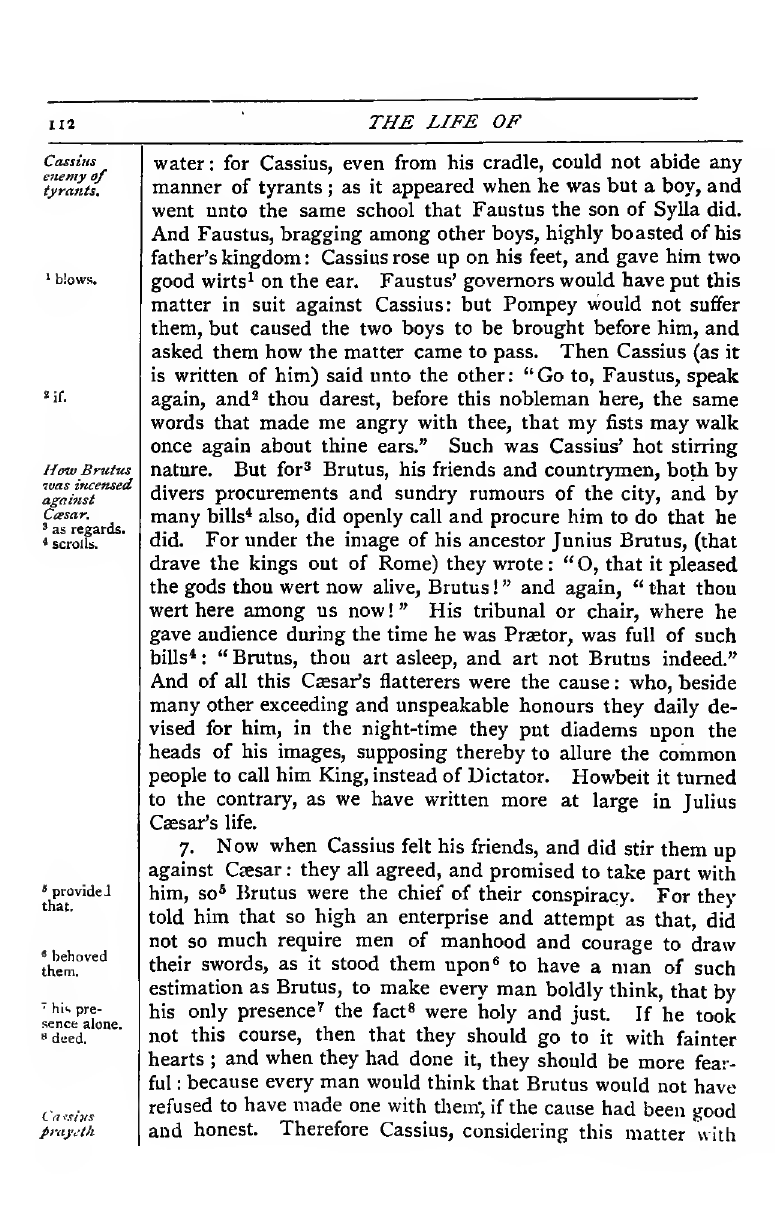
Image note: this is PDF p. 140, printed p. 112, in the later public selection *Shakespeare's Plutarch*. It is a readable page-image control for North's wording, not a photograph of the 1579 edition.
6. The 1595 North Edition and the Agreement to Kill Caesar Only
The edition control closest to the play has now been completed. Friedrich August Leo's 1878 Four Chapters of North's Plutarch was photolithographed at the size of the original 1595 edition and includes the complete Marcus Brutus. Its printed p. 1057 repeats the recruitment paragraph: the conspirators promise to take part; Brutus's presence makes the fact appear holy and just; and the cause appears good and honest. It proceeds directly to Cassius's approach and the recruitment of Ligarius. There is no oath proposal or rejection.
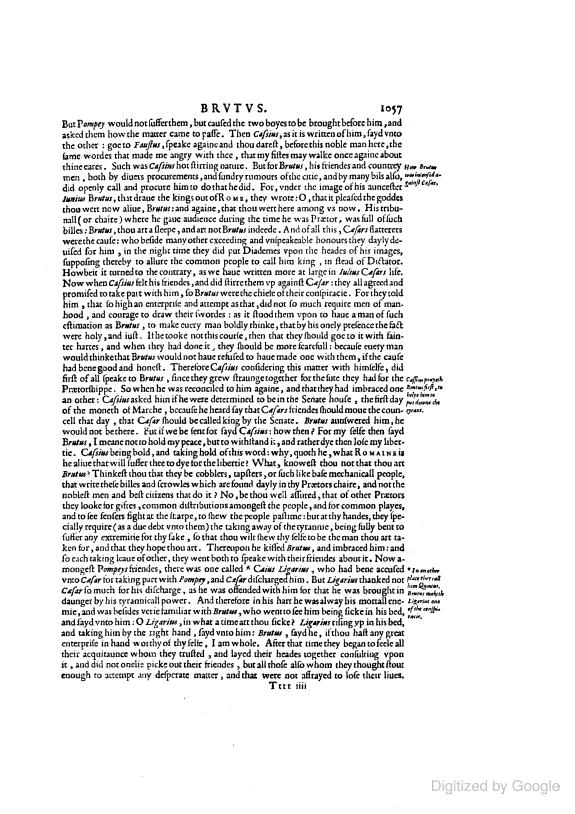
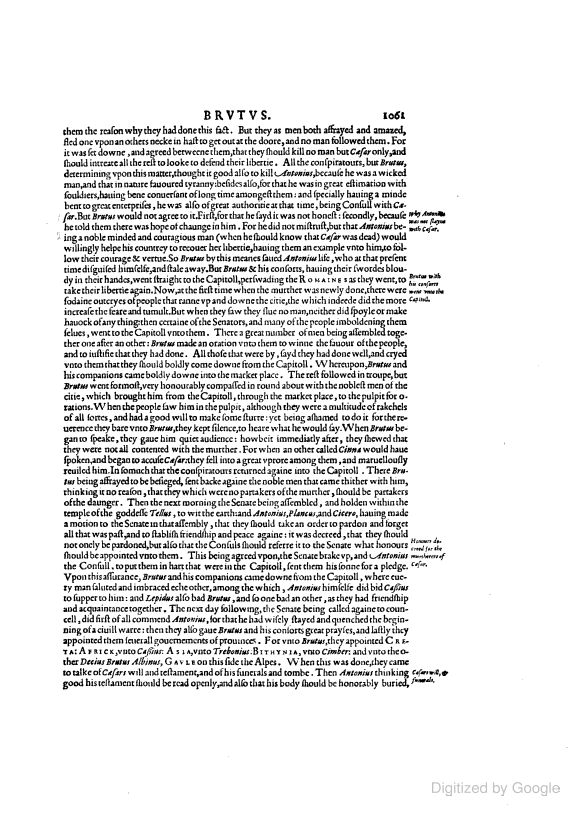
North nevertheless gives the conspiracy a formal limitation after Caesar's death:
“For it was set downe, and agreed betwene them, that they should kill no man but Caesar onely, and should intreate all the rest to looke to defend their libertie.”
All the conspirators except Brutus favor killing Antony. Brutus refuses:
“First, for that he sayd it was not honest: secondly, bicause he told them there was hope of chaunge in him.”
The Folger play preserves and expands this decision. Decius asks, “Shall no man else be touched, but only Caesar?” Cassius urges Antony's death; Brutus insists:
Let's be sacrificers, but not butchers, Caius.
We all stand up against the spirit of Caesar,
And in the spirit of men there is no blood.
O, that we then could come by Caesar's spirit
And not dismember Caesar! But, alas,
Caesar must bleed for it. And, gentle friends,
Let's kill him boldly, but not wrathfully.
He says their purpose must appear “necessary and not envious,” so that they will be called “purgers, not murderers.” Folger control: Julius Caesar 2.1.265–299.
Neville's confession poses a related limitation problem with different persons and actions. Elizabeth's person and estate must remain absolutely protected; Essex's party proposes seizing those it calls his enemies; and Neville separately refuses to act against Cecil because he is allied and beholden to him and will not “blot my reputacion to be fals vnto him or any man.” These are not identical political positions, but each record shows conspirators defining whom an enterprise may touch and justifying the boundary through honesty, necessity, reputation, or allegiance.
Full control: AMBOISE NORTH 1595 LIMITED VIOLENCE RESEARCH PASS 2026 07 12, Folger 1595 North record, and Google Books photolithograph.
7. Neville's Person and Estate Formula Predates the Confession
Neville already used the paired security formula in his Paris letter to Cecil of 5 October 1599 O.S. Reporting Étienne Pasquier's request for English material against the Jesuits, Neville wrote:
“This day Pasquier was with me again, to request some instructions of their proceedings against her Majesty's person and her estate, and particularly of their late dealing in Spain with Squire for the poisoning of her. If it please your honor to afford me an abstract of their bad practices, set down by some of her Majesty's learned council, I think it might be to good purpose.”
This predates the Essex confession and gives the phrase an established diplomatic-security context in Neville's own prose. In the confession, the formula is repeated at three stages: Cuffe's assurance, Neville's condition for hearing the proposal, and Neville's demand for the Amboise oath. The Amboise history supplies the remembered constitutional procedure, while the person / estate formula was already part of Neville's working vocabulary for threats against Elizabeth.
Control: letter_032, Winwood vol. 1, Book II, pp. 115-118, with four locally preserved page images.
8. A Hoby-Network Political-Theory Lead
Matthieu Coignet's Politique Discourses upon Trueth and Lying (1586), translated by Sir Edward Hoby, considers changed circumstances that might release a person from keeping a promise. Its examples include the case where keeping the promise would allow another to:
“attempt against his person or estate which did promise”
The argument differs from both Neville and Brutus, but the book joins promise-keeping, political prudence, and the person or estate formula. Edward Hoby was the son of Sir Thomas Hoby and Elizabeth Cooke; Elizabeth was the sister of Katherine Cooke Killigrew, Henry Neville's mother-in-law. The book therefore belongs to a close intellectual-family network worth exploring.
No entry for Coignet/Hoby was found in the Billingbear transcription or the local Audley End/Billingbear comparison spreadsheet during this pass. It is retained as a network and political-thought lead, not as a documented Neville-owned book.
Control: TCP A19072; Folger catalogue record.
9. A Wider Shakespeare Research Program
This source chain suggests several bounded follow-ups:
- collate the
1595North edition at the same Brutus paragraph and obtain an image of the early printed page, so the completed1579TCP check is independently controlled in the edition nearest the play; - examine whether Shakespeare's repeated
enterprisevocabulary around conspiracy follows the same moral distinction between action against ministers and action against the sovereign; - compare the Amboise gate plan and Neville's description of the Essex court-entry plan with staged approaches to guarded rulers in Julius Caesar, Richard II, and Hamlet, using exact Folger passages and the plays' recognized narrative sources;
- trace the history of the phrase
lawfull State/her estatein French-war histories and English treason examinations; - inspect the Billingbear La Popeliniere page itself and compare its wording with Serres, Castelnau, and later printed narratives.
10. Citations and Witness Notes
Quoted Source Passages
The controlled source passages are quoted above in sections 1, 2, and 4: Neville's confession from the local O'Donnell transcription; Serres's Amboise oath from TCP A01160, printed pp. 63-64; and the Folger oath debate in Julius Caesar 2.1. Quotations preserve the source spelling or Folger lineation appropriate to each witness.
- Henry Neville to Robert Cecil,
2 March 1601: Nevill to Cecil 1601 03 02 ODonnell transcription. - Jean de Serres, An historical collection (London,
1598), TCPA01160, STC11275, ESTCS121331: local source XML[local source path removed]; public Michigan EEBO-TCP record and text. - Billingbear list witness: IMG 8163 and Billingbear Book List Transcription:1215.
- La Popeliniere
1581image/catalog controls: BaTyR record, Gallica ARK, and Utrecht record. - Folger Shakespeare control: act 02 scene 01:204.
- North source control: Plutarch, translated Thomas North, The Lives of the Noble Grecians and Romanes (
1579), TCPA09802, printed p.1059, facsimile coordinatetcp:23915:545; Folger STC 20066 record and public North text. - Dated source-layer pass: AMBOISE NORTH PLUTARCH OATH SOURCE LAYER RESEARCH PASS 2026 07 12.
11. Next Research
The page-level collation of La Popeliniere is complete. The next task is textual genealogy: compare his two oath notices with Serres's fuller English narrative and with earlier French accounts, then ask which wording best explains Neville's “solemne oath” and “person or estate” formulation.
The North check adds two new priorities: collate the 1595 North edition at the same paragraph, and obtain a page image from the 1579 or 1595 edition. The complete checked 1579 Life of Brutus contains no oath/swear form, but the edition nearest the play should be independently controlled before the absence is generalized across all North editions.
Notes on Access
- Neville's confession and the Billingbear page image are locally available.
- Serres is controlled from EarlyPrint XML/FTS, the public Michigan TCP text, and Archive.org images of printed pp.
63-64. - Utrecht object
424366supplies a stable IIIF manifest and direct images for the relevant La Popeliniere first-volume pages. - The Folger passage is locally available and line-anchored.
- North's
1579wording is controlled from local TCPA09802; the included readable page image comes from a later public edited reprint, not the1579sheet.
2026-07-13 Deep Research Update: The Billingbear-Listed History Now Contains the Oath
Correct Utrecht volume and page route
The correct Utrecht object is first volume 20.500.14918-424366, not the second-volume object 424500. Its IIIF manifest contains the Amboise narrative. Direct inspection of images corresponding to printed pp. 162-163 resolves the principal open question.
La Popeliniere's first article
On the page introducing the “Tumulte d'Amboise,” La Popeliniere writes:
Leur ligue fut articulée dont le premier point à ce qu'ils disēt, fut la protestation de n'attēter aucune chose cōtre la Majesté du Roy, & les Princes de son sang.
Normalized expansion:
Leur ligue fut articulée, dont le premier point, à ce qu'ils disent, fut la protestation de n'attenter aucune chose contre la Majesté du Roy et les Princes de son sang.
Translation:
Their league was set out in articles, of which the first point, as they said, was the protestation that they would attempt nothing against the Majesty of the King and the Princes of his blood.
This directly matches the constitutional limit Neville remembered: the enterprise is presented as acting against ministers while formally protecting the sovereign and royal line.
Reciprocal oath at Nantes
The next page describes the secret assembly at Nantes on 1 February and states:
Somme que la Renaudie ayant le serment de tous & reciproquement presté le sien: declara le Chef duquel il auoit charge & aussi leur monstra son pouuoir.
Translation:
In sum, La Renaudie, having the oath of them all and having reciprocally sworn his own, declared the chief from whom he had authority and also showed them his commission.
La Popeliniere therefore has both elements Neville cites: a protective article and an oath binding the participants. It does not, on these pages, give Serres's longer speech about warning the king and dying before his face.
Serres's 1598 English expansion, now page-image controlled
Archive.org printed p. 63 was also inspected directly. It says that before the participants gave their promise, each should:
sweare, and solemnely vowe to God, not to enterprise or do any thing against the authoritie of the king, or the Estate of France
and that:
euery man swore, not to attempt any thing, but onely for the good, profit, and moditie of their king and naturall Lord
The printed rubric gives:
The solemne protestation of the confederates
and the text formulates the article as:
not to attempt any thing against the Maiestie of the King, Princes of the blood, nor the lawfull State of France.
Finally, “Renaudie ... sware and made all the company to sweare.” Serres is consequently the closer surviving printed parallel to Neville's phrases solemne oath, not to attempt any thinge, and protection of the queen's person or her estate; La Popeliniere is the documented Billingbear-list route and confirms the historical substance in a book associated with Neville's library.
Manuscript claim audit
- Primary manuscript image checked in this pass: the Amboise paragraph crop from TNA
SP 12/279, fol.15. - Independent non-AI control: the O'Donnell human transcription of Neville's
2 March 1601confession. - Agreement: the image supports the key sequence
solemne oath,not to attempt any thinge against the queenes person or her estate,enterprise of Amboise, anda president ... in the storie. - Unresolved readings: this update does not claim a new diplomatic transcription of the entire confession; it controls the quoted Amboise sentence and retains the O'Donnell transcription for the full document.
- Prior conflict: none found for the substance of this sentence. OCR and AI readings were not used as evidence.
Folger-controlled dramatic comparison
The contrast with Julius Caesar remains exact. Cassius proposes, “And let us swear our resolution.” Brutus replies:
BRUTUS
No, not an oath. If not the face of men,
The sufferance of our souls, the time's abuse--
If these be motives weak, break off betimes,
And every man hence to his idle bed.
He asks:
What other bond
Than secret Romans that have spoke the word
And will not palter? And what other oath
Than honesty to honesty engaged
That this shall be or we will fall for it?
The histories and Neville make a formal oath the safeguard of a limited enterprise; Brutus turns refusal of an oath into proof that honorable conspirators require no additional bond. This is a structured political-ethical comparison, not a claim that the histories supplied the play's wording.
Direct images: p314, p315, serres 1598 n62, and serres 1598 n63. Utrecht IIIF manifest; Archive.org Serres witness.
Source-Fact Audit — 8 August 2026 (Round 7)
The factual source chain is now complete enough to state without collapsing witnesses. Neville's confession says he demanded a “solemne oath” against attempting anything against the queen's “person or her estate,” citing Amboise as a precedent “in the storie.” La Popelinière's 1581 history, an edition listed at Billingbear, contains both the protective article and reciprocal oath. Serres's 1598 English history gives the fuller verbal parallel: “sweare, and solemnely vowe” not to act against the king's authority or the Estate of France.
The play takes a different position. Cassius says, “And let us swear our resolution”; Brutus answers, “No, not an oath,” and substitutes honor and spoken commitment as the bond. The comparison is a documented shared political problem—how conspirators limit and bind an enterprise—with opposed answers. The Billingbear listing makes La Popelinière a concrete access route, but it does not identify which history Neville meant or prove that the listed copy supplied a play.