Julius Caesar and John Salusbury
Topic: Julius Caesar and Sir John Salusbury
Scope ruling — 28 August 2026
This packet remains available as standalone Salusbury and print-history research. Its Love's Martyr argument is not relevant to the Henry Neville authorship book and must not feed that book's evidence, chapter structure, or bibliography.
Round 8 dedication/contribution distinction — 8 August 2026
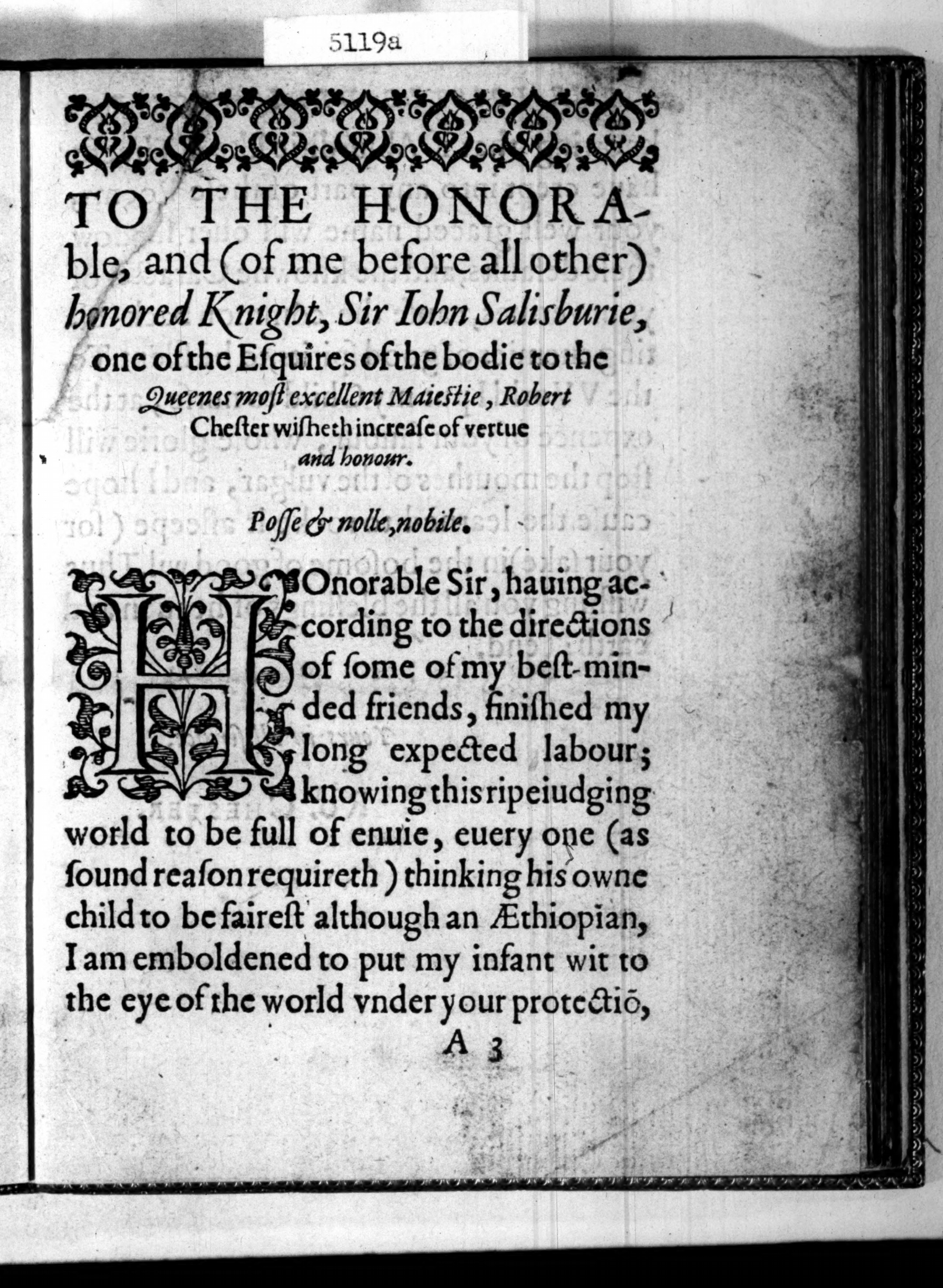
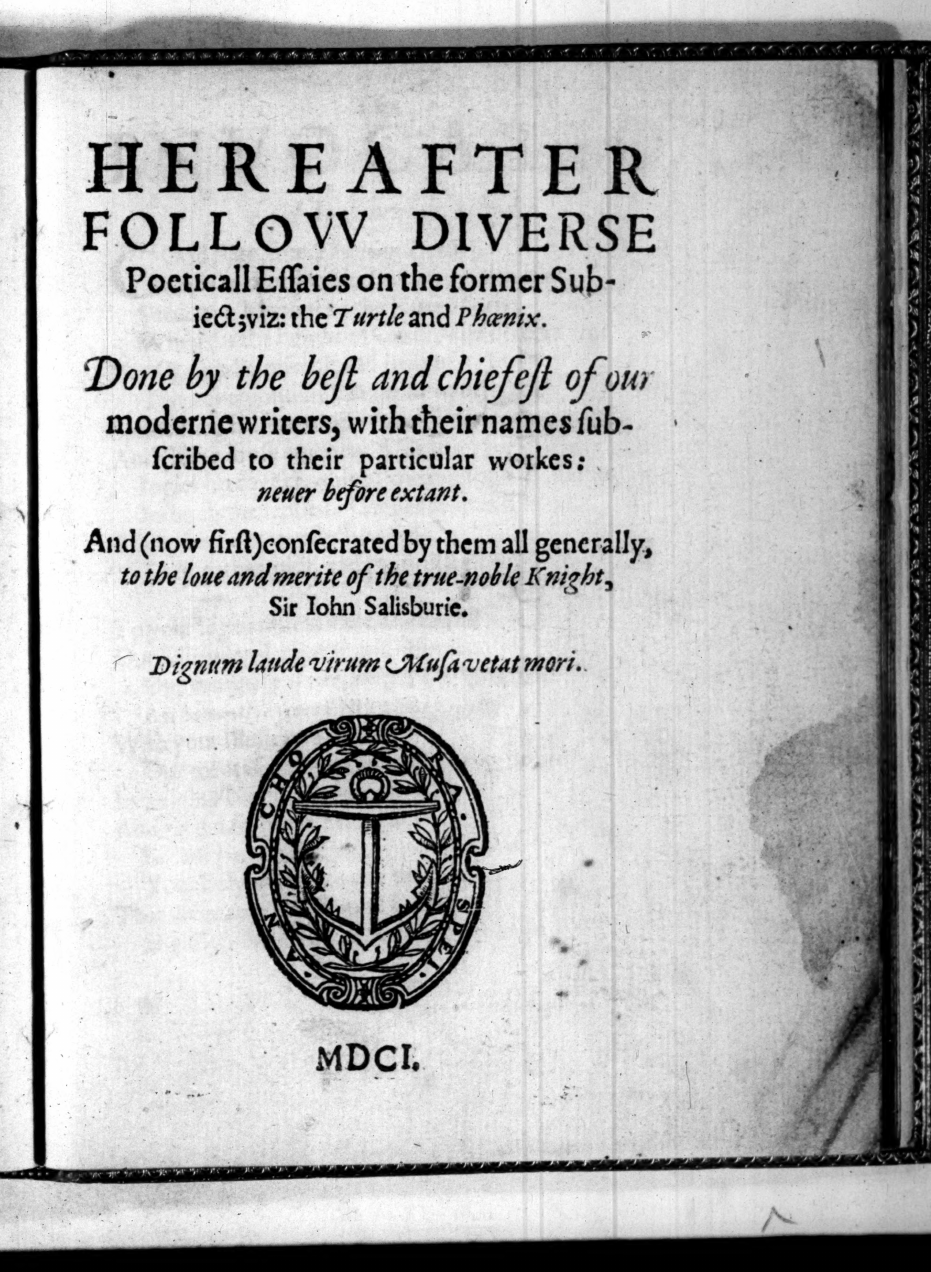
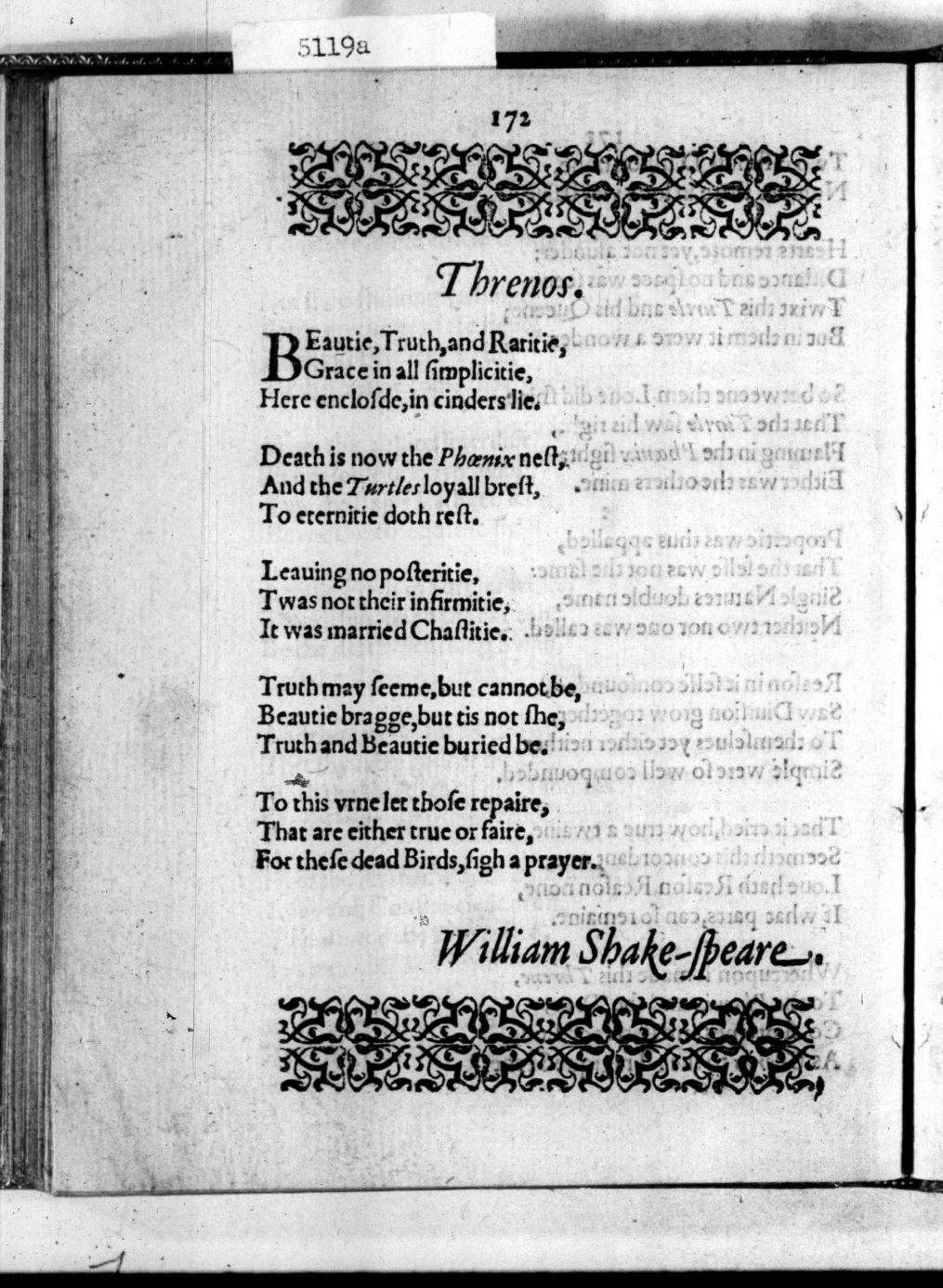
The 1601 object controls two different relationships. Chester's main dedication personally addresses Sir John Salusbury and wishes him increase of vertue and honor. The divider before the appended poems says that the poetic essays are consecrated by them all generally to Salusbury. Shakespeare's poem is then printed and signed William Shake-speare inside that section.
These facts establish placement and printed attribution. They do not establish that Shakespeare wrote a private commission for Salusbury, knew the wording of Chester's dedication, or used Antony's honorable man refrain as irony against the dedicatee. Salusbury's anti-Essex alignment is separately documented in an adversarial complaint alleging that he called a man knighted by a traytor; that statement should remain attributed to the complainant rather than turned into an unqualified quotation from Salusbury.
Source-Control Verdict
The source record supports three firm propositions and one deliberately open interpretation.
First, Robert Chester's Love's Martyr directly and repeatedly honors Sir John Salusbury, and the separate divider to the appended poems says that those poems were collectively consecrated to him. Second, Shakespeare's contribution is physically present and signed William Shake-speare. Third, Sir John was politically opposed to Essex-aligned rivals in 1601; the surviving record does not support the claim that he betrayed his own brothers.
The open interpretation is whether the book's conspicuous honour language could have sounded ironic to a reader recalling Antony's Brutus is an honorable man refrain. The comparison is textually possible, but no direct witness proves that Chester, Shakespeare, Salusbury, or a contemporary reader intended it as a veiled insult.
Quoted Source Passages from the Direct 1601 Print Witness
1.1 Chester's Dedication
- Source: Robert Chester, Love's Martyr (
1601), Archive.org EEBO page-image witness, PDF page3; image witnesses Love Martyr 1601 IA pdfpage 003. - Quotation:
"TO THE HONORAble, and (of me before all other) honored Knight, Sir Iohn Salisburie"
"Robert Chester wisheth increase of vertue and honor."
- What it proves: Chester's main work directly names and praises Salusbury.
- Limit: Repetition of
honouris also conventional dedicatory language. The page itself supplies no typographical or verbal marker that tells the reader to reverse it into irony.
1.2 The Appended Poetic Essays Are Also Consecrated to Salusbury
- Source: same book, PDF page
175, separate divider datedMDCI; image witnesses page 175. - Quotation:
"HEREAFTER FOLLOW DIVERSE Poeticall Essaies on the former Subiect, viz: the Turtle and Phoenix."
"And (now first) consecrated by them all generally, to the loue and merite of the true-noble Knight, Sir Iohn Salisburie."
- What it proves: The book presents the appended poems as continuing the same subject and as collectively honoring Salusbury.
- Limit: A collective title-page statement does not prove that every contributor independently composed a personal encomium to Salusbury or knew every circumstance of the compilation.
1.3 Shakespeare's Signed Contribution
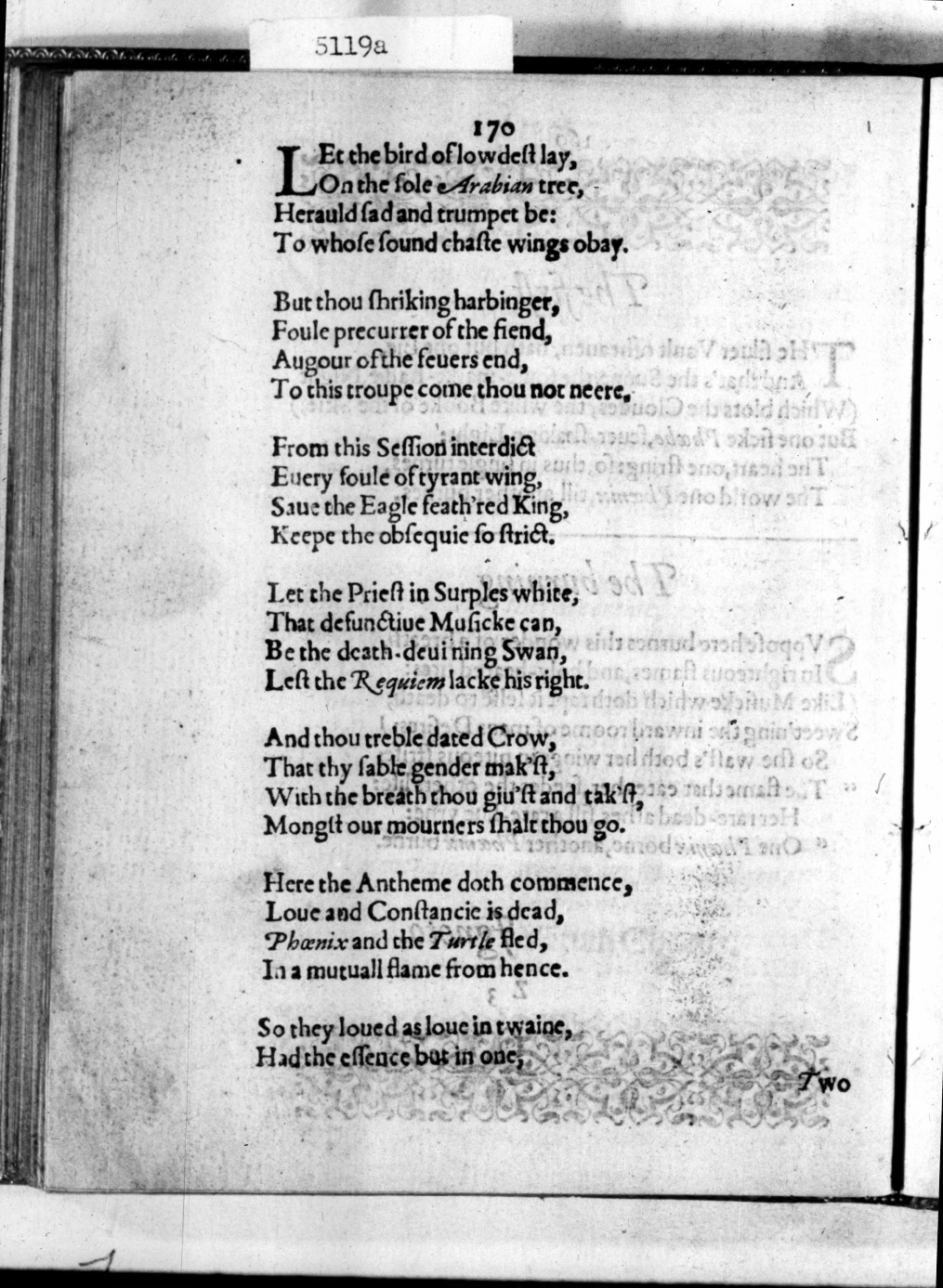
- Source: same book, PDF pages
180-182, printed pp.170-172. - Opening image: page 180.
- Closing/signature image: page 182.
- Closing quotation:
"To this vrne let those repaire, / That are either true or faire, / For these dead Birds, sigh a prayer."
"William Shake-speare."
- What it proves: The 1601 witness prints and signs Shakespeare's poem within the Salusbury-consecrated section.
- Limit: The signature and section heading do not by themselves reveal the allegory's persons, the date of composition, or the contributor's private attitude toward Salusbury.
2. Who Was Sir John Salusbury?
The controlling modern reference is the Dictionary of Welsh Biography, published by the National Library of Wales and the University of Wales Centre for Advanced Welsh and Celtic Studies. It is checked here against Carleton Brown's much fuller 1914 documentary study.
Core chronology
- John Salusbury was born in
1567, the posthumous younger son of John Salusbury and Katheryn of Berain. - His elder brother Thomas was executed for participation in the Babington Plot in
1586. - John then became heir to Lleweni and married Ursula Stanley later in
1586. - He entered the Middle Temple in
1595, served the queen as squire of the body, and was knighted in June1601. - After the Wrexham election conflict, he was returned as MP for Denbighshire in December
1601. - He died on
24 July 1612.
These details matter because the name John Salusbury also belonged to men in rival Salusbury branches. The dedicatee must not be conflated with Captain John Salusbury of Rûg, an Essex adherent and political enemy.
3. Salusbury and Essex
3.1 A contemporary anti-Essex allegation
Carleton Brown transcribes a sentence from Sir Richard Trevor's Star Chamber complaint about the Wrexham election conflict. Trevor alleged that Sir John said Sir John Lloyd:
"was knighted by a traytor."
Brown identifies the traitor through a February 1600/1 information stating that Lloyd had been knighted in Ireland by the Earl of Essex. The statement comes from Salusbury's enemy and appears inside adversarial litigation; it is nevertheless direct evidence that Salusbury was publicly represented as denouncing Essex after the rebellion.
Source: Carleton Brown, ed., Poems by Sir John Salusbury and Robert Chester (1914), Introduction, pp. xxii-xxiii; Sir John Salusbury Poems Carleton Brown 1914 IA.
3.2 Rival Salusburies and the Essex faction
Brown's documentary biography separates the men:
- Captain Owen Salusbury, whom Sir John fought in
1593, later served as an active Essex partisan and was killed at Essex House during the rising. - Captain John Salusbury of a rival branch was arrested for his part in the rebellion and later joined the coalition opposing Sir John's parliamentary election.
- Sir John Lloyd and Sir Richard Trevor likewise belonged to the hostile local faction, with Lloyd associated with Essex service.
The feud was not necessarily only ideological; local rivalry, lawsuits, debt, religion, office, and kinship also mattered. But the documentary record is incompatible with describing Sir John himself as pro-Essex in 1601.
3.3 Knighthood and suppression of the revolt
The Dictionary of Welsh Biography says Sir John's June 1601 knighthood was no doubt a reward for his part in suppressing the Essex revolt. The wording is an informed inference, not the text of a surviving knighthood warrant that explicitly states the reason. Use likely rewarded rather than the warrant says.
4. The Betrayed His Own Brothers Claim Does Not Survive Checking
The earlier research claim said Salusbury ratted out the Essex conspirators, perhaps even his own brothers. The checked genealogy and chronology do not support it.
- Thomas, executed in
1586, was Sir John's elder brother, singular. - His prosecution belonged to the Babington Plot, fifteen years before the Essex rising.
- No source located in this pass says that John informed on or betrayed Thomas.
- The Essex-aligned Owen Salusbury and Captain John Salusbury were members of rival or collateral Salusbury branches, not Sir John's brothers.
Book prose may say that Sir John opposed Essex and Essex-aligned Salusbury kinsmen. It should not say he betrayed his brothers unless a new direct document proves that act.
5. The Julius Caesar Honorable Man Comparison
5.1 Direct play text
The Folger text preserves Antony's lineation in 3.2:
I come to bury Caesar, not to praise him.
The evil that men do lives after them;
The good is oft interred with their bones.
So let it be with Caesar. The noble Brutus
Hath told you Caesar was ambitious.
If it were so, it was a grievous fault,
And grievously hath Caesar answered it.
Here, under leave of Brutus and the rest
(For Brutus is an honorable man;
So are they all, all honorable men),
Come I to speak in Caesar's funeral.
Source: act 03 scene 02:148.
Antony repeats And Brutus is an honorable man, progressively turning formal praise into accusation through context and repetition.
5.2 What the comparison can support
Chester's dedication repeats honorable, honored, and honor; Julius Caesar had already made reiterated honor-language a famous vehicle for corrosive irony. A researcher can therefore ask whether the Salusbury page might admit a second, hostile hearing—especially for readers aware of the Essex aftermath.
5.3 What it cannot support
No direct evidence currently shows that:
- Chester intended the dedication sarcastically;
- Shakespeare wrote the dedication;
- Shakespeare selected or edited Chester's honor-language;
- a contemporary linked Salusbury to Brutus;
- the appended poem was supplied as an insult to the dedicatee.
The correct label is interpretive hypothesis, not documented allusion.
6. The Phoenix, Turtle, Elizabeth, Essex, and Salusbury
Carleton Brown began from the fact that the main poem and appended essays share a subject and a dedicatee. He rejected Alexander Grosart's identification of the Phoenix with Elizabeth and the Turtle with Essex because the anti-Essex Salusbury was, in Brown's view, the last patron to whom such an allegory would be dedicated.
That is a powerful historical negative control, not a complete solution. Other interpretations have treated the birds as Salusbury and Ursula, abstract ideals, Catholic figures, or a deliberately irreducible emblem. The direct 1601 pages name neither Elizabeth nor Essex as a bird.
The National Library of Wales's Salusbury manuscript exhibition notes both the dedication and the scholarly tradition associating Sir John and Ursula with the central figures. Its wording is appropriately cautious: this is an argued interpretation, not the book's explicit identification.
7. Shakespeare, Essex, and Chronological Caution
The Henry V chorus imagines the return of the general of our gracious empress from Ireland Bringing rebellion broached on his sword (act 04 scene 08:238). The topical reference is widely read as Essex before the disastrous end of his Irish command.
It establishes that the play could compliment or anticipate Essex in 1599. It does not by itself prove a fixed pro-Essex political identity for Shakespeare after the 1601 rebellion. The move from topical compliment and Southampton patronage to a personal political verdict requires separate argument.
8. Evidence Table
| Claim | Current status | Best control |
|---|---|---|
| Chester directly dedicated Love's Martyr to Salusbury | documented | 1601 PDF page 3 |
| Appended poetic essays were collectively consecrated to Salusbury | documented | 1601 divider, PDF page 175 |
| Shakespeare's poem appears signed in that section | documented | printed pp. 170-172 |
| Sir John opposed Essex-aligned rivals | documented, with factional nuance | Trevor complaint via Brown; DWB chronology |
| Sir John helped suppress the Essex revolt | strong secondary inference | Dictionary of Welsh Biography |
| Sir John betrayed his own brothers | unsupported / rejected | genealogy and chronology contradict the wording |
| Chester's honor-language alludes to Antony/Brutus | possible interpretation | direct texts only; no external witness |
| Phoenix=Elizabeth and Turtle=Essex | historically weakened | Brown's anti-Essex Salusbury control |
| Phoenix/Turtle=Salusbury/Ursula | substantial interpretive tradition, not explicit fact | Brown/NLW and biographical readings |
9. Book-Safe Formulation
Love's Martyr is unambiguously a Salusbury book at the level of dedication: Chester honors him, and the divider to the appended poems collectively consecrates those essays to him. The same section contains Shakespeare's signed poem. Salusbury's anti-Essex posture makes a simple Elizabeth/Essex allegory historically difficult and gives the book a sharper political context. Chester's repeated honor-language can be compared with Antony's corrosive refrain in Julius Caesar, but the comparison should be framed as a provocative reading, not as proof of a coded insult. The claim that Salusbury betrayed his brothers should be removed.
Sources
- Chester, Robert. Love's Martyr: or, Rosalins Complaint. London,
1601. TCPB12045; full Archive.org image witness; bim early english books 1475 1640 loves martyr chester r 1601. - Brown, Carleton, ed. Poems by Sir John Salusbury and Robert Chester. Early English Text Society,
1914; Archive.org; Sir John Salusbury Poems Carleton Brown 1914 IA; Sir John Salusbury Poems Carleton Brown 1914 IA djvu. - Dictionary of Welsh Biography: Salusbury family of Lleweni and Bachygraig.
- Dictionary of Welsh Biography: Thomas Salusbury.
- National Library of Wales: Salusbury manuscript.
- Grosart, A. B., ed. Robert Chester's Love's Martyr (
1878), Archive.org. Use as a type-facsimile/access edition, not instead of the 1601 images. - Folger Julius Caesar
3.2: act 03 scene 02:148. - Feinstein, Ken. Preserved Twitter research: twitter Julius Caesar.
- essex rebellion, related Essex packet.
- NETWORK PLAY CLUSTER SOURCE PASS 2026 07 09.
11. Images
Notes on Access and Status
Ready means the packet now has direct print witnesses, a controlled Salusbury biography, a corrected kinship claim, direct Folger play text, and explicit interpretive limits. The Star Chamber originals, publication sequence, and irony question remain legitimate future-research tasks.