Ben Jonson
Topic: Ben Jonson
Full Convivium / Sireniacal Network Audit — 1 September 2026
Book-use decision: retain this expanded audit in the AI Topics only. Do not add the full person-by-person network to the manuscript without a later explicit request.
The earlier four-name Epigrams result is only one layer of the evidence. A complete audit of commendatory verse, dedications, masque records, manuscript circulation, payments, and Jonson's 1618 journey establishes unambiguous direct connections with ten people in the Convivium company. Lionel Cranfield adds an official £33 payment entry; Richard Connock adds a dated verse epistle whose attribution should be checked directly in BL Add. MS 27407. Robert Phelips shares the Coryate print and Sireniacal environment; John West is the only person for whom no independent Jonson link has yet appeared.
The full report gives Christopher Brooke's 1614 poem, the twenty-five-year Jonson–Inigo Jones masque partnership, and a person-by-person evidence table: JONSON CONVIVIUM FULL NETWORK RESEARCH 2026 09 01.
Convivium Roster Audit — 1 September 2026
A complete check of the fourteen Convivium Philosophicum names against all 133 poems in Jonson's 1616 Epigrammes (TCP A04632) found four explicit overlaps:
- John Donne: addressee of XXIII and XCVI; also named in XCIV's title.
- Sir Henry Goodyere: addressee of LXXXV and of LXXXVI through
TO THE SAME. - Sir Henry Nevil: addressee of CIX.
- Thomas Coryate: named as
CORIATinside CXXIX, but not its addressee.
Hugh Holland is not named in the Epigrams. His direct Jonson relationship is his commendatory verse for Sejanus (1605), followed by his Convivium placement and his signed 1623 First Folio poem. No anonymous epigram personae should be identified with the other diners without independent evidence.
Research Notice: Cinthia's Revenge commendatory poem
Scope note: this item is not directly Neville-related. It is retained here as contextual evidence about Ben Jonson's commendatory practice, his
B. I.signature, and his characteristic treatment of readers and concealed authorship.
John Stephens's Cinthia's Revenge: or, Mænander's Extasie (1613) contains a ten-line commendatory poem headed To his much and worthily esteemed friend the Author and signed B. I. Modern Jonson editors accept the poem as Ben Jonson's: Percy Simpson included it in The Cambridge Edition of the Works of Ben Jonson (1907), and Tom Cain and Ruth Connolly include it in The Poems of Ben Jonson (2021). The Early English Books Online / TCP XML and the available page rendering agree on the wording, including the italicized question, what Author would conceale his name?
That question responds directly to Stephens's adjacent epistle, where he says that he purposly concealed his name and did not wish to play Tom-foole in Print for name-sake. Jonson turns Stephens's anonymity into a small taxonomy of readers: the superficial looker, the reader who roves at an uncertain passage, the hopeful understander, and the person who cannot read but may eventually admire (with the period sense of wonder as well as praise). The repeated movement from taking the volume in hand to understand closely resembles Jonson's own demand in Epigram I, To the Reader, that whoever takes his book in hand should read it well: that is, to understand. The rove / mark language is an archery metaphor for conjectural interpretation, while the claim that blind men may sometimes hit the mark belongs to the proverb family represented by a fool's bolt may sometimes hit the mark.
Assessment: the poem is best read as sincere commendation mixed with Jonsonian satire of superficial readers and affectionate teasing of Stephens's deliberate anonymity. It does not supply evidence for a concealed alternative author, and no direct Neville connection has been identified.
Deep analysis: Epigram CIX, To Sir Henry Nevil
Supporting analysis: Ben Jonson, To Sir Henry Nevil: Text, Publication, Context, and Close Analysis (2026-08-25). The internal research-file and reader-facing PDF locations are recorded in this topic's outputs_generated metadata; the PDF's evidentiary citations point to public editions, archives, articles, and corpus records.
High-priority prior notice: Bruce (James) Leyland and James Goding
This correspondence was already identified in print and must be credited prominently in future work. In Who Will Believe My Verse?: The Code in Shakespeare's Sonnets (Australian Scholarly Publishing, 2018), p. 11, Bruce Leyland (credited in the publication as James Leyland) and James Goding reproduce Jonson's epigram and state that its language “seems to echo he that calls on thee” in Shakespeare's Sonnet 38. Their footnote 24 directs readers to their Appendix 2 discussion of Sonnet 38 at pp. 164–65.
Priority assessment: high. This is a published, exact notice of the same calls on thee / Muse correspondence, not merely a general Neville–Shakespeare association. It establishes priority of observation. It does not establish that the echo is intentional, nor does it validate the book's larger code or authorship theory; those remain separate arguments to be tested independently. The page has been checked directly in the public Google Books preview: Leyland and Goding, p. 11.
Exhaustive test of the broader Leyland echo hypothesis, 2026-08-26
The complete 133-poem Epigrammes census is now finished. It identifies 33 numbered poems involving 20 independently attested writer-honorees, plus thirteen generic, satirical, merely mentioned, or uncertain writer figures. Each writer-honoree poem was classified after Cambridge-edition source checking, chronology control, exact normalized 3–6-lemma screening where a usable corpus survives, period document-frequency control, and manual semantic review.
Corrected result (book synchronization, 2026-08-28): the final evidence ledger classifies the 33 poems as ten strong target-text responses or reuses (A), two plausible responses (B), one broader dialogic or book-responsive relation without demonstrable phrase borrowing (C), seven negative results (N), and thirteen untestable cases (U). Among the twenty testable or partly testable poems, the resulting rates are therefore 10/20 (50%) strong, 12/20 (60%) strong plus plausible, and 13/20 (65%) when the single broader dialogic case is included. The earlier 6/20 and 8/20 figures in this topic were superseded by the completed manual audit but had not been propagated here; they must not be reused.
The broader conclusion remains bounded: response or reuse is characteristic in the testable sample, not universal, and the sample is selected by identifiable writer-honorees rather than designed as an authorship classifier. The strongest cases cluster around Donne and James, with additional examples involving Francis Beaumont, William Camden, Philip Sidney, and Clement Edmondes. They include verse exchange, presentation, criticism, translation, public speech, commentary, and praised books. Jonson also switches sources: poems to writer-honorees draw on Pliny, Seneca, Martial, Horace, Cicero, Virgil, Claudian, Plato, and Persius. Epigram 122, syntactically modeled on Martial while praising Rudyerd, is a particularly clear counterdirection.
Epigram 109 remains a special case rather than proof of the general rule. The resolved Neville corpus yields only the generic phrase first to know; the stronger controlled relation is with Shakespeare's Sonnets 38 (calls on thee plus Muse) and 29 (the reciprocal six-lemma set fate, hope, friend, possess, scope, state). This supports a Shakespearean intertextual lead, not a general target-author habit and not, by itself, Neville's authorship of Shakespeare.
- Reader-facing report: JONSON EPIGRAMS LEYLAND ECHO HYPOTHESIS 2026 08 26
- Full 133-row census: jonson all 133 epigrams census
- 33-poem evidence ledger: jonson writer epigram evidence
- 20-person inventory: jonson writer people inventory
Complete Jonson–Sonnets lexical-rhyme census
The book's later control study was also missing from this topic. It compared every one of Jonson's 133 numbered Epigrams with all 154 Shakespeare sonnets: 133 × 154 = 20,482 poem-pair comparisons. The source inventory contains 812 Jonson rhyme-pair records and 1,079 sonnet rhyme-pair records. End words were lowercased and conservatively lemmatized; ordinary sonnets were parsed by their ABAB CDCD EFEF GG scheme, with the exceptional structures of Sonnets 99 and 126 treated separately, while Jonson's epigrams were parsed as adjacent couplets. This is a lexical line-ending comparison, not a claim of identical spelling or modern pronunciation.
| Exact shared lexical rhyme pairs | Comparisons | Percentage |
|---|---|---|
| 0 | 19,897 | 97.144% |
| 1 | 575 | 2.807% |
| 2 | 10 | 0.0488% |
| 3 or more | 0 | 0% |
Epigram CIX and Sonnet 29 form one of the ten double-overlap comparisons, sharing the rhyme pairs hope/scope and fate/state. No other sonnet shares two pairs with Epigram CIX. Among the ten double overlaps, this is the only comparison in which a shared pair also occupies the same ordinal rhyme group: hope/scope is the third rhyme group in each poem. Because Shakespeare's quatrain rhyme alternates while Jonson writes adjacent couplets, the ordinal correspondence is interesting but not the same physical pattern. External inverse-document-frequency weighting ranks CIX/Sonnet 29 third among the ten double overlaps, not first.
The result has two essential limits. First, the target was selected after the resemblance was noticed, so 10/20,482 is a descriptive corpus count, not a preregistered p-value. Second, Robert Parry's Sinetes passions vppon his fortunes (1597), Passion XXVII, already combines both pairs in one 24-line poem, in the directions hope → scope and state → fate. Public records are the Folger catalogue entry and the EarlyPrint text, TCP A09044. In the broader pre-1609 line-ending control, hope/scope appears in 79 documents and fate/state in 179. The double rhyme therefore supports an exploratory intertextual comparison but cannot establish uniqueness or direct borrowing.
The stronger Sonnet 38 relation is a different evidence unit: the publicly indexed EarlyPrint control found the Sonnet and Jonson CIX as the two authorial passages placing the lemma sequence call on thou within fifteen tokens before Muse. That narrow conjunction is strengthened by its corpus result but limited by grammatical-role inversion and incomplete corpus coverage. Neither sonnet comparison converts Epigram CIX into direct proof that Neville wrote Shakespeare; both supplement the primary fact that Jonson publicly makes a Muse call upon the named Henry Neville.
Main finding
Jonson's epigram is best read as a forensic defence of Sir Henry Neville's moral intention. It answers a precise charge: the false statesman pretends a scope / Of seruice to the publique while making priuate gaine his real end. Jonson denies that charge, then distinguishes the matter and elements of honor from its outward dresse. The poem's sequence is a theory of legitimate statesmanship: know one's own state before the States; make inward roote equal outward height; let the soul give the flesh moral weight; and allow deeds rather than titles to generate the name.
Date of composition: unresolved, and the disagreement should be recorded as a disagreement
We do not know when the poem was written. No surviving document dates it. Both of the positions below are inferences from the poem's own words; neither rests on external evidence, and this packet takes neither side.
What is documentary (2026-08-26 verification pass):
- The only surviving witness is the
1616folio. That is the sole firm terminus ante quem. - A printed Epigrammes existed before the folio: Stationers' Register entry by John Stepneth
- Colin Burrow (Cambridge Works of Ben Jonson, Epigrams introduction): "If there was an
- Neville died
10 July 1615; he was refused the secretaryship in1612.
15 May 1612; Sir Arthur Throckmorton set aside sixpence for it in 1612; Drummond listed it among books read in 1612 and 1613; the Bodleian sent "Ben Jhonsons Epigrammes" to the binder on 15 September 1614 and shelved it at 87 I 19 Art. (Lyons, PBSA 114.3 (2020): 343–364). Its contents are unknown, so it does not place or exclude epigram 109.
edition in 1612, it is very likely that Jonson modified and augmented it for the edition of 1616," and he argues that at least one poem (67) is c. 1614. So even inclusion in the lost book would not fix the 1616 wording.
Position A — a lifetime poem, occasioned by the 1612 refusal. This originates with Fleay (1891), whose entry, verified directly in the printed text (A Biographical Chronicle of the English Drama, 1559–1642, vol. 1, p. 320), reads in full: "1612. 109. To Sir Henry Nevil (of Billingbear). Was refused Secretaryship in 1612." Burrow reports this as "the most probable occasion for the poem."
Weight to give it: low as evidence, though it is the position of the standard modern edition. Fleay's method across the whole list is to attach a datable event from the addressee's life to each poem; many of his entries are hedged ("Query", "I think", "(?)") or undated. He supplies no argument for 109 beyond the coincidence of subject. Fleay's own concluding sentence on that same list contradicts his entry: "The arrangement of the Epigrams is not chronological ... and there is no date in them that can be definitely assigned later than 1611." An event-date is not a composition-date: a poem defending Neville against the charge of self-interested office-seeking could be written during the 1612 campaign or afterwards about it.
Position B — a posthumous defence, between 10 July 1615 and the folio. The internal case: the Muse now calls on Neville, a summoning; the lent life is to be made good against the Fates; Now I haue sung thee thus is a completed action submitted to posterity's judgment; and the close sets new wombes against tombes. Jonson's editor cross-refers lent life to Epigram 22, On My First Daughter — an epitaph — so the phrase's Jonsonian home is elegiac. Goe on is not decisive against this, since the following couplet explains how a dead man goes on.
Weight to give it: also low, and weakened by a control run on 2026-08-26. Jonson deploys the same memorial machinery for living patrons. The Forrest XII, to the living Countess of Rutland, has the Muse who alone raises souls to heaven and the tombs/wombs antithesis entire; Epigram 127, to the living Esmé Lord Aubigny, has "I doe therefore call Posteritie / Into the debt" with "Lent timely succours, and new life begot"; Epigram 104, to the living Susan Countess of Montgomery, has the Fates, lent, birth, posteritie and judgement. The funerary register therefore does not by itself imply a dead addressee.
The two precedents inside Jonson's own book
The objection "why would Jonson write this while Neville was alive and might still rise?" and the counter-objection "the poem is headed To, and addresses a living man in the present tense" are both answerable from the Epigrammes themselves. Each turns out to have a precedent, and they point in opposite directions.
Precedent for a posthumous poem headed "To" and addressed in the second person. Epigram XXXIII is headed simply "TO THE SAME" — that is, to Sir John Roe, the subject of XXXII. Roe died of plague in Jonson's arms in January 1606. The poem reads, in full:
I'le not offend thee with a vaine teare more,
Glad-mention'd ROE, thou art but gone before,
Whither the world must follow. And I, now,
Breathe to expect my when, and make my how.
Which if most gracious heauen grant like thine,
Who wets my graue, can be no friend of mine.
So the heading "TO SIR HENRY NEVIL" and the sustained second person are no obstacle whatever to a posthumous reading. Jonson does exactly this, in this book, to a dead man. This removes the strongest formal objection to the posthumous case.
Precedent for a lifetime poem left standing in the folio after the addressee had died. Epigram CXIII is addressed to Sir Thomas Overbury and dated by the Cambridge editor to c. 1610. Overbury was imprisoned in the Tower on 2 April 1613 and poisoned there, dying 14 September 1613; the murder trials ran through 1615 and into 1616, the folio's own year. Jonson — who told Drummond that Overbury had become his "mortal enemy" — nevertheless printed the poem in 1616 unaltered and in the present tense: "So where thou liu'st, thou mak'st life vnderstood." He did not recast it as an epitaph, did not mark the death, did not withdraw it.
Epigram CXIII stands four poems after CIX. The demonstrated fact is that Jonson's 1616 folio prints lifetime poems to men who had since died, without adjustment. So the posthumous date of printing of epigram 109 carries no inference at all about its date of composition.
Three further controls on the wording
- "Lent life" is not a death-signal. The life-as-loan topos occurs three times in the
- **Denying that the addressee is a place-hunter is Jonson's standing compliment to living
- Consigning a living addressee to posterity's judgment is also normal Jonson. Epigram
Epigrammes and Forrest: at Epigram XLV, On My First Sonne (a dead child: "Seuen yeeres tho'wert lent to me, and I thee pay, / Exacted by thy fate"); at Epigram CIX; and at The Forrest III, addressed to the living Sir Robert Wroth — "To doe thy countrey seruice, thy selfe right; / That neither want doe thee affright, / Nor death; but when thy latest sand is spent, / Thou maist thinke life a thing but lent." The Wroth passage is the closest Jonsonian parallel to 109.11 and it pairs the loan of life with country service, exactly as epigram 109 does. Its addressee was alive.
public men*, including men who had just received* office. Epigram LXIIII, to Salisbury on his accession to the Treasurership, opens: "NOt glad like those that haue new hopes or sutes / With thy new place ... Nor glad for fashion. Nor to shew a fit / Of flatterie to thy titles." Epigram LXVI, to the living Sir Henry Cary, closes: "He's valiant'st that dares fight, and not for pay; / That virtuous is, when the reward's away." Epigram 109's "Thou art not one, seek'st miseries with hope, / Wrestlest with dignities" belongs to that idiom.
CXXVII, to the living Esmé Lord Aubigny: "No, I doe therefore call Posteritie / Into the debt, and reckon on her head".
Where that leaves the question
The situational argument for a posthumous poem is real and is the best argument on that side: Neville was, through 1612–14, publicly and strenuously pursuing the secretaryship through Rochester and Overbury, with a written memorial to the king; to tell such a man to his face that he does not "wrestle with dignities" is a strained compliment while the campaign is live, and a natural vindication once it is over and he is beyond defending himself. "Now I haue sung thee thus, shall iudge of thee" does read as the closing of an account.
But it remains an argument from tone, and every element it rests on — the To heading, the second person, the lent life, the Fates, posterity's judgment, the wombs and tombs — is documented in Jonson addressing the living. Meanwhile the one hard fact on the other side, that the poem was printed after Neville died, is shown by the Overbury epigram to prove nothing about when it was written.
Jonson's own book supplies a precedent for each reading. No surviving document decides between them.
Net position for the book: the memorial vocabulary argument fails in both directions — it cannot date the poem after Neville's death, and Fleay's event-date cannot date it before; and Jonson's own book supplies a precedent for each practice (Epigr. 33 addresses the dead Roe as thee under a To heading; Epigr. 113 keeps a c.1610 lifetime poem to Overbury in the present tense in the 1616 folio although Overbury died in 1613). Write the poem as undated, give both readings, and do not let either become the default. The one thing the 1616 witness establishes is that the poem reached print posthumously.
Primary Neville parallel
The closest primary analogue is Neville's own letter to Ralph Winwood of 16 February 1603 Old Style (26 February 1604 New Style), printed in *Memorials of Affairs of State*, vol. 2, p. 17. Neville says every honest man should dedicate his life to public ends rather than private contentment, but that no man is bound to seek Imployments; offices of Honor are too high for him; and he should attend his private State while leaving publick Affairs to those charged with them.
That argumentative sequence closely matches Jonson's lent life, not seeking or wrestling with dignities, public service versus private gain, honour and height, and thine owne state before the States. No evidence shows Jonson saw the private letter. The secure inference is that Jonson's defence resembles Neville's own established ethical self-presentation; direct borrowing is unproved.
Publication control: 1612 and 1616
Tara L. Lyons's “New Evidence for Ben Jonson's *Epigrammes* (ca. 1612) in Bodleian Library Records”, PBSA 114.3 (2020), 343–64, is the relevant article. It combines the Stationers' Register entry of 15 May 1612, Throckmorton's anticipated sixpenny purchase, Drummond's 1612–13 reading lists, and the Bodleian's 1614 binding and shelfmark records. Together these prove that a separate small printed Epigrammes circulated before Jonson republished the collection in the 1616 folio Workes. Lyons develops the material argument in “Reading a Lost Book”, English Literary Renaissance 53.1 (2023), 1–34.
The lost book's contents are unknown. Its existence does not prove that epigram 109 was printed in 1612. A 1612 inclusion, a 1614–15 addition, and revision for 1616 remain distinct possibilities.
Text and verbal findings
The 1616 page image, Internet Archive first-folio scan, and EEBO–TCP A04632 agree on the words. The folio's punctuation and repeated then matter. Modernizing line 10 to than obscures a possible sequence: possess the substance of honour and then its dress, just as one first knows one's own state and then the States.
The concluding wombes/tombes rhyme is not itself rare. An EarlyPrint lemma search found womb within twenty words of tomb 707 times in 581 documents. Jonson's particular constructions are highly distinctive: exact new wombes, wrestle with dignity, deed ... new womb, and soul ... flesh ... weight each returned only this poem under the reported queries. Exact lent life returned 13 documents, with Jonson the earliest returned witness. The poem therefore builds original relations from conventional ethical and funerary materials.
Structure and book placement
The poem proceeds as a compact legal oration: it qualifies the Muse as a witness who serves neither fame nor titles; refutes the charge of false service; states Neville's positive ethical intention; and appeals to posterity for judgment. In the 1616 order, epigrams 107–08 contrast false and true military service, 109 transfers that opposition to state service, and 110 immediately repeats deeds, honours, name, future time, and renewed life through writing. The sequence strengthens the reading of 109 as a hinge between service and literary posterity, though it cannot date the poem's first composition.
Assessment: the poem summons Neville, clears his motive, and creates the afterlife it promises: posterity judges him through deeds and Jonson's verse. Its date of composition is unresolved — see the dating section above, which records the lifetime (Fleay/Burrow, 1612 occasion) and posthumous (1615–16) readings as competing inferences rather than adopting either. The 1604 Winwood letter shows that this defence's ethical logic belonged to Neville's earlier self-description, which is compatible with both datings. The lost 1612 Epigrammes prevents certainty and does not itself place this poem in the earlier book. Do not write "most probably posthumous" (or "most probably 1612") in book prose.
CELM Letter-Catalogue Leads
- Source: CELM, Catalogue of English Literary Manuscripts 1450–1700, Ben Jonson author page, accessed
2026-08-03. - CELM routes and findings:
- `*JnB 740`: autograph letter signed by Jonson to Sir Robert Cecil, dated
[1605], Hatfield House, Cecil Papers114/58; CELM notes edition in Herford and Simpson, vol. I, pp.194–196. - `*JnB 741`: autograph letter signed to Sir Robert Cecil,
8 November 1605, The National Archives,SP 14/16/30; CELM records facsimile evidence. - `JnB 744`: copies of a series of nine letters or petitions, probably
1613, in Folger MSV.a.321, at fols.64v–65r,90r–94r. CELM's recipient list includes Mr Leech, Thomas Bond, Thomas Howard (?Earl of Suffolk), Robert Cecil, an unidentified lord, Lucy Bedford (?), Esmé Stuart (?), Philip Herbert, and William Herbert. - `*JnB 751`: autograph letter to Sir Robert Cotton, circa
1635, British LibraryCotton MS Julius C. III, fol.222r. - Use in book: These records add manuscript-level Cecil, Cotton, and Herbert correspondence routes around Jonson. They are useful comparanda for the documented printed epigram to Sir Henry Nevil and for the Cecil/Cotton/Herbert network, but they do not establish that Jonson wrote to Neville.
- Confidence: High for the CELM catalogue data and autograph asterisks; manuscript contents and hands were not independently inspected in this pass.
- Next retrieval: Obtain images or repository descriptions for
JnB 740,JnB 741,JnB 744, andJnB 751; search the full texts and endorsements for Neville, Savile, Cotton's precedence work, and the Herbert circle. - Identity guardrail: No listed letter is addressed to Sir Henry Neville. Jonson's printed
To Sir Henry Nevilremains a separate evidentiary lane and still requires elder/younger Neville identity control.
Source-Control Summary
- Haterius anchor: Jonson's controlled wording is the Latin tag
Sufflaminandus erat, not a plain statement that Shakespeare was Haterius. - Greenwey/Tacitus anchor: the stage-player lane contains
Yet Haterius preuailedandstage-plaiers to be free from stripes. - Epigram anchor:
CIX. TO SIR HENRY NEVILandwhat posteritie/tombesremain memorial-compatible but not date-proof. - Guardrail: the sly Neville reading depends on Haterius as senator/orator and Neville as parliamentarian; document it as a hypothesis unless a direct Jonson key is found.
- Quotation-depth correction: the main quotations below now preserve passage context, not only phrase anchors. The short bullets above are finding aids; the evidentiary quotations are in
Quoted Source Passages.
Haterius, Lost Epigrammes, and Memorial Language
- Supporting research file: JONSON HATERIUS 1612 EPIGRAMMES SOURCE PASS 2026 06 29.
- Gmail check located the article behind the lost-1612-Epigrammes lead: Gregory Thompson to Ken Feinstein,
Jonson epigrammes,2020-08-17, attachment710019. The PDF is now preserved locally as lyons new evidence jonson epigrammes 1612 pbsa 2020. - The article is Tara L. Lyons, "New Evidence for Ben Jonson's Epigrammes (ca. 1612) in Bodleian Library Records," Papers of the Bibliographical Society of America
114.3(2020),343-364. - Lyons supports a lost printed Epigrammes before the 1616 Works: the Bodleian daybook records
Ben Jhonsons Epigrammesin a binding consignment of15 September 1614, later associated with shelfmark87 I 19 Art., and absent from that shelfmark by1635. - This evidence changes the Nevil epigram dating problem. If
CIX. TO SIR HENRY NEVILwas already in the lost ca.1612Epigrammes, it predates Sir Henry Neville's death on10 July 1615and cannot have originated as a posthumous memorial. If it was added or materially revised for the 1616 Works, a memorial reading remains possible. No extant copy of the ca.1612Epigrammes currently proves either branch. - Haterius claim control: Jonson does not simply "call Shakespeare Haterius." In the posthumous 1641 Jonson second volume / Timber lane (
A72473), Jonson says Shakespeare flowed so freely that he sometimes needed to be stopped, then invokes the Latin tagSufflaminandus eratas Augustus said of Haterius. The safe formulation is "Jonson compared Shakespeare's uncontrolled fluency to Augustus's Haterius saying." - Core Haterius/Neville hypothesis: Haterius functions as a classical Roman senator/orator signal, while Neville was known as a parliamentary actor. The proposed slyness is that Jonson can appear to be making a learned comment on Shakespeare's style while also choosing a senatorial analogue that points toward Neville's political identity.
- Local Greenwey/Tacitus
A13333now confirms the stronger stage-player point at text level: in the Annals book 1 stage-player discipline episode, Greenwey saysHaterius preuailedbecause Augustus had declared stage-players free from stripes. This strengthens the tweet route. It still does not prove Jonson used Greenwey's English Tacitus for the later Shakespeare/Haterius reminiscence. - ODNB source-control position: D. R. Woolf's article on Richard Greenway/Grenewey is locally downloaded at odnb 9780198614128 e 67025. Use it as modern T2 context for Greenway's
1598Tacitus and its Savile/Essex/Cuffe setting, not as proof that Jonson depended on Greenway or that the Haterius/Neville inference is a source fact. - Jonson's 1605 Seianus (
B14291) confirms Jonson worked with Tacitus/Dio classical source apparatus. Its Haterius note cites Dio, while the paratext says Jonson used Tacitus in the Lipsius edition and Dio in the Henri Estienne folio. Do not cite this as proof that Jonson used Greenwey's 1598 English Tacitus unless a direct Greenwey dependence is separately demonstrated. - EEBO/EarlyPrint phrase checks support only a limited conclusion: the Nevil epigram's
lent life/Fates/posteritie/new wombes/tombescluster is memorial-compatible, but it does not prove posthumous composition.
Page-Image Controls
- Added direct page-image controls for Jonson's two First Folio prefatory lanes and the 1616 Henry Nevil epigram: SOURCE NOTES.
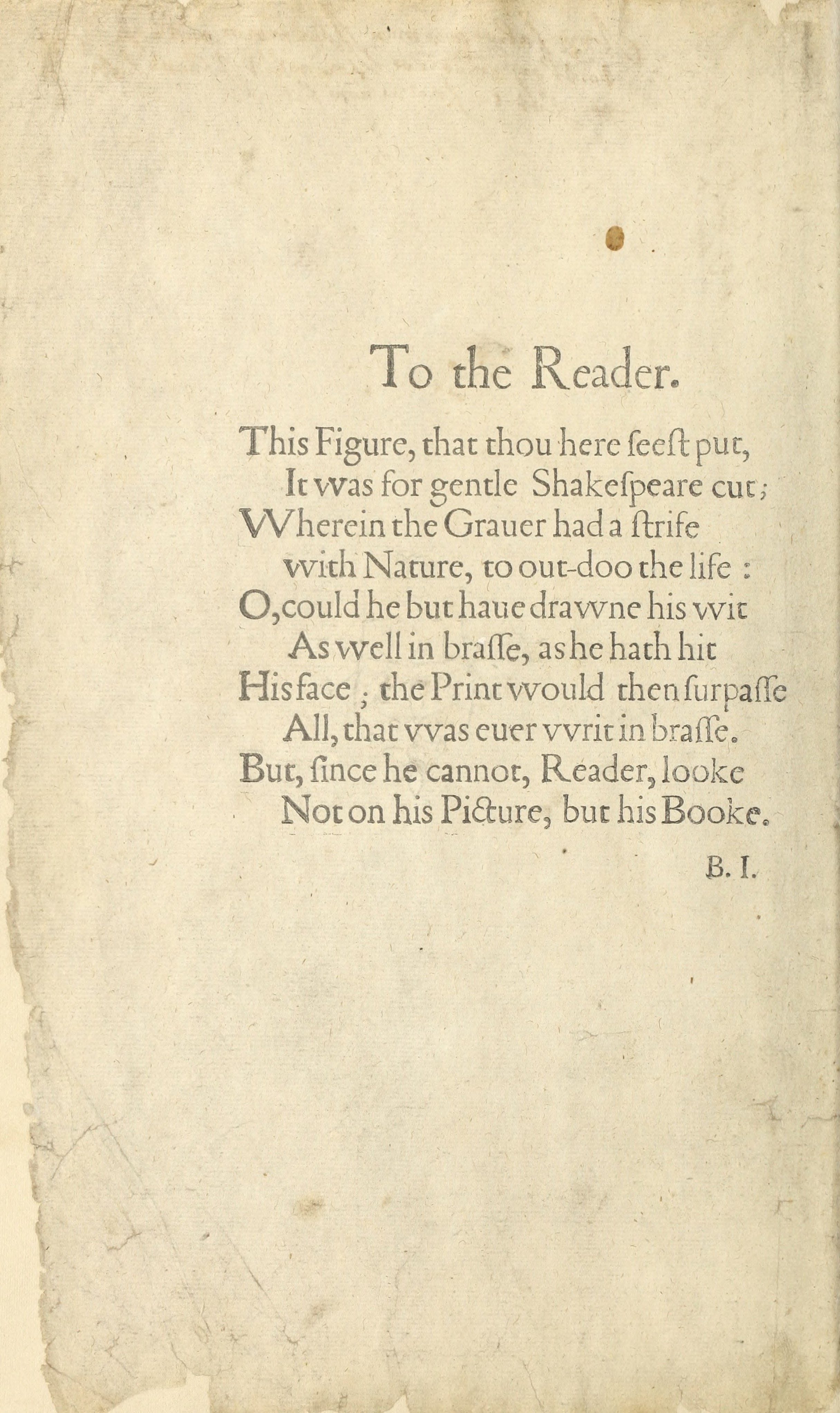
- First Folio leaf first folio 1623 leaf0008 directly verifies the
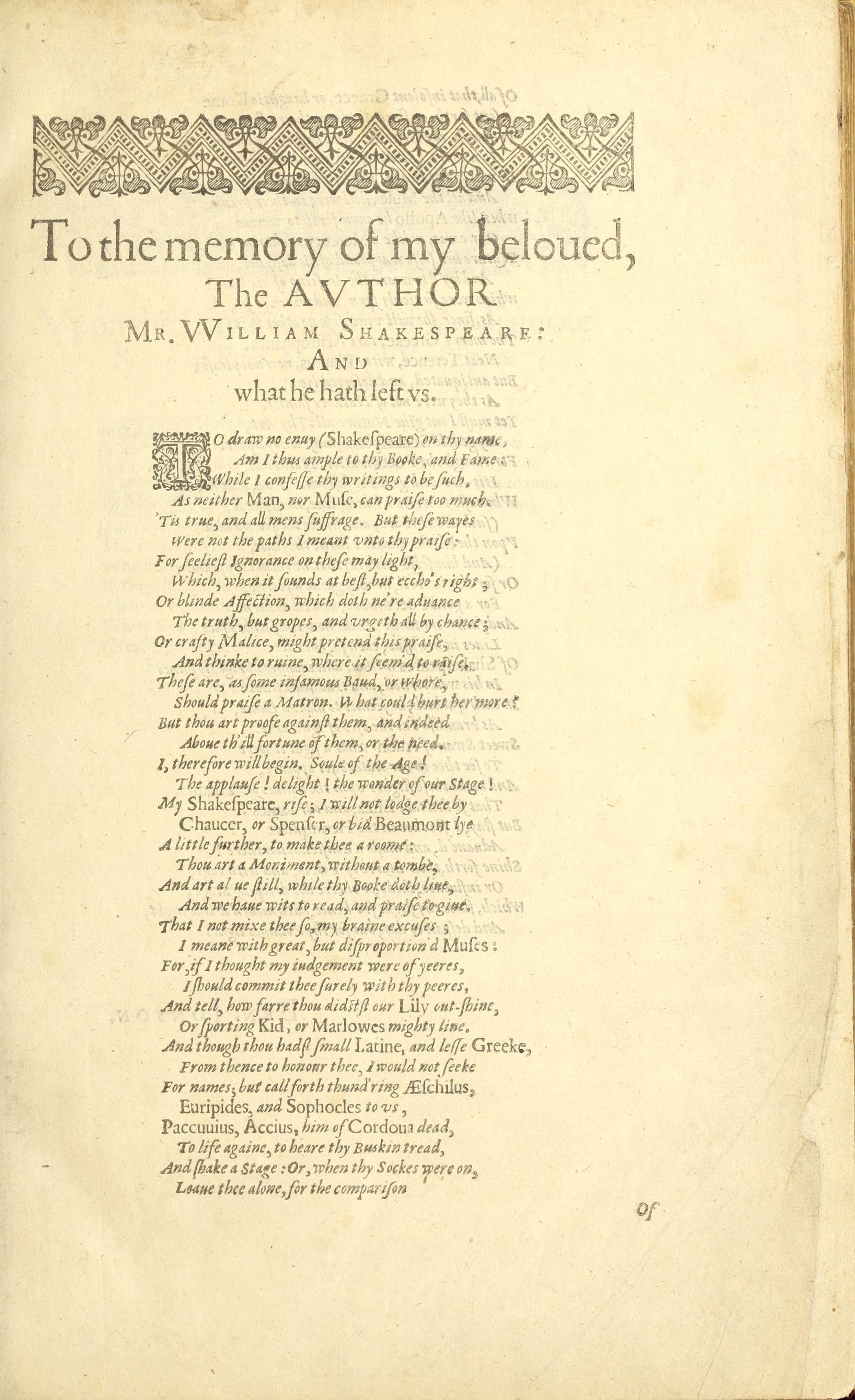
To the Readerpoem signedB.I.facing the Droeshout title page. - First Folio leaves first folio 1623 leaf0015 and first folio 1623 leaf0016 directly verify the long
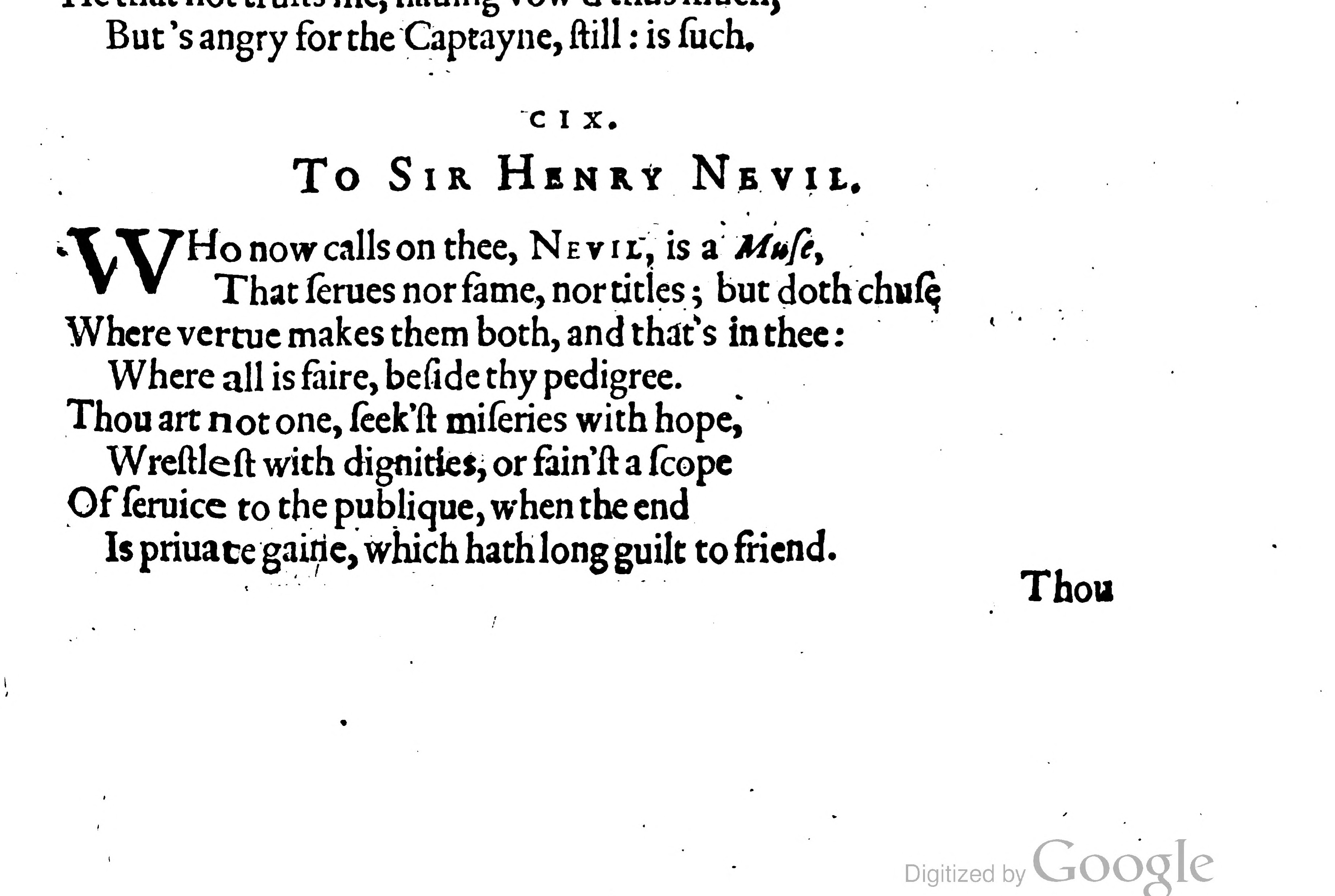
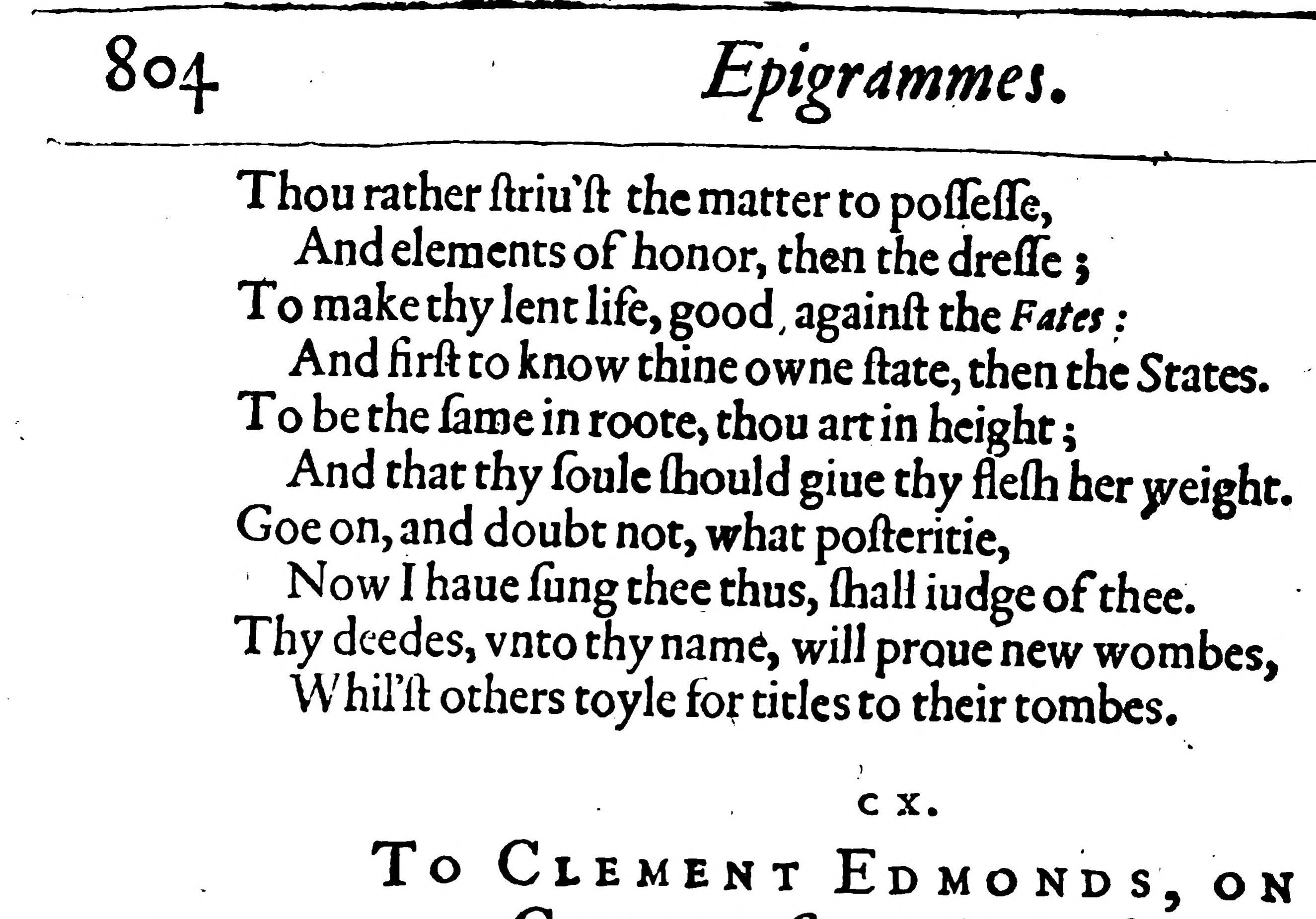
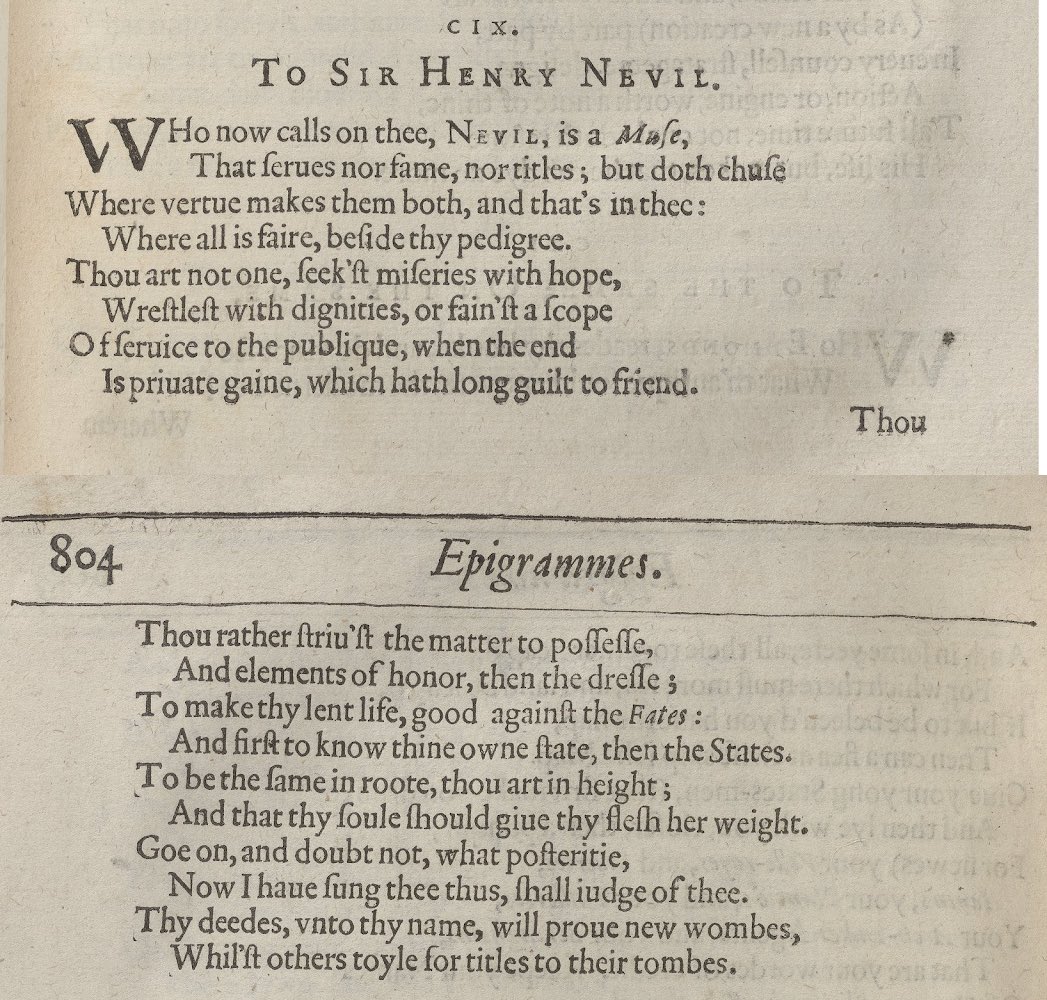
To the memory of my beloued...poem and the signatureBen: Ionson. - Jonson 1616 leaves jonson workes 1616 leaf0822 and jonson workes 1616 leaf0823 directly verify printed pages
803-804,CIX. To Sir Henry Nevil; readable crops are preserved for the opening and posterity/tombes close. - This removes the previous page-image gap for the main Jonson claims. It still does not prove Jonson edited, managed, financed, or encoded the First Folio.
Web and Edition Routes
- Web search surfaced public routes for the Nevil epigram, including a later 1692 Works transcription and modern Taylor & Francis/Oxford-style edition references.
- These are useful orientation and identity-check routes only. The controlling evidence remains the local page-image packet and EarlyPrint/TCP witnesses
A04632andA11954. - Identity guardrail: any later editorial note identifying "Sir Henry Nevil" should be checked against elder Henry Neville (
1563/4-1615) versus younger or collateral Neville lines before being imported into book prose.
Jonson Evidence Lanes
This packet now separates three Jonson lanes that older notes tended to blend: the 1623 First Folio prefatory poems, the 1616 Jonson folio epigram to Sir Henry Nevil, and later/secondary commentary or Ken Feinstein interpretation.
- EarlyPrint/TCP
A11954confirms two Jonson First Folio contributions: the Droeshout-facing poem headed "To the Reader" and signedB.I., and the long encomium headed "To the memory of my beloued, The AVTHOR MR. WILLIAM SHAKESPEARE: AND what he hath left vs," signedBEN: IONSON. A11954also controls the major Jonson phrases often cited in the First Folio lane, including "Soule of the Age," "small Latine, and lesse Greeke," and "Sweet Swan of Auon."- EarlyPrint/TCP
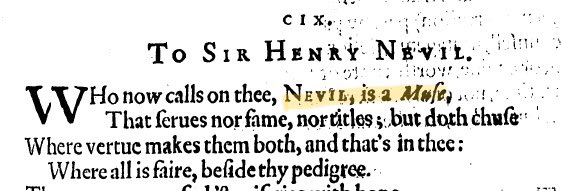
A04632confirms Jonson's 1616 epigramCIX. TO SIR HENRY NEVIL, including the opening "WHo now calls on thee, NEVIL, is a Muse," thelent lifepassage, "Goe on, and doubt not, what posteritie," and the closingtombesline. - The older wiki/Wikisource/Archive.org citations remain useful finding aids and image/page leads, but local
A04632andA11954now control the text layer. - McPherson remains the control for the narrow Jonson-library lane: Jonson owned Savile's Rerum Anglicarum Scriptores, but the annotation evidence must keep the Oxford-copy / Stratford-copy distinction preserved in the separate Savile packet.
- A scoped BRO sweep for Jonson, Ionson, First Folio, commendatory, prefatory, and posterity terms found no direct BRO manuscript witness.
Doc_73/IMG_8660is listed only as a removed screenshot of printed Ben Jonson text, not as a transcription source.
Quoted Source Passages
Follow SOURCE QUOTATION STANDARD. These are the decisive short passages for the Jonson/Neville/Haterius lanes.
First Folio Jonson witness
- Source: Mr. VVilliam Shakespeares comedies, histories, & tragedies (London, 1623),
STC 22273,TCP A11954; local First Folio page-image packet. - Quotation:
"To the memory of my beloued, The AVTHOR MR. WILLIAM SHAKESPEARE"
"BEN: IONSON"
- What it proves: Jonson is a direct signed prefatory witness in the 1623 First Folio.
- Limits: This proves prefatory authorship, not that Jonson edited, financed, compiled, or concealed the Folio.
1616 Jonson epigram to Sir Henry Nevil
- Source: Ben Jonson, The Works (London, 1616),
TCP A04632; local Jonson 1616 page-image packet. - Opening quotation:
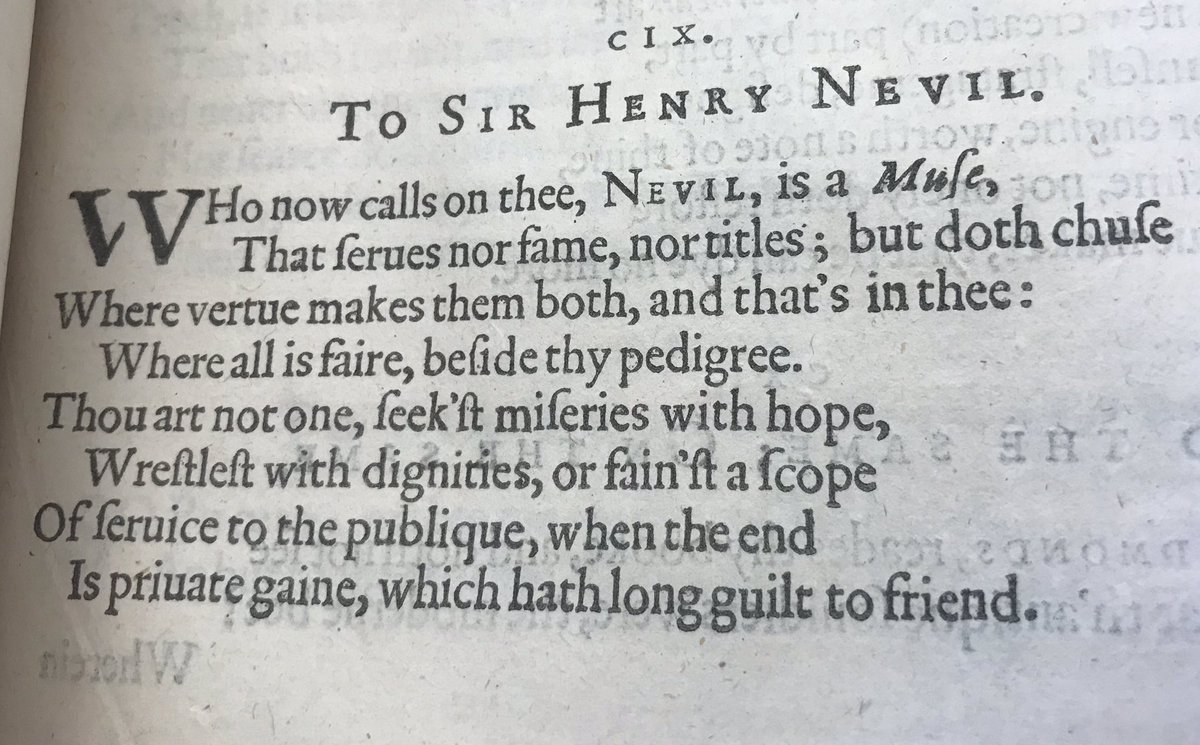
"CIX . TO SIR HENRY NEVIL . WHo now calls on thee , NEVIL , is a Muse ,
That serues nor fame , nor titles ; but doth chuse
Where vertue makes them both , and that 's in thee :
Where all is faire , beside thy pedigree ."
- Closing quotation:
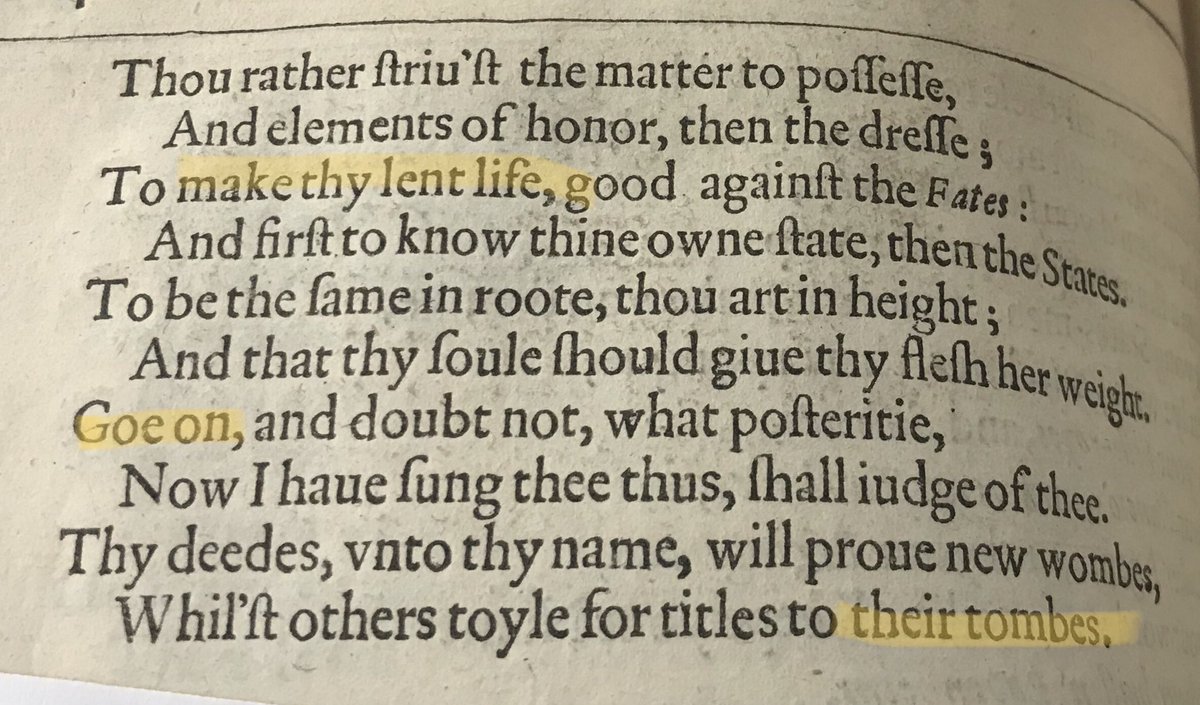
"To make thy lent life , good against the Fates :
And first to know thine owne state , then the States .
To be the same in roote , thou art in height ;
And that thy soule should giue thy flesh her weight .
Goe on , and doubt not , what posteritie ,
Now I haue sung thee thus , shall iudge of thee .
Thy deedes , vnto thy name , will proue new wombes ,
Whil'st others toyle for titles to their tombes ."
- What it proves: Jonson printed a direct epigram to Sir Henry Nevil in 1616, with posterity/tomb language relevant to the memorial question.
- Limits: Because a lost ca. 1612 Epigrammes may have existed, the 1616 witness alone cannot prove posthumous composition after Neville's death.
Haterius/Shakespeare comparison
- Source: Ben Jonson, The vvorkes of Beniamin Ionson. The second volume (London, 1641),
TCP A72473, Timber/Discoveries lane. - Quotation:
"Hee was ( indeed ) honest , and of an open , and free nature :
had an excellent Phantsie ; brave notions , and gentle expressions :
wherein hee flow'd with that facility , that sometime it was necessary
he should be stop'd : Augustus in Hat . Sufflaminandus erat ;
as Augustus said of Haterius . His wit was in his owne power ;
would the rule of it had beene so too ."
- What it proves: Jonson invokes Augustus's Haterius saying when qualifying Shakespeare's fluent wit.
- Limits: The source does not say "Shakespeare was Neville." The Neville reading depends on the classical-political analogy: Haterius as senator/orator, Neville as parliamentarian.
Haterius in Greenwey/Tacitus
- Source: Richard Greenwey's 1598 English Tacitus,
TCP A13333, Annals book 1 stage-player discipline episode; local handcheck dossierCCR PH 0057 lawfull for. - Quotation:
"many being of opinion that it it was conuenient , that the Pretor
should haue authoritie to whip the stage-plaiers . But Haterius Agrippa
Tribune of the people contradicted him : whom Asinius Gallus rebuked
in an oration : Tiberius holding his peace ; suffering the Senate to vse
that shadow of libertie . Yet Haterius preuailed , bicause Augustus had
once declared the stage-plaiers to be free from stripes"
- What it proves: the stronger tweet claim is now text-supported for Greenwey/Tacitus: Haterius appears inside the stage-player discipline controversy, not merely elsewhere in the same Tacitus witness.
- Limits: this does not prove Jonson read or used Greenwey's translation for the 1641 Shakespeare reminiscence. It proves that the Haterius/stage-player association exists in an English Tacitus available before Jonson's later printed comment.
Haterius as Senator/Orator
- Source: Greenwey/Tacitus
A13333, Annals book 4; local handcheck dossierCCR DF 0022 gsenators hsenator. - Quotation:
"In the ende of this yeere two famous men died , Asinius Agrippa ,
rather of a renowned then auncient stocke , himselfe not degenerating
from them ; and Q. Haterius descended from Senators , whilest he liued
greatly esteemed for eloquence : but monuments of his wit there are none ;
bicause he was esteemed rather for vehemencie and quicke deliuerie ,
then diligence and premeditation ."
- What it proves: the senator/orator side of the Haterius analogy is source-controlled in Greenwey's Tacitus.
- Limits: this supports the political analogy only. It is not a direct Neville identification.
Lost printed Epigrammes route
- Source: Tara L. Lyons, "New Evidence for Ben Jonson's Epigrammes (ca. 1612) in Bodleian Library Records," PBSA 114.3 (2020): 343-364; document witnesses.
- Quotation:
"Ben Jhonsons Epigrammes"
- What it proves: Lyons identifies a Bodleian records route for a now-lost printed Jonson Epigrammes before the 1616 Works.
- Limits: The record does not show whether
CIX. TO SIR HENRY NEVILwas present in that lost edition.
3. Checked Source Lanes
A. 1623 First Folio Jonson poems
- EarlyPrint
A11954identifies the 1623 First Folio as Mr. VVilliam Shakespeares comedies, histories, & tragedies, printed by Isaac Jaggard and Ed. Blount,STC 22273,ESTC S111228. - The first Jonson item appears before the title page:
- heading: "To the Reader"
- opening phrase: "This Figure"
- closing contrast: the reader should look not on the picture, but the book
- signature:
B.I. - The second Jonson item appears after Heminge and Condell's reader address:
- heading: "To the memory of my beloued, The AVTHOR MR. WILLIAM SHAKESPEARE: AND what he hath left vs"
- major control phrases: "Soule of the Age," "small Latine, and lesse Greeke," and "Sweet Swan of Auon"
- signature:
BEN: IONSON - Direct 1623 page images now control this lane:
- first folio 1623 leaf0008:
To the Reader, signedB.I. - first folio 1623 leaf0009: title page and Droeshout portrait.
- first folio 1623 leaf0015 and first folio 1623 leaf0016: long Jonson poem.
- This proves Jonson's First Folio prefatory-poem role. It does not prove he edited, compiled, financed, or managed the Folio.
B. 1616 Jonson folio epigram to Sir Henry Nevil
- EarlyPrint
A04632identifies Jonson's The Works as a 1616 printed witness. A04632confirms epigramCIX. TO SIR HENRY NEVIL.- The local XML controls the key text anchors used in the Neville argument:
- "WHo now calls on thee, NEVIL, is a Muse"
- "lent life"
- "Goe on, and doubt not, what posteritie"
- "tombes"
- Direct 1616 page images now control this lane:
- jonson workes 1616 leaf0822 nevil opening crop:
CIX. To Sir Henry Nevilopening. - jonson workes 1616 leaf0823 nevil close crop:
lent life,posteritie, andtombesclose. - This supports the factual claim that Jonson wrote an epigram to Sir Henry Nevil in the 1616 folio. The interpretation that the poem is mourning or concealment language remains an argument, not a settled source fact.
C. Donne / Beaumont / Nevil Muse pattern
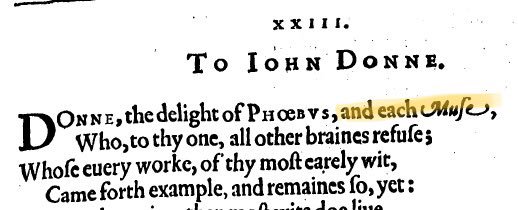
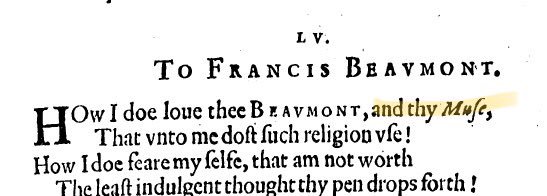
A04632confirms Jonson's epigram to John Donne begins with a line ending inMuse: "DONNE, the delight of PHOEBVS, and each Muse."A04632confirms the Nevil epigram opening "WHo now calls on thee, NEVIL, is a Muse."- The preserved Ken Feinstein tweet images show a Beaumont crop with the analogous
Museline, but this pass did not locate that Beaumont line in localA04632; the only localBeaumont/BEAVMONThits found were Francis Beaumont's prefatory signatures near the front of the volume. - Treat the three-name
Musepattern as a visual/tweet lead until the Beaumont witness is mapped to an exact Jonson text, page image, or alternate edition.
D. Jonson / Savile library lane
- McPherson confirms the Jonson-owned Savile Rerum Anglicarum Scriptores lane, with important qualification: the Oxford copy is the stronger candidate for Jonson annotation, while the Stratford copy's annotations are not Jonson's.
- This is relevant to Jonson's scholarly-library network and the Henry Savile topic, but it should not be used as proof of a First Folio production role.
E. Jonson / Shakespeare / Haterius lane
- Preserved tweets make the Haterius argument explicit:
2019-07-22: Jonson's Shakespeare/Haterius comparison is presented as a subtle reference to Henry Neville, with Tacitus, Greenwey, Seianus, and Haterius-as-senator offered as the route. Local line control: twitter Books Read:375.2021-06-30: the claim is sharpened to Haterius-as-politician and Neville-as-parliamentary leader. Local line control: Ben Jonson 4:192.2021-01-29: the prompt to compare Jonson's Shakespeare comments with Jonson's Henry Neville epigram is preserved. Local line control: Ben Jonson:137.- Primary-source control:
A72473, Jonson's 1641 second volume, preserves the Shakespeare comment in Timber/Discoveries: Jonson loved and honored Shakespeare's memory, praises his nature and fancy, then uses the Haterius tag to qualify his fluency.A13333, Greenwey's 1598 Tacitus, containsL. Hateriusin Senate/commonwealth contexts, places Haterius in the stage-player discipline episode, and later records Haterius as descended from senators and known for eloquent vehemence.B14291, Jonson's 1605 Seianus, includes a Haterius character/reference and extensive Tacitus/Dio marginal apparatus.- Core interpretive logic: Haterius was a senator/orator; Neville was a parliamentarian. The argument is that Jonson's Haterius choice may be a sly classical-political pointer to Neville while remaining deniable as a learned stylistic comparison.
- Current assessment: the Haterius allusion is real and source-controllable. The Neville inference is plausible as an authorship-project interpretation, but not a source fact. It should be written as "Jonson's Haterius comparison gives a classical senator/parliamentarian analogy that can be read alongside Neville's political identity," not as "Jonson identifies Shakespeare as Neville."
F. Lost ca. 1612 Epigrammes edition
- Tara L. Lyons's PBSA article supplies the key bibliography:
15 May 1612: John Stepneth enteredBen Johnson his Epigramsin the Stationers' Register.1612: Sir Arthur Throckmorton expectedJhonsons Epigarmmesand set aside sixpence.1612and1613: William Drummond recorded reading Jonson's epigrams.15 September 1614: Bodleian librarian Thomas James sent a title recorded asBen Jhonsons Epigrammesto binder Elias Peerse.30 September 1614: the binding consignment was returned and paid for.- The Bodleian shelfmark trail places the volume at
87 I 19 Art.for at least a few years and absent by1635. - This supports the existence of a printed, now-lost Epigrammes before the 1616 Works. It does not show the contents, order, or textual state of that lost book.
- Consequence for
CIX. TO SIR HENRY NEVIL: treat the 1616 posthumous/memorial interpretation as possible but unproved. A lost-1612 inclusion would make the poem a lifetime encomium unless 1616 revision can be demonstrated.
G. Memorial-language audit for the Nevil epigram
- Raw local
A04632controls the poem's potentially memorial language:lent life,Fates,posteritie,new wombes, andtombes. - The preserved
2019-03-03tweet thread explicitly reads these as mourning terms and calls the poem a tribute to Neville after his1615death. Local line control: twitter First Folio:75. - EarlyPrint FTS checks, using
[local source path removed], produced these controls: Sufflaminandus:1hit, JonsonA72473.Haterius:9hits, including Greenwey/TacitusA13333, Jonson SeianusB14291, SuetoniusA13126, and JonsonA72473.- exact word phrase
lent life:7index hits, several non-memorial or ambiguous; lemmalend life:24hits. - exact word phrase
calls on thee:6hits, including Shakespeare SonnetsA12043/A12044; exactnow calls on thee:0index hits. new wombes/new wombs:0word-index hits, but rawA04632confirms Jonson's line; lemmanew womb:4hits.what posteritie:9hits;what posterity:5hits. The phrase is not inherently funerary.- lemma
tomb:2861hits, sotombesis semantically relevant but not diagnostically rare. - Corpus conclusion: the language supports a memorial reading when combined with the 1616 post-death witness, but it cannot date the poem after Neville's death. The lost-1612 problem must remain explicit in any final book prose.
4. Claims Demoted or Held
- Do not cite wiki, Wikisource, or Ken tweet prose as the controlling text for the Nevil epigram when local
A04632is available. - Do not say Jonson managed, edited, compiled, financed, or concealed the First Folio unless a direct source is found. Current source control proves prefatory authorship and broader literary precedent only.
- Do not treat
B.I.as ambiguous in this packet's direct witness lane without noting that the adjacent long poem is signedBEN: IONSONand that the Droeshout poem is conventionally Jonson's. Final publication should still image-collate the page. - Do not use
Soule of the Age,small Latine,Sweet Swan of Auon, or the Stratford/Auon language as evidence for a Neville authorship route by itself. Those phrases are reception and memorial evidence. - Do not use BRO
Doc_73as a manuscript or archival witness. It is currently only a removed screenshot entry in the BRO grouping metadata. - Do not overstate the Donne/Beaumont/Nevil
Musepattern until the Beaumont crop is tied to an exact printed witness. - Do not say Jonson "called Shakespeare Haterius" without explanation. Use the stricter wording: Jonson compared Shakespeare's unchecked fluency to Augustus's saying about Haterius.
- Do not overstate the Haterius/stage-player point as a Jonson-source fact. Current local evidence now supports the Greenwey/Tacitus direct-involvement claim, but it does not prove Jonson used Greenwey for Timber/Discoveries.
- Do not use Jonson's Seianus as proof of Greenwey dependence. The checked local witness proves Tacitus/Dio source work; the Haterius note there points to Dio.
- Do not state that the Nevil epigram was certainly written after Neville's death. The 1616 witness is posthumous, but the lost ca.
1612Epigrammes may already have contained the poem.
5. Book-Safe Formulation
A source-controlled version can say:
Ben Jonson is a direct First Folio prefatory witness: EarlyPrint
A11954preserves the title-page-facing poem signedB.I.and the longer Shakespeare encomium signedBEN: IONSON. Jonson is also a direct Neville witness in his own 1616 folio:A04632prints epigramCIX. TO SIR HENRY NEVIL, opening with Nevil as aMuseand later invoking posterity. These are real textual connections. They do not by themselves prove that Jonson organized the First Folio, concealed authorship, or transmitted Neville manuscripts.
For the Haterius lane, a book-safe sentence is:
In Jonson's later Shakespeare reminiscence, preserved in the 1641 second volume, Jonson praises Shakespeare's nature and imagination but says his fluent wit sometimes needed checking, invoking Augustus's saying about Haterius. Because Haterius is a Roman senator/orator in the Tacitus/Suetonius tradition, the comparison can be read as a discreet political allusion to Sir Henry Neville, a parliamentarian whom Jonson separately praised. That is an interpretive connection, not a direct identification.
The Greenwey/Tacitus support can be added cautiously:
Greenwey's 1598 English Tacitus strengthens the classical route because it presents Haterius both as a Senate/oratory figure and, in book 1, as the man whose intercession prevailed in a dispute over the punishment of stage-players. This makes the Haterius choice unusually apt for a learned, theatrical, political allusion, while still falling short of proving Jonson's intent.
For the Nevil epigram dating lane, a book-safe sentence is:
The 1616 Works prints Jonson's epigram to Sir Henry Nevil after Neville's death, and its language of
lent life,Fates, posterity, andtombesis compatible with memorial reading. But Tara Lyons's evidence for a lost printed Epigrammes before 1616 means the poem may have existed while Neville was alive unless we can prove it was absent from the lost ca. 1612 edition or revised after July 1615.
6. Citations
- Shakespeare, William. Mr. VVilliam Shakespeares comedies, histories, & tragedies. London: Isaac Jaggard and Edward Blount,
1623.STC 22273;TCP A11954;ESTC S111228. EarlyPrint database:[local source path removed]. Header: A11954 header. - Jonson, Ben. The Works. London: printed by Will. Stansby,
1616.TCP A04632. EarlyPrint database:[local source path removed]. Header: A04632 header. - Jonson, Ben. The vvorkes of Beniamin Ionson. The second volume. London,
1641.TCP A72473. EarlyPrint database:[local source path removed]. Controls the Timber/Discoveries Haterius/Shakespeare reminiscence. - Internet Archive / Boston Public Library copy of Jonson's second volume, including Timber, or Discoveries (
1641): https://archive.org/details/vvorkesofbeniami00jons. - Jonson, Ben. Seianus his fall. London: G. Elld for Thomas Thorpe,
1605.TCP B14291. EarlyPrint database:[local source path removed]. - Tacitus, Cornelius. The annales of Cornelius Tacitus. The description of Germanie. Translated by Richard Greenwey. London,
1598.TCP A13333. EarlyPrint database:[local source path removed]. - Lyons, Tara L. "New Evidence for Ben Jonson's Epigrammes (ca. 1612) in Bodleian Library Records." Papers of the Bibliographical Society of America
114.3(2020):343-364. document witnesses: lyons new evidence jonson epigrammes 1612 pbsa 2020. Gmail source: Gregory Thompson to Ken Feinstein,Jonson epigrammes,2020-08-17, attachment710019. - Internet Archive / Boston Public Library. Mr. VVilliam Shakespeares comedies, histories, & tragedies,
1623: https://archive.org/details/mrvvilliamshakes00shak. - Internet Archive / Google Books-derived scan. The workes of Benjamin Jonson (1st folio),
1616: https://archive.org/details/workesofbenjamin01jons. - First Folio / Herbert / Jonson image packet,
2026-06-20: SOURCE NOTES. - McPherson, David. "Ben Jonson's Library and Marginalia: An Annotated Catalogue." Studies in Philology, vol. 71, no. 5, Texts and Studies,
1974, pp.1,3-106. JSTOR 4173858. document witnesses: McPherson BenJonsonsLibrary 1974. - "Books from Ben Jonson's library at the Folger." Folgerpedia, Folger Shakespeare Library, https://folgerpedia.folger.edu/Books_from_Ben_Jonson%27s_library_at_the_Folger.
- Jonson, Ben. The Workes of Benjamin Jonson,
1692folio,Epigrams, public transcription with commentary: https://hollowaypages.com/jonson1692epigrams.htm. Reception/commentary witness only. - Feinstein, Ken. Preserved local First Folio tweet file: twitter First Folio.
- Feinstein, Ken. Preserved local Ben Jonson tweet file: twitter Ben Jonson.
- Related source-control packet: ben jonsons library and henry savile.
7. image witnesses Witnesses and Page-Image Controls
Direct page-image controls
Preserved tweet-media witnesses
8. Notes on Access
- The First Folio and 1616 Jonson folio evidence is now controlled at both EarlyPrint/TCP XML/transcription level and direct page-image level for the key Jonson passages. Remaining work: compare against other copy-specific witnesses for variant-state control.
- The tweet images remain useful orientation, but book prose should quote from page images or checked local XML, not from tweet text alone.
- The separate Jonson/Savile packet should continue to carry the library/provenance qualifications.
9. Direct 1641 Timber / Discoveries Page Images, 2026-07-09
The Internet Archive/Boston Public Library witness vvorkesofbeniami00jons supplies direct colour images of the decisive passage at printed pp. 97-98.
- Ben Jonson Timber 1641 IA vvorkesofbeniami00jons page n804 begins beneath the heading
Discoveriesand carries the marginal labelDe Shakespeare nostrat.It reads:
I remember, the Players have often mentioned it as an honour to Shakespeare, that in his writing, (whatsoever he penn'd) hee never blotted out line. My answer hath beene, would he had blotted a thousand.
I lov'd the man, and doe honour his memory (on this side Idolatry) as much as any. Hee was (indeed) honest, and of an open, and free nature; had an excellent Phantsie; brave notions, and gentle expressions: wherein hee flow'd with that facility, that sometime it was necessary he should be stop'd: Sufflaminandus erat; as Augustus said of Haterius.
The page images confirm the local TCP text and clarify the argument's structure. Jonson first rejects the players' uncritical “never blotted” praise, then explicitly affirms love, honour, honesty, imagination, and expression before applying the Haterius check to excessive fluency. The classical comparison is real. A Neville identification is not stated.
10. Lost Epigrammes PDF Recheck
Tara L. Lyons's local PBSA PDF was rechecked directly. It documents:
- the
15 May 1612Stationers' Register entry,Ben Johnson his Epigrams; - the
15 September 1614Bodleian binding-list entry,Ben Jhonsons Epigrammes; - the return of the bound book on
30 September 1614; - assignment to shelfmark
87 I 19 Art.; - absence by
1635.
The lost book is therefore much better than a conjectural project: a printed copy appears to have entered and circulated through the Bodleian. But no surviving contents list proves whether CIX, To Sir Henry Nevil, belonged to that pre-1616 state. The packet retains both dating branches.
11. Completion Review, 2026-07-09
- Direct page images now control Jonson's First Folio poems, the 1616 Nevil epigram, and the 1641 Shakespeare/Haterius passage.
- Local TCP controls Jonson, Greenwey's Tacitus, and Seianus; the Lyons and McPherson PDFs supply bibliographical and library-history context.
- The packet is ready as a research base because every major claim has a source lane and an explicit limit. Remaining copy comparison, Cambridge-commentary, and lost-book contents questions are future refinements, not reasons to suppress the evidence already secured.
- Full cluster work log: PUBLICATION RECEPTION CLUSTER SOURCE PASS 2026 07 09.
12. Book Integration Update — 2026-08-31
- Chapter 36 reproduces the complete 1616 CIX,
TO SIR HENRY NEVIL, and treats the named poem as the high-value fact: Muse, public service, self-knowledge and States, song, deeds, name, and posterity attach directly to Neville. - Neville's 16 February 1603 O.S. letter to Winwood supplies an independent authenticity control for Jonson's opposition between public ends and private gain, imposed service and sought office, honor and dress, private state and public affairs. No claim is made that Jonson saw the letter.
- The lost printed Epigrammes is documented in Bodleian records by 1614, but no surviving contents list proves that CIX was present. The poem's composition date remains unresolved.
- Sonnet 38's calls on thee/Muse reversal is medium-high exploratory support; Sonnet 29's double rhyme relation is medium exploratory support, with Robert Parry's 1597 poem retained as a uniqueness control.
- The Jonson page images, glosses, book history, interpretation, and textual comparisons are controls on evidence families, not independent votes.