Essex Rebellion
Topic: Essex Rebellion
Camden's Four-Episode Narrative: First-Witness Control
The dedicated Camden *Annales* packet now supplies a page-image collation of the first complete Latin edition (1625, USTC 1028004) and the earliest English Part II (1629, USTC 3014090). Camden connects four stages: Essex names Neville as “not ignorant”; Cuffe's trial recounts his approaches to Neville; Cuffe apologizes for endangering him; and Neville is examined at York House about Drury House and the French embassy journal.
The evidentiary guardrails are important. “Not ignorant” alleges knowledge, not participation. Camden says he was present and heard Neville's confession read, but Browne's 1629 translation removes both that eyewitness claim and Camden's memory qualification. Browne also changes the Latin clause about Essex moving against the Queen to an “inuasion of the Court.” The earliest Latin says Neville was adjudged to prison; the explicit Tower wording comes from Norton and independent custody evidence.
The report with facsimiles, transcriptions, fresh translation, and discrepancy table is CAMDEN ESSEX NEVILLE 1625 1629 COMPARATIVE REPORT 2026 08 03.
Fulke Greville: close to Essex, but not part of Neville's recruitment
The new Greville/Neville research sharpens the Essex network without turning it into a single conspiracy. Greville maintained lodgings at Essex House by 1597, dealt directly with Cuffe over the attempted publication of Essex's Cadiz True Relation, and was named with Neville to a Commons committee on military abuses on 27 January 1597/98. These are documented connections before the rising.
Neville's 1600-01 recruitment route remains Cuffe, Southampton, Davers, and Drury House. No checked source says that Greville recruited Neville, attended the Drury House meeting, supported the rising, or intervened for Neville afterward. In 1602, Savile separately mediated for Neville's release and for Greville's desired return from his Plymouth naval office; those were two different petitions.
The dedicated source map is fulke greville and henry neville.
Source-Control Summary
- Neville confession anchor:
my duty and conscience binding meframes the statement as compelled/self-protective disclosure (Nevill to Cecil 1601 03 02 ODonnell transcription). - Cuffe anchor: Neville says
mr. Cuffehad been persuading him fortwo or three moneths. - Tower-risk anchor: Neville reports talk of
seasing the Tower. - Guardrail: quote Neville as a participant-witness under pressure; do not turn his confession rhetoric into neutral motive analysis without Duncan, Bacon/Winwood, and Cuffe controls.
- Source-separation correction: Winwood's Case is a related apologia, not the printed text of the 2 March declaration. Detailed collation: CONFESSION CASE SOURCE SEPARATION AND VIZARD COLLATION 2026 07 13.
- New Chamberlain image control: State Papers Online now supplies the manuscripts behind the
24 February 1601,8 July 1601, and8 May 1602reports. Their related calendars separate three stages: Neville revealed Thomas Lee's scheme; Neville later appeared before the Lords while his penalty remained unknown to Chamberlain; and Neville expected release after agreeing to a £5,000 fine payable at £1,000 a year.
Source Stratigraphy and Date Correction
Three Neville documents have repeatedly been compressed into one “confession.” They must be kept distinct:
| Date / witness | Document | Evidentiary function |
|---|---|---|
c. 26 February 1601 (endorsed February 1600 Old Style) | Neville to Cecil, Hatfield/Cecil Papers (77.15) | A short covering letter: Neville says he has written out what he remembers of the “late wicked practice” and will send it to Cecil and the lord admiral. It does not contain the Drury House narrative. |
2 March 1601 modern dating (Secundo Marcij 1600 Old Style) | Neville's full declaration, calendar item SP 12/279/11, locally routed to fol. 15; O'Donnell transcription | The detailed chronological narrative naming Cuffe, Southampton, Danvers, the court-gate plan, guard halberds, Parliament, and the Tower. This is the source quoted in §§1-4 above. |
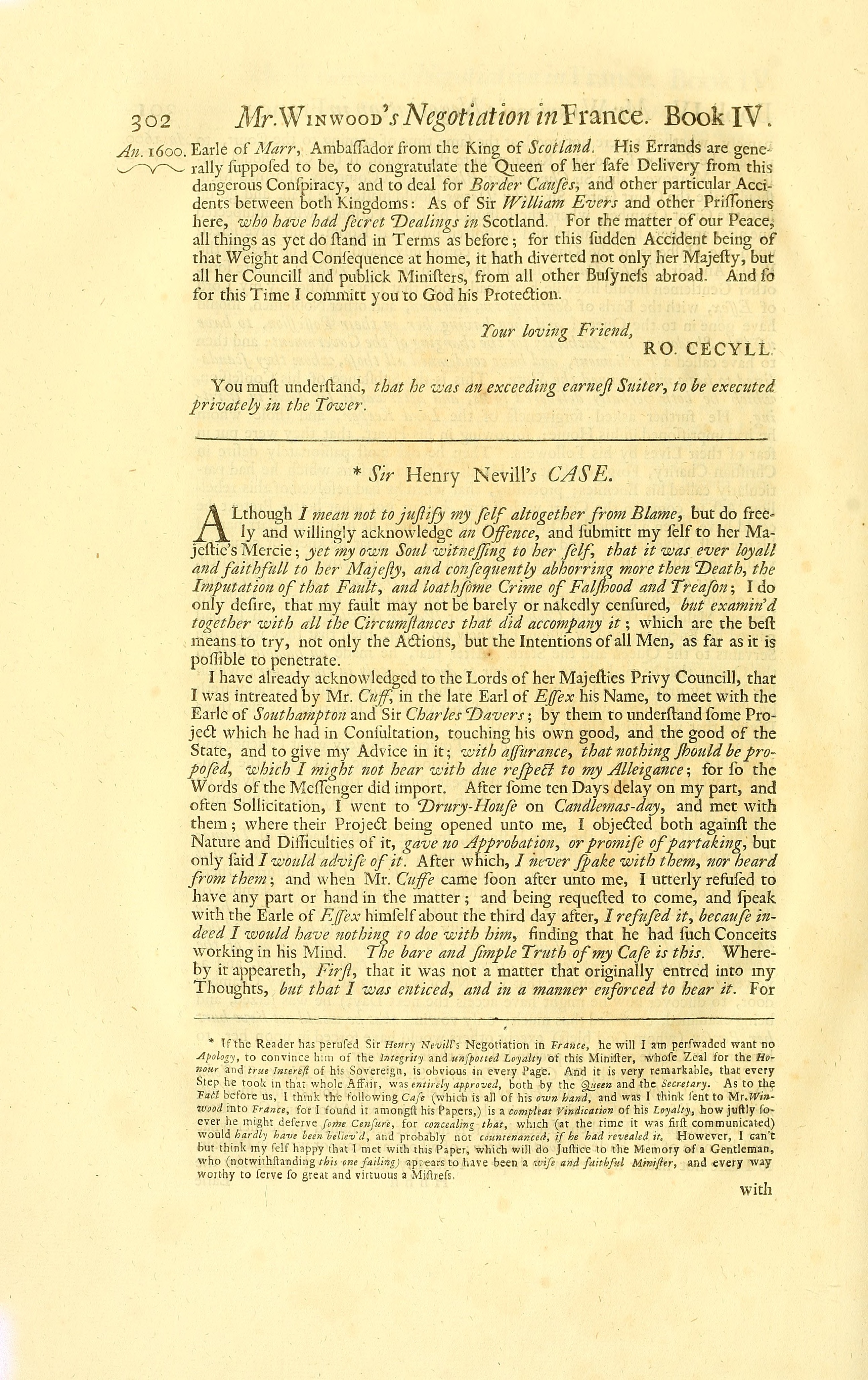
undated aftermath text, printed by Winwood in 1725, pp. 302-304 | “Sir Henry Nevill's CASE” | A compressed apologetic brief admitting concealment while denying consent or participation. It is not the same text as the 2 March declaration. |
The former project date 26 February 1602 is an error. BHO's Cecil Papers page dates the covering letter [1600/1, c. Feb. 26]; the rebellion, Essex's execution, the 2 March declaration, and Cuffe's 13 March execution all belong to 1601 in modern reckoning.
This distinction materially improves book use. The covering letter documents Neville's custody posture; the declaration supplies event detail; the Case is a later or parallel defense organized as an argument about culpability.
Quoted Source Passages
1. Neville Frames the Confession as Duty-Bound Disclosure
- Source: Henry Neville to Robert Cecil, confession/apology statement,
2 March 1601, O'Donnell transcription; local text Nevill to Cecil 1601 03 02 ODonnell transcription. - Quotation:
"Right honnorable, my duty and conscience binding me, besides your hors. commaundment, to declare whatsoever hath com to my knowledge touching the desseins and the enterprises of the late Erle of Essex, I have faithfully set yt downe in this evill couched narration following: and not only that, but whatsoever els hath passed betweene me & him or any of his complices since my comming out of france, that your hors. seeing all the circumstances that concerne mee laid open before you, may make the cleerer Iudgement of my intention."
- What it proves: Neville's statement belongs to the Essex aftermath as a formal disclosure about Essex's designs and enterprises.
- Limits: The opening rhetoric is self-protective; cite it as Neville's statement posture, not as neutral proof of motive.
2. Cuffe Is Named as the Agent Drawing Neville Toward Southampton and Davers
- Source: Same
2 March 1601O'Donnell transcription. - Quotation:
"when I aunswered that my lord might as well deliver his mind to me by him as by them, he said my lord had rather made choice of them then of him, to breede a confidence betweene them & mee And indeede mr. Cuffe had bin at least two or three moneths perswading me to make acquaintance with my l. of Southhampton & Sr. Charles Davers who he said did greately desire notwithstanding I still omitted yt."
- What it proves: Neville identifies Cuffe as a sustained intermediary before the rebellion, not as an incidental messenger, and specifically links Cuffe's pressure to Southampton and Sir Charles Davers.
- Limits: It does not alone establish what Cuffe intended beyond Neville's account; compare with Cuffe execution and Bacon/State Papers material.
3. The Confession Describes the Proposed Court Action
- Source: Same
2 March 1601O'Donnell transcription. - Quotation:
"yt was proposed to send som 40 persons in severall Companies to the muse who vpon the discovery of my lordes approach ... should make on before to the Court gate & possesse yt, And som other of theire company to be before in the hall of the court, who vpon the sight of their possessing the gate, should make vp into the gard chamber and sease vpon the gardes halberds & so be masters of that chamber."
- What it proves: Neville reports a concrete court-access plan involving a gate, the guard chamber, and seizure of halberds, not merely a vague grievance meeting.
- Limits: Neville is reporting what was proposed to him; the passage does not prove operational feasibility or that Neville approved the plan.
4. The Confession Includes the Tower-Seizure Rumor
- Source: Same
2 March 1601O'Donnell transcription. - Quotation:
"In speech of their meanes I do not remember that they spake of above 120 hands. som noble men they named that they would take along with them, as among other my l. of Rutland. But they said they could not trust him with the matter above two howres before they attempted yt. they spake of seasing the Tower as a matter which they could do when they would, by the meanes of Sr John Davies..."
- What it proves: Neville's account reaches beyond a private meeting into a live report of violent strategic options, including the Tower and a named supposed means through Sir John Davies.
- Limits: Neville reports talk of a plan; this does not prove the Tower plan was real, feasible, or approved by Neville.
5. Chamberlain Gives the Tower-Aftermath Chronology
- Source: John Chamberlain letters in McClure, Letters of John Chamberlain, vol. 1, pp.
122,145,192; document witnesses uc1 32106005854481 1782657835. - Quotation:
"Sir Harry Nevill ... is in the Towre"
"lookes every day to come out of the Towre"
"delivered out of the Towre"
- What it proves: Chamberlain supplies an outside-news sequence for Neville's imprisonment, expected release, and later delivery from the Tower.
- Limits: These are printed edited letters, not prison administrative records; use the APC and PRO access documents for custody mechanics.
State Papers Online now upgrades three stages from edition-only routes to identified manuscript-image records, without changing the edition's wording:
| Date | Manuscript | Gale record | Calendar significance |
|---|---|---|---|
24 February 1601 | SP 12/278 f.216, scans 217-219 | `MC4304581225` | Thomas Lee disclosed his intended privy-chamber action to Neville and Sir Robert Crosse; both revealed it. This is distinct from Neville's later concealment of the Essex project. |
8 July 1601 | SP 12/281 f.13, scans 14-16 | `MC4304680156` | Neville had appeared before the Lords; Chamberlain did not know the penalty. |
8 May 1602 | SP 12/284 f.13, scans 15-17 | `MC4304680547` | Neville expected release after agreeing to pay the £5,000 fine in five annual instalments, with the first payment immediately. |
These are calendar summaries linked to the manuscript images, not fresh diplomatic transcriptions. Their strongest use is chronological and comparative: Neville's prompt disclosure of Lee's plan is a useful negative control against his admitted failure to disclose the Essex project.
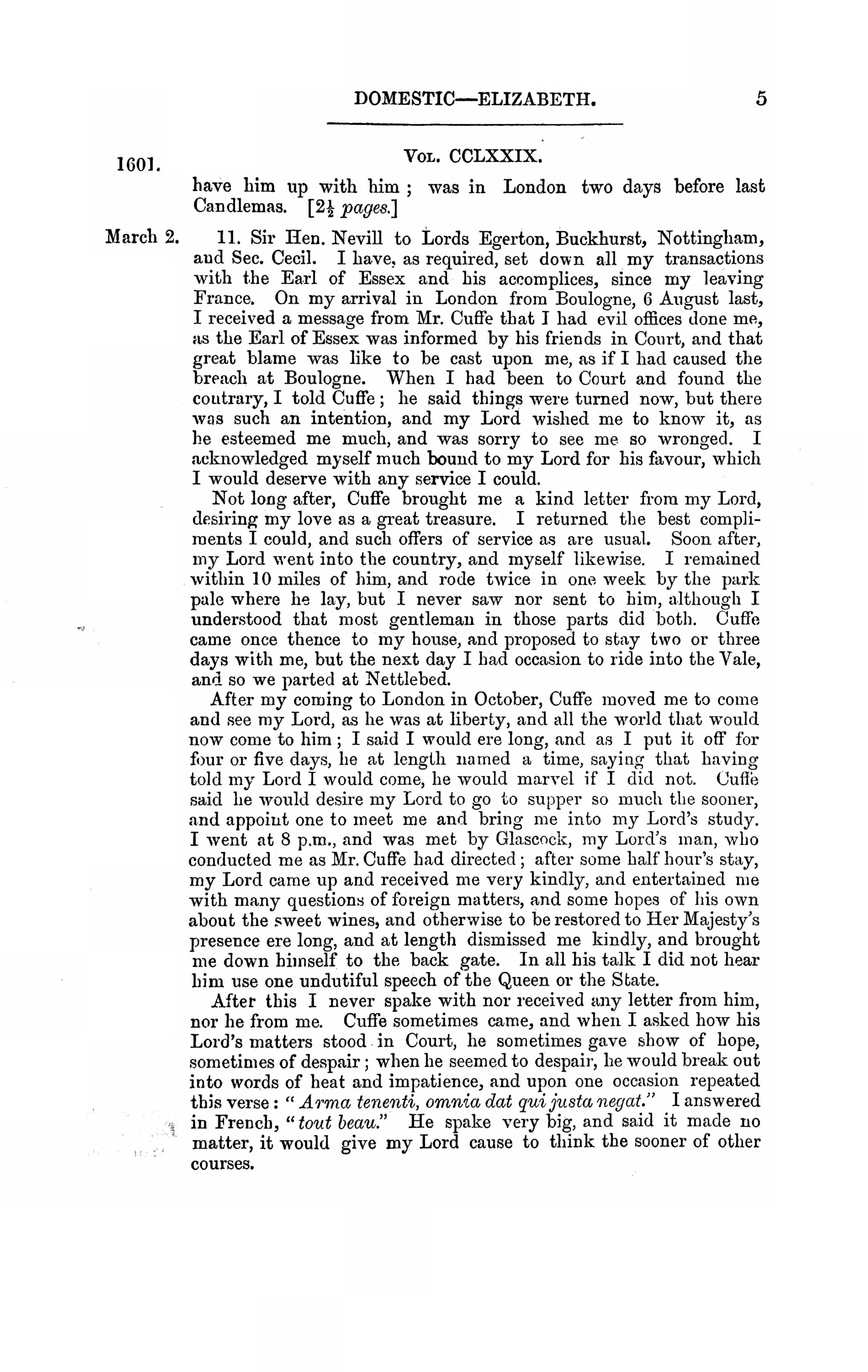
6. The Official Calendar Independently Summarizes the Full Declaration
- Source: Calendar of State Papers, Domestic, Elizabeth, 1601-1603, pp.
5-8, vol.CCLXXIX, item11,2 March 1601; exact page images and OCR preserved locally. - Quotation:
“I have, as required, set down all my transactions with the Earl of Essex and his accomplices, since my leaving France.”
- What it proves: The calendar supplies a public, independently edited control for the O'Donnell transcription and confirms that the declaration occupied
7¾ pagesin the underlying State Papers. - Limits: The calendar modernizes and summarizes. For wording, use the O'Donnell transcription only with its manuscript-collation caveat.
7. Winwood's Case Admits Concealment but Denies Participation
- Source: Ralph Winwood, Memorials, vol. 1 (
1725), pp.303-304, checked against exact Archive.org page images. - Quotation:
“I do freely and from my Heart, acknowledge my Offence in concealing of it”
“I did not consent to it upon any evil Ground”
- What it proves: Neville's apologetic position was not a denial that he knew of the project. It conceded concealment while arguing that contempt for an “unlikely” project, reluctance to become an accuser, and absence of disloyal intent explained the failure to report.
- Limits: Winwood published the text in
1725and openly defended Neville in an editorial note. The printed Case is a partisan preservation witness, not a neutral judgment.
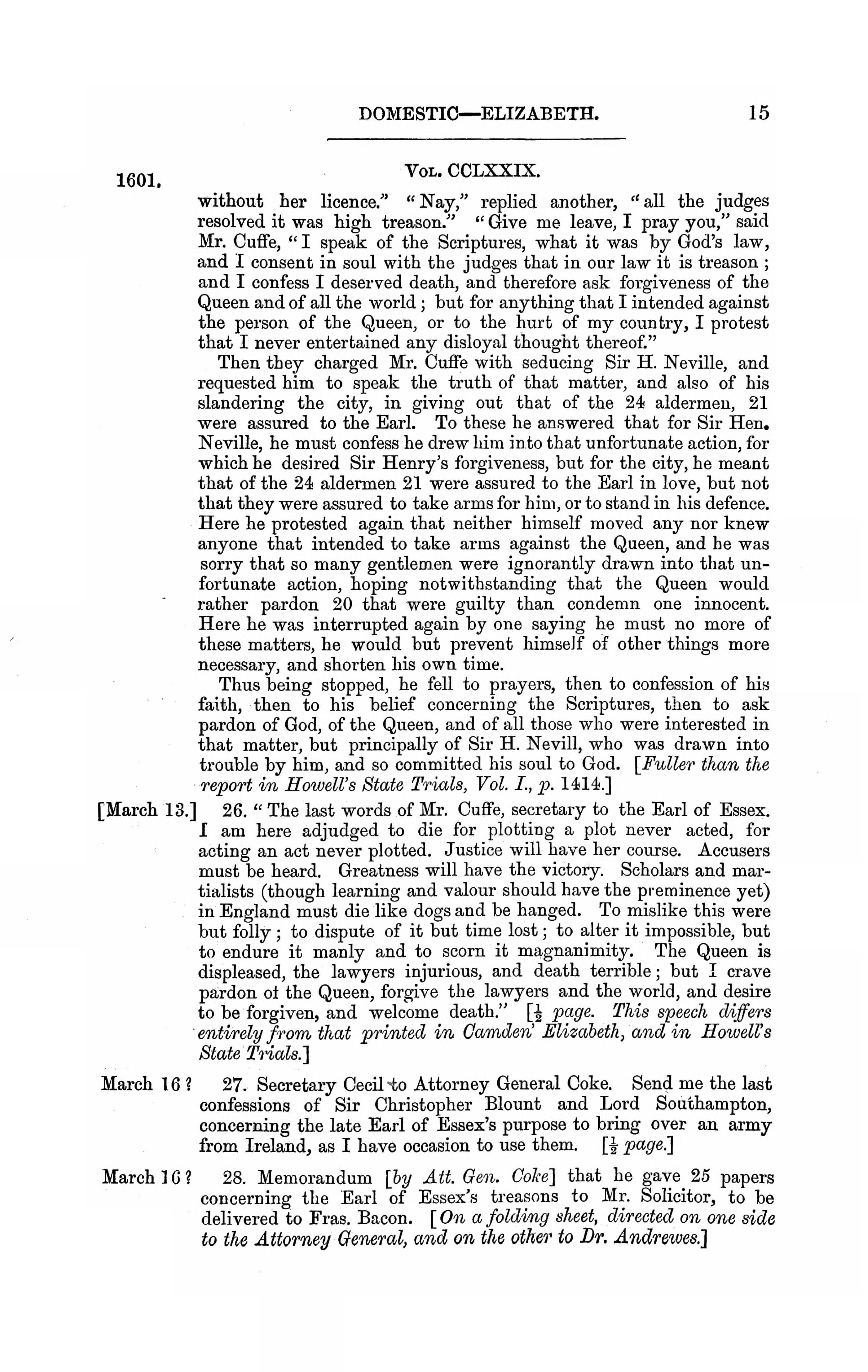
8. The Cuffe Calendar Preserves Two Different Scaffold-Speech Witnesses
- Source: Calendar of State Papers, Domestic, Elizabeth, 1601-1603, pp.
14-15, vol.CCLXXIX, items25-26,[13 March 1601]. - Item
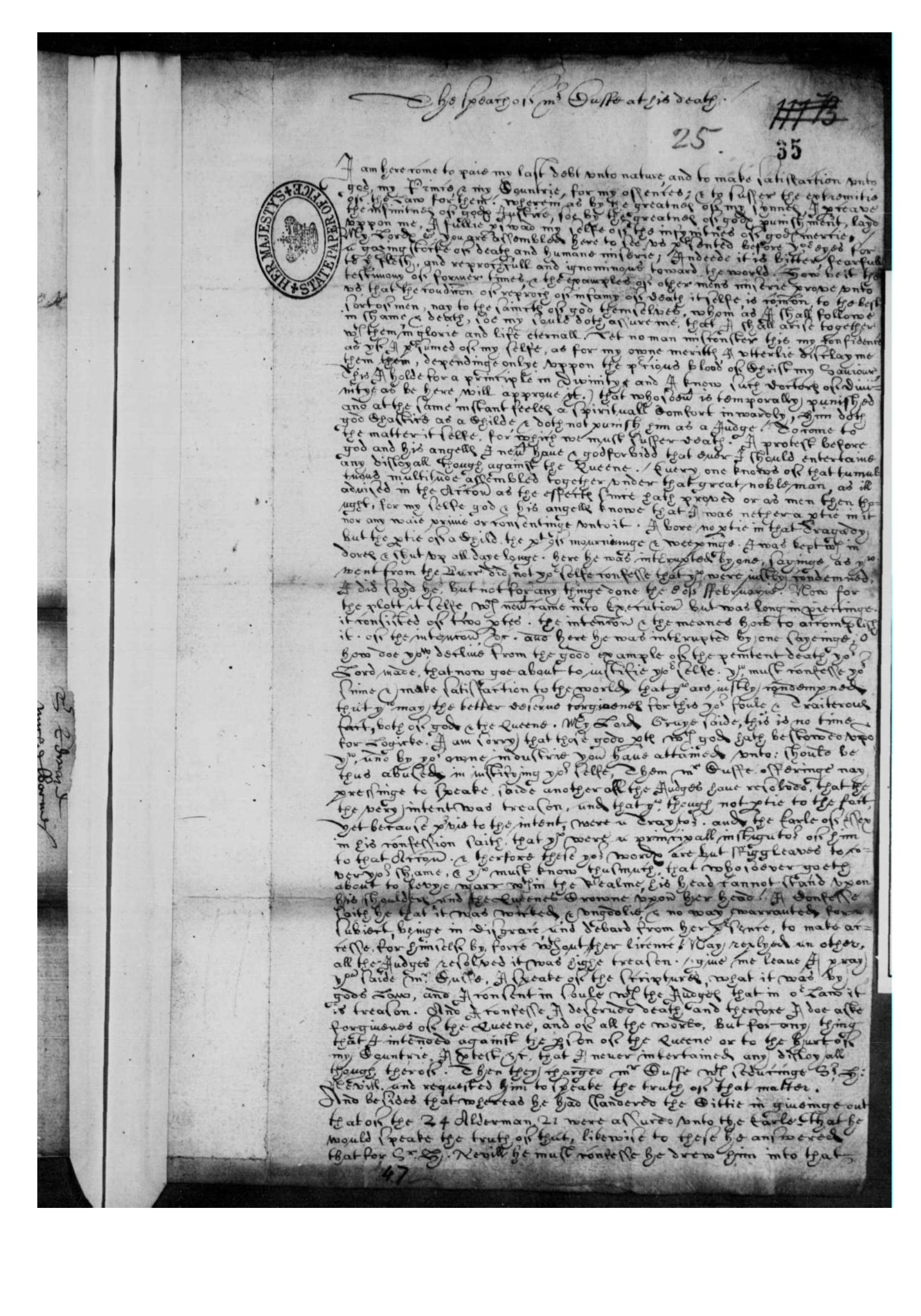
25is the long, interrupted speech in which Cuffe disputes the scope of his guilt, admits drawing Neville in, and asks Neville's forgiveness. - Item
26is a separate half-page “last words” witness beginning:
“I am here adjudged to die for plotting a plot never acted, for acting an act never plotted.”
- What it proves: There is no single transparent “Cuffe execution speech.” At least two materially different State Papers witnesses survive, and the calendar itself says item
26differs entirely from Camden and Howell. - Limits: Scaffold speech is a mediated genre, shaped by auditors, interrupters, reporters, and later editors. The Neville admission in item
25is unusually useful because it matches the direction of Neville's own declaration, but it is still reported speech.
1. Verified Sourced Facts
- The local wiki page for
Essex Rebellionstates that it gathers:
“Francis Bacon's accounts”
“Henry Neville's documents: Full confession and apology/justification for his role, recorded in Winwood's Memorials (Volume 1, pp. 302-304)”
“Robert Cecil's correspondence: Letter to George Carew (1555-1629) describing the rebellion and mentioning Neville”
“Additional records: Henry Cuffe documents, Venetian ambassador's report on Neville's release, and correspondence with Dudley Carleton”
- Source correction: the wiki description above conflates two texts. Winwood prints the separate Case; the full declaration is
SP 12/279 f.15and is independently summarized in CSPD Elizabeth, vol.CCLXXIX, item11, pp.5-8. - The local source note for the Richmond Palace performance materials states that on
7 February 1601Essex supporters procured a special performance of:
“Richard II”
- Neville's full declaration of
2 March 1601(signedSecundo Marcij 1600Old Style) says that he had been:
“entreated by Mr. Cuff, in the late Earl of Essex his name, to meet with the Earl of Southampton and Sir Charles Davers”
- The same statement says Neville was to:
“understand some project which he had in consultation”
- The same statement also says:
“there was a purpose to take some pretext to lay up my Lord of Southampton”
- The same statement records:
“there came by in coach my Lords of Essex and Southampton, Sir Christopher Blunt and Sir Charles Davers”
- The same statement records:
“I went thence soon after to Drury House, and there found my Lord of Southampton with Sir Charles Davers”
- The local import log for the Winwood case pages identifies Neville’s confession as opening:
“my duty and conscience binding me... to declare whatsoever hath com to my knowledge touching the desseins and enterprises of the late Erle of Essex.”
- The Calendar of State Papers entry for Cuffe's execution speech,
SP 12/279 f.35, records that Cuffe was charged with seducing Sir Henry Neville and acknowledged drawing Neville into the action.
- The same entry says Cuffe asked pardon "principally of Sir H. Nevill," who had been drawn into trouble by him.
- McClure's Chamberlain edition adds a compact contemporary-news sequence for Neville's Tower aftermath: p.
122reportsSir Harry Nevillin the Tower; p.145reports that Sir Henry Nevill expected release after agreeing to his fine; p.192reports the10 April 1603delivery of Southampton and Neville from the Tower by royal warrant.
- Kevin D. Lindberg's dissertation is useful secondary context for the Essex Rebellion cluster because it treats Essex's public identity as a deliberately constructed cultural persona joining military honor with learning, intelligence, Tacitean historiography, and political counsel.
- Lindberg's broader caution is also useful: Essex's circle was not operating from one clean political theory. The rebellion grew out of overlapping languages of honor, resistance, succession anxiety, Tacitism, and factional grievance. This helps explain why Cuffe's classical and Aristotelian readings mattered without turning them into a single doctrinal program.
- Duncan integration note: Owen Duncan's dissertation chapter 5, headed in the table of contents as "A Victim of Vaulting Ambition," is mined here as an Essex source map. Duncan's useful extraction points are Cuffe's Oxford/Savile/Winwood/Essex position, Cuffe's approach to Neville after Boulogne, Neville's secret Essex contact, the Drury House meeting, Neville's failure to warn Cecil, and Neville's later confession/apology. Duncan argues that ambition explains Neville's silence better than honor alone; that is an attributed interpretation, not a direct source fact.
- Core image controls now exist at two levels: Bacon's
1601declaration; Winwood vol. 1 pp.301-304; Gale/SPO manuscript renders for the Neville declaration and Cuffe speech; and newly preserved Archive.org calendar page images for the Neville declaration (printed pp.5-8) and both Cuffe speech witnesses (printed pp.14-15). This completes the printed-witness collation floor but not diplomatic manuscript transcription.
- Confession/Hamlet source note: the confession is stronger as a primary Essex-aftershock and Tower/court-access document than as a proof-by-parallel packet. The direct phrase checks preserve several Hamlet leads, but
enterprises ofis common across EarlyPrint and should not be described as broadly print-rare.
1A. Duncan Source-Control Layer
- Duncan's Essex chapter should be used to route evidence back to Winwood, Spedding/Bacon, HMC Salisbury, Chamberlain, Bruce, and the Cuffe execution-speech witness.
- Duncan is especially valuable for explaining why Neville's punishment may have been harsher than a simple "mere non-disclosure" reading would predict.
- Duncan is not a substitute for the two direct source lanes:
SP 12/279 f.15for the long declaration and Winwood, vol. 1, pp.302-304, for the distinct Case. - Book-safe formulation: Duncan reads Neville as compromised by ambition, Essex sympathy, anti-Spanish policy hopes, and silence after learning enough to suspect danger. That reading should be cited as Duncan's interpretation while direct factual anchors remain in the confession/apology records.
2. Ken Feinstein Twitter and Blog Information
- Ken Feinstein's Twitter layer treats the Essex Rebellion as central to the chronology of the later Shakespeare canon: Neville's imprisonment, Southampton's imprisonment, the commissioned Richard II performance, Cuffe's role, and a claimed tonal shift around Hamlet.
- The Twitter layer also emphasizes Cuffe's Lucan quotation to Neville and the importance of extracting Neville's Winwood confession directly.
- Twitter batch-2 source route: requested thread
#37is controlled through twitter thread research batch 02 networks lucan amiens windsor. It strengthens the routing between Essex recruitment, Cuffe's Lucan tag to Neville, and the contemporary Thorpe/Blount Lucan quarto. For this Essex packet, the direct source lane remains Neville's statement/confession, Cuffe's execution material, Camden/Paleit, and the surrounding State Papers/Winwood/Bacon records. - These are important book-level leads, but this packet should keep them distinct from verified source facts until each is tied to the relevant direct witness.
3. Source Text Index
Local wiki summary
- “Full confession and apology/justification for his role, recorded in Winwood's Memorials (Volume 1, pp. 302-304)” — preserved here as the inherited wiki wording, but now corrected: Winwood prints only the distinct Case, not the full declaration.
- “Letter to George Carew (1555-1629) describing the rebellion and mentioning Neville”
- “Henry Cuffe documents”
- “Venetian ambassador's report on Neville's release”
Neville declaration, 2 March 1601 modern dating
- “entreated by Mr. Cuff, in the late Earl of Essex his name, to meet with the Earl of Southampton and Sir Charles Davers”
- “understand some project which he had in consultation”
- “there was a purpose to take some pretext to lay up my Lord of Southampton”
- “there came by in coach my Lords of Essex and Southampton, Sir Christopher Blunt and Sir Charles Davers”
- “I went thence soon after to Drury House, and there found my Lord of Southampton with Sir Charles Davers”
Winwood / confession source note
- “my duty and conscience binding me... to declare whatsoever hath com to my knowledge touching the desseins and enterprises of the late Erle of Essex.”
Cuffe execution-speech item
- “Speech of Mr. Cuffe at his execution for treason”
- “he must confess he drew him into that unfortunate action”
- “principally of Sir H. Nevill”
Chamberlain / McClure Tower aftermath
- “Sir Harry Nevill ... is in the Towre”
- “lookes every day to come out of the Towre”
- “the earle of Southampton and Sir Henry Nevill were delivered out of the Towre”
- “by a warrant from the Kinge”
4. Citations
- “Essex Rebellion.” Henry Neville Research Wiki, 24 Dec. 2020, http://nevilleresearch.com/index.php?title=Essex_Rebellion.
- wiki essex rebellion, local preservation of the wiki page.
- richard ii and the essex rising, for the 7 Feb. 1601 performance packet and Hammer/Gajda citations already assembled there.
- henry neville and earl of southampton, for the corrected
26 February 1601covering-letter /2 March 1601declaration distinction and Southampton-facing Essex context. - DOWNLOADS IMPORT LOG, older import entry now superseded where it associates the declaration's “duty and conscience” opening with Winwood pp. 302–304.
- Winwood, Ralph, ed. Memorials of Affairs of State in the Reigns of Q. Elizabeth and K. James I, vol. 1. London, 1725. Archive.org page-image witness for Sir Henry Nevill's case, pp.
301-304: memorialsofaffai01winw. Local page-image set: SOURCE NOTES. - Anonymous / Francis Bacon. A declaration of the practises & treasons attempted and committed by Robert late Earle of Essex and his complices. 1601. Archive.org page-image witness: declarationofpra00esse. image witnesses with Neville "Ligier Ambassadour" line: declarationofpra00esse leaf0032 ligier ambassador page.
- Speech of Mr. Cuffe at his execution for treason. Calendar of State Papers, Domestic Series, Elizabeth I, 1601-1603 with Addenda 1547-1565, vol. CCLXXIX, no. 25, March 13, 1601. Document ref.
SP 12/279 f.35. Staged PDF: GALE MC4304600028. - Speech of Mr. Cuffe at his execution for treason. State Papers Online manuscript-image witness,
SP 12/279 f.35, March 13, 1601, GaleMC4304680028. Staged PDF: cuffe speech GALE MC4304680028. - Cuffe execution-speech JPEG renders,
SP 12/279 f.35, pages1-3: state_papers_renders. - Lindberg, Kevin D. “A Torch Borne in the Wind: The Cultural Persona of Robert Devereux, 2nd Earl of Essex.” Dissertation, 2001. Staged PDF: Lindberg TorchBorneInTheWind EssexPersona 2001.
- Duncan, Owen Lowe, Jr. The Political Career of Sir Henry Neville: An Elizabethan Gentleman at the Court of James I. Ph.D. dissertation, The Ohio State University,
1974, chapter 5. Original PDF: DUNCAN OL 1974 7424317. Full Antigravity transcription: DUNCAN OL 1974 7424317 combined. Mining dossier: DUNCAN DISSERTATION MINING DOSSIER 2026 06 09. - Confession / Hamlet research pass,
2026-06-21: CONFESSION HAMLET RESEARCH PASS 2026 06 21. - Confession/Case source-separation and vizard collation,
2026-07-13: CONFESSION CASE SOURCE SEPARATION AND VIZARD COLLATION 2026 07 13. - Chamberlain, John. The Letters of John Chamberlain. Edited by Norman Egbert McClure, vol. 1, American Philosophical Society, 1939, pp.
122,145,192. document witnesses: uc1 32106005854481 1782657835. - Green, Mary Anne Everett, ed. Calendar of State Papers, Domestic Series, of the Reign of Elizabeth, 1601-1603. London: Longmans, Green, Reader, and Dyer,
1870, pp.5-8, vol.CCLXXIX, item11(Neville declaration); pp.14-15, items25-26(Cuffe scaffold-speech witnesses). Archive.org scan. Local OCR: cspd elizabeth 1601 1603 djvu. - Roberts, R. A., ed. “Cecil Papers: February 1601, 21-28.” Calendar of the Cecil Papers in Hatfield House, vol. 11 (London,
1906), p.88, item[1600/1, c. Feb. 26], Sir Henry Nevill to Sir Robert Cecil. British History Online, accessed9 July 2026.
5. Notes on Access
- This packet presently serves as a source map for the Essex-related materials already extracted elsewhere in the corpus.
- The full O'Donnell transcription of the
2 March 1601declaration has now been read end-to-end, and the complete public calendar summary has been checked on printed pp.5-8. The remaining declaration task is diplomatic manuscript collation, not basic extraction. - The declaration's final “vizard” paragraph has now been collated directly against manuscript page 5. That focused result does not promote the uncollated quotations from the other pages to diplomatic status.
- Winwood pp.
302-304have been read on exact page images and identified as the distinct apologetic Case, not the full declaration. - Duncan's chapter 5 is a strong guide to the Essex chronology and source trail, but its culpability argument must remain labelled as Duncan's reading until each underlying witness is checked directly.
- Date correction: the local
26 Februarycovering letter belongs to1601, not1602, and merely announces that Neville has written his account. The detailed Cuffe/Southampton/Drury House quotations come from the2 March 1601declaration. - The Cuffe execution speech is now an important companion witness for Neville's own statement: Neville says Cuffe drew him toward Southampton/Danvers; the Cuffe execution calendar says Cuffe admitted drawing Neville into the unfortunate action.
- The confession/Hamlet phrase table should be kept analytically downstream of this Essex packet. Its value depends on first establishing the confession as a direct Essex/Tower witness, then using the play comparison as a controlled literary lead.
- Source-control result: Lindberg should be used here for broad Essex cultural context only. It helps explain why learning, intelligence, Tacitism, and public image were politically active inside Essex's circle. It does not add direct Neville-event evidence.
- Local Twitter files with Essex leads include twitter Essex Rebellion, twitter Parliament and Politics, twitter Loves Martyr, and twitter First Folio.
6. Fact-Source Notes
- The BL Stowe MS 962 catalogue directly places
Cuffe his speech at the time of his Executioneatf. 31v. This gives the Essex/Cuffe lane an external manuscript-catalogue control in addition to the State Papers/Gale witness already staged. - British History Online's James I calendar page now gives a public text control for the later
10 April 1603Southampton/Neville delivery from the Tower. Use that only for the post-Elizabeth release aftermath, not for the 1601 rising itself. - No new evidence changes the core Essex packet hierarchy: Neville's confession/statement and the Cuffe execution material remain the strongest direct sources; play-performance and literary parallels remain downstream interpretive lanes.
2026-07-13 Declaration Verification Record
Primary image checked: SP 12/279 f.15, manuscript page 5 and the State Papers Online/TNA source-information cover. Independent non-AI control: John O'Donnell's identified human transcription and CSPD Elizabeth, vol. CCLXXIX, item 11, pp. 5-8. Existing local text compared: O'Donnell DOCX/TXT and Neville Letters Corpus v8. Decisive reading and image location: final paragraph of page 5; the abbreviations are wch after “laid open” and wth before “specious pretences.” Conflicting prior readings: O'Donnell's second expansion is which; the image supports with. A machine-generated alternative was discarded as non-evidence. Remaining uncertainty: the long quotations from pages 1–4 remain based on the identified human transcription and calendar control rather than a completed line-by-line image collation. Status: human_transcription_only for the declaration as a whole; primary_image_and_independent_control for the identity/date and collated final paragraph. Verified by/date: Codex research pass, 13 July 2026.
Archive.org Variant-Sweep Correction
- CSPD Elizabeth 1595-1597, printed p.
270, records a26 Aug. 1596note about Sir Arthur Savage selling a Cadiz-spoil gold chain toSir Hen. Nevill. - Correction,
2026-06-24: thisSir Hen. Nevillis Henry Neville's cousin, not the main Henry Neville. Do not use it as pre-rebellion Essex/Cadiz milieu evidence for this packet. It remains useful only as a false-to-target identity-control item. The direct Essex Rebellion evidence hierarchy remains Neville's confession/statement, Bacon/Winwood, and Cuffe's execution-speech material.
2026-08-08 Correction: the Smythe timber letter is not Tower evidence
The Thomas Smythe/East India Company timber letter was previously read as 10 August 1602 and used here to discuss estate business during Neville's imprisonment. Both its recto dateline and outside docket actually read 1609. The entire connection between this letter and Neville's Tower confinement, fine administration, or Anne Neville's access is withdrawn. The 1601 Privy Council order remains valid evidence for controlled estate consultation in the Tower, but Document 20a supplies no evidence for the Essex-rebellion aftermath.
Claim audit:
- primary images checked: BRO
IMG 8298andIMG 8299; APC vol. 32 p. 64 printed page image; - independent controls: Royal Berkshire catalogue for
D/EN/F6/1; BHO/APC edition; - unresolved: when the original covenant was made and who managed delivery during confinement;
- no change to the unresolved diplomatic status of the 2 March confession transcription.
2026-07-17: Drury House identified and separated from Neville's house
The Drury House of the Essex consultations was Sir Robert Drury's London family property near the Strand, not Southampton's house. REED's 1613 inventory identifies it as Robert Drury's London home and says his father Sir William built it. University of Chicago Bacon papers independently address Sir Robert and Lady Drury there and document later property arrangements. This corrects the old DNB statement that the house belonged to Southampton.
The official 1601 declaration gives the functional reason for using it:
“because hee thought himselfe and his own house more obserued, it was
thought fit that the meeting and conference should bee at Drury House, where
S. Charles Dauers lodged.”
Neville's 2 March confession was checked directly at the decisive line:
“I went thence soone after to drury howse & there found my l. of Southhampton
with Sr Charles Davers”
The image reading agrees with John O'Donnell's identified human transcription and the CSPD calendar. The evidence establishes Danvers's lodging, Southampton's presence, Neville's visit, and the choice of a less watched meeting place. It does not establish Robert Drury as a participant in the rising.
This house must be kept distinct from Robert Drury's May 1600 complaint about a Southampton letter lying in Neville's your howse. The earlier pronoun cannot refer to Drury's own property. The May letter instead supplies evidence that Robert Drury and Southampton were personal correspondents before the consultations and that Drury already belonged to Neville's Paris and extended family networks.
Public sources: official declaration; REED inventory; CSPD; Camden. Full packet: sir robert drury nevilles house and drury house.
Manuscript claim audit, 17 July 2026
Primary image checked: SP 12/279 f.15, including the Drury House sentence. Independent controls: John O'Donnell's human transcription, CSPD 1601–1603, and the official printed declaration. No manuscript claim identifies Drury House with the May 1600 house; that conflation is explicitly rejected. Status: primary_image_and_independent_control.
Round 9 fact/source audit — 8 August 2026
The packet now treats Neville's Essex material as a documentary sequence rather than one undifferentiated “confession”: the duty-and-conscience covering letter, the long declaration, and Winwood's separately transmitted Case. Neville's opening is evidence of the posture he adopted before Cecil; the plans attributed to Cuffe and others remain Neville's report of proposals, not proof that every plan was feasible or approved.
Camden supplies an important later witness but not a replacement for the papers. His 1625 Latin narrative says that he heard Neville's confession read and preserves a memory qualification; Browne's 1629 English version omits both features and changes other wording. The source layers therefore remain separately quotable. The unrelated Thomas Smythe timber letter has also been removed from this evidentiary lane: its direct date and subject are 10 August 1609 and East India Company ship timber, not Tower custody.