Henry Neville and the Earl of Southampton
Topic: Henry Neville and the Earl of Southampton
Source-Fact Audit — 7 August 2026 (Round 4)
- This relationship is a sequence of separately dated contacts, not one undifferentiated association.
- Cuffe's recruitment activity, the Drury House meeting, the Essex rising and Tower aftermath, the 1604 arrest episode, and later parliamentary contact each require their own witness.
- Presence in the same political event or record does not establish private agreement, friendship, or literary collaboration.
- Calendar abstracts may establish that an event or letter was recorded, but exact wording must come from the printed document or manuscript image identified in the citation.
- Any Shakespeare-related inference is kept apart from the prosopographical and political chronology.
Source-Control Summary
- Essex-contact anchor: Neville says he was
entreated by Mr. Cuffto meet Southampton and Sir Charles Danvers. - Drury House anchor: Neville reports finding
my Lord of Southampton with Sir Charles Davers. - Prior-acquaintance anchor: Neville says he had not spoken with Southampton since Southampton was a child in Burghley's house.
- Guardrail: Southampton is a major contact lane, but each phase must remain separated: Essex recruitment, Tower aftermath, 1604 arrest, and later parliamentary partnership.
- Household-adjacency note, added
2026-07-13(revised same day): Southampton's stepfather, Sir William Hervey, was already named first overseer —my assured good friends, Sir William Hervey, knight— in Brian Annesley's will of1 Apr 1600, and married the sole executrix, Cordell Annesley, on5 Feb 1608after the Countess's death. This is the King Lear-analogue family (will TNAPROB 11/104/286, transcript-checked; Cecil Papers dispute calendar-checked; scholarship register from Stopes 1922 and Halio's New Cambridge introduction). Documented with guardrails in brian annesley cordell king lear hervey southampton. No Neville-Annesley document exists; this is Southampton-household context only.
Southampton's Legal Majority and the 1593–94 Dedications — 27 August 2026
The correction
Southampton did not become legally adult until 6 October 1594, when he attained twenty-one. Both narrative poems dedicated to him were launched while he remained legally under age and within the royal wardship structure administered by Lord Burghley:
| Date | Documentary event | Southampton's position |
|---|---|---|
18 Apr 1593 | Venus and Adonis entered in the Stationers' Register | age 19 years, 194 days; royal ward; 536 days before full age |
9 May 1594 | Lucrece entered in the Stationers' Register | age 20 years, 215 days; royal ward; 150 days before full age |
6 Oct 1594 | twenty-first birthday | attained legal full age and was released from minority/wardship |
19 Nov 1594 | Garnet letter reports £5,000 “present payment” for refusing Lady Vere | contemporary report six weeks after majority; payment itself unproved |
Source controls
- Southampton's father announced the birth from Cowdray in Folger
L.b.584, - The current Folger IIIF manifest for digital node
189279gives `[October 5], - The National Archives Court of Wards guide defines under age as
21 for a boy - Crowley, “Was Southampton a Poet?” pp.
123–125and n.31, records that Lord - Hurstfield independently establishes Burghley's institutional position as
- Shakespeare Documented nodes
114and196control the18 April 1593and
writing that “this present morning, at iii of clok,” his wife had been delivered “of a goodly boy.” The manuscript dateline says “this pres[ent] Tuesday 1573.” Kempe prints the letter at Loseley Manuscripts (1836), p. 240.
1573, while standard scholarship gives 6 October. The manuscript weekday supports the standard date: 6 October 1573 Old Style was a Tuesday; 5 October` was not. The catalogue discrepancy must be disclosed if the birth letter is cited for the exact date.
and 14 for a girl. It also distinguishes release from wardship at twenty-one from receipt of inheritance: the heir still had to prove age, pay the Crown, sue out livery, and await a Great Seal warrant.
Howard of Effingham bought the wardship and transferred Southampton's custody and marriage arrangements to Burghley, into whose care Southampton came in late 1581 or early 1582.
Master of the Court of Wards from January 1561 until August 1598.
9 May 1594 registration dates and the first-edition dedications.
Majority was not instantaneous control of the inheritance
The precise formulation is that Southampton attained legal full age and was released from wardship on 6 October 1594. It is not yet safe to say that he received complete control of his inheritance that day. The governing system required a separate livery process. This source pass has not located Southampton's age certification, livery warrant, patent, exact payment, or exact completion date.
A modern thesis cites HMC Salisbury Manuscripts, vol. 6, p. 533, for this payment. That citation has been checked against the printed page and is wrong: the page concerns Anthony Bacon and Essex, not Southampton or livery. It must not be repeated.
The £5,000 report
Foley, Records of the English Province of the Society of Jesus, vol. 4, pp. 48–49, prints a Garnet letter endorsed 19 November 1594. It reports: “The young Earl of Southampton, refusing the Lady Vere, payeth 5000li. of present payment.” The page images have been checked. This is a contemporary report, not a receipt or account. The controlled wording is that a report said Southampton's refusal exposed him to or required a £5,000 present payment; whether the sum was actually assessed and paid remains unproved.
Consequence for the book
The dedications address not merely a “young Earl,” but a legal minor. The public launch in 1593 and the more intimate renewal in spring 1594 both precede his majority. This sharpens four points:
- Southampton still belonged to the Burghley-controlled wardship structure when
The world's hopeful expectation, the promise of futuregraver labor, `what- Neville's later recollection of Southampton as a child in Burghley's house now
- The correction does not prove an adult Neville–Southampton intimacy,
both poems appeared.
I have to do`, and the wish for long life all address a patron whose independent adult future was still anticipated.
connects to the living legal-household structure surrounding the 1593–94 patron, not merely to a remote childhood memory.
Southampton's knowledge of concealed authorship, or Burghley's approval of the dedications. Neville's 2 March 1601 no-contact statement remains the governing guardrail.
Full source ledger, non-results, and Chapter 37 instructions: SOUTHAMPTON MAJORITY WARDSHIP DEDICATIONS SOURCE PASS 2026 08 27.
Grey's Street Assault on Southampton — 29 January 1601
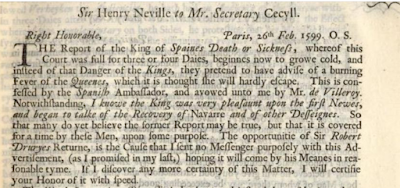
The newly separated 29 January 1601 N.S. Winwood letter adds a sharp piece of contemporary evidence to the immediate pre-Essex chronology. Neville reports from Paris that Lord Grey had assaulted Southampton while Southampton was on horseback in a London street and that Grey had been sent to the Fleet. Neville was abroad and should be treated as a contemporary reporter, not an eyewitness.
William Camden's annal for 1601 independently describes the same core event: Grey drew his sword on Southampton as Southampton rode through the street and was committed to prison. Camden places it among the developments that deepened Essex's anger shortly before the rising of 8 February 1601. The agreement of Neville's letter and Camden controls the basic incident while preserving an important limit: neither witness by itself proves that the assault caused the rising or that Neville participated in the factional response.
Why it matters here
- Neville was receiving and transmitting current news about the Grey–
- The episode supplies immediate context for the Southampton-danger story that
- It makes the late-January chronology more exact: the street violence occurred
- The record also confirms that Neville's separate
28and29 Januaryletters
Southampton conflict while serving in France.
Neville later said Cuffe had used to draw him toward the Essex circle.
only days before the rebellion, but it must remain contextual evidence rather than a single-cause explanation.
must not be merged. The 28 January letter contains the Orsino/Sebastian naming cluster; the 29 January letter contains the Grey–Southampton report.
Further research
- Recover the Privy Council, Fleet, and household-news records for Grey's
- Compare the precise dating in Camden, Chamberlain, Whyte, and the Cecil Papers
- Determine what intelligence route carried the London news to Neville in Paris.
committal and release.
against Neville's New Style dateline.
Essex-Document Date Correction
The former date 26 February 1602 for the Cuffe/Southampton/Drury House narrative is wrong. Two documents were conflated:
- BHO's Cecil Papers calendar dates Neville's short covering letter
[1600/1, c. Feb. 26], or26 February 1601in modern reckoning. In it, Neville says he has set down what he remembers of the “late wicked practice” and is preparing to send the account. - The detailed declaration quoted throughout this packet is dated
2 March 1601modern style (Secundo Marcij 1600Old Style) and is calendared in CSPD Elizabeth, vol.CCLXXIX, item11, printed pp.5-8.
Thus the Cuffe/Southampton quotations below belong to 2 March 1601, not to a document of February 1602. Winwood's later-printed “Sir Henry Nevill's CASE,” pp. 302-304, is a third, compressed apologetic text. It begins “Although I mean not to justify my self altogether from Blame” and does not contain the Cuffe/Southampton/Drury House narrative. Full comparison: CONFESSION CASE SOURCE SEPARATION AND VIZARD COLLATION 2026 07 13.
Quoted Source Passages
1. Neville's Statement Places Southampton at the Center of the Essex Approach
- Source: Henry Neville to Robert Cecil, confession/apology statement,
2 March 1601, O'Donnell transcription; local text Nevill to Cecil 1601 03 02 ODonnell transcription. - Quotation:
"About Christmas last, but whether before or after I do not well remember, he told me they were informed that there was a purpose to take som pretext to lay vp my l. of Southhampton, And that they tooke yt as a preface to the laying vp of my l. of Essex him self. But that he thought my lord was resolved they should never coope him more."
- What it proves: Neville's own post-rebellion account says Cuffe framed Southampton as endangered and used that danger to draw Neville toward the Essex circle.
- Limits: This is a retrospective defensive statement after the rebellion; it proves Neville's reported account, not every objective fact behind the warning.
2. The Same Statement Records the Requested Southampton/Davers Meeting
- Source: Same
2 March 1601O'Donnell transcription. - Quotation:
"his purpose was to make me pryvy to some desseins he had both for his owne safety & for the good of the state ... And for that purpose he desired that I would meete as soone as might be with my l. of Southhampton and Sr. Charles Davers who should relate the particulars vnto mee."
- What it proves: The Southampton connection is not merely social proximity; Neville says Cuffe wanted a specific meeting with Southampton and Davers to disclose Essex's designs.
- Limits: The statement is filtered through Neville's self-exculpatory account and should be paired with Cuffe-side and State Paper controls.
3. Neville Denies a Longstanding Adult Intimacy with Southampton
- Source: Same
2 March 1601O'Donnell transcription. - Quotation:
"I went thence soone after to drury howse & there found my l. of Southhampton with Sr. Charles Davers, where after som ordinary salutacions, because I had never spoken wth. my lord since he was a child in my old l. Treasorours howse, my lord began to breake with mee..."
- What it proves: Neville represents the Southampton contact as a recent Cuffe-engineered approach rather than an established adult alliance.
- Limits: This narrows the pre-rebellion relationship claim; it does not eliminate later documented Southampton/Neville political alignment.
4. Chamberlain Reports the Joint 1603 Tower Release
- Source: John Chamberlain to Dudley Carleton, April
1603, in McClure, Letters of John Chamberlain, vol. 1, p.192; document witnesses uc1 32106005854481 1782657835. - Quotation:
"The tenth of this moneth the earle of Southampton and Sir Henry Nevill were delivered out of the Towre"
- What it proves: A contemporary-news witness places Southampton and Neville together in the post-Essex Tower-release chronology.
- Limits: This proves joint release/delivery reporting, not authorship, literary collaboration, or a concealed prison-writing arrangement.
Tower Release Source Controls
- The 1603 Southampton/Neville release lane now has a second image witnesses-control layer beyond the Folger
V.a.321manuscript-copy image retrieved on2026-06-04. - Stopes pp.
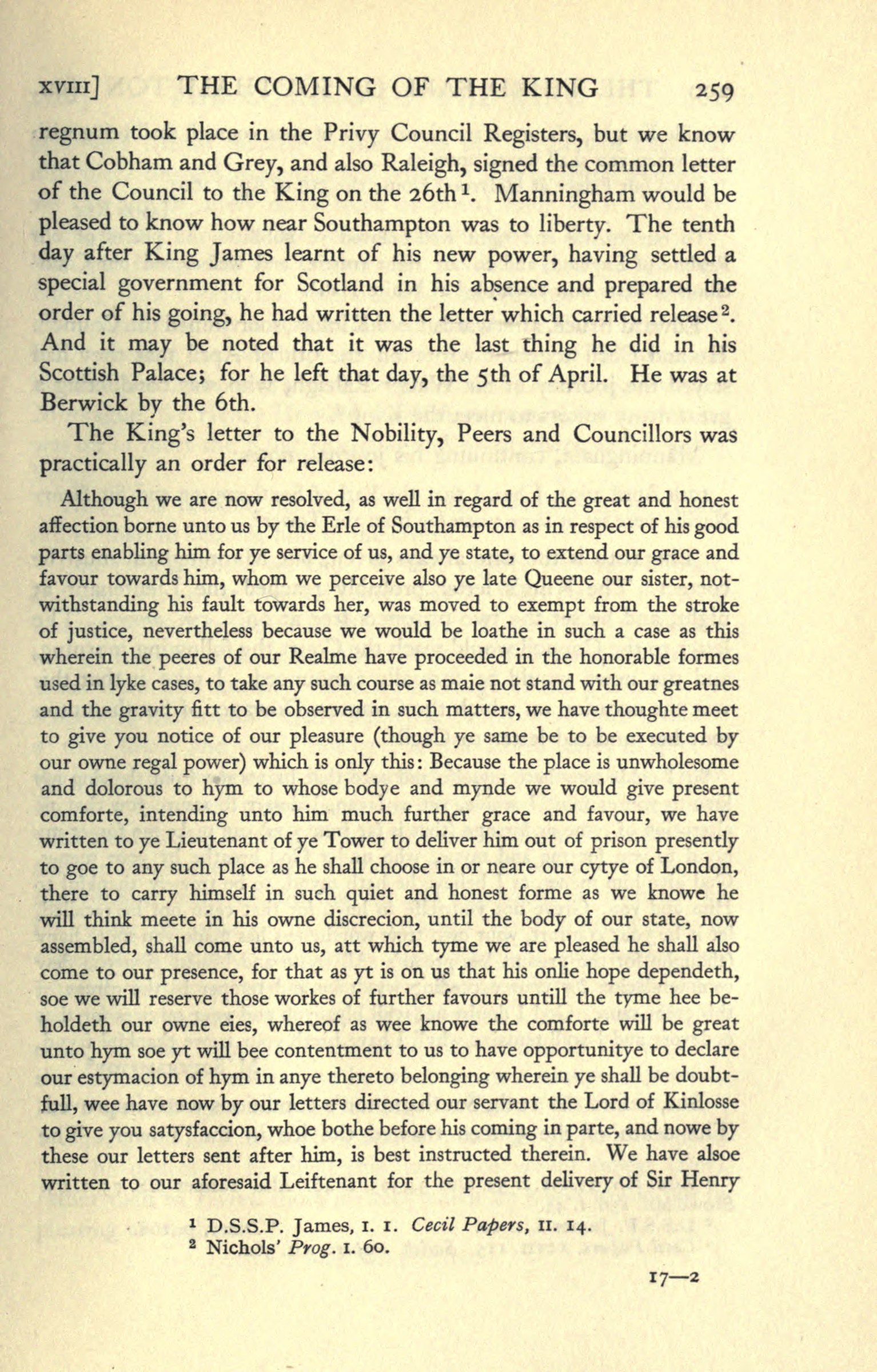
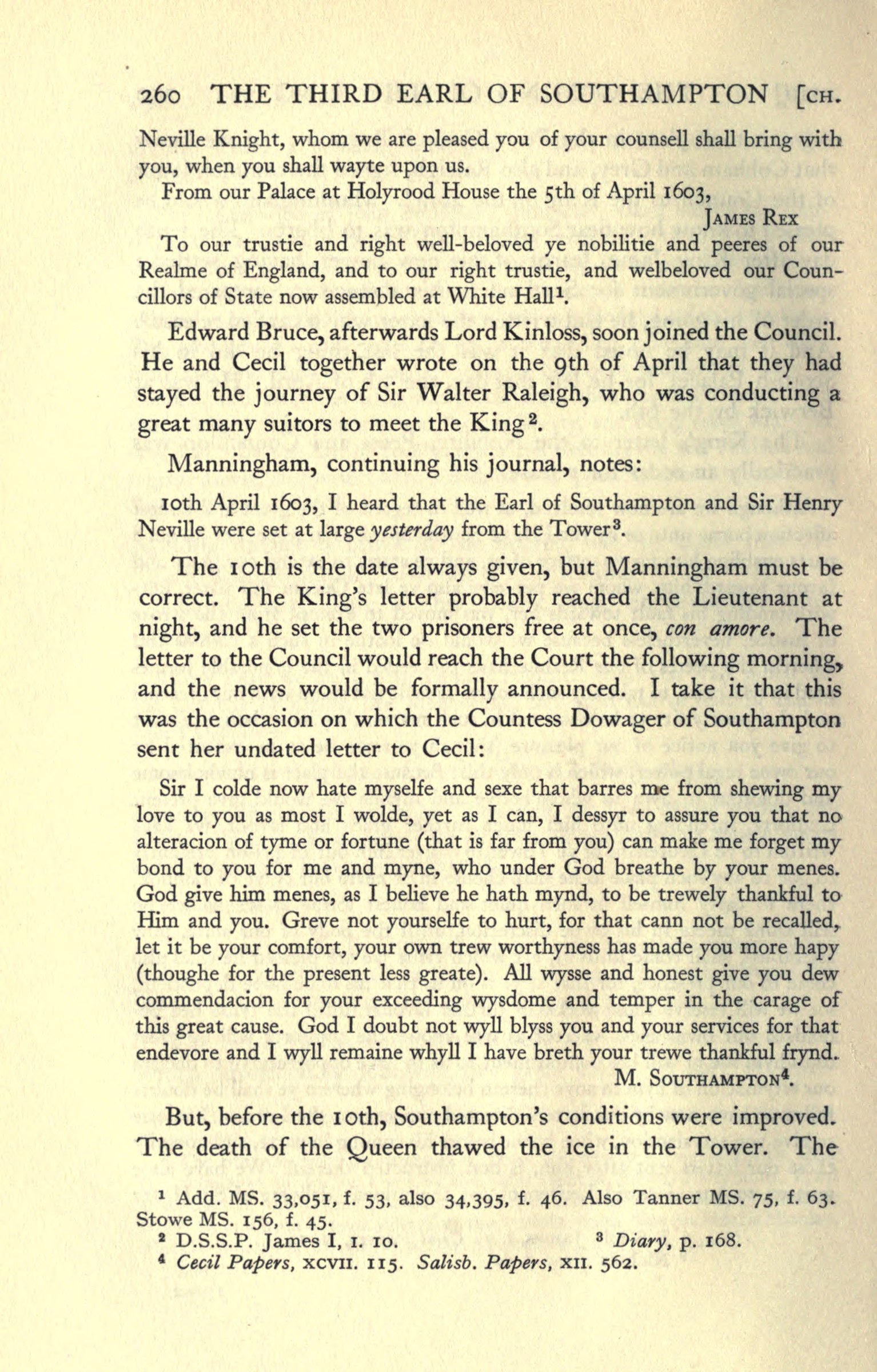
259-260have been staged from Internet Archive to control the printed witness map for James I's Holyrood release letter/order. - CSPD James I, vol. 1, p.
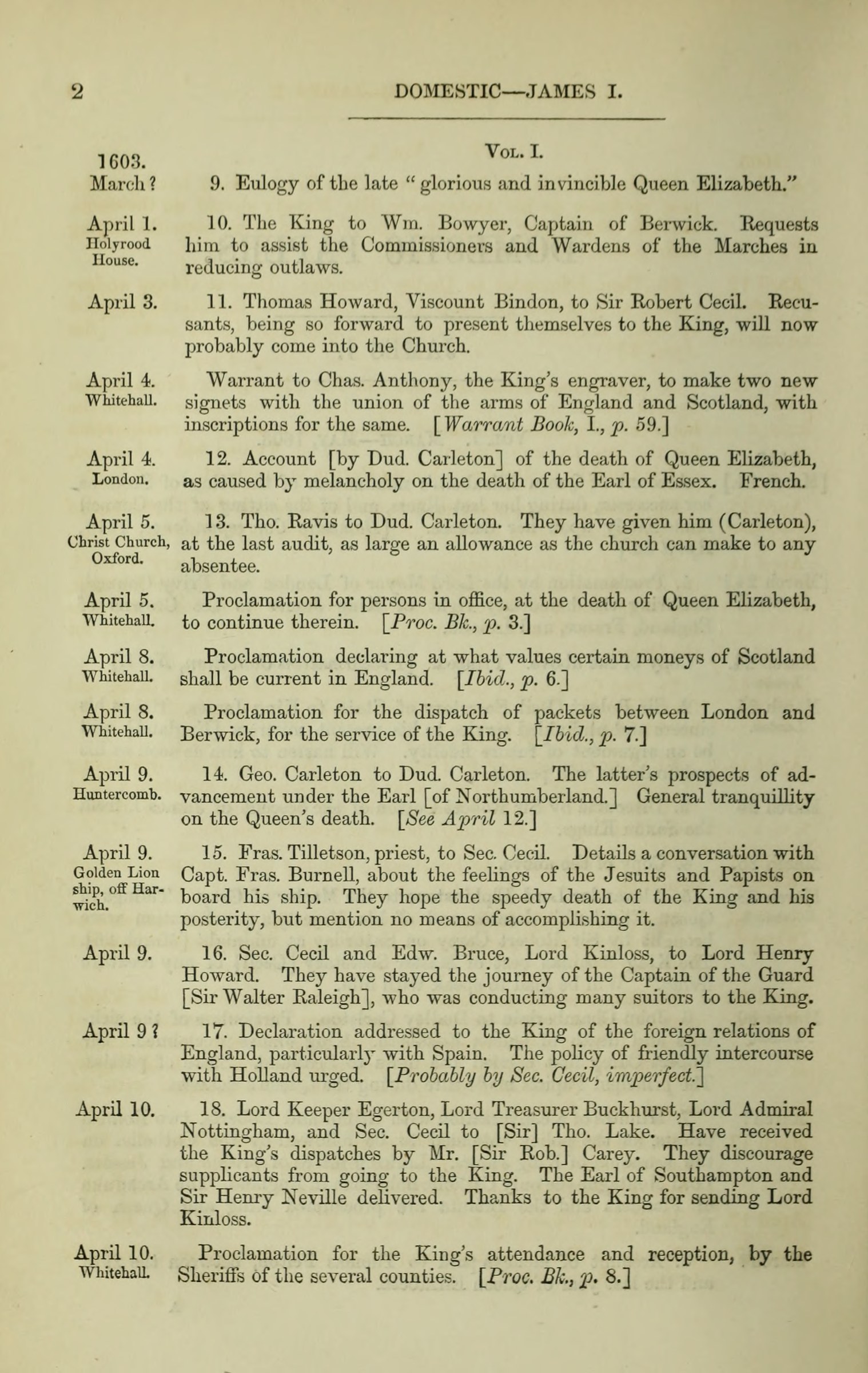
2, has been staged from Internet Archive as the correct page image for the10 April 1603delivery report. Earlier p.10and p.11pulls in the same image packet are adjacent administrative context and should not be cited for the Southampton/Neville delivery.
1. Verified Sourced Facts
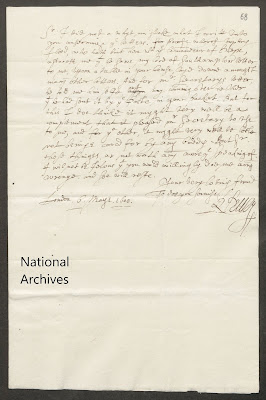
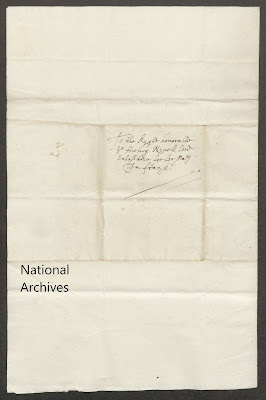
- A local source note for National Archives item
PRO 30/50/2/97, dated6 May 1600, preserves a transcription path stating:
“Humphrey Fludd, who had been in Dieppe with the Commander, confirmed seeing the Earl of Southampton's letter on a table in Neville's house among other correspondence.”
- MegaLetters source check, updated
2026-05-24: the same witness is staged locally as Doc 34 PRO 097 098, with manuscript images PRO 30 50 2 097 and PRO 30 50 2 098. The root file now identifies the item as Robert Drury to Neville, London,6 May 1600, matching the blog/Zurcher lane; older generated reports that call it Winwood or date it5 May 1600are stale.
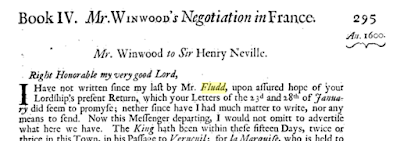
- In the local Neville letters corpus, Henry Neville wrote to Ralph Winwood on
29 July 1600:
“My Lord of Southampton and my Lord grey are both gone into the low-countries”
- In the same corpus, Neville wrote to Winwood on
2 Nov. 1600:
“My Lord of rutland, my Lord of Southampton, and my Lord grey, are returned out of the low-countries”
- In Neville's declaration dated
2 March 1601and addressed to Lords Egerton, Buckhurst, Nottingham, and Secretary Cecil, Neville states that he had been:
“entreated by Mr. Cuff, in the late Earl of Essex his name, to meet with the Earl of Southampton and Sir Charles Davers”
- The same
2 March 1601declaration states that Neville was to:
“understand some project which he had in consultation”
- The same document states:
“there was a purpose to take some pretext to lay up my Lord of Southampton”
- The same document states that Neville was asked:
“that I would meet as soon as might be with my Lord of Southampton and Sir Charles Davers”
- The same document states:
“Mr. Cuffe had been at least two or three months persuading me to make acquaintance with my Lord of Southampton and Sir Charles Davers”
- The same document states:
“there came by in coach my Lords of Essex and Southampton, Sir Christopher Blunt and Sir Charles Davers”
- The same document states:
“I went thence soon after to Drury House, and there found my Lord of Southampton with Sir Charles Davers”
- The same document states:
“I had never spoken with my Lord since he was a child in my Lord Treasurer's house”
- Lisa Jardine quotes a post-rebellion note from Sir Thomas Arundel to Robert Cecil stating:
“This Cuff was sente by my lo: of Essex to reade to my lo: of Southampton in Paris where hee redd Aristotles polyticks to hym wth sutch exposytions as, I doubt, did hym but lyttle good: afterwards hee redd to my lo: of Rutlande.”
- Paul E. J. Hammer states that:
“Southampton certainly kept Cuffe with him in Paris during September i598, when the latter was returning from his stay in Florence.”
- Hammer's broader point is that Cuffe belonged to Essex's scholarly secretariat, not that he was simply a private academic tutor. The Southampton/Rutland Aristotle readings should therefore be framed as part of Essex-circle political education and dangerous counsel, not as an isolated classroom anecdote.
- Hammer also places the Paris/Southampton episode after Cuffe's Florence mission for Essex. That matters because it aligns the Southampton reading claim with Cuffe's wider role in Essex foreign intelligence, Italian contacts, and scholarly-political service.
- Neil Cuddy writes of
24 June 1604:
“The earl of Southampton was arrested on Sunday 24 June by order of the king and council, together with lord Danvers and Sir Henry Neville, fellow former Essex conspirators; their papers were seized and the suspects interrogated, but they were released next day after 'several examinations'.”
- Cuddy also writes:
“Sandys was abetted in the scheme by Southampton's other great Commons collaborator Sir Henry Neville.”
- Cuddy also writes:
“In 1611 Southampton and his 'dear Damon' Sir Henry Neville put forward their 'undertaking'”
- Kathleen Tillotson writes:
“Here Drayton clearly appeals for the release of the Earl of Southampton and Sir Henry Neville, but he hardly writes like a supporter of the conspiracy.”
- Margot Heinemann writes of Essexian literary and political circles:
“These writers, translators, playwrights, historians, and political thinkers included Shakespeare and his patron the Earl of Southampton ... Sir Henry Neville”
- Heinemann also writes:
“Sir Henry Neville, a highly-qualified fellow-Essexian with Puritan and republican interests, though strongly backed by Southampton, failed to get the Secretaryship of State in 1614”
- Folger Shakespeare Library record
227817identifiesV.a.321, fols.16v-17, as a ca. 1615 manuscript copy of James I's 5 April 1603 Holyrood letter to the Lords and Council at Whitehall concerning the release of Southampton from the Tower and also Sir Henry Neville.
- Folger Digital Collections image
img31714supplies the public page image forV.a.321, fols.16v-17, titledfolio 16 verso - folio 17 recto. The image was retrieved locally on2026-06-04and shows the Neville release clause on the right-hand page.
- British Library
Stowe MS 156, f.45, independently identifies a warrant, dated Holyrood House, 5 April 1603, for setting at liberty from the Tower Henry Wriothesley, Earl of Southampton, and Sir Henry Neville.
- Oxford MARCO identifies Bodleian
MS. Tanner 290, fol.2, as a transcript of James I's 5 April 1603 order for Southampton's release from the Tower. The public summary does not name Neville, so this remains a parallel release-order witness until inspected.
- The Calendar of State Papers Domestic, James I, volume 1, reports on 10 April 1603 that the Earl of Southampton and Sir Henry Neville had been delivered. This supports the two-date formulation: warrant/letter dated 5 April 1603, release/delivery reported by 10 April 1603.
- Source-image controls: the 5 April 1603 release-order lane is now supported by Folger
V.a.321plus Stopes pp.259-260; the 10 April 1603 delivery report is now pinned to CSPD James I, vol. 1, p.2, with the image witnesses staged in the Essex/Southampton/Tower packet. - McClure vol. 1, printed p.
192, adds a contemporary Chamberlain-to-Carleton printed-letter witness for the same10 April 1603delivery report. Chamberlain writes thatthe earle of Southampton and Sir Henry Nevill were delivered out of the Towre by a warrant from the Kinge; McClure's note identifies them as Henry Wriothesley, third Earl of Southampton, and Sir Henry Neville, ambassador to France.
- Watson 2026 independently strengthens the Jacobean secretaryship context by placing Neville in the post-Cecil contest against Thomas Lake, supported by Protestant lords including Pembroke and Southampton, and connected to Overbury's influence with Rochester and the king.
- Watson 2024 supplies a stronger underlying factional witness through Viscount Fenton: one court side is described as the Howards, while the other includes Southampton and Pembroke with some Lower House men who had been drawn toward Rochester by Overbury. Fenton later says Southampton and Pembroke stood strongly for Neville as secretary.
- The Calendar of State Papers execution-speech item for Henry Cuffe records that Cuffe was charged with seducing Sir Henry Neville and answered that he drew Neville into the action and sought Neville's forgiveness. This provides an independent Cuffe-side witness to the same Essex-network pressure described in Neville's
2 March 1601declaration.
- Lara M. Crowley publishes and analyzes a possible verse letter by Southampton to Queen Elizabeth, preserved in British Library MS Stowe 962, in the context of Southampton's imprisonment after the Essex rising. Crowley's argument does not prove every attribution point beyond dispute, but it strengthens the packet's picture of Southampton as a literary-political actor in the same Essex aftermath.
- Crowley also notes that MS Stowe 962 contains a prose item associated with Henry Cuffe's execution speech. This is important because it places Southampton-poetry material and Cuffe execution material in the same manuscript-miscellany environment, though it does not by itself prove Neville's access to that miscellany.
- Source-control check of Crowley's PDF adds precision: the Stowe poem is a
74-line verse epistle on fols.47-48, historically situated in the February-March1601Tower period after Southampton's conviction with Essex. Crowley considers ghost-writer and later persona-piece alternatives, but argues thatMS Stowe 962has unusually reliable ascriptions and a relevant Essex-aftermath cluster. This makes the poem a strong Southampton literary-context item, not a settled authorship proof.
2. Ken Feinstein Twitter and Blog Information
- The same Ken Feinstein source note states:
“Fludd also reported that Mr. Secretary's (Robert Cecil's) letter had been sent via post in Neville's packet.”
3. Sourced Timeline
| Date | Sourced event | Source |
|---|---|---|
| 6 Oct. 1573 | Southampton's birth date as established by the Cowdray birth announcement, its Tuesday dateline, and the standard biographical chronology. The Folger IIIF metadata currently gives [October 5]; that bracketed catalogue date conflicts with the manuscript's weekday. | Folger L.b.584, digital node 189279; Kempe, Loseley Manuscripts, p. 240 |
| late 1581 / early 1582 | Southampton came into Burghley's care after Lord Howard transferred custody and marriage arrangements; he spent much of his youth at Cecil House. | Crowley, pp. 123–125 and n.31, citing Akrigg |
| 18 Apr. 1593 | Venus and Adonis was entered in the Stationers' Register with its Southampton dedication. Southampton was nineteen and remained a royal ward. | Shakespeare Documented node 114 |
| 9 May 1594 | Lucrece was entered in the Stationers' Register with its Southampton dedication. Southampton was twenty, 150 days short of full age. | Shakespeare Documented node 196 |
| 6 Oct. 1594 | Southampton attained twenty-one and legal full age. Release from minority did not itself complete the separate livery procedure required to receive the inheritance. | TNA Court of Wards guide; birth chronology |
| 19 Nov. 1594 | Garnet reports that Southampton, refusing Lady Vere, “payeth 5000li. of present payment.” This is a contemporary report, not proof that payment occurred. | Foley, Records of the English Province, IV.48–49 |
| 6 May 1600 | A source note for PRO 30/50/2/97 preserves a transcription path stating that Humphrey Fludd saw “the Earl of Southampton's letter” on a table in Neville's house. The same image witness is also staged as MegaLetters Doc_34. | Feinstein, “Shakespeare, Southampton, Humphrey Fludd and Henry Neville”; MegaLetters Doc_34 |
| 29 July 1600 | Neville reports to Ralph Winwood: “My Lord of Southampton and my Lord grey are both gone into the low-countries”. | Neville Letters Corpus, letter_072 |
| 2 Nov. 1600 | Neville reports to Winwood: “My Lord of rutland, my Lord of Southampton, and my Lord grey, are returned out of the low-countries”. | Neville Letters Corpus, letter_078 |
| c. 26 Feb. 1601 | Neville tells Cecil he has written out what he remembers of the “late wicked practice” and is preparing to send it. | Cecil Papers, vol. 11, p. 88, (77.15) |
| 2 Mar. 1601 | Neville's full declaration recounts Cuffe's efforts to bring him together with Southampton and Danvers and records the Drury House meeting. | CSPD Elizabeth, vol. CCLXXIX, item 11, pp. 5-8; O'Donnell transcription |
| post-rebellion note recalling 1598 | Arundel's note says Cuffe had been sent to read Aristotle's Politics to Southampton in Paris and later to Rutland. | Jardine quoting Arundel to Cecil |
| 5 April 1603 | James I's Holyrood release order/letter for Southampton also included Sir Henry Neville; direct manuscript-copy controls include Folger V.a.321, fols. 16v-17 / image img31714, and BL Stowe MS 156, f. 45. | Folger; BL Stowe MS 156; Stopes witness map |
| 10 April 1603 | CSPD reports that the Earl of Southampton and Sir Henry Neville had been delivered from the Tower. The correct staged page image is CSPD James I, vol. 1, p. 2. | CSPD James I, vol. 1, p. 2 |
| 24 June 1604 | Cuddy records the joint arrest of Southampton, Danvers, and Sir Henry Neville, with release the next day after examinations. | Cuddy |
| 1604 | Tillotson reads Drayton’s The owle as appealing for the release of Southampton and Sir Henry Neville. | Tillotson |
| 1607 | Cuddy describes Neville as Southampton's “other great Commons collaborator”. | Cuddy |
| 1611 | Cuddy records: “Southampton and his 'dear Damon' Sir Henry Neville put forward their 'undertaking'”. | Cuddy |
4. Source Text Index
Neville / Southampton contact and reference points
- “Humphrey Fludd, who had been in Dieppe with the Commander, confirmed seeing the Earl of Southampton's letter on a table in Neville's house among other correspondence.”
- “Fludd also reported that Mr. Secretary's (Robert Cecil's) letter had been sent via post in Neville's packet.”
- “My Lord of Southampton and my Lord grey are both gone into the low-countries”
- “My Lord of rutland, my Lord of Southampton, and my Lord grey, are returned out of the low-countries”
Neville’s 2 March 1601 declaration
- “entreated by Mr. Cuff, in the late Earl of Essex his name, to meet with the Earl of Southampton and Sir Charles Davers”
- “there was a purpose to take some pretext to lay up my Lord of Southampton”
- “that I would meet as soon as might be with my Lord of Southampton and Sir Charles Davers”
- “Mr. Cuffe had been at least two or three months persuading me to make acquaintance with my Lord of Southampton and Sir Charles Davers”
- “there came by in coach my Lords of Essex and Southampton, Sir Christopher Blunt and Sir Charles Davers”
- “I went thence soon after to Drury House, and there found my Lord of Southampton with Sir Charles Davers”
- “I had never spoken with my Lord since he was a child in my Lord Treasurer's house”
- “This Cuff was sente by my lo: of Essex to reade to my lo: of Southampton in Paris”
- “Southampton certainly kept Cuffe with him in Paris during September i598”
- “he had led the earls of Southampton and Rutland into treason by his dangerous ‘exposytions’ of Aristotle's Politics.”
- “British Library Manuscript Stowe 962”
- “folios 47-48”
- “Southampton was the only conspirator tried with Essex”
- “Cuffes speech at the time of his Executione”
- “he must confess he drew him into that unfortunate action”
- “principally of Sir H. Nevill”
James I / Parliament material
- “together with lord Danvers and Sir Henry Neville, fellow former Essex conspirators; their papers were seized and the suspects interrogated, but they were released next day after 'several examinations'.”
- “Here Drayton clearly appeals for the release of the Earl of Southampton and Sir Henry Neville, but he hardly writes like a supporter of the conspiracy.”
- “Southampton's other great Commons collaborator Sir Henry Neville.”
- “In 1611 Southampton and his 'dear Damon' Sir Henry Neville put forward their 'undertaking'”
- “Sir Henry Neville, a highly-qualified fellow-Essexian with Puritan and republican interests, though strongly backed by Southampton”
- “Southehamptoun and Pembrouke ... stand mutche to have Nevell Secreterrye”
- “supported by Protestant lords including Pembroke and Southampton”
- “the earle of Southampton and Sir Henry Nevill were delivered out of the Towre”
- “by a warrant from the Kinge”
5. Evidence Images
PRO 30/50/2/97 source-note images
1603 release and delivery controls
6. Citations
- Cuddy, Neil. “The Anglo-Scottish Union and the Court of James I, 1603-1625.” Transactions of the Royal Historical Society, vol. 39, 1989, pp. 107-124.
- Crowley, Lara M. “Was Southampton a Poet? A Verse Letter to Queen Elizabeth.” English Literary Renaissance, vol. 41, no. 1, 2011, pp. 111-145.
- Crowley, Lara M. “Was Southampton a Poet? A Verse Letter to Queen Elizabeth [with text].” English Literary Renaissance, vol. 41, no. 1, 2011, pp. 111-145. Staged PDF: Crowley WasSouthamptonAPoet 2011.
- Feinstein, Ken. “Shakespeare, Southampton, Humphrey Fludd and Henry Neville.” Ken Feinstein (blog), 16 Aug. 2019, https://kenfeinstein.blogspot.com/2019/08/shakespeare-southampton-humphrey-fludd.html.
- Hammer, Paul E. J. “The Uses of Scholarship: The Secretariat of Robert Devereux, Second Earl of Essex, c. 1585–1601.” The English Historical Review, vol. 109, no. 430, 1994, pp. 26-51. document witnesses: Hammer UseScholarshipSecretariat 1994.
- Heinemann, Margot. “Rebel Lords, Popular Playwrights, and Political Culture: Notes on the Jacobean Patronage of the Earl of Southampton.” The Yearbook of English Studies, vol. 21, 1991, pp. 63-86.
- Folger Shakespeare Library.
V.a.321, fols.16v-17, record227817, copy of letter from James I, Holyrood, to the Lords and Council at Whitehall, 5 April 1603. https://catalog.folger.edu/record/227817. - Folger Shakespeare Library Digital Collections.
img31714,folio 16 verso - folio 17 recto, public image ofV.a.321, fols.16v-17. https://digitalcollections.folger.edu/img31714. Single-image IIIF manifest: https://digitalcollections.folger.edu/node/87949/manifest-single. - Folger Shakespeare Library.
Letterbook, ca. 1582-ca. 1615, ca. 1615. [manuscript], record227713, volume containingV.a.321. https://catalog.folger.edu/record/227713. - British Library.
Stowe MS 156, f.45, warrant for setting at liberty from the Tower the Earl of Southampton and Sir Henry Neville, Holyrood House, 5 April 1603. https://searcharchives.bl.uk/catalog/040-001952944. - Bodleian Libraries / MARCO.
MS. Tanner 290, fol.2, transcript of James I's order for Southampton's release from the Tower, Holyrood House, 5 April 1603. https://marco.ox.ac.uk/ark%3A29072/x06m311p9493. - Calendar of State Papers, Domestic Series, of the Reign of James I, vol. 1, 1603-1610, ed. Mary Anne Everett Green. London: Longman, Brown, Green, Longmans and Roberts, 1857, p. 2. Internet Archive: https://archive.org/details/calendarofstatep01grea. Local page image: calendarofstatep01grea leaf0016 p2 april 1603 context.
- Chamberlain, John. The Letters of John Chamberlain. Edited by Norman Egbert McClure, vol. 1, American Philosophical Society, 1939, p.
192, letter to Dudley Carleton, London, April1603. document witnesses: uc1 32106005854481 1782657835. - Stopes, C. C. The Life of Henry, Third Earl of Southampton: Shakespeare's Patron. Cambridge: Cambridge University Press, 1922, pp. 259-260. Internet Archive: https://archive.org/details/lifeofhenrythird00stopiala. image witnesses: lifeofhenrythird00stopiala leaf0285 p259 release witnesses and lifeofhenrythird00stopiala leaf0286 p260 release witnesses.
- Essex/Southampton/Tower image-research packet,
2026-06-20: SOURCE NOTES. - Watson, Jackie. "Real and Imagined Space: The Rhetoric of Thomas Overbury's Imprisonment." Journal of Early Modern Studies, vol. 15, 2026, pp. 113-128. DOI: 10.36253/JEMS-2279-7149-17193. document witnesses: Watson Overbury 2026.
- Watson, Jackie. Epistolary Courtiership and Dramatic Letters: Thomas Overbury and the Jacobean Playhouse. Edinburgh University Press / De Gruyter, 2024. Chapter 2. Local source set: Watson_Epistolary_Courtship_Dramatic_Letters_2024.
- Jardine, Lisa. “Studied for Action Revisited.” document witnesses: Jardine Studiedactionrevisited 2024.
- O'Callaghan, Michelle. “Politics, Patronage and Poetry in the 1590s: The Ghost of Richard the Third and the Essex Circle.” The Yearbook of English Studies, vol. 31, 2001, pp. 31-49.
- Tillotson, Kathleen. “Drayton and Richard II: 1597-1600.” The Review of English Studies, old series, vol. 15, no. 58, Apr. 1939, pp. 172-179. Oxford Academic, https://academic.oup.com/res/article/os-XV/58/172/1530750.
- Neville Letters Corpus. Version 8. XML corpus of 138 letters and 3 documents,
[local source path removed]. Used here for the dated letters to Ralph Winwood; the former1602-02-26attribution is superseded by the corrected BHO/CSPD source separation above. - Green, Mary Anne Everett, ed. Calendar of State Papers, Domestic Series, of the Reign of Elizabeth, 1601-1603. London,
1870, pp.5-8, vol.CCLXXIX, item11. Archive.org scan. - Confession/Case source-separation and final-paragraph collation,
2026-07-13: CONFESSION CASE SOURCE SEPARATION AND VIZARD COLLATION 2026 07 13. - Roberts, R. A., ed. “Cecil Papers: February 1601, 21-28.” Calendar of the Cecil Papers in Hatfield House, vol. 11 (London,
1906), p.88, item[1600/1, c. Feb. 26]. British History Online. - Winwood, Ralph. Memorials of Affairs of State in the Reigns of Queen Elizabeth and King James I, vol. 1. London, 1725, pp.
291–292, Neville to Winwood,29 January 1601 N.S.Internet Archive. - Camden, William. Annales, English translation, section for
1601, reporting Grey's assault on Southampton and imprisonment. University of Birmingham Philological Museum. - Zeeveld, W. Gordon. “A Tudor Defense of Richard III.” PMLA, vol. 55, no. 4, 1940, pp. 946-957.
- Speech of Mr. Cuffe at his execution for treason. Calendar of State Papers, Domestic Series, Elizabeth I, 1601-1603 with Addenda 1547-1565, vol. CCLXXIX, no. 25, March 13, 1601. Document ref.
SP 12/279 f.35. Staged PDF: GALE MC4304600028.
7. Notes on Access
- Source-control position: the 1603 release can now be cited with direct manuscript-copy controls, not only with secondary scholarship. Use Folger
V.a.321, fols.16v-17/ Digital Collectionsimg31714, and BLStowe MS 156, f.45, for the 5 April 1603 warrant/letter; use CSPD James I, vol. 1, for the 10 April 1603 delivery report. The full retrieval map is southampton neville release order source note 2026 06 04. - image witnesses-control result,
2026-06-04: Folgerimg31714was downloaded to folger Va321 f16v f17r release southampton nevill 1603 04 05 img31714 031714. The next work is transcription/collation, followed by BLStowe MS 156, f.45. - Source-control position: the release/delivery lane now has local page images for Stopes pp.
259-260and CSPD James I, vol. 1, p.2. Keep the dates distinct: 5 April 1603 is the Holyrood release order/letter; 10 April 1603 is the reported delivery from the Tower. - Do not merge BL
Cotton MS Titus B VII, ff.443r-444v, into the same release-order witness until inspected. The BL catalogue gives a different date, 1 April 1603, and does not mention Neville in that item summary. - The May 1600 Fludd/Southampton item is presently cited through the local blog source note at blog southampton fludd 2019 08 16, which identifies the National Archives item as
PRO 30/50/2/97and gives a modern-spelling transcription. - The same item is also staged in the MegaLetters collection at Doc 34 PRO 097 098. Use the manuscript image links and corrected root file there for verification, while still treating final quotations as needing diplomatic image review.
- Source-control warning,
2026-05-31: do not confuse thisPRO 30/50/2/97Fludd/Southampton route with letter 097, which is a separate Neville-to-Cecil recommendation forMr. Thorpedated6 May 1600. - The article PDFs used for this packet are stored locally at:
- Heinemann Rebel Lords Southampton Patronage 1991
- james southampton imprisonment neville
- Crowley Was Southampton a Poet 2011
- The May 1600 Fludd/Southampton item is still one layer short of a fresh archival transcription. The strongest current path in this packet is the preserved transcription trail, not a newly edited manuscript reading.
- The Humphrey Fludd who appears in the
PRO 30/50/2/97witness (May 1600) may be the same Humphrey Fludd who deposed in the Bellott v. Mountjoy lawsuit in 1612 — the same legal proceeding in which William Shakespeare gave testimony. If these are the same person, it places a documented Neville-network figure in the same legal record as Shakespeare. This identification has not been verified within this packet and should be treated as a lead rather than a confirmed connection, but it is worth noting as a possible additional intersection between the Neville network and Shakespeare's documented life. - The
Hen. W./ Encomium material is not central to the Southampton packet and should not be used here as if it were Southampton evidence. The dedicatedEncomiumpacket is the right place for that dispute. - The Cuffe execution-speech calendar item should be read alongside Neville's
2 March 1601declaration. It strengthens the Cuffe/Neville side of the Southampton-Essex network, but it does not itself prove any Southampton literary patronage claim. - Crowley should be used to strengthen Southampton's literary and manuscript context after the Essex rising. It should not be overstated as proof that Southampton authored the poem, or as direct proof that Neville saw MS Stowe 962.
- Source-control position: for the fuller Crowley/Stowe analysis, use southampton verse letter to elizabeth stowe 962. The Southampton packet should keep only the network implications; the manuscript-attribution discussion belongs in the dedicated Stowe packet.
- Source-control position: Hammer should be used to frame the Cuffe/Southampton/Rutland readings as part of Essex's scholar-secretary political machinery. The direct Southampton/Neville lane still depends more on Neville's own
2 March 1601declaration and letters; Hammer strengthens the Cuffe-to-Southampton scholarly-political context. - Source-control position: Jardine adds the method frame for the same evidence: "reading" with Southampton was not necessarily neutral tutoring. In the Essex circle, scholarly reading could be a form of political counsel and factional preparation. Keep this as context; the direct Neville/Southampton evidence still comes from Neville's own letters and statement.
- Source-control position: Watson 2026 adds a post-Cecil secretaryship context in which Neville is supported by Protestant lords including Pembroke and Southampton and is trying to access Overbury's influence with Rochester and the king. This supports the Jacobean Southampton/Pembroke/Neville political alignment, not a direct literary-patronage claim.
- Source-control position: Watson 2024 strengthens the same point with the fuller Fenton and Neville/Winwood letter sequence. Use it as factional-political evidence, not as proof of literary collaboration.
2026-07-13 Declaration Verification Record
Primary image checked: SP 12/279 f.15, manuscript page 5 and the State Papers Online/TNA source-information cover. Independent non-AI control: John O'Donnell's identified human transcription and CSPD Elizabeth, vol. CCLXXIX, item 11, pp. 5-8. Existing local text compared: O'Donnell DOCX/TXT and Neville Letters Corpus v8. Decisive source-separation result: the declaration contains the Cuffe/Southampton/Drury House material; Winwood's Case is a different composition. Conflicting prior readings: older project material sometimes treated the two texts as the same confession; that identification is superseded. Remaining uncertainty: the Southampton quotations above remain controlled by the identified human transcription and printed calendar, not by completed line-by-line collation of manuscript pages 1–4. The separate PRO 30/50/2/97 Fludd item also retains its stated attribution/transcription caveat. Status: human_transcription_only for the full declaration text; identity and date are controlled by primary image plus independent sources. Verified by/date: Codex research pass, 13 July 2026.
8. Fact-Source Notes
- British History Online gives a public text control for the
10 April 1603delivery report in CSPD James I, vol. 1: the Council reports that the Earl of Southampton and Sir Henry Neville were delivered. URL: https://www.british-history.ac.uk/cal-state-papers/domestic/jas1/1603-10/pp1-13. - Keep the two dates distinct in prose:
5 April 1603is the Holyrood release order/warrant lane;10 April 1603is the reported delivery from the Tower. - BL Stowe MS 962 and CELM now provide public catalogue context for the Southampton prison poem and adjacent Cuffe material. Cite the dedicated Stowe packet for that manuscript-literary lane rather than overloading this network packet.
2026-07-17: Southampton's lost letter to Robert Drury
The 6 May 1600 Robert Drury letter has now been re-read directly and placed inside the embassy-mail chronology. The phrase is “my lord of Southamptons letter to me”: Southampton was the sender and Drury the intended recipient. Humphrey Flood said he saw it on a table among many other letters in Neville's “house.” The complaint is addressed to Neville as ambassador in France, and your howse grammatically names Neville's house or household.
The best current reconstruction is that Southampton's letter followed Drury toward Neville's Paris embassy and was not redirected after Drury returned to England. This is an inference. The lost letter's date, contents, direction of travel, and address panel are unknown, and the surviving complaint does not say where Flood saw it.
The Southampton–Drury relationship is independently meaningful. Robert Drury was already receiving personal correspondence from the earl by May 1600. Nine months later Charles Danvers lodged in Robert Drury's London house, and the Essex group used it because Essex House was watched. Neville then went to Drury House and found Southampton with Danvers. These events show continuity in the social network; they do not make Drury House the earlier your house.
Robert Drury also married Anne Bacon, whose father Sir Nicholas Bacon of Redgrave was the brother of Neville's stepmother Elizabeth Bacon. Drury thus married the niece of Neville's stepmother. This is useful family-network context, not evidence about the lost letter's contents.
Full evidence packet: sir robert drury nevilles house and drury house. Reader-facing synthesis: comprehensive report.
Manuscript claim audit, 17 July 2026
Primary images checked: PRO 30/50/2/97–98 and the Drury House sentence in SP 12/279 f.15. Independent controls: John O'Donnell's human transcriptions; TNA catalogue; CSPD 1601–1603; the official 1601 declaration. Unresolved: the lost Southampton letter and the physical location of Flood's sighting. Status: primary_image_and_independent_control.
Book Integration Update — 2026-08-31
- Chapter 37 now treats the 1593 and 1594 Southampton dedications as one public sequence: cautious debut and promised “graver labor” become assurance, endless love, possession, and continuing devotion.
- Southampton was nineteen at the Venus and Adonis registration, twenty at the Lucrece registration, and became legally adult on 6 October 1594, 150 days after Lucrece was entered. Livery remained a separate process.
- Neville's declaration proves childhood contact in Burghley's house and simultaneously prevents backdating adult intimacy to 1593–94.
- The later record—joint 1603 release, joint 1604 arrest, Commons collaboration, and the 1611 “dear Damon” language—proves mature political trust only after contact resumed.
- Chapter 37 gives greater affirmative weight to Lucrece's source-subtracted property, tyranny, concealed prudence, faction, and regime-change system than to the patronage route alone.