Richard II and the Essex Rising
Topic: Richard II and the Essex Rising
Book integration update — 31 August 2026
Chapter 31 treats the episode as a political-memory lead rather than a verbal parallel. Phillips establishes a specially requested old play about Richard II's deposition and killing and the extra payment; Meyrick preserves mixed Henry IV and Richard II naming; Hammer supplies the controlling reconstruction of a planned later court intervention. The book states that Shakespeare's Richard II is the most likely identification without converting the examinations into a preserved script or modern title page.
Neville is not placed at the Globe. His affirmative relation is recruitment into the same succession, counsel, petition, ancestry, and court-entry crisis in which the play became operational. The chapter retains that distinction while removing repeated formulations of it.
Source-Fact Audit — 7 August 2026
The direct witnesses establish a specially requested performance immediately before the rising, but preserve an identification problem. Augustine Phillips describes a play about the deposing and killing of Richard II and says it was so old & so long out of vse. Gelly Meyrick uses the mixed wording kyllyng of Kyng Richard the second in testimony tied to the Globe.
These examinations are evidence for the request, performance circumstances, payment, and subject. They do not supply a modern title page. The 1597 quarto proves that Shakespeare's Richard II belonged to the Lord Chamberlain's Men repertory; the 1615 quarto advertises the deposition scene; neither quarto by itself identifies the exact 7 February 1601 performance.
Neville, Southampton, Cuffe, the Essex group, the tavern meeting, and Globe attendance must be handled person by person. Presence in the political crisis or earlier meeting does not establish presence at the theatre. The packet's job is to preserve that event sequence and the surviving ambiguity.
Source-Control Summary
- The direct performance witnesses are Augustine Phillips and Sir Gelly Meyrick in the State Papers examinations reproduced by Shakespeare Documented from TNA materials. Use those before Hammer, Gajda, quarto title pages, or later printed commentary.
- The safest book prose is: on
7 February 1601, the Lord Chamberlain's Men performed a specially requested Globe play described in examinations as involving Henry IV and the deposing/killing of Richard II; Shakespeare's Richard II is the most plausible identification, but the exact performed text remains debated. - Keep adjacent evidence in its own lanes: Cuffe/Neville/Lucan proves Essex political-recruitment context; Southampton belongs through the Essex House and Drury House crisis network; the
1597quarto proves repertory plausibility; the1615quarto proves later printed deposing-scene advertisement. None of those lanes alone proves the exact7 February 1601play text. - Attendance must be stated person by person. Hammer places Cuffe in the tavern dinner party before the play, but says Cuffe then left while the others crossed the river. Cuffe is therefore not a documented Globe spectator. The present packet likewise has no direct evidence that Neville or Southampton attended.
JSTOR Chrome Source Notes
- Batch pass: AI TOPICS JSTOR CHROME HARDENING PASS 2 2026 06 26.
- Chrome/JSTOR access to Hammer's article at stable
40210244was verified through the user's authenticated Wikipedia Library/OCLC JSTOR session. After the user clarified the viewer workflow, the JSTOR viewer toolbar download saved a fresh local copy as Hammer RichardII Essex 2008 JSTOR viewer download, extracted to Hammer RichardII Essex ViewerDownload 2008. - Hammer's article-body evidence reinforces the packet's source hierarchy: Phillips and Meyrick remain the direct performance witnesses; Hammer remains the controlling scholarly caution on identification; quarto title pages remain printed play controls, not direct Essex-performance evidence.
- The new pass also sharpens the Southampton lane. Southampton belongs in this topic through the Essex House/Drury House crisis network and Hammer/Gajda's Cuffe-centered factional chronology, not through an unsupported claim that Southampton personally attended the Globe performance.
- Book-use guardrail: state that Shakespeare's Richard II is the most plausible identification, while preserving Hammer's uncertainty over the exact performed play and rejecting any Hayward-play shortcut unless a direct witness is found.
Source-Control Position: Direct Performance Evidence
- New source pass created: RICHARD II ESSEX PERFORMANCE SOURCE PASS 2026 06 26.
- The direct performance controls should now be treated as the State Papers examinations of Augustine Phillips (
TNA SP 12/278, fols. 85r-86v, 18 February 1601) and Sir Gelly Meyrick (TNA SP 12/278/78, fols. 141-142, 17 February 1600/01), both reproduced by Shakespeare Documented from TNA materials. - Phillips supplies the strongest "special commission" evidence: Sir Charles Percy, Sir Josceline Percy, Lord Monteagle, and others requested a play of the deposing/killing of Richard II and paid 40 shillings above the ordinary rate.
- Meyrick supplies the strongest dinner-to-Globe sequence and preserves the ambiguity that matters: he remembers both Henry IV language and Richard II killing language.
- Hammer remains the controlling scholarly caution. Shakespeare's Richard II is the most plausible identification, but the exact performed text should not be asserted as a settled fact.
- Southampton should be central to this packet through the Essex House and Drury House crisis network, not by inventing Globe attendance. Gajda supplies the best current Southampton/Cuffe/Neville chronology.
- Hatfield/Cecil material on British History Online is useful for aftermath and network context around Southampton, Neville, and Sir Gelly Merrick, but it is not the direct proof of the Globe performance.
- The 1597 quarto proves Lord Chamberlain's Men performance history for Shakespeare's Richard II; the 1615 quarto is a later deposing-scene print witness. Neither should override the Phillips/Meyrick wording.
corpus analysis and BRO Check
- Rechecked EarlyPrint/TCP metadata and text for
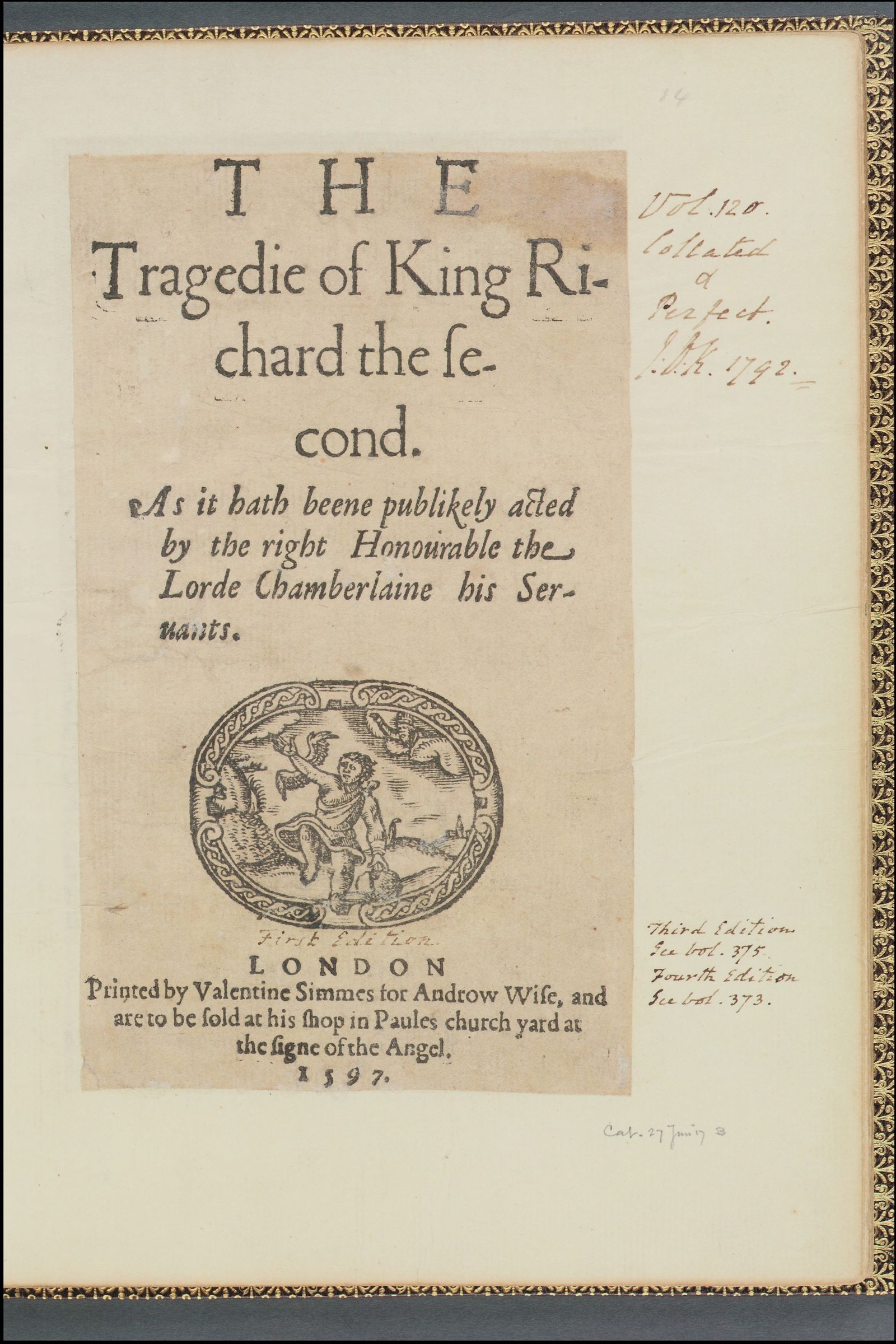
A11994: the title witness is The tragedie of King Richard the second As it hath beene publikely acted by the right Honourable the Lorde Chamberlaine his Seruants (1597). - Rechecked local Neville Letters Corpus v8 for the confession lane:
letter_135remains the local encoded confession witness dated1601-03-02. - No BRO transcription in this Worker I sweep supplied a direct Richard II performance witness. BRO
Doc_16asupplies later Essex-rumour context in a 1613 Savile junior/Sonning letter, but that is not evidence for the 7 February 1601 performance. - Keep the packet's central caution: the Lucan/Cuffe/Neville material strengthens Essex political context, not the identity of the play staged at the Globe.
Quarto Image Controls
- The earlier
A11994page-image gap is now closed at the title-page level: the Huntington Digital Library 1597 first quarto record and IIIF image have been staged locally, withSTC 22307and the title-page wording visible. - Two further controls have been staged from Internet Archive: the 1598 second quarto (
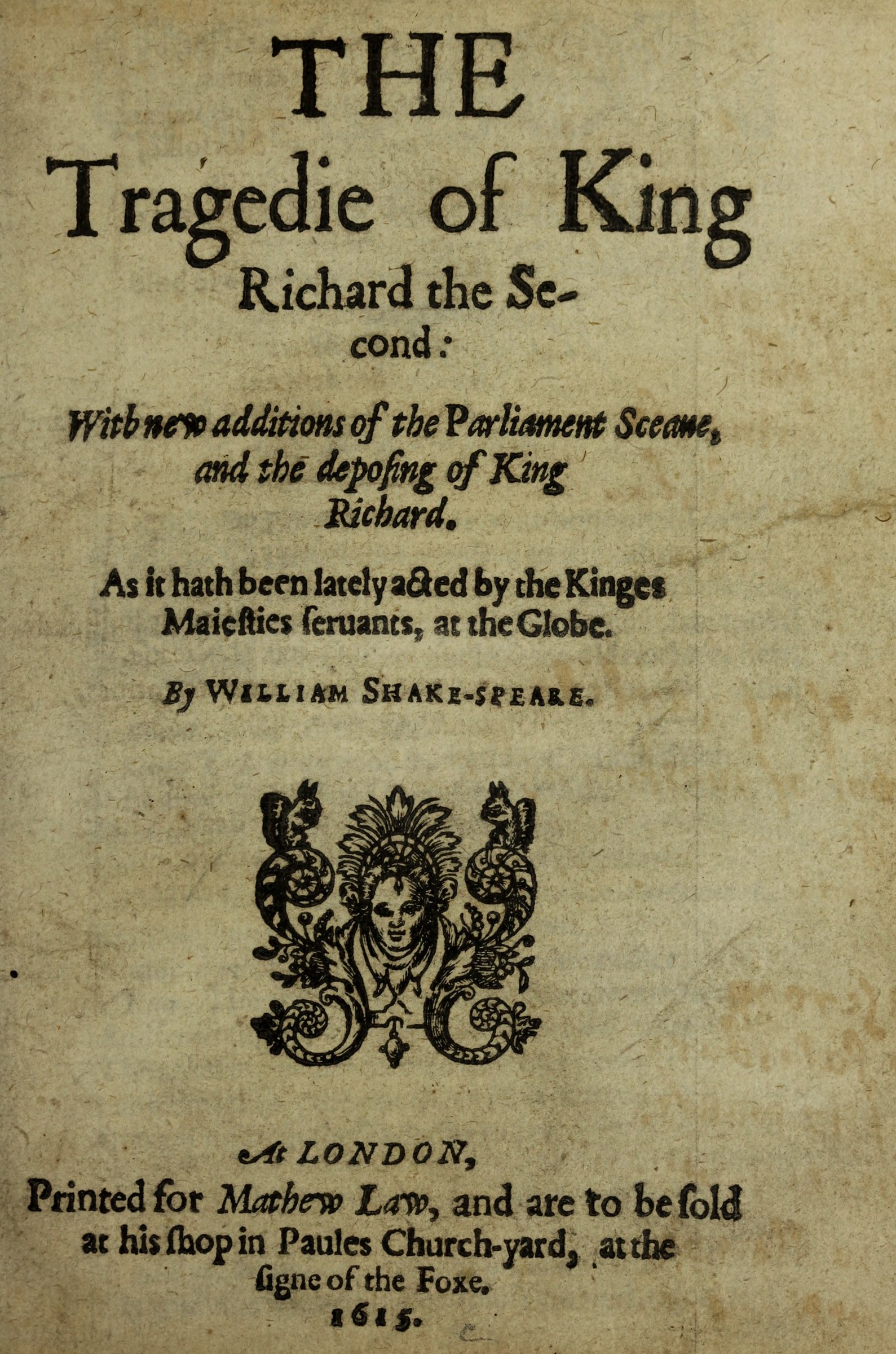
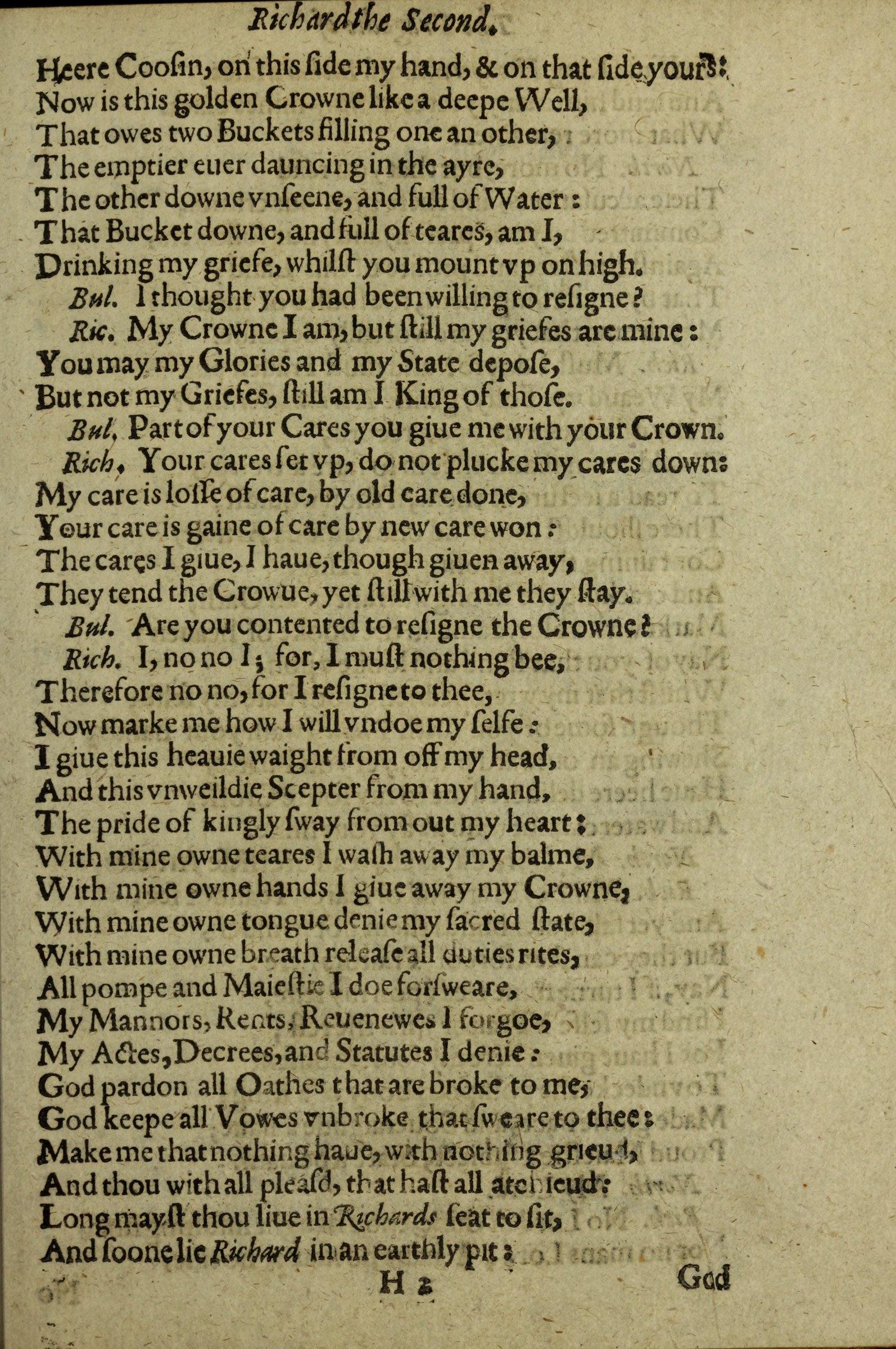
STC 22308) and the 1615 quarto (STC 22312) with the title-page claim about the Parliament/deposing scene and two deposition-scene leaves. - Keep the source hierarchy clear. The 1597/Huntington image is the best current page control for the
TCP A11994title witness; the 1615 quarto is a later printed witness for the restored deposing-scene text, not evidence that Shakespeare's exact play was the Essex performance.
Quoted Source Passages
1. Augustine Phillips Supplies the Special-Commission Evidence
- Source: Alan H. Nelson, "Examination of Augustine Phillips," Shakespeare Documented, Folger Shakespeare Library; TNA, State Papers Domestic, Elizabeth I,
SP 12/278, fols.85r-86v,18 February 1601; source synthesis RICHARD II ESSEX PERFORMANCE SOURCE PASS 2026 06 26. - Quoted passages:
"the deposyng and kyllyng of Kyng Rychard the Second"
"xls more then theire ordynary"
"so old & so long out of vse"
- What it proves: Phillips is the cleanest direct witness for a specially requested performance, extra payment, and the Richard II deposition/killing wording.
- Limit: Phillips should not be used alone to assert that the exact staged text must have been Shakespeare's printed Richard II.
2. Sir Gelly Meyrick Supplies the Globe Venue and Mixed Title Wording
- Source: Alan H. Nelson, "Examination of Sir Gelly Meyrick," Shakespeare Documented, Folger Shakespeare Library; TNA, State Papers Domestic, Elizabeth I,
SP 12/278/78, fols.141-142,17 February 1600/01; same source synthesis. - Quoted passages:
"the Globe over the water"
"the play wold be of Harry the iiijth"
"kyllyng of Kyng Richard the second"
- What it proves: Meyrick ties the event to the Globe and preserves the mixed Henry IV / Richard II killing wording that makes the identification problem real.
- Limit: Do not smooth Meyrick into a single modern title without explaining the ambiguity.
3. Hammer Gives the Controlling Scholarly Caution
- Source: Paul Hammer, "Shakespeare's Richard II, the Play of 7 February 1601, and the Essex Rising," local extracted text Hammer RichardII Essex ViewerDownload 2008.
- Quoted passages:
"the precise identity of the play remains uncertain"
"coterie performance on a public stage"
"insufficient importance to investigate the players involved"
- What it proves: Hammer is the best modern control for the fact that Shakespeare's Richard II is likely but not mechanically settled by the surviving examinations.
- Limit: Use Hammer's caution to qualify the identification, not to weaken the direct performance fact itself.
4. The 1597 Quarto Is a Play-Control Witness, Not the Essex Witness
- Source: EarlyPrint/TCP
A11994and staged image huntington 1597 q1 stc22307 title page. - Quoted passages:
"The tragedie of King Richard the second"
"publikely acted by the right Honourable the Lorde Chamberlaine his Seruants"
- What it proves: Shakespeare's Richard II was already in the Lord Chamberlain's Men repertory by the
1597quarto. - Limit: The quarto does not by itself prove it was the exact play commissioned by Essex followers.
5. The 1615 Quarto Is a Later Deposing-Scene Print Control
- Source: Staged Internet Archive image archive tragedieofkingri00shak 0 leaf0005 1615 q5 new additions title page.
- Quoted passages:
"with new additions"
"the parliament sceane"
"the deposing of King Richard"
- What it proves: By
1615, the deposition/parliament scene was advertised as a printed textual feature. - Limit: This is a later print witness; do not use it as direct evidence for the
1601Globe performance.
6. Gajda and Neville Place the Play beside the Drury House Crisis
- Source: Alexandra Gajda, The Earl of Essex and Late Elizabethan Political Culture, local chapter essex chapter 1; Neville confession extraction Nevill to Cecil 1601 03 02 ODonnell transcription.
- Quoted passages:
"specially commissioned play at the Globe Theatre"
"Sir Henry Neville"
"Sir Thomas Bodley"
"Court gate & possesse yt"
- What it proves: The play-performance topic belongs beside the Essex House / Drury House / Neville-Cuffe-Southampton crisis network.
- Limit: Southampton and Neville should be central through the crisis network, not through an invented claim that they attended the Globe performance.
7. Hammer Separates Cuffe from the Theatre Party
- Source: Paul E. J. Hammer, “Shakespeare's Richard II, the Play of 7 February 1601, and the Essex Rising,” pp.
22-23; checked against the local JSTOR PDF and extracted text. - Hammer reconstructs the midday party at the tavern in Gunter's house near Temple Gate as including Sir Charles Percy, Monteagle, Meyrick, Blount, Constable, Cuffe, Bushell, and Jones. His next sentence states that “Cuffe subsequently left,” while the others crossed to the Globe.
- What it proves: Cuffe belonged to the immediate social and political setting in which the performance occurred.
- Limit: It does not prove that Cuffe commissioned the play, selected its text, attended the Globe, or heard the performance. The distinction is especially important because “Cuffe was present with the group” can otherwise be misread as theatre attendance.
Event Sequence and Evidentiary Boundaries
| Date | Event | Best control | Safe conclusion |
|---|---|---|---|
Monday, 2 February 1601 | Southampton and Danvers brief Neville at Drury House | Neville's 2 March 1601 declaration; Hammer's reconstruction | Neville enters the court-entry planning lane; this is not evidence of theatre attendance |
Thursday or Friday, 5-6 February | Percy and companions arrange a special performance | Phillips examination | A particular old Richard-deposition/killing play was requested with extra payment |
Saturday midday, 7 February | Cuffe joins the tavern dinner group, then leaves | Hammer's collation of examinations | Social proximity, but no documented Cuffe attendance at the Globe |
Saturday afternoon, 7 February | The others cross to the Globe; the Lord Chamberlain's Men perform | Phillips and Meyrick examinations | The performance is certain; the exact text remains uncertain |
Saturday evening, 7 February | A summons to Essex from the Council accelerates the crisis | Hammer | The next day's street action was improvised under new pressure, not simply the performance enacted as a coup script |
Sunday, 8 February | Essex followers move through London and return to Essex House | State Papers, trial and confession materials | Political aftermath must not be projected backward to identify the play mechanically |
Hammer's larger revision matters as much as his title-identification caution. He argues that the specially commissioned play was aimed at an anticipated aristocratic court intervention later in the following week, whereas the events of 8 February emerged after the Council's summons changed the situation. This weakens a simple “propaganda rehearsal for tomorrow's rebellion” narrative even if Shakespeare's Richard II was the play.
1. Verified Sourced Facts
- Paul E. J. Hammer writes:
“On the afternoon of 7 February 1601 - the day before the so-called Essex Rising - the Lord Chamberlain s Men certainly staged a play ‘of Kyng Harry the iiiith and of the kyllyng of Kyng Richard the Second’ at the insistence of certain gentlemen who were to be involved in the events of the following day”
- Hammer also writes:
“the precise identity of the play remains uncertain”
- Alexandra Gajda writes:
“Several of Essex’s friends and followers had spent the afternoon watching the Lord Chamberlain’s Men act a specially commissioned play at the Globe Theatre of ‘Kyng Henry the iiiith, and of the kyllyng of Kyng Richard the Second’.”
- Gajda identifies the secret inner group at Essex House that night as including:
“the earl of Southampton”
“Henry Cuffe”
- Hammer's attendance reconstruction must be kept beside that political evidence: Cuffe dined with the theatre party at midday but left before it crossed the river. The current evidence does not place him inside the Globe.
- Hammer writes of the surviving evidence:
“Elizabethan authorities regarded the play of insufficient importance to investigate the players involved”
- Hammer also writes:
“Although a series of compelling reasons seem to make Shakespeare’s Richard II a desirable choice for Sir Charles Percy and his friends to watch a week before Essex’s expected aristocratic intervention at court, Shakespeare’s Richard II hardly offers the sort of unalloyed endorsement of Bolingbroke’s actions which the earl’s anxious followers might be expected to want to see”
- The EEBO corpus records the 1597 printed play as:
“The tragedie of King Richard the second As it hath beene publikely acted by the right Honourable the Lorde Chamberlaine his Seruants.”
- Page-image controls now pairs that local
TCP A11994title witness with the Huntington 1597 first quarto image (STC 22307). The same packet also stages the Internet Archive 1598 second quarto (STC 22308) and 1615 quarto (STC 22312) so exact title-page wording and the later printed deposing-scene witness can be checked visually before book prose. - The local Essex-rebellion wiki note states that the Essex source cluster includes:
“Francis Bacon's accounts”
“Henry Neville's documents: Full confession and apology/justification for his role, recorded in Winwood's Memorials (Volume 1, pp. 302-304)”
- Neville's
2 March 1601confession to Robert Cecil is now available locally through the O'Donnell DOCX transcription and in the Neville Letters Corpus asletter_135, categorydocument, titleNeville Confession. This supersedes the earlier treatment of the staged Gale PDF as an unread image-only lead for the confession text.
- Edward Paleit places Cuffe's recruitment of Henry Neville inside the wider early modern reading of Lucan's Caesar. Paleit quotes Neville's deposition that Cuffe cited:
“Arma tenenti, omnia dat qui iusta negat.”
- Paleit argues that the tag could be read as placing Essex in the position of Lucan's Caesar: an alienated, militarily powerful subject encouraged to answer political exclusion by force.
- Source-control check of Paleit's PDF adds an important caution: the Lucan tag is adjacent Essex-political-reading evidence, not evidence for which play was performed on
7 February 1601. Paleit is explaining how Cuffe's classical quotation could be heard as Caesarist justification for armed action; Hammer/Gajda remain the better controls for the Richard II performance itself.
- Paleit also distinguishes witnesses. Neville's deposition and Camden's memory of Cuffe's trial keep the Lucan tag in the Cuffe-to-Neville recruitment lane. Thomas Fuller's later notice makes the more dramatic claim that the line was spoken to Essex himself; that is important reception history but weaker as direct event evidence.
- The Calendar of State Papers execution-speech item for Cuffe records that Cuffe was charged with seducing Sir Henry Neville and answered that he "drew him into that unfortunate action." This strengthens the Cuffe/Neville/Essex evidence layer adjacent to the Richard II performance, while remaining distinct from the question of which play was staged.
- Source-control check of the staged Gale/CSPD PDF confirms that Cuffe's execution speech is not just a later paraphrase: the calendar records the charge about seducing Neville, Cuffe's answer, and the closing phrase that Cuffe asked pardon principally of Sir H. Nevill.
- Cyndia Susan Clegg argues that the Richard II deposition/parliament scene should be read in the context of Elizabethan press censorship and the succession controversy surrounding Robert Parsons's A conference about the next succession. Her article is useful because it ties Richard II censorship questions to the same political environment in which Neville was operating as ambassador/intelligence correspondent.
- Clegg directly states that Henry Neville brought the Jesuit/Infanta succession issue to Robert Cecil's attention in a letter dated
27 June 1599, claiming that the Jesuit party was taking the Infanta's side after Parsons's book. Neville proposed that support for the Infanta's title be used as a loyalty test for priests and recusants.
2. Ken Feinstein Twitter and Blog Information
- No Ken Feinstein Twitter/blog material is isolated in this packet at present.
3. Source Text Index
Hammer
- “On the afternoon of 7 February 1601 - the day before the so-called Essex Rising - the Lord Chamberlain s Men certainly staged a play ‘of Kyng Harry the iiiith and of the kyllyng of Kyng Richard the Second’”
- “the precise identity of the play remains uncertain”
- “Elizabethan authorities regarded the play of insufficient importance to investigate the players involved”
Gajda
- “watching the Lord Chamberlain’s Men act a specially commissioned play at the Globe Theatre of ‘Kyng Henry the iiiith, and of the kyllyng of Kyng Richard the Second’.”
EEBO title witness
- “The tragedie of King Richard the second”
- “As it hath beene publikely acted by the right Honourable the Lorde Chamberlaine his Seruants.”
Local Essex source map
- “Francis Bacon's accounts”
- “Henry Neville's documents: Full confession and apology/justification for his role, recorded in Winwood's Memorials (Volume 1, pp. 302-304)”
- “my duty and conscience binding me”
- “touching the designs and the enterprises of the late Earl of Essex”
Cuffe / Lucan / Neville
- “Arma tenenti, omnia dat qui iusta negat.”
- “Sir Henry Neville”
- “Caesar crossing the Rubicon”
- “he must confess he drew him into that unfortunate action”
- “Then they charged Mr. Cuffe with seducing Sir H. Neville”
Clegg / succession censorship / Neville
- “Henry Neville brought this situation to Robert Cecil's attention in a letter of 27June 1599”
- “Priests and recusants, when apprehended, should be examined whether they have not been solicited or solicited others to subscribe to the infanta's title.”
4. Evidence Images
Richard II quarto controls
5. Citations
- Hammer, Paul E. J. “Shakespeare’s Richard II, the Play of 7 February 1601, and the Essex Rising.” Shakespeare Quarterly, vol. 59, no. 1, Spring 2008, pp. 1-35. JSTOR, https://www.jstor.org/stable/40210244. document witnesses: 40210244. JSTOR viewer download: Hammer RichardII Essex 2008 JSTOR viewer download. Extracted text: Hammer RichardII Essex 2008; Hammer RichardII Essex ViewerDownload 2008.
- Current-batch Hammer extraction used for the attendance and event-sequence recheck: Hammer ShakespearesRichardII 2008.
- Gajda, Alexandra. “The Essex Rising of 1601.” The Earl of Essex and Late Elizabethan Political Culture. Oxford University Press, 2012, pp. 27-66. Oxford Academic, https://doi.org/10.1093/acprof:oso/9780199699681.003.0002.
- Nelson, Alan H. "Examination of Augustine Phillips." Shakespeare Documented, Folger Shakespeare Library. TNA, State Papers Domestic, Elizabeth I,
SP 12/278, fols. 85r-86v, 18 February 1601. DOI https://doi.org/10.37078/341. - Nelson, Alan H. "Examination of Sir Gelly Meyrick." Shakespeare Documented, Folger Shakespeare Library. TNA, State Papers Domestic, Elizabeth I,
SP 12/278/78, fols. 141-142, 17 February 1600/01. DOI https://doi.org/10.37078/357. - Kinney, Arthur F. "Essex and Shakespeare versus Hayward." Shakespeare Quarterly, vol. 44, no. 4, Winter 1993, pp. 464-466. JSTOR, https://www.jstor.org/stable/2871001.
- Roberts, R. A., ed. Calendar of Cecil Papers in Hatfield House: Volume 11, 1601. Introduction. British History Online, https://www.british-history.ac.uk/cal-cecil-papers/vol11/i-xxix.
- Roberts, R. A., ed. "Cecil Papers: February 1601, 21-28." Calendar of Cecil Papers in Hatfield House: Volume 11, 1601. British History Online, https://www.british-history.ac.uk/cal-cecil-papers/vol11/pp75-100.
- Shakespeare, William. The tragedie of King Richard the second. 1597.
TCP A11994. Oxford Text Archive, https://ota.bodleian.ox.ac.uk/repository/xmlui/handle/20.500.12024/A11994. - Shakespeare, William. The tragedie of King Richard the second. 1597 first quarto,
STC 22307, Huntington Digital Library record https://hdl.huntington.org/digital/collection/p15150coll3/id/3778. Local title-page image: huntington 1597 q1 stc22307 title page. - Shakespeare, William. The tragedie of King Richard the Second. 1598 second quarto,
STC 22308, Internet Archive item tragedieofkingri00shak. Local title-page image: archive tragedieofkingri00shak leaf0007 1598 q2 title page. - Shakespeare, William. The tragedie of King Richard the Second: with new additions of the parliament sceane and the deposing of King Richard. 1615 quarto,
STC 22312, Internet Archive item tragedieofkingri00shak_0. image witnesses set begins at archive tragedieofkingri00shak 0 leaf0005 1615 q5 new additions title page. - "King Richard II, by William Shakespeare." The Online Books Page, early source editions map, https://onlinebooks.library.upenn.edu/webbin/work?id=olbp81548.
- Essex/Southampton/Tower image-research packet,
2026-06-20: SOURCE NOTES. - “Essex Rebellion.” Henry Neville Research Wiki source note preserved locally at wiki essex rebellion.
- “Essex Rebellion.” local Twitter/source note preserved at twitter Essex Rebellion.
- Bacon, Francis. A declaration of the practises & treasons attempted and committed by Robert late Earle of Essex and his complices. 1601. EarlyPrint/EEBO control:
TCP A01216. - Neville, Henry. Confession to Robert Cecil,
2 March 1601. Local DOCX transcription: [Nevill to Cecil, 1600 [= 1601].03.02.docx]([local source path removed]). Extracted text: Nevill to Cecil 1601 03 02 ODonnell transcription. - Neville Letters Corpus. Version 8. XML corpus. Confession encoded as
letter_135, dated1601-03-02, recipientRobert Cecil, titleNeville Confession: Neville Letters Corpus v8. - Paleit, Edward. “The ‘Caesarist’ Reader and Lucan’s Bellum Civile, ca. 1590 to 1610.” Review of English Studies, new series, vol. 62, no. 254, Apr. 2011, pp. 212-240. Staged PDF: 23016463 Paleit Caesarist Reader Lucan.
- Clegg, Cyndia Susan. “‘By the choise and inuitation of al the realme’: Richard II and Elizabethan Press Censorship.” Shakespeare Quarterly, vol. 48, no. 4, Winter 1997, pp. 432-448. Staged PDF: Clegg ByChoiseInuitation 1997.
- Speech of Mr. Cuffe at his execution for treason. Calendar of State Papers, Domestic Series, Elizabeth I, 1601-1603 with Addenda 1547-1565, vol. CCLXXIX, no. 25, March 13, 1601. Document ref.
SP 12/279 f.35. Staged PDF: GALE MC4304600028.
6. Notes on Access
- This packet is a starting file for a larger Essex cluster. It now has a local transcription/XML path for Neville's
2 March 1601confession, but it does not yet provide a full close reading of that confession in this packet body. - The Hammer article is available locally as 40210244 and has now been extracted to Hammer RichardII Essex 2008.
- JSTOR source-control result: authenticated JSTOR access was verified for Hammer and the viewer toolbar download saved a fresh document witnesses after the download folder was checked correctly. Use the document witnesses/text sidecars for exact article-body checking and keep Hammer's caution visible in all book prose.
- The Gajda chapter is available locally as essex chapter 1.
- The Richard II title witness is taken from the EEBO corpus metadata for
TCP A11994and now has a matching Huntington 1597 first-quarto page image staged in the2026-06-20source-image packet. - Source note: the Lucan/Cuffe/Neville point is now supported by Paleit's article and by the Cuffe execution calendar item. The packet should still avoid collapsing this into the Richard II performance claim: the Lucan material strengthens the Essex political-reading context, not the identity of the play performed on 7 February 1601.
- Source-control position: Paleit should be used for the Caesarist-reading frame and for the source-layer distinction among Neville's deposition, Camden's account of Cuffe's trial, and Fuller's later notice. Do not use Fuller as if it were equivalent to the deposition.
- Source-control position: the Cuffe execution PDF strongly supports the Cuffe/Neville personal-political link, but it should remain analytically separate from the performance-identification question.
- Source note: Clegg adds an important Neville-specific
1599succession-politics lead. The next task is to locate and extract Neville's27 June 1599letter to Cecil directly, rather than relying only on Clegg's summary. - Source-control position: use the new quarto images for source control, but preserve Hammer's caution about the disputed performance identity. The 1615 quarto is strong for later printed deposing-scene control; it is not a direct Essex-performance witness.
- Attendance correction,
9 July 2026: Cuffe is a pre-performance dinner participant who left before the river crossing. Do not call him a spectator. No equivalent direct attendance evidence has been found for Neville or Southampton.
7. Fact-Source Notes
- Archive.org metadata for the 1598 Richard II quarto confirms the public image route and identifies the item as The tragedie of King Richard the Second,
1598, printed by Valentine Simmes for Andrew Wise: https://archive.org/details/tragedieofkingri00shak. - The prior
2026-06-20quarto-image packet remains the better local visual control. This update only adds that the public Archive.org item is still stable and citable. - No new source in this pass changes Hammer/Gajda caution: the 7 February 1601 performance identity remains a controlled scholarly problem, not a simple fact extracted from the quartos.