Shakespeare Source Books and Henry Neville
Topic: Shakespeare Source Books and Henry Neville
Governing exclusions and proof levels — 28 August 2026
There is no relevant Audley End copy of Hall's Chronicle, and Hall's Chronicle must not appear in the Neville source-book case. The distinct Holinshed lane concerns a 1577 University of Kansas copy bearing William Killigrew's name; William was Anne Killigrew Neville's paternal uncle. That object proves neither Neville's use nor Neville's annotation.
The Audley End annotation material remains outside public item-level discussion. Public prose may describe the documented collection and research status, but it may not expose unpublished individual annotations or use them as settled handwriting evidence.
Source-Fact Audit — 7 August 2026
This synthesis packet is an index of source questions, not a finding that any book was transmitted to Shakespeare. Every entry must preserve at least four distinct facts:
- the wording and date of a Billingbear catalogue entry;
- whether a specific edition or surviving object has been identified;
- what the proposed source book actually says; and
- what the independently cited Shakespeare text actually says.
Catalogue presence in 1780 does not establish Henry Neville's acquisition, ownership, reading, annotation, or access before 1615. A surviving Audley End match requires object-level provenance. A textual correspondence requires full quotations and independent consideration of other sources and circulation.
The packet's existing Saxo, Cinthio, Boccaccio, Savile/Blotius, and newsletter lanes should therefore remain source routes, each with its own limits. Terms such as case, strongest, or source-book evidence should be read as research labels only, never as substitutes for the underlying catalogue and text.
New Source-Book Case: the Billingbear Italian Chivalric-Romance Library
The Billingbear/Audley End records preserve a connected romance collection rather than an isolated copy of Pulci: two surviving volumes of Simone Fornari's 1549-50 commentary on Ariosto, Pulci's Morgante Maggiore (1551), Brusantino's Angelica Inamorata (1553), Renaldini's Innamoramento di Ruggeretto (1554), Tasso's Rinaldo (1562), Ariosto's Orlando Furioso (1580), and a 1780-catalogue entry for Boiardo's Orlando Innamorato (Venice, 1602). The surviving Pulci, Brusantino, and Renaldini objects have consecutive Audley End numbers and are now described in half-calf bindings, a pattern requiring coordinated binding and provenance photography rather than an assumption of common original purchase.
The exact 1551 Pulci edition has now been image-collated. A separate EarlyPrint and page-image search also established direct English reception: Tommaso Garzoni's The Hospitall of Incurable Fooles (London, 1600), printed for Edward Blount, names Margutte in Luigi Pulci and describes his fatal laughter at a monkey putting on his boots. The sentence was closely translated from Garzoni's Italian Hospidale, so it documents an English transmission route rather than an independent English discovery of the episode.
The 1602 Boiardo entry has also been refined. It is likely Imberti's composite edition containing Boiardo, Agostini's continuation, Domenichi's rewriting, and Bonelli's alterations. Robert Tofte translated the opening three cantos of the Domenichi branch in 1598. In that same year his Alba printed LOVES LABOR LOST, I once did see a Play; the Folger play itself ends with Berowne's Our wooing doth not end like an old play. / Jack hath not Jill. These ladies' courtesy / Might well have made our sport a comedy (Love's Labour's Lost 5.2.947-49, Folger). This Tofte/Boiardo/performance nexus is documented in robert tofte boiardo 1598 loves labours lost billingbear 1602.
The Shakespeare research questions are documented in the dedicated packet with Folger quotations from As You Like It, 1 Henry IV, and Othello. In particular, Falstaff's What is honor? speech ends Honor is a mere scutcheon. / And so ends my catechism (1 Henry IV 5.1.135-42, Folger), permitting a controlled comparison with Margutte's food-creed without treating the shared parodic form as proof of borrowing. See billingbear italian chivalric romance library pulci ariosto tasso.
New Source-Book Case: Guazzo 1579, Conversation, and Performed Knowledge
The Billingbear catalogue records Stefano Guazzo's La civil conversatione, Venice 1579, and the combined workbook plus local English Heritage export associate it with surviving Audley End object 81035060, quarto, half calf, still in FR/19 Library, Case M, Shelf 6. A complete scan of the exact Altobello Salicato edition confirms that it was corrected and enlarged by Guazzo and treats learning, academies, self-knowledge, social adaptation, household relations, princes, reputation, and the world as a stage.
The English transmission is securely before the relevant plays: Pettie published Books 1–3 in 1581, and Bartholomew Young of the Middle Temple completed Book 4 from Italian in 1586. John Gillies explicitly asks whether the book Ulysses reads in Troilus and Cressida 3.3 might be Guazzo, because both texts make self-knowledge dependent upon qualities communicated to others and reflected back through their judgment. A new Love's Labour's Lost avenue compares Guazzo's rejection of solitary, merely “painted” learning with the play's movement from Navarre's “little academe” to Berowne's claim that women are “the books, the arts, the academes.”
The Troilus and Cressida comparison is anchored in the Folger text:
ULYSSES
Who in his circumstance expressly proves
That no man is the lord of anything--
Though in and of him there be much consisting--
Till he communicate his parts to others;
Nor doth he of himself know them for aught
Till he behold them formed in the applause
Where they're extended
Source: act 03 scene 03:173.
The Love's Labour's Lost reversal is likewise direct Folger text:
BEROWNE
From women's eyes this doctrine I derive.
They sparkle still the right Promethean fire.
They are the books, the arts, the academes
That show, contain, and nourish all the world.
Source: act 04 scene 03:536.
The guazzo 1579 billingbear civil conversation shakespeare supplies the primary Guazzo quotations, complete Folger passages, exact-edition images, EarlyPrint phrase checks, modern scholarship, and the physical-object research program. It does not assign an acquisition date or an early reader to object 81035060.
New Source-Book Case: Guarini 1602 and the Form of the Late Plays
The Billingbear Guarini is no longer merely a title in the Italian cluster. The exact edition is Ciotti's twentieth impression of Il pastor fido, Venice, 1602: the author-corrected definitive play accompanied by annotations, engravings, and the Compendio della poesia tragicomica. The local Audley End comparison associates it with surviving object 81035057.
The guarini pastor fido billingbear winters tale tragicomedy separates Greene's direct Pandosto material from Shakespeare's formal transformation. Greene already supplies jealousy, trial, oracle, lost child, shepherd upbringing, recognition, and marriage. Shakespeare removes Greene's incestuous desire and terminal suicide, preserves Hermione for theatrical return, and moves from tragic danger through pastoral concealment to happy reversal—the dramatic operation Guarini describes in the Compendio.
English access is independently established by a London Italian edition in 1591 and a 1602 English translation. The translation adds an important Neville-network route: it is dedicated to Sir Edward Dymoke, whose aunt Frances was married to Neville's close correspondent and loving kinsman Thomas Windebank, and it carries a commendatory sonnet by Samuel Daniel.
New Source-Book Case: Botero 1589 and Measure for Measure
The Billingbear catalogue's Botero is now supported at four distinct levels: the photographed 1780 list entry; a local combined Billingbear/Audley End workbook row; a locally preserved English Heritage record for a matching surviving Audley End volume, object 81035077; and a full-view witness of the exact Gioliti 1589 edition.
The primary text materially deepens the source-books chapter. Botero's consecutive chapters on magistrates and justice do not offer only a generic mercy maxim. They describe the political sequence dramatized in Measure for Measure: careful choice of a deputy; corruption after promotion; princely inspection of minister and people; disguise as a means of hearing truth; judicial rigor; and princely equity. The botero ragion di stato billingbear measure for measure quotes the 1589 Italian and exact Folger passages side by side.
The research also found a 1601 English Nannini text, translated through Gabriel Chappuys, in which princes walk their cities disguised to learn what is said and act as their own spies. Because Chappuys also published a bilingual Botero in 1599, this is now an Italian-French-English transmission avenue as well as a library-list correspondence.
This case should be kept analytically separated into: list presence in 1780; survival/matching at Audley End; unknown acquisition date; unknown reader; and textual relevance to the play. Images of object 81035077 could materially advance the first four questions.
0A. Structured Quoted Source Passages
Use these entries under SOURCE QUOTATION STANDARD.
1. Billingbear Records The Core Source-Book Cluster
- Source: Updated Billingbear transcription keyed to page images, Billingbear Book List Transcription:125, Billingbear Book List Transcription:358, Billingbear Book List Transcription:464, and Billingbear Book List Transcription:569.
- Quotation:
"Saxonis Grammatici Danica ... Historia ... 1576"
"Hecatommithi, overo Cento Novelle di M. Giovanbattista Giraldi Cinthio ... Ven. 1580"
"Il Decamerone di M. Giovan Boccaccio ... Ven. app. Vinc. Valg. ... 1555"
- What it proves: The current local transcription records Saxo, Cinthio, and Boccaccio source-book entries in the Billingbear list layer.
- Limits: List presence is not the same thing as proof of Henry Neville's personal purchase, annotation, reading, or Shakespearean transmission.
2. The Later Rolli Entry Must Be Excluded From Neville-Era Source Access
- Source: Same updated Billingbear transcription, Billingbear Book List Transcription:464, plus the Decameron source-image note SOURCE NOTES:13.
- Quotation:
"Il Decameron di Boccaccio di Rolli _____ false date 1527."
"Current identification is the Paolo Rolli / Tommaso Edlin London 1725 false-date edition-family."
- What it proves: One of the two Decameron list entries is now identified as a later false-date edition family and should not be counted as a sixteenth-century Neville source book.
- Limits: This does not weaken the Valgrisi
1555Decameron line; it narrows the argument to the relevant witness.
3. Alibech/Rustico Supplies A Manuscript-Side Decameron Familiarity Lane
- Source: MegaLetters reverse-side transcription/crop dossier, Doc 115 PRO Alibech righe side alibech crop:13.
- Quotation:
"Alibech Alibech & Rustico"
"and Rustico Rusticuccio"
"killigrew ... Sr Harry"
- What it proves: The source-book chapter has a manuscript-side Decameron reference lane, separate from the estate-list book entries.
- Limits: The crop/transcription is a working witness. Final prose still needs the image/provenance/handwriting chain and the
PRO 30/50/70/2versusSP 12/238, f. 180label issue kept visible.
4. Savile/Blotius Evidence Shows Source-Acquisition Infrastructure
- Source: Henry Savile to Hugo Blotius source note, HENRY SAVILE TO HUGO BLOTIUS 1588 NEVILLIUS SOURCE NOTE:33, and Thomas Savile ONB report, ONB BLOTIUS ADDITIONAL LETTERS 2026 06 03:112.
- Quotation:
"Sidneus et Neuillius/Nevillius"
"de ratione muniendi urbes"
"Geographia Ptolemaei"
- What it proves: The Savile/Sidney/Neville orbit had documented continental correspondence and copying/source-acquisition channels.
- Limits: This proves infrastructure and network access, not that Henry Neville acquired a specific Shakespeare source book through Blotius.
5. Venice Newsletters Are Procedural Comparanda, Not A Total Source Claim
- Source: Savile/Neville newsletter provenance note, SAVILE NEWSLETTERS PROVENANCE SOURCE NOTE 2026 06 21:36.
- Quotation:
"repeated dispatches, conflicting reports, Venetian command procedure"
"They do not replace Cinthio as the domestic plot source."
- What it proves: The source-books chapter should keep Italian novelle, book-list evidence, manuscript scribbles, and newsletter/state-intelligence material in separate lanes.
- Limits: The newsletters are strongest for Othello's state-intelligence frame, not for the jealousy plot or for a total-source argument.
1. Verified Sourced Facts
Note on witness tiers: This packet combines evidence of different strengths. Items drawn from primary archival documents, EEBO/TCP witnesses, or directly inspected printed texts carry more weight than unsupported secondary repetition. Feinstein's blog and tweet trail should not be flattened into "weak web evidence": where it preserves Ken Feinstein's original inspection, transcription, image comparison, or discovery work, it is project primary research and should be cited as such while the final apparatus pins the underlying witness.
Source-Control Position
This synthesis is a source map, not a proof packet. For book prose, keep four evidence lanes separate:
- Direct text/source-book controls: Neville's Advice to the King use of North's Plutarch; the Billingbear list lines now keyed to PNG images; and conventional source scholarship explaining why Saxo, Cinthio, Boccaccio, Tacitus, Holinshed, and related books matter.
- Estate-list/provenance controls: the Billingbear list can show that editions were recorded in a later estate catalogue, but it does not by itself prove Henry Neville personally bought, read, annotated, or transmitted a specific source to the plays.
- Handwriting/annotation controls: Audley End and Merton claims must be routed through henry nevilles italic handwriting, audley end tacitus and henry neville, the relevant Audley End packets, and the crop-ledger standard now modeled in NORTHUMBERLAND HANDWRITING LEDGER.
- Literary-transmission claims: even when a source book is listed or a passage is textually relevant, the step from "available source" to "used in Shakespeare" remains interpretive unless a play-specific packet supplies direct language, chronology, and transmission controls.
The 2026-05-31 correction is especially important for Alibech/Rustico and the Audley/Merton handwriting cluster. The Alibech/Rustico material is currently a local lead/crop dossier tied to MegaLetters Doc_115, a National Archives PRO 30/50/70/2 catalogue route, and an unresolved project label SP 12/238, f. 180; it must not be described here as an autograph Neville witness or as a direct documentary Neville-Decameron proof until the archive route and image-hand controls are reconciled. Likewise, categorical tweet claims about same-hand identity or provenance certainty are preserved only as research-history claims.
Worker C BRO sweep, 2026-05-30, corrected by the full five-image pass of 2026-07-15: searches for Saxo, Gesta, Hecatommithi, Cinthio, Boccaccio, Decameron, Plutarch, North, and Holinshed in [local source path removed] did not find a direct named-source-book witness comparable to the Billingbear list. Doc 22m D EN F6 series does preserve a different, precise witness in a 1604 educational account: for bookes at m^r Dales, followed by nested aristotelis, poetria, and Rectorica, plus a parchment boke described as Sallij analysis in politica. The account is contextually attributable to the younger Henry Neville, then in his Merton educational period; it is not evidence that the ambassador owned those physical books and should not be substituted for the Billingbear, Audley End, or Merton library evidence. See the dedicated account topic.
Source-acquisition source position: the ONB Blotius materials add an important general source-infrastructure lane. Robert Sidney requested Venetian ambassadorial relations from Blotius in 1581; Henry Savile's 1588 letter to Blotius names Sidney and Neville as mutual contacts; and Thomas Savile's 1589-1590 Padua letters show specific copying, courier, and manuscript-comparison requests through the Vienna Imperial Library. This does not prove that Henry Neville obtained any Shakespeare source book through Blotius, but it documents the kind of continental library-access mechanism available within the Savile/Sidney/Neville orbit.
George Carew source position: Carew now has a dedicated packet because he is a parallel witness for the same travel-to-source-culture formation. Todd/Gajda place him in the Savile manuscript-copying lane at Vienna, Woolfson places him with Neville and Savile at Padua in August 1581, and Carew later produced a state-of-France analysis. This supports the broader source/intelligence culture of the travel circle, not a direct Shakespeare source-book transmission claim.
Billingbear transcription integration, 2026-06-06: the updated full local transcription of the Billingbear list is now the controlling text layer for the listed source-book entries. The source files, rotated-image set, update script, and task artifacts are recorded in BILLINGBEAR UPDATED TRANSCRIPTION INTEGRATION 2026 06 06. This supersedes the earlier "spot-check only" caution for ordinary topic use, but it does not convert list presence into proof of Henry Neville's personal acquisition, reading, annotation, or literary transmission.
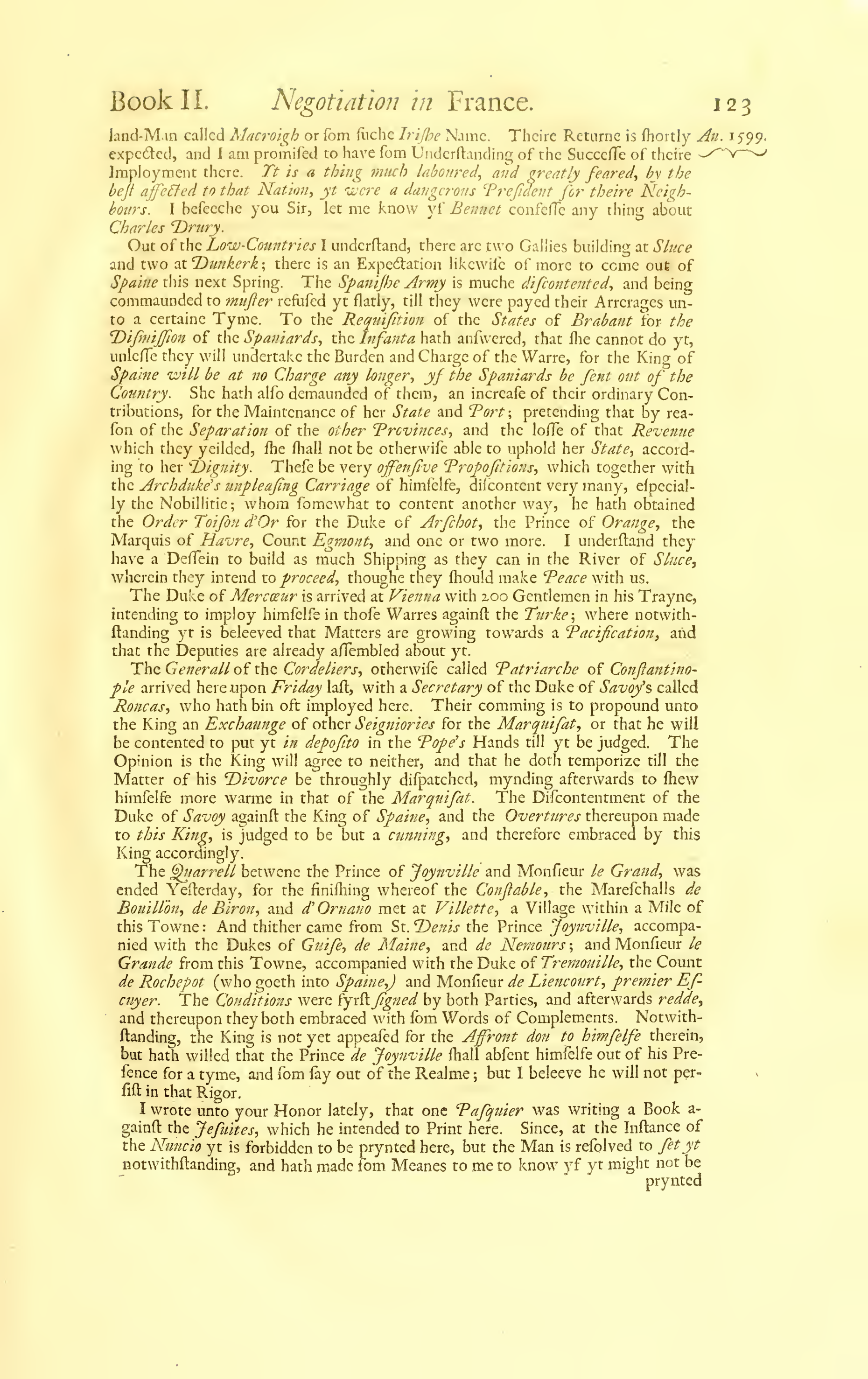
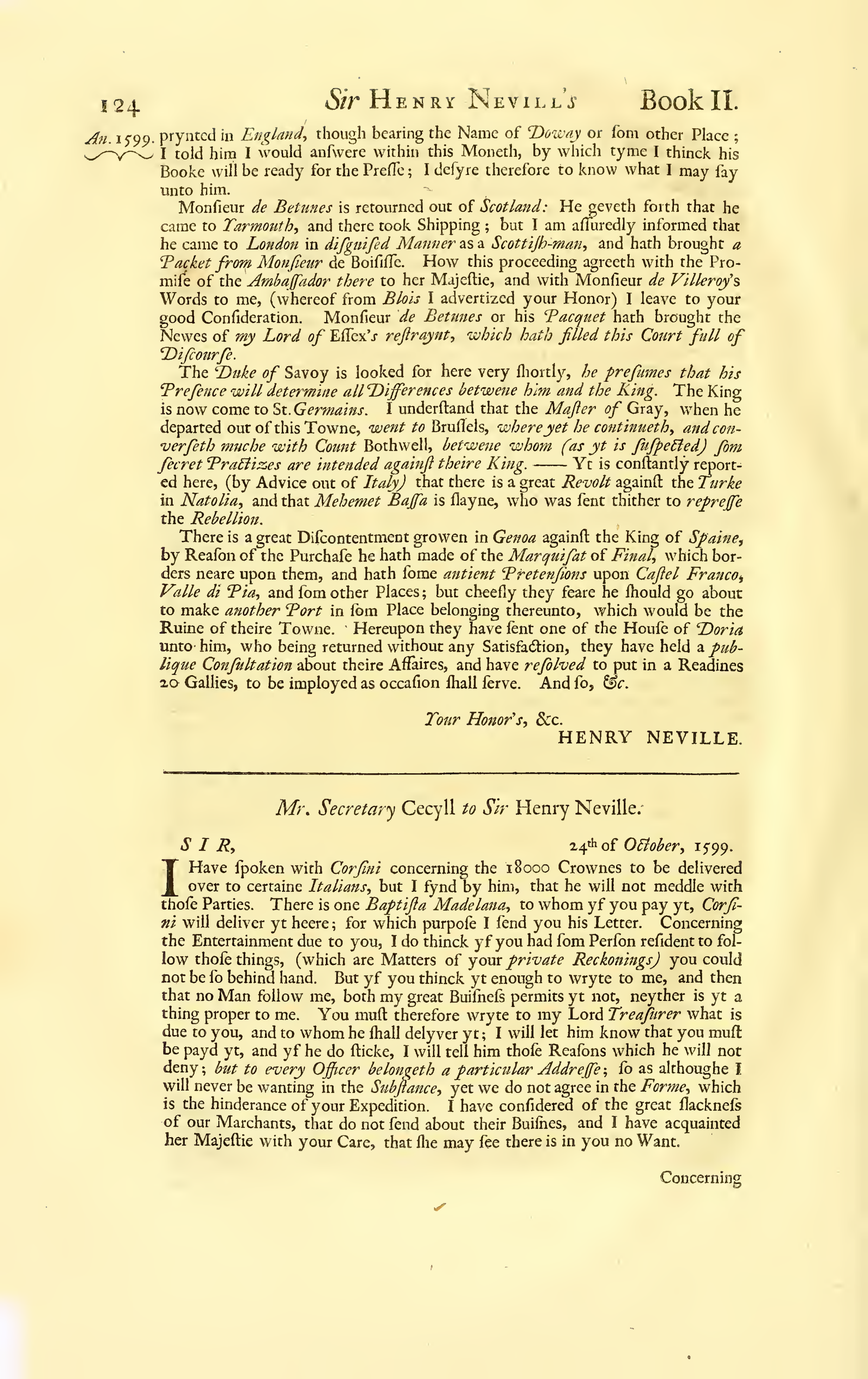
Pasquier / print-routing source position: full Winwood page images now strengthen a different kind of source-books evidence. Printed Winwood vol. 1, pp. 123-124, shows Neville in Paris reporting that Étienne Pasquier was writing against the Jesuits and asking Cecil whether the book might be printed in England under a false continental imprint. The likely print witness is now identified as Pasquier's Le catechisme des Jesuites, with the English translation The Iesuites catechisme appearing in 1602 as EarlyPrint/EEBO A09135. This does not prove that Neville transmitted Shakespeare's source books. It does, however, document an operational book-production lane inside the same ambassadorial setting: anti-Jesuit source material, censorship pressure, English print access, and controlled or non-transparent imprint strategy. Use this in the source-books chapter only as publication/access infrastructure, routed through neville and book publication and the Winwood image-audit packet.
Tycho portrait / Hamlet name-source source position: the Tycho-to-Thomas-Savile letter adds a high-value print-circulation lane adjacent to the source-books chapter. BL Harley MS 6995 and the Dreyer/Tekstnet text show Tycho sending Savile four copies of his recently Amsterdam-engraved portrait in 1590, while asking English poets and Daniel Rogers for an epigram on the image and his works. The candidate SMK Open portrait KKSgb7575 is dated 1588-1590 and visibly carries heraldic labels corresponding to Rosenkrantz and Gyldenstierne/Guildenstern. Use this as a guarded Hamlet source-map lead, not as direct proof of Shakespeare's use. Route details through tycho brahe portrait rosencrantz guildenstern hamlet and thomas savile blotius and italian newsletters.
Feingold / Merton geometry correction, 2026-06-23: the Euclid/Savile lead is now parked as identity-open and probably not relevant to the Henry Neville authorship/source-book argument. Feingold p. 107 remains a possible archival lookup route, but it should not be used as evidence of Neville source-book access, Savile transmission, mathematical interests, or Shakespeare relevance unless the Bodleian inventory line is inspected and proves the named Henry Neville belongs in this project.
A. Directly Supported Source-Book Evidence
- The Feingold Neville/Euclid notice is a parked, identity-open lead and should be removed from the active source-book argument unless direct Bodleian inspection rehabilitates it.
- Neville's
Advice to the Kingquotes Thomas North's Plutarch closely enough to justify a direct source-book packet grounded in the Neville letters XML and the EEBO/TCP witness for North. - The Holinshed/Killigrew packet now has two hardened lanes: the KU
1577copy signed by William Killigrew and the Clegg/Privy Council evidence namingMr. H. Killegrewamong the reviewers of the1587Holinshed. The annotations are of interest for marked passages and source-book context, but Ken's current view is that they do not match Neville's known annotations; do not use them as Neville-hand evidence. - The Alibech/Rustico material is a high-value Decameron lead, not yet a direct Neville-hand proof. The controlling packet preserves the National Archives
PRO 30/50/70/2route, the projectSP 12/238, f. 180conflict, and MegaLettersDoc_115; use it only after direct image and hand controls are reconciled. - Several key Billingbear source-book lines are now preserved in the updated Billingbear transcription keyed to specific PNG images:
IMG 8163: Saxo Grammaticus, Danica Historia, Frankfurt,1576.IMG 8173: Giraldi Cinthio, Hecatommithi, Venice,1580.IMG 8177: Boccaccio / Rolli Decameron, ending in the updated transcription asfalse date 1527.IMG 8181: Boccaccio, Il Decamerone, Venice, Valgrisi,1555.IMG 8184: Grassi, Guarini, Machiavelli, and Minadoi Italian source/political/military books.- Direct PNG inspection by Codex on
2026-04-21confirms the high-importance source-book lines for Saxo, Cinthio, the two Boccaccio entries, and the page-24 Italian source/political/military cluster in substance. - The updated transcription plus page-image controls upgrade the Billingbear source-book evidence from blog/tweet-only for several items to direct local witness evidence. Remaining review is now bibliographic and copy-provenance control, plus character-level review where a reading affects exact edition identification.
- The Saxo / Danica historia, Cinthio / Hecatommithi, and Boccaccio / Decameron source-book lines are no longer dependent only on the Feinstein blog/tweet layer, though acquisition and reading claims remain interpretive.
- Bragantini's Measure for Measure article strengthens the conventional source-scholarship basis for keeping Cinthio's Ecatommiti and Epizia in the Measure for Measure source lane. His Botero discussion has now been expanded through the Billingbear photograph, Audley End object record, exact 1589 text, and Nannini/Chappuys parallel; it remains an avenue for textual and copy-provenance research rather than a completed transmission history.
- Kisery's Hamlet article strengthens the source-map lane around Saxo/Amlethus by tracing political Hamlet material through Nannini's
1561Orationi and Melton's1609Sixe-folde politician. - Womersley's Henry V article strengthens the France/1599 political-source context for Henry V, including Neville's ambassadorial setting.
- Teramura's articles on Lear and Titus are good source-tradition scholarship for Chaucer/Merlin/Lear's Fool and Terence/Titus, though they do not currently connect directly to Neville's library.
- The Pasquier / false-imprint evidence is now stronger as full-page Winwood image control rather than tweet-crop control. It belongs to the publication-access side of the source-books chapter, not to the estate-list or play-source proof side.
B. Physical-Book and Provenance Context
- Multiple Audley End and Merton packets preserve a real research trail connecting reported annotations, book provenance, and Neville-attributed handwriting across surviving books. The Audley End Tacitus blog is an important original-research claim, not merely a weak web lead; the individual book packets and handwriting ledger still need to carry the final image-level apparatus.
- The Billingbear list remains important as provenance context, but not every source-book claim tied to that list is equally hardened at present.
Web / Archive / Google Books source position: browser and web searches add useful public-source routes but do not change the evidence hierarchy.
- Google Books/browser search for
"Henry Nevill" "Aldine Pliny"produced bookseller/provenance-periodical hits in The Publishers' Circular and Booksellers' Record, British Books, and related volumes. Treat these as a search route for the Mayfield/Audley End Aldine Pliny, not as direct evidence of Shakespearean source use. - Google Books/browser search for
"Henry Nevill" "Mayfield" "Bell-Irving"producedMayfield: The Story of an Old Wealden Village, p.159, and related Sussex local-history hits. This supports the Mayfield/local-history route and should be linked tomayfield manor and ironworks. - Public Cinthio controls found or confirmed: Shakespeare Birthplace Trust blog/image route for a 1580 Hecatommithi title page; Soane Collections 1565 Hecatommithi catalogue record; and MDZ/BSB 1566 digitized Hecatommithi witness.
- Public source controls are useful for witness comparison. The direct Neville-side evidence remains the Billingbear list, Audley/Braybrooke catalogue route, local source-image packets, and manuscript/book-copy controls.
Archive.org variant-sweep source-book source position: the deeper Archive.org name/source sweep confirmed several North Plutarch routes that should be kept as separate witnesses. plutarchnorthlives remains the 1579 North image route aligned with TCP A09802; plutarchnorthlives2ed is a useful 1595 second-edition route; nby_704536-2 is a single-life Caius Martius Coriolanus image witness without dependable OCR; and nby_704536 is a single-life Marcus Antonius route. These strengthen public source-witness control for source-book discussion, but they do not add new Neville ownership or reading evidence by themselves.
Source-Book Research Matrix
The matrix prevents several distinct claims—textual source, estate-list survival, Neville’s reading, network access, and Shakespearean use—from collapsing into the single word “owned.” Confidence applies to the stated Neville-side proposition, not to the uncontested fact that a work exists or is conventionally relevant to a play.
| Work or source lane | External/source witness | Neville-side evidence | Shakespeare relevance | Current confidence | Next retrieval or control target |
|---|---|---|---|---|---|
| Thomas North, Plutarch’s Lives | EEBO/TCP A09802; public 1579 Archive.org witness and 1595 witness | Neville’s 1612–13 Advice to the King quotes North closely | North is a major source for the Roman plays | High for Neville’s demonstrated use of North; no authorship inference follows automatically | Keep paragraph-level Advice/North alignment as the controlling proof packet. |
| Saxo Grammaticus, Danica Historia, Frankfurt 1576 | Billingbear transcription and IMG 8163; external Saxo/Hamlet source scholarship | Recorded in the later Billingbear estate list | Amleth/Hamlet source tradition | Medium for family-library/list presence; unproved for Henry Neville’s acquisition or Shakespearean transmission | Complete exact edition and copy-provenance control. |
| Giraldi Cinthio, Hecatommithi, Venice 1580 | Billingbear transcription and IMG 8173; conventional Othello/Measure scholarship | Recorded in the later Billingbear list; its date overlaps Neville’s continental years | Othello’s novella plot; Cinthio/Epitia route for Measure for Measure | Medium for list presence; circumstantial for Neville-era acquisition; unproved for transmission | Control the listed edition bibliographically and keep play-specific source parallels in the Cinthio packet. |
| Boccaccio, Decamerone, Valgrisi 1555 | Billingbear transcription and IMG 8181 | Recorded in the later Billingbear list | All’s Well source tradition and wider novella analogues, usually through intermediary traditions that must be specified | Medium for list presence; unproved for direct literary use | Separate direct Boccaccio access from Painter and other intermediary-source routes. |
| Boccaccio/Rolli entry, “false date 1527” | Billingbear IMG 8177 and revised transcription | A later Rolli-era edition appears in the estate list | No Neville-era access value | Excluded from Henry Neville’s lifetime source-access argument | Retain only as a catalogue-history warning; do not cite as a 1527 Neville book. |
| Alibech/Rustico memorandum or scribble | MegaLetters Doc_115; PRO 30/50/70/2 route; conflicting SP 12/238, f. 180 project label | Possible Decameron familiarity, but archive identity and hand remain unresolved | A manuscript-side Boccaccio/novella familiarity lane | High-value lead, not proof | Reconcile archive route, full image, coordinates, and repeated handwriting controls before attribution. |
| Holinshed/Killigrew copy and review network | KU 1577 signed Killigrew copy; Privy Council/reviewer evidence for 1587 | Killigrew-network context, not Neville ownership; present annotation assessment does not identify Neville’s hand | Direct relevance to the English history plays and Macbeth | High for the Killigrew witnesses; low for Neville-specific use | Keep Killigrew provenance and Neville attribution as separate questions. |
| Audley End Tacitus | Surviving physical-volume and annotation trail in the Audley End packet | Reported marked Tacitus; annotation-hand identification is not yet source-coordinate complete | Roman political/dramatic language and the Sejanus environment | High-value physical-book lead, hand unproved | Full-page shelfmark, page/line coordinates, repeated hand exemplars, and non-Neville control hands. |
| Dudith’s books/manuscript request | Dudith to Neville, 7 Aug. 1581, visually checked modern edition p. 88 | Directly mentions Neville’s books left with Dudith and asks for an unknown manuscript or print | Establishes real source-search practice, not a named play source | High for Neville’s learned book network | Obtain/check the autograph draft, Berlin Depot Breslau R 253 no. 19 f. 10r. |
| Blotius/Vienna library channel | ONB Robert Sidney, Henry Savile, and Thomas Savile objects | Neville is named as a Blotius contact by Savile; no Neville request has been found | Demonstrates diplomatic, technical, and classical source-acquisition infrastructure | High for network infrastructure; low/unproved for a particular Neville book | Continue indexed ONB search without rewriting Sidney or Thomas Savile requests as Neville’s. |
| Pasquier anti-Jesuit printing/false-imprint route | Winwood vol. 1, pp. 123–124, full-page controls | Neville directly proposes possible English printing under a false continental imprint | Demonstrates practical publication/censorship routing | High for Neville’s print-operation knowledge; not a Shakespeare-source chain | Identify any surviving correspondence or Stationers’ evidence connecting the proposal to the 1602 English witness. |
| Tycho portrait with Rosenkrantz/Gyldenstierne labels | Tycho to Thomas Savile, 1590; candidate SMK portrait KKSgb7575 | Savile-network circulation of portrait copies; no direct Neville receipt yet | Guarded Hamlet name-source lead | Lead | Prove which portrait state was sent and whether Neville encountered a copy. |
BRO Doc_22m book-account line | 1604 expense/account transcription | General local book-purchase context only | No named Shakespeare source | Low/context only | Catalogue the account independently; do not use it as substitute source-book evidence. |
| Feingold/Merton Euclid notice | Secondary notice with unresolved personal identity | The named Henry Neville may not be this project’s Neville | No established Shakespeare relevance | Parked/excluded | Revive only if direct Bodleian inventory inspection resolves identity. |
Research judgment
The strongest result is not that every listed book was “Henry Neville’s Shakespeare source.” It is that several different kinds of evidence now coexist and can be tested separately: Neville demonstrably quoted North; his family library later recorded important source editions; Dudith directly involved him in book custody and manuscript/print searching; the Savile/Sidney circle demonstrably used continental library networks; and Neville later handled sensitive print routing as ambassador. That cumulative picture makes source access historically concrete. Authorship or play-specific transmission still requires the separate textual and chronological demonstration identified in each play packet.
The common local-PDF/source-network audit is ITALIAN TRAVEL SOURCE BOOKS AND TWO GENTLEMEN SOURCE PASS 2026 07 09.
2. Ken Feinstein Twitter and Blog Information
A. The Billingbear Book List — Source Texts (via Feinstein blog trail)
- A Ken Feinstein tweet dated
1 Jan. 2021states:
"The Billingbear Book List is the most important document ever discovered relating to the SAQ. It shows how Henry Neville owned the sources for Hamlet, Othello, Measure for Measure, All's Well that Ends Well, etc."
B. The Physical Books at Audley End — Not Just a Catalogue
- A Ken Feinstein tweet dated
16 Oct. 2019states:
"Please note, Henry Neville was in Italy around 1580. It is quite likely he purchased Gli Hecatommithi in Italy and shipped it back to England. There are several other Italian books in the Billingbear library from exactly the same time."
- A Ken Feinstein tweet dated
17 Dec. 2019states:
"Henry Neville's copy of Cinthio's Gli Hecatommithi was printed in 1580. That is the same time Neville was travelling in Europe with Henry Savile. The Gesta Danorum — source for Hamlet — was from 1576."
C. Henry Savile's Editions = Henry Neville's Editions
- A Ken Feinstein tweet dated
11 Jan. 2020states:
"This book list is one of my greatest discoveries. This is the bibliography of Savile's 1591 Tacitus translation. Henry Neville owned many of these editions. Savile was his tutor no surprise."
- A Ken Feinstein tweet dated
22 Dec. 2019states:
"Here are the editions used by Henry Savile in his Tacitus translation. Pretty much same ones owned by Henry Neville. The teacher told the student which editions to get. No surprise."
- A Ken Feinstein tweet dated
13 Jul. 2021states:
"Henry Neville was traveling with Henry Savile in 1581. Here is a book Savile purchased in Padua. About 25 years earlier Neville's father was a Marian Exile in Padua."
D. Merton College Books - Handwriting Triangulation Claims to Control
- A Ken Feinstein tweet dated
21 Oct. 2020states:
"There are at least two books at the Merton College library donated by Henry Neville. One is about Ptolemaic astronomy. The other is about Roman history and relates to Ben Jonson's play Sejanus. Very exciting to connect these with the Neville books at Audley End."
- A Ken Feinstein tweet dated
6 Nov. 2020states:
"Bursting with excitement that with the permission of the Warden and Fellows of Merton College Oxford, I can share these annotations with you. This book on Ptolemaic astronomy was donated by Henry Neville to the college and the annotations appear to be in his handwriting."
- A Ken Feinstein tweet dated
13 Jun. 2023asserts a strong match between a Merton College book and books at Audley End. Treat this as Ken's original paleographic claim requiring final apparatus: Merton volume, Audley End volume, images, and crop comparisons.
- A Ken Feinstein tweet dated
29 Jun. 2023asserts that a Merton College book and the Audley End Tacitus show the same hand. Treat this as Ken's original comparison claim, with publication depending on a source-coordinate table rather than on the tweet wording alone.
- A Ken Feinstein tweet dated
17 Jan. 2024states:
"Blog post on this annotated book on Ptolemaic astronomy donated by Henry Neville to Merton College. This is an important key for understanding the Audley End annotations."
- Context: the tweet trail ties this lane to Henry Savile's wardenship of Merton, Neville's own Merton connection, and Neville's son's Merton connection. Those institutional associations are useful for routing research, but each donated-book and annotation claim still needs its own catalogue and image control.
E. Neville's Father — Marian Exile in Padua
- Multiple Ken Feinstein tweets state:
"Henry Neville's father was a Marian Exile in Padua. Henry Neville as a young man travelled extensively in Italy with his tutor Henry Savile. It is no surprise that the early works of Shakespeare reference these locations." (Feinstein, 30 Mar. 2021)
"Henry Neville's father was a Marian Exile in Padua. His father-in-law studied in Padua. He himself visited Padua with his tutor Henry Savile." (Feinstein, 30 Mar. 2021)
3. Quoted Source Text
New source-scholarship from Sent-email PDFs
- “Giraldi Cinzioʼs Ecatommiti (VIII 5)”
- “Orationi in materia civile, e criminale”
- “both speeches translated by Nannini are attributed to Amleto”
- “the summer of 1599”
- “Prophecy and emendation: Merlin, Chaucer, Lear’s Fool”
- “Black Comedy: Shakespeare, Terence, and Titus Andronicus”
Revised Billingbear transcription source-book lines
IMG 8163: “Saxonis Grammatici Danica ... Historia ... Franc. ad Mon} 1576.”IMG 8173: “Hecatommithi, overo Cento Novelle di M. Giovanbattista Giraldi Cinthio ... Ven. 1580”IMG 8177: “Il Decameron di Boccaccio di Rolli ... false date 1527.”IMG 8181: “Il Decamerone di M. Giovan Boccaccio ... Ven. app. Vinc. Valg.} 1555.”IMG 8184: “Ragioni di adoprar sicuramente l'Arme ... di Giacomo di Grassi ... Ven. 1570.”IMG 8184: “Il Pastor Fido del Guarini ... Ven. 1602”IMG 8184: “Il Principe di Nicolo Machiavelli ... Firen. 1551.”IMG 8184: “Historia della Guerra fra Turchi et Persiani di Gio. Tomaso Minadoi da Rovigo ... Ven. 1594.”
Direct PNG inspection
IMG 8163: Saxo /Danica Historia/1576is visibly present; the same page also visibly supports the broader classical/history cluster around Raleigh, Vives, Kromer, Livy, Sigonii, La Popeliniere, Diodorus, and Ochoa.IMG 8173: Cinthio /Hecatommithi/Ven. 1580is visibly present.IMG 8177: theIl Decameron di Boccaccio ... 1527line is visibly present. The updated transcription reads the ending asfalse date 1527; do not preserve the olderSalviati 1527wording unless the image is separately rechecked.IMG 8181: theIl Decamerone di M. Giovan Boccaccio ... Vinc. Valg. ... 1555line is visibly present.IMG 8184: the Grassi, Guarini, Machiavelli, and Minadoi cluster is visibly present; exact spellings such asOffesa/Offessashould remain subject to a final diplomatic check.- Additional spot checks:
IMG 8160visibly supports the Rerum Anglicarum / Diodorus / Appian-Dio classical-history cluster;IMG 8164visibly supports the Dionysius of Halicarnassus1546line;IMG 8169visibly supports the Ariosto / Orlando Furioso1580line.
Ken Feinstein tweets (source-map layer; not verified facts)
- "The Billingbear Book List is the most important document ever discovered relating to the SAQ. It shows how Henry Neville owned the sources for Hamlet, Othello, Measure for Measure, All's Well that Ends Well, etc."
- "There are several other Italian books in the Billingbear library from exactly the same time."
- "Henry Neville's copy of Cinthio's Gli Hecatommithi was printed in 1580. That is the same time Neville was travelling in Europe with Henry Savile."
- "This is the bibliography of Savile's 1591 Tacitus translation. Henry Neville owned many of these editions. Savile was his tutor no surprise."
- "The teacher told the student which editions to get. No surprise."
- "Henry Neville was traveling with Henry Savile in 1581. Here is a book Savile purchased in Padua."
- The
13 Jun. 2023,29 Jun. 2023, and11 May 2024tweet trail asserts strong same-hand/provenance conclusions for Merton and Audley End examples. In this hardened synthesis those claims are retained as Ken's original project claims; the next step is to supply the source-coordinate handwriting table that lets the claims stand independently of tweet wording.
4. Citations
- Feinstein, Ken. "Henry Neville's Library of Shakespeare Sources." kenfeinstein.blogspot.com, 31 Aug. 2019. Local preservation: blog neville library sources 2019 08 31.
- Billingbear Book List Transcription. Updated local transcription keyed to PNG image filenames. Billingbear Book List Transcription. Converted image folder: Billingbear_Book_List_PNG. Integration note: BILLINGBEAR UPDATED TRANSCRIPTION INTEGRATION 2026 06 06.
- Feinstein, Ken. X post, 16 Oct. 2019. Tweet ID 1184294888411545604. (Italian books / Italy 1580.)
- Feinstein, Ken. X post, 17 Dec. 2019. Tweet ID 1206836221009264640. (Gli Hecatommithi 1580 + Gesta Danorum 1576 + Savile traveling.)
- Feinstein, Ken. X post, 22 Dec. 2019. Tweet ID 1208840396412878848. ("The teacher told the student which editions to get.")
- Feinstein, Ken. X post, 11 Jan. 2020. Tweet ID 1216080599712055297. (Savile's Tacitus bibliography = Neville's editions.)
- Feinstein, Ken. X post, 20 Jan. 2020. Tweet ID 1219096108212768770. ("Best day ever. Henry Savile's 1591 Tacitus is digitized on Google books.")
- Feinstein, Ken. X post, 1 Jan. 2021. Tweet ID 1344910344292978688. (Billingbear list as most important SAQ document.)
- Feinstein, Ken. X post, 21 Oct. 2020. Tweet ID 1318941108118855688. (Merton College book with Neville annotations matching Audley End.)
- Feinstein, Ken. X post, 21 Oct. 2020. Tweet ID 1319038583718596608. (Two Merton College books: Ptolemaic astronomy + Roman history / Sejanus.)
- Feinstein, Ken. X post, 6 Nov. 2020. Tweet ID 1324792813167542282. (Ptolemaic astronomy book at Merton, donated by Neville, with his handwriting.)
- Feinstein, Ken. X post, 13 Jul. 2021. Tweet ID 1415046059588415489. (Savile purchased book in Padua in 1581.)
- Feinstein, Ken. X post, 30 Mar. 2021. Tweet ID 1377027... (Father Marian exile in Padua; Neville traveled in Italy with Savile.)
- Feinstein, Ken. X post, 13 Jun. 2023. Tweet ID 1668492166166093825. (Merton College / Audley End match assertion.)
- Feinstein, Ken. X post, 27 Jun. 2023. Tweet ID 1673843336799719424. (Audley End same-hand assertion.)
- Feinstein, Ken. X post, 29 Jun. 2023. Tweet ID 1674248428300427264. (Merton College book vs Audley End Tacitus — same handwriting.)
- Feinstein, Ken. X post, 17 Jan. 2024. Tweet ID 1747760722493538653. (Blog post on Merton College Ptolemaic astronomy book.)
- Feinstein, Ken. X post, 11 May 2024. Tweet ID 1789088957432758452. (Provenance-certainty assertion.)
- norths plutarch and henry nevilles advice to king james
- boccaccios decameron in henry nevilles library
- gli hecatommithi and henry neville
- gesta danorum and henry neville
- holinsheds chronicles killigrew copy and henry neville
- alibech rustico and boccaccios decameron, controlling packet for the Alibech/Rustico lead,
PRO 30/50/70/2, MegaLettersDoc_115, and the unresolvedSP 12/238, f. 180route. - henry nevilles italic handwriting, controlling packet for handwriting claims and image-bank limits.
- audley end tacitus and henry neville, controlling packet for the Tacitus IV.18 / Audley End image lead.
- NORTHUMBERLAND HANDWRITING LEDGER, methodological ledger for future source-coordinate handwriting work.
- Bragantini, Renzo. “Measure for Measure and the Italian Cinquecento. Intertextuality and Sources: Certain, Likely, and Possible.” Staged PDF: Bragantini MeasureForMeasureItalianCinquecento.
- Kisery, Andras. “‘I Lack Advancement’: Public Rhetoric, Private Prudence, and the Political Agent in Hamlet, 1561-1609.” ELH, vol. 81, 2014, pp. 29-60. Staged PDF: Kisery I Lack Advancement Hamlet 2014.
- Womersley, David. “France in Shakespeare’s Henry V.” Renaissance Studies, vol. 9, no. 4, 1995, pp. 442-459. Staged PDF: Womersley FranceInShakespearesHenryV 1995.
- Teramura, Misha. “Prophecy and emendation: Merlin, Chaucer, Lear’s Fool.” Staged PDF: Teramura ProphecyEmendation MerlinChaucerLear 2019.
- Teramura, Misha. “Black Comedy: Shakespeare, Terence, and Titus Andronicus.” Staged PDF: Teramura Shakespeare Terence Titus 2018.
- BRO account/book-purchase lead: Doc 22m D EN F6 series.
- hugo blotius vienna library source acquisition, controlling packet for the Blotius/Vienna Library source-acquisition lane.
- thomas savile blotius and italian newsletters, controlling packet for Thomas Savile / Thomas Savell source-network identity and the Italian-newsletter addressee problem.
- neville and book publication, controlling packet for the Pasquier false-imprint / book-production evidence.
- Winwood vol. 1 source-control table and OCR audit, 2026-06-21: WINWOOD VOL1 AMBASSADOR TABLE 2026 06 21. Local full-page Pasquier images: winwood_ambassador_ocr_audit_2026-06-21.
5. The Evidentiary Hierarchy
The source-books evidence operates at four levels of strength:
Strongest currently controlled source-book/text evidence:
- The 1612–13 Advice to the King demonstrably retells the Antigonus–Demetrius episode and follows much of the narrative sequence found in Thomas North's Plutarch (Neville Letters Corpus,
document_neville_advice, paragraph 5). The1579,1595, and1603North editions do not supply Neville's final two-noun formulation, while Amyot, period Latin, and Greek preserve two concepts more fully. Use this as direct evidence of Neville's active Plutarchan reading, not as a near-verbatim North-only quotation or an exact-edition fingerprint. - The Saxo / Danica historia, Cinthio / Hecatommithi, Boccaccio / Decameron, and Machiavelli
1551lines are now firmer than before because they are preserved in the updated local transcription keyed to page images, not only in the Feinstein blog/tweet trail. - The
IMG 8164,IMG 8160, and related Billingbear lines provide direct estate-list controls for Dionysius/Cassius Dio/Appian/Tacitus-context source lanes, while the exact physical-copy and annotation claims remain separate.
High-value leads requiring source-coordinate controls:
- The Alibech/Rustico scribble lead: MegaLetters
Doc_115, National ArchivesPRO 30/50/70/2, and the projectSP 12/238, f. 180label remain unresolved against one another. Do not call this Neville's hand until direct images and hand controls are reconciled. - The Audley End Tacitus with Annals IV.18 reportedly underlined/bracketed. The Tacitus passage itself is verified, but the Neville-letter extraction, Audley End page identifiers, physical-volume catalogue, and annotation-hand identification still need direct controls.
- Audley End and Merton annotation comparisons. These may become important handwriting/provenance evidence, but the current synthesis treats them as controlled leads pending full-page images, shelfmarks, crop coordinates, and repeated exemplars.
- Savile-hand claims in Audley End volumes should be kept separate from Neville-hand claims and routed through the individual Audley End/Savile packets.
Circumstantial but significant:
- The 1780 Billingbear Book List records source texts associated with Shakespearean source traditions, but it is not proof by itself of acquisition by Henry Neville, direct reading, annotation, or literary use.
- The dating of certain editions (for example 1576 and 1580) is suggestive when set beside Neville's continental travel, but the acquisition story remains interpretive rather than documentary.
- Savile's Tacitus bibliography citing overlapping editions is a meaningful contextual pattern, but claims about teacher-directed acquisition should remain in the Feinstein interpretation layer unless independently documented.
- The Pasquier false-imprint lane is significant evidence of Neville's ability to discuss and route politically sensitive printing from France through England. It should not be converted into proof that any Shakespeare source book moved through the same mechanism.
Do not promote without more evidence:
- Tweet-language claims about categorical handwriting matches, obvious same-hand conclusions, or provenance certainty.
- Any unqualified statement that the Alibech/Rustico scribble is an autograph Neville witness.
- Any chapter-level statement that a listed source book proves Shakespearean literary transmission without a play-specific packet supplying the textual bridge.
6. Notes on Access
- This is the synthesis packet for the planned book chapter on Shakespeare's source-books.
- The updated Billingbear transcription is the current local text-control layer for this packet. Cite it as a local research transcription, and keep exact edition/copy-provenance claims separate from list presence.
- The evidentiary hierarchy above was not previously stated in the book; it should be added to Chapter Five.
- The Merton College connection is a potentially important triangulation route for the Audley End handwriting identification, but not yet an independent proof. It should be incorporated into Chapter Four or Chapter Five only with catalogue records, direct images, and a documented comparison table.
- The Savile/editions connection is best treated as a contextual pattern rather than a proved acquisition history unless the underlying documentary support is strengthened further.
- The second-pass Gmail PDFs add important source-scholarship support but do not by themselves prove Neville owned or read any specific source. Use them to explain why the listed source books matter, then cite the Billingbear/Audley/Merton witnesses separately for Neville-side access.
- The BRO transcription corpus does not currently replace the source-book witness stack.
Doc_22mis a minor book/account lead only; named Shakespeare-source claims still need Billingbear/Audley/Merton/source-scholarship controls. - The Alibech/Rustico item belongs in the Decameron source lane as a lead, not as a settled autograph claim. Use alibech rustico and boccaccios decameron as the controlling packet until the archive route and image-hand evidence are reconciled.
2026-07-13 New Source-Book Findings from Surviving Objects
The Billingbear–Audley End workbook has yielded seven newly inspected full-text witnesses and nine specific surviving-object matches. Three findings are immediately Shakespeare-facing:
Albergati and the constitutional problem of Measure for Measure
English Heritage object 81035076 is the Rome 1602 Discorsi politici, an explicit attack on Bodin in defense of Aristotle. Albergati's discussion of the leaden Lesbian rule distinguishes equitable adaptation from a judge's becoming moderatore, & arbitro delle leggi. Folger Measure for Measure 1.3.20–32 and 2.2.117–20 stage the corresponding problem through dormant statutes, an empowered deputy, strict application, and the claim that law—not the judge—condemns. This is a structural political-theory comparison, documented in the Albergati packet.
The 1602 philosopher lives contain an exact Athenian-Timon distinction
Object 81035055, Le vite de filosofi cavate da Laertio et altri, does not narrate the Shakespearean Timon story. Its illustrated life of another Timon opens by distinguishing him from quel scelerato huomo cittadino Ateniese who would neither see nor associate with anyone. Folger Timon of Athens 4.3.59 identifies its hero as Misanthropos who hates mankind. The volume is therefore neither a generic “Timon source” nor irrelevant: it is an exact surviving Billingbear-listed witness for the Athenian-misanthrope association. See the two-Timons packet.
Ruscelli turns the Italian library into a language curriculum
Object 81035061, the exact Venice 1581 Commentarii della lingua italiana, is a technical language book. It discusses borrowing, pronunciation, orthography, prose and verse, and identifies Petrarch, Boccaccio, Ariosto, and Guicciardini as models. The Shakespeare research question is therefore broader than plot access: did the library support disciplined Italian reading and composition? The answer now has an identifiable object and inspectable leaves. See the Ruscelli packet.
The larger surviving cluster also includes Paruta, Maffei, Minadoi, Boccalini, Nobili, and Leunclavius. Its relevance must be tested book by book and against exact Folger passages. The object cluster and imaging protocol are summarized in billingbear surviving political geographical library 2026 07 13.
2026-08-28 Chapter 18 Source/Custody Audit
The new Chapter 18 reconstruction replaces the single word owned with five separately testable propositions:
- a work is textually related to a Shakespeare play;
- an exact edition is identified and chronologically available;
- that edition is recorded at Billingbear in
1780; - a later physical object or catalogue match is identified;
- Henry Neville's personal access is independently documented.
The resulting ranked matrix contains sixteen representative lanes and deliberately has no numerical authorship score. Its leading cases are different kinds of evidence rather than interchangeable “hits”:
- North / Plutarch: strongest present personal-reading evidence. Neville demonstrably reused the Antigonus–Demetrius tradition, but the exact English or multilingual route remains unresolved.
- Cinthio, Venice 1580: strongest source-and-later-library conjunction. It is a principal narrative source for Othello and part of the mediated Measure for Measure descent; Billingbear presence does not yet prove Henry's purchase or use.
- Holinshed: strongest immediate-family physical-copy route. William Killigrew owned the Kansas
1577copy and Henry Killigrew participated in the1587review; neither fact proves Neville consulted a particular copy. - Chamber / Barlaam, Paris 1600: strongest model of a Neville-addressed learned book later recorded at Billingbear. It is personal book evidence, not a Shakespeare plot source.
- Saxo, Frankfurt 1576: exact pre-Hamlet edition with the Amleth sequence, but Belleforest and the lost drama remain the missing middle.
Four controls are now mandatory:
- the Rolli “1527” Decameron is a later false-date edition and excluded from Neville-era access;
- the Billingbear Greek Appian of
1551is not the English Appian of1578normally used in source scholarship; - the catalogue row transcribed as
Livy's Roman History, London, 1586remains bibliographically unresolved and must not be identified as Holland's1600translation; - the Billingbear Boiardo of
1602cannot explain Tofte's1598Love's Labour's Lost performance notice.
Guazzo and Guarini remain serious but bounded. Guazzo is a proposed intertextual and philosophical influence, especially for Ulysses' book and reflected self-knowledge; the world-stage metaphor is nonexclusive. Guarini supplies a documented tragicomic framework for The Winter's Tale, while Greene remains the plot source. Dionysius is a possible supplementary Coriolanus source; Sansovino and Botero are geopolitical or political analogues; Di Grassi and the Pigafetta books are practical context unless play-specific textual dependence is independently demonstrated.
The audit uses only public catalogue identity, public editions, published scholarship, and public collection/provenance facts. It does not disclose or infer from nonpublic Audley End annotation detail.
2026-08-28 Chapter 20 Multilingual Route Synthesis
Chapter 20 now separates nine classical and continental source lanes by the route that actually survives. This supersedes any formulation that treats a source author's name, a later catalogue entry, and Henry Neville's demonstrated reading as equivalent facts.
Present hierarchy
- Plutarch: the strongest personal-use lane. Neville's parliamentary
- Cinthio 1580: the strongest exact source-edition conjunction. The Venice
- Pigafetta: the strongest personal-network-plus-book lane. Contemporary
- Chamber/Augustine: a serious learned-network lane for the astrology
- Guicciardini 1580 with Marinello: a methodological conjunction. The
- Dionysius, Boccaccio, Guazzo, and Guarini: real but mediated or contextual
- Appian 1551 Greek: retained as the negative edition control. It is not the
Advice demonstrably retells Antigonus and Demetrius. The ending “confidence and concord” cannot be generated by North's one-noun “agreement” alone; Amyot, Greek, and period Latin preserve two concepts. The result eliminates a North-only verbal model but does not identify one replacement edition.
printing is directly relevant to Othello and upstream of Measure for Measure, while Neville had continental opportunity and the edition later appears at Billingbear. No purchase or continuous-custody record survives.
state papers place Signor Pigafetta with “young Mr. Nevell,” and Filippo Pigafetta-associated technical books later appear at Billingbear. Filippo must remain distinct from Marc'Antonio Pigafetta, author of the 1585 London Itinerario. Association does not prove transfer or consultation.
controversy in King Lear 1.2 and Sonnet 14. Chamber's 1601 Treatise was dedicated to Thomas Egerton, not Neville; Neville's address belongs to Chamber's 1600 Barlaam. The relation is controversy-level, not an exclusive verbal-source claim.
edition explicitly packages history as training “to rule and govern states,” closely matching Neville's demonstrated use of Plutarch, Tacitus, and prior crises in active counsel. Consultation of the later catalogued copy remains unproved.
lanes. Plutarch/Amyot/North must be subtracted before direct Dionysian use is proposed; Painter controls Boccaccio's immediacy for All's Well; Greene, not Guarini, supplies The Winter's Tale plot; Guazzo is conduct and conversation context rather than a demonstrated plot source.
standard 1578 English Appian route cited for Antony and Cleopatra.
New reproducible controls
- The nine-row dataset records demonstrated personal use, documented human
- The four-column figure uses categorical symbols, not a numerical authorship
- Rows dependent on the 1780 catalogue are explicitly recognized as dependent
- John Chamber's two books and the two Pigafetta identities are never merged.
- No individual nonpublic Audley End annotation is described, quoted,
route, continental opportunity, exact later household edition, present rank, and the missing-link control for every lane.
score.
evidence and are not added as independent votes.
enumerated, or used inferentially.