Ambassador to France
Topic: Ambassador to France
Source-Fact Audit — 7 August 2026 (Round 4)
- The embassy itself is a documentary fact: Neville served as Elizabeth I's ambassador resident in France in 1599–1601, and dated correspondence should be cited for particular actions rather than compressed into a generalized account of his diplomacy.
- A calendar abstract, a printed dispatch, and an original manuscript are different witnesses. Exact quotation marks belong only around wording checked in the cited witness; modern paraphrase must remain outside quotation marks.
- The surviving diplomatic record can establish meetings, messages, expenses, intelligence, and negotiations. It does not by itself establish that a particular French book, theatrical practice, or political idea passed from Neville to a Shakespeare play.
- The unidentified Winwood-derived OCR passage retained below remains quarantined until its volume, page, date, and speaker are resolved. It is not evidence merely because its language is congenial to the topic.
- Comparative literary questions are therefore preserved as research leads, separate from the dated embassy facts.
Source-Control Summary
- Public-page controls to keep visible: CSPD Elizabeth p.
157for the Windsor deer/game notice, CSPD James I pp.371-372for travel licence / Windsor office, and CSPD James I p.484for French-service compensation. - The former high-priority gap for
SP 12/271/29is now closed at printed-calendar level. CSPD Elizabeth1598-1601, pp.220-221, directly summarizes Neville's27 June 1599Paris dispatch and identifies the Tresham and Paget enclosures; exact page images and Archive.org leaf alignment are staged locally. - Winwood control: the embassy letter run should be cited through the page-audited Winwood table before any long quotation (WINWOOD VOL1 AMBASSADOR TABLE 2026 06 21).
- MegaLetters control: PRO 30/50 diplomatic drafts should be quoted only after image collation; use them now for routing and short anchors.
- Guardrail: ambassadorial chronology is documentary context. It does not itself prove a play-source pipeline.
Web / Archive.org Notes
- Added the 2026-06-04 Archive.org page-control route to this packet's working source map. The useful public controls remain known item/page URLs, not broad Archive.org metadata search.
- Page anchors to preserve for this topic cluster:
- CSPD Elizabeth, vol. 5, p.
157, Queen Elizabeth/Neville deer-game notice:https://archive.org/details/cu31924091775290/page/157 - CSPD James I, vol. 1, pp.
371-372, travel licence / Windsor reversionary-office material:https://archive.org/details/calendarofstatep01grea/page/371andhttps://archive.org/details/calendarofstatep01grea/page/372 - CSPD James I, p.
486, French-service compensation:https://archive.org/details/calendarofstatep01grea/page/486/mode/2up - CSPD James I, p.
505, younger Henry mistaken for a pirate:https://archive.org/details/calendarofstatep01grea/page/505 - Cottoni Posthuma, pp.
75ff., Boulogne / Anglo-Spanish precedency material occasioned by Sir Henry Nevill:https://archive.org/details/cottoniposthumad00cott/page/75 - Use these as diplomatic/biographical controls. They do not by themselves prove play-source transmission.
- Broad Archive.org metadata searching for exact personal-name combinations was weak in this pass, so the next retrieval work should stay focused on known items, page images, TNA catalogue records, and local PRO 30/50 images.
1. Source-Control Summary
This packet is now a source map, not a narrative biography. The directly checked core is strong for Neville's status as English resident or ordinary ambassador in France, his 1599 arrival and first embassy business, and his separate 1600 role as a Boulogne peace commissioner. It remains mixed because several useful dates and interpretive claims still depend on secondary summaries or local source-finding notes.
The main correction from this pass is bibliographic: the preserved local wiki says "Winwood's Memorials of Affairs of State, Vol. 1" but links to Archive.org item memorialsofaffai03winw, which is volume 3. Neville's 1599-1600 embassy and the Boulogne commission are in memorialsofaffai01winw, volume 1.
Additional source-control source position: MegaLetters Doc_122 adds an important post-recall / post-arrest administrative witness. It is Robert Cecil to Thomas Lake, not a Zachary Lock custody order, and it belongs here because it addresses Winwood remaining in France and the dissolution of Neville's Paris household after Neville was unlikely to return to his French charge.
Worker D source note: the BRO sweep adds context, not a replacement chronology. Doc_14g remains the direct BRO address witness for Neville as ambassador resident in France. Doc_14d is a pre-departure estate/legal witness locating Neville at Killigrew's Lothbury house before going into France. Doc_12 is a post-service draft about French-service losses and reputation. Doc_14e is a Paris household/student witness that mentions Sir Thomas Overbury and Huguenot news. None of these BRO items verifies the local-wiki Boulogne date sequence.
Image/material source position: a published letter-book table identifies TNA PRO 30/50/2, fols. 121r-144v, as a May-June 1599 Henry Neville resident-ambassador letter-book fragment. The corresponding local MegaLetters opening-embassy images for Doc_61 through Doc_71 have been staged under [local source path removed]. A source note now maps image witnesses sequence 172-213 to fols. 121r-141v; fols. 142r-144v remain unstaged/unmapped.
Non-MegaLetters discovery source position: TNA PRO 30/50/70, Additional diplomatic correspondence of Sir Henry Neville, is a separate item-level diplomatic file dated 1589-1603. The parent and each checked item report digitised=false. Local work already uses /70/2 through the Venice/Rome newsletter lane, but /70/3-20 remain active image/order targets.
ODNB source-list crosswalk source position: Greengrass's compressed citation to SP 78/43, fols. 25-60 resolves to an item cluster. The core appointment witness is TNA SP 78/43/17, fol. 25, instructions for Sir H. Neville as ambassador to France, with another copy. Related appointment records just outside the cited folio phrase are SP 78/43/24, fol. 76, points on which Neville desires instructions, and SP 78/43/25, fol. 78, a pass for Neville going as ambassador to France. These are source-controlled but still image-map-needed.
Archive.org addendum, corrected 2026-07-15: CSPD James I vol. 1, printed p. 486, vol. XLIII, item 22, dates Sir Henry Nevill's letter to Salisbury to 14 Jan. 1609. Its unusually specific summary exactly matches BRO Doc_12: recent reconciliation, financial difficulty, a request that Salisbury forward Neville's suit to the King for a farm of land or annuities to younger sons, and £4,000 spent in French public service. This identifies the BRO draft's date and recipient. Archive.org Cottoni posthuma also supplies page images for the 1651 printed precedency abstract linked to Neville's Boulogne/Calais dispute with the Spanish ambassador.
Archive.org / Warrant Book addendum, 2026-06-04: CSPD Elizabeth vol. 5, p. 157, adds a January 1599 Queen Elizabeth notice to Neville that joins this embassy packet to the Windsor Forest office lane. The calendar says Elizabeth directed Neville to restrain game/deer killing in Mote Park and Sunninghill Park during his absence as resident ambassador in France, and cites Warrant Book, I., p. 36. The old wiki/source-page route was one page early; the corrected Archive leaf is n170. The current manuscript target is TNA SP 40/1, p. 36, which Discovery reports as not digitized.
Duncan integration note: Owen Duncan's dissertation chapters 3-4 are now mined as a secondary source map for the embassy. Duncan is useful for the shape of the narrative: Neville's reluctance because embassy service was expensive; the knighthood, advance entertainment budget, promised term, and hoped-for later court office; Winwood's role as secretary; French debt; Treaty of Blois/commercial privileges; merchant grievances and depredations at sea; anti-Spanish and anti-Catholic intelligence; Savoy/Saluces leverage; Boulogne peace talks; and Neville's August 1600 return. This should not displace Winwood, HMC Salisbury, CSPD, SP 78/43, MegaLetters, or PRO 30/50 controls for exact dispatch facts.
Local BRO website verification: Doc 12 D EN F6 2 3 is present in the local website data as BRO_Doc_12_D_EN_F6_2_3, with both 8xxx and clearer 0xxx image sequences and no missing-image flags. On 14 July 2026, all eight images were inspected at original resolution. The docket, shelfmark, French-service language, 4.000 l. claim, reputation clause, land-recompense suit, copyhold licence, parsonage reversion after Neville's wife's mother, and pool/cripple comparison are directly legible. The dense cancellation and insertion apparatus remains P0/PARTIAL and should not be reproduced as a fully verified diplomatic transcription.
Core-image addendum, 2026-06-20: a priority image pass now stages public Archive.org page images for the printed controls most useful to this packet: Winwood vol. 1 opening embassy pp. 14-16, the Boulogne commission pp. 186-188, Bacon's 1601 Essex declaration page naming Neville as "Ligier Ambassadour," CSPD Elizabeth p. 157, CSPD James I p. 484, and Cottoni Posthuma pp. 75-77. These images improve the direct page-control layer for the embassy, Boulogne, and afterlife/cost lanes. They do not replace the still-needed TNA images for SP 78/43, SP 40/1, PRO 30/50/70, or the BRO/MegaLetters line collations.
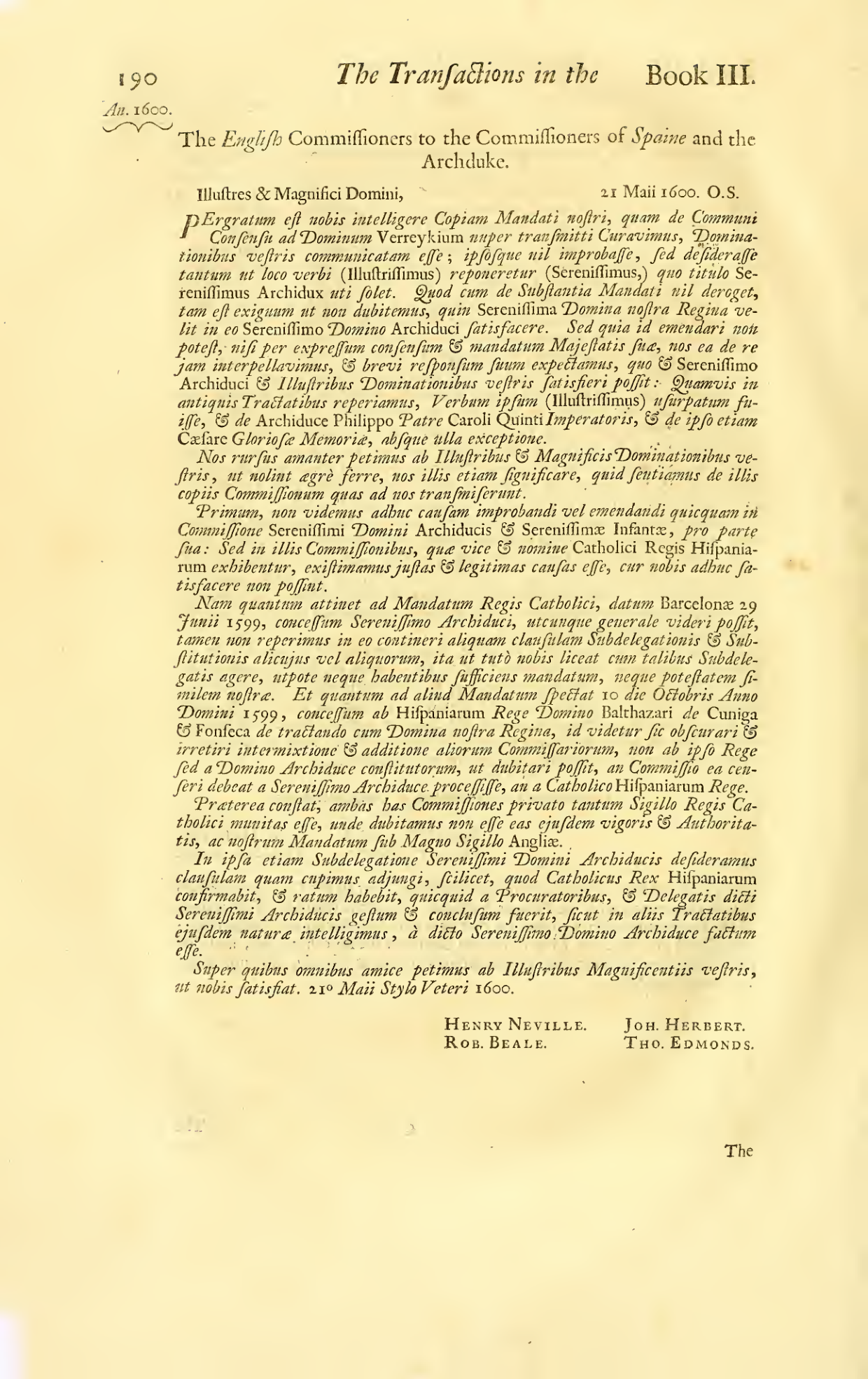
Winwood OCR-audit source position: the new WINWOOD VOL1 AMBASSADOR TABLE 2026 06 21 adds image controls for printed pp. 20, 51, 123-124, 190, and 194, and it exposes a critical guardrail. The local OCR remains useful for searching the Book II embassy run, but its Boulogne/post-Boulogne pages are not text authority. In particular, page 171, page 175, and page 179 do not match the corresponding page images. Diagnosis refined 2026-07-24, and an interim explanation withdrawn. The observation stands: those OCR files do not match the image controls. An interim explanation offered earlier the same day — that Winwood vol. 1 paginates each Book separately — is wrong and withdrawn. Page images show pagination is continuous: Book II ends at printed p. 185 and Book III opens at printed p. 186, confirmed in two independent local scans. The actual position is worse than an offset: [local source path removed] is not either local Winwood vol. 1 scan. Its printed p. 186 carries an English narrative where both scans carry the Book III title page and the Latin commission, and the phrase 'severall Points' is absent from the 511-page scan's text layer. That OCR set is an unidentified source and must not be cited as Winwood until identified. The Boulogne commission is now worked from page images in boulogne peace commission 1600. For the Boulogne section, cite the image-controlled printed pages: p. 186 opens Book III with the commission, p. 187 names the commissioners, p. 188 begins the 20 May report to Cecil, p. 190 carries a signed 21 May commissioners' letter, and p. 194 carries a Latin answer dated 24 May.
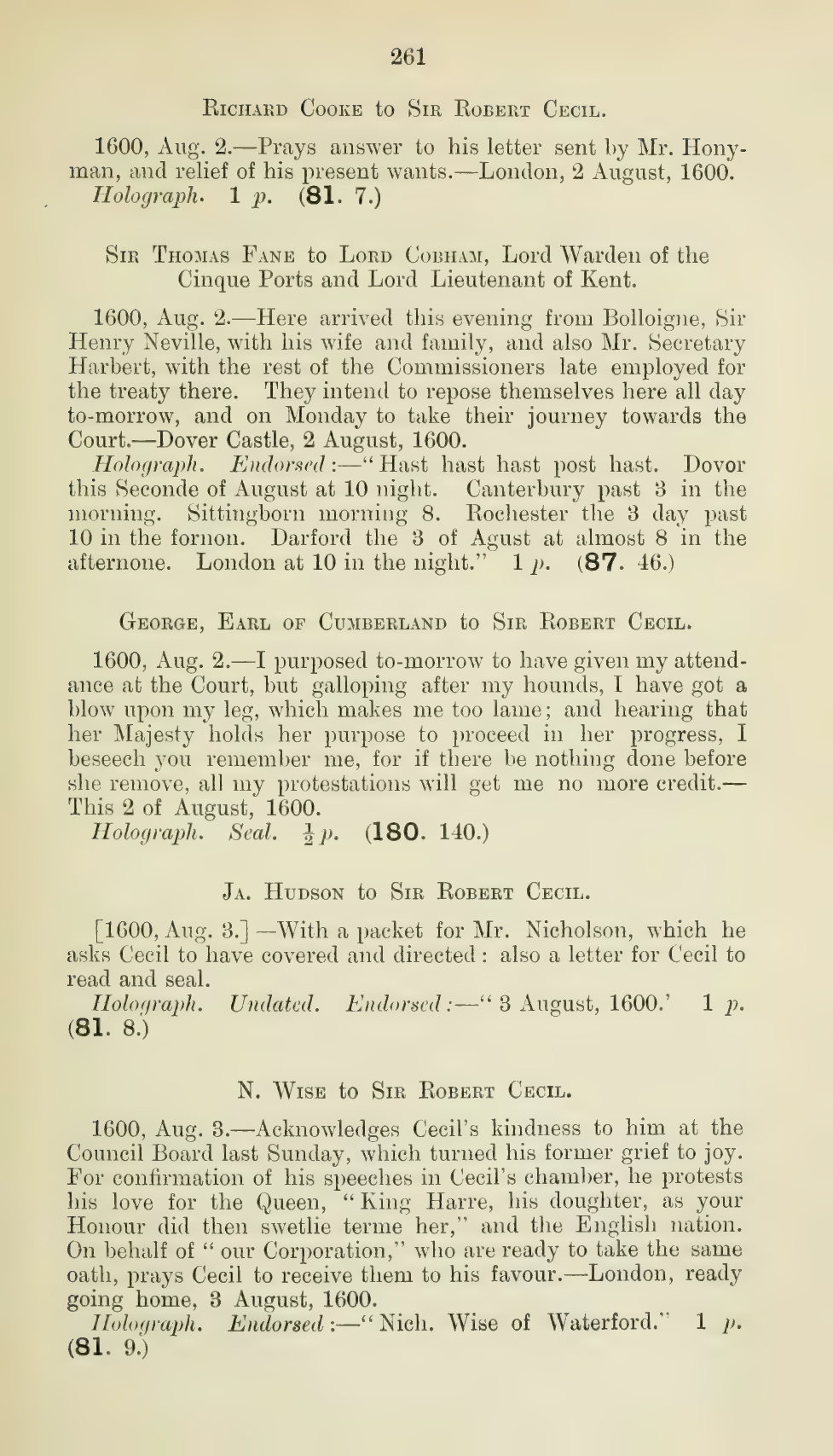
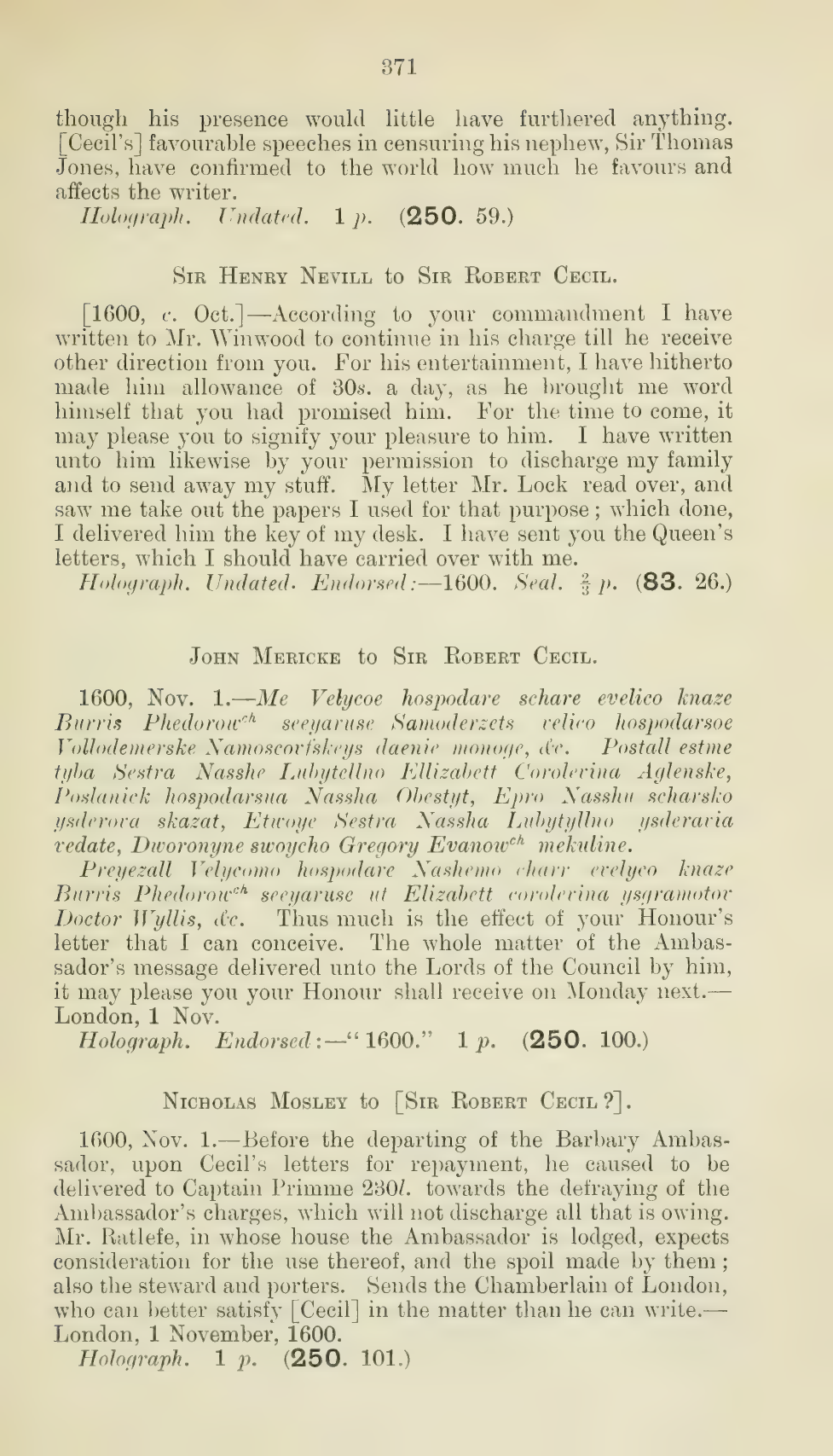
HMC Salisbury image source position: the Archive.org/Hatfield image packet SOURCE NOTES adds two non-Winwood controls for the embassy afterlife. HMC vol. 10, printed p. 261, reports Neville's 2 August 1600 arrival at Dover from Boulogne with his wife, family, Secretary Herbert, and the other commissioners. HMC vol. 10, printed p. 371, reports Neville writing Cecil that Winwood should continue in charge, that Neville's family and stuff should be discharged from France, and that Mr Lock read Neville's letter and received the key of his desk.
As You Like It / Stationers return-window source position: the consolidated analysis AS YOU LIKE IT STATIONERS RETURN SOURCE ANALYSIS 2026 06 24 connects the HMC Dover-arrival witness to the Folger/Shakespeare Documented 4 August 1600 Stationers' Register stay. The book-safe conclusion is return-window proximity, not causation: the entry falls between Neville's Dover landing and his London/court reappearance.
Archive.org variant-sweep addendum, 2026-06-24: the broader spelling pass is documented in ARCHIVE ORG HENRY NEVILLE VARIANT SWEEP 2026 06 24. The strongest France/embassy gains are source-routing rather than new chronology. Archive.org item bim_eighteenth-century_memorials-of-affairs-of-_sawyer-edmund_1725_1 is a useful alternate vol. 1 witness for Winwood/Sawyer because its preface explicitly frames Sir Henry Neville's 1599-1600 French negotiations and the Treaty of Bulloign as material printed from original MSS made available by Grey Neville. Keep this alongside memorialsofaffai01winw, not as a replacement for manuscript controls. The same sweep also hardens cottoniposthumad00cott as the public image route for Cotton's Anglo-Spanish precedency abstract "occasioned by Sir Henry Nevill." Correction, 2026-06-24: the CSPD Elizabeth 1597 travel-licence hit in cu31924091775282, printed pp. 442-443, belongs to Henry Neville's cousin, not the ambassador. Do not use it as France-embassy preparation evidence or as a later travel-control record for the main Henry Neville.
Twitter Batch 03 source position: requested thread #44 adds a staged image route for a Henry Neville 1600 French trade document in formal Secretary hand, credited in the thread to John O'Donnell's transcription work. The images are preserved under thread_44_1202459345071394816. This is now identified as Doc 53 PRO 147 151, TNA PRO 30/50/2, a memorandum endorsed A note of the impositions raysed by the French upon our marchants since the yeere 1572. It belongs in the ambassadorial trade-law lane beside the Rochester letter context in Doc_51 and Doc_52. Follow-up source-control check found the public blog route at trade disputes france 2019 12 05, source URL https://kenfeinstein.blogspot.com/2019/12/henry-nevilles-notes-on-trade-disputes.html, and the complete O'Donnell DOCX at Nevill 1600 document (2).docx.
Quoted Source Passages
- Source: Mary Anne Everett Green, ed., Calendar of State Papers, Domestic Series, of the Reign of Elizabeth, 1598-1601 (London,
1869), pp.220-221, vol.CCLXXI, item29; State Papers routeSP 12/271/29.
Quotation: “there has grown great dissension among our Papists abroad”; the Jesuit party “take her side violently”; priests and recusants should be examined about subscribing to “the Infanta's title.” What it proves: Neville's ambassadorial work included active intelligence assessment, factional analysis among English Catholic exiles, evaluation of reconciliation offers, and a proposed policy test connecting the Infanta succession claim to loyalty. Limits: These are the calendar editor's compressed words, not a diplomatic transcription. The manuscript and the W. Tresham and Charles Paget enclosures remain the higher-tier collation target.
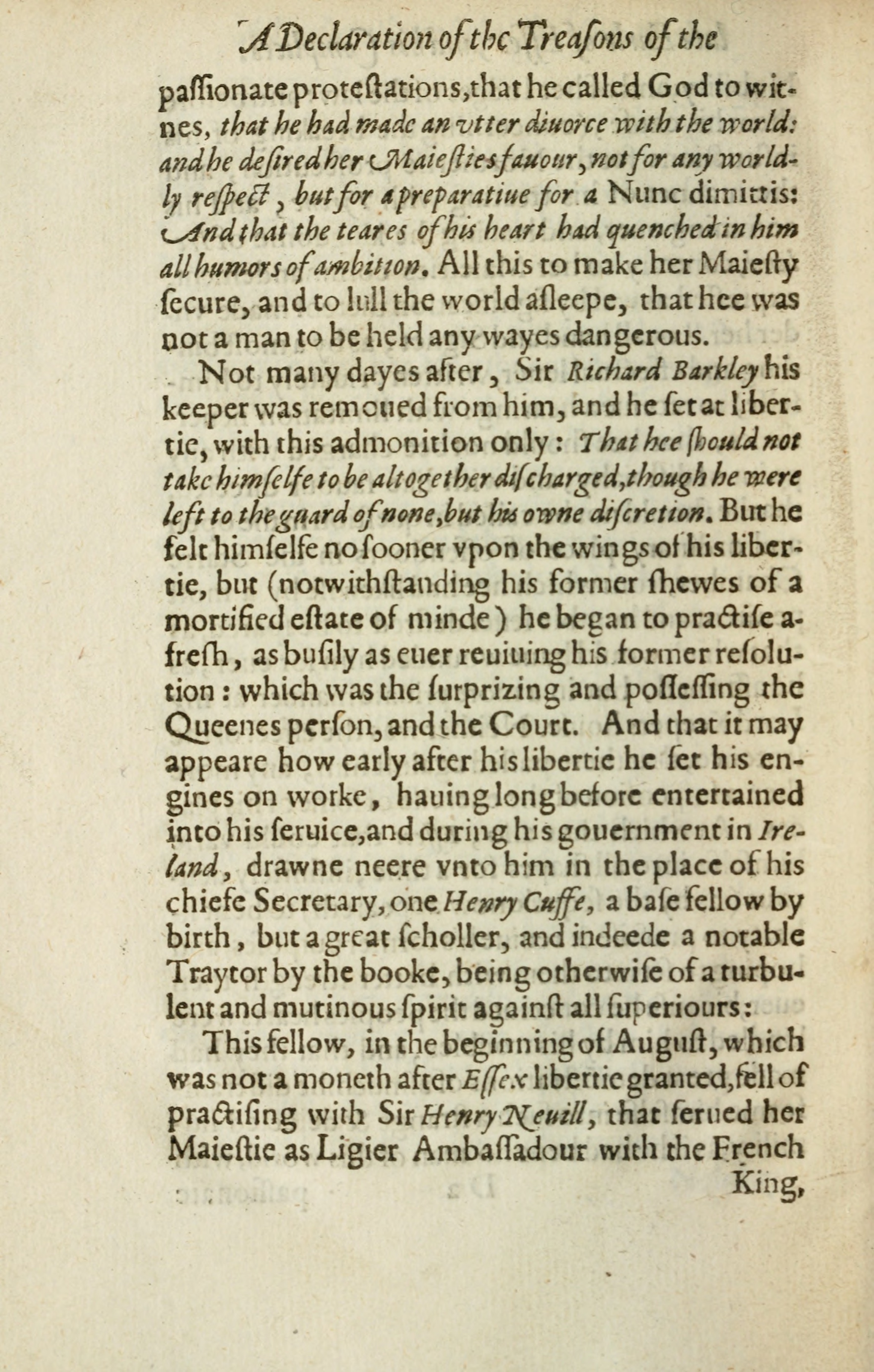
- Source: Anonymous / Francis Bacon, A declaration of the practises & treasons attempted and committed by Robert late Earle of Essex (London, 1601),
TCP A01216; Archive.org page-image witness staged in declarationofpra00esse leaf0032 ligier ambassador page.
Quotation: "Sir Henry Neuill, that serued her Maiestie as Ligier Ambassadour with the French King"; "newly come ouer into England from Bulleyn." What it proves: A hostile official Essex-rebellion print identifies Neville as Elizabeth's ligier ambassador to France and ties him to the Boulogne return context. Limits: This proves Neville's official diplomatic role and return context; it does not prove any literary transmission or play-source use.
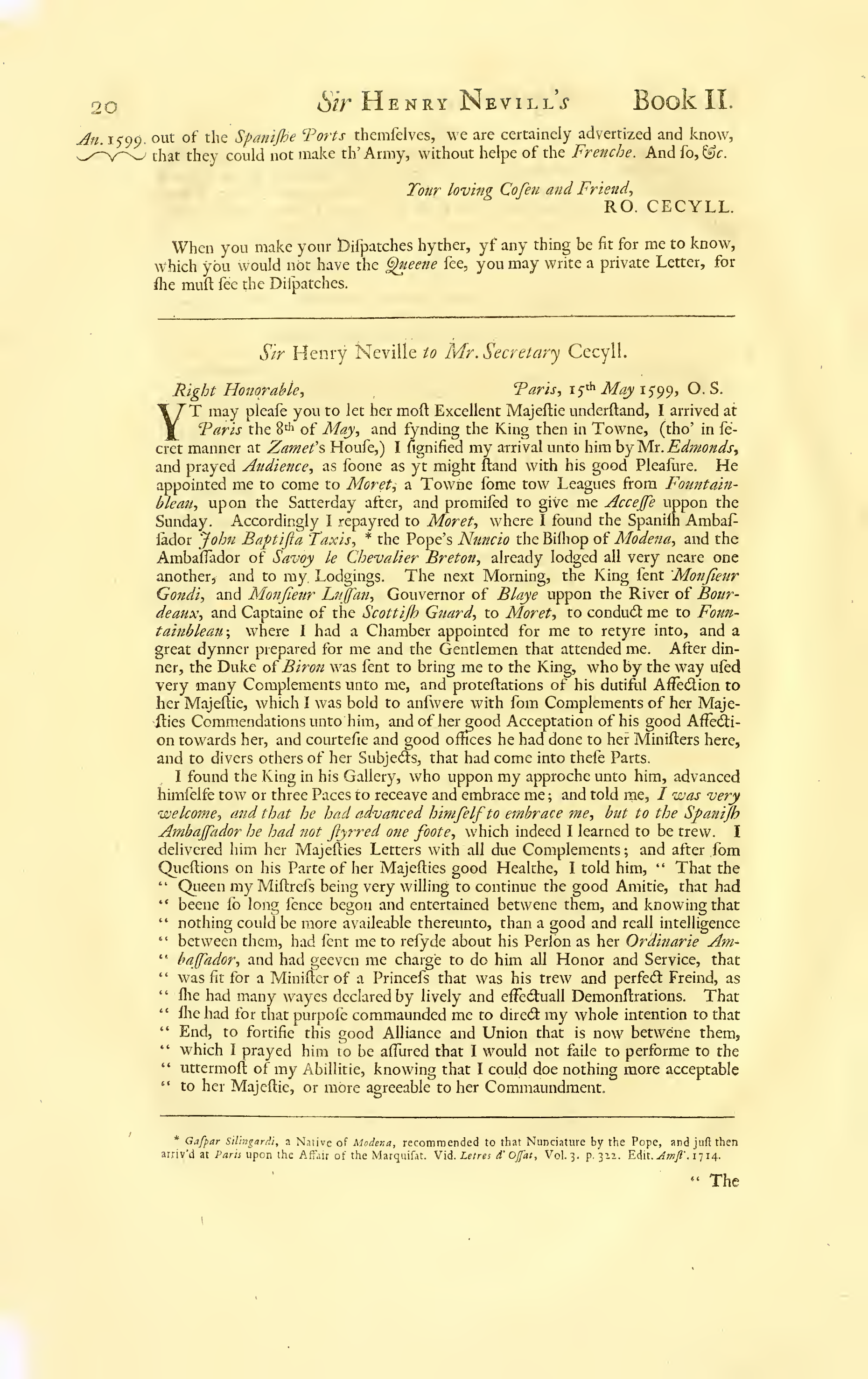
- Source: Ralph Winwood, ed., Memorials of Affairs of State, vol. 1 (1725), Neville to Cecil, Paris, 15 May 1599, p.
20; image witnesses winwood v1 p20 paris 15 may ordinary ambassador.
Quotation: "I arrived at Paris the 8th of May"; "to refyde about his Person as her Ordinarie Ambassador." What it proves: Winwood's printed diplomatic witness gives the opening Paris chronology and Neville's ordinary-ambassador charge. Limits: It is a later printed witness from papers, not the original state-paper manuscript; final diplomatic quotation should still track manuscript controls where possible.
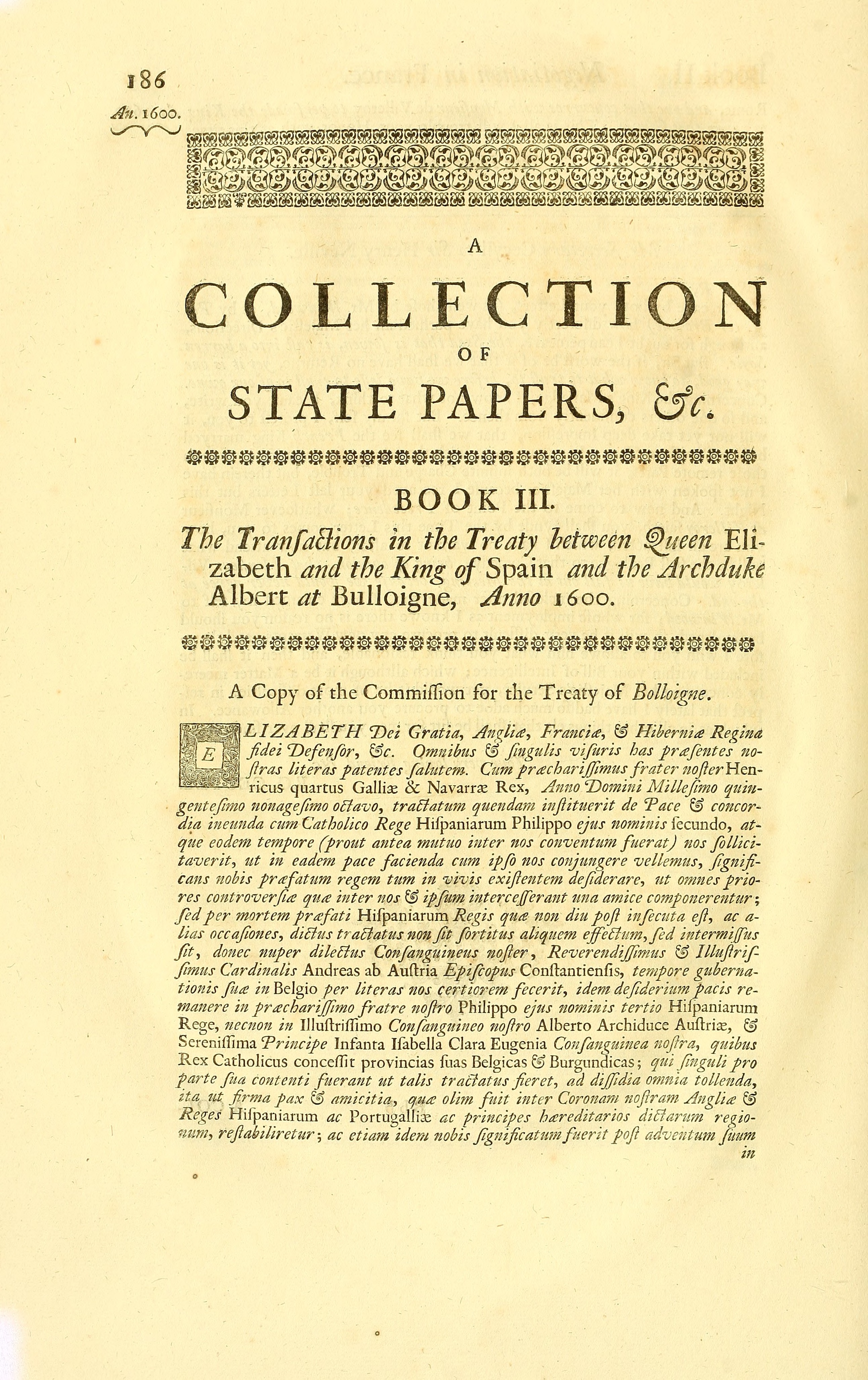
- Source: Winwood, Memorials, vol. 1, Boulogne commission section, pp.
186-188; image witnesses memorialsofaffai01winw leaf0220 p186 boulogne commission start.
Quotation: "A Copy of the Commission for the Treaty of Bulloigne"; "Henrici Neville equitis, legati nostri ordinarie ... Francorum Regem residentis." What it proves: Neville was formally named in the Boulogne peace-commission setting as Elizabeth's ordinary ambassador resident with the French king. Limits: This controls the commission identity and style; it does not verify every date in older local Boulogne timeline summaries.
- Source: BRO
D/EN/F6/2/1, Sir Henry Killigrew to Sir Henry Neville in France, dated27 May 1600; both manuscript images directly checked.
Quotation: "Embassado[r] resident w[ith] the french king in Fraunce." What it proves: An independent family/BRO witness styles Neville as resident ambassador in France outside the Winwood printed diplomatic sequence. Date control and limits: my L. of Wormond is still prisoner refers to the Earl of Ormond's captivity from 10 April until June 1600, while the Hatfield calendar preserves a premature 28 April delivery report. This fixes the year. Four following maritime lines remain unresolved.
2. Direct Evidence Lanes
A. Resident / Ordinary Ambassador Status
TCP A01216, Bacon's 1601 Essex declaration, directly names Neville as serving Elizabeth as "Ligier Ambassadour with the French King" and says he had newly come over into England from Bulleyn/Boulogne when Essex's agent began approaching him.- The public Archive.org page image for Bacon's 1601 Essex declaration is now staged locally. The imaged page contains the Neville "Ligier Ambassadour" line, while the following page carries the Bulleyn/Boulogne continuation context.
- Folger's Elizabethan Court Day by Day: Prominent Foreigners and Ambassadors gives the compact service chronology: Neville was resident ambassador to France from April
1599to July1601; he was knighted on9 April 1599before departure; he was at court on recall from France on7 August 1600; on3and18 October 1600he was ordered to return but delayed; and in1601he was arrested and did not return to France. - Winwood, vol. 1, prints Neville's
15 May 1599dispatch from Paris saying he arrived at Paris on8 Mayand told Henri IV that Elizabeth had sent him to reside about the king's person as her ordinary ambassador. - Mark Greengrass's ODNB entry is consistent with this lane and adds secondary detail: Neville was nominated resident ambassador in February
1599, was knighted before departure, arrived in France on3 May 1599, and began with debt, merchant, shipping, Protestant, Scottish, and Catholic-intelligence problems. - McClure's Chamberlain edition supplies a contemporary-news layer for the embassy appointment and recall arc. It has Chamberlain naming
Master Nevill of Berkshireamong proposed France envoys, then reporting thatMaster Nevill goes within these eight or ten dayes into Fraunce; later letters say Neville had becomedeafe since his going over, was making means to be called home, and was then urged to return into France.
B. Pre-Departure Network Formation
- BL
Stowe MS 167supplies a catalogue-controlled bridge between appointment and actual travel. Cecil's letter to Edmondes at ff.97r-98v, dated between27 Marchand8 April 1599, says Sir Henry Neville "will forward in Easter week," defined by the catalogue as the week commencing8 April. The surrounding sequence is Edmondes to Cecil from Paris on30 March(ff.95r-96v),13 April(ff.99r-100v), and26 April(ff.103r-104v). This makes the intended-departure chronology more precise, but it is still not proof of the exact day Neville left England. - The same Stowe volume contains Cecil's
6 November 1598description of the proposed envoy as "Mr. Hary Nevyle, a gent. well languaged and of a Noble House" (ff.60r-62v). This directly complements Chamberlain's appointment reports and shows how Cecil presented Neville's linguistic and social fitness for the embassy. - TNA
SP 78/43/17, fol.25, is the item-level source behind the ODNB instruction citation:Instructions for Sir H. Neville, Ambassador to France - and another copy, dated[1599 Jan]. - TNA
SP 78/43/24, fol.76, adds Neville's own points on which he desired instructions, dated1599 [Feb]. - TNA
SP 78/43/25, fol.78, adds the pass for Neville going as ambassador to France, dated1599 [Feb]. - Use these three records as the appointment/instructions/pass cluster, but do not quote or claim image control until the exact folio images are mapped or ordered.
- CSPD Elizabeth vol. 5, p.
157, adds a separate pre-departure administrative witness: Queen Elizabeth's January1599notice about restraining game/deer killing in Mote Park and Sunninghill Park while Neville was absent as resident ambassador in France. The underlying source isWarrant Book, I., p. 36, now routed to TNASP 40/1, p.36. - MegaLetters
Doc 5 PRO 010 011, a local transcription/copy of Neville to Thomas Edmondes, endorsed22 Dec. 1598, says Neville had been commanded to prepare himself to serve as ambassador in France and asks Edmondes for advice, house logistics, and correspondence. Treat this as a high-value local transcription until the image is checked. - MegaLetters
Doc 23 PRO 067 068, Neville to George Gilpin,1 Jan. 1599/1600, says Neville had been commanded to serve as ambassador resident in France, stresses intelligence with ministers abroad, and proposes a cipher. Treat the date as old-style local transcription wording until image-collated. - The Thomas Windebank packet preserves Neville Letters XML witnesses for
1599-02-17,1599-02-19, and1599-06-28letters to Windebank. These belong to the embassy logistics / French debt lane; Womersley specifically cites the19 Feb. 1599letter for the repayment politics behind Henry V. - The public born-digital Chamberlain edition at Early Modern Letters Online provides stable TEI routes for the appointment reports already used through McClure. Letter
9,20 October 1598, names "Master Nevill of Berkshire" among the candidates; letter10,8 November, says the queen had resolved on Neville despite his "earnest sute to the contrary"; and letter15,17 January 1599, says he would go within eight or ten days and names Winwood. These statements record contemporary expectation. Stowe's Easter-week notice shows why the January wording must not be mistaken for the actual departure date.
C. Opening Embassy and Winwood Control
- Winwood, vol. 1, is the controlling printed witness for the opening embassy sequence. Its contents list begins with Cecil to Neville on
19 April 1599, Neville to Cecil on26 April 1599, Neville at Dieppe on3 May 1599, and Neville at Paris on15 May 1599. - The printed
15 May 1599dispatch confirms the Paris arrival and first audience sequence: arrival at Paris, audience arrangements through Edmondes, presentation of Elizabeth's letters, and the ordinary-ambassador charge. - The
2026-06-21Winwood audit adds direct image controls for the15 May 1599Paris dispatch, the27 June 1599Paget/Tresham intelligence dispatch, and the pp.123-124Pasquier / false-imprint passage. Treat these as page-controlled printed witnesses, while still checking manuscript state-paper items before final archival quotation. - A separate direct calendar control now identifies the same intelligence dossier as CSPD Elizabeth, vol.
CCLXXI, item29, printed pp.220-221,SP 12/271/29. The main entry summarizes Neville's factional analysis and policy proposals; item29.Icalendars W. Tresham to Cecil, and item29.IIcalendars Charles Paget to Neville. This resolves the former extraction gap while preserving the difference between Winwood's printed letter, the calendar summary, and the underlying manuscripts. - The May-June
1599MegaLetters sequence (Doc_61throughDoc_71) should be treated as a local manuscript/copy routing layer. Some items overlap Winwood. For book prose, cite Winwood first where it prints the same letter; use MegaLetters only after image or print collation. - External material-control update: Elizabethan Diplomacy and Epistolary Culture describes this same opening-embassy sequence as a stitched two-quire fragment in TNA
PRO 30/50/2, fols.121r-144v, with letters primarily between Neville, Queen Elizabeth, and Robert Cecil. The staged local packet controls fols.121r-141v; the published tail, fols.142r-144v, still needs retrieval or identification. - Elizabeth R. Williamson adds important material detail to that description. The Neville archive box mostly preserves received originals and scribal copies of dispatched letters, many endorsed by Neville. A one-folio working paper is endorsed "The effect of my speech to M de Villeroy and Rosin in January 1599" and retains deletions and corrections. The May-June
1599letter-book fragment survives as two quires barely held by a remaining string, begins and ends in the middle of letters, has missing pages and catchwords, and can be partly reconstructed because some loose letters match the copies. This changes how the file should be used: it is a damaged working diplomatic book whose physical sequence can help reunite loose and bound witnesses, not simply a transparent modern collection of independent letters.
C1. Courier Infrastructure
Mark Brayshay's study of Elizabethan and early Stuart diplomatic couriers identifies a payment that places Neville's correspondence inside the state transport system. It says that "a courier such as Peter Brown who brought letters express from Sir Henry Neville, England's ambassador in France who was with the French court in Blois, cost £12 on 17th August 1599." Brayshay cites TNA E 351/543, f. 44, and puts the payment within a sample year containing 193 express journeys. The item supplies a dated Blois location, a named courier, a cost, and an Exchequer-account retrieval target. It does not disclose the contents of the letters carried.
C2. Separate TNA PRO 30/50/70 Diplomatic Dossier
- TNA
PRO 30/50/70is not thePRO 30/50/2opening-embassy fragment. It is a separate parent record forAdditional diplomatic correspondence of Sir Henry Neville,1589-1603, described at item level. PRO 30/50/70/2is the Venice/Rome newsletter packet already routed locally; it should be kept separate from the new image request.- Fresh image/order targets include
/70/4, the 19 July 1599 proposition by the English ambassador to the French council;/70/8, a partly ciphered letter;/70/10, J. Packer to Neville from Boulogne describing a conversation with the Duke of Montpensier;/70/16, points for Grosso to procure advertisements out of Spain;/70/17, a sixteen-article memorial; and/70/20, a contraband-vessels treaty paper.
D. Boulogne Peace Commission, 1600
- Winwood, vol. 1, book III, p.
186, opens the Boulogne section with "A Copy of the Commission for the Treaty of Bulloigne." The visible commissioner names appear on p.187: Henry Neville, ordinary ambassador resident with the French king, John Herbert, Robert Beale, and Thomas Edmonds/Edmunds. - Winwood p.
188begins the commissioners'20 May 1600letter to Cecil about arrival, exchange of commissions, and precedence / commission-validity problems. A further image-controlled page, p.190, carries a signed21 May 1600commissioners' letter. - This direct Winwood commission verifies the delegation names that had previously appeared only as a local-wiki/secondary summary in this packet. It does not by itself verify every wiki timeline date such as "March 11," "April 19," or "July 27 - August 7"; those still need calendar or state-paper checks.
- Do not use the local OCR wording in
page 171for this section. It does not match the page image and should not be quoted as Winwood. - MegaLetters
Doc 41 PRO 113 114is a local copy of instructions dated8 July 1600to Neville at Boulogne. Its address styles him as ambassador for Elizabeth with the French king and commissioner at Boulogne. The body concerns priority/precedence and a possible return if the Audiencier did not resolve the point. - MegaLetters
Doc 42 PRO 115 121is a Privy Council letter dated Greenwich25 July 1600to Neville, John Herbert, and the rest of the commissioners at Boulogne. It confirms the continuing precedence dispute and the effort to keep the treaty on foot without yielding Elizabeth's honor. - Archive.org
Cottoni posthuma, pp.75-89, printsA Breife Abstract of the Question of Precedencie between England and Spaine. Its title page links the abstract to Sir Henry Nevill, Elizabeth's ambassador, and the Spanish ambassador at Calais/Boulogne. Treat this as a printed Cotton witness to compare with FolgerV.b.27, BLStowe MS 179, and Cotton/Vespasian manuscript routes; do not use it as proof of Neville authorship. - CELM substantially enlarges that manuscript comparison. A search for
Henry Nevillreturns at least eighteen manuscript containers for Robert Cotton's A Breife Abstract ... Occasioned by Sir Henry Nevill. The most important is BLCotton MS Julius C IX:CtR 80, ff.107r-119r, is marked by CELM as Cotton's autograph working notes and drafts, docketed "Proceding of England befor France and Spayne Fragments";CtR 81, ff.122r-130r, is a professional copy with Cotton's annotations. Other witnesses are catalogued in BodleianMS Willis 57andMS Carte 96; BLAdd MS 36081,Add MS 48088,Egerton MS 3378,Harley MS 1858,Harley MS 4889, andHargrave MS 226; John RylandsEnglish MS 293; NLSMS 5831; NorthamptonshireFH 129; HatfieldCecil MS 242; SomersetDD/AH/51/2; Trinity CambridgeR.5.15; Trinity College DublinMS 723andMS 807; and YaleOsborn b22. The census supports Cotton's authorship and wide manuscript transmission. It does not support Neville's authorship merely because his diplomatic dispute occasioned the treatise.
E. Non-Return and Paris Household Aftermath
- MegaLetters
Doc 122 PRO 30 50 4 004 006, Robert Cecil to Thomas Lake,3 Mar. 1600/1, says Cecil wants Neville to write to Winwood to stay in France until another person is appointed to that charge. - The same item says Neville was unlikely to return to his charge and that it would be convenient for him to dissolve the rest of the family or household he left behind at Paris, while Winwood should remain until further direction.
- This is a working visual transcription from manuscript images, not a final diplomatic text. Use it for routing and source control until image collation is complete.
F. BRO / Household Witness
- BRO
D/EN/F6/2/1, Sir Henry Killigrew to Sir Henry Neville in France, dated27 May 1600, addresses Neville as Elizabeth's ambassador resident with the French king. The date is now controlled through the Earl of Ormond's April-June 1600 captivity and a Hatfield calendar's premature 28 April report of his delivery. - The letter concerns Neville's “two sonnes at schole and borde,” a disputed account with Mr Wale, servant speech, restored friendship, Ormond's continuing captivity, and partly unresolved maritime news. It is useful because it is an independently controlled family/BRO witness outside the Winwood state-paper stream.
- BRO
Doc 14d D EN F6 2 5is now controlled as John Remington of Lund writing to Neville at Sir Henry Killigrew's Lothbury house. The letter is undated, but its address tom^r Henry Nevill Esquire, request for actionbefore yow goe into Fraunce, and wish for a happy return place it probably between late1598and early April1599: Cecil was describing the proposed envoy by 6 November 1598, while Neville was knighted on 9 April 1599. Remington asks Neville to acknowledge a release before masters of Chancery in connection withfyue hundred pounds. The same letter concerns the Lund purchasers' attempt to escape lease obligations forBoone dayes and Boone hennes. This is pre-departure estate and finance evidence, not proof of appointment by itself. - Neville's fully image-collated estate statement,
D/EN/F6/1/6, dated20 July 1601, gives the retrospective financial frame. Lund descended from his mother; the part soldupon my first going ouer into Fraunceyielded £2,400; and the remainder sold after his return yielded £1,000 to help friends who had become sureties for his debts. With Wargrave property soldin Anno 38for £330 and Woolfines/Waltham parcels for £300, the schedule totals £4,030. HMC Salisbury vol. 11 p. 371 then rounds the same asserted embassy burden to £4,000. The wording establishes a two-stage Lund disposal and a wider four-part capital account tied by Neville himself to the first French employment. It does not yet prove how the Remington letter's £500 fits inside the £2,400 total. - BRO
D/EN/F6/2/3, a draft docketed "Copie of a letter to a lord," is Neville's letter to Robert Cecil, earl of Salisbury, of14 January 1609. All eight Berkshire photographs were inspected at original resolution. The checked text says Neville spent “upon the point of 4.000 l. of mine owne” by occasion of his French service and was prepared to prove it “upon the hazard of my poore reputation.” The inheritedwhole reputationreading is wrong. It says that with Salisbury's presence and approval he began “a sute to his ma:^ty” for land in recompense, later invoking “his ma:^ts gracious disposition.” He also records the copyhold licence and the reversion of a parsonage after his wife's mother. Salisbury is asked for the help that the cripple at the pool lacked when no one would put him into the stirred water. The full deletion/insertion apparatus remains unresolved. - The State Paper fair or sent copy has now been retrieved and inspected at TNA
SP 14/43, fols.29-30. It is signedHenry Nevill, addressed to the Earl of Salisbury, and docketedJan. 14 1608under old-style year reckoning. Its clean text directly confirms the relationship with the Berkshire draft. CSPD James I vol. 1, printed p.486, vol. XLIII, item 22, supplies the public calendar control. A stray image formerly grouped with the State Paper packet is an unrelated letter addressed to Sir Thomas Windebank and has been excluded. - The two witnesses preserve composition in motion. The Berkshire fold leaf says Neville does not ask Salisbury “to promote any / sute originally framed,” but wants assurance of his good liking before attempting it. That qualification disappears from the clean copy, which instead asks Salisbury to perform the “charitable office” of helping the Bethesda sufferer into the stirred water. Full analysis and source audit: Henry Neville to Salisbury, 14 January 1609.
- Royal Berkshire Archives
D/EN/F6/2/4, William Simondes from Paris to Neville
at Billingbear, is now fixed to 24 November 1608 and image-controlled across all three leaves. It shows a Neville student household arriving in Paris on 15 November after Saumur and Blois, with money/credit directions, supervision, and expenditure for the increase of our knowledge. The party lodged in the Rue de Tournon at the sign of the White Scarf, in the Faubourg Saint-Germain, near the ambassador. British Library Stowe MS 170 independently places Sir George Carew in Paris on the exact date, identifying the ambassador whose counsel and household kindness Simondes describes. It is not Neville's own ambassadorial dispatch.
- The
last monethJargeau assembly fixes the letter to24 November 1608.
Chamberlain's independently printed 9 December 1608 letter identifies the m^r Burlace and m^r Litton whom Simondes left at Blois as William Borlase and William Lytton. Simondes also places Sir Thomas Overbury at Orleans. The writer is strongly identifiable with William Simonson/Symondson of Kent, Merton fellow from 1598, the fellow named in the 1607 Neville travel licence and the leading identification for Willm Simonson in the 1615 registered will.
- Villeroy-manuscript addendum,
2026-07-12: the Bodleian Summary Catalogue records that William Symondson of Merton donatedMS. Bodl. 235in1624, a first-quarter-seventeenth-century manuscript of Nicolas de Neufville, seigneur de Villeroy's memoirs covering1574-94, with both parts described as signedde Neufville. This is directly relevant to the embassy because the localPRO 30/50/2corpus preserves extensive Neville–Villeroy negotiation over royal debt, salt-tax assignments, grain exports, maritime depredations, merchant claims, and treaty renewal. The manuscript's pre-1624 provenance is unknown; do not call it Neville's manuscript.
Conflans house and library research path, 2026-07-16
The printed page image of Neville's 29 June 1599 dispatch now controls a significant physical-location detail: Neville says that he “spake with [Villeroy] afterwards at his House at Conflans.” Isabelle de Conihout's specialist reconstruction of the Laubespine-Villeroy library identifies Conflans as the site of a collection described in 1619 as about two thousand volumes and inventoried after Villeroy's death at nearly three thousand. Its core included books inherited through Madeleine de l'Aubespine, poet and translator of Ovid and Ariosto, and a Desportes Amours manuscript.
The evidence proves Neville's presence at the house, not his entry into the library or use of any particular book. The household accounts, posthumous inventory, and Villeroy correspondence now form a concrete retrieval program. See Nicolas de Neufville, Seigneur de Villeroy; Winwood, vol. 1, printed p. 54; de Conihout's article.
3. Secondary and Interpretive Lanes
- Duncan's 1974 dissertation supplies a coherent secondary synthesis for the 1599-1600 embassy arc. Its best use here is source-routing and narrative control, not final quotation. Treat the opening "Youthful Hopes" / later "Disillusionment" structure as Duncan's interpretive framing.
- Womersley's France in Shakespeare's Henry V connects the 1599 French repayment/debt context to Henry V and cites Neville's
19 Feb. 1599letter to Thomas Windebank in CSP Domestic, 1598-1601, p.164. - Clegg's Richard II / press-censorship article cites Neville's
27 June 1599letter to Robert Cecil,SP 12/271/29, with enclosed letters by W. Tresham and Charles Paget. The public CSPD calendar has now been extracted and page-checked at pp.220-221, independently confirming Clegg's summary and adding the full factional/policy outline. The manuscript still needs diplomatic collation. - The Beza, Holles, French-vocabulary, trade-law, and Windebank packets should remain satellite packets. They help explain what Neville's French embassy generated, but they should not be collapsed into the basic appointment/commission chronology.
4. Demoted / Cautionary Claims
- The local wiki's Boulogne timeline is a lead, not a verified fact. Its entries for
11 March,19 April,10-15 May,23-24 June, and27 July - 7 Augustshould remain out of book prose until checked against state-paper calendars, Winwood page images, or manuscript witnesses. - The old citation labelled "Winwood's Memorials, Vol. 1" but linking to
memorialsofaffai03winwis source drift. Usememorialsofaffai01winwfor Neville's 1599-1600 embassy. - MegaLetters transcriptions are valuable discovery witnesses but should not be treated as final diplomatic transcriptions until their images are checked, especially for copied material, overwritten insertions, and archival endorsements.
5. Quoted Source Text
A01216
- "Sir Henry Neuill, that serued her Maiestie as Ligier Ambassadour with the French King"
- "newly come ouer into England from Bulleyn"
Winwood, vol. 1
- "I arrived at Paris the 8th of May"
- "to refyde about his Person as her Ordinarie Ambassador"
- "A Copy of the Commission for the Treaty of Bulloigne"
- "Henrici Neville equitis, legati nostri ordinarie ... Francorum Regem residentis"
- Guardrail: do not quote the local OCR page_171 "severall Points" wording for Boulogne; the visible Winwood p.
186image does not contain it.
Chamberlain / McClure embassy-news anchors
- "Master Nevill of Berkshire"
- "goes within these eight or ten dayes into Fraunce"
- "become deafe since his going over"
- "makes meanes to be called home"
- "urged to returne into Fraunce"
- "Ralph Winwood, secretary to Sir Henry Neville, ambassador to France"
MegaLetters / BRO Local Transcriptions
- Doc_5: "serve her ... as her ambassadour in ffraunce"
- Doc_23: "serve her as her Ambassador resident in ffrance"
- Doc_41 address: "Ambassado[r] for her Ma[tie] with the french King and Comissioner at Bouloign"
- Doc_42 address: "Her Mats Ambassador ... the rest of the Commissioners for the treaty at Bulloigne"
- Doc_122: "not likely that himselfe shalbe returned to his Charge"
- BRO Doc_14g address: "Embassado[r] resident w[ith] the french king in Fraunce"
- BRO Doc_14d: "before yow goe into Fraunce"
- BRO Doc_12: "my service in France" / "upon the point of 4.000 l. of mine owne" / "upon the hazard of my poore reputation"
- BRO Doc_14e: "Paris, where there are many daungerous provocations"
CSPD / Cottoni printed controls
- CSPD Elizabeth vol. 5 p.
157: Queen Elizabeth's notice linking Neville's French-embassy absence toMote and Sunninghill Parks. - CSPD Elizabeth
1598-1601, pp.220-221:SP 12/271/29, Neville's Infanta/Jesuit intelligence dispatch with separate Tresham and Paget enclosures. - CSPD James I, p.
486, vol. XLIII, item 22: the14 January 1609Salisbury letter that identifies BROD/EN/F6/2/3by its distinctive petition for a farm of land or annuities to younger sons after £4,000 of French-service expense. - Cottoni Posthuma: printed precedency abstract linked to Neville and the Spanish ambassador at Calais/Boulogne.
6. Citations
- Anonymous / Francis Bacon. A declaration of the practises & treasons attempted and committed by Robert late Earle of Essex and his complices, against Her Maiestie and her kingdomes. 1601. STC 7607. TCP
A01216. EarlyPrint / EEBO-TCP; checked locally in[local source path removed]. Archive.org page-image witness: declarationofpra00esse. image witnesses with the "Ligier Ambassadour" line: declarationofpra00esse leaf0032 ligier ambassador page. - Winwood, Ralph, ed. Memorials of Affairs of State in the Reigns of Q. Elizabeth and K. James I, vol. 1. London, 1725. Correct Archive.org item: memorialsofaffai01winw. Key pages: opening embassy table and dispatches, pp.
14ff.; Boulogne commission, pp.186-188. - Chamberlain, John. The Letters of John Chamberlain. Edited by Norman Egbert McClure, vol. 1, American Philosophical Society, 1939, pp.
49,65,90,100,110,122,192. document witnesses: uc1 32106005854481 1782657835. - Chamberlain, John. Born-digital TEI letters
9,10, and15, Early Modern Letters Online: 20 Oct. 1598, 8 Nov. 1598, and 17 Jan. 1599. - British Library,
Stowe MS 167, Edmondes Papers vol. 2, especially ff.60r-62vand95r-104v: https://searcharchives.bl.uk/catalog/040-001952956. - Winwood vol. 1 source-control table and OCR audit, 2026-06-21: WINWOOD VOL1 AMBASSADOR TABLE 2026 06 21. image witnesses packet: winwood_ambassador_ocr_audit_2026-06-21.
- Gristwood, Sarah. The Elizabethan Court Day by Day: Prominent Foreigners and Ambassadors. Folgerpedia / Folger Shakespeare Library, pp.
44-45: PDF. - Greengrass, Mark. "Neville, Sir Henry (1561/2-1615)." Oxford Dictionary of National Biography. Staged PDF: Greengrass HenryNeville ODNB 2014.
- Womersley, David. "France in Shakespeare's Henry V." Renaissance Studies, vol. 9, no. 4, 1995, pp. 442-459. Staged PDF: Womersley FranceInShakespearesHenryV 1995.
- Clegg, Cyndia Susan. "'By the choise and inuitation of al the realme': Richard II and Elizabethan Press Censorship." Shakespeare Quarterly, vol. 48, no. 4, Winter 1997, pp. 432-448. Staged PDF: Clegg ByChoiseInuitation 1997.
- Green, Mary Anne Everett, ed. Calendar of State Papers, Domestic Series, of the Reign of Elizabeth, 1598-1601. London,
1869, pp.220-221, vol.CCLXXI, item29,SP 12/271/29. Archive.org item cu31924091775290; page-image leaves n233 and n234. image witnesses: cspd elizabeth 1598 1601 printed p220 sp12 271 29 and cspd elizabeth 1598 1601 printed p221 sp12 271 29. - Elizabethan Diplomacy and Epistolary Culture. "Select table of manuscript letter-books of Elizabethan crown servants abroad," identifying Henry Neville's resident-ambassador fragment at TNA
PRO 30/50/2, fols.121r-144v, May-June1599: https://ebrary.net/144708/political_science/select_table_manuscript_letter_books_of_elizabethan_crown_servants_abroad. - Williamson, Elizabeth R. Elizabethan Diplomacy and Epistolary Culture (2021), public chapter "Knowledge Capture: Letters, Books, Libraries," on Neville's received letters, endorsed copies, working paper, and damaged letter-book: https://ebrary.net/144696/political_science/knowledge_capture_letters_books_libraries.
- Brayshay, Mark. "Carrying the State's Diplomatic Correspondence to and from Elizabethan and Early Stuart England's Ambassadors and Other Agents," 2024 proceedings, pp.
269-317, especially the17 August 1599Peter Brown payment citing TNAE 351/543, f.44: public text. - TNA Discovery,
PRO 30/50/70,Additional diplomatic correspondence of Sir Henry Neville: https://discovery.nationalarchives.gov.uk/details/r/C3494153. - TNA Discovery,
SP 78/43/17, fol.25, instructions for Sir H. Neville as ambassador to France: https://discovery.nationalarchives.gov.uk/details/r/C7319809. - TNA Discovery,
SP 78/43/24, fol.76, Neville's points on which he desired instructions: https://discovery.nationalarchives.gov.uk/details/r/C7319816. - TNA Discovery,
SP 78/43/25, fol.78, pass for Neville going as ambassador to France: https://discovery.nationalarchives.gov.uk/details/r/C7319817. - CSPD Elizabeth vol. 5, p.
157, Archive.orgcu31924091775290, Queen Elizabeth's January1599Windsor deer/game notice to Neville: https://archive.org/details/cu31924091775290/page/157. - TNA Discovery,
SP 40/1,Precedent book, target forWarrant Book, I., p. 36: https://discovery.nationalarchives.gov.uk/details/r/C3828514. - Queen Elizabeth / Windsor deer notice source note: queen elizabeth windsor deer notice 1599 source note 2026 06 04.
- CSPD James I vol. 1, p.
486, Archive.orgcalendarofstatep01grea, Sir Henry Nevill to Salisbury on French-service compensation and younger sons,14 January 1609: https://archive.org/details/calendarofstatep01grea/page/486/mode/2up. The same entry is publicly searchable through British History Online. - Cotton, Robert. Cottoni posthuma. London, 1651. Archive.org
cottoniposthumad00cott, precedency abstract start, p.75: https://archive.org/details/cottoniposthumad00cott/page/75. - CELM, search results for Cotton's A Breife Abstract ... Occasioned by Sir Henry Nevill: https://celm.folger.edu/search/?q=Henry+Nevill&type=repository&field=full. Cotton
Julius C IX,CtR 80-81: https://celm.folger.edu/repositories/british-library-cotton.html#british-library-cotton_id675733. - Folger catalogue,
V.b.27, manuscript copy of Cotton's precedency treatise: https://catalog.folger.edu/record/227712. - Archive.org Neville sweep note: archive org neville sweep 2026 06 04.
- Core pillars image research pass,
2026-06-20: SOURCE NOTES. - ODNB source-list crosswalk note: odnb source list crosswalk 2026 06 04.
- Fresh non-MegaLetters archival leads note, with
PRO 30/50/70/1-20item summary: fresh non megaletters archival leads 2026 06 04. - Duncan, Owen Lowe, Jr. The Political Career of Sir Henry Neville: An Elizabethan Gentleman at the Court of James I. Ph.D. dissertation, The Ohio State University,
1974, chapters 3-4. Original PDF: DUNCAN OL 1974 7424317. Full Antigravity transcription: DUNCAN OL 1974 7424317 combined. Mining dossier: DUNCAN DISSERTATION MINING DOSSIER 2026 06 09. - Local preservation of old wiki source trail: wiki ambassador.
- MegaLetters source-routing dossier: megaletters pro 30 50 source dossier.
- Neville to Thomas Edmondes,
22 Dec. 1598: Doc 5 PRO 010 011. - Neville to George Gilpin,
1 Jan. 1599/1600: Doc 23 PRO 067 068. - Boulogne instruction witnesses: Doc 41 PRO 113 114 and Doc 42 PRO 115 121.
- Cecil to Thomas Lake about Winwood and Neville's Paris household,
3 Mar. 1600/1: Doc 122 PRO 30 50 4 004 006. - HMC Salisbury / Hatfield page-image packet,
2026-06-21, including Boulogne-return and Winwood/Lock/desk-key controls: SOURCE NOTES. - Consolidated As You Like It / Stationers return-window analysis,
2026-06-24: AS YOU LIKE IT STATIONERS RETURN SOURCE ANALYSIS 2026 06 24. - BRO transcription, Sir Henry Killigrew to Sir Henry Neville in France,
27 May: Doc 14g D EN F6 2 1. - BRO transcription, John Remington to Sir Henry Neville before departure for France: Doc 14d D EN F6 2 5.
- Lund sale / Remington / embassy-finance source packet: lund manor sale john remington boon days french embassy 1596 1601.
- BRO transcription, draft about French-service losses and reputation: Doc 12 D EN F6 2 3.
- BRO transcription, William Simondes from Paris to Sir Henry Neville,
24 November: Doc 14e D EN F6 2 4. - Local BRO/RBA verification dossier for Duncan leads: DUNCAN BRO LOCAL WEBSITE VERIFICATION 2026 06 10.
7. Notes on Access
- Checked on
2026-05-29: EarlyPrint local SQLite confirmsA01216title/date/author and the "Ligier Ambassadour" passage. - Checked on
2026-05-29: Archive.org metadata confirmsmemorialsofaffai01winwis vol. 1 andmemorialsofaffai03winwis vol. 3. - Checked on
2026-05-29: Folger PDF text supports the resident-service and recall chronology cited here. - Checked on
2026-05-29: staged Greengrass, Womersley, and Clegg PDFs contain the supporting secondary passages described above. - Checked on
2026-07-09: downloaded the complete public CSPD OCR and scandata, aligned printed pp.220-221to Archive.org leavesn233-n234, visually checked both images, and confirmed the calendar routeSP 12/271/29with items29.I-IIfor its enclosures. - Updated on
2026-05-29: MegaLettersDoc_122is routed here as ambassador-afterlife evidence, while the custody packet keeps the Lock/Locke access sequence distinct. - Use Winwood vol. 1 as the first printed control for the 1599-1600 French embassy. Use the local wiki only as a source-discovery trail.
- Use Duncan chapters 3-4 as an interpretive and source-routing layer only. The dissertation is especially good at explaining why embassy finance, merchant law, French debt, and anti-Spanish policy were connected, but exact letter wording and dates should come from Winwood, State Papers, HMC, CSPD, and checked local manuscript packets.
Doc_12is locally present and its key clauses are now image-controlled. Its draft state and P0 status still prohibit presenting the complete cancellation/insertion apparatus as a finished transcription.- Staged image packet,
2026-06-04: tna_pro_30_50_2_opening_embassy_megaletters_doc61_71_seq172_213. Source note: tna pro 30 50 2 opening embassy source note 2026 06 04. Map:PRO 30 50 2 172= fol.121r; the staged sequence ends atPRO 30 50 2 213= fol.141v. - TNA
PRO 30/50/70should be ordered as a separate diplomatic dossier, excluding/70/2unless the Venice/Rome newsletter images need recollation. - For
SP 78/43, do not equate raw research file labels such asSP 78 43 076with manuscript folio76. Visual checks in the ODNB crosswalk showed those local labels are sequence/corpus labels, not safe catalogue-folio controls. - The January
1599Windsor deer/game notice should not be treated as part ofSP 78/43; it is a Warrant Book target, currentlyTNA SP 40/1, p.36. Use the Archive.org CSPD page image as printed-calendar control until the warrant-book page is obtained. - The
14 Jan. 1609CSPD/Salisbury compensation entry identifies BRODoc_12by its distinctive content. The State Paper witness behind vol. XLIII, item 22 has now been inspected atSP 14/43, fols. 29-30; it is the signed, addressed fair or sent copy of the same composition. The Cottoni Posthuma precedency abstract remains a printed-image control for its separate manuscript tradition. - The
2026-06-20image batch stages representative public page images for the Archive.org controls cited here. Use those images for page verification and illustration; continue to treat exact wording from manuscript-side witnesses as pending until the relevant TNA/BRO/MegaLetters images are line-collated.
Additional Fact-Source Notes
- Archive.org now gives public page-image controls for Winwood vol. 1 (
memorialsofaffai01winw, 1725) and Cottoni Posthuma (cottoniposthumad00cott, 1651). These are useful printed controls for Neville's embassy and later precedency/compensation material. - The print controls should not replace the manuscript targets.
PRO 30/50/70,SP 78/43, andSP 40/1remain the governing routes for diplomatic papers, French correspondence, and the Windsor deer/game warrant-book item. - Broad Archive.org metadata searches did not add a better control than the already staged source map. Future work should order or inspect the named manuscript witnesses rather than widen the print search.
2026-07-13 Calais Precedence Afterlife: Cotton and Donne
Neville's diplomatic dispute with the Spanish ambassador at the 1599/1600 Calais peace negotiations generated a tract tradition that extends beyond the immediate embassy correspondence. Robert Cotton's work was printed in 1642 as A briefe abstract of the question of precedency, betweene England and Spain. The title explicitly states that the question was:
Occasioned by Sir Henry Nevil Knight, the Queen of Englands embassadour, and the embassadour of Spain at Callys
and describes Cotton as writing at the commandement of the Queens Majesty.
Controls now assembled:
- EarlyPrint/TCP metadata and text:
A80650; - Heidelberg library catalogue: author, full title, 1642 imprint, Wing
C6482A, and ThomasonE.128[2]; - CELM/Folger repository listing: an incomplete manuscript copy at BL Additional MS 48088, fols.
2r-5r, beginningTo seek before the decay of the Roman Empire, related to events in 1599/1600 and first printed in 1642; - Gosse's printed Donne letter to Cotton,
[1603?], showing Donne analyzing the 1602 Valdés treatise on the same Franco-Spanish precedence problem.
This expands the embassy topic from an incident to a documentary afterlife. The dispute prompted historical and legal research, manuscript copying, and later print. Donne's participation belongs to that research afterlife, although his letter does not name Neville and does not prove contact between them.
Public controls: Heidelberg catalogue, Oxford EEBO-TCP browse record, and CELM BL Additional 45000-49999.
Claim audit: no new diplomatic transcription has been promoted. The Cotton printed title and catalogue descriptions are the controls; the BL manuscript copy has not been inspected and remains a future image target.
2026-07-13 Embassy Cost: Direct Hatfield Calendar Control and Shelfmark Conflict
The embassy’s financial burden can now be documented without relying on a modern biographical estimate alone. In an August 1601 letter to Robert Cecil, written while Neville was seeking mitigation of his Tower fine, Neville asked Cecil to take account of his recent royal service. HMC Salisbury vol. 11, printed p. 371, calendars the passage as follows:
“Begs him to consider what great charge he was at in his late service, wherein he was forced to sell land to the value of 4,000l.”
The same calendar entry says that Neville’s land in possession produced no more than £700 yearly. It records his proposal that the fine be reduced to 6,000 marks, with 1,000 marks paid on delivery of a pardon, 2,000 more at Hallowtide, and the remaining 3,000 marks at 300 marks a year. He also asked leave to sell two Yorkshire tithes. Embassy expense and the punishment after Essex therefore form one continuous financial history: the earlier service had already consumed saleable land before the fine was imposed.
The newly controlled BRO draft independently states the same scale of loss in Neville's own working text: by occasion of his French service he had spent “upon the point of 4.000 l. of mine owne.” The Hatfield calendar and BRO draft therefore corroborate the amount through two distinct documentary witnesses. They are not the same letter: the Hatfield item is an August 1601 appeal to Cecil about Tower-fine terms, whereas CSPD James I, p. 486, identifies the BRO draft as Neville's 14 January 1609 letter to Salisbury asking him to advance the suit to King James.
The £2,400 + £1,600 division is not yet source-controlled
Andrew Thrush’s History of Parliament biography states that Neville sold land worth £2,400 to equip himself for the embassy and raised another £1,600 over the following years. Those figures total the £4,000 in the Hatfield calendar, but Thrush’s note routes the division to Berkshire D/EN F6/1/8.
The local BRO photographs carrying the pencil shelfmark D/EN/F6/1/8 were inspected at original resolution in this pass. IMG 8317 and IMG 8318 contain a short Warfield copyhold/admittance slip with dates 1606 and 1641; IMG 8344 repeats the shelfmark. They do not contain an embassy-expense account or a fine proposal. Possible explanations include a changed reference, a former bundle number, or an error in the published note, but none should be chosen without archival confirmation.
The source position is therefore:
£4,000of land sold because of the “late service”: directly supported by HMC Salisbury’s human-edited calendar and inspected page image;£2,400before departure plus£1,600afterward: retained as a History of Parliament research lead;D/EN/F6/1/8: not a valid citation to the locally photographed item for either financial statement.
The embassy was not only a sequence of negotiations and dispatches. It altered Neville’s estate capacity, and its financial effects were still being pleaded from the Tower in 1601. This provides a stronger frame for his repeated complaints about the burden of residence, the Exchequer tellership, the proposed return to France, the £10,000 fine, and the later efforts to rebuild his position under James.
Source controls
- R. A. Roberts, ed., Calendar of the Manuscripts of the Marquess of Salisbury, vol. 11 (
1601), p.371, Internet Archive, calendarofmanusc11grea, hmc11 printed p371 372 pdf409. - Andrew Thrush, “NEVILLE, Sir Henry I (1564–1615)”, History of Parliament: The House of Commons 1604–1629; local saved capture history of parliament henry neville wayback 20220115.
- Local photographed shelfmark controls:
[local source path removed],IMG 8318, andIMG 8344; pre-existing working description Doc 22e D EN F6 1 8. - TEN TOPIC PUBLIC LIFE DOCUMENTARY CHRONOLOGY PASS 2026 07 13.
Manuscript claim audit
- Primary images checked: BRO
IMG 8317,IMG 8318, andIMG 8344. - Independent non-AI control: HMC Salisbury vol. 11, printed p.
371; Berkshire CALMView’s parent-file description forD/EN/F6/1. - Unresolved: the correct current or former Berkshire reference behind Thrush’s note and the underlying Hatfield holograph
(87.153). - Disagreement recorded: the local
D/EN/F6/1/8item does not match the financial document described by History of Parliament.
2026-07-17: The Paris house as a diplomatic mail node
Robert Drury's 6 May 1600 complaint adds a concrete view of Neville's embassy as a household mail system. Drury says Flood saw Southampton's letter to him on a table in Neville's house “amongst many other letters.” He then says Cecil told him that another letter for Drury had been sent by post “in your packet.”
The surrounding Winwood letters explain the mechanism:
- 26 February 1599/1600 O.S.: Neville used the opportunity of Sir Robert
- 20 November 1599 O.S.: Neville had held “my packet” for a day after it was
- 9 April 1600 O.S.: Neville asked Cecil to send instructions by ordinary
Drury's return to send intelligence from Paris to Cecil.
ready.
messenger because “gentlemen that bring packetts make no haste.”
The April sentence is especially important because it describes packets being brought to Neville in Paris less than a month before Drury's complaint. A personal Cecil letter put “in your packet” would therefore travel inside the official channel destined for Neville's embassy. This does not reveal the English building where the packet was first assembled.
The household was residential as well as official. In August 1599 Neville reported that Charles Drury had been enticed away “from my House” while Neville was at Blois. In August 1600 Neville returned with his wife and family. A March 1600 address panel in the same PRO 30/50/2 sequence also directs Henry Killigrew's letter to Neville “at his house in Parris”; that exact address has been directly read but still needs an independent transcription control.
The resulting conclusion is strong but calibrated: Neville's Paris house/household is the best referent of Drury's your howse; the document does not explicitly locate Flood's sighting. Lothbury remains the only serious English alternative and presently lacks packet evidence.
Full analysis: sir robert drury nevilles house and drury house. Public sources: Winwood p. 133, p. 155, and p. 170.
Manuscript claim audit, 17 July 2026
Primary images checked: PRO 30/50/2/97–98, 88–89, and 52–53. Independent controls: O'Donnell's Drury transcription; TNA catalogue; Winwood's printed embassy letters. Provisional image-only claims: the exact “house in Parris” address and the identification of the unnamed recipient of the Dieppe-governor draft. Status: mixed; the Drury wording is primary_image_and_independent_control, while the two image-only details remain unresolved.