William Symondson: Neville Tutor, Will Circle, and Villeroy Manuscript
Topic: William Symondson: Neville Tutor, Will Circle, and Villeroy Manuscript
Source-Fact Audit — 7 August 2026 (Round 4)
- The spellings Symondson, Simondson, and related forms create a plausible documentary chain, but no single witness presently equates every occurrence.
- The 1608 letter's literal wording is
your sonne; Henry's name should not be inserted into the quotation. The joined 1608–09 Simondes, knighthood, and false-piracy sequence nevertheless strongly identifies that son as Henry Neville III. - Tutoring, witnessing, probate, and manuscript-gift events are distinct roles and dates; their aggregation is a research network, not proof of continuous service.
- The Bodleian record directly documents the Villeroy manuscript gift in 1624. It does not establish that the manuscript came from Neville or that Neville had possessed it.
- Identity and provenance gaps are retained as open questions rather than resolved through spelling similarity or association.
Source-Control Summary
The records use three principal spellings: Simonson, Symondson, and Simondes. Joseph Foster's university register, the 1607 travel licence, the 1608 signed Paris letter, the 1615 registered will, and the 1624 Bodleian gift form a coherent chronological and institutional sequence. The single-person identification is strong, but no surviving source yet explicitly equates every spelling.
The most important new fact is the Bodleian gift: William Symondson, Merton fellow, donated a near-contemporary manuscript of Nicolas de Neufville, seigneur de Villeroy's political memoirs in 1624. Villeroy was a principal diplomatic correspondent and negotiating counterpart of Sir Henry Neville in 1599–1600.
Do not describe the Villeroy manuscript as a Neville-owned book. Its pre-1624 provenance is presently unknown.
Documentary sequence
1594–1651: Oxford career
Foster records:
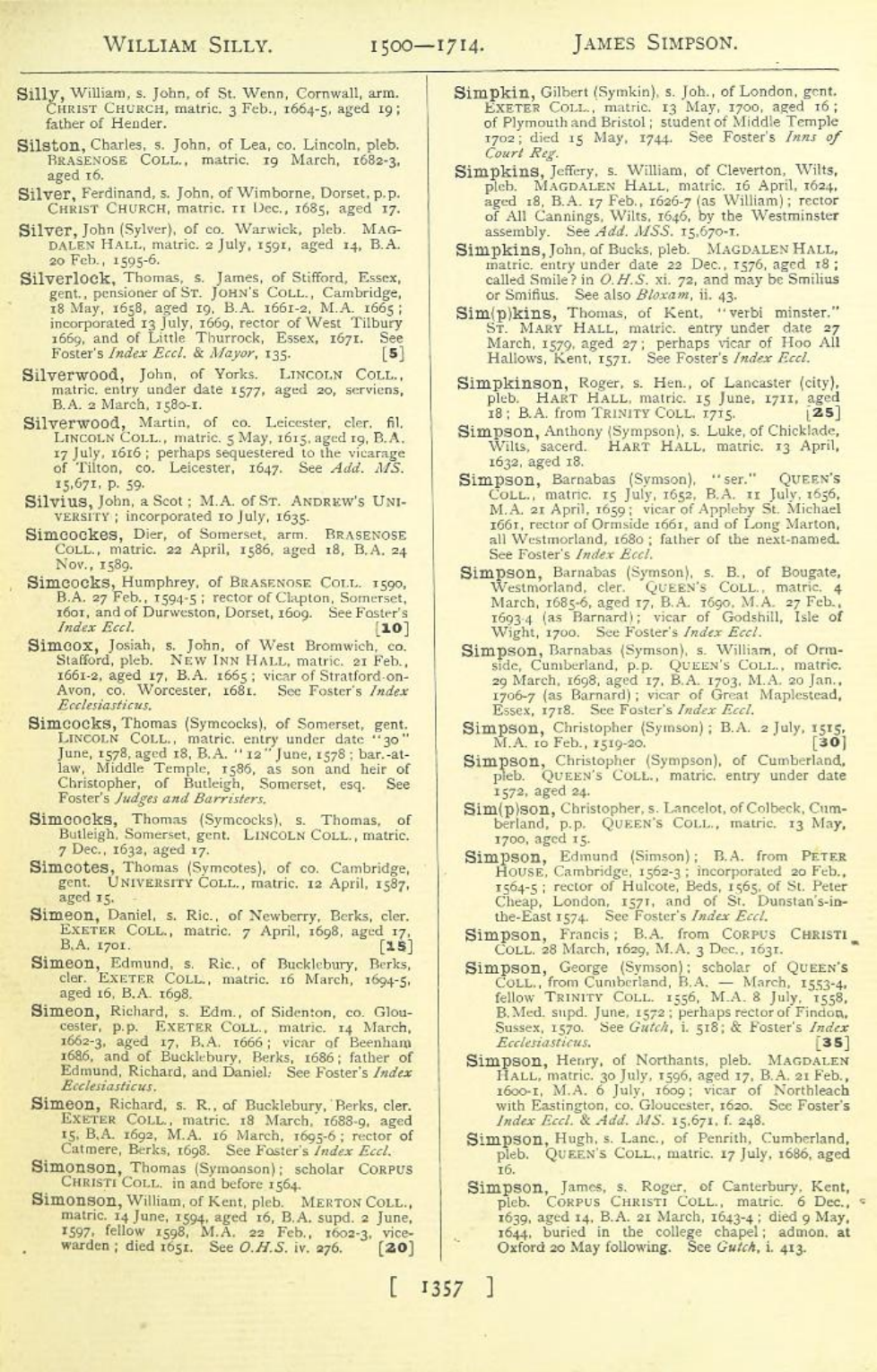
“Simonson, William, of Kent, pleb. Merton Coll., matric. 14 June, 1594, aged 16, B.A. supd. 2 June, 1597, fellow 1598, M.A. 22 Feb., 1602-3, vice-warden; died 1651.”
Source: Joseph Foster, Alumni Oxonienses, early series, vol. 4, p. 1357; Internet Archive.
1607: licensed travelling companion
CSPD calendars a licence dated 24 September 1607 for Sir Henry Neville and his son to travel for three years with William Symondson, Fellow of Merton College. Archive.org, printed p. 371.
1608: tutor and political correspondent in Paris
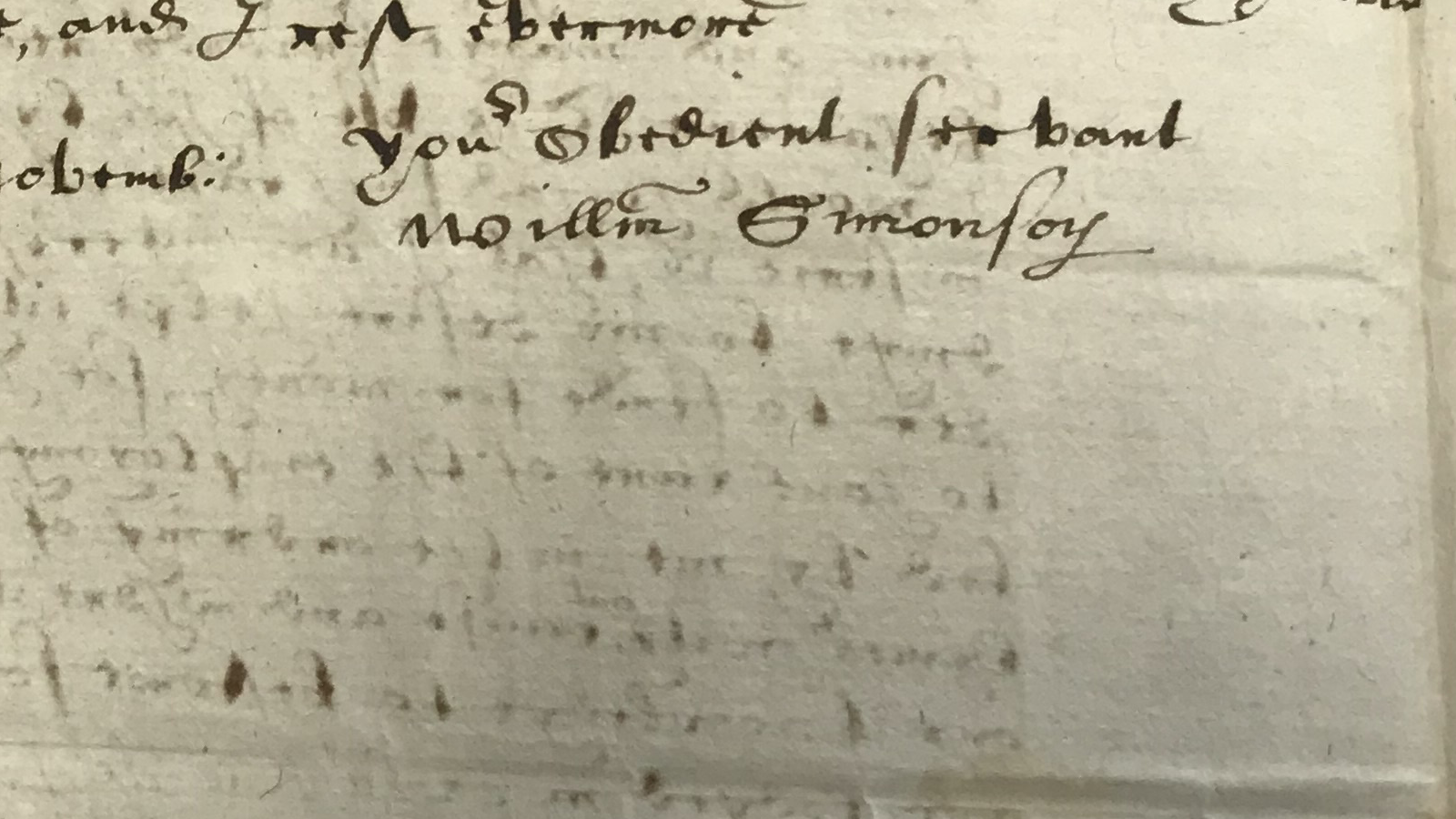
In Royal Berkshire Archives D/EN/F6/2/4, Willm Simondes reports reaching Paris with Neville's son, manages remittances, tries to regulate the son's expenses and conduct, and reports on the October 1608 Protestant political assembly at Jargeau. All three photographed leaves have now been inspected at original resolution. The archive's public catalogue controls the parent file D/EN/F6/2; the physical wrapper supplies the exact /4 placement.
“The fifteenth of November we came to Paris”
“We are nowe at Paris, where there are many daungerous provocations, much
corrupt company”
The most revealing educational phrase occurs in a partially difficult spending passage. Its controlled words are:
“for the increase of our knowledge”
“The last moneth was held at Gergeau a towne on the Loyre, about Orleans, a nationall Synode by those of the religion.”
Source: Doc 14e D EN F6 2 4; Jargeau year control from the Catalogue collectif de France.
The same letter says that the party passed through Blois and left m^r Burlace and m^r Litton there. Chamberlain's independently printed 9 December 1608 letter identifies these travelers as William Borlase and William Lytton, says they had turned back from La Rochelle to Blois, and reports that their fathers would confer about them. The two letters are separated by only fifteen days. This converts two formerly floating surnames into a documented travel network. The dedicated topic is Neville's Son in France, 1607–08: Symondson, Borlase, Lytton, and Overbury.
1615: witness-clause name
The PCC registered copy ends:
“H. Savill. Edward Nevill. Willm Simonson. William Hamond.”
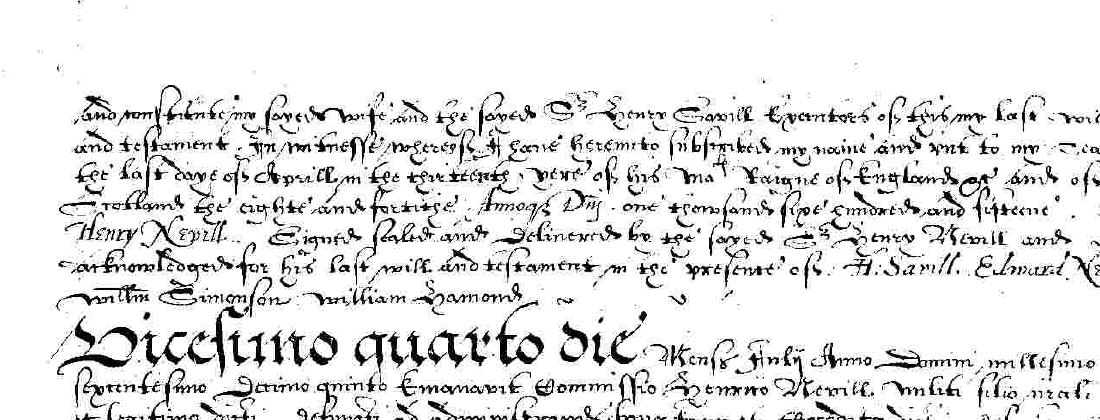
This is a probate-register copy, so the name is not an autograph signature. Retrieve TNA PROB 10/323 before attempting handwriting comparison.
1624: donor of Villeroy's memoirs
The Bodleian Summary Catalogue describes MS. Bodl. 235, 209 paper leaves, written in the first quarter of the seventeenth century, as Villeroy's memoirs covering 1574–94. The two parts are each said to be signed de Neufville. The donation inscription reads:
“Ex dono Gulielmi Symondson ... socii collegii Mertonensis. Anno Domini 1624.”
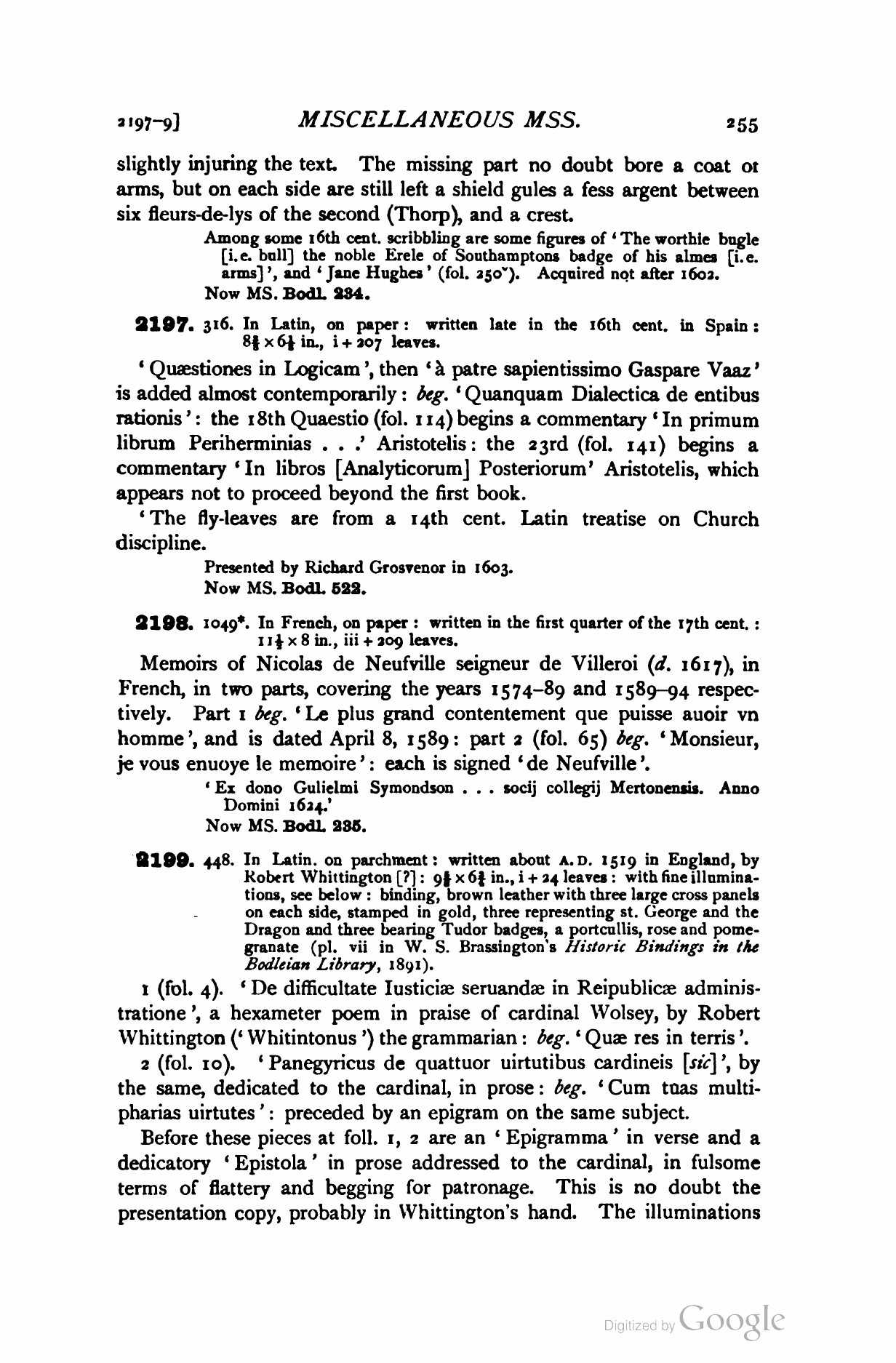
Source: Summary Catalogue of Western Manuscripts, vol. 2, part 1, entry 2198, p. 255; Internet Archive.
Direct Neville–Villeroy context
Neville's 26 May 1599 letter to Villeroy argues over repayment of English loans, the Rouen and Le Havre salt revenues, and the diplomatic basis of durable amity:
“pour faire durer les amitiés il faut qu'elles soient fondées sur des interests egaux & offices reciproques”
“to make friendships last they must be founded on equal interests and reciprocal offices.”
Source: TNA PRO 30/50/2; Doc 64 PRO 191 193.
Villeroy's 8 June response treats the 20,000 crowns, grain transport to Spain, maritime depredations, and treaty renewal, then signs himself:
“Vostre tresumble & affectionné serviteur & amy / De Neufville”
Source: TNA PRO 30/50/2; Doc 65 PRO 198 199.
Further direct exchanges survive in Doc 4 PRO 008 009, Doc 14 PRO 043 045, Doc 18 PRO 054 055, Doc 33 PRO 095 096, and Doc 37 PRO 103 104.
Posthumous manuscript-circle context
The preceding catalogue pages record Sir Henry Savile's 1620 gift of a fourteenth-century Sallust manuscript to the Bodleian. Savile was a named executor and appears in the witness clause of Neville's registered will. Thus two men in Neville's immediate 1615 circle donated political-historical manuscripts within nine years of Neville's death.
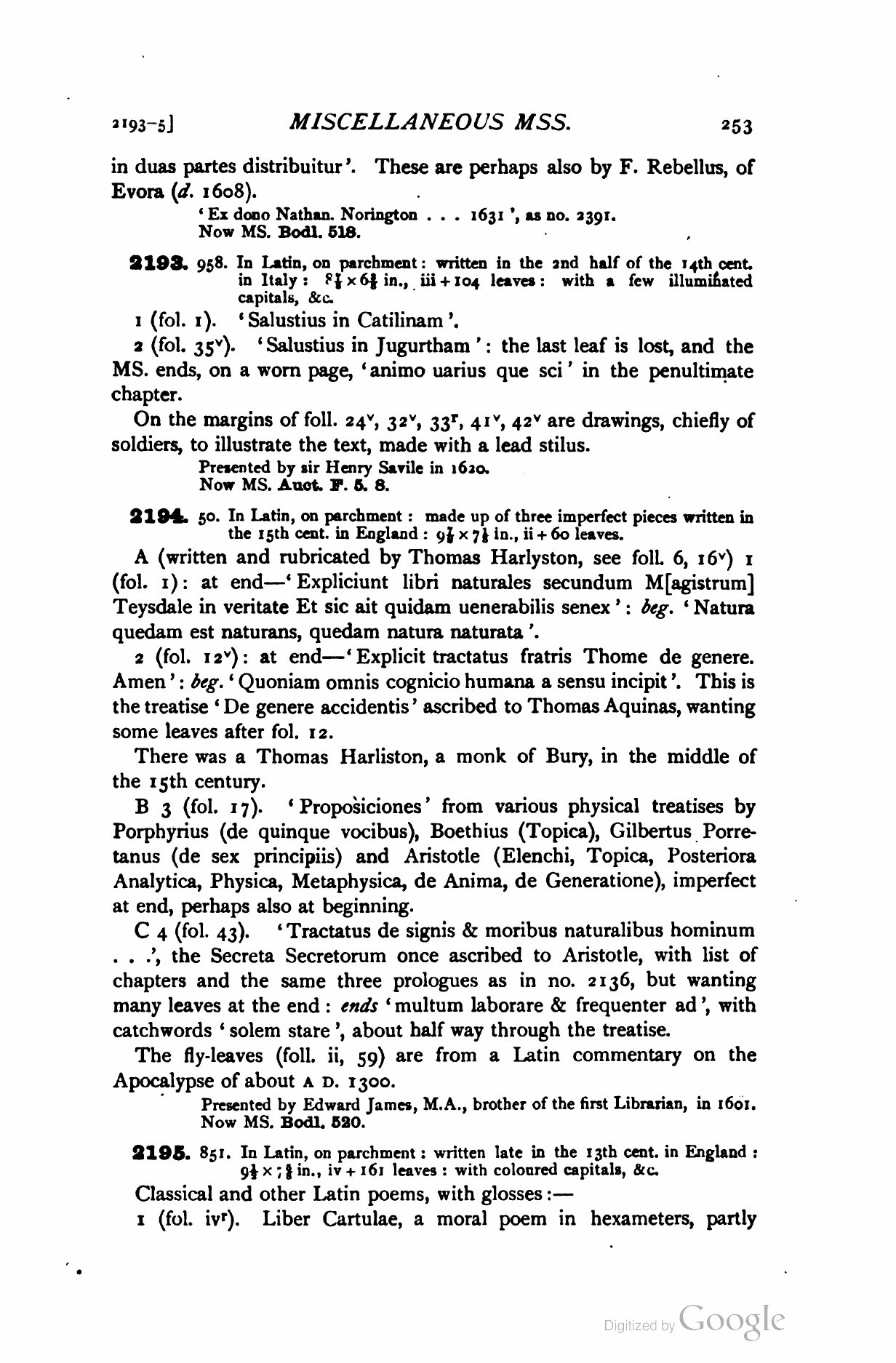
This documents the manuscript culture of Neville's associates. It is not evidence that the manuscripts came from Neville or that the donations formed a coordinated program.
Research leads
- Retrieve the original will, TNA
PROB 10/323. - Obtain a modern Bodleian description and images of
MS. Bodl. 235, especially the binding, flyleaves, watermarks, ownership notes, andde Neufvillesubscriptions. - Search Merton College records for Symondson's fellowship, vice-wardenship, travel absence, and 1624 gift.
- Search Neville accounts and correspondence under all spelling variants.
- Search Merton and Magdalen College records together for the parallel
- Search Sir Rowland Lytton and Sir William Borlase papers for the `19 December
- Test the separate William Hammond/Bracknell identity lead through Berkshire records and wills. RBA
D/EN/F46contains1648-49letters from R. Neville at Addington to William Hammond at Bracknell on family and estate matters, including a letter on a Henry Neville burial. Catalogue record.
Symondson/Neville and Dunstar/Lytton/Borlase travel parties.
1608` conference about the stranded travelers.
Quoted Source Passages
The controlled quotations are transcribed above from Foster p. 1357, BRO D/EN/F6/2/4, TNA PROB 11/126/63, the Bodleian Summary Catalogue p. 255, and TNA PRO 30/50/2. The BRO and PRO 30/50/2 wording remains a working image transcription; the printed Foster and Bodleian wording is page-image controlled.
Citations
- Joseph Foster, Alumni Oxonienses, early series, vol. 4, p. 1357, Internet Archive item.
- Calendar of State Papers, Domestic, James I, vol. 1, p. 371, Archive.org page image.
- Berkshire Record Office,
D/EN/F6/2/4, Doc 14e D EN F6 2 4. - TNA,
PROB 11/126/63, Henry Neville Will Transcription v3. - F. Madan and H. H. E. Craster, A Summary Catalogue of Western Manuscripts in the Bodleian Library, vol. 2, part 1, entry 2198, p. 255, Internet Archive.
- TNA,
PRO 30/50/2, local MegaLetters transcriptions linked above. - Catalogue collectif de France, “Actes de l'Assemblée généralle tenue à Gergeau, en l'année 1608,” catalogue record.
Notes on Access
The printed Foster, CSPD, and Bodleian witnesses are publicly accessible through Internet Archive. The CCFr description is public. The BRO letter is controlled locally from photographed manuscript images. The PRO 30/50/2 letters are locally imaged and transcribed. The original will PROB 10/323 and modern Bodleian manuscript description/images remain to be obtained.
Full research report
See WILLIAM SYMONDSON NEVILLE TUTOR WILL CIRCLE VILLEROY MANUSCRIPT FRESH RESEARCH 2026 07 12.
2026-07-13 Second Manuscript Donation: Wycliffite New Testament
The University of Manchester's John Rylands digital catalogue identifies a second manuscript associated with William Simonson: English MS 81, an Earlier Version Wycliffite New Testament. The official human catalogue transcription of the ownership inscription on fol. 1r reads:
Ed. Reynolds ex dono D. Guillelmi Simonson. Coll. Merton socii. Fowller
The catalogue identifies Edward Reynolds (1599-1676) and William Simonson (d. 1651, elected fellow of Merton in 1598). The high-resolution IIIF image was downloaded and directly inspected; the inscription visibly includes Ed: Reynolds, ex dono D: Guilielmi, and Simonson Coll: merton: socij. The official catalogue transcription remains the controlling reading.

The manuscript had an earlier institutional history: the catalogue traces it from Dame Anne Danvers to Syon Abbey in 1517, then through Reynolds, Lea Wilson, Ashburnham, and Henry Yates Thompson before reaching the Rylands. No date for Simonson's gift to Reynolds is stated.
This new evidence changes the shape of the Symondson topic. The 1624 Villeroy gift is no longer an isolated bibliographical curiosity: Neville's former tutor is now documented transferring at least two politically or religiously significant manuscripts—Villeroy's memoirs to the Bodleian and a Wycliffite New Testament to Edward Reynolds. That repeated manuscript-circulation activity is worth pursuing through Merton records and Reynolds provenance studies.
Limits are essential. English MS 81 is not shown to have belonged to Neville; the gift is undated; and possession of a Wycliffite manuscript does not by itself establish Simonson's theology. The evidence proves manuscript ownership and transfer, not ideological adherence.
8 August 2026 cross-packet identification update
The former rule that the traveller must remain wholly unidentified was too narrow because it considered only the licence and the single Paris letter. Simondes's 24 November 1608 report documents his supervision of “your sonne” in France. Henry Neville III was knighted on 30 March 1609; on 21 April Carleton reported “Young Sir Hen. Nevill arrested for a pirate, by mistake”; and the May Star Chamber catalogue identifies the plaintiff in the resulting Frenchman-linked false-piracy case as Sir Henry Nevill, son of Sir Henry Nevill. The synthesis strongly identifies Henry III as Simondes's pupil and travelling companion while leaving the individual quotations unaltered.
Sources: University of Manchester digital catalogue; IIIF manifest; local catalogue JSON and image in round-five sources.