Henry Neville Will (1615)
Topic: Henry Neville Will (1615)
Source-Control Summary
- Probate will anchor: Anne Neville and Sir Henry Savile are named as executors in the registered copy (Henry Neville Will Transcription v3).
- Killigrew anchor:
Sr Robert Killigrewereceives a plate bequest as afreind, not as executor. - Brother anchor: the witness
Edward Nevillis Neville's adult younger brother Edward Neville II. The preceding bequest clause calls himmy brother Edward Nevilland names his children Henry and Anne. - Probate-act anchor: Anne Neville and Savile
renuntiaveruntthe execution burden. - Administration anchor: the commission issued to Sir Henry Neville, the natural and lawful son, to administer Neville's
bona, jura et creditaaccording to the will. - Guardrail: keep
PROB 11/126/63separate from the IPM will recital until the date, burial-place, and executor-list conflict is image-reconciled. - Custody guardrail: executor renunciation and physical safekeeping are not the same act. Swinburne's contemporary probate treatise says preserving a deceased person's goods from theft did not by itself constitute administration as executor.
Overview
This packet controls the located probate witness for Sir Henry Neville's will. It should now be cited whenever the book or topic corpus discusses Neville's death, estate circle, executors, debts, legacies, children, household goods, or reported references to Robert Killigrew.
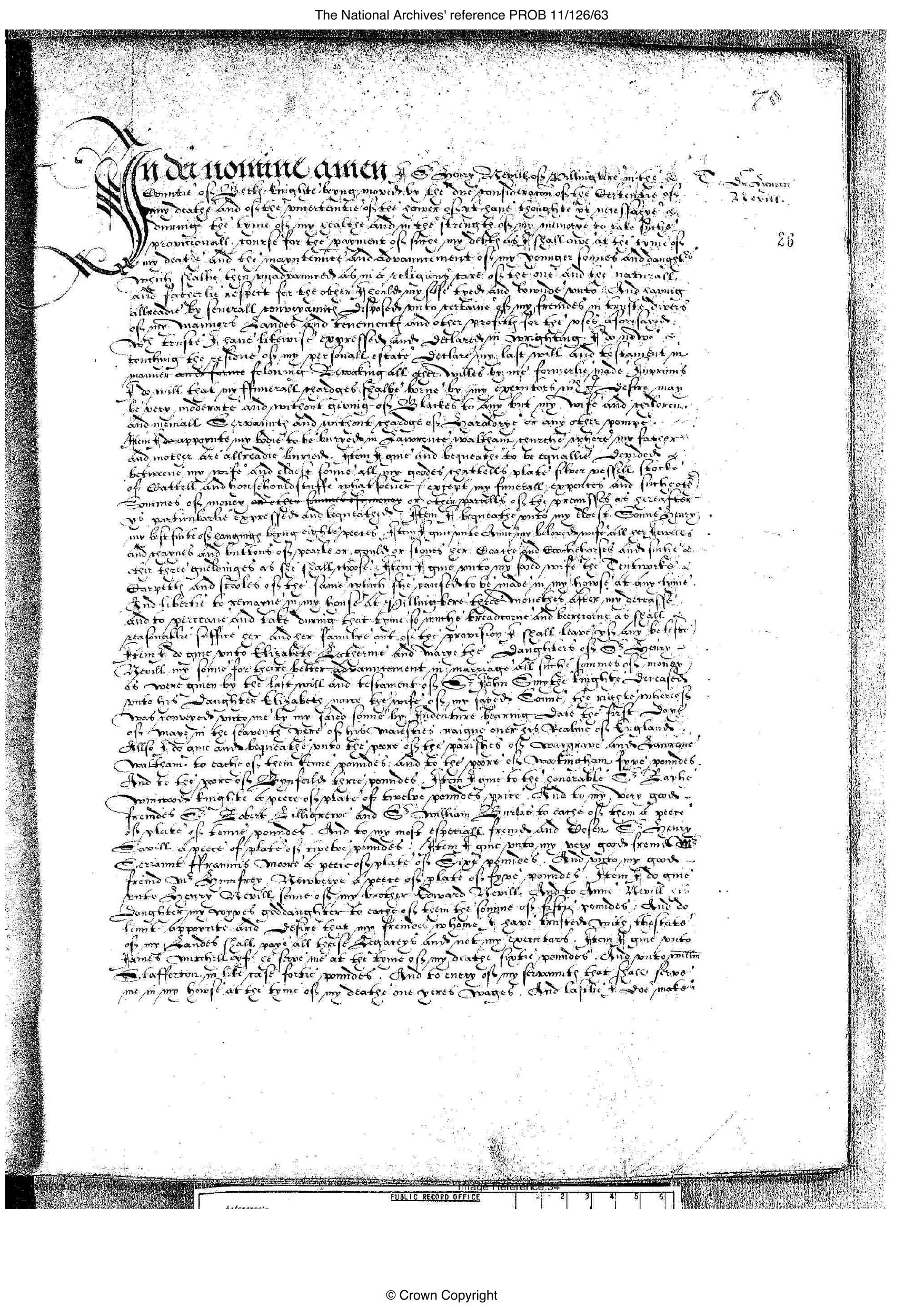
The will has been located locally as a National Archives probate PDF, PROB 11/126/63. It is the registered PCC copy. It is image-only: automated text extraction returns only the TNA reference and copyright notice. A refined v3 working transcription is now available locally and supersedes the rough AI v1 transcription and earlier clean draft for ordinary topic use.
ODNB also cites an original-will packet, TNA PROB 10/323, unnumbered. TNA Discovery exposes PROB 10/323 only at bundle level as July-August 1615 proved wills, surnames A-W, so the Neville original still needs to be found within that bundle before it can be collated against the register and IPM.
1. Verified Sourced Facts
- A local copy of Sir Henry Neville's probate will is now filed at:
[local source path removed]
- The same file was located on the external drive at:
[local source path removed][local source path removed]
- The PDF metadata and rendered page headers identify the National Archives reference as:
PROB 11/126/63
- TNA Discovery identifies the registered copy as:
PROB 11/126/63,Will of Sir Henry Nevill of Billingbere, Berkshire,24 July 1615
- Greengrass's ODNB source list additionally cites the original will as:
PROB 10/323, unnumbered
- TNA Discovery identifies
PROB 10/323at bundle level as:
Wills proved during July 1615, surnames A-W. Wills proved during August 1615, surnames A-W
- The PDF has two image pages.
pdftotextdoes not extract the will body; it returns only the TNA reference/copyright layer.
- The current preferred working transcription is:
[local source path removed]
- An earlier clean working transcription remains for comparison at:
[local source path removed]
- An earlier rough AI working transcription also exists, but it has inferior readings and should be treated as superseded:
[local source path removed]
- Visual inspection confirms that page 1 is the will of Sir Henry Neville. The opening begins:
“In dei nomine amen ... I Sr Henry Nevill knight ...”
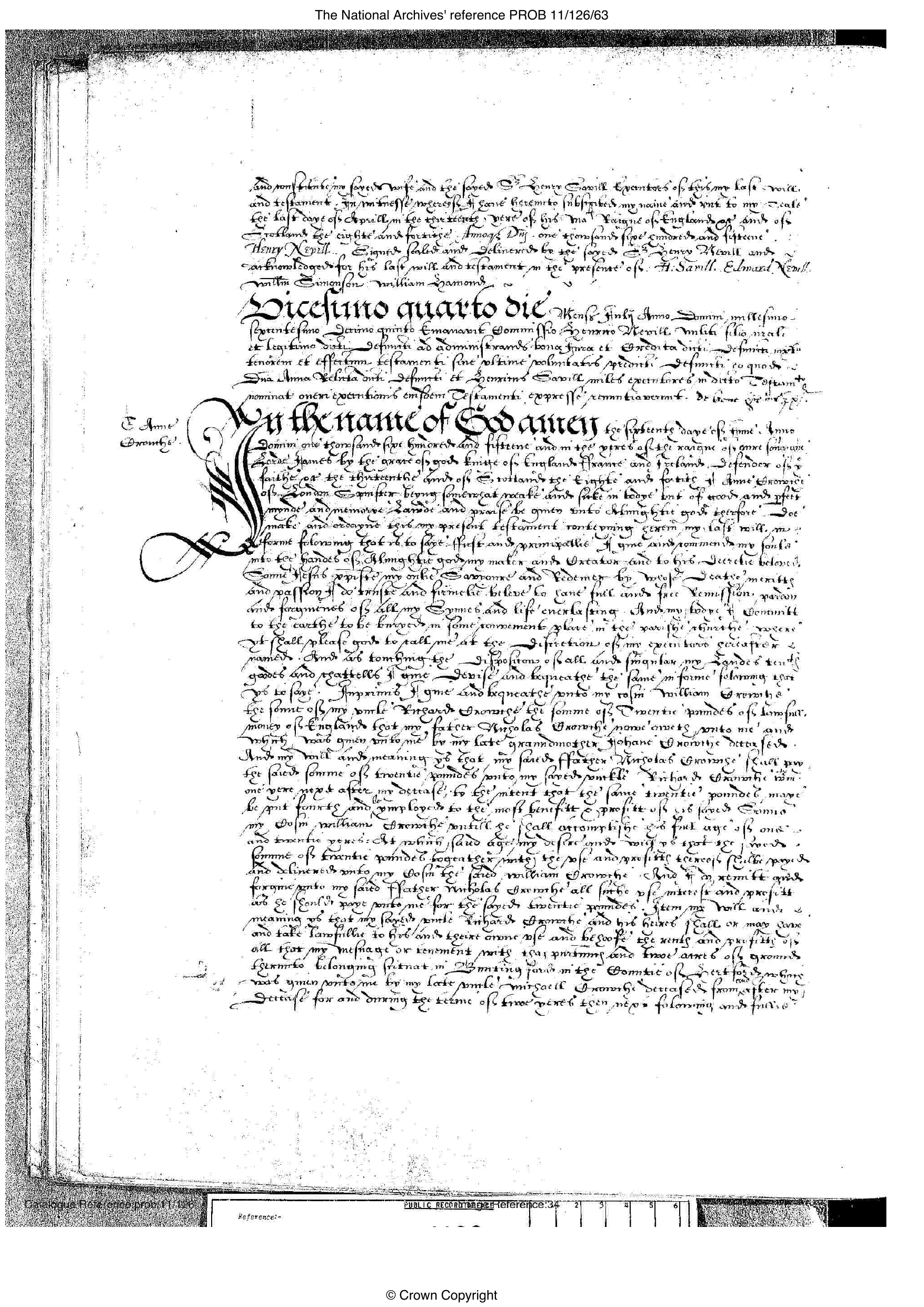
- The v3 transcription reads the executor clause as:
“and constitute my sayed wife and the sayed Sr Henry Savill Executors of this my last will”
- The v3 transcription reads the witnesses as:
“H. Savill. Edward Nevill. Willm Simonson William Hamond.”
Edward Nevillis Henry's adult brother Edward Neville II, born in 1567, rather than Henry's son Edward. The will names the relationship immediately before the execution clause:
“I do give unto Henry Nevill sonne of my brother Edward Nevill, and to Anne Nevill his daughter my wyves goddaughter, to eache of them the somme of fyftie poundes.”
- The clause establishes a separate Culham/Windsor family group. Henry and Anne were the ambassador's nephew and niece. Anne Killigrew Neville was niece Anne's godmother. Foster's Oxford register and History of Parliament further identify the brother and four of his five sons; see the dedicated edward neville ii brother windsor mp will witness and culham family.
- New identity research strongly associates
Willm Simonsonwith William Symondson/Simondes, the Merton fellow licensed to accompany Neville's son abroad in 1607 and the tutor who wrote from Paris in 1608. Foster records a William Simonson of Kent at Merton, fellow from 1598, M.A. 1602-03, later vice-warden, died 1651. In 1624 this Merton fellow donated a manuscript of Villeroy's political memoirs to the Bodleian.
- Material-source restriction: because
PROB 11/126/63is a registered copy,Willm Simonsonis the probate scribe's rendering of the witness name, not a surviving autograph. No handwriting match should be attempted until the originalPROB 10/323is obtained.
- The v3 transcription reads Robert Killigrew as appearing in the bequest section as one of Neville's "very good friends," receiving a piece of plate. It does not read Robert Killigrew as an executor:
“freindes Sr Robert Killigrewe and Sr William Burlace to eache of them a peece / of plate of tenne poundes.”
- The v3 transcription identifies the two executors named in the will as Anne Neville and Sir Henry Savile, and the probate act states that they renounced execution. Administration issued to Henry Neville, natural and lawful son of the deceased:
“D[omi]na Anna Relicta dicti defuncti et Henricus Savill miles executores in dicto Testam[en]to / nominat[i] oneri executionis eiusdem Testamenti expresse renuntiaverunt”
- The will states that Neville made provision during "the tyme of my healthe and perfect strengthe of my memorye." It concerns, among other matters, payment of debts, maintenance and advancement of younger sons and daughters, household goods, servants, friends, and family bequests.
- This will is distinct from the 1615 inquisition post mortem. The inquisition independently states that Henry Neville made a written will on:
“nono die Julij”
- The inquisition also states that executors or administrators were to hold listed properties:
“pro et duran termio viginti et unius annor”
- The stated purpose in the inquisition is:
“ad et pro solucoe debitor suor et performacoe legacor suor et educacoe liberor suor”
- Source-control position: a redone transcription of the inquisition restores the English will recital on
C 142/356/123/005. That IPM recital is not identical to the located probate-register will. It says the will was made on9 July 1615, requests burial in Wargrave parish church, and names Dame Anne Neville, Sir Henry Savile, Sir John Bourchier of London, and Thomas Windebank as executors or estate actors who took on the burden of execution.
- The probate-register v3 transcription instead dates the will to the last day of April
1615, requests burial in Laurence Waltham church, names Anne Neville and Sir Henry Savile as executors, and records their renunciation with administration granted to Henry Neville the son.
- Controlled conclusion: the IPM and probate register agree on the broad estate mechanism: debts, legacies, children, and pre-existing trust/conveyance arrangements. They currently disagree on date, burial place, and executor list. Book prose should not choose one silently until
C 142/356/123/005andPROB 11/126/63have been audited together.
- Posthumous-paper conclusion: for movable goods and papers, the probate act puts Sir Henry Neville the son at the center of formal administration. Anne's renunciation does not prove she lacked physical custody of household goods; it means she was not the acting executor under the registered April will.
Quoted Source Passages
Probate Register Executor Clause
- Source: Sir Henry Neville will, PCC registered copy, TNA
PROB 11/126/63; preferred v3 working transcription Henry Neville Will Transcription v3. - Quotation:
"and constitute my sayed wife and the sayed S[i]r Henry Savill executors of this my last will and testament."
- What it proves: The probate-register will names Anne Neville and Sir Henry Savile as executors.
- Limits: The probate act says both renounced, so this line must be read with the renunciation passage and not as proof that they administered the estate.
Robert Killigrew Bequest
- Source: Same will and v3 transcription.
- Quotation:
"freindes Sr Robert Killigrewe and Sr William Burlace to eache of them a peece / of plate of tenne poundes."
- What it proves: Robert Killigrew is explicitly named in Neville's will as a friend and plate-bequest recipient.
- Limits: It does not make Killigrew an executor; older project prose saying that should remain corrected.
Brother Edward and his children
- Source: Same will and v3 transcription.
- Quotation:
“I do give unto Henry Nevill sonne of my brother Edward Nevill, and to Anne Nevill his daughter my wyves goddaughter, to eache of them the somme of fyftie poundes.”
- What it documents: Henry's younger brother Edward had a son Henry and daughter Anne; Henry left each £50; Anne Killigrew Neville was Anne's godmother.
- Execution context: the same Edward appears a few lines later among the witnesses. This packet identifies him directly as Henry's brother.
Probate Act Renunciation
- Source: Latin probate act appended to
PROB 11/126/63, v3 transcription. - Quotation:
"D[omi]na Anna Relicta dicti defuncti et Henricus Savill miles, executores in dicto testamento nominati, oneri executionis eiusdem testamenti expresse renuntiaverunt."
- What it proves: The probate act records Anne Neville and Sir Henry Savile expressly renouncing the burden of execution.
- Limits: The passage controls the registered-copy probate act, not the unnumbered original-will packet cited by ODNB.
Inquisition Cross-Witness
- Source: Inquisition Post Mortem, TNA
C 142/356/123/005, redone transcription C 142 356 123 005. - Quotation:
"nono die Julij"
"my body I commit to the earth to be buried in the parish church of Wargrave"
"my lovinge wiffe Dame Anne Nevill ... Sir Henry Savile ... Sir John Bourchier ... Thomas Windebanke"
"tooke upon them the burthen of the execution."
- What it proves: The IPM preserves a different will-recital layer: 9 July dating, Wargrave burial language, and a broader execution/trustee group.
- Limits: It conflicts with the probate-register will on date, burial place, and executor list, so it must be reconciled rather than harmonized silently.
Contemporary Rule On Renunciation And Safe Custody
- Source: Henry Swinburne, A briefe treatise of testaments and last willes (London, dated
1590, actually published1591), TCPA13252, ESTCS118058, printed pp.236-237; direct Archive.org image witness item page. - Quotation:
"to take into his custodie the goodes of the deceased, to the ende they may bee safe from being stolne or purloined"
"deedes of charitie common to everie christian, and not peculiar to an executor"
- What it documents: In contemporary English probate doctrine, preserving goods did not necessarily amount to accepting or administering the executorship.
- Application to Neville: Anne's renunciation cannot by itself answer who physically guarded Neville's household papers. The separate probate commission nevertheless identifies Sir Henry Neville the son as the formal administrator of the deceased's goods, rights, and credits.
2. Ken Feinstein Twitter and Blog Information
- Ken Feinstein's preserved Killigrew/Holinshed blog states that Robert Killigrew was closely connected to Henry Neville and that Neville explicitly mentions Robert Killigrew in his will.
- That claim is now supported in a narrower form by the v3 transcription: Robert Killigrew is mentioned in the will as a friend and plate-bequest recipient. The stronger "executor" formulation should not be used.
- Current controlled phrasing:
Ken Feinstein's preserved blog reports that Robert Killigrew is explicitly mentioned in Henry Neville's will; the probate witness
PROB 11/126/63has now been located, and the v3 transcription reads Robert Killigrew as a plate-bequest recipient among Neville's "very good friends," not as executor.
3. Source Text Index
Will PDF / Visual Inspection
- “In dei nomine amen ... I Sr Henry Nevill knight ...”
- “freindes Sr Robert Killigrewe and Sr William Burlace to eache of them a peece / of plate of tenne poundes.”
- “and constitute my sayed wife and the sayed Sr Henry Savill Executors of this my last will”
- “H. Savill. Edward Nevill. / Willm Simonson William Hamond.”
- “D[omi]na Anna Relicta dicti defuncti et Henricus Savill miles executores in dicto Testam[en]to / nominat[i] oneri executionis eiusdem Testamenti expresse renuntiaverunt.”
Inquisition Cross-Witness
- “nono die Julij”
- “pro et duran termio viginti et unius annor”
- “ad et pro solucoe debitor suor et performacoe legacor suor et educacoe liberor suor”
- “my body I commit to the earth to be buried in the parish church of Wargrave”
- “my lovinge wiffe Dame Anne Nevill ... Sir Henry Savile ... Sir John Bourchier ... Thomas Windebanke”
- “tooke upon them the burthen of the execution”
4. Evidence Images
5. Citations
- Neville, Sir Henry. Will. Prerogative Court of Canterbury. The National Archives,
PROB 11/126/63. document witnesses:[local source path removed].
- TNA Discovery,
PROB 11/126/63,Will of Sir Henry Nevill of Billingbere, Berkshire: https://discovery.nationalarchives.gov.uk/details/r/D906720.
- TNA Discovery,
PROB 10/323, July-August1615proved-will bundle, cited by ODNB as the unnumbered original will packet: https://discovery.nationalarchives.gov.uk/details/r/C5475786.
- ODNB source-list crosswalk note: odnb source list crosswalk 2026 06 04.
- Local source-control note:
[local source path removed].
- Preferred v3 working transcription:
[local source path removed].
- Earlier clean working transcription:
[local source path removed].
- Superseded rough AI transcription:
[local source path removed].
- Inquisition Post Mortem for Sir Henry Neville. The National Archives,
C 142/356/123. Local topic: neville inquisition 1615.
- Redone inquisition transcription,
C 142/356/123/005, added2026-05-27: C 142 356 123 005. - Swinburne direct images and source-control note: SOURCE NOTES.
- Fresh paper-custody and probate synthesis: NEVILLE PAPER CABINET AND POSTHUMOUS CUSTODY FRESH RESEARCH 2026 07 12.
- Brother/witness and Culham-family reconstruction: EDWARD NEVILLE II BROTHER WILL WITNESS CULHAM FAMILY FRESH RESEARCH 2026 07 12.
- Feinstein, Ken. "William Killigrew's Holinshed's Chronicles, Henry Neville, and Shakespeare?" kenfeinstein.blogspot.com, 26 June 2019. Local preservation:
[local source path removed].
6. Notes on Access
- The will is now local and does not require Gmail lookup for ordinary project use.
- The document witnesses is a TNA image witness for the registered copy, not a machine-readable transcription and not yet the original will packet.
- The v3 transcription includes an Anne Crowche will beginning after Neville's Latin probate act. That is a separate register entry and should not be treated as part of Neville's will.
- Remaining source-control work:
- audit the v3 transcription against the images line by line
- retrieve or browse
PROB 10/323for the unnumbered original will cited by ODNB - reconcile the probate-register will with the redone inquisition will recital, especially date, burial place, executor list, and renunciation/execution language
- extract all Neville beneficiaries into genealogy/person-control packets
- correct any book prose that calls Robert Killigrew an executor
- reconcile the will's granddaughter language with the Neville children and grandchildren packets
- Until the final image audit is complete, cite this as a strong working transcription rather than a final diplomatic edition.
Additional Fact-Source Notes
- The will packet needs archival reconciliation rather than more web discovery. The highest-value next source remains
PROB 10/323, the unnumbered original will cited by ODNB, alongside the probate-register and redone inquisition witnesses. - Keep the executor/renunciation language unresolved until the register, IPM recital, and original will are compared line by line.
- Book use: cite the current transcription as a strong working transcription only. Do not call Robert Killigrew an executor unless the final source audit supports it.
2026-07-13 Death, Probate Roles, Trust Roles, and Immediate Office Succession
Three distinct kinds of succession need to remain separate.
1. The registered will and probate act
The registered PCC copy controls the will’s own appointments. It names Anne Neville and Sir Henry Savile as executors. The probate act says they renounced the burden of execution, after which administration according to the will was granted to Sir Henry Neville, the natural and lawful son. Robert Killigrew appears as a friend and plate legatee, not as an executor.
The present v3 transcription is a strong working human transcription but is not yet a final diplomatic edition. The registered will still disagrees with the IPM recital over date, burial place, and the longer group described there as taking the execution burden.
2. Earlier trustees and estate powers
History of Parliament says that before the will Neville had assigned control of his estate to a trustee group including Winwood, Killigrew, Borlase, Savile, Francis Moore, and Humphrey Newbury. In the next sentence it separately says that execution of the estate was entrusted to Anne Neville and Sir Henry Savile. That distinction is important. A trustee in an earlier settlement, a named executor in a will, and an administrator appointed after renunciation are not interchangeable roles.
The direct trust instrument remains an archival target. Until it is inspected, History of Parliament should be used as a route to Berkshire D/EN F/6/18 and the related posthumous estate litigation, not as a substitute transcription of the trust.
3. Public offices passed to the son
Chamberlain’s 13 July 1615 letter continues from its death notice onto printed p. 608:
“Master Secretarie procured the keeping of Windsor, the stewardship of Sunning, and all his other places in or about the forrest for his sonne.”
McClure identifies the son as Sir Henry, Neville’s eldest son. This is immediate office succession, not probate administration. It shows Winwood acting quickly after Neville’s death to preserve the family’s Windsor Forest position.
Whitelocke’s death entry
Whitelocke gives an independent contemporary date and place:
“On Munday the tenthe of July, 1615, at Pillingbeer in the countye of Barkes, departed out of this life sir Henry Nevill, my true and worthy frend.”
He follows this with an account of their political friendship and calls Neville:
“the most sufficient man for understanding of state businesse that was in this kingdom, and a verye good scholer and a stout man”
These pages strengthen the external death chronology but do not resolve the internal will/IPM conflict.
Source controls
- Chamberlain, vol. 1, pp.
607–608: mcclure printed p607 pdf632 and mcclure printed p608 pdf633. - Whitelocke, Liber Famelicus, pp.
46–47: whitelocke 076 and whitelocke 077; Internet Archive. - Andrew Thrush, official History of Parliament biography, notes
111,116–17. - TEN TOPIC PUBLIC LIFE DOCUMENTARY CHRONOLOGY PASS 2026 07 13.
Manuscript claim audit
- Primary images controlling this topic remain the two rendered pages of
PROB 11/126/63, linked above; they were not re-transcribed in this update. - Existing transcription checked:
Henry Neville Will Transcription v3; it remains labeled working, not final. - Independent non-AI controls newly added: McClure’s Chamberlain edition and Bruce’s Whitelocke edition.
- Unresolved: original will
PROB 10/323; trust instrumentD/EN F/6/18; registered-will versus IPM recital; probate-act wording at final diplomatic level. - Prior conflict preserved: the IPM recital’s longer executor/trustee group must not overwrite the registered will’s executor clause or renunciation act.