Alibech, Rustico, and Boccaccio's Decameron
Topic: Alibech, Rustico, and Boccaccio's Decameron
Round 8 three-proposition control — 8 August 2026
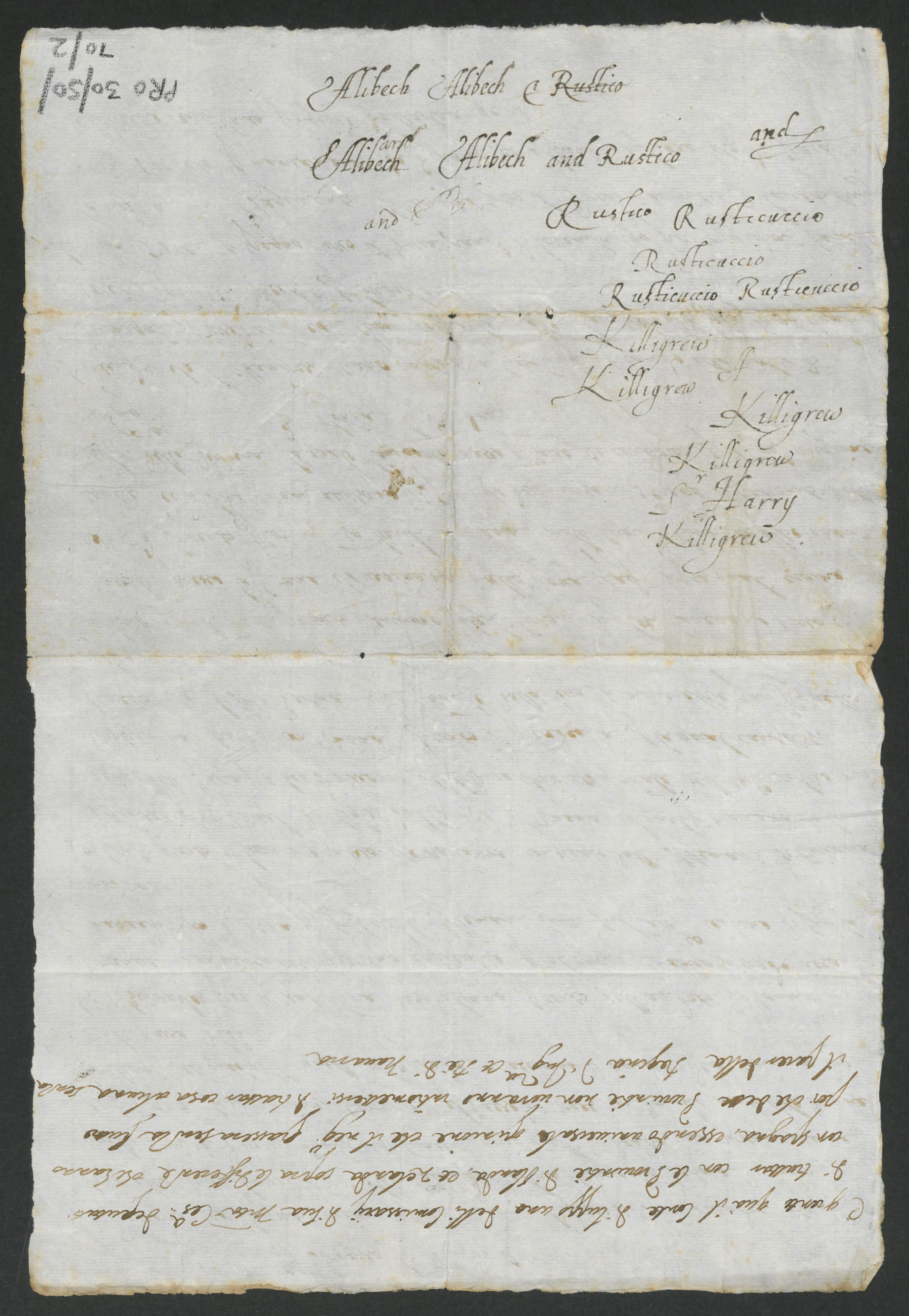
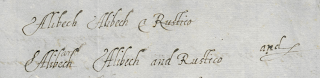
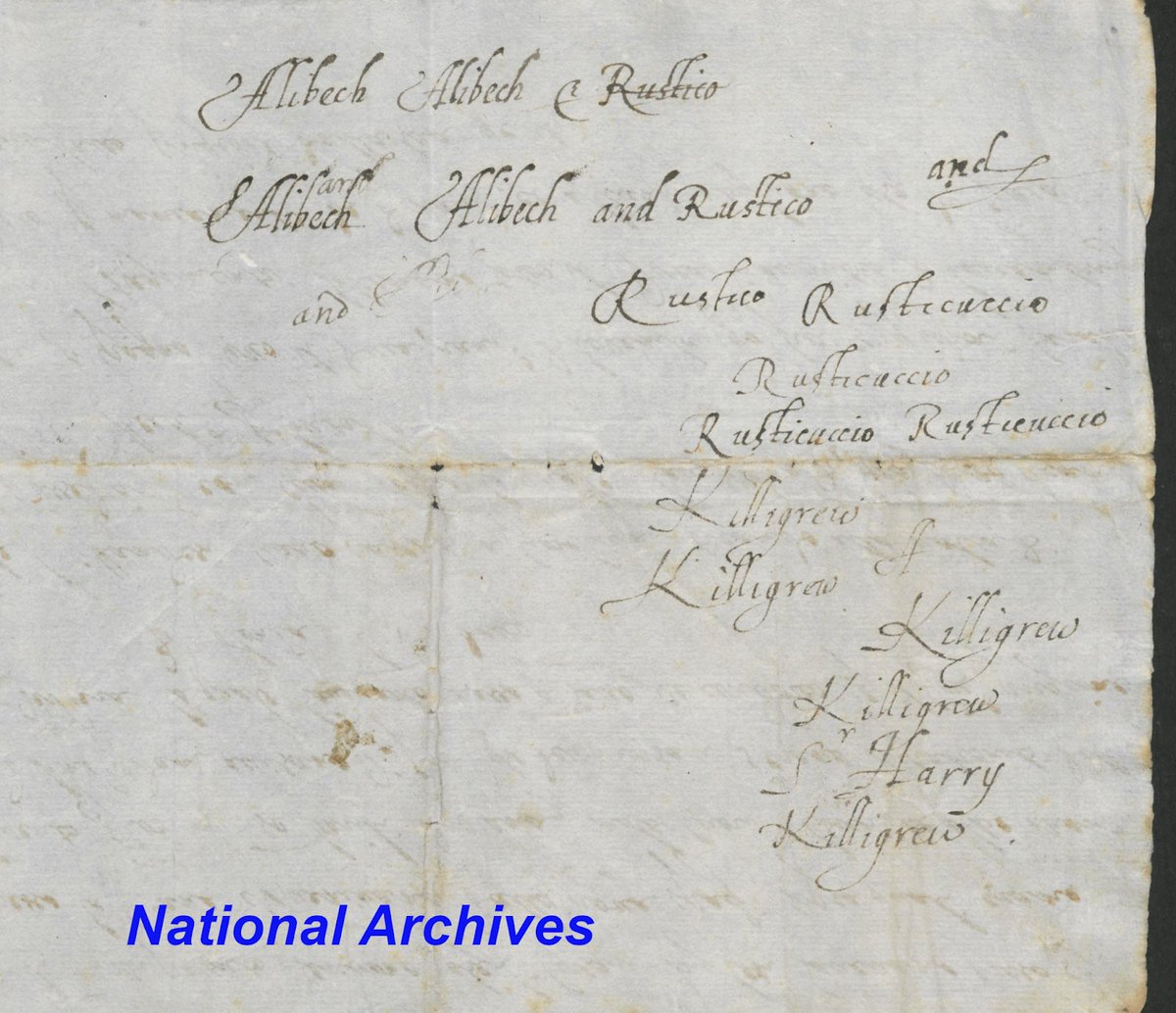
The sheet supports three propositions of unequal certainty. Alibech and Rustico identify Decameron III.10 at the level of names and tale. The source photograph is controlled as PRO 30/50/70/2, image 014, within a TNA item of Italian newsletters sent to Thomas Savile. The writer of the reverse-side scribbles remains unauthenticated; Killigrew and Sr Harry are contextual clues, not a signature.
Book-integration position — 31 August 2026
The paired names Alibech and Rustico are now stated positively in the book: they identify Decameron III.10 and demonstrate familiarity with that tale in the Neville/Savile working-paper context. This is not reduced to a rejected Petruchio-name theory.
Gascoigne's Supposes contains an earlier Petrucio, so an English analogue may exist. Its relevance has not yet been verified through detailed comparison of Ariosto, Gascoigne, the manuscript forms, and the play. The Petruchio question is therefore open; the Decameron-familiarity fact does not depend on resolving it.
The source-text identification and archival route remain distinct from the technical palaeographical question of the exact scribble hand. Full pass: HOBY DECAMERON SOURCE PLURALISM BOOK PASS 2026 08 31.
The older SP 12/238, f. 180 citation should therefore remain recorded as a rejected/unresolved project citation, not silently deleted. TNA dates that State Papers volume to January–May 1591, while the controlled photographed object is inside the separately identified newsletter item. The factual next step is provenance of the citation and independent hand analysis, not another literary interpretation of the names.
Rusticuccio / Petruchio / Sonnet 144 / Padua extension audit — 9 August 2026
The Twitter extension has now been tested against the local early-modern play database, EarlyPrint/EEBO, the current Italian DraCor corpus, public Italian linguistic and biographical sources, Sonnet 144 scholarship, and the controlled Padua itinerary. Full pass: RUSTICUCCIO PETRUCHIO SONNET 144 SHREW RESEARCH PASS 2026 08 09.
The resulting position is:
Rustico->RusticuccioandPietro->Petrucciogenuinely share the- A direct
Rusticuccio->Petruchioname-source claim has not been - Sonnet
144strongly supports a sexual/venereal reading of devil, hell, - Henry Neville's own documented Padua presence in
1581is substantial - A new secondary avenue is Iacopo Rusticucci in Dante's Inferno XVI.
productive Italian -uccio derivational process. This establishes a sound morphological analogy but not a unique source relationship.
demonstrated. Gascoigne's Supposes, performed in 1566, includes Petrucio as a minor servant's name, while Ariosto's Italian I Suppositi leaves the corresponding Sienese servant unnamed. This identifies a possible English analogue, but its relevance to the play requires detailed textual comparison rather than inference from the shared name.
temptation, and fire. Decameron III.10 is a plausible allusive parallel, but EarlyPrint/EEBO shows that the devil-in-hell sexual idiom circulated in English by 1566 and again in 1595; it is not an exclusive Boccaccio fingerprint.
Italian biographical context. It does not by itself connect the sheet to composition of Shrew.
Dante's fierce-wife, sexual-transgression, hell, and fire complex was elaborated by Boccaccio in his Dante commentary. The resonance with Shrew and Sonnet 144 is striking, but the sheet's immediate Alibech/Rustico context makes playful variation on Rustico the more economical first reading.
The controlled publication language should therefore preserve the Twitter insight as three differently weighted propositions: morphology strong; Sonnet allusion plausible but non-exclusive; Petruchio derivation and the possible Gascoigne analogue unresolved pending detailed comparison.
Shindler correction — 9 August 2026
The historical Sonnet 144 citation is now controlled. Robert Shindler, “The Stolen Key,” The Gentleman's Magazine 272 (January 1892), 70–84, states on printed pp. 78–79 that Sonnet 144.12 clearly refers to a well-known Boccaccio story. Page-image witnesses are Archive leaves n88 and n89. This is positive historical evidence, not a negative result.
Two limits must accompany the citation. Shindler does not name Alibech, Rustico, or III.10, so the precise tale identification is inferred from the sexualized hell. His footnote also speculates that material from the English translation published in 1620 circulated earlier in manuscript; direct review of that 1620 edition shows that III.10 was replaced by the chaste Serictha story. Shindler therefore establishes a Boccaccio interpretation by 1892, but does not yet establish the transmission route he proposes.
Research-Ready Verdict
Three distinct evidence layers are now controlled and must remain distinct:
- Text identification: the sheet repeats
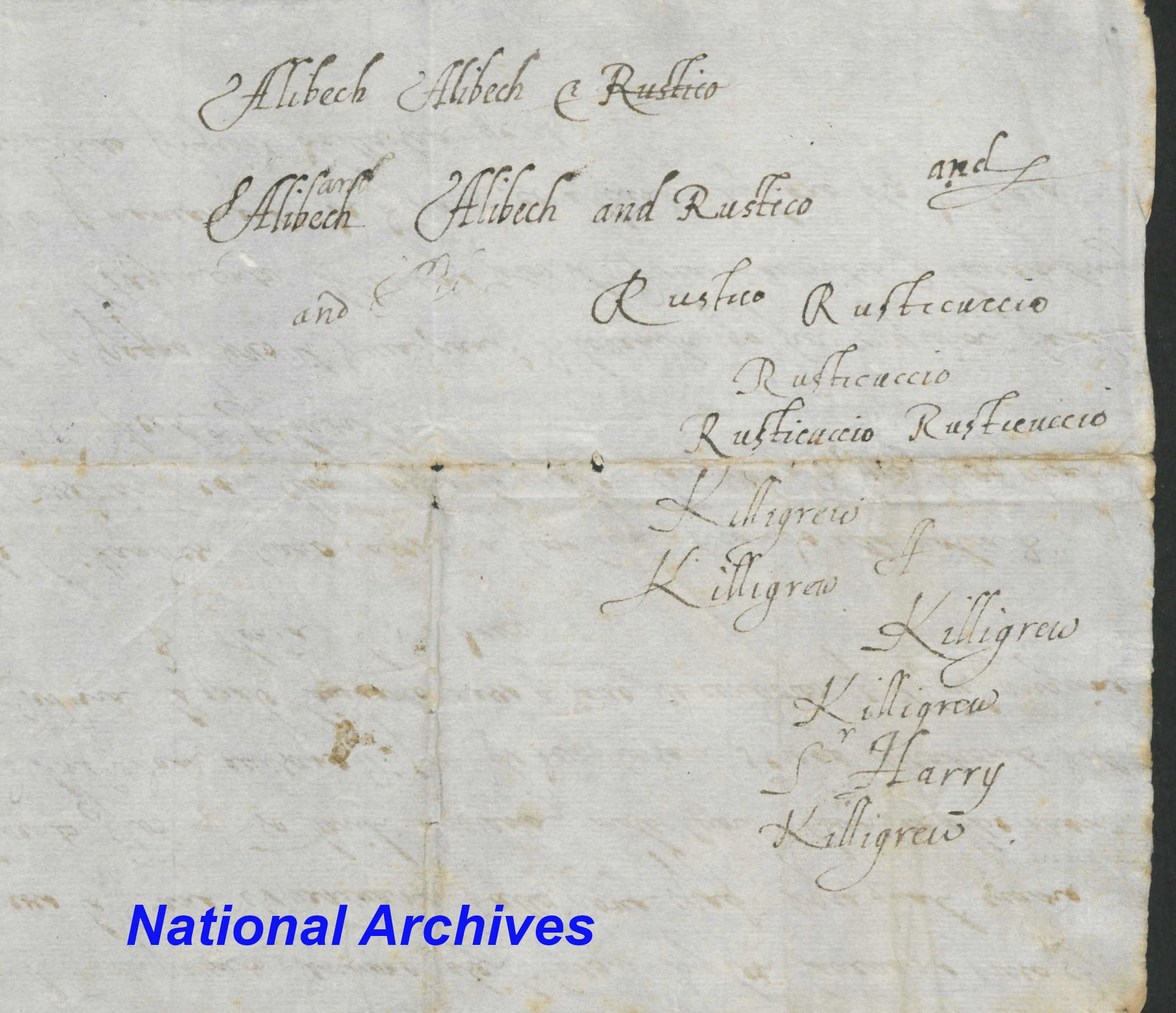
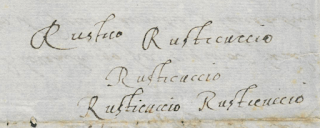
Alibech,Rustico, andRusticuccio; Alibech and Rustico unambiguously identify Decameron III.10. - Archival route: the unlabelled derivative image is derived from the numbered local capture
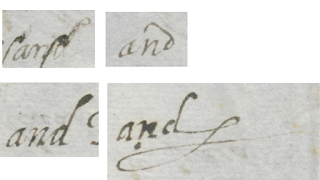
PRO 30 50 70 2 014; the source image itself visibly carriesPRO 30/50/70/2, and the 59-image folder plus itsdocconsistently identifies the series as that TNA item. TNA's API catalogue recordC6744768describes sixteen Italian newsletters to Thomas Savell, September-November 1591. - Hand attribution: the words and archive route are not the same as authorship of the scribbles. The repeated
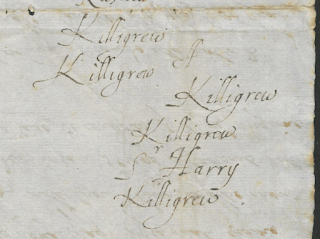
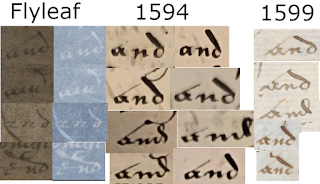
KilligrewandSr Harryforms make Henry Neville a serious candidate, but no independent palaeographical report presently proves his hand.
The older SP 12/238, f. 180 reference is not an alternative shelfmark for the staged image. TNA's catalogue identifies SP 12/238 as a separate State Papers Domestic volume covering January-May 1591. Until the origin of the folio citation is recovered, book prose must cite the photographed sheet as PRO 30/50/70/2, image witnesses 014, and label SP 12/238, f. 180 an unresolved or erroneous secondary citation.
0A. Structured Quoted Source Passages
Use these entries under SOURCE QUOTATION STANDARD.
1. Catalogue-Level Newsletter Route
- Source: Savile/Neville Italian newsletters provenance source note, SAVILE NEWSLETTERS PROVENANCE SOURCE NOTE 2026 06 21:3.
- Quotation:
"
PRO 30/50/70/2: sixteen Italian newsletters addressed to Thomas Savell of London""dated from Rome and Venice in
1591"
- What it proves: The current local source chain places the Alibech/Rustico reverse witness inside the Thomas Savile / Italian newsletter dossier.
- Limits: The catalogue record does not name the literary scribbles or their writer. The image witnesses sequence supplies the item-level route; do not substitute
SP 12/238, f. 180.
2. Reverse-Side Transcription Gives The Decameron Names
- Source: MegaLetters Doc 115, Doc 115 PRO Alibech righe side alibech crop:13.
- Quotation:
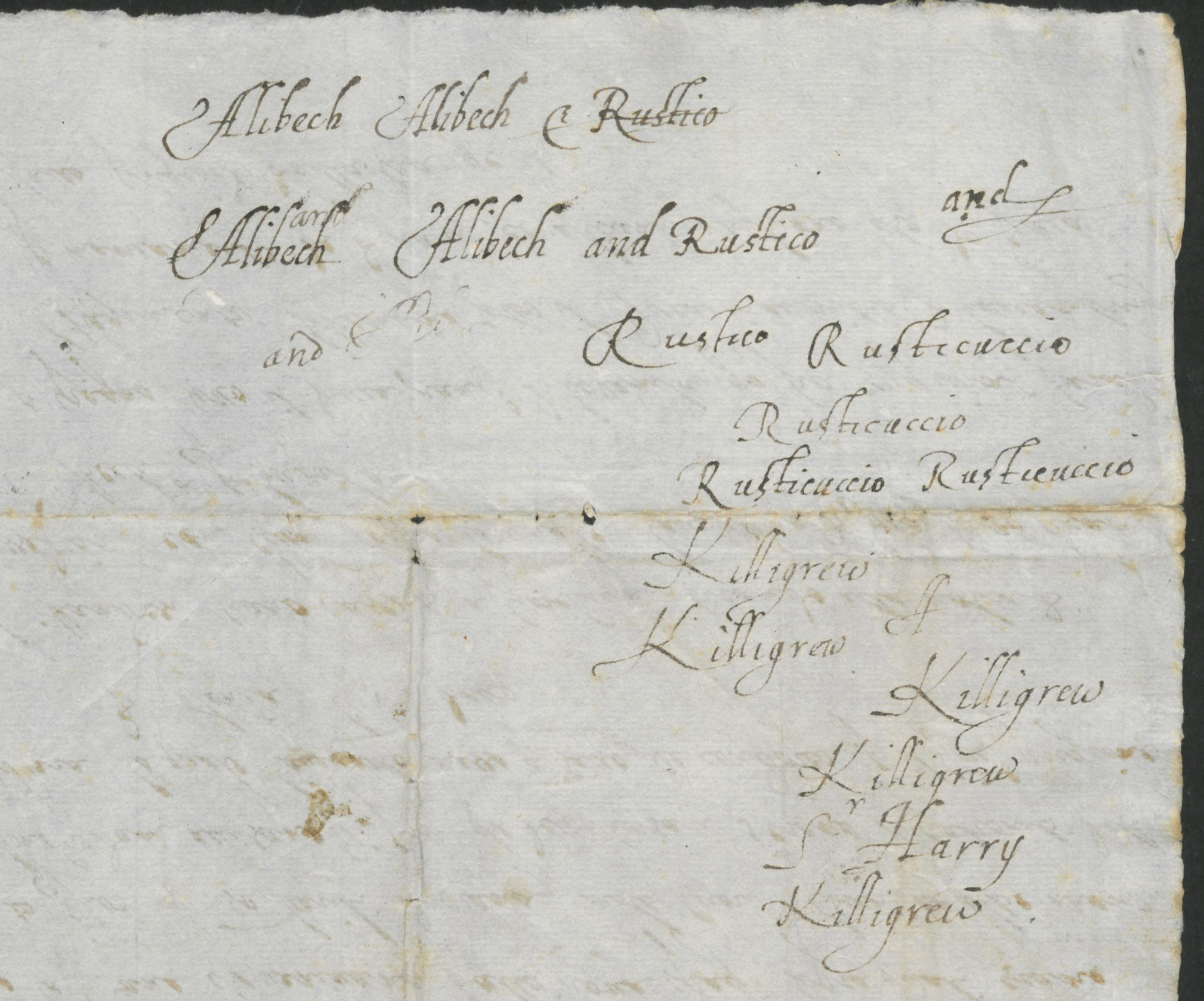
"Alibech Alibech & Rustico"
"and Rustico Rusticuccio"
- What it proves: The manuscript-side witness explicitly contains names from the Alibech/Rustico Decameron story.
- Limits: This is a working transcription/crop dossier; it proves the words more readily than the identity of their writer.
3. The Same Reverse Side Carries Killigrew/Harry Forms
- Source: Same Doc 115 transcription, Doc 115 PRO Alibech righe side alibech crop:21.
- Quotation:
"killigrew"
"Sr Harry"
- What it proves: The Decameron-name layer is not isolated from the Neville/Killigrew provenance problem; the same working witness includes family-name forms central to the hand/provenance argument.
- Limits: These words alone do not prove handwriting identity.
Sr Harryalso does not specify which Sir Henry is meant.
4. The Italian Fragment Belongs To A News-Intelligence World
- Source: Same Doc 115 transcription, Doc 115 PRO Alibech righe side alibech crop:28.
- Quotation:
"parere della Regina d' Ing.ra et Re di Nauarra"
- What it proves: The reverse-side sheet also carries political news language about the Queen of England and King of Navarre, keeping the witness in the diplomatic/newsletter environment.
- Limits: This does not by itself date or identify the hand; it supports context and source-route coherence.
5. The Shelfmark Conflict Resolves in Favour of PRO 30/50/70/2 for This Image
- Source: Savile/Neville provenance source note, SAVILE NEWSLETTERS PROVENANCE SOURCE NOTE 2026 06 21:46.
- Quotation:
"Do not silently alternate between
PRO 30/50/70/2andSP 12/238, f. 180."
- What it proves: Local source control now goes farther than this earlier warning. The original numbered image visibly carries
PRO 30/50/70/2, belongs to a 59-image sequence named for that item, and matches the sheet used for the derivative Alibech file. - Limits: This does not explain where the incompatible SP folio citation originated; it shows only that the staged image should not be cited by that reference.
6. Boccaccio's Tale Makes the Name Cluster Unambiguous
- Source: Brown University, Decameron Web, Day Three, Tale Ten.
- Quotation:
Alibech divien romita, a cui Rustico monaco insegna rimettere il diavolo in Inferno
il cui nome era Rustico
- What it proves: The pairing is not a vague lexical resemblance. Alibech and Rustico are the named protagonists of III.10, the tale in which the monk turns
rimettere il diavolo in Infernointo an erotic deception. - Limits: Identifying the literary referent does not prove why the names were copied, whether
Rusticucciois merely playful diminutive practice, or whether the sheet was used in composing any play.
7. Roberts Controls the Hoby/Audley/Billingbear Book, but Not Neville's Reading
- Source: Dunstan Roberts, “Books Owned by Sir Thomas Hoby (1530-1566),” pp. 53-59.
- Quotation:
“one is a copy of Giovanni Boccaccio's Il Decamerone (Venice: Vincenzo Valgrisi, 1555)”
“Both books have Hoby's signature on their title pages.”
“It seems likely that the two books came to Audley End via a connection between two families, the Hobys and the Nevilles.”
- What it proves: Audley End inventory
81035044is a Hoby-signed Valgrisi Decamerone that Roberts connects circumstantially to the later Billingbear-Audley estate trail; the 1780 Billingbear catalogue records the same edition. - Limits: Roberts dates the transfer only broadly between
1558and1780. The copy is Hoby's annotated book, not an identified Henry Neville-annotated copy.
Guidance / Source Notes
- Current outline use: treat the Alibech/Rustico sheet as direct evidence that someone using a Thomas Savell Italian-newsletter sheet recalled or played with Decameron III.10. Treat Henry Neville's authorship of the scribbles as a argued attribution, not a settled fact.
- Ken's current attribution position is that the
Alibech,Rustico, and related scribbles are Henry Neville's hand. Preserve that conclusion as Ken's research position and present the repeated Killigrew/Sir Harry forms as supporting observations; do not rewrite the independent-source status as stronger than it is. - Ken's current provenance position: the newsletters were from Neville's archive. The source route is controlled by the Savile/Neville relation evidence, the reverse-side Henry Killigrew witness in the relevant hand layer, and the retained Neville-family archive context.
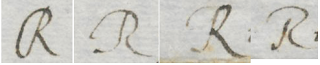
- The final missing upgrade is an independent hand assessment built from repeated full-word exemplars and known Neville documents. The source image, collection reference, text identification, and Hoby-volume provenance can already be cited without waiting for that assessment.
- Decameron source-book context update: the Billingbear
false date 1527line should be demoted as the later Rolli/Edlin1725edition-family. The relevant Billingbear source-book context is the Hoby/Audley End Valgrisi1555copy.
Web / Archive Notes
- TNA's public API returned the full
C6744768record: citable referencePRO 30/50/70/2, covering dates September-November 1591, sixteen Italian newsletters to Thomas Savell, held at TNA, not digitised. This independently confirms the catalogue layer already quoted in the packet. - The local source chain is unusually strong for item identity: all 59 numbered photographs use the stem
PRO 30_50_70_2;docrecords those 59 pages as one local document calledItalian Letters Fresh; the Alibech derivative has the same dimensions as numbered image 014; and image 014 visibly carries the archival reference at lower right. - TNA's API separately identifies
SP 12/238as “Letters and papers sorted and bound in date order,” January-May 1591. That makes it chronologically and archivally distinct from the September-November PRO 30/50/70/2 packet. No public TNA item-level description connects its f. 180 to Alibech or Rustico. - Brown's full Italian text and the University of Manchester's 1492 illustrated-leaf record provide public controls for the tale itself. Neither bears on the scribble hand.
Status-Control Position
- Current controlled claim: a local crop/transcription dossier reads
Alibech,Rustico, andRusticuccioforms on an Italian-newsletter-related item. - The archive route is now resolved for the photographed sheet. The hand attribution is not. Final book prose should distinguish “the sheet carries” from “Neville wrote” unless it explicitly presents the latter as an attribution and cites the handwriting argument.
- Sonnet 144, Two Gentlemen, All's Well, Cymbeline, and other Shakespeare-source claims require separate play/source packets.
1. Verified Sourced Facts
- A National Archives catalogue record describes:
“Sixteen newsletters addressed to Thomas Savell of London by an anonymous correspondent, dated from Rome and Venice; in Italian”
- The same record gives the reference:
“PRO 30/50/70/2”
- The same record dates the item:
“1591 Sept-Nov”
- A 2026-04-21 web audit treats the National Archives Discovery record as the only external catalog-level control currently available for the
PRO 30/50/70/2newsletter packet. The Discovery site confirms the item identity at catalog level but does not expose the reverse-side handwriting images in this packet.
- Local-image reconciliation,
2026-07-09: the full source photograph is image 014 in a 59-image local capture of PRO 30/50/70/2. The archive reference is visible on the photographed sheet. This closes the source-image shelfmark route even though the TNA catalogue does not provide public digital images.
- The Decameron story named by the scribbles is Boccaccio's Day 3, Tale 10: the story of Alibech and Rustico. Brown University's Decameron Web provides both English and Italian text witnesses for
III.10, making it the preferred public scholarly control for the story identification until a specific early-modern edition/source witness is chosen.
- The updated Billingbear transcription and direct PNG inspection now support two estate-list Decameron entries, but only one is source-book relevant for Henry Neville's era:
IMG 8177:Il Decameron di Boccaccio di Rolli ... false date 1527IMG 8181:Il Decamerone di M. Giovan Boccaccio ... Vinc. Valg. ... 1555
- The estate-list line-image side of the Decameron evidence is therefore strengthened for the Valgrisi/Hoby copy, while the Rolli false-date line is demoted as later. The
1591Alibech/Rustico sheet is the direct literary-reference witness; attributing its scribbles to Henry Neville remains a separate palaeographical claim. The Hoby/Valgrisi copy supplies supporting source-book context.
- Fresh MegaLetters pass,
2026-05-23: Doc 115 PRO Alibech righe side alibech crop preserves a local transcription layer for theAlibech,Rustico,Rusticuccio, andKilligrewscribble crop plus a related Italian newsletter fragment. Its metadata fieldFROM: Boccaccioshould not be read literally as a letter sender; it is a subject/source label for the Boccaccio reference.
- Source-network position: the Thomas Savile packet now records ONB/Blotius letters from
1589-1590, the Harley MS 6995 Tycho/Blotius cluster from1590, and local Savile cousin controls in MegaLettersDoc_26andDoc_35. Use those to harden Savile as a source-network figure and relation to Neville; do not leave this packet framed as an open Thomas Savile/Savell identity problem.
2. Source-Control Position
- The strongest local transcription layer is now MegaLetters
Doc_115, which reads repeatedAlibech,Rustico,Rusticuccio,killigrew, andSr Harryforms above an Italian newsletter fragment. Doc_115is a working transcription/crop dossier, not a final diplomatic witness. Its image links point back to the externalItalian Letters Freshimage set, so final use still requires direct image collation.- The former archival-reference conflict is resolved for this image in favour of
PRO 30/50/70/2. The project citationSP 12/238, f. 180remains unexplained and should be removed from final prose unless its own image or archival note is recovered. - A BRO transcription sweep found no direct
Alibech,Rustico,Boccaccio, orDecameronwitness in[local source path removed]. BRO is negative for this manuscript/source-book lane.
3. Ken Feinstein Twitter and Blog Information
- A Ken Feinstein blog post dated
15 Jan. 2020identifies a1591document in which the blog argues Neville wrote“Alibech”,“Rustico”, and“Rusticuccio”on the back of an Italian newsletter sent through Thomas Savile.
- The preserved Ken Feinstein blog post argues that the Alibech/Rustico story is relevant to Shakespearean material in:
- All's Well That Ends Well
- Cymbeline
- Two Gentlemen of Verona
- Sonnet
144 - “The Alibech and Rustico story (from the Decameron) is extremely lewd, involving seduction with language equating the act to "putting the devil into hell."”
- “Sonnet 144, published in 1599, appears to allude directly to this story through its language of devils, hell, and temptation.” Current evidence note: the sexual reading is strong and the III.10 comparison is plausible, but the idiom is not unique to Boccaccio; use
allusive parallel, notproved direct source. - “"Rusticuccio" employs Italian diminutive suffixes, paralleling how "Petruchio/Petruccio" derives from "Pietro" in The Taming of the Shrew, written around 1591.” Current evidence note: the morphological comparison is correct, but a source claim is unproved. Gascoigne's 1566 Supposes supplies a possible English analogue; its relation to the play has not yet been verified in detail.
- A 2026-08-09 follow-up adds a carefully bounded Dante/Boccaccio lane: Iacopo Rusticucci's fierce wife, sexual transgression, infernal fire, and Boccaccio commentary create a possible secondary resonance with Shrew and Sonnet 144. This is not presently the primary identification of the manuscript's
Rusticuccio. - The preserved Ken Feinstein tweet trail also states that Neville owned two copies of the Decameron and that the scribbles are important for Shakespeare authorship arguments. Current evidence note: update outline language to one relevant sixteenth-century Decameron source-book trail plus one later Rolli false-date estate-list entry.
4. Citations
- “Sixteen newsletters addressed to Thomas Savell of London by an anonymous correspondent, dated from Rome and Venice; in Italian.” The National Archives Discovery,
PRO 30/50/70/2,1591 Sept-Nov, https://discovery.nationalarchives.gov.uk/details/r/C6744768. - The National Archives Discovery API, record
C6744768, direct structured catalogue response: API record. Local source corpus metadata: doc; controlling numbered photograph: PRO 30 50 70 2 014. - The National Archives Discovery,
SP 12/238, “Letters and papers sorted and bound in date order,” January-May 1591, recordC1903232: catalogue record. This is cited as an exclusion/control for the erroneous alternative reference, not as the Alibech image source. - thomas savile blotius and italian newsletters, controlling packet for the Thomas Savile/Blotius and Thomas Savell newsletter-addressee lanes.
- Boccaccio, Giovanni. Decameron, Day 3, Tale 10, “Alibech and Rustico.” Brown University, Decameron Web, English text, https://www.brown.edu/Departments/Italian_Studies/dweb/texts/DecShowText.php?myID=nov03010&lang=eng; Italian text, https://www.brown.edu/Departments/Italian_Studies/dweb/texts/DecShowText.php?myID=nov03010&lang=it.
- Boccaccio, Giovanni. Decamerone, Venice: Johannes and Gregorius de Gregoriis, 1492, Third Day, Tenth Tale, f. 48v, text and woodcut. University of Manchester Library, Rylands Collection, image
JRL1306692: Alibech and Rustico. - Billingbear Book List Transcription,
IMG 8177andIMG 8181. Working local transcription: Billingbear Book List Transcription. Page images: IMG 8177; IMG 8181. - Decameron source-image packet, including Hoby/Audley Valgrisi title page, annotation comparison sheet, and Billingbear Decameron entries: SOURCE NOTES.
- Roberts, Dunstan. “Books Owned by Sir Thomas Hoby (1530-1566).” Transactions of the Cambridge Bibliographical Society 17.1 (2020): 53-66. JSTOR stable record. document witnesses: Roberts BOOKSOWNEDSIR 2020. Relevant controls: Audley End inventory
81035044; Roberts pp. 53-59; Billingbear catalogueBRO D/EN/F37. - Full Alibech/Rustico manuscript-side witness in source-image packet: alibech rustico full manuscript side pro 30 50 70 2.
- Savile / Blotius / Tycho source-image packet, including Harley MS 6995 controls and local Henry Savile cousin images: SOURCE NOTES.
- Feinstein, Ken. “Henry Neville, Shakespeare, and Boccaccio's Decameron.” kenfeinstein.blogspot.com, 15 Jan. 2020, https://kenfeinstein.blogspot.com/2020/01/henry-neville-shakespeare-and.html. Local preservation: blog boccaccio decameron 2020 01 15.
- Feinstein, Ken. “Big Discovery: In 1591 Henry Neville wrote these scribbles on the back of an Italian news letter. It relates directly to Boccaccio's Decameron, a major source for the works of Shakespeare.” X, 15 Jan. 2020, https://twitter.com/user/status/1217456057154301956. Local archive: twitter Books Read.
- Feinstein, Ken. “The Decameron is a source for the works of Shakespeare. Henry Neville owned two copies of the book. He wrote Alibech and Rustico, an unambiguous reference to the book, on the back of a letter in 1591.” X, 17 Jan. 2020, https://twitter.com/user/status/1218231986415816704. Local archive: Books Read.
- Feinstein, Ken. “Thomas Savile forwarded Neville newsletters in Italian. Because Henry Neville could read Italian and was very interested in Italy. Here on the back of one of them he scribbles “Alibech and Rustico” a reference to the Decameron — a major Shakespeare source.” X, 8 Jan. 2024, https://twitter.com/user/status/1744410550828941718. Local archive: twitter Books Read.
- Feinstein, Ken. “Shakespeare Authorship Day 9: Henry Neville made these scribbles in 1591 which reference Boccaccio's Decameron. At precisely the same time Two Gentlemen of Verona was being written with that book as one of it's sources.” X, 1 Jan. 2021, https://twitter.com/user/status/1344910344292978688. Local archive: twitter Books Read.
- billingbear decameron, local figure file connected to this document cluster.
- MegaLetters local staging of the scribble crop: Doc 115 PRO Alibech righe side alibech crop.
- MegaLetters source-routing dossier: megaletters pro 30 50 source dossier.
5. image witnesses Witnesses
6. Notes on Access
- This packet is anchored by the TNA Discovery record and API for
PRO 30/50/70/2, the original numbered local source photograph014, the 59-image source manifest, the MegaLetters transcription layer, Brown's tale text, and Roberts's Hoby-volume study. Blog/tweet material now records research history and interpretive claims rather than carrying the source identity by itself. - The packet now includes a local MegaLetters working transcription of the newsletter back / crop, but it is still not a final independent diplomatic transcription. Final prose should cite the full manuscript-side image and the source note, not only the crop or tweet image.
- The ONB Thomas Savile letters and Harley 6995 controls support Thomas Savile as a real Italian/continental source-acquisition actor. The source-image reference is now reconciled. The decisive remaining work is independent hand attribution, not archive identification.
- Brown University's Decameron Web confirms that Alibech/Rustico is a real and distinctive Decameron reference, but it does not by itself prove that Neville made the scribbles or that the scribbles were Shakespeare-source notes.
- The Billingbear Decameron entries now have estate-list line-image support through the updated transcription and PNG inspection. This strengthens the Valgrisi/Hoby library/source-book context and demotes the Rolli line as later; it should not be substituted for the direct Alibech/Rustico handwriting/provenance proof.
- Claims about Shakespeare-source importance are preserved as Ken Feinstein interpretation rather than recast here as neutral fact.
- Final prose may say that Ken attributes the hand to Neville and may explain why. It should not use unqualified
Neville wrotelanguage until the attribution is independently controlled. - Related play/source packets to cross-check later include:
- play alls well that ends well
- play cymbeline
- play merry wives of windsor
- northumberland manuscript
Book Integration Update — 2026-08-31
- Chapter 33 includes the 1591 “Alibech” and “Rustico” manuscript image as direct evidence of Decameron familiarity.
- Gascoigne's English Supposes contains a servant named
Petrucio, but its relevance to the play has not been established by detailed comparison. It is a possible English analogue, not a demonstrated route. - Neville's Padua experience remains relevant geographical and intellectual context; the precise name derivation remains open.