Northumberland Manuscript
Topic: Northumberland Manuscript
Quoted Source Passages
1. The Public Facsimile Route Is Now Identified
- Source: Core-pillars source note for Archive.org item
cu31924013117480, SOURCE NOTES, lines35-44. - Quotation:
"Collotype facsimile & type transcript of an Elizabethan manuscript preserved at Alnwick Castle, Northumberland"
"not an institutional high-resolution image of the original manuscript"
- What it proves: The packet now has a public facsimile/transcript route beyond isolated blog crops.
- Limits: The facsimile is mediated; it does not settle handwriting attribution.
2. The Local Blog Preserves the Core Neville/Motto Reading
- Source: Northumberland Part 1 local preservation blog northumberland part1 2019 10 26, as summarized in this packet.
- Quotation:
"The name \"Nevill\" appears to be written twice"
"the Neville family motto \"ne vile velis\" is also written twice"
- What it proves: The inherited research lead rests on concrete observed readings on the flyleaf: the family name and motto.
- Limits: These readings do not prove Henry Neville's hand, ownership, or authorship without source-coordinate crops and hand separation.
3. The Part 2 Blog Makes the Ownership/Scribbler Argument Explicit
- Source: Northumberland Part 2 local preservation blog northumberland part2 2019 11 06, lines
78-84. - Quotation:
"strong reason to believe"
"very likely that Henry Neville was indeed the owner and scribbler"
- What it proves: The blog claim is an explicit interpretive argument, not an accidental later paraphrase.
- Limits: Preserve this as "the blog argues." The current AI topic source tier remains
lead, not proof.
4. The Part 3 Blog Gives the 1590 Baseline Route
- Source: Northumberland Part 3 local preservation blog northumberland part3 2019 11 09, lines
24-38. - Quotation:
"Document Number: MC4305085404"
"Lansdowne MS 65/22"
"This is the earliest letter we currently have from Henry Neville."
- What it proves: The blog identifies a concrete State Papers / Lansdowne route for a candidate 1590 Neville-hand comparison.
- Limits: The direct BL/SPO image still needs retrieval and crop-coordinate collation before it can be treated as a controlled handwriting baseline.
5. The Handwriting Ledger Defines the Minimum Proof Standard
- Source: Northumberland handwriting source-coordinate ledger NORTHUMBERLAND HANDWRITING LEDGER, lines
11-24,41-51. - Quotation:
"Do not silently mix different hands."
"Do not say Henry Neville wrote the Northumberland flyleaf."
"source-coordinate crop boxes"
- What it proves: The packet now has an explicit method rule preventing premature paleographic claims.
- Limits: This is a project-control standard; it still needs completed crops, overlays, and comparison witnesses.
Archive.org / Ledger Notes
- Archive.org metadata for
cu31924013117480confirms the public facsimile route as Collotype facsimile & type transcript of an Elizabethan manuscript preserved at Alnwick Castle, Northumberland, London/New York: Longmans, Green,1904, Cornell University Library contributor. - This strengthens public page access only. It does not upgrade the flyleaf hand attribution.
- The next source-control step remains the source-coordinate handwriting ledger: original or best-available image, crop box, transcription, hand assignment, comparison witness, QA overlay, and confidence tag.
1. Verified Sourced Facts
- Source-control position: a dedicated handwriting ledger stub now controls this cluster:
- NORTHUMBERLAND HANDWRITING LEDGER
This ledger requires source image, crop box, transcription, hand assignment, native crop, zoom/display crop, QA overlay, quality tag, and editorial note before any handwriting comparison can be promoted.
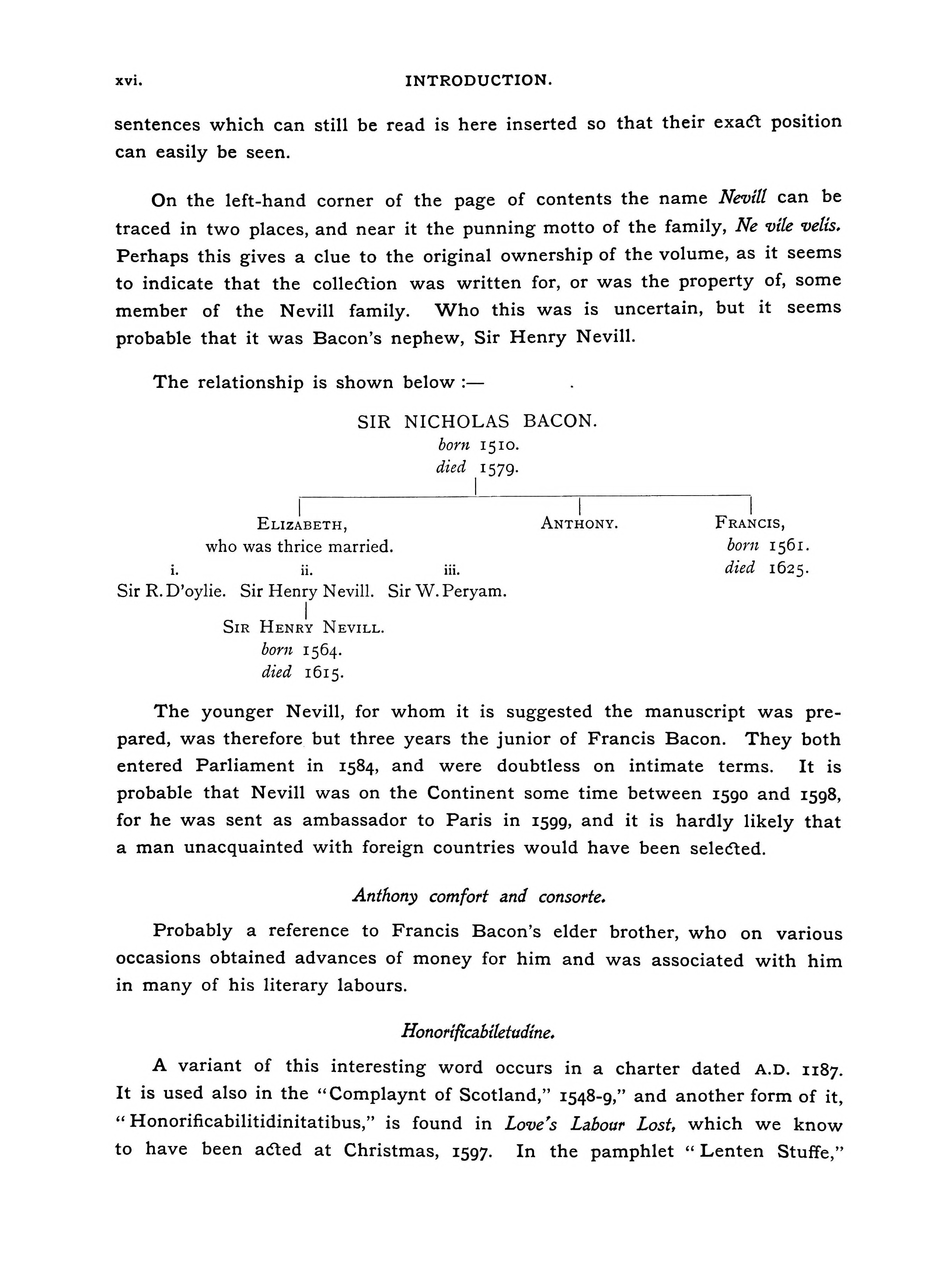
- Core-image controls: the 1904 Burgoyne collotype facsimile and type transcript is pinned to a public Archive.org item and staged as local page images. Stable routes are also pinned for Shakespeare Documented (DOI `10.37078/290`), Lost Plays, and CELM. The new image set includes Burgoyne's explanatory page for the "Nevill" /
Ne vile velisreadings, a modern-script rendering excluded from paleographic use, and several historical plate controls. The dated NORTHUMBERLAND FLYLEAF SOURCE CONTROL PASS 2026 07 09 records their differing image generations, rights limits, and locator conflict.
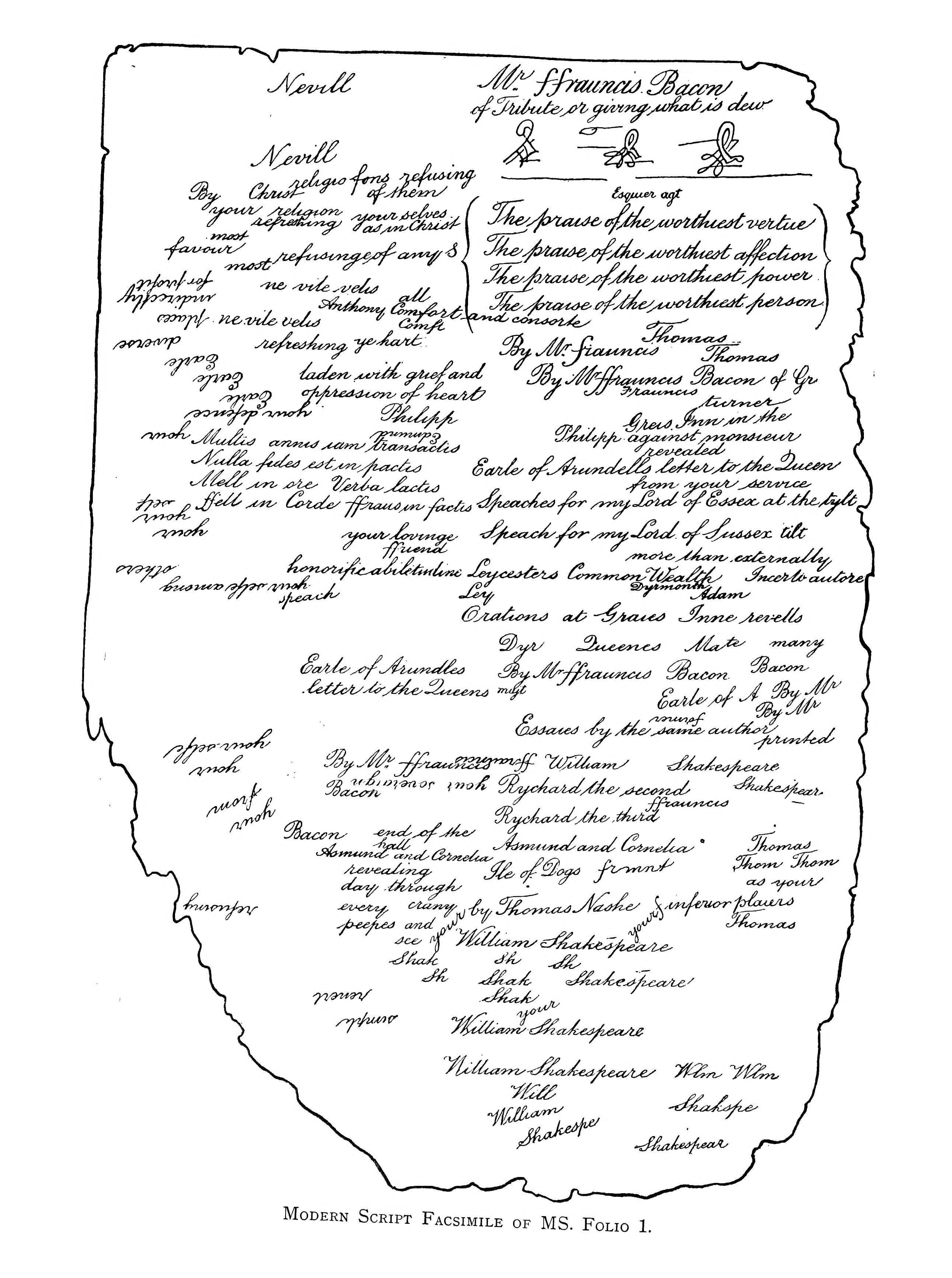
- Current source verdict,
2026-05-31: the Northumberland flyleaf remains a high-value manuscript-contact and handwriting-comparison lead. It is not a proof packet for Neville's hand. No final prose should say Henry Neville wrote the flyleaf, owned the manuscript, or that the flyleaf and BRO pen trials match until the flyleaf hands and comparison witnesses are controlled by source-coordinate crop evidence.
- BRO
D/EN/O12/25clarification,2026-07-15: the catalogue/image conflict is resolved at packet level. Direct inspection shows a compound item containing (1) a heavily revised draft catalogued as Henry Neville to Burghley, dated27 June 1598; (2) Sir John Popham's signed enclosure dated26 June; and (3) an outer address/docket bearing faint trials includingAfter my hartyandAfter my harty commendations. The former all-Popham description and shifted alternate-image map are withdrawn. This does not authenticate the outer-leaf trials as Neville's hand: catalogue attribution of the draft cannot be transferred across physical surfaces without paleographic control. See RBA D/EN/O12/25 and the dedicated 1598 Sonning topic.
- Source-tier warning,
2026-05-30: this umbrella packet is now set tolead, nottbd, because there is a preserved local source sequence and substantial image material. It is still not a final handwriting proof packet. Treat the Northumberland material as three layers: direct manuscript/catalogue evidence, preserved Ken Feinstein blog/image interpretation, and paleographic inference.
- Source-control position,
2026-07-09: direct local controls include the preserved Part 1, Part 2, and Part 3 blog files; Burgoyne1904page images; local page captures for Shakespeare Documented, Lost Plays, and CELM; and one source-coordinateNevillcandidate from Burgoyne Folio 1a. Shakespeare Documented's institutional images remain link-only under the displayed rights statement. Still unresolved are thefol. 1r/p. i/fol. 46r-v/Folio 1a-clocator conflict, the BL/SPO image control forLansdowne MS 65/22, and the exact BRO identity of the1598pen-trial comparison document.
- BRO transcription sweep, updated
2026-07-15: no BRO transcription proves that Henry Neville wrote the Northumberland flyleaf.D/EN/O12/25is now physically resolved as a Neville draft with a Popham enclosure and outer-leaf pen trials, but the trial hand remains unknown. It may be studied as a located candidate surface, not as a secure Neville-hand baseline.
- BRO source-control position,
2026-07-14:D/EN/F6/2/7contains Dorothy Seymour's incoming italic letter and a separate later pedigree. The pedigree has no visible writer's label or independent palaeographical authentication and is excluded from the Neville control set. No new analysis of the Northumberland manuscript is undertaken here.
- The local Northumberland note states:
“The page contains a reference link”
- The same note states:
“A discussion link referencing "Discussion of Henry Neville" via an archive.org source”
- The first Northumberland study note states:
“The flyleaf seems to have been written between 1594-1597.”
- The same note states:
“The name "Nevill" appears to be written twice on the top left”
- The Burgoyne 1904 facsimile/transcript introduction also discusses the "Nevill" and
Ne vile velisreadings, but Burgoyne's suggestion that the name probably refers to Sir Henry Nevill is an editorial inference. Use it as a historical facsimile/source note, not as proof of hand, ownership, or authorship. - The same note states:
“the Neville family motto "ne vile velis" is also written twice”
- The same note states:
“The flyleaf has the word "honorificabiletudine" written on it.”
- The same note states:
“The name "Francis Bacon" is also written several times.”
- The same note states:
“The flyleaf has the name of William Shakespeare written on it several times as well as the names of two Shakespeare plays (Richard II and Richard III) and a quote from Rape of Lucrece.”
- The second Northumberland study note states:
“On the left we have "To the right" and then "ho ho the the".”
- The same note states:
“Henry Neville often wrote "To the right honorable"”
- The third Northumberland study note identifies the comparison witness:
“Sir Henry Nevell's complaint to Lord Burghley, that he is rigidly used by Lord Warwick for casting iron ordnance, 1590”
- The same note states that this letter is:
“Reference: Lansdowne MS 65/22”
- The same note states of the 1590 witness:
“This is the earliest letter we currently have from Henry Neville.”
2. Ken Feinstein Twitter and Blog Information
- No Ken Feinstein Twitter/blog material is isolated in this packet at present.
3. Quoted Source Text
Local Northumberland wiki page
- “The page contains a reference link”
- “A discussion link referencing "Discussion of Henry Neville" via an archive.org source”
Northumberland Part 1
- “The flyleaf seems to have been written between 1594-1597.”
- “The name "Nevill" appears to be written twice on the top left”
- “the Neville family motto "ne vile velis" is also written twice”
- “The flyleaf has the word "honorificabiletudine" written on it.”
- “The name "Francis Bacon" is also written several times.”
- “The flyleaf has the name of William Shakespeare written on it several times as well as the names of two Shakespeare plays (Richard II and Richard III) and a quote from Rape of Lucrece.”
Northumberland Part 2
- “On the left we have "To the right" and then "ho ho the the".”
- “Henry Neville often wrote "To the right honorable"”
Northumberland Part 3
- “Sir Henry Nevell's complaint to Lord Burghley, that he is rigidly used by Lord Warwick for casting iron ordnance, 1590”
- “Reference: Lansdowne MS 65/22”
- “This is the earliest letter we currently have from Henry Neville.”
4. The Bacon–Neville Family Connections
The co-presence of the Bacon and Neville names on the manuscript sheet is explained by two documented family connections:
Connection 1: The Cooke Sisters (first cousins)
Two of the daughters of Sir Anthony Cooke of Gidea Hall are directly documented in connection with Neville:
- Ann Cooke → married Sir Nicholas Bacon (Lord Keeper) → Francis Bacon and Anthony Bacon
- Katherine Cooke → married Sir Henry Killigrew → Anne Killigrew, who married Henry Neville (December 1584)
Francis Bacon and Anne Killigrew Neville were therefore first cousins — their mothers Ann Cooke and Katherine Cooke were sisters, both daughters of Sir Anthony Cooke of Gidea Hall.
Sourced: Allen, Gemma, ed., The Letters of Lady Anne Bacon (2014), editorial note: "Henry Neville was married to Anne Killigrew, daughter of Katherine Cooke Killigrew... cousin to Anthony and Francis Bacon." (The word "niece" in Allen reflects loose early modern usage for a female relative; the standard genealogy of the Cooke daughters identifies Ann and Katherine as sisters.) Gristwood, Sarah, The Elizabethan Court Day by Day: 1584 (Folgerpedia), p. 45, for Anne Killigrew's parentage (Katherine Cooke).
A third Cooke sister, Mildred Cooke, married William Cecil, Lord Burghley → making Robert Cecil a first cousin of both Bacon and Anne Killigrew Neville. Source: Prior, Mary. "Cecil [née Cooke], Mildred, Lady Burghley (1525/6–1589)." Oxford Dictionary of National Biography. Oxford University Press, 2004. doi:10.1093/ref:odnb/4988.
Connection 2: Step-family (Francis Bacon's half-sister was Neville's stepmother)
Francis Bacon's older half-sister, Elizabeth Bacon, was Henry Neville's stepmother. She was the eldest daughter of Sir Nicholas Bacon by his first wife Jane Ferneley; Francis was by the second wife Ann Cooke. Elizabeth married Sir Henry Nevell of Billingbere (Henry Neville's father) as his third wife c. 1578. My Ladye Nevells Booke (William Byrd keyboard MS, completed 11 September 1591) was made for her during this marriage. After Sir Henry's death in January 1593 she married Sir William Peryam — hence "Lady Peryam."
Source: Harley, John, "'My Ladye Nevell' Revealed," Music & Letters 86.1 (2005), pp. 1–15.
Significance for the Manuscript
These two connections explain why the names of both Bacon and Neville could appear in the same broader family and political orbit without requiring any theory of direct collaboration or concealment between them. This is contextual genealogy only. It does not prove ownership of the Northumberland Manuscript or identify the flyleaf hand.
5. Citations
- “Northumberland Manuscript.” Henry Neville Research Wiki, 4 Oct. 2020, http://nevilleresearch.com/index.php?title=Northumberland_Manuscript.
- Burgoyne, Frank J., ed. Collotype facsimile & type transcript of an Elizabethan manuscript preserved at Alnwick Castle, Northumberland. London: Longmans, Green, 1904. Archive.org public facsimile/transcript: cu31924013117480. Local source-image note: SOURCE NOTES.
- Burgoyne 1904 image witnesses: explanatory Nevill/motto page cu31924013117480 leaf0019 intro nevill motto honorific; embedded facsimile/context page cu31924013117480 leaf0022 facsimile folio1 or context; modern-script facsimile cu31924013117480 leaf0195 unnumbered plate; plate controls cu31924013117480 leaf0196 unnumbered plate, cu31924013117480 leaf0197 unnumbered plate, and cu31924013117480 leaf0198 unnumbered plate.
- Feinstein, Ken. “Part 1: Henry Neville, Shakespeare, and the Northumberland Manuscript.” kenfeinstein.blogspot.com, 26 Oct. 2019, https://kenfeinstein.blogspot.com/2019/10/new-evidence-henry-neville-shakespeare.html. Local preservation: blog northumberland part1 2019 10 26.
- Feinstein, Ken. “Part 2: Henry Neville, Shakespeare, and the Northumberland Manuscript.” kenfeinstein.blogspot.com, 6 Nov. 2019, https://kenfeinstein.blogspot.com/2019/11/part-2-henry-neville-shakespeare-and.html. Local preservation: blog northumberland part2 2019 11 06.
- Feinstein, Ken. “Part 3: Documenting Henry Neville's Handwriting and the Northumberland Manuscript.” kenfeinstein.blogspot.com, 9 Nov. 2019, https://kenfeinstein.blogspot.com/2019/11/part-3-documenting-henry-nevilles.html. Local preservation: blog northumberland part3 2019 11 09.
- BRO candidate comparison file:
D/EN/O12/25, Popham certificate / Sonning copyhold packet with address-panel trialsAfter my harty commendations. Local transcription: Doc 37 D EN O 12. CALMView enrichment line: calmview catalogue enrichment. - Northumberland handwriting source-coordinate ledger: NORTHUMBERLAND HANDWRITING LEDGER.
- Northumberland flyleaf source-control pass: NORTHUMBERLAND FLYLEAF SOURCE CONTROL PASS 2026 07 09; first controlled-candidate manifest.
- BRO non-document pen-trial inventory note: DOCUMENT GROUPS.
- BRO post-AGY caution note for high-risk Neville control transcriptions: BRO POST AGY SPOTCHECK 2026 05 29.
- BRO autograph/context controls: Doc 04e D EN F6 3 5, Doc 13 D EN F6 2 7, Doc 20c D EN F6 1 16 Neville Lawrence Waltham draft.
6. Notes on Access
- This packet presently preserves the local four-part source sequence and the stated manuscript identifiers. It does not claim a completed independent paleographic judgment.
- The Northumberland material is currently best treated as a manuscript-contact and handwriting-comparison source cluster, not as a standalone proof packet.
- The
2026-06-20Burgoyne facsimile images improve public source access and page control. They do not complete the handwriting comparison because the facsimile is mediated, the flyleaf appears to involve multiple hands, and no crop-coordinate ledger has yet tied each reading to an original-manuscript image. - Evidence note: downstream prose should use “the blog argues,” “the preserved image set shows,” or “candidate comparison” unless the claim is backed by direct catalogue/image evidence. Do not state that Neville wrote the flyleaf until the flyleaf hands and comparison witnesses are controlled at image level.
- Evidence note: use the ledger's minimum book-safe formulation. A valid future handwriting comparison must preserve source-coordinate crop boxes and QA overlays, not just side-by-side blog crops or prose judgments.
- The wiki points to this external discussion link:
- “Discussion of Henry Neville” in *The New Shakespeareana*