Northumberland Manuscript Part 2: the 1598 BRO pen-trial comparison
Topic: Northumberland Manuscript Part 2: the 1598 BRO pen-trial comparison
Round 8 surface-by-surface control — 8 August 2026
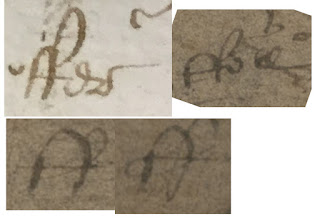
The compound D/EN/O12/25 item contains three distinguishable things: Neville's heavily revised draft to Burghley dated 27 June 1598; Sir John Popham's signed letter of 26 June; and an outer address/docket surface carrying pen trials. Attribution of the draft does not travel across the fold to authenticate the outer trials. The two controlled After my harty candidates therefore remain unknown hand and not_comparison_ready.
This preserves the positive evidence: the candidate marks exist at logged image coordinates in the same compound archival item, and the adjacent Neville draft is real. What is missing is same-hand proof. No comparison to the Northumberland flyleaf should be scored until repeated forms from an independently authenticated Neville hand and repeated forms from the trial surface are segmented without mixing writers.
1. Verified Sourced Facts
- Source-control position: this packet is now governed by the Northumberland handwriting source-coordinate ledger:
- NORTHUMBERLAND HANDWRITING LEDGER
The ledger quarantines all match language until source image, crop box, transcription, hand assignment, native crop, zoom/display crop, QA overlay, quality tag, and editorial note exist for each comparison example.
- Source-coordinate pass,
2026-07-09: NORTHUMBERLAND PART2 BRO PEN TRIAL CONTROL PASS 2026 07 09 now logs the full-context photographIMG_0227, detail sourceIMG_0228, near-duplicate controlIMG_0229, the local transcription, and the catalogue-description conflict.
- Controlled candidates,
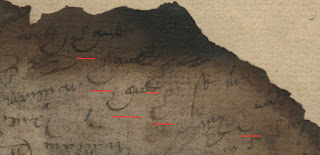
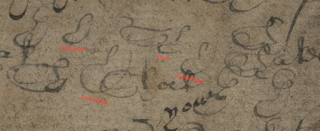
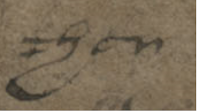
2026-07-09: two regions fromIMG_0228now have source boxes, guard boxes, native crops, display enlargements, and full-source QA overlays. The canonical manifest recordsBRO-DEN-O12-25-AFTER-MY-HARTY-01asfaint-inkandBRO-DEN-O12-25-AFTER-MY-HARTY-COMMENDATIONS-01asuncertain. Both hands areunknown; both arenot_comparison_ready.
- BRO
D/EN/O12/25clarification, updated2026-07-15: direct inspection resolves the former catalogue/image conflict. The compound item contains a heavily revised draft catalogued as Henry Neville to Burghley on27 June 1598, Sir John Popham's signed letter of26 June, and an outer address/docket with the trial candidates. The revised draft was formerly misidentified as Popham's certificate, and the IMG_0274–0279 map was shifted. The packet identity is now stable; the trial hand is still unknown because attribution of one leaf cannot be transferred to another surface.
- Source-control position: the packet's central comparison witness is image-controlled and item-identified but hand-unresolved. The preserved blog calls it a Berkshire Record Office
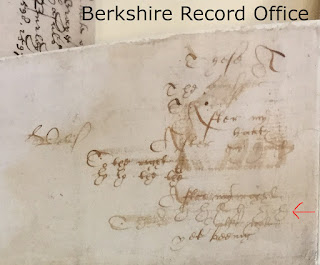
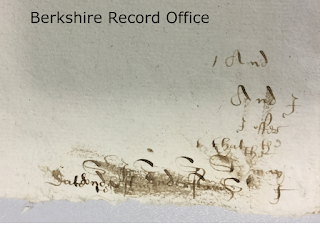
draft letter from 1598, clearly written in Henry Neville's handwriting; the coordinate record proves the presence and location of trial marks, while the archive catalogue identifies the adjacent draft. Neither control proves that the same writer made the outer-leaf trials.
- Evidence-tier demotion: phrases such as “almost exactly match,” “exact same letter forms,” and “very likely” remain blog-level handwriting interpretation until the exact BRO document, image IDs, crop boxes, and flyleaf comparison crops are logged.
- BRO sweep,
2026-05-30:DOCUMENT GROUPSalso identifies removed non-document pen-trial photos (Doc_36,Doc_46,Doc_58) andDoc 43c D EN O 23contains separate 1595 ordnance-copy pen tests. These are comparison leads only, not proof that they are the Part 2 source.
- Status-control position: the current source-safe formulation is that a preserved blog argues for resemblance between a candidate 1598 BRO pen trial and the Northumberland flyleaf. Treat the argument as a handwriting lead only until the physical item, shelfmark, address-panel hand, crop boxes, and comparison set are controlled.
- This packet preserves a image witnesses set from Ken Feinstein’s
6 Nov. 2019Northumberland Manuscript follow-up post.
- The preserved post identifies the comparison document only as a Berkshire Record Office
draft letter from 1598.
- Within the current Northumberland sequence, this Part 2 packet is the one that introduces the Berkshire Record Office pen-trial comparison document behind the Northumberland handwriting argument.
2. Ken Feinstein Twitter and Blog Information
- A Ken Feinstein blog post dated
6 Nov. 2019states:
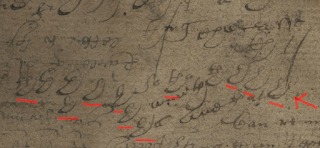
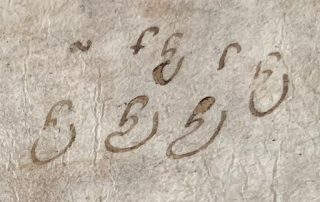
“Henry Neville made scribbles that almost exactly match the scribbles on the flyleaf.”
Current evidence note: preserve the phrase as blog wording only; do not use almost exactly match in book prose.
- The same post states:
“I discovered this while examining his papers at the Berkshire Record Office.”
- The same post identifies:
“a draft letter from 1598, clearly written in Henry Neville's handwriting.”
- The same post states:
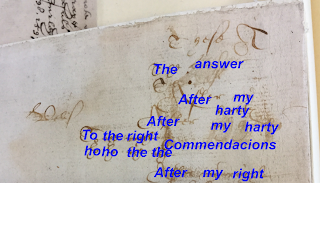
“On the back of the letter there are some scribbles (or "pen trials").”
- The same post states:
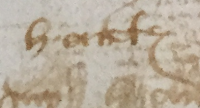
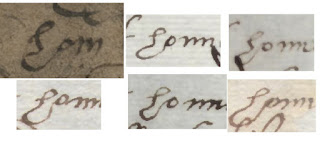
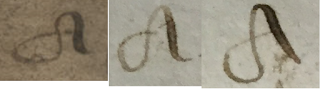
“the exact same letter forms are scribbled on both documents.”
- The same post states:
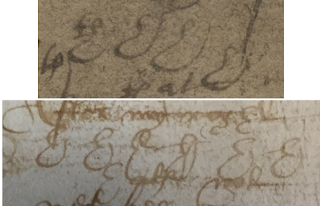
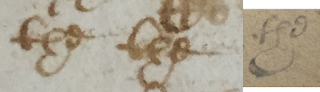
“Reading the words on these scribbles, it immediately becomes apparent what Henry Neville is writing. "After my harty" and "After my harty commendacions" and "after my" are written on the right.”
- The same post also states:
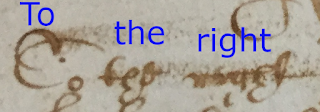
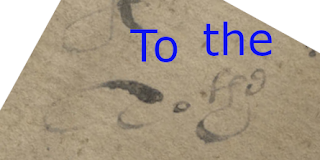
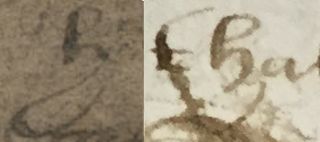
“On the left we have "To the right" and then "ho ho the the".”
- The same post states:
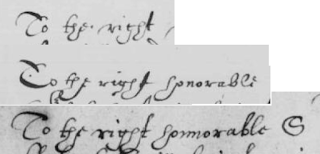
“Henry Neville often wrote "To the right honorable" when he was addressing a letter”
- The same post further states:
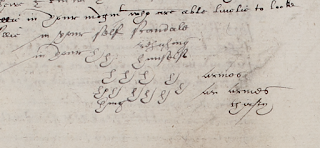
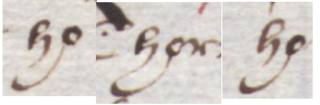
“John Casson discovered a book inscribed by Henry Neville in 1600. There are "h" scribbles”
- The same post concludes:
“it seems to me very likely that Henry Neville was indeed the owner and scribbler of the Northumberland Manuscript.”
Current evidence note: this remains the blog's conclusion, not a verified packet finding.
3. Quoted Source Text
Ken Feinstein blog post, 6 Nov. 2019
- “Henry Neville made scribbles that almost exactly match the scribbles on the flyleaf.”
- “I discovered this while examining his papers at the Berkshire Record Office.”
- “a draft letter from 1598, clearly written in Henry Neville's handwriting.”
- “On the back of the letter there are some scribbles (or "pen trials").”
- “the exact same letter forms are scribbled on both documents.”
- “Reading the words on these scribbles, it immediately becomes apparent what Henry Neville is writing. "After my harty" and "After my harty commendacions" and "after my" are written on the right.”
- “On the left we have "To the right" and then "ho ho the the".”
- “Henry Neville often wrote "To the right honorable" when he was addressing a letter”
- “John Casson discovered a book inscribed by Henry Neville in 1600. There are "h" scribbles”
- “it seems to me very likely that Henry Neville was indeed the owner and scribbler of the Northumberland Manuscript.”
4. Citations
- Feinstein, Ken. “Part 2: Henry Neville, Shakespeare, and the Northumberland Manuscript.” kenfeinstein.blogspot.com, 6 Nov. 2019, https://kenfeinstein.blogspot.com/2019/11/part-2-henry-neville-shakespeare-and.html. Local preservation: blog northumberland part2 2019 11 06.
- Royal Berkshire Archives D/EN/O12/25, compound Henry Neville draft / Sir John Popham enclosure / outer-leaf pen-trial packet. See also the dedicated Sonning-copyhold topic.
- BRO pen-trial and non-document inventory note: DOCUMENT GROUPS.
- BRO separate ordnance-copy pen-test lead: Doc 43c D EN O 23.
- Northumberland handwriting source-coordinate ledger: NORTHUMBERLAND HANDWRITING LEDGER.
- Part 2 BRO pen-trial control pass: NORTHUMBERLAND PART2 BRO PEN TRIAL CONTROL PASS 2026 07 09.
- Machine-readable crop ledger: manifest; reproducible builder: build bro o12 25 candidate crops.
- northumberland manuscript, broader packet.
- henry nevilles italic handwriting, related handwriting packet.
5. Evidence Images
Controlled candidates, 2026-07-09
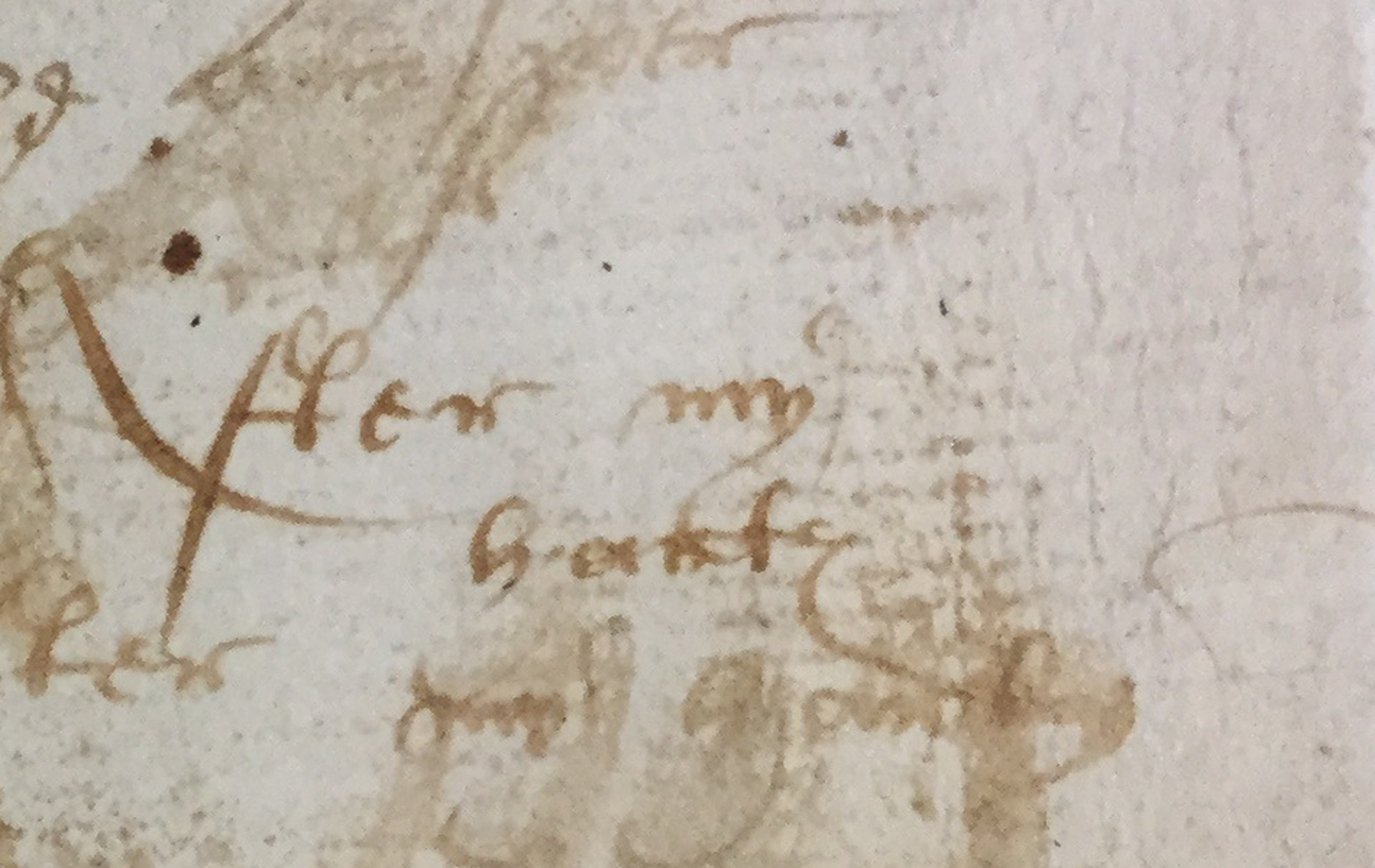
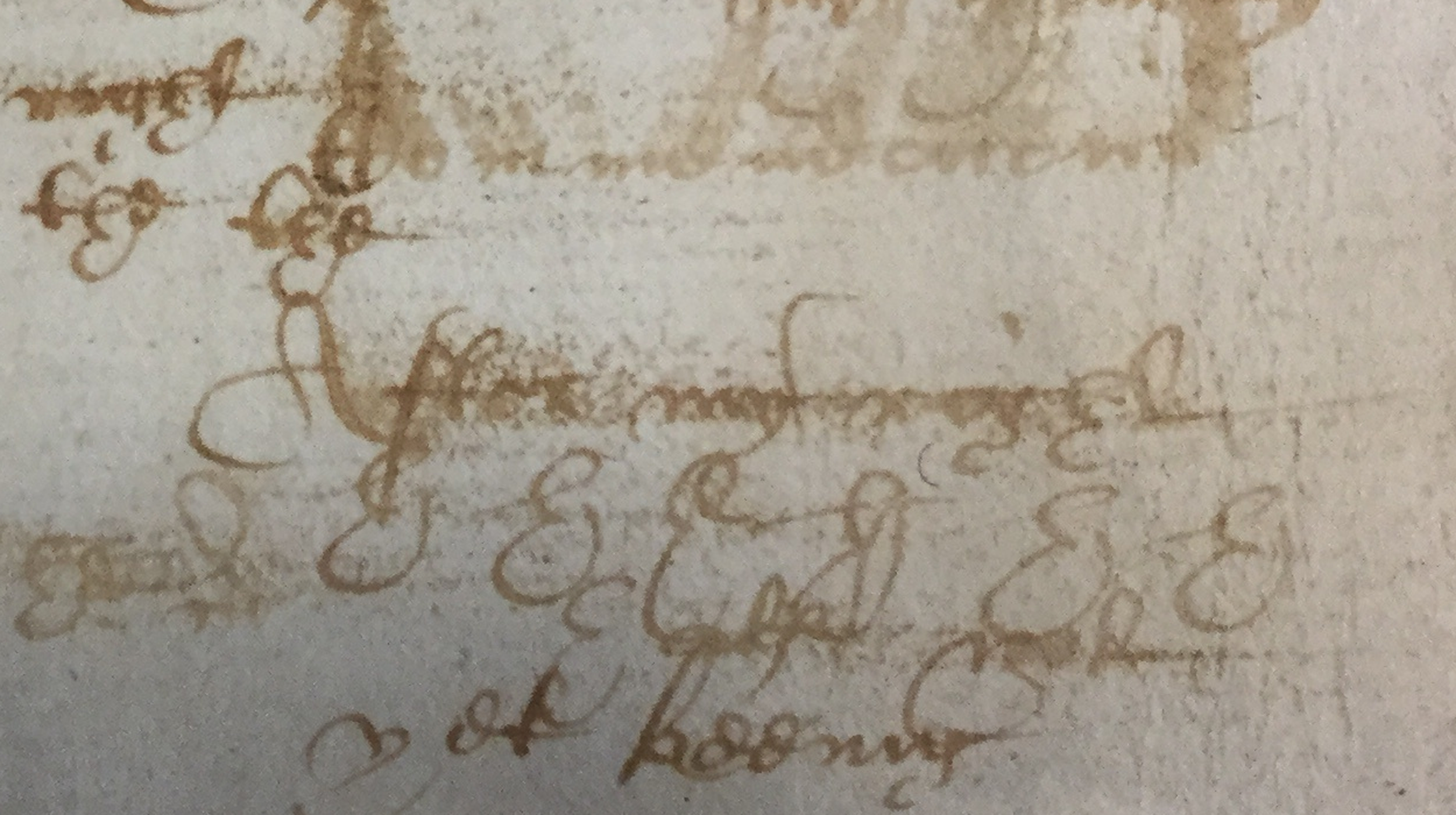
These are unknown-hand candidate regions from IMG_0228, not comparison plates. The second reading is especially uncertain because the marks are faint and overwritten.
Preserved blog images
6. Notes on Access
- This packet preserves the second Northumberland blog post as a Ken Feinstein handwriting-analysis packet.
- The packet’s core evidentiary claim is the match between Neville pen trials and Northumberland flyleaf scribbles.
- The candidate comparison document is now routed to D/EN/O12/25 and local photographs
IMG_0227-IMG_0229, but the physical packet/catalogue relationship remains unresolved. This is more precise than the blog's genericdraft letter from 1598description, not proof that it is the same Neville-hand witness claimed by the post. - This Part 2 packet is a high-value lead because it introduces the comparison document behind the pen-trial argument. The trial regions are now traceable, but the comparison document is not sufficiently identified or hand-segmented to be a proof packet.
- Evidence note: the full-page/detail crop ledger now exists. The next step is BRO confirmation of the packet components and independent diplomatic transcription, not a direct Northumberland match claim.
- Evidence note:
After my hartyis a useful pen-trial candidate, not an attribution proof. Do not call it Neville's hand unless the physical item, catalogue mismatch, address-panel hand, and repeated Neville-hand controls are resolved with source-coordinate crops and QA overlays. - Evidence note:
IMG_0229is a near-duplicate view of the same panel and must not be counted as an independent repeated example. The two candidate regions onIMG_0228must not be assumed to be one hand merely because they share a panel.