Mayfield Manor and Ironworks
Topic: Mayfield Manor and Ironworks
Source-Fact Audit — 7 August 2026 (Round 3)
- The legal descent is now exact: Sir Thomas Gresham devised Mayfield and Wadhurst to Sir Henry Neville and the male issue of Elizabeth Gresham Neville; the 1581 private Act confirmed the settlement. Elizabeth had predeceased Gresham and did not herself possess and transmit the estate.
- Neville's ownership and movement of large quantities of cast-iron ordnance are directly documented in the
D/EN/O23transaction records. Those records do not identify the furnace of origin for every piece. - The 8 November 1592 patent transcript (
LR 15/301) and candidate patent roll (C 66/1382) control the licensed export lane; the roll membrane still needs inspection. - The final Feet of Fines quitclaim to Thomas May is Easter term 1598. A 1597 deed/sale tradition may represent an earlier stage, but the original conveyances are needed to reconcile the sequence.
- Estate ownership, furnace operation, gun ownership, legal licence, and shipping are related but distinct facts. No checked source says Neville personally cast the guns.
Robert Sackville / Patent Update, 18 July 2026
The dedicated robert sackville iron ordnance patent bro network now controls this part of the Mayfield packet. The principal corrections and additions are:
- BRO
D/EN/O/23/3is docketed8 February 1595Old Style, which is 8 February 1596 in modern dating. It follows the August and November 1595 deliveries and belongs between Giles de Vischer's January petition and the Privy Council proceedings of March 1595/6. - Direct original-resolution inspection of
D/EN/O/23/5establishes Sackville's wording asyron workeandgood and sufficient yron worke, not a woodland commodity. - The February working sheet records a staged obligation of
175 tons:152 tons 0 cwt 3 qrsalready delivered, including an overage of2 tons 0 cwt 3 qrs, plus22 tons 19 cwt 1 qrat Weymouth. The overage and Weymouth stage make exactly25 tons. - The public State Paper calendar says de Vischer had joined Neville and Engelstedt in the licence and accused Sackville of taking control of it. The same State Paper contains Sackville's detailed answers to those allegations. The Privy Council did not decide the charges; it returned the matter to Chancery and Requests after establishing that Sackville and Engelstedt had answered on oath.
- TNA
C 66/1382is now identified as the candidate patent roll. Its membrane still needs inspection. TNAREQ 2/266/18is the surviving Court of Requests accounting case concerning iron ordnance exported under Crown licence. - A later State Paper calendar explicitly describes iron ordnance on wharves at
Millhall, in Kent. This makes Mill Hall/Aylesford on the Medway a strong candidate for the 1595 delivery point near Maidstone, but not yet a final identification.
These additions make Mayfield part of a regulated, litigated, multi-port supply chain. They do not prove that every gun in the file was cast at Mayfield furnace.
Completion Audit: Estate, Furnace, And Ordnance Are Distinct
This packet is ready as a research dossier because it now supports three strong propositions and explicitly separates a fourth unresolved one:
- Henry Neville held and resided at Mayfield and exercised Sussex public authority.
- Mayfield and its surrounding Wealden landscape contained important furnace, forge, woodland, transport, and gunfounding activity.
- Neville directly owned and managed large quantities of cast-iron ordnance through a documented
1595delivery, bond, and shipping network. - The precise furnace of origin for every Neville shipment remains unresolved; residence plus ordnance ownership does not prove personal casting at Mayfield furnace.
The 1597 / 1598 Sale Problem Tightened
The final legal-transfer stage is now directly controlled from Edwin H. W. Dunkin's complete Sussex Manors, Advowsons, Etc., Recorded in the Feet of Fines, printed p. 295, using the public Archive.org scan and full OCR. The entry reads, in part:
"Thomas Maye of Burwash, esq., plaintiff, and Henry Nevyll, esq., and Anne his wife, deforciants";
East., 40 Eliz. [1598].
It covers Mayfield and Battersden/Pentbridge manors, the rectory and park, tenements in Mayfield/Wadhurst/Lamberhurst, half the hundred of Loxfield, free warren, and the vicarage advowson. The final recorded Feet of Fines quitclaim to Thomas May is therefore Easter term 1598.
This does not automatically invalidate every 1597 reference. Bell-Irving and Cooper may preserve a preliminary deed, a different part of the transaction, or a date error. Safe book wording is now: an earlier 1597 sale/deed tradition exists, but the final fine to Thomas May is explicitly dated 1598; original conveyances are required to reconstruct the steps.
How Mayfield Passed from Gresham to Neville
The complete wills-and-Act sequence now replaces the shorthand that Mayfield was simply inherited “through Neville's mother.” Henry Neville's mother, Elizabeth Gresham Neville, was Sir Thomas Gresham's niece and was described by him as his “heire apparaunt” while she lived. She died in 1573, however, before Sir Thomas made his land will and before he died. Mayfield was not an estate she herself succeeded to and then transmitted.
Sir Thomas's land will of 5 July 1575 directly placed Mayfield and Wadhurst with Sir Henry Neville and the male heirs he had begotten on Elizabeth. The devise carried a condition requiring the Nevilles to bear wardship, livery, and primer-seisin charges on Sir Thomas's wider estate; otherwise it was to be “utterly void to all entents and powrpos.” The private Act of 1581 then provided that Sir Henry and his son Henry should “have, holde, and enjoye the mannours of Maighfelde and Wadhurste,” with the parsonages and other Sussex lands, free of that wider condition. If the younger Henry were dead, the Act named his brother Edward as the successor.
The exact book formulation is therefore: Sir Thomas Gresham devised Mayfield and Wadhurst to Sir Henry Neville and the male issue of his late niece Elizabeth Gresham Neville; the 1581 Act confirmed the estate to that Neville line. Elizabeth supplied the genealogical route, but the immediate legal instruments were Sir Thomas's devise and the parliamentary settlement. Page-checked text and images are in elizabeth gresham neville and the gresham inheritance line#11-mayfield-and-wadhurst-were-a-separate-devise.
Evidence Hierarchy For The Iron Lane
| Question | Best evidence | Present answer |
|---|---|---|
| Was Neville at Mayfield? | APC 5 May 1591, jointure/manor records, parish/local controls | yes |
| Was Mayfield an iron-production landscape? | WIRG, Lower, Bell-Irving, archaeology/site literature | yes |
| Did Neville own and move cast-iron ordnance? | D/EN/O23, Abraham Jones, Sackville delivery draft | yes, directly documented |
| Did every gun come from Mayfield furnace? | no direct per-piece production ledger yet | unproved |
| Did Neville personally cast guns? | no checked source | do not claim |
| Was the surviving Mayfield cannon Neville's? | WIRG reappraisal associates its mid-1570s context with Gresham | no secure Neville attribution |
| Did Neville hold an export patent? | TNA C 66/1382 candidate roll; CSPD de Vischer/Neville/Engelstedt calendar; patent-restructuring memorial | patent and named partnership now publicly traceable; original roll and assignments still need inspection |
The nine local WIRG PDFs were re-searched in this pass. Their technical and archaeological work materially deepens the furnace, forge, coastal-defence, Office of Ordnance, and Gresham/Hogge context, but it also reinforces the need to keep the 1570s Mayfield cannon and 1590s Neville ordnance business distinct.
Future Research Uses
The packet can now support full chapters or articles on:
- Mayfield as a direct Gresham devise to Elizabeth's husband and male issue, later a Neville jointure asset;
- Wealden iron's charcoal, coppice, waterpower, labour, and transport economy;
- the political regulation and illegal export of cast-iron ordnance;
- Neville's relationship with Robert Sackville, Abergavenny, Abraham Jones, Lewes, Maidstone, and Weymouth;
- the distinction between landownership, finance, merchant contracting, gunfounding, proof, storage, and shipping;
- the collateral Henslowe/Hogge Sussex network, without turning proximity into a direct theatrical relationship.
The document witnesses census, Mayfield transfer correction, WIRG review, and negative findings are documented in POSTHUMOUS NETWORK ESTATE CLUSTER SOURCE PASS 2026 07 09.
Quoted Source Passages
- Source: BRO/Royal Berkshire
D/EN/O23/3, copy/draft letter to Robert Sackville, Doc 43c D EN O 23:34.
Quotation:
"they have made delivery to your use at Millall, of 44 ton 200 C 3 quarters, and at Lewes of 28 ton and 1300 ... at maidstone ... 79 ton ... rising in all comes to 152 ton 3 quarters of a hundred."
What it proves: Neville's ordnance business is documented in a concrete delivery-and-quantity record, with Millhall, Lewes, Maidstone, Sackville, and bonds all in the same transaction. Limit: This is a copy/draft witness in the BRO papers. It should be image-collated before final diplomatic quotation, but it is already stronger than a later local-history summary.
- Source: same
D/EN/O23/3draft, Doc 43c D EN O 23:57.
Quotation:
"I have given order to my man to make delivery of them at Weymouth to deliver 22 ton 1900 C one quarter ... maketh up the full sum of 175 ton."
What it proves: The transaction reached beyond Sussex handling sites to Weymouth shipping or delivery logistics, and the total scale was large enough to require staged reckonings. Limit: The draft does not by itself prove the legal patent route or identify the originating furnace for every piece.
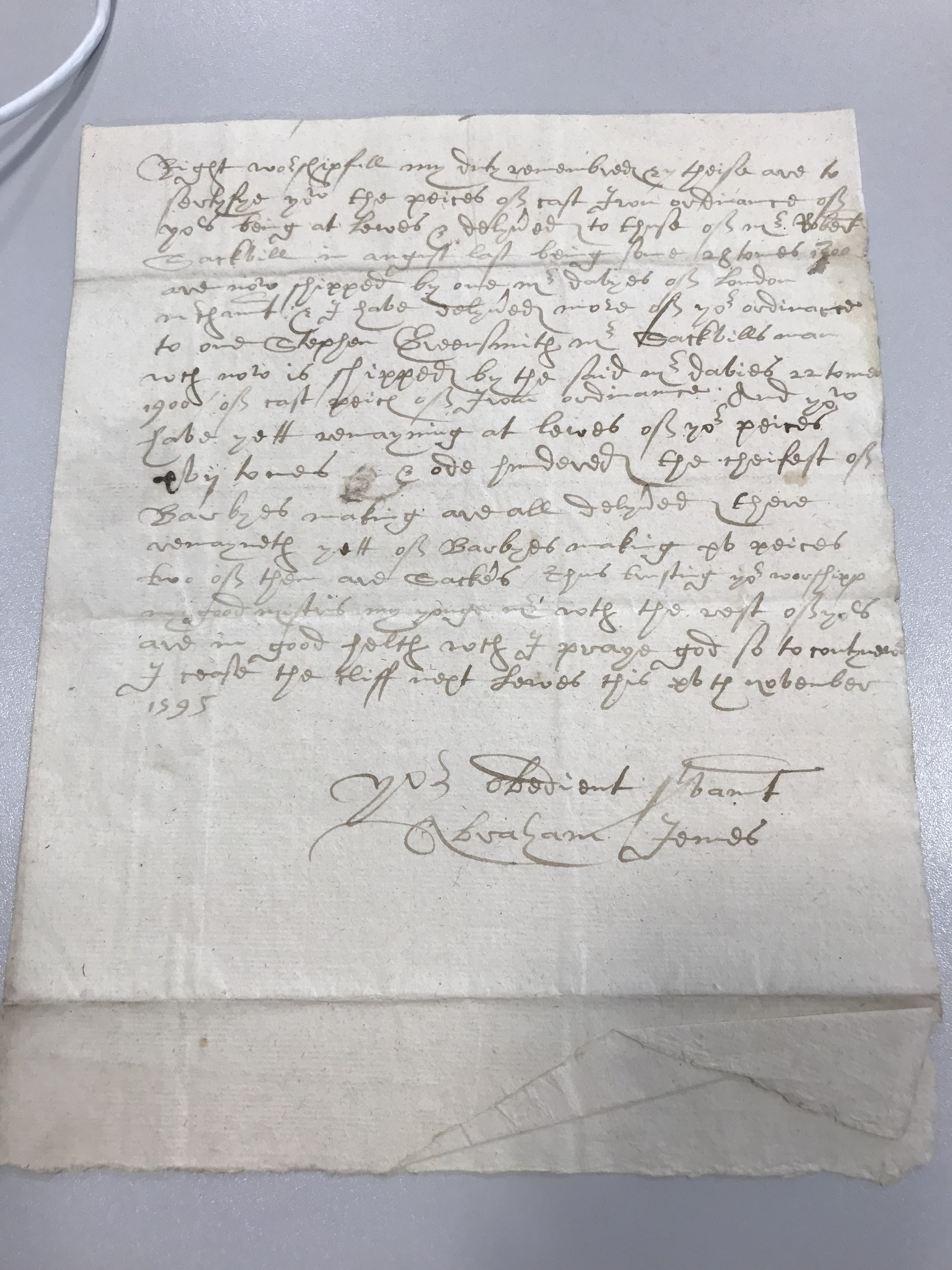
- Source: Abraham Jones to Sir Henry Neville, Lewes,
23 Nov. 1595, Doc 44 D EN O 23:23.
Quotation:
"the peices of cast Iron ordnance of yowrs being at Lewes ... being some 28 ton 1700 ... are now shipped ... 22 tonnes 1900 ... of cast peices of Iron ordnance."
What it proves: A direct correspondent reports Neville-owned cast-iron ordnance at Lewes, shipping, tonnage, and remaining stock. Limit: It proves Neville's ordnance ownership/logistics; it does not alone settle the patent question or every Mayfield-furnace attribution.
- Source: Acts of the Privy Council,
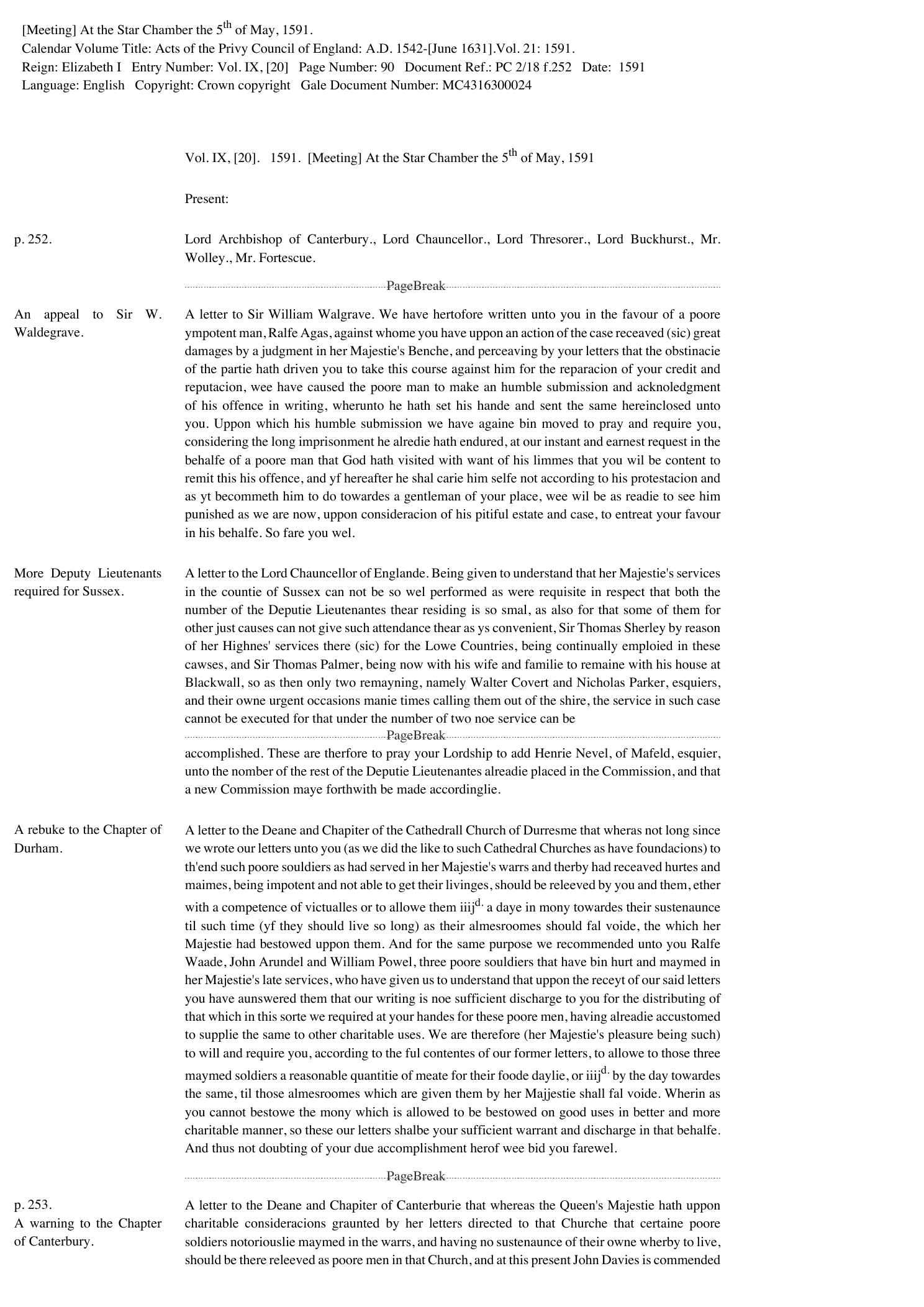
5 May 1591, local OCR/page render, mayfield privy council 1591 pdftext:32.
Quotation:
"These are therfore to pray your Lordship to add Henrie Nevel, of Mafeld, esquier, unto the nomber of the rest of the Deputie Lieutenantes."
What it proves: The official Privy Council record places Henry Neville at Mayfield in 1591 and links him to Sussex county service. Limit: This supports Mayfield identity/local authority; it is not itself ironworks evidence.
- Source: Eva Margaretta Bell-Irving, Mayfield, local OCR, mayfield bell irving 1903 ocr:8283.
Quotation:
"Henry Nevil (of Frant and Mayfield, considered the chief Sussex ironmaster)" and cannon cast "for the necessary provision of our own navigation."
What it proves: Bell-Irving preserves the later local-history route tying Neville to Sussex gunfounding policy and the Warwick/Blincoe regulatory episode. Limit: Use as a lead and context source. The direct
D/EN/O23ordnance letters and underlying State Papers/Lansdowne records should control final evidentiary weight.
Wealden Iron Source Notes
- New research pass: MAYFIELD WEALDEN IRON RESEARCH PASS 2026 06 21.
- New source-image packet: SOURCE NOTES.
- The evidentiary center of gravity is now the direct
D/EN/O23ordnance lane: Sackville, Abraham Jones, Mayfield/Millhall/Lewes/Maidstone/Weymouth, ironwork, bonds, andcast Iron ordnance. - Bell-Irving remains valuable but is now treated as a source map for Hogge, Warwick/Blincoe, Buckhurst, Gresham, and Mayfield local tradition unless the underlying State Papers / Lansdowne records are checked.
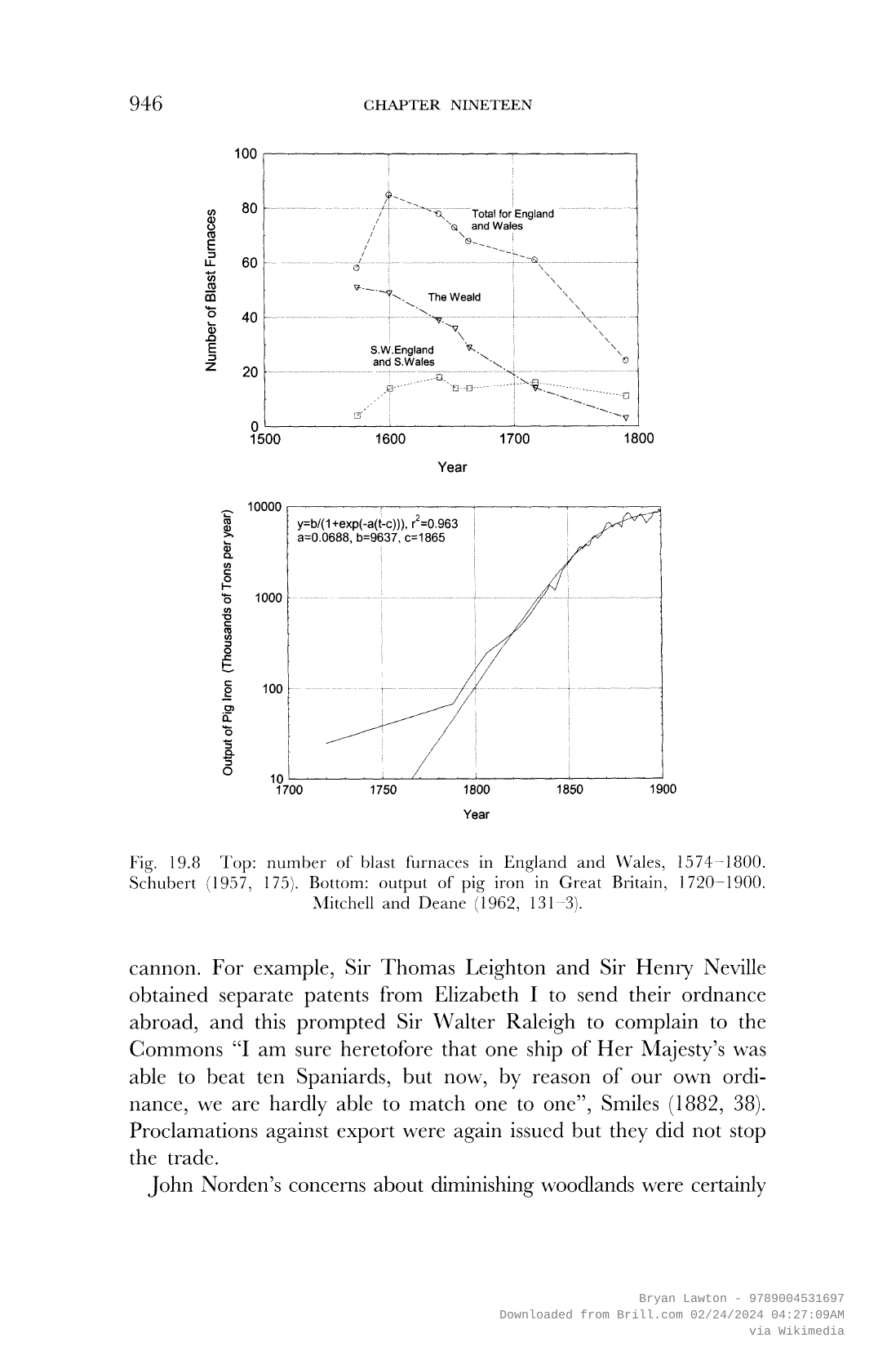
- Lawton is now identified correctly as a 72-page chapter, not a one-page clipping. The Neville/Leighton export-patent sentence is visible on rendered PDF page
14/ printed p.946, but the patent record still needs retrieval before legal use. - WIRG and Hodgers materially strengthen the Wealden technical and H.N. fireback leads, but their object language is cautious. Do not state that the firebacks are certainly Henry Neville's or certainly from Mayfield.
- Guardrail: do not identify Thomas Nevill of Mayfelde in the
1574ironworks list as Henry Neville without separate identity proof, and do not let WIRG'sb.1564line override the project's separate birthdate controls.
Archive.org Deepening Notes
- New Archive-focused report: ARCHIVE ORG DEEP RESEARCH MAYFIELD WEALDEN IRON 2026 06 21.
- Lower's 1849 and 1850 Sussex Archaeological Collections articles now have page-image witnesses staged in the source packet. This pass strengthens Mayfield as an iron-site cluster; page-backs the Buxted/Mayfield Hogge-Huggett cannon tradition; and exposes the State-Paper Office route for the
1573Barker declaration and1574Hogge/ironworks-list records. - Cooper's 1869 Mayfield article is now staged as an independent Archive witness for the Gresham-to-Neville devise, Neville residence from register entries, and the
6 May 1597sale-date claim. - Guardrail: Lower's 1574 Mayfield entries name Gresham, Isted, Fowle, and Ellis. They do not identify Henry Neville.
Archive.org Follow-Leads Notes
- New follow-leads report: ARCHIVE ORG FOLLOW LEADS LOWER IRONWORKS 2026 06 22.
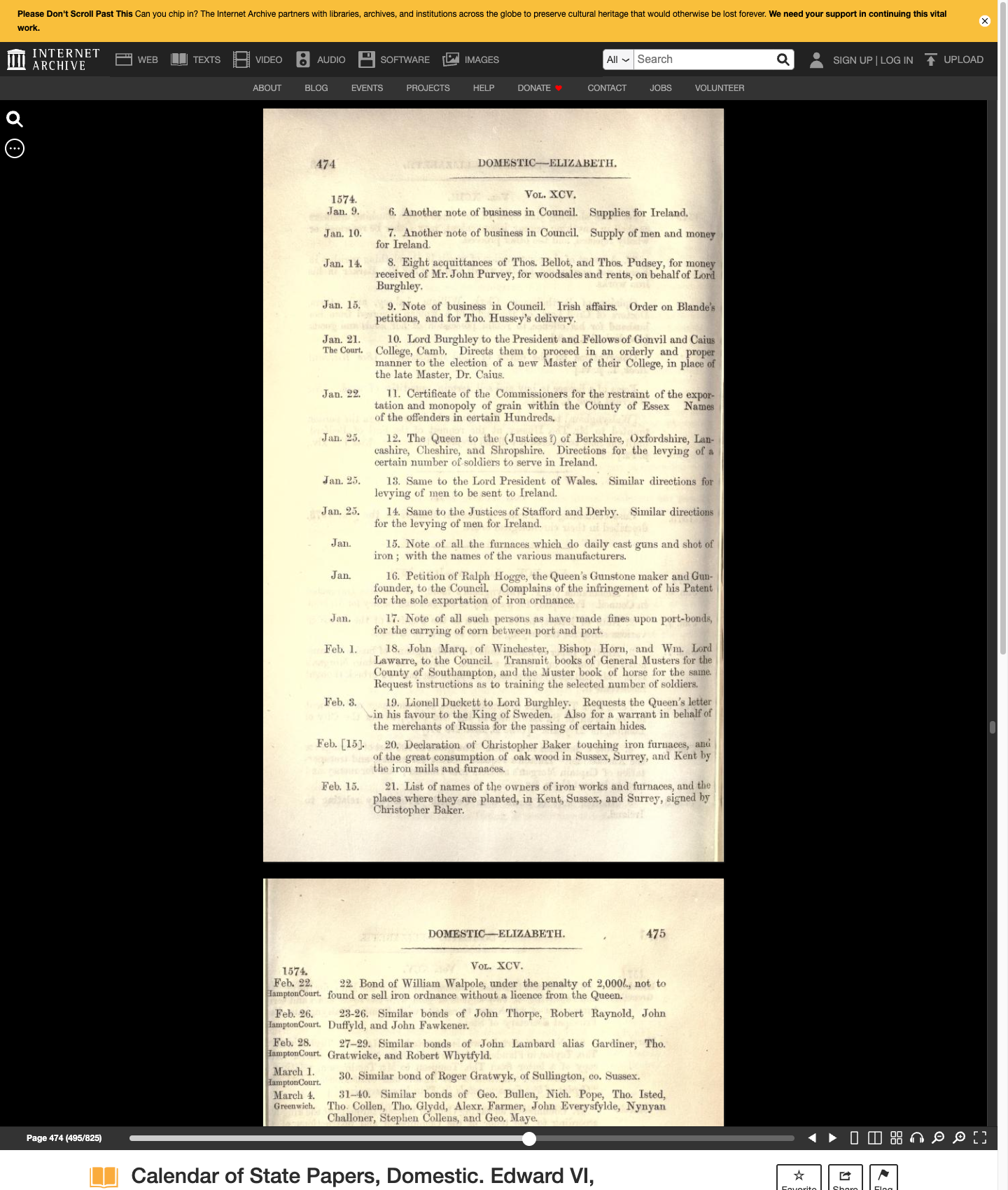
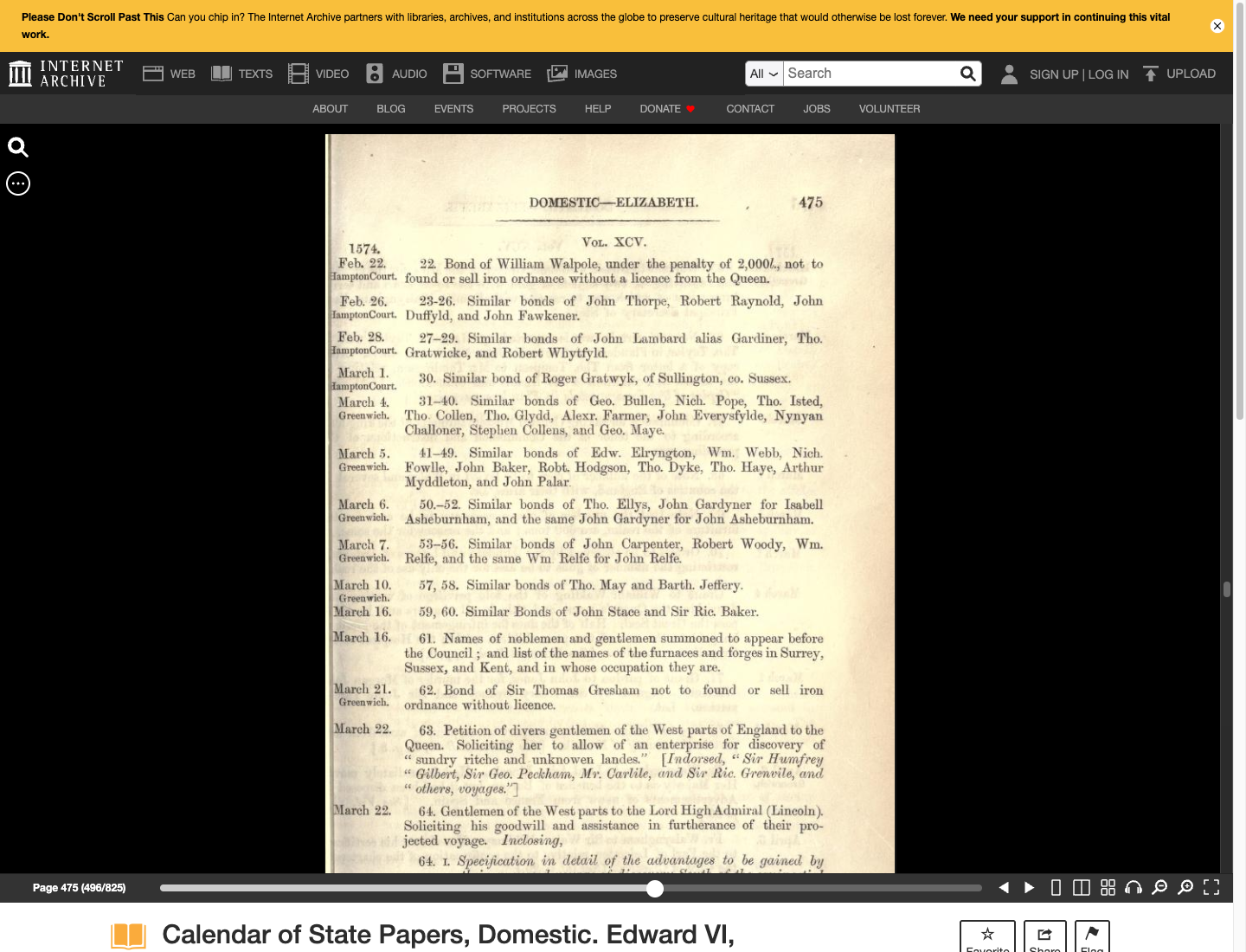
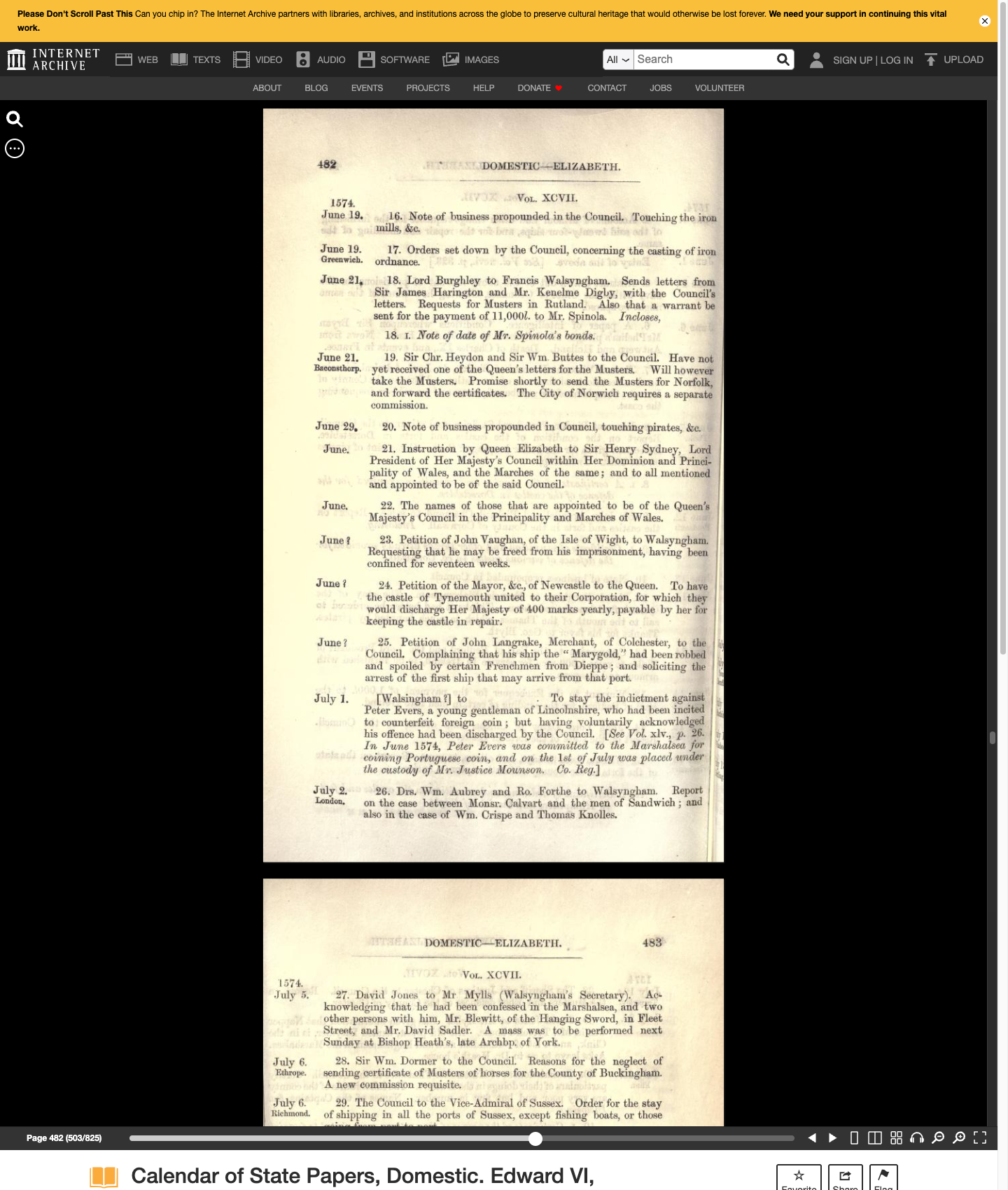
- Lower's old State-Paper Office references now map to printed CSP Domestic page witnesses: the
1574Hogge petition, Christopher Baker/Barker declaration, owners/furnaces list, iron-ordnance bond packet, Gresham bond, April1574owners/founders list, June1574Council orders, July1576manufacture/sale orders, and April1579Pistor export-licence note. - This makes the official-regulation frame stronger: by the 1570s the Privy Council was tracking owners, founders, places, bonds, casting, sale, and export of Wealden iron ordnance. It is a better policy context for the later Henry Neville
1590Warwick/Blyncoe complaint. - Guardrail: the pass does not find Henry Neville in the
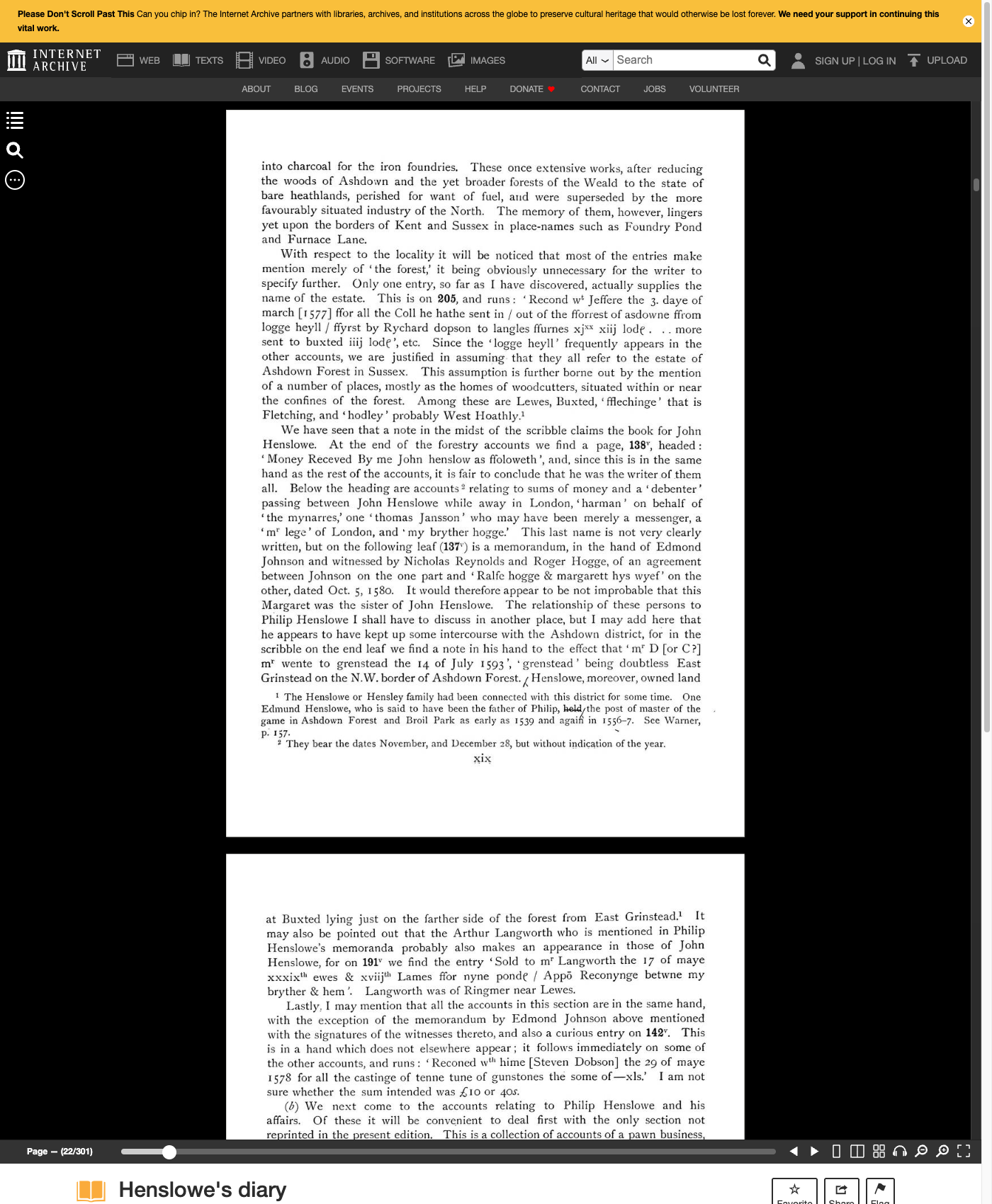
1574State-Paper material, and it does not resolve Bell-Irving'sThomas Nevill of Mayfeldeline. Lower's Mayfield names remain Gresham, Isted, Fowle, and Ellis unless the underlying manuscript says more. - New collateral lead: Greg's Archive.org Henslowe's Diary edition links John Henslowe's forestry accounts to Ashdown Forest, Buxted,
my brother hogge,Ralfe hogge & margarett hys wyef, andtenne tune of gunstones. This is not Neville evidence, but it is a potentially important Hogge-to-Henslowe theater/ironworks bridge.
WIRG Additional Research Notes
- New specialist-source addendum: MAYFIELD WEALDEN IRON ADDITIONAL RESEARCH LEADS 2026 06 22.
- New WIRG source packet: wirg_additional_2026-06-22.
- Teesdale's WIRG re-examination of the
1574State-Paper lists is now the best control for those entries. The staged table pages support Gresham, Isted, Ellis/Bibleham, and nearby Huggen's/Middleton material; I did not find a Neville entry in the WIRG table/text. - The Mayfield Falcon/cannon reappraisal points to a Gresham-era dating, probably mid-1570s, not a Neville-era cannon. This strengthens Mayfield Furnace as an ordnance site before Neville's tenure but should not be presented as direct Neville object evidence.
- The
1587Sussex coastal-defense article, based on BLAdd MS 57494, is now a high-value context source for the Warwick/Blyncoe and "necessary provision of our own navigation" material. - Ruth Brown's WIRG extracts from Office of Ordnance Debenture Books,
1593-1610, are a strong comparison source for theD/EN/O23ordnance-delivery lane. - The Mayfield finery-forge debate adds useful topographical/technical detail but also a guardrail: the furnace/ordnance case is stronger than the same-site finery-forge case.
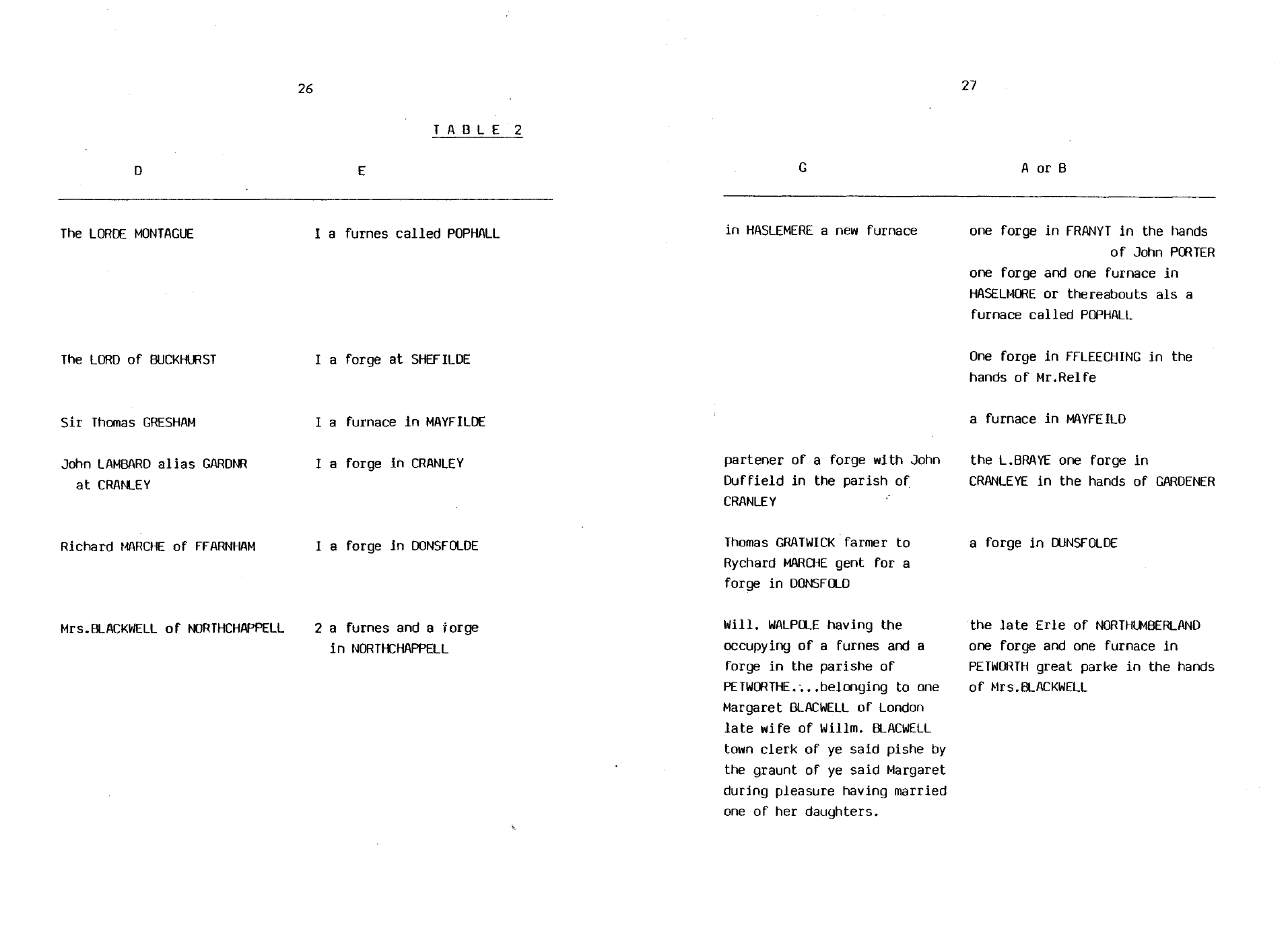
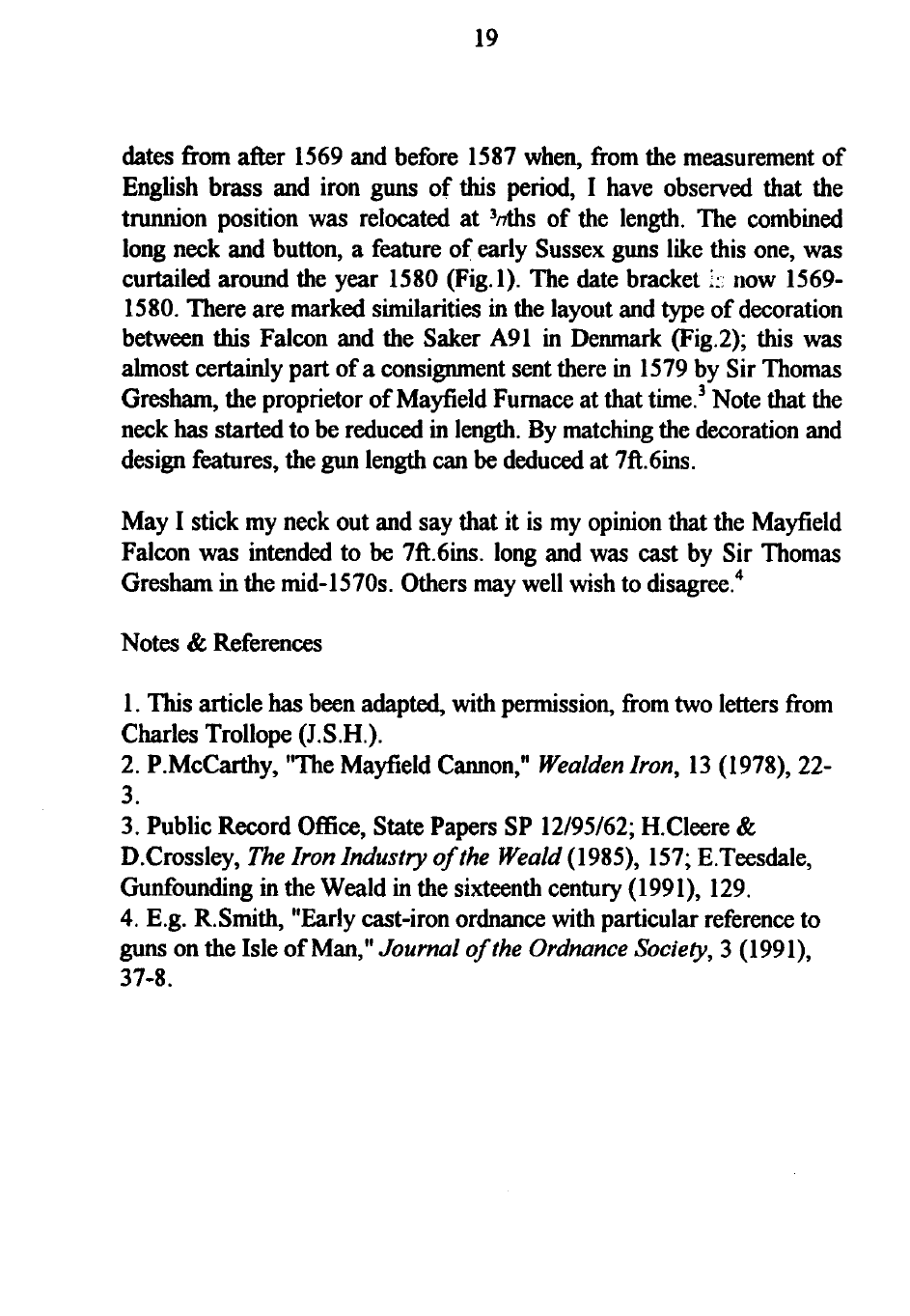
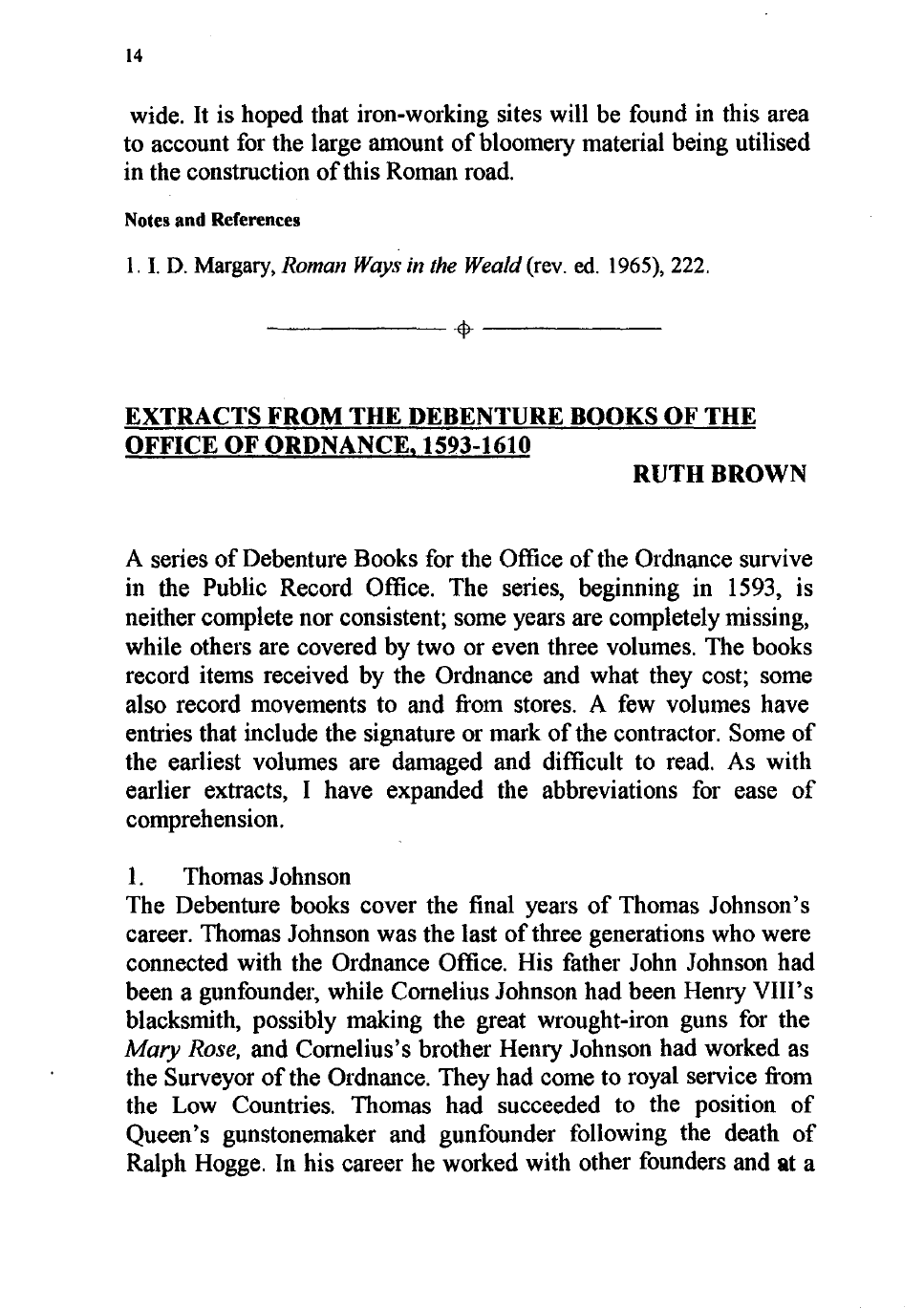
WIRG Database Ordnance-Mill Witness, 2026-07-12
The 2026-07-12 Henslowe/Sherley deep-research pass (HENSLOWE SHERLEY ALLEYN DEEP RESEARCH PASS 2026 07 12) surfaced a further State-Paper witness for the Gresham-era Mayfield furnace, inside the WIRG online database's person record for Brian Hogge (retrieved and staged 2026-07-12).
- The WIRG record cites
TNA SP/95/20 f.48, dated by WIRG "prob 1574", and quotes a mill list whose own summary line counts five. The quoted text names, among them:
Sr Thomas Gresham his furnace in the pishe of Mayfeild in Sussex
Mr Brian Hogge his furnace in the pishe of Bucksteed or in fframkfeild pishe
- The list's stated point, in the quoted wording:
Thise fyve mylles are employed to no other use but to the makeing of Ordnance
- What it adds: an explicitly ordnance-only characterization of Gresham's Mayfield furnace in the mid-1570s, and a documentary co-listing of the Mayfield furnace with the Hogge (Buxted) gunfounding furnace — the same Hogge world from which the Henslowe family's iron-office accounting emerged. This strengthens the pre-Neville ordnance dating of Mayfield Furnace already argued from the Falcon reappraisal and the 1574 founder lists, and it tightens the documentary bridge to henslowe hogge sherley theater network.
- Limits: the witness checked here is the WIRG database record, not the State Paper itself. The
SP/95/20reference style is WIRG's; it has not been reconciled against a TNA catalogue entry, and the original folio has not been inspected. Treat the exact citation as WIRG-mediated until the document or a calendar entry is checked. Note also that WIRG attributes this furnace note to Brian Hogge (Ralph's brother), so it should not be silently merged with the Ralph Hogge gunstone-office material. - Reference-reconciliation lead: on the same staged WIRG page, the Ralph Hogge record cites
The National Archives, SP12/95/20 f.49, prob 1574for "Ralfe Hogge one furnace called Marshall." The adjacent-folio citation in fullSP 12style suggests the Brian Hogge note'sSP/95/20 f.48is the same piece, SP 12/95/20 — the vol. 95 State-Paper cluster already routed through Lower's 1850 supplement and Teesdale's list control — with the "12" dropped. This is an inference from WIRG's own citations, not a checked TNA identification. - Count guardrail: the staged Brian Hogge note prints four furnace lines (Buckhurst/Milton at Rotherfield, Gresham at Mayfield, Fowle at Wadhurst, Brian Hogge at Buxted/Framfield) beneath the "Thise fyve mylles" summary. Do not enumerate "the five mills" from this witness; the full list requires the original folio.
- Witness file: wirg_Hogge.html.
WIRG Person Records: Neville, Gresham, and the 1591 Export Patent, 2026-07-12
A follow-on WIRG probe pass (NEW RESEARCH AVENUES WIRG PATENT WILLS PASS 2026 07 12) retrieved the WIRG database person records for Sir Henry Neville (1564-1615), his father (d. 1593), and Sir Thomas Gresham. All quotations below are from the staged WIRG records (wirg_Nevill_family.html, wirg_Gresham.html); the underlying originals are not yet inspected, so every item here is a WIRG-mediated witness.
The 1591 cast-iron ordnance export patent, TNA C 66/1382
The WIRG Sir Henry Neville record quotes at length from TNA C 66/1382, Patent Roll, 34 Eliz. I, Part 4 (17 Nov 1591 - 16 Nov 1592): a patent granted to Henry Neville esq, Ludolph Ingelsteadt and Giles Vischer, merchants and strangers, giving (in the quoted wording):
Full power, free liberty, licence and authority ... from and after the date hereof until the end of term of twenty years then next ensuing ... convey, transport and carry out of and from any of the ports, havens and places within our realm of England hereafter specified, that is to wit, the Tower Wharf in the Port of London, the Port of Rochester in the county of Kent, the Port of Meeching in the County of Sussex, the Port of Hull in the County of Yorkshire, Port of Bristol and from none other haven, port, creek or place into any the parts beyond the seas being in league and amity with us ... such and so many minions and falcons of cast iron ordnance ...
- What it adds: a named twenty-year export monopoly for cast-iron minions and falcons held by Henry Neville with two merchant strangers, dated to the regnal year beginning
17 Nov 1591. This is the strongest candidate yet for the document behind Lawton's Neville ordnance-export statement and for the CSPD1595?iron-ordnance patent discussion naming Mr. Neville and othersalready logged in the timeline packet. - Caution: Lawton's statement pairs Neville with
Leighton; the WIRG-quoted patent pairs him withIngelsteadtandVischer. Either Lawton garbled the instrument or two instruments exist. Do not merge them untilC 66/1382is inspected. - Interpretive frame worth preserving: Ralph Hogge's
1573complaint (SP 12/95/16, staged) was about iron-ordnance export licensing; Neville held an export patent from1591; and Thrush's History of Parliament biography has Neville on the1614Commons committee for a bill to curb the export of iron ordnance (work in parliament). The licence-holder-to-regulator arc is documentary, subject to the patent inspection above.
Partner identifications, 2026-07-13 (CREATIVE RESEARCH PATENT PARTNERS ANNESLEY LEAR PASS 2026 07 13; candidate level until the originals are read):
Ludolph Ingelsteadtis plausibly Ludolph Engelstedt, a London merchant stranger: TNA Discovery gives his will,PROB 11/131/579,Ludolph Engelstedt of Saint Michael Crooked Lane, City of London, proved15 May 1618(recordD899957), and a Low Countries letter, SP 84/63/167 ([?1588],L. Engelstedt to --- on Flushing). Tullock's British Explosives Industry document chronicle (1909, staged OCR) adds two State-Paper items:Nov 1589, Engelstedt to Walsingham withparticulars of the contract entered into between Her Majesty and him for the manufacture and supply of saltpetre(SP 12/228/38), and14 Nov 1595, a crown memorial weighingEngelstedt's offerto supply120 lasts of powder and some saltpetre from beyond seasat4 in the 100(SP 12/254/64). If the identity holds, Neville's export-patent partner was the crown's own saltpetre/powder middleman, and the patent belongs inside a two-way munitions trade: powder and petre imported, cast ordnance exported to allies.Giles Vischeris plausibly the Flemish strangerGielis/Gyllis de Visscherof the London Returns of Aliens (Kirk & Kirk, staged OCR; multiple assessment entries, household with wifeBarbare), and/or the Chancery plaintiff of TNAC 3/266/95,De Vischer v Sidley(Giles de Vischerv. Sir William Sidley,1596-1616, money matters).- Staged witnesses: tullock explosives, returnsofaliensd02kirk, returnsofaliensd1031hugu.
- Guardrail: three chains (patent name, SP
Engelstedt, Crooked Lane testator; and patent name, ReturnsVisscher, Chanceryde Vischer) are separately attested but not yet proved to be the same men. Read PROB 11/131/579, SP 12/228/38, SP 12/254/64, SP 84/63/167, and C 3/266/95 before merging identities in prose.
Neville father-and-son WIRG records
- WIRG dates Mayfield Furnace ownership: the father
Owner 1579-c.1585, the sonOwner c.1585-1597, with the son's residences given as Mayfield and Waltham St Lawrence/Billingbear. The c.1585handover date is a testable new claim for the estate chronology (the father lived until1593). - The father's record carries the kinship/succession links:
Gresham, Thomas ... is Henry Neville's uncleandpredecessor; the son's record has Gresham asgreat uncleandMay, Thomas (d. 1617) is Henry Neville's successor. - The son's record names employees
William Barbye,Thomas Hodgson, andAbraham James, and quotes BROD/EN/O23,15 November 1595:Abraham James at Mayfield to Henry Neville: 'I have delivered more of your ordnance to one Stephen Greensmith, Mr Sackville's man, which now is shipped by the said Mr Davies' [of London]. - Name-control caution: this packet's existing D/EN/O23 lane says Abraham Jones; WIRG reads Abraham James in a
15 Nov 1595item (the packet's quoted letter is the8 Feb 1595Sackville draft, so these may be different items in the same file). Recheck the BRO transcription before using either surname in prose. - The record also cites ESRO
CAM 2/8/1,22 Aug 1610, a mortgage declaration by Thomas May of Mayfield that recitespurchase of the manor by TM from Sir Henry Nevill, with the Bromfield/May mortgage chain and scrivener witnesses — a new post-sale control for the1597/1598disposal sequence tracked in this packet's open questions. - The record cites Neville's will as TNA
PROB 11/126/63,30 Apr 1615, proved24 Jul 1615, and gives Bell-Irving (1903), pp.159-60, as its page reference. It also displays aSir Henry Nevilleimage thumbnail, not yet retrieved.
Gresham at Mayfield in his own voice
The WIRG Sir Thomas Gresham record (roles: Ironmaster, Owner/landlord of ironworks, gun founder; site links Mayfield Furnace - Owner bef 1570-1579, Brookland Forge - Lessee bef 1574-79, Henly (Brokelaw?) Forge - Owner bef 1574-1579) adds dated witnesses beyond the founder lists already staged in this packet:
- A letter written from Mayfield,
5 Mar 1571/2, Gresham to Lord Burghley, quoted as:Mr. Danyell departs this daye; who haythe shewed me great friendship wyth his coming, in amending my furnace, and melting of my irone: for the wyche I shall desire your Lordeship most humbly to geve hym your thanckes on my behalf.(cited to Burgon, 1835, pp.425-6). This is first-person Gresham resident at Mayfield managing the furnace;Danyellappears in the record's person connections as Gresham's employee. - TNA SP 12/12 f.96,
8 June 1560: account of arms, munition, and military stores for the Ordnance Officereceived from Sir Tho. Gresham,8th September 1559 to 8th June 1560. - TNA SP/95/15 f.38,
1573:A noate of all the ffurnesses wch do daylye cast gonnes and shott of yron, placing Gresham among founders whohave begunne to cast gonnes and shott nowe of late wthin this v or vi years, as against the Hogge/Hodgson/Milton group whowas the fyrst begynners in pson Levetts tyme and onely cast for the Towr. - TNA SP12/95/79 f.177v,
Mar 1575:John Carpenter farmeth a forge of Sir Thos. Gresham called Brokelawe forge in ffrante— a Frant forge control that matches Bell-Irving's later description of Henry Nevil asof Frant and Mayfield. - British Library Lansdowne MS 683/10 f.19v,
Jan 1576/7:Founders of Ordinancelist naming Gresham with Culpeper, Bowyer, Willard, Fowle, Hogge, Hodgson, Milton, Wheston, and Fermer. - Gresham's will is cited as TNA
PROB 11/61/557,4 Jul 1575, probate26 Nov 1579, and the record linksNeville, Henry (b.1564, d.1615) is Thomas Gresham's great nephewand the father asnephewandsuccessor.
Follow-up: Burgon's Life and Times of Sir Thomas Gresham is on Archive.org; a sweep for all Mayfield-dated Gresham letters would upgrade the Gresham-residence claims from list entries to letter witnesses.
Burgon Printed-Witness Upgrade, 2026-07-13
The Burgon sweep was executed on 2026-07-13 (BURGON NEVILLES TRELAWNY WILL DEEP RESEARCH PASS 2026 07 13): full OCR texts of both 1839 volumes are staged in burgon_gresham_sweep_2026-07-13 (Archive.org lifetimesofsirth01burguoft / lifetimesofsirth02burguoft). Key Mayfield results, now at printed-book level (OCR sidecar witness; page images still to stage):
- The 5 Mar 1571/2 furnace letter is verified at Burgon ii, 425-6 (running header
IRON-WORKS IN SUSSEX), matching the WIRG quotation verbatim; the WIRG citation's1835should be1839. The same letter's postscript concerns Gresham's fractured leg, and a companion 1 Aug 1571 letter (from Gresham-House) concerns the Lady Mary Grey suit — Lady Mary Grey was in Gresham's household in these years, which is the letter's occasion. - October 1570: Gresham retired to Mayfield with his wife and household when a servant had plague at Osterley (ii, ~424). With the letter above, this brackets a documented Gresham residence at Mayfield in 1570-1572.
- Queen Elizabeth's 1573 Kentish progress (Burgon ii, 424-5; now
- Burgon's furnace-site note (ii, 426):
there is a house yet standing on the ground belonging to the palace, near the place where the furnace was: which is supposed to have been the residence of the master of the works, from the peculiar construction of an arch in the cellar; and the last Mayfield-area forge in work wasBibleham-forge, workedas lately as the year 1778— connecting to this packet's existing Bibleham/Isted lane. - Gresham became
possessed of Mayfield by purchase at an early period of his life; a servant's burial in the Mayfield parish register (1576) is nearly the only other residence trace Burgon found. 1783 watercolours of Mayfield Palace survive in Burrell's MSS, BLAdd MS 5671, ff.24-36— an image-program lead. - Literary side-lead (i, 458, from Rev. Joseph Hunter):
John Gresham of Mayfield, cousin-german of Sir Thomas, married Elizabeth Dormer, whose second husband William Plumbe (will proved1 Mar 1593) wasuncle to Joshua Sylvester, the poet. Lead only; also flags a second Greshamof Mayfieldfor name control against the 1574 founder lists.
controlled against the Elizabethan Court Day by Day): Mayfield surpassed all Gresham's other residences in point of splendour; containing furniture which, alone, was estimated at 7,550l. (Burgon cites Ward's untraced Sir Thomas Gresham's Journal, MS.). Burgon's compressed narrative says the Queen came on leaving Berling-Place on the 2nd or 3rd of August. The day-by-day record gives the fuller route: Comfort near Birling on 29 July; dinner at Oxenhoath on 1 August; Eridge from 1 August; and a visit to Mayfield on an uncertain date between 3 and 6 August. The progress therefore links the Abergavenny Neville houses and Gresham's Mayfield within one week, but not by a proved direct Birling-to-Mayfield move.
Lady Mary Grey in the Gresham Household at Mayfield, 1569-1572
The custody sequence
John William Burgon's Life and Times of Sir Thomas Gresham, volume 2, prints and collates the relevant correspondence. Lady Mary Grey was transferred to Gresham's custody in June 1569. On 20 September 1570, Gresham said she had been with him for fifteen months. On 22 October, after plague appeared at Osterley, he wrote that he, his wife, and the household were in London and intended to move to Mayfield:
I and my wife, wythe all my howse be at London, and doo inteand wythe the
Queene's Majestie's leve to ryde withe my wife and howsholde to my howse at
Mayfilde in Sussexe
In the same paragraph he asked:
what I shall doo wythe my Lady Mary Gray
This shows that Mary's custody had to be resolved as part of the intended household movement. It does not, on its own, say that she made the journey.
Gresham then wrote from Mayfield on 5 March 1571/2, thanking Burghley for remembering his wife's request for Lady Mary's removal and describing:
what bondaige and harte sorrow she hath had for this three yere
The same letter thanks Mr Daniel for work at Mayfield:
in amending my furnace, and melting of my irone
One Mayfield letter therefore joins three otherwise separate histories: Lady Mary Grey's royal custody, the movement and burdens of the Gresham household, and the operation of the furnace.
Burgon's inference and the wording safe for the book
After collating the sequence, Burgon describes Lady Mary as forming “an integral part of the family group.” He writes:
Occasionally, all three repair to Osterley together ... and we have twice
tidings of their residence at Mayfield, in Sussex.
The “all three” are Gresham, Lady Gresham, and Lady Mary Grey. This is a clear printed-editor conclusion that Mary resided with the household at Mayfield. The quoted individual letters presently available do not contain the equally explicit sentence “Lady Mary was at Mayfield.” The packet therefore keeps two levels visible:
- the letters establish Gresham's custody of Mary, his intended household move
- Burgon's collation places Mary within the group resident there.
to Mayfield, his continuing removal suit, and a subsequent letter written from Mayfield;
The book-safe formulation is:
Burgon's collation of Gresham's correspondence places the detained Lady Mary
Grey within the Gresham household during its Mayfield residence, although the
letters quoted so far do not independently name Mayfield as Mary's lodging.
If confirmed from the original correspondence or custody accounts, Mayfield was not merely a future Neville estate and industrial site. It briefly served as a household setting for the custody of a surviving Tudor succession claimant. Mary was a granddaughter of Mary Tudor, queen of France, and had been placed under restraint after marrying Thomas Keyes without royal permission.
Source and next archival controls
- John William Burgon,
- Burgon cites Domestic Correspondence in the State Paper Office, Lansdowne
- The next task is to map Burgon's old references to current State Papers
*The Life and Times of Sir Thomas Gresham*, vol. 2 (London, 1839), pp. 404-15, 423-27.
MS 12, arts. 8 and 11, and Murdin's State Papers, pp. 212-17.
shelfmarks and inspect the images for movement orders, lodging language, or household-expense evidence.
The August 1573 Progress: Birling, Eridge, and a Mayfield Visit
The 1573 progress route has now been reconstructed day by day from the Folger's Elizabethan Court Day by Day, with Chambers and the Historic England account of Eridge Park as controls. It corrects Burgon's compressed statement that the queen went directly from Birling to Mayfield.
| date | court location or movement | source-controlled detail |
|---|---|---|
| 29 July | Comfort / Birling, Lord Abergavenny | Simon Bowyer “made ready” at Comfort, the Lord of Abergavenny's house |
| 1 August | Oxenhoath | dinner with Sir Thomas Cotton |
| 1-7 August | Eridge, Lord Abergavenny | Piers Pennant “made ready” and prepared “a standing” |
| 3 or 6 August | visit to Mayfield | visit to Sir Thomas Gresham; Mayfield was not the court's documented week-long base |
| 10 August | after the Wealden stage | Burghley wrote that the French ambassador had been with the queen at Eridge and described the difficult rocks and valleys of the Weald |
The itinerary matters in three ways. First, it places two Abergavenny houses and Gresham's Mayfield within one tightly connected progress week, but does not erase the stop at Oxenhoath or the Eridge base. Second, the Eridge and Mayfield landscape was also an iron-production landscape: Historic England identifies Eridge as a principal Wealden iron site, and Gresham's 1580 inventory records Mayfield's “iron mills.” Third, the French ambassador's presence gives the week a diplomatic as well as household and industrial setting.
No entertainment text has been found for Comfort/Birling, Eridge, or Mayfield. The phrases “made ready” and “a standing” prove preparation and viewing infrastructure; they do not by themselves prove that a play, masque, pageant, or speech was performed. The correct research question is therefore whether household accounts, Revels records, local payments, or estate papers preserve a lost performance witness—not whether the itinerary itself already proves one.
Public controls:
- *Elizabethan Court Day by Day: 1573*, Folger Shakespeare Library.
- Eridge Park, National Heritage List for England entry 1000265, Historic England.
- E. K. Chambers, The Elizabethan Stage, vol. 4, progress itinerary for 1573.
Uploaded Scholarship Notes
- New digest: MAYFIELD WEALDEN IRON UPLOADED ARTICLES DIGEST 2026 06 22.
- Organized source folder: Wealden_Iron_Scholarship_2026-06-22.
- New page-image packet: uploaded_articles_2026-06-22.
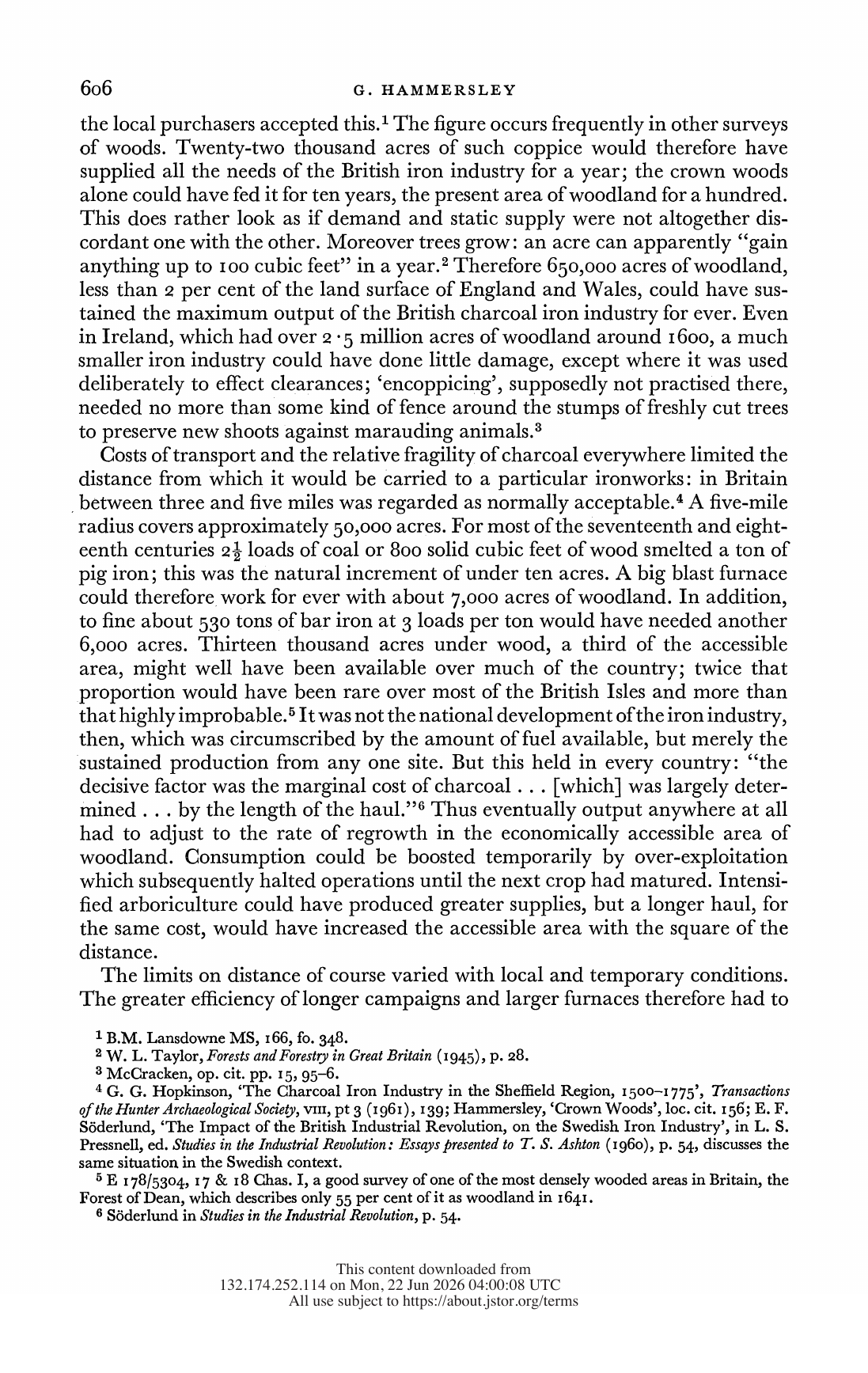
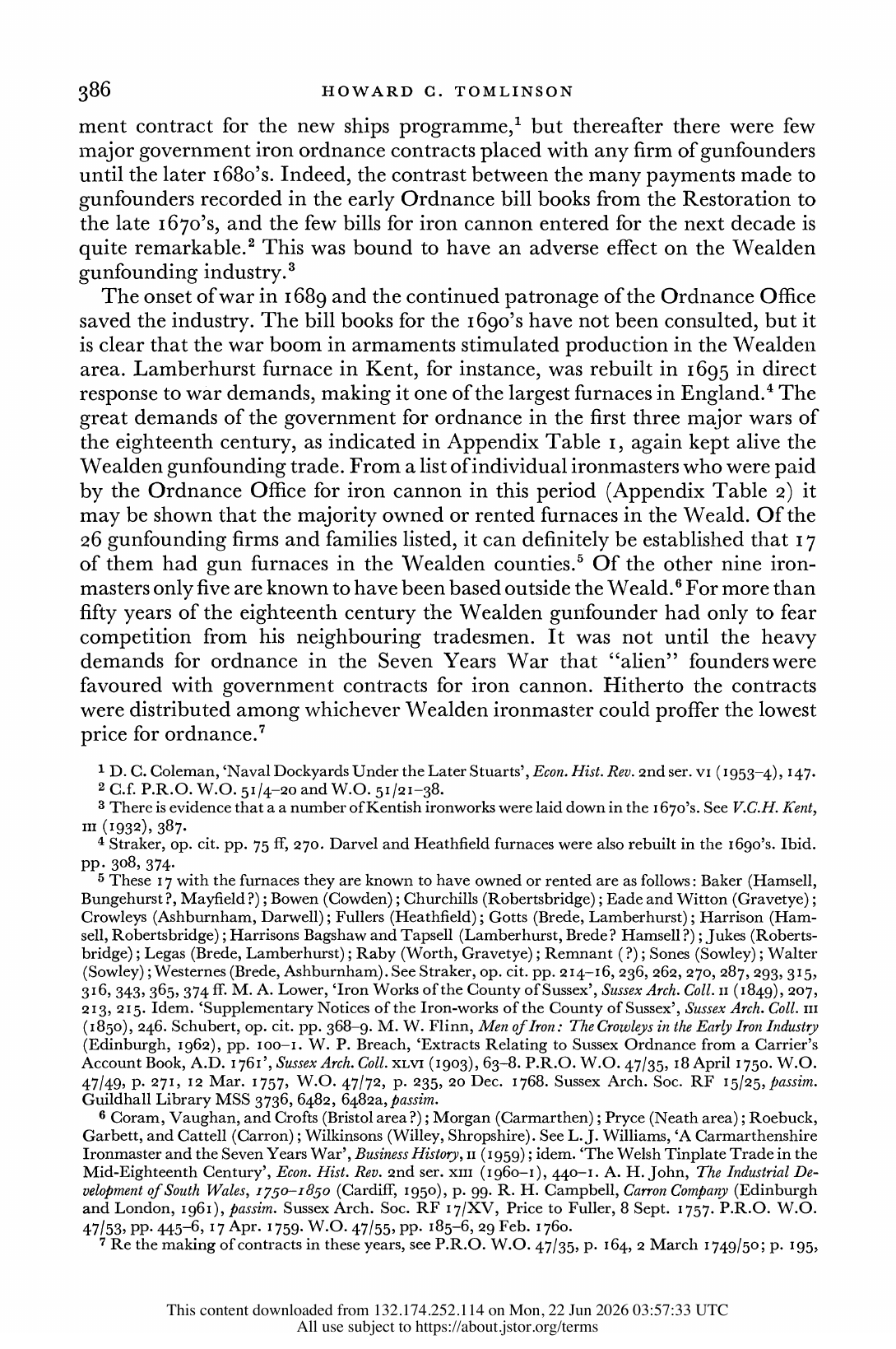
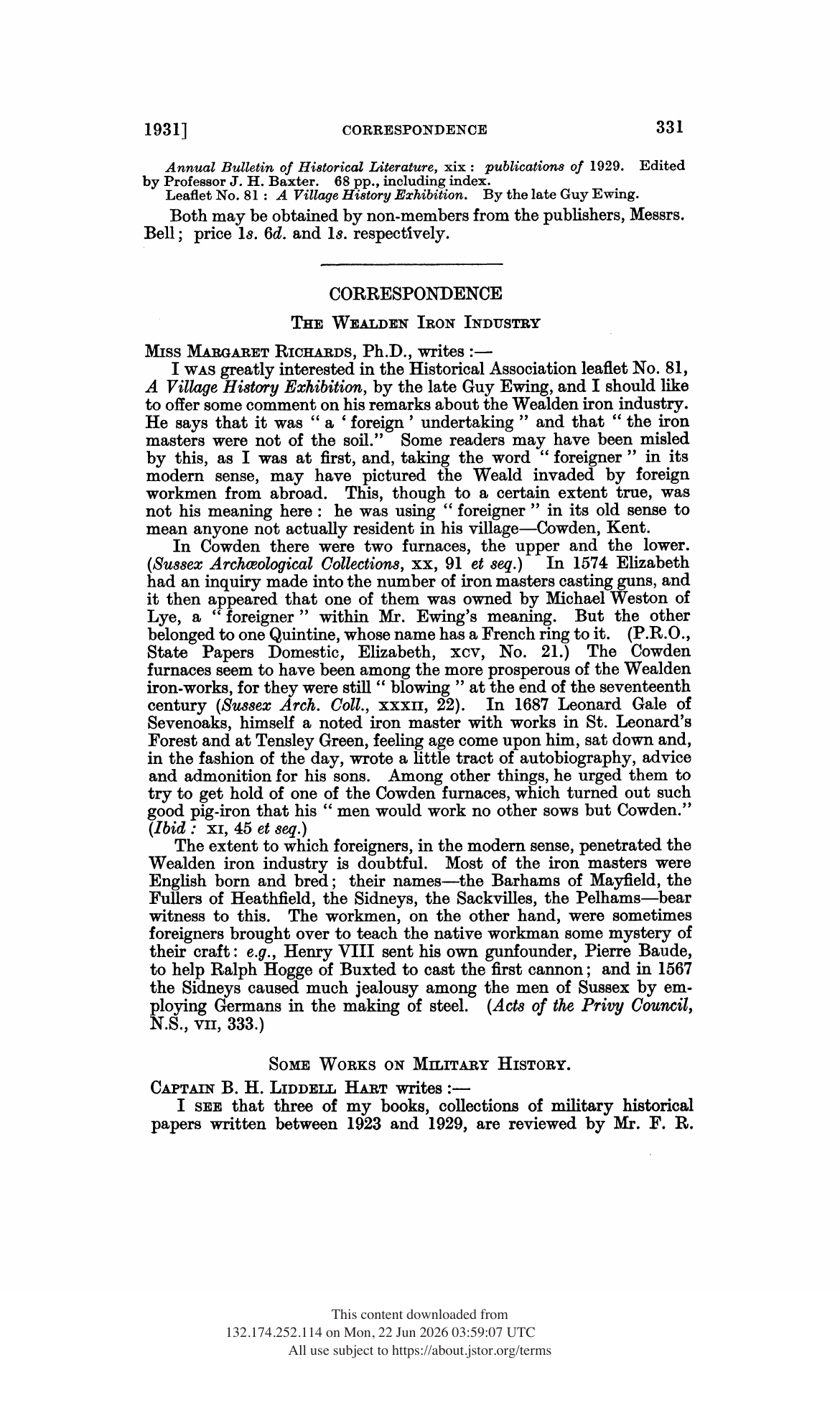
- Crossley, Hammersley, Tomlinson, King, Awty, Nef, Richards, Quinn, and Hetherington have now been text-extracted and read. The first seven are the core Wealden iron/gunfounding set; Quinn is a theatre/network bridge; Hetherington is collateral genealogy only.
- The strongest gains for this topic are: Crossley for the practical management of sixteenth-century ironworks; Hammersley for charcoal, ironwood, and transport economics; Tomlinson for the Weald's long gunfounding pre-eminence; King for Wealden output chronology; Awty for French/pays de Bray skilled-labor origins; and Richards for the "foreign" terminology guardrail and Barhams of Mayfield.
- Guardrail: these articles strengthen the context around Neville's
D/EN/O23ordnance business, but they do not replaceD/EN/O23as the strongest Henry Neville evidence.
Google Books / Archive.org Follow-Up
- Browser/Google Books search for
"Henry Nevill" "Mayfield" "Bell-Irving"confirmedMayfield: The Story of an Old Wealden Villageas a useful local-history route. Archive.org metadata formayfieldstoryan00irvgooggives Eva Margaretta Bell-Irving, London, W. Clowes and Sons,1903, University of Michigan contributor. - The same search found related Sussex/Rotherfield local-history routes. Use these for context and lead generation only; they do not supersede BRO
D/EN/O23as the strongest Henry Neville ordnance witness. - Browser/Google Books search for
"Henry Nevill" "Aldine Pliny"produced bookseller/provenance-periodical hits. Those belong primarily to the Audley/Billingbear signed-book route, not to the ironworks claim.
Archive.org Variant-Sweep Ordnance Notes
- CSPD Elizabeth 1595-1597, vol. CCLV, item
63, printed pp.153-154, now gives a public Archive.org route for an official ordnance-patent lead. The calendar discussion says the patent toMr. Neville and otherswas for21years, of which six were past, and that Mr. Sackville then held the patent; it also mentions payments on iron ordnance transported or sold at home. - This strengthens the lead behind Lawton's Neville/Leighton export-patent statement, but it does not replace the patent record. Treat the calendar as a source-routing control for the legal/export side of the Mayfield ordnance business, while
D/EN/O23remains the strongest direct Neville-side witness for delivered cast-iron ordnance. - Identity caution remains active: the calendar's
Mr. Nevillemust be tied to the younger Sir Henry Neville before this becomes a settled personal business fact.
1. Verified Sourced Facts
- The user-supplied History of Parliament transcription for Sir Henry Neville III states:
“The eldest son and heir of Sir Henry Neville I ... was born in 1588 at Mayfield in Sussex. Mayfield was sold in 1597”
- A Privy Council entry dated
5 May 1591refers to:
“Henrie Nevel, of Mafeld, esquier”
- The same Privy Council entry requests that he be added to the Sussex deputy lieutenancy commission.
- Eva Margaretta Bell-Irving writes of Sir Henry Neville:
“upon first coming into possession in 1596, held the lordship or manor of Mayfield in its entire state”
- Bell-Irving states:
“By an indenture of 14th August 1597, he sold to Thomas Aynscombe ... all the waste lands in Mayfield, Wadhurst, and Lamberhurst”
- Bell-Irving also states:
“By an indenture 6 May, 1598, Sir Henry Nevill sold to Sir Thomas May ... for the consideration of £6,387”
- Bell-Irving describes the 1598 conveyance as including:
“all that the Manor of Mayfield and all houses etc. and all the glass and wainscott of the chief Manor House or mansion house of the said manor”
- Bell-Irving states of Mayfield in the ironworks chapter:
“there were forges in the parish of Mayfield”
- Bell-Irving states of the mid-Tudor ordnance industry:
“This was Ralphe Hogge, or Huggett, before mentioned, whose furnaces were between Mayfield and Buxted.”
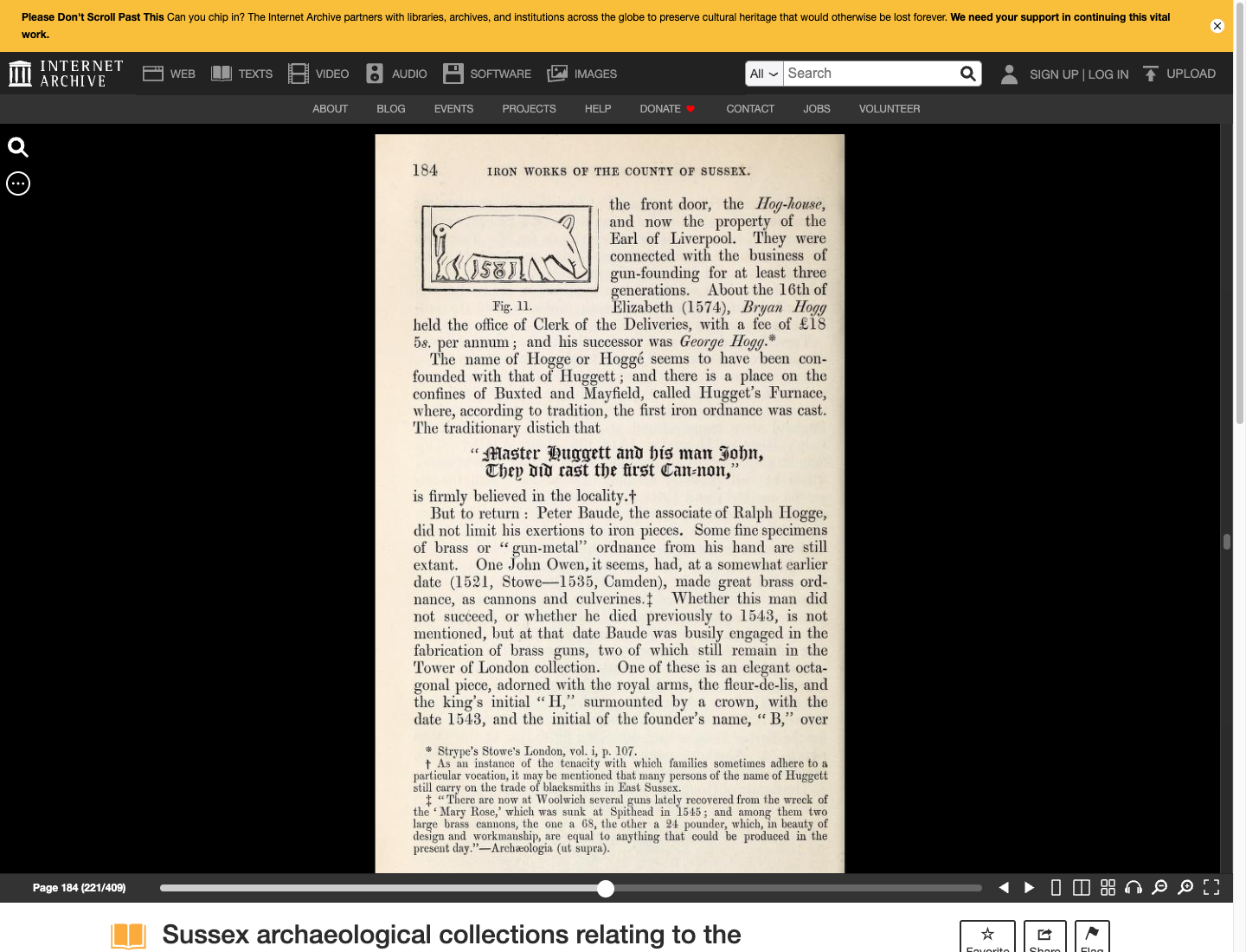
- Mark Antony Lower's 1849 ironworks article places Huggett's Furnace:
“on the confines of Buxted and Mayfield”
- The same page preserves the local first-cannon tradition:
“Master Huggett and his man John, / They did cast the first Cannon”
- Lower's 1849 topographical summary states:
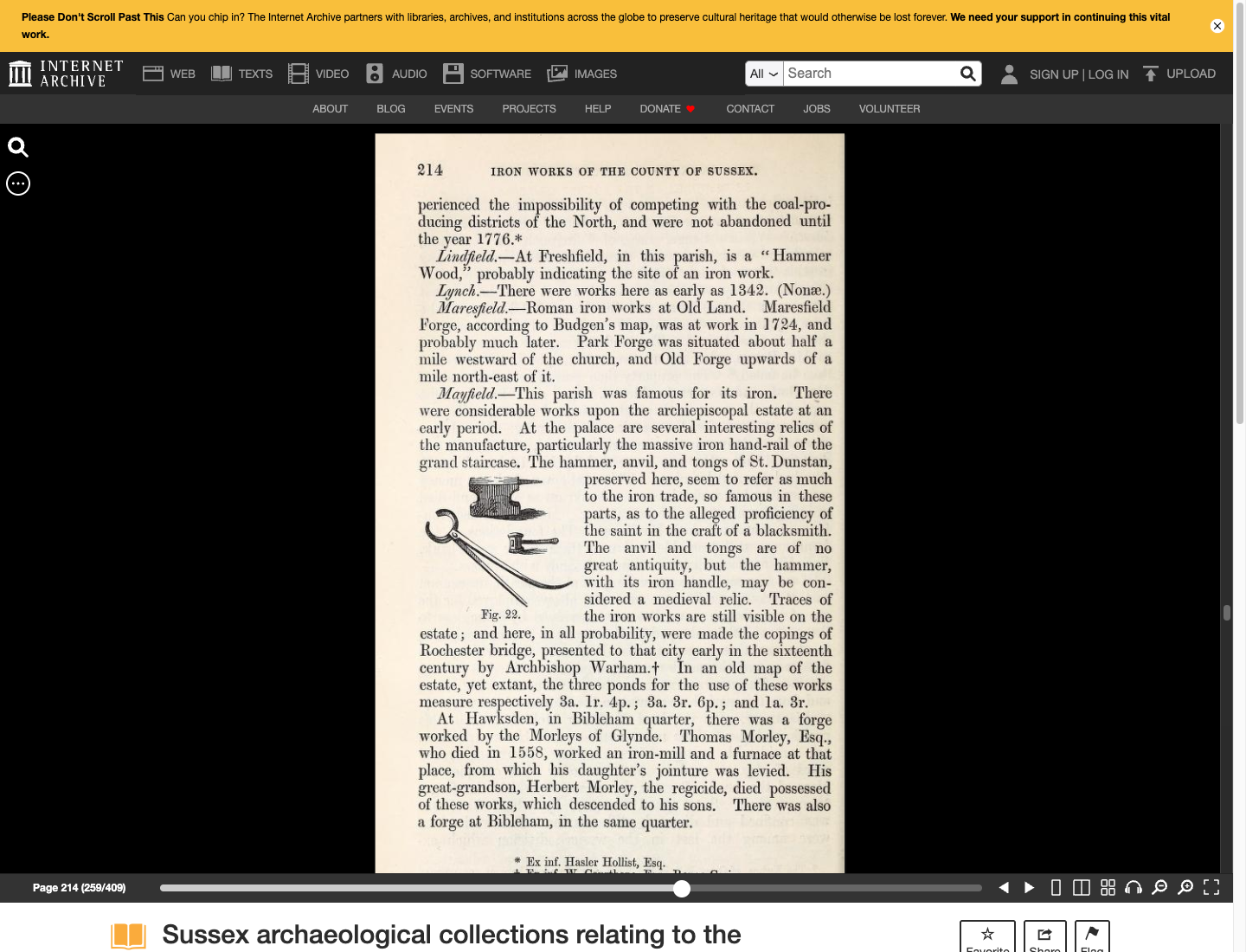
“May field. — This parish was famous for its iron.”
- Lower records "considerable works" on the archiepiscopal estate, visible traces, an old estate map with three ponds for the works, a forge at Hawksden in Bibleham quarter, an iron-mill and furnace worked by Thomas Morley, and another forge at Bibleham.
- Lower also lists Mayfield-area sites including Bungehurst Furnace and Forge, Huggett's Furnace, Coushossly Furnace on the Mayfield/Wadhurst boundary stream, and traces on Lower-House, Twits, and Merriams.
- Bell-Irving writes that a January
1574petition from Ralphe Hogge complained of infringement of his patent:
“for the sole exportation of Ordnance”
- Bell-Irving states that a return of
15 Feb.following gave:
“a list of the owners of ironworks in Sussex, Surrey, and Kent”
- Lower's 1850 supplement gives the State-Paper Office source route behind this regulatory episode:
1573no.96, January1574no.15,15 Feb.no.18, and another paper of the same date no.56. - In Lower's 1850 transcription, Hogge is described as:
“manufacturer of guns and shot for the Ordnance Office”
- The return required bonds under a penalty of:
“£2000, not to found or sell ordnance without license from the queen”
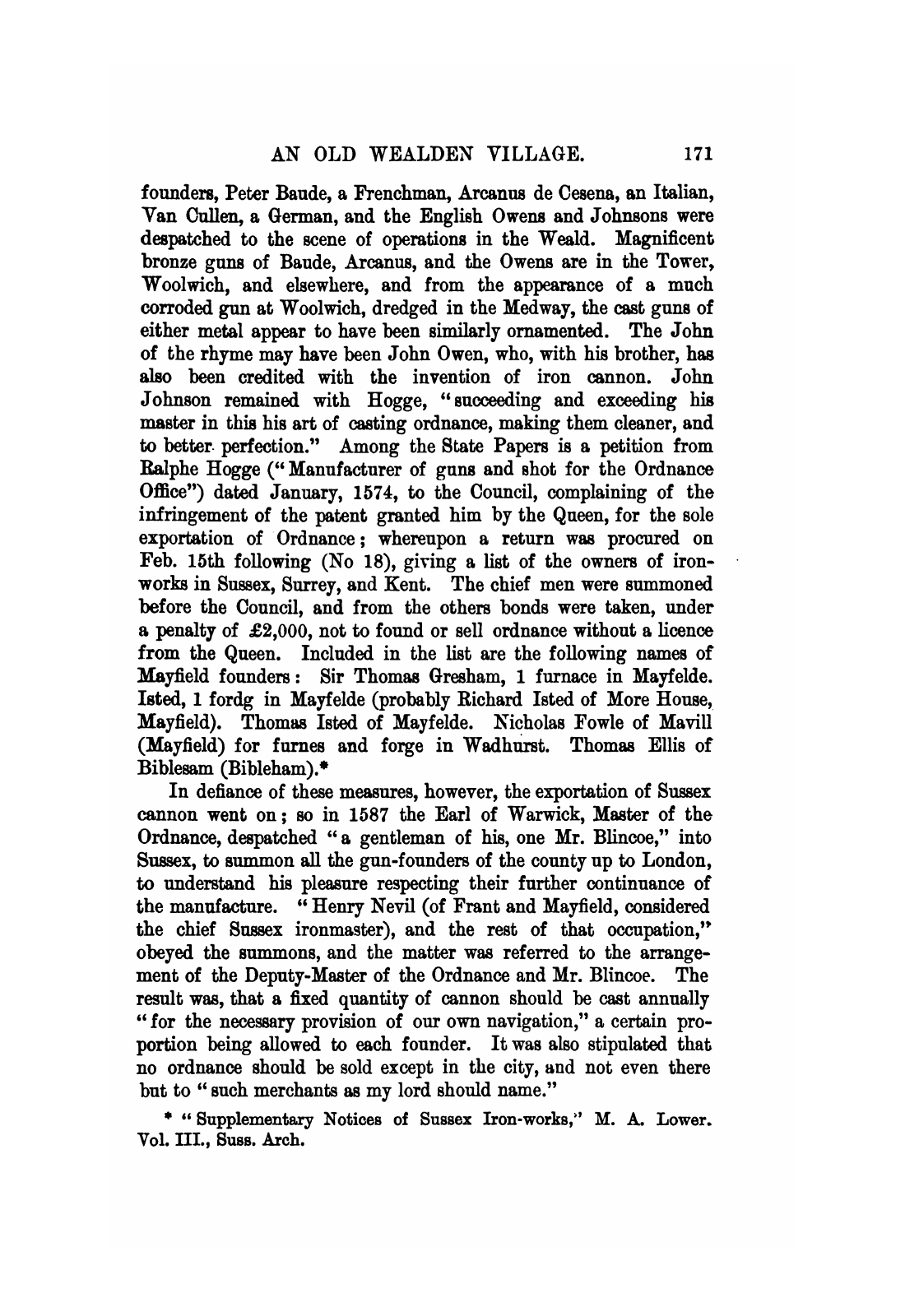
- Bell-Irving states:
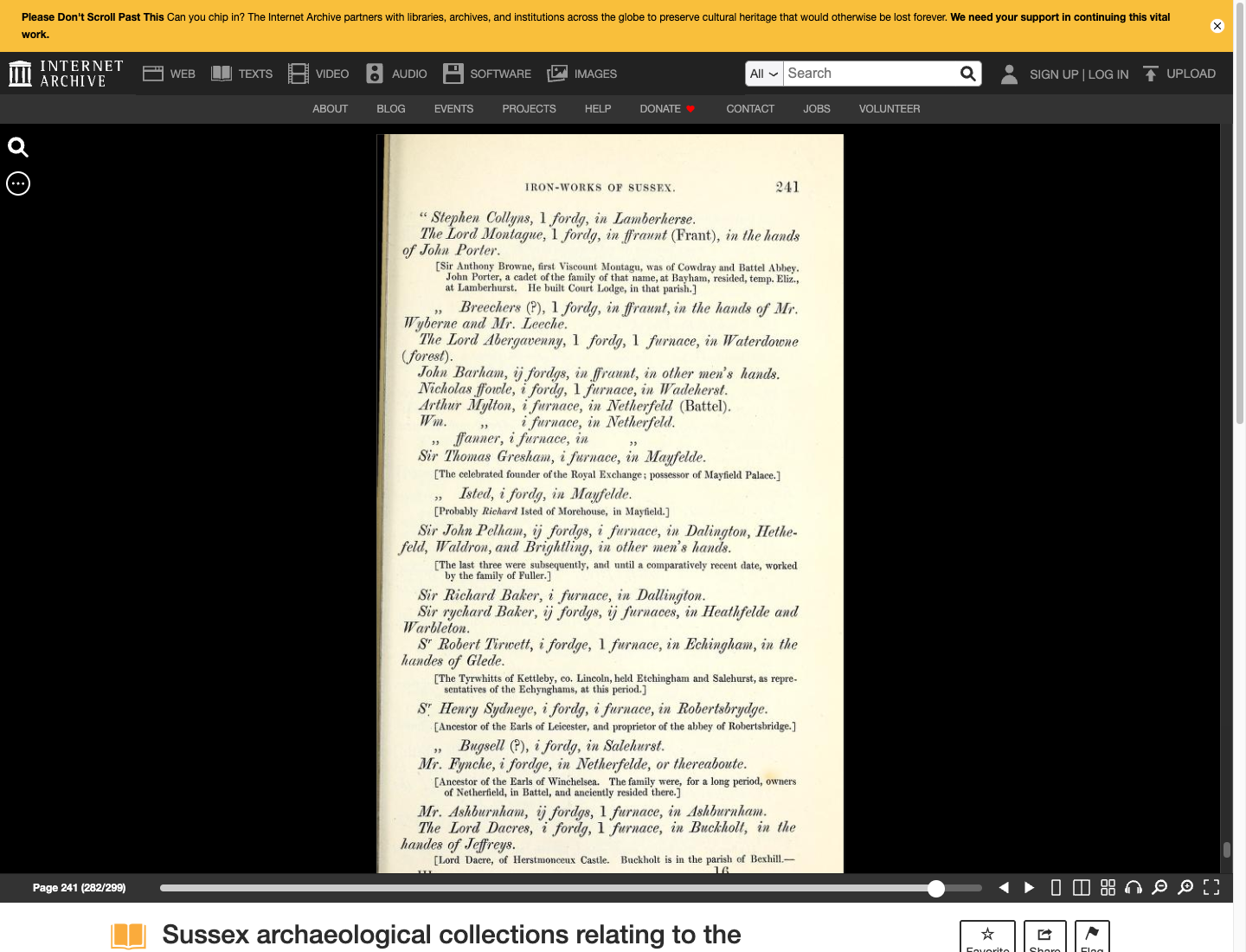
“Included in the list are the following names of Mayfield founders: Sir Thomas Gresham, 1 furnace in Mayfielde.”
- In the same passage Bell-Irving lists:
“Isted, 1 fordg in Mayfelde”
“Thomas Isted of Mayfelde.”
“Nicholas Fowle of Mavill (Mayfield) for furnes and forge in Wadhurst.”
“Thomas Ellis of Biblesam (Bibleham).”
- Bell-Irving states of
1587:
“Henry Nevil (of Frant and Mayfield, considered the chief Sussex ironmaster), and the rest of that occupation”
- Bell-Irving states that the arrangement made in 1587 was:
“that a fixed quantity of cannon should be cast annually ‘for the necessary provision of our own navigation,’ a certain proportion being allowed to each founder.”
- Bell-Irving states of a letter dated
8 August 1589from Lord Buckhurst:
“Their lordshippes doe see the little regard the owners of furnaces and the makers of these peeces have of their bondes”
- Bell-Irving states of another letter dated
6 October 1590that it directs magistrates:
“to ‘straighten restraints of making shott and ordnance,’ and to take bonds of £1,000 each of every furnace owner”
- Bell-Irving also writes:
“The noble families, such as the Ashburnhams, Pelhams, Nevills, Sidneys, Sackvilles, Howards, Gages, and others, turned ironmasters”
- Dunkin’s feet-of-fines index records for
East., 40 Eliz. [1598]:
“Thomas Maye of Burwash, esq., plaintiff, and Henry Nevyll, esq., and Anne his wife, deforciants”
- The same
1598entry records:
“Manors of Maighfeld and Battersden alias Pentbridge, and rectory of Maighfeld and park of Maighfeld”
- The same
1598entry also records:
“tenements in Maighfeld, Wadherst and Lamberhurst, and half hundred of Loxfeild, and free warren in Maighfeld, Wadherst and Lamberherst, also advowson of vicarage of Maighfeld, quitclaimed to plaintiff and heirs”
- Dunkin’s feet-of-fines index records for
Mich., 7 Ja. I. [1609]:
“Mayfield Park, Court Meadow and Pennybridge, and the advowson of vicarage of MAYFIELD alias MAYGHTFIELD, quitclaimed to plaintiffs and heirs of George Snelling”
- Sussex Archaeological Collections states:
“The initials on the Andirons are those of Henry Neville, of Mayfield”
- The same catalog entry describes a fire-back with:
“crossed staples with the initials H.N. (Henry Neville ?)”
- The same entry states of that fire-back:
“supposed by Mr. M. A. Lower to have been made by Henry Neville, of Mayfield, Sussex.”
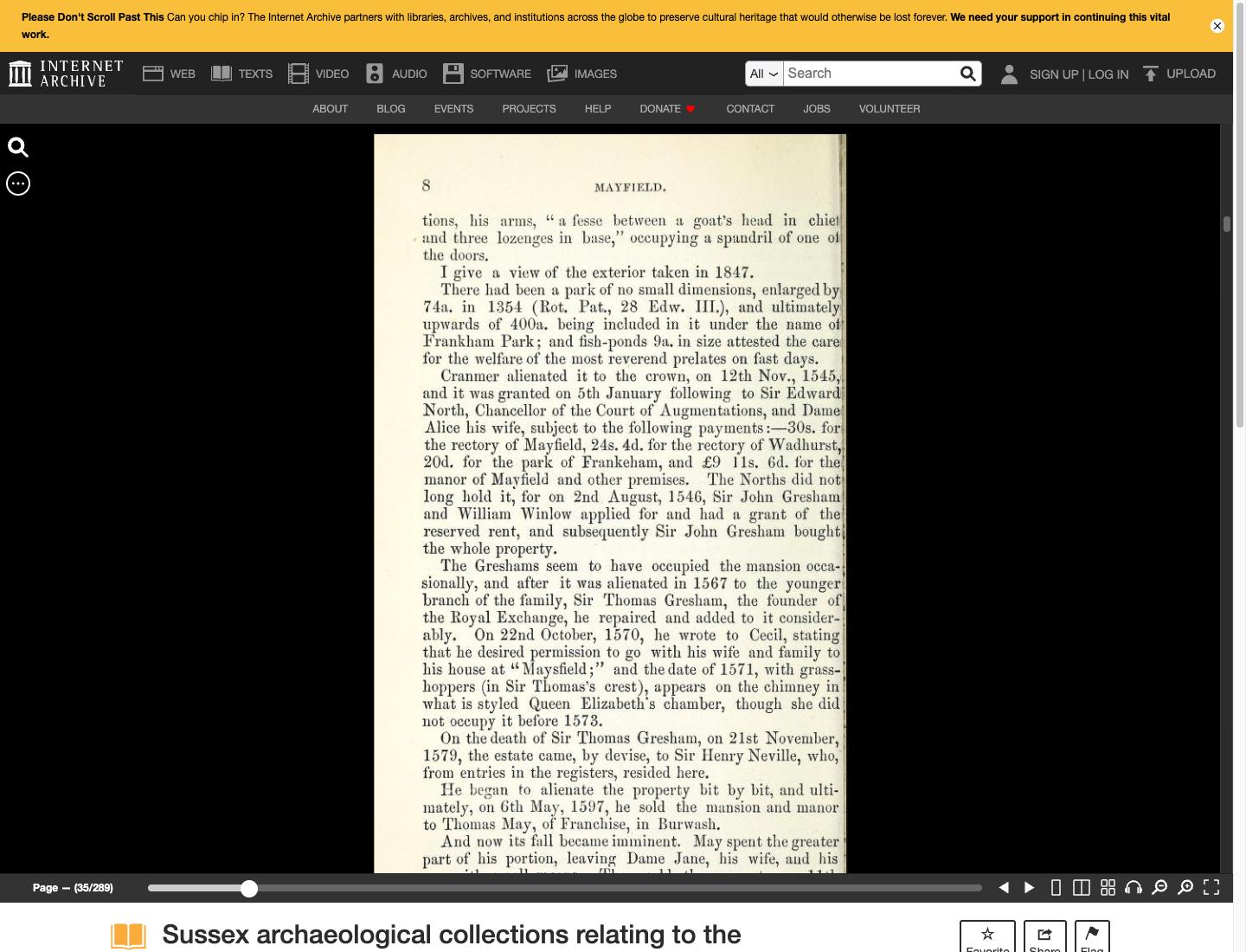
- Another Sussex Archaeological Collections Mayfield article states:
“On the death of Sir Thomas Gresham, on 21st November, 1579, the estate came, by devise, to Sir Henry Neville”
- The same article states:
“from entries in the registers, resided here.”
- The same article also states:
“ultimately, on 6th May, 1597, he sold the mansion and manor to Thomas May, of Franchise, in Burwash.”
- The local Neville letters corpus includes a letter dated
1590-01-01to William Cecil that states:
“my Lord of Warwick sent a gentleman of his one mr Blyncoe with a letter of commandment unto all the Gunfounders in Sussex”
- The same 1590 letter states:
“upon complaint made by my lords of the Council of the abuse of transportation of ordnance into foreign countries”
- The same 1590 letter also states:
“some quantity of ordnance should yearly be made for the necessary provision of our own navigation”
- The legacy Neville letters corpus labels the composite Sackville sheet
1593-08-01, but direct inspection of BROD/EN/O/23/3establishes a main copy docketed8 February 1595/6Old Style (1596New Style) plus separate, not securely year-dated August marginal drafts. The manuscript records:
“they have made delivery to your use at Millall, of 44 ton 2 C 3 quarters, and at Lewes of 28 ton and 13 C”
- The same working sheet records
79 ton and 5 hundredat Maidstone and a total of:
“152 ton 0 C 3 quarters”
- The same sheet places Lord Bergavenny inside the ordnance/bond transaction:
“our letter to my L. of Bergveny is to this effect”
- Source-control note, updated
2026-07-18: this strengthens the Sackville/Abergavenny/Billingbear network. Robert Sackville was brother of Lady Mary Sackville, who married Sir Henry Nevill of the Abergavenny line, according to Brooke's1619Catalogue and succession. That Abergavenny Henry—not Henry Neville of Billingbear—was Robert's brother-in-law. The exact legal capacity in which Lord Abergavenny held or released the bonds remains to be established. - The House of Lords Journal entry for
10 March 1589records the bill titledAn Act for Assurance to be made of the Jointure of Anne Wife of Henrie Neville, Esquire. - The same Lords Journal entry states that the act made prior conveyances by Henry Neville of the manor of
MaighfeildeandWadhurstein Sussex "frustrate and void," and ordered those conveyances to be deposited sealed with the Clerk of Parliament pending royal assent. - The same Lords Journal entry records that the deeds were cancelled on
12 May 1589. - The Wealden Iron Research Group data site entry for Thomas Hodgson states:
“Teesdale (p. 126) notes him working for Henry Neville, presumably at Mayfield Furnace, in 1592.”
- The same WIRG page lists the person connection:
“Neville, Henry (b.1564, d.1615) is Thomas Hodgson's employer”
- The same WIRG page lists the iron site connection:
“Mayfield Furnace - ?gun founder in 1592”
- The WIRG data site also records that Thomas Hodgson was associated with Pounsley Furnace in
1608. His father was Robert Hodgson (d.1598). His brother was Barnaby Hodgson. These family details are preserved here to distinguish this Thomas Hodgson from others in the WIRG database and to extend the ironmaster-network picture beyond the single 1592 Mayfield entry. - The WIRG data site person record for Brian Hogge quotes, under the citation
The National Archives, SP/95/20 f.48, prob 1574:
“Sr Thomas Gresham his furnace in the pishe of Mayfeild in Sussex”
- The same quoted list includes:
“Mr Brian Hogge his furnace in the pishe of Bucksteed or in fframkfeild pishe”
- The same quoted list concludes:
“Thise fyve mylles are employed to no other use but to the makeing of Ordnance”
- This is a WIRG-mediated witness: the quotations above reproduce the WIRG record's rendering (wirg_Hogge.html, staged 2026-07-12), and the SP original has not been inspected. See the WIRG Database Ordnance-Mill Witness section above for the reference-reconciliation lead and the four-lines/five-mills count guardrail.
- Bryan Lawton writes:
“Sir Thomas Leighton and Sir Henry Neville obtained separate patents from Elizabeth I to send their ordnance abroad”
- BRO/Royal Berkshire
D/EN/O23materially strengthens the ordnance side of this packet.Doc 43c D EN O 23preserves a copy/draft docketed8 February 1595Old Style—8 February 1596New Style—in Neville's name to Robert Sackville about delivery of ordnance at Millhall, Lewes, Maidstone, and Weymouth; the return of bonds; Lord Abergavenny; and marginal drafts from Mayfield. - The same
Doc_43cworking sheet gives44 ton 2 C 3 quartersat Millhall,28 ton and 13 Cat Lewes,79 ton and 5 hundredat Maidstone, and22 ton 19 C one quarterat Weymouth. Its arithmetic reaches175 tonexactly. Doc 44 D EN O 23preserves Abraham Jones writing from Lewes to Sir Henry Neville on23 November 1595that pieces of Neville'scast Iron ordnancehad been delivered and shipped, with further pieces remaining at Lewes.- The D/EN/O23 papers make the Mayfield/ironworks argument stronger as a documented commercial and logistical ordnance lane, not merely a later local-history claim.
- Duncan integration note: Duncan's dissertation chapter 2 independently routes the Mayfield/ordnance story through the same core source family. He cites
Lansdowne MSS,65, no.27/ no.22, f.70, for Neville's dispute over Warwick/Blincoe restraint, ordnance export controls, and the suspected private benefit of restricting sales to a named merchant. He also citesNeville MSS,D/En/O23, for letters concerning sale/delivery of iron ordnance, Robert Sackville, Abraham Jones, and Neville's non-junior role in the business. Treat Duncan as a source map and use the localD/EN/O23transcriptions and any Lansdowne images/calendars for direct claims. - Local BRO website verification: the O23 records are present in the local website data as
BRO_Doc_43a_D_EN_O_23,BRO_Doc_43b_D_EN_O_23,BRO_Doc_43c_D_EN_O_23, andBRO_Doc_44_D_EN_O_23, with images present and no missing-image flags.IMG 0230was visually spot-checked forDoc_43c; the draft supports the visible ordnance-delivery and quantity structure. - Source-image controls: O23 images, Bell-Irving page renders, the Privy Council page render, and Lawton chapter renders are staged in SOURCE NOTES. This upgrade strengthens the direct ordnance/logistics lane while preserving cautions about Bell-Irving, Lawton's patent statement, and probabilistic fireback attributions.
- WIRG additional research: downloaded and text-extracted WIRG vols.
2nd ser. 6,14,15,21,34,36 pt. 1,37, and40. The strongest additions are Teesdale's1574list control, Trollope's Gresham-era Mayfield Falcon dating, Combes's1587Sussex coastal ordnance survey context, Brown's Office of Ordnance debenture extracts, and the Cornish/Herbert versus Hodgkinson Mayfield finery-forge debate. - Uploaded-scholarship source position: Crossley (
1966) supports the managerial scale and raw-material demands of sixteenth-century blast-furnace/forge operation; Hammersley (1973) reframes iron fuel as local charcoal, coppice, transport-radius, and bargaining economics; Tomlinson (1976) supports the Weald's long national importance in iron gunfounding; King (2005) places the Weald's early-modern output peak around the1590s; Awty (1981) gives the pays de Bray skilled-labor migration frame; Richards (1931) warns that "foreign" can mean non-local and names the Barhams of Mayfield among English ironmasters. - Uploaded-scholarship source position: Quinn (
2017) strengthens a collateral Hogge/Henslowe/theatre-network bridge by noting that Philip Henslowe's sister Margaret married Ralph Hogg/Hogge of Buxted, John Henslowe was Hogg's office manager, and the Diary originated as John Henslowe's office ledger. Treat this as network context, not direct Neville evidence. - Theater-network source position: a dedicated source-map packet now tracks the hypothesis that Mayfield/Wealden iron, Hogge/Henslowe accounting, Sherley/Kemp/Alleyn Sussex theater links, and Abergavenny acting-company patronage could help explain a route by which Henry Neville became adjacent to theatrical circles. See henslowe hogge sherley theater network.
2. Ken Feinstein Twitter and Blog Information
- No Ken Feinstein Twitter/blog material is isolated in this packet at present.
3. Quoted Source Text
History of Parliament transcription
- “was born in 1588 at Mayfield in Sussex”
- “Mayfield was sold in 1597”
Privy Council entry, 5 May 1591
- “Henrie Nevel, of Mafeld, esquier”
- “These are therfore to pray your Lordship to add Henrie Nevel, of Mafeld, esquier, unto the nomber of the rest of the Deputie Lieutenantes”
Bell-Irving, Chapter XII
- “Sir Henry Nevill, upon first coming into possession in 1596, held the lordship or manor of Mayfield in its entire state”
- “By an indenture of 14th August 1597, he sold to Thomas Aynscombe”
- “By an indenture 6 May, 1598, Sir Henry Nevill sold to Sir Thomas May ... for the consideration of £6,387”
- “all that the Manor of Mayfield and all houses etc. and all the glass and wainscott of the chief Manor House or mansion house of the said manor”
Bell-Irving, Chapter XIII
- “there were forges in the parish of Mayfield”
- “This was Ralphe Hogge, or Huggett, before mentioned, whose furnaces were between Mayfield and Buxted.”
- “for the sole exportation of Ordnance”
- “a list of the owners of ironworks in Sussex, Surrey, and Kent”
- “Included in the list are the following names of Wealden founders: Sir Thomas Gresham, 1 furnace in Mayfielde.”
- “Isted, 1 fordg in Mayfielde”
- “Thomas Isted of Mayfelde.”
- “Nicholas Fowle of Mavill (Mayfield) for furnes and forge in Wadhurst.”
- “Thomas Ellis of Biblesam (Bibleham).”
- “Thomas Nevill of Mayfelde.”
- “Henry Nevill (of Frant and Mayfield, considered the chief Sussex ironmaster), and the rest of that occupation”
- “for the necessary provision of our own navigation”
- “Their lordshippes doe see the little regard the owners of furnaces and the makers of these peeces have of their bondes”
- “to ‘straighten restraints of making shott and ordnance,’ and to take bonds of £1,000 each of every furnace owner”
- “The noble families, such as the Ashburnhams, Pelhams, Nevills, Sidneys, Sackvilles, Howards, Gages, and others turned ironmasters”
Lower, Sussex Archaeological Collections, vol. 2
- “on the confines of Buxted and Mayfield”
- “Master Huggett and his man John, / They did cast the first Cannon”
- “May field. — This parish was famous for its iron.”
- “There were considerable works upon the archiepiscopal estate at an early period.”
- “Traces of the iron works are still visible on the estate”
- “At Hawksden, in Bibleham quarter, there was a forge worked by the Morleys of Glynde.”
- “Huggett's Furnace is in the western district of this parish.”
- “Coushossly Furnace ... on the boundary stream between this parish and Wadhurst”
Lower, Sussex Archaeological Collections, vol. 3
- “manufacturer of guns and shot for the Ordnance Office”
- “the patent granted him by the queen, for the sole exportation of ordnance”
- “a list of the owners of iron-works in the three counties”
- “Sir Thomas Gresham, i furnace, in Mayfelde.”
- “Isted, i fordg, in Mayfelde.”
- “Thomas Isted, of Mayfeld.”
- “Nicholas Fowle, of Mavill (Mayfeld), 'for furnes and forge in Wadhurst.'”
- “Thomas Ellis, of Biblesam (Bibleham, in Mayfield).”
- “Sir Thomas Gresham, Knt. (of Mayfield).”
Feet of fines / manor and rectory entries
- “Thomas Maye of Burwash, esq., plaintiff, and Henry Nevyll, esq., and Anne his wife, deforciants”
- “Manors of Maighfeld and Battersden alias Pentbridge, and rectory of Maighfeld and park of Maighfeld”
- “tenements in Maighfeld, Wadherst and Lamberhurst, and half hundred of Loxfeild, and free warren in Maighfeld, Wadherst and Lamberherst, also advowson of vicarage of Maighfeld, quitclaimed to plaintiff and heirs”
- “Mayfield Park, Court Meadow and Pennybridge, and the advowson of vicarage of MAYFIELD alias MAYGHTFIELD, quitclaimed to plaintiffs and heirs of George Snelling”
Sussex Archaeological Collections / fire-back
- “The initials on the Andirons are those of Henry Neville, of Mayfield”
- “crossed staples with the initials H.N. (Henry Neville ?)”
- “supposed by Mr. M. A. Lower to have been made by Henry Neville, of Mayfield, Sussex.”
Sussex Archaeological Collections / Mayfield article
- “On the death of Sir Thomas Gresham, on 21st November, 1579, the estate came, by devise, to Sir Henry Neville”
- “from entries in the registers, resided here.”
- “ultimately, on 6th May, 1597, he sold the mansion and manor to Thomas May, of Franchise, in Burwash.”
Neville letters corpus
- “my Lord of Warwick sent a gentleman of his one mr Blyncoe with a letter of commandment unto all the Gunfounders in Sussex”
- “upon complaint made by my lords of the Council of the abuse of transportation of ordnance into foreign countries”
- “some quantity of ordnance should yearly be made for the necessary provision of our own navigation”
- “they have made delivery to your use at millall , of 44 ton 200 & 3 quarters , and at Lewes of 28 ton and 1300”
- “which in all comes to 152 ton & 3 quarters of a hundred”
House of Lords Journal, 10 March 1589
- “An Act for Assurance to be made of the Jointure of Anne Wife of Henrie Neville, Esquire”
- “the Manor of Maighfeilde and Wadhurste”
- “the Deeds mentioned therein were cancelled the 12th Day of May”
WIRG data site
- “Teesdale (p. 126) notes him working for Henry Neville, presumably at Mayfield Furnace, in 1592.”
- “Neville, Henry (b.1564, d.1615) is Thomas Hodgson's employer”
- “Mayfield Furnace - ?gun founder in 1592”
- “Pounsley Furnace” — listed in Hodgson's WIRG site connections, 1608
- Father: “Robert Hodgson” (d. 1598); brother: “Barnaby Hodgson”
WIRG data site, Brian Hogge record (quoting TNA SP/95/20 f.48, "prob 1574")
- “The National Archives, SP/95/20 f.48, prob 1574”
- “The L Buckhurst or else Arthur Milton's [furnace] in the pishe of Rotherfeild in Sussex”
- “Sr Thomas Gresham his furnace in the pishe of Mayfeild in Sussex”
- “Nico: ffowle his furnace in the pishe of Wardirst in Sussex”
- “Mr Brian Hogge his furnace in the pishe of Bucksteed or in fframkfeild pishe”
- “Thise fyve mylles are employed to no other use but to the makeing of Ordnance”
Lawton
- “Sir Thomas Leighton and Sir Henry Neville obtained separate patents from Elizabeth I to send their ordnance abroad”
BRO / Royal Berkshire D/EN/O23
- “ver me my ordnance unto you”
- “at Millall”
- “at Lewes”
- “at maidstone”
- “our letter to my L: of Bergavenny”
- “make delivery of them at Weymouth”
- “from maighfeild”
- “cast Iron ordnance”
- “37 tonnes & odd hundred”
4. Citations
- Bell-Irving, Eva Margaretta. Mayfield: The Story of an Old Wealdon Village. London, William Clowes and Sons, 1903.
- Dasent, John Roche, editor. Acts of the Privy Council of England: A.D. 1542-[June 1631]. Vol. 21: 1591. Her Majesty’s Stationery Office, 1900. State Papers Online, Gale.
PC 2/18 f.252, entry dated 5 May 1591. - Thrush, Andrew. “NEVILLE, Sir Henry III (1588-1629), of Billingbear, Berks.” The History of Parliament: the House of Commons 1604-1629, https://www.historyofparliamentonline.org/volume/1604-1629/member/neville-sir-henry-iii-1588-1629.
- Lawton, Bryan. “Renaissance and Early Modern Metal Working.” Various and Ingenious Machines. Volume Two: Manufacturing and Weapons Technology. Brill, 2004, pp. 933-1004. DOI: https://doi.org/10.1163/9789004531697_007.
- Lower, Mark Antony. “Historical and Archaeological Notices of the Iron Works of the County of Sussex.” Sussex Archaeological Collections, vol. 2, 1849, pp. 169-220. Internet Archive, https://archive.org/details/sussexarchaeolog02suss.
- Lower, Mark Antony. “Supplementary Notices of the Iron-Works of the County of Sussex.” Sussex Archaeological Collections, vol. 3, 1850, pp. 240-248. Archaeology Data Service, https://archaeologydataservice.ac.uk/library/browse/issue.xhtml?recordId=1185064.
- Lower, Mark Antony. “Supplementary Notices of the Iron-Works of the County of Sussex.” Sussex Archaeological Collections, vol. 3, 1850, pp. 240-248. Internet Archive, https://archive.org/details/sussexarchaeolog03suss.
- Cooper, William Durrant. “Mayfield.” Sussex Archaeological Collections, vol. 21, 1869, pp. 1-20. Internet Archive, https://archive.org/details/sussexarchaeolog21suss_0.
- Dunkin, Edwin H. W., editor. Sussex Manors, Advowsons, Etc., Recorded in the Feet of Fines, Henry VIII to William IV (1509-1833). Lewes, Farncombe and Co., 1914. Internet Archive, https://archive.org/details/sussexmanorsadvo02dunkuoft.
- Blaauw, W. H. “Mayfield.” Sussex Archaeological Collections Relating to the History and Antiquities of the County, vol. 21, Sussex Archaeological Society, 1869, pp. 1-20. Internet Archive, https://archive.org/details/sussexarchaeolog21suss_0.
- Salzman, L. F., editor. Sussex Archaeological Collections Relating to the History and Antiquities of the County. Vol. 46. Lewes, Sussex Archaeological Society, 1903. Internet Archive, https://archive.org/details/sussexarchaeolog46suss.
- Neville Letters Corpus. Version 8. XML corpus of 138 letters and 3 documents,
[local source path removed]. Letterletter_001_1590(Neville Letter 1590 Burghley) and letterletter_119(Neville Letter 1593 08 01 Sackville). - "House of Lords Journal Volume 2: 10 March 1589," in Journal of the House of Lords: Volume 2, 1578-1614 (London, 1767-1830), British History Online, https://www.british-history.ac.uk/lords-jrnl/vol2/pp157-158 [accessed 1 May 2026].
- “Hodgson, Thomas.” WIRG Data Site, Wealden Iron Research Group, https://wirgdata.org/searchpro2.cgi?personid=552.
- “Hogge, Brian.” WIRG Data Site, Wealden Iron Research Group, https://wirgdata.org (person-name search result page for "Hogge", retrieved 2026-07-12; no stable person URL preserved). Staged copy: wirg_Hogge.html. Quotes TNA
SP/95/20 f.48("prob 1574"); the State Paper itself is uninspected. - Wealden Iron Research Group. “History of the Wealden Iron Industry.” https://www.wealdeniron.org.uk/history/.
- Wealden Iron Research Group. “Publications.” https://www.wealdeniron.org.uk/publications/.
- Wealden Iron Research Group. “Research.” https://www.wealdeniron.org.uk/research/.
- Wealden Iron Research Group. “Where to See Wealden Iron.” https://www.wealdeniron.org.uk/wealden-iron-find-out-more/.
- Hodgkinson, Jeremy. “Henry Nevill” fireback series entries. Hodgers Firebacks Database, https://hodgers.com/firebacks/results/series/5.
- Copy letter / draft to Robert Sackville concerning ordnance delivery,
8 Feb. 1595/6Old Style (1596New Style),D/EN/O23/3: Doc 43c D EN O 23. - Abraham Jones to Sir Henry Neville concerning cast-iron ordnance, Lewes,
23 Nov. 1595,D/EN/O23: Doc 44 D EN O 23. - bro transcriptions source dossier, source map for the BRO/Royal Berkshire transcription corpus.
- Local BRO/RBA verification dossier for Duncan leads: DUNCAN BRO LOCAL WEBSITE VERIFICATION 2026 06 10.
- Duncan, Owen Lowe, Jr. The Political Career of Sir Henry Neville: An Elizabethan Gentleman at the Court of James I. Ph.D. dissertation, The Ohio State University,
1974, chapter 2, esp. Mayfield/ordnance discussion and footnotes to Lansdowne65andD/En/O23. Original PDF: DUNCAN OL 1974 7424317. Full Antigravity transcription: DUNCAN OL 1974 7424317 combined. Mining dossier: DUNCAN DISSERTATION MINING DOSSIER 2026 06 09. - Mayfield / Wealden iron research pass,
2026-06-21: MAYFIELD WEALDEN IRON RESEARCH PASS 2026 06 21. - Mayfield / Wealden iron source-image packet,
2026-06-21: SOURCE NOTES.
5. Notes on Access
- The History of Parliament wording used above comes from user-supplied transcription.
- The Bell-Irving book is available locally at mayfieldstoryan00irvgoog.
- A public catalog/view record for Bell-Irving’s book is available at Google Books.
- The NevilleResearch Mayfield page is a source-aggregation page rather than a primary or secondary authority: Mayfield - Henry Neville Research Wiki.
- The Privy Council source is available locally at Mayfield Star Chamber Privy Council 1591.
- The Lawton quotation is available locally at Neville iron ordnance.
- Bell-Irving explicitly cites M. A. Lower’s Sussex ironworks article in the Mayfield ironworks chapter; the ADS record above provides a public access point to the journal issue.
- Archive.org page-image captures from Lower vol. 2, Lower vol. 3, and Cooper vol. 21 are staged under archive_org_deepening.
- Lower's vol. 3 supplement is a source map to State-Paper Office records, not itself the final archival witness. The next evidentiary move is to identify the modern SP/CSP references behind
1573no.96,1574no.15,15 Feb.no.18, and no.56. - The Archive.org search/text pass did not find "Thomas Nevill of Mayfelde" in Lower's vol. 3 supplement. Keep Bell-Irving's line as an unresolved source claim until its underlying witness is identified.
- The Dunkin and Sussex Archaeological Collections quotations above were extracted from the Internet Archive text layers of those printed volumes.
- The sale date is in three-way tension across the sources used here: the user-supplied History of Parliament transcription says
Mayfield was sold in 1597; Blaauw gives6th May, 1597; Bell-Irving gives6 May, 1598, and the feet-of-fines material used elsewhere in this packet points to1598. The packet preserves the wording of each source rather than harmonizing the dates. - The Neville letters quotations above are transcribed from the local XML corpus. The extracted letters do not themselves name Mayfield in the quoted passages; they are included here because they document Neville’s direct involvement in Sussex ordnance matters during the 1590s.
- Source-control position: the BRO
D/EN/O23/3–5images were inspected directly at original resolution on18 July 2026, with the Royal Berkshire Archives parent catalogue as independent control. These witnesses support the quantities, delivery points, cast-iron wording, and Mayfield/Sackville/Abergavenny connection. Any extended diplomatic edition should still preserve lineation and bracket unresolved non-material readings. - Local website verification,
2026-06-10: the O23 evidence is now more than a Duncan lead; it is represented in the local site data with image paths. Continue to use short, checked snippets only unless the manuscript images are re-opened for final quotation. - Duncan's chapter 2 strengthens the Mayfield packet mainly by exposing source leads. The book-facing hierarchy remains: direct
D/EN/O23and any checked Lansdowne witness first; Duncan for synthesis. - The Lords Journal entry is a direct parliamentary-journal witness for the Anne Neville jointure bill and its connection to prior Mayfield/Wadhurst conveyances. It is not the full printed act text; that remains a separate source target.
- The WIRG data page is a tertiary research database entry. Its wording and uncertainty markers are preserved here as quoted.
- The WIRG data page gives Henry Neville’s lifespan as
b.1564, d.1615; that birth year conflicts with the project’s separate birthdate packet, which favors1563. - The NevilleResearch page lists additional archive leads under the labels
Details on the Sale of Mayfield,Henry Neville Fireback,Details on Gunpowder and Saltpetre,quitclaim of Mayfield,Mayfield lawsuit, andMayfield sale. Those labels should be checked against the underlying archive items before their contents are treated as sourced facts.
2026-07-13 Parliamentary Monopoly-List Control and Patent Conflict
Sir Simonds D'Ewes's printed parliamentary journal supplies a direct public witness that was missing from the Mayfield packet. On the page headed 20 November 1601, D'Ewes introduces “a Note or Catalogue” of monopolies and patents shown to the committee. The list includes:
“To Sir Henry Nevill the Patent for Ordnance.”
This is concise but important. It confirms that the Commons' monopoly inquiry treated an ordnance patent as Sir Henry Neville's. It does not name Mayfield, define the patent term, identify all partners, or reproduce the grant. D'Ewes also says that most of the patents shown to the committee had been granted since the sixteenth year of Elizabeth, but “most” cannot date each line individually.
Inspected D'Ewes page; Internet Archive page.

The source conflict must remain explicit
Three current routes do not yet describe the patent in the same way:
| Witness | Term | Partners or holder language | What it controls |
|---|---|---|---|
| D'Ewes's parliamentary list | unstated | “Sir Henry Nevill” | the patent's existence and parliamentary attribution to Neville |
WIRG's summary of C 66/1382 | 20 years | Henry Neville, Ludolph Ingelsteadt, Giles Vischer | a specific patent-roll lead requiring direct roll inspection |
| CSPD, Vol. CCXL, item 134 | unstated | de Vischer says he joined Neville and Engelstedt; complaint and Sackville's detailed answers survive together | the adversarial patent dispute and its named original partnership |
| CSPD, Vol. CCLV, item 63 | 21 years, six said to be past | patent “to Mr. Neville and others”; “Mr. Sackville now holds the patent” | a proposed restructuring and compensation for surrender, with an unresolved dating discrepancy |
These may reflect an original grant, assignments, partnership changes, renewal, or conflation of separate instruments. They should not be silently harmonized. The next decisive task is to obtain C 66/1382 and then search connected patent, assignment, and surrender records for Sackville, Ingelsteadt, and Vischer.
The new page also strengthens the political setting of the industrial evidence. Neville's ordnance activity was not only a private Mayfield concern; by 1601 its patent status was visible within the Commons' central monopoly investigation. This helps explain why his later 1614 committee work on iron-ordnance export belonged to a field in which he had direct commercial and regulatory experience.