Stefano Guazzo at Billingbear: Civil Conversation, Social Performance, and Shakespeare
Topic: Stefano Guazzo at Billingbear: Civil Conversation, Social Performance, and Shakespeare
Research Result
The 1780 Billingbear catalogue records a precise book that has not previously received a dedicated AI Topic:
La civil Conversatione del Stefano
Guazzo _____________________ Vineg. 1579
The catalogue photograph is IMG_8183. The local Billingbear/Audley End workbook matches the entry to English Heritage object 81035060, described as L'Opere di Guazzo, 1579, quarto, half calf, still at Audley End House in FR/19 Library, Case M, Shelf 6. The catalogue title, author, place, and year align with Stefano Guazzo's La civil conversatione, Venice: Altobello Salicato, 1579. A complete full-view Google Books witness confirms that exact imprint and shows that this was the author-corrected and enlarged text, not simply an undifferentiated reprint of the 1574 first edition.
Guazzo's four books move from a debate between solitude and society to the practice of conversation outside the house, domestic relationships within it, and finally a ten-person banquet that demonstrates civil conversation in action. The work treats learning, dialogue, self-knowledge, reputation, adaptation to different social partners, flattery, counsel, princes, household order, laughter, gendered conversation, and the theatrical performance of social identity. “Conversation” therefore means much more than talk. It includes conduct, co-presence, social formation, and the way a person is known—and changed—through others.
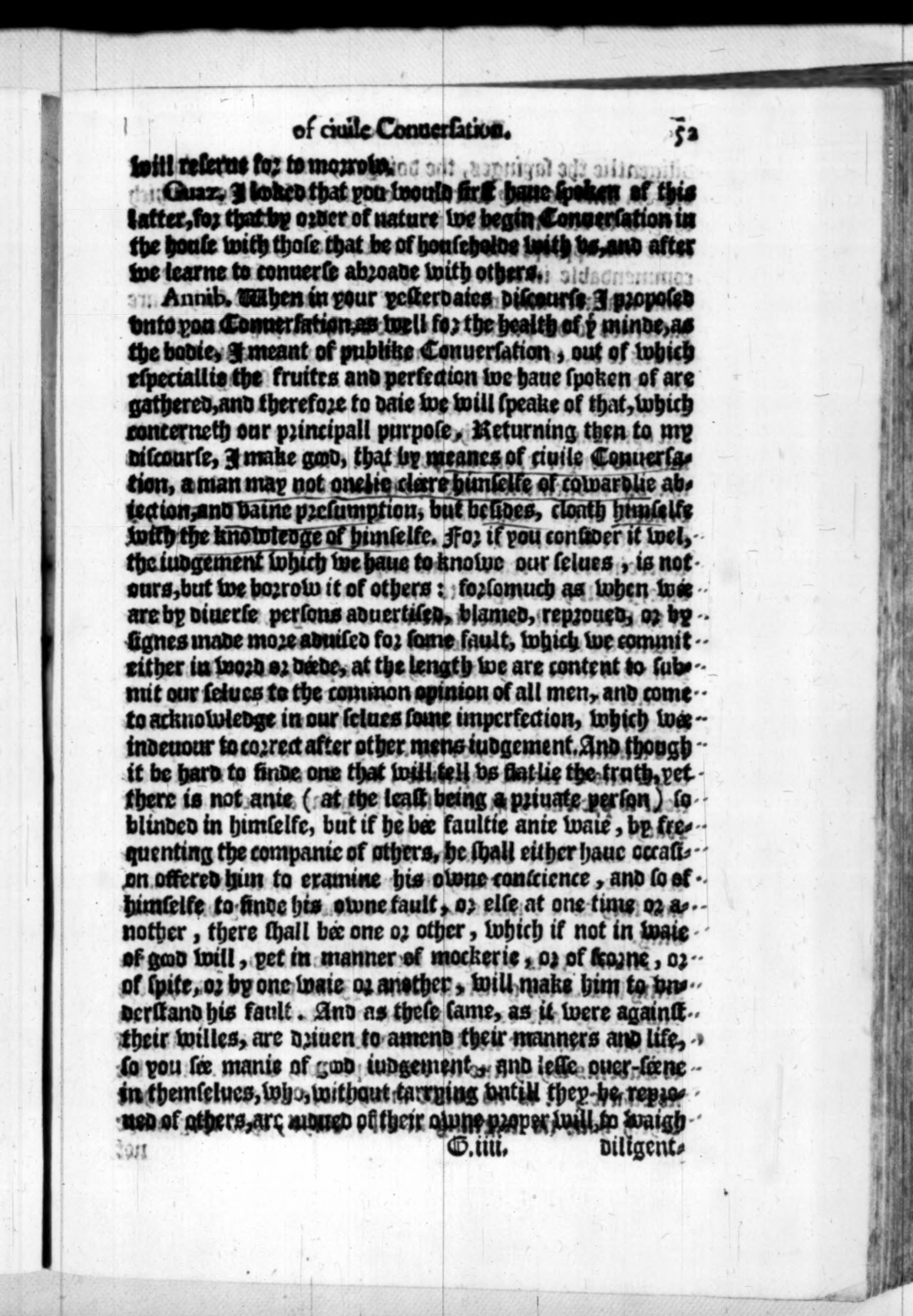
This is a substantial Shakespeare research avenue. John Gillies's 2018 article explicitly asks whether the book Ulysses reads in Troilus and Cressida 3.3 might be Guazzo, because Guazzo says that the judgment by which people know themselves “is not ours, but wee borrow it of others,” while Ulysses's book says no one knows what he possesses until his qualities are communicated to others and returned in their applause. The Folger text confirms the complete dramatic passage below.
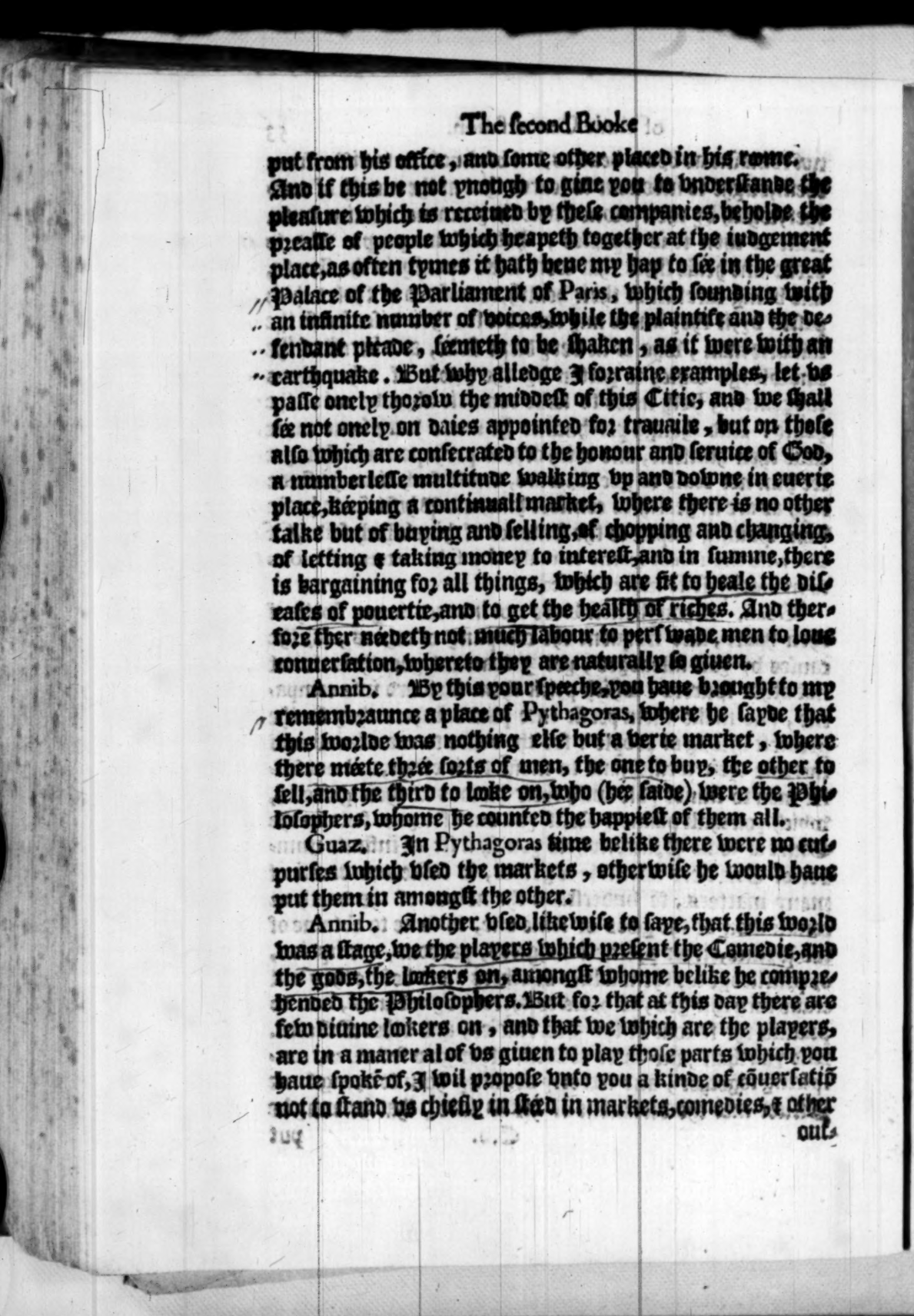
Other comparisons must be documented without collapsing a shared cultural topos into proof of direct borrowing. Guazzo's 1581 English text says “this world was a stage, wee the players whiche present the Comedie”; As You Like It says “All the world's a stage, / And all the men and women merely players.” The exact four-word EarlyPrint phrase world was a stage occurs only in Guazzo among the 23,000-plus locally indexed TCP texts, but the world-stage metaphor is ancient and widespread. The textual proximity is worth recording; it does not by itself identify a source.
The most creative new avenue is Love's Labour's Lost. Guazzo argues that learning reaches perfection through discourse, correction, and communal testing rather than isolated reading. The play begins by turning Navarre's court into “a little academe,” “still and contemplative,” with scholars secluded for three years. It later reverses that program when Berowne calls women “the books, the arts, the academes / That show, contain, and nourish all the world.” This is not yet a verbal-source conclusion. It is a precise structural question: does the play dramatize the same contest between solitary learning and knowledge completed through human conversation that organizes Guazzo's first book?
The surviving Billingbear book does not establish when it entered the library or who read it. It does, however, create a physical and bibliographical research target, while the 1581 and 1586 English editions establish broad English access before the Shakespeare plays considered here. The next decisive step is a complete photographic examination of Audley End object 81035060.
Source-Control Summary
- Billingbear witness:
IMG_8183directly records Guazzo, Venice, 1579. - Surviving-object witness: local English Heritage data record object
81035060, 1579, quarto, half calf,FR/19 Library, Case M, Shelf 6. - Exact-edition witness: the complete Google Books scan
eUBXAAAAcAAJsupplies the Altobello Salicato title page and the 382-page digitized copy. - English-text witness: EarlyPrint/TCP
A02291, STC12422, supplies searchable, encoded text for Pettie's 1581 translation of Books 1–3. - Complete English page-image witness: Internet Archive item
bim_early-english-books-1475-1640_the-civil-conversation-o_guazzo-stefano_1586supplies 477 page images of the 1586 Thomas East edition, including Bartholomew Young's Book 4. - Shakespeare witness: every Shakespeare statement below is accompanied by a direct quotation from the Folger corpus with preserved line breaks.
- Modern scholarship: Gillies 2018 explicitly develops the Guazzo/self-knowledge/Troilus question; Watson 2024 uses Guazzo to frame courtly role-playing in The Winter's Tale; Elam 1996 places Guazzo's courtesy/comedy relationship in the Italian cultural background of Twelfth Night.
- Open boundary: no current record dates the Billingbear copy's acquisition or identifies Henry Neville—or anyone else—as its early reader.
1. The Billingbear Entry and the Surviving Audley End Object
The photographed catalogue page is preserved here:
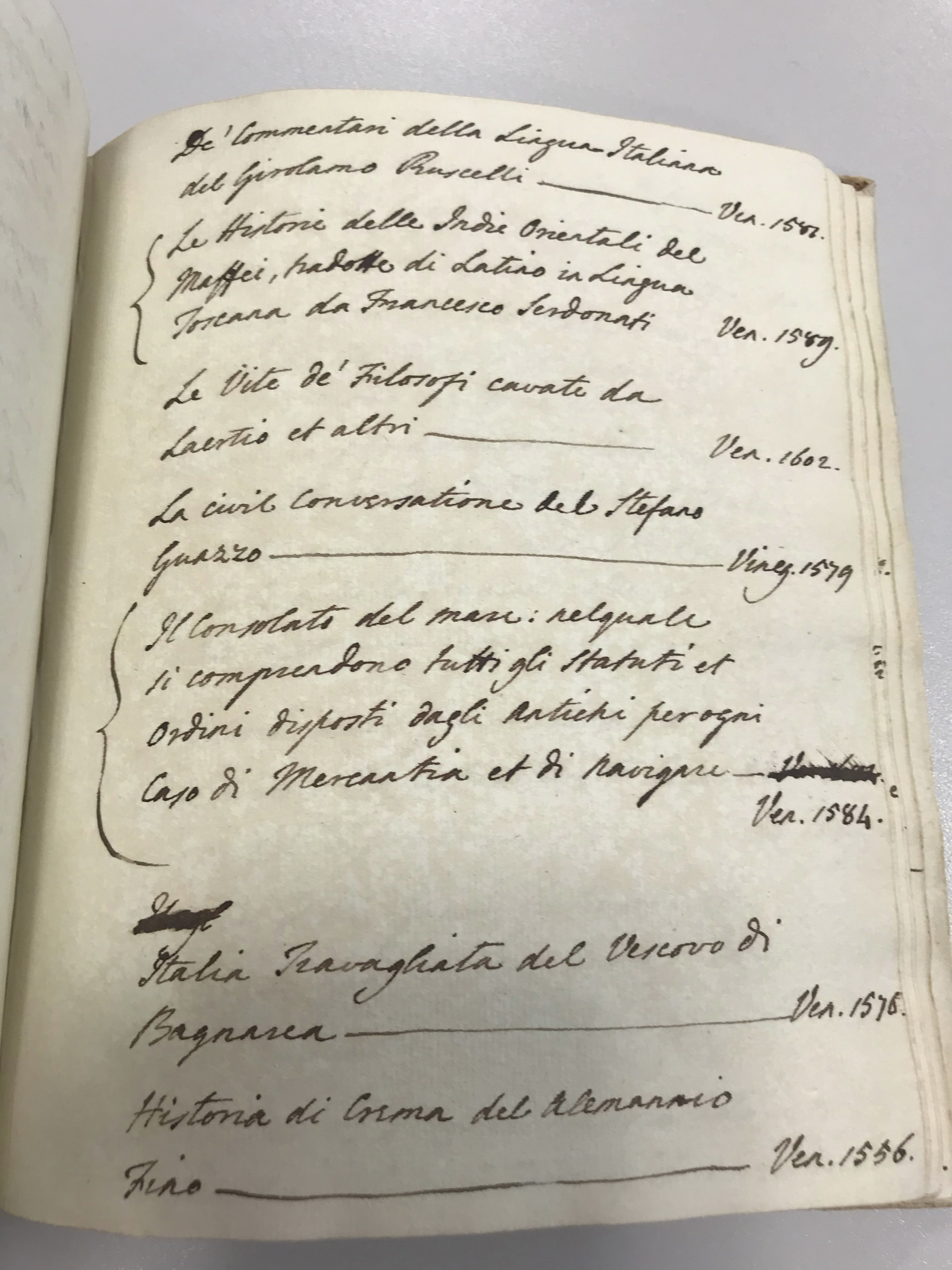
The combined workbook row records:
- English Heritage ID:
81035060; - present in the 1780 Billingbear list: yes;
- Audley End comparison flag:
1; - title: L'Opere di Guazzo;
- maker: Stefano Guazzo;
- date and place: Venice, 1579;
- format: quarto;
- binding: half calf;
- legal status: long-term loan;
- UCL note: La Civil conversatione del Stefano Guazzo.
The locally preserved English Heritage export adds:
ID Number: 81035060
Date Made: 1579
Title: L'Opere di Guazzo
Materials: HALF CALF
Measurements: 4to
Current Location: AUDLEY END HOUSE
Location Levels: FR/19 Library, Case M, Shelf 6
“Half calf” may describe a later binding. Only images of the binding, endpapers, title page, preliminary leaves, and text can reveal whether earlier provenance material survives.
2. The Exact Venice 1579 Edition
The Google Books title page reads:
LA CIVIL CONVERSATIONE
DEL SIG. STEFANO GVAZZO
GENTIL'HVOMO DI CASALE DI MONFERRATO,
DIVISA IN QVATTRO LIBRI.
Nuouamente dall'istesso auttore corretta, & in diuersi luoghi di molte cose, non meno utili che piaceuoli, ampliata.
In Vinegia, Presso Altobello Salicato, MDLXXIX.
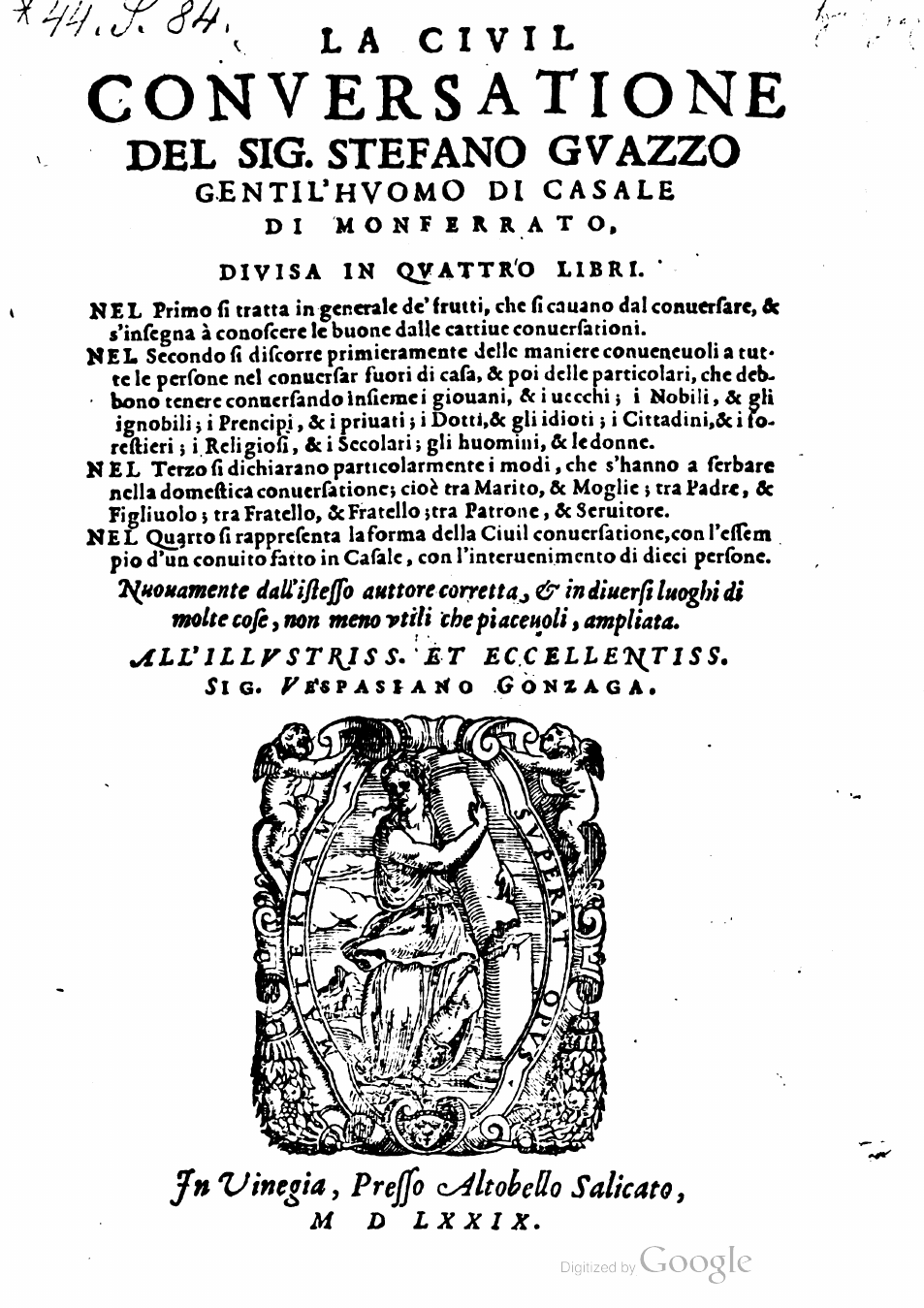
The title page itself supplies the architecture of the work:
- Book 1: the fruits of conversation and the distinction between good and bad company;
- Book 2: conduct outside the house among young and old, noble and non-noble, princes and private persons, learned and unlearned, citizens and strangers, religious and secular, men and women;
- Book 3: domestic conversation between husband and wife, father and son, brother and brother, master and servant;
- Book 4: a banquet at Casale involving ten people, demonstrating civil conversation in practice.
The author calls this edition corrected and enlarged. That phrase matters for future collation. The Audley End volume should be compared against this exact witness rather than against a 1574, 1580, 1588, or later edition merely because all carry the same general title.
Public controls: Google Books, 1579; USTC 835115.
3. English Transmission Before the Plays
Pettie, 1581
George Pettie's London 1581 translation contains Books 1–3. The Folger catalogue cautions that the vendor-supplied long title mentions Book 4 even though “Only books 1–3 [were] published in this edition.” Pettie translated through Gabriel Chappuys's French, not solely from the Italian.
- EarlyPrint/TCP:
A02291; - STC:
12422; - imprint: London, Richard Watkins, 1581;
- public text: Michigan EEBO-TCP;
- Folger catalogue: 1581 electronic record.
Pettie and Young, 1586
The complete 1586 title page makes the division of labor explicit. Pettie translated the first three books; Bartholomew Young of the Middle Temple translated Book 4 from Italian:
In the fourth is set downe the forme of Ciuile Conuersation, by an example of a Banquet, made in Cassale, betweene sixe Lordes and foure Ladies. And now translated out of Italian into English by Barth. Young, of the middle Temple, Gent.
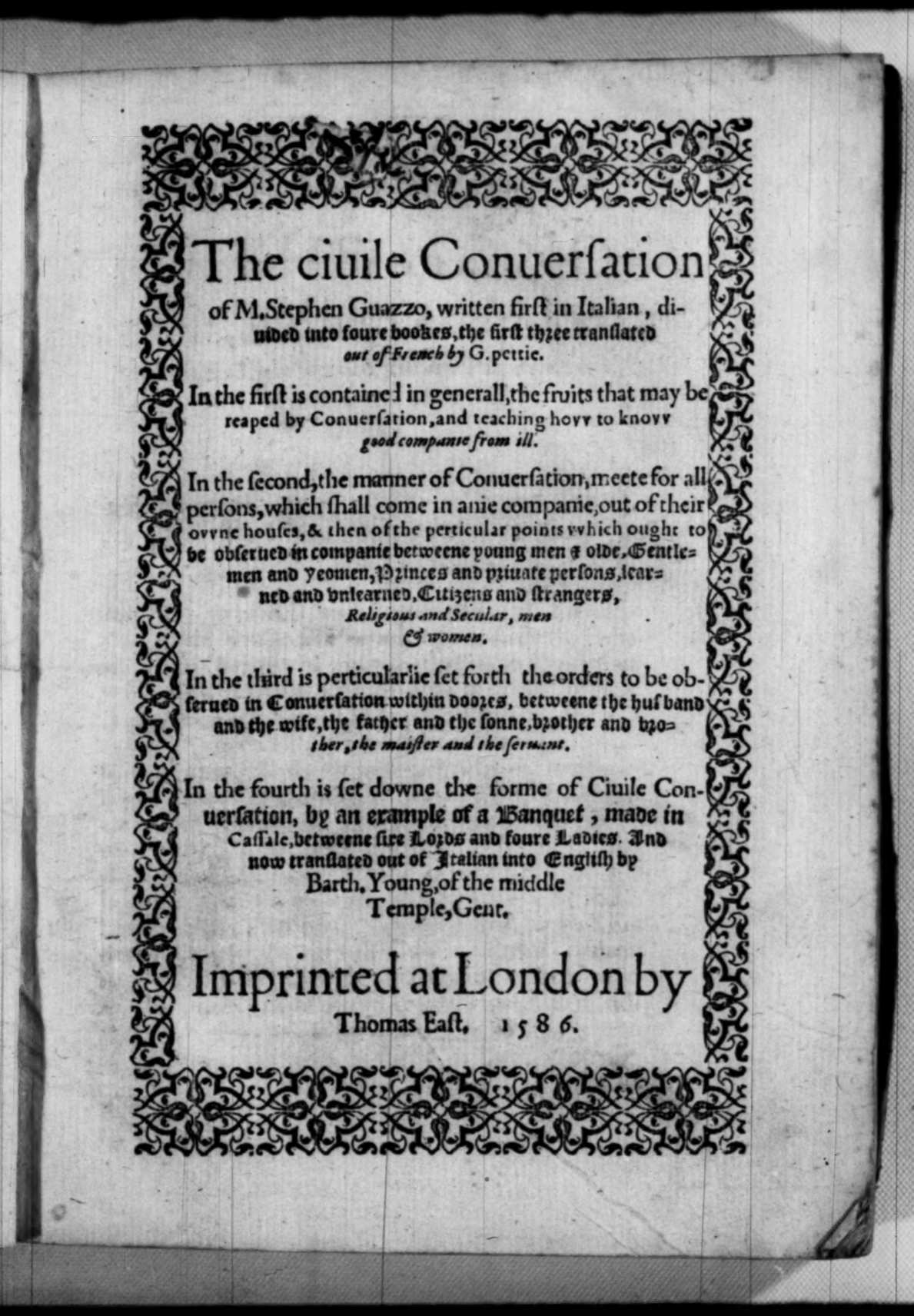
Archive control: Internet Archive item. The scan is a microfilm-derived image witness; its OCR was used for routing, while exact quotations were checked against EarlyPrint and rendered page images.
4. Quoted Source Passages: What Guazzo Actually Says
Conversation completes learning
Annibale argues that instruction begins with teachers, while knowledge must be tested through discourse with other learned people:
conversation is the full perfection of learning, and that it more auayleth a student to discourse one houre with his like, then to studie a whole day by himselfe in his studie. Yea and in conferring with his companions, if he haue vnderstood any thing amisse, he therby most commonly commeth to the right meaning of the matter, & cléereth his minde of many errours
He concludes:
vertue & knowledge set foorth in bookes, is naught else then a painted vertue: and that true vertue and learning, is gotten rather by practise then by reading.
Source: EarlyPrint A02291, TCP page break A02291-022-b; visually checked in the 1586 edition, printed Book 1 p. 16 / PDF page 45.
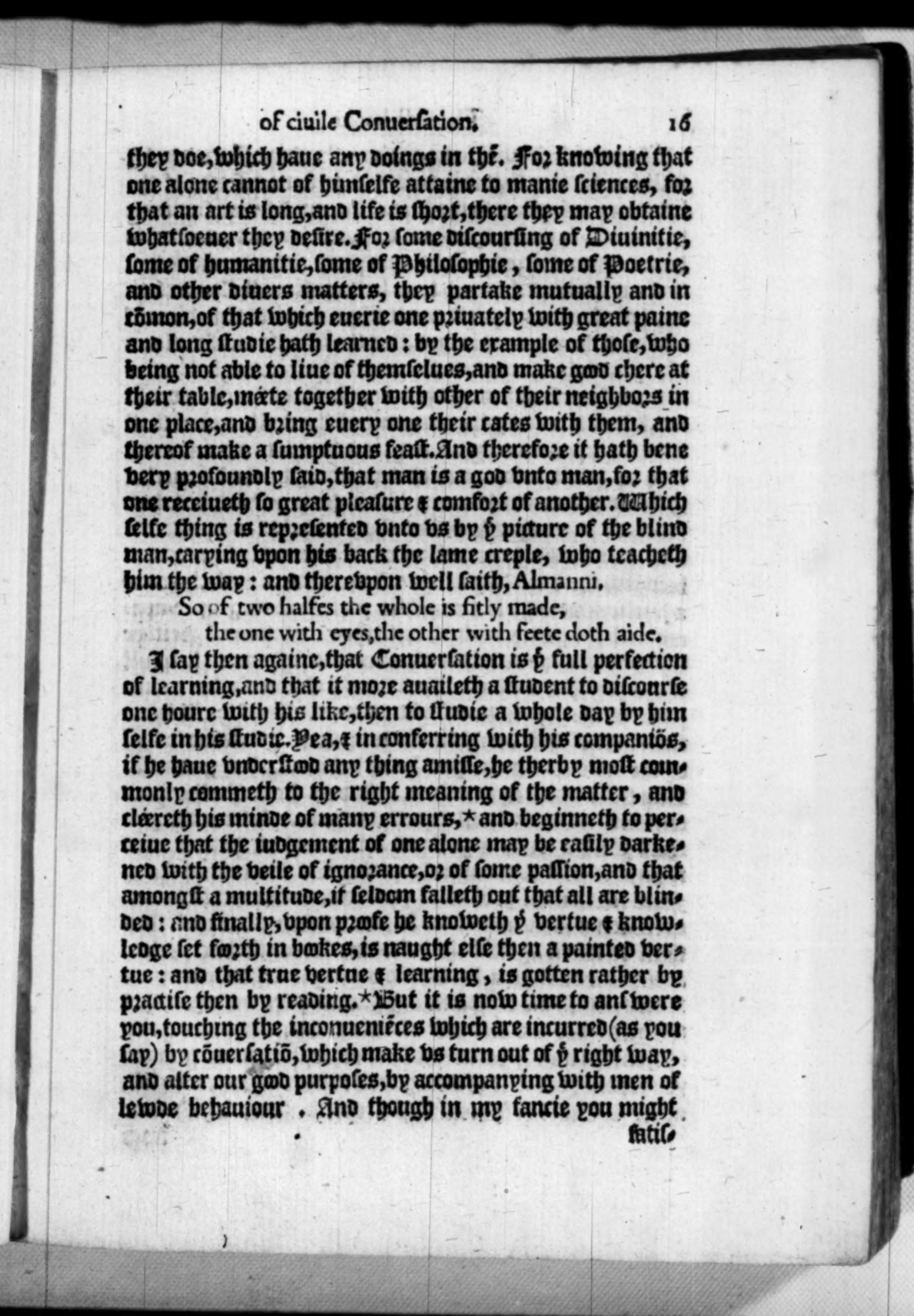
Academies pool specialized knowledge
Guazzo names academies or universities in Mantua, Pavia, and Casale. His explanation is communal rather than cloistered: because one person cannot master many sciences in a short life, participants bring privately acquired learning together like neighbors contributing dishes to a feast. He writes that they discuss:
some of diuinitie, some of humanitie, some of Philosophy, some of Poetry, and other diuers matters, they partake mutually & in common, of that which euery one priuately with great paine & long study hath learned
Source: EarlyPrint A02291, TCP page breaks A02291-022-a to A02291-022-b.
The self is known through other people
At the beginning of Book 2, Annibale states:
the iudgement which wée haue to knowe our selues, is not ours, but wée borrow it of others
He explains that correction, blame, mockery, and observation of other people's conduct cause individuals to recognize and amend their own faults:
our iudgements, and the knowledge of our selues, dependeth of the iudgement and conuersation of many
Source: EarlyPrint A02291, TCP page breaks A02291-058-b to A02291-059-b; visually checked in the 1586 facsimile, PDF page 115.
Social adaptation and moral continuity
Guazzo recognizes a tension at the heart of civil behavior:
to be acceptable in companie, we must put of as it were our own fashions and manners, and cloath our selues with the conditions of others
Yet he immediately reserves a stable moral core:
touching the respect of honestie and vertue, wée ought to bée alwayes one and the same. But touching the diuersitie of the persons with whom wée shall be conuersaunt, wée must alter our selues into an other
Source: EarlyPrint A02291, TCP page break A02291-053-b.
Conversation can transmit vice
Guazzo also describes social formation as infection:
as some diseases of the body are infectious, so the vices of the minde take from one to another
and:
so much force hath continual conuersation, that oft times against our wils, we imitate the vices of others
Source: EarlyPrint A02291, TCP page break A02291-023-a.
The world as stage
The 1581/1586 English text says:
Another vsed likewyse to say, that this world was a stage, wée the players whiche present the Comedie, and the gods, the lookers on
Annibale then turns the metaphor toward compromised social performance, observing that there are few divine spectators and that the players commonly perform self-interested parts.
Source: EarlyPrint A02291, TCP page break A02291-060-b; visually checked in the 1586 edition, printed Book 2 p. 54 / PDF page 118 / Archive leaf n117.
5. Love's Labour's Lost: Solitary Academy Versus Conversational Learning
The play begins with the King of Navarre converting a court into a secluded academy. From the Folger corpus, Love's Labour's Lost 1.1:
KING
Let fame, that all hunt after in their lives,
Live registered upon our brazen tombs,
And then grace us in the disgrace of death,
When, spite of cormorant devouring time,
Th' endeavor of this present breath may buy
That honor which shall bate his scythe's keen edge
And make us heirs of all eternity.
Therefore, brave conquerors, for so you are
That war against your own affections
And the huge army of the world's desires,
Our late edict shall strongly stand in force.
Navarre shall be the wonder of the world;
Our court shall be a little academe,
Still and contemplative in living art.
You three, Berowne, Dumaine, and Longaville,
Have sworn for three years' term to live with me,
My fellow scholars, and to keep those statutes
That are recorded in this schedule here.
Source: act 01 scene 01:11.
The play later makes Berowne reverse the premise. From Folger, 4.3:
BEROWNE
From women's eyes this doctrine I derive.
They sparkle still the right Promethean fire.
They are the books, the arts, the academes
That show, contain, and nourish all the world.
Else none at all in ought proves excellent.
Source: act 04 scene 03:536.
Guazzo's first book supplies a historically exact conceptual comparator: solitary study produces only “painted” learning unless it is exercised, corrected, and completed through other people. The play does not reproduce Guazzo's dialogue or simply endorse Berowne's erotic rhetoric. It stages a comparable reversal from regulated seclusion to knowledge claimed through social and gendered encounter. This should be tested against Castiglione, academies literature, anti-monastic satire, and other conduct books before being presented as a distinct source claim.
6. Troilus and Cressida: Ulysses Reads a Book About Borrowed Self-Knowledge
Gillies identifies the closest philosophical convergence. Guazzo says self-judgment is borrowed from others. In Troilus and Cressida 3.3, Ulysses is explicitly reading. The complete Folger passage reads:
ACHILLES What are you reading?
ULYSSES A strange fellow here
Writes me that man, how dearly ever parted,
How much in having, or without or in,
Cannot make boast to have that which he hath,
Nor feels not what he owes, but by reflection;
As when his virtues, shining upon others,
Heat them, and they retort that heat again
To the first giver.
ACHILLES This is not strange, Ulysses.
The beauty that is borne here in the face
The bearer knows not, but commends itself
To others' eyes; nor doth the eye itself,
That most pure spirit of sense, behold itself,
Not going from itself, but eye to eye opposed
Salutes each other with each other's form.
For speculation turns not to itself
Till it hath traveled and is mirrored there
Where it may see itself. This is not strange at all.
ULYSSES
I do not strain at the position--
It is familiar--but at the author's drift,
Who in his circumstance expressly proves
That no man is the lord of anything--
Though in and of him there be much consisting--
Till he communicate his parts to others;
Nor doth he of himself know them for aught
Till he behold them formed in the applause
Where they're extended
Source: act 03 scene 03:151.
Gillies writes that the position is “credited to a book (Guazzo?) that Ulysses happens to be reading at that very moment.” The question mark must remain. The passage is nevertheless more specific than a generic resemblance: both texts make self-knowledge depend on qualities communicated to other people and reflected back through their judgment.
7. As You Like It: The World-Stage Formulation
From the Folger corpus, As You Like It 2.7:
DUKE SENIOR
Thou seest we are not all alone unhappy.
This wide and universal theater
Presents more woeful pageants than the scene
Wherein we play in.
JAQUES All the world's a stage,
And all the men and women merely players.
They have their exits and their entrances,
And one man in his time plays many parts
Source: act 02 scene 07:209.
Guazzo's English wording—“this world was a stage, wée the players whiche present the Comedie”—is close enough to preserve in the source map. The larger passage also treats courtiers as people who “play” interested social parts. Yet the world-as-stage topos long predates both texts. The useful research question is not whether Guazzo invented it, but whether the 1581 English formulation and its conduct-book application helped shape this particular dramatic use.
8. Social Infection and Sonnet 111
Guazzo says habitual company can alter a person “against our wils.” Folger's Sonnet 111 gives public employment and manners a similarly staining force:
O, for my sake do you with Fortune chide,
The guilty goddess of my harmful deeds,
That did not better for my life provide
Than public means which public manners breeds.
Thence comes it that my name receives a brand;
And almost thence my nature is subdued
To what it works in, like the dyer's hand.
Pity me, then, and wish I were renewed,
Whilst, like a willing patient, I will drink
Potions of eisel 'gainst my strong infection
Source: sonnet 111:3.
Gillies uses this sonnet to explain the older sense of conversation as conduct and social environment: the self can be colored by what it continually does and by the company in which it lives. This is a conceptual comparison, not a verbal-source assertion.
9. Performed Identity, Othello, and The Winter's Tale
Guazzo's tension between a stable moral self and adaptation to the conditions of others creates a useful language for courtly role-playing. Gillies relates it to Iago. The full Folger context makes the performance explicit:
IAGO
Were I the Moor I would not be Iago.
In following him, I follow but myself.
Heaven is my judge, not I for love and duty,
But seeming so for my peculiar end.
For when my outward action doth demonstrate
The native act and figure of my heart
In complement extern, 'tis not long after
But I will wear my heart upon my sleeve
For daws to peck at. I am not what I am.
Source: act 01 scene 01:83.
Watson's 2024 chapter uses Guazzo to frame the moral ambiguity of the dependent courtier in The Winter's Tale. Camillo outwardly submits to Leontes while seeking a course that will not make him a murderer. Folger, 1.2:
CAMILLO I must believe you, sir.
I do, and will fetch off Bohemia for 't--
Provided that, when he's removed, your Highness
Will take again your queen as yours at first,
Even for your son's sake, and thereby for sealing
The injury of tongues in courts and kingdoms
Known and allied to yours.
and shortly afterward:
CAMILLO My lord,
Go then, and with a countenance as clear
As friendship wears at feasts, keep with Bohemia
And with your queen. I am his cupbearer.
If from me he have wholesome beverage,
Account me not your servant.
Source: act 01 scene 02:521.
These plays do not merely illustrate etiquette. They test the moral consequences of adapting outward conduct to a ruler or social role—precisely the unresolved pressure in Guazzo's instruction to remain morally “one and the same” while altering oneself toward different conversational partners.
10. The Word “Conversation” in Pericles
The early modern word can denote a whole manner of life. Folger's Pericles uses it in that moral sense:
The good in conversation,
To whom I give my benison,
Is still at Tarsus, where each man
Thinks all is Writ he speken can
Source: act 01 scene 04:180.
This does not point uniquely to Guazzo. It confirms that a reader of the play must not reduce “conversation” to spoken chat. Conduct, company, reputation, and moral habit are all active senses.
11. Local Scholarship Already in the Project
Owen Duncan
Duncan's 1974 dissertation already named Guazzo in its account of Henry Neville's proposed educational environment. Duncan says Gabriel Harvey observed Cambridge undergraduates reading Castiglione, Philbert, Guazzo, and Guicciardini, and that Curtis found Guazzo among Oxford scholars' library inventories. This is a useful route, not direct proof that Neville read Guazzo. The underlying Harvey letter, Curtis pages, and probate inventories must be checked.
The newly isolated Billingbear object changes the status of Duncan's mention: Guazzo is no longer only a conjectural curriculum title. An exact 1579 edition appears in the family library and survives at Audley End. What remains unknown is when it entered that library.
John Gillies
Gillies, “The Conversational Turn in Shakespeare” (2018), distinguishes conversation as social/moral habit from conversation as verbal exchange. He treats Guazzo as a major agent in the secular and pragmatic development of the term and explicitly proposes the Troilus book question. document witnesses: Gillies Conversational Turn in Shakespeare 2018; open article.
Jasmine Watson
Watson's 2024 chapter on epistolary courtiership quotes Guazzo's advice about tolerating a man reputed good even when private conscience distrusts him, then uses the conduct-book problem to analyze Camillo's performed obedience in The Winter's Tale. This is a valuable bridge between Guazzo, Inns-of-Court culture, letters, service, and drama. Local extracted chapter: WATSON J 2024 EPISTOLARY COURTSHIP DRAMATIC LETTERS 10.1515 9781474483391 008.
Keir Elam
Elam's “The Fertile Eunuch” (1996) places Guazzo's courtesy/comedy relationship in the Gonzaga cultural background through which he approaches Twelfth Night. He quotes the world-stage passage and emphasizes Guazzo's combination of courtesy, wit, comedy, and performed civility. This supports a broad Italian dramatic-conduct context, not a claim that Guazzo directly supplied the plot of Twelfth Night. Local text: Elam FertileEunuchTwelfth 1996.
Oxford's 2026 dialogue history
The 2026 chapter “Fashioning Community in Civil (and Uncivil) Conversations” places Pettie/Young's Guazzo among a family of Italianate English dialogues and stresses that dialogue forms communities as well as exchanging words. It quotes Guazzo's expansive claim:
The tongue serveth us to teach, to demaund, to confer, to traffike, to counsaile, to correct, to dispute, to judge, and to expresse the affection of our heart: meanes whereby men come to love one another, and to linke themselves togeather.
Public source: Oxford Academic chapter.
12. EarlyPrint Phrase Checks
The EarlyPrint FTS was queried against word_text:
| Phrase | TCP hits | Result |
|---|---|---|
"world was a stage" | 1 | Guazzo, A02291 |
"full perfection of learning" | 1 | Guazzo, A02291 |
"borrow it of others" | 2 | Guazzo in the self-knowledge sense; an unrelated 1632 sermon in another sense |
The result makes Guazzo's exact English stage wording conspicuous in the indexed corpus. It does not demonstrate that the topos itself was rare, because other writers could express it with different words, in Latin, in manuscript, or in texts outside TCP. Full report: EARLYPRINT PHRASE SEARCH REPORT.
13. Research Program
- Request a complete image set for Audley End object
81035060: covers, spine, edges, endpapers, pastedowns, all preliminary leaves, title page, colophon, every marked page, and representative gatherings. - Collate the physical object against the 1579 Altobello Salicato scan and USTC 835115.
- Reconstruct binding and shelf-mark history across the 1780 Billingbear catalogue, 1834 and 1877 Audley End catalogues, and later English Heritage records.
- Obtain and read John Lievsay's Stefano Guazzo and the English Renaissance, 1575–1675 (1961) and Daniel Javitch's “Rival Arts of Conduct in Elizabethan England” (1971).
- Verify Duncan's Harvey/Curtis educational claims from the underlying letterbook and Oxford inventories.
- Compare Guazzo's academy passages against the whole Folger text of Love's Labour's Lost, not only the two quoted nodes.
- Search EarlyPrint by concepts and spelling variants: solitude/study, conference/correction, self-knowledge/reflection, borrowed judgment, stage/player/comedie, infection/companions, changing one's manners, and flattery.
- Compare Guazzo with Castiglione, Della Casa, Cinthio's civil-life dialogues, Whetstone, Bryskett, and Montaigne so that shared conduct-book conventions are not misidentified as unique correspondences.
- Examine whether Henry Neville's surviving letters enact or explicitly discuss the same problems: counsel, truth before princes, adaptation to audiences, reputation, frank speech, flattery, and judgment formed through multiple reports.
Sources
- Billingbear catalogue,
IMG_8183: Billingbear Book List Transcription:615; billingbear IMG 8183 rotated. - Billingbear/Audley End combined workbook: BOOKS_BRO_AEH_COMBINED_190830.xlsx.
- English Heritage object export: pre 1616 books Feb 2010 Audley End from 2023 thread:958.
- Guazzo, La civil conversatione, Venice, Altobello Salicato, 1579: Google Books; googlebooks eUBXAAAAcAAJ 1579.
- Guazzo/Pettie, The civile conversation, London, 1581, TCP
A02291: Michigan text; A02291 EarlyPrint TEI. - Guazzo/Pettie/Young, The civile Conversation, London, Thomas East, 1586: Internet Archive; bim early english books 1475 1640 the civil conversation o guazzo stefano 1586.
- John Gillies, “The Conversational Turn in Shakespeare,” Études Épistémè 33 (2018), DOI 10.4000/episteme.2336.
- “Fashioning Community in Civil (and Uncivil) Conversations,” in Dialogue in Late Medieval and Early Modern England, c. 1400–1680 (Oxford University Press, 2026): chapter.
- Owen Duncan dissertation: DUNCAN OL 1974 7424317 combined:1190.
- Jasmine Watson, “Royal Prerogative and the Role of Counsel,” local 2024 book chapter extraction cited above.
- Keir Elam, “The Fertile Eunuch: Twelfth Night, Early Modern Intercourse, and the Fruits of Castration,” Shakespeare Quarterly 47.1 (1996), local JSTOR extraction cited above.
15. Notes on Access
- The 1579 Google Books witness is full view and has been downloaded locally in its entirety.
- EarlyPrint/TCP
A02291is a complete searchable transcription of the 1581 English Books 1–3; it is not a page-image witness. - The 1586 Internet Archive item is a complete microfilm-derived page-image witness with OCR. OCR supplied search routes only; exact wording was checked against page images and the TCP text.
- The matching Audley End object
81035060has not yet been imaged for this project. Its binding, preliminaries, annotations, inscriptions, and collation remain the main access gap. - The Lievsay 1961 monograph and Javitch 1971 essay have been identified but not yet acquired in complete searchable form.
Documentation Rule
No Shakespeare wording in this packet is supplied from memory. Every claim about a play or sonnet is accompanied by a quotation from the Folger corpus, preserving Folger line breaks and speaker labels.