As You Like It
Topic: As You Like It
Book integration and current controls — 31 August 2026
Chapter 22 has been reorganized around five affirmative, source-controlled facts:
- Lodge's checked 1592 Rosalynde witnesses contain no
AmiensorAmyens, - Neville dated a letter “Between Amyens and Abbeville” on
14 May 1600 - Neville's
24 September 1599underhand dissuade ... from construction - Canonical corpus v22 contains
23proposition lemma tokens in13records, - Neville's
18 July 1599treaty copulative becomes Touchstone's “country
while As You Like It adds Lord Amiens in 2.1.
(Winwood 1:183–85).
precedes the Folio's underhand means ... dissuade ... from construction.
beginning 26 May 1599; the broad term is common in prose but rare in the contemporary dramatic comparison.
copulatives”; the checked 1590–1615 drama set has the singular or plural in six plays, but the plural only in As You Like It.
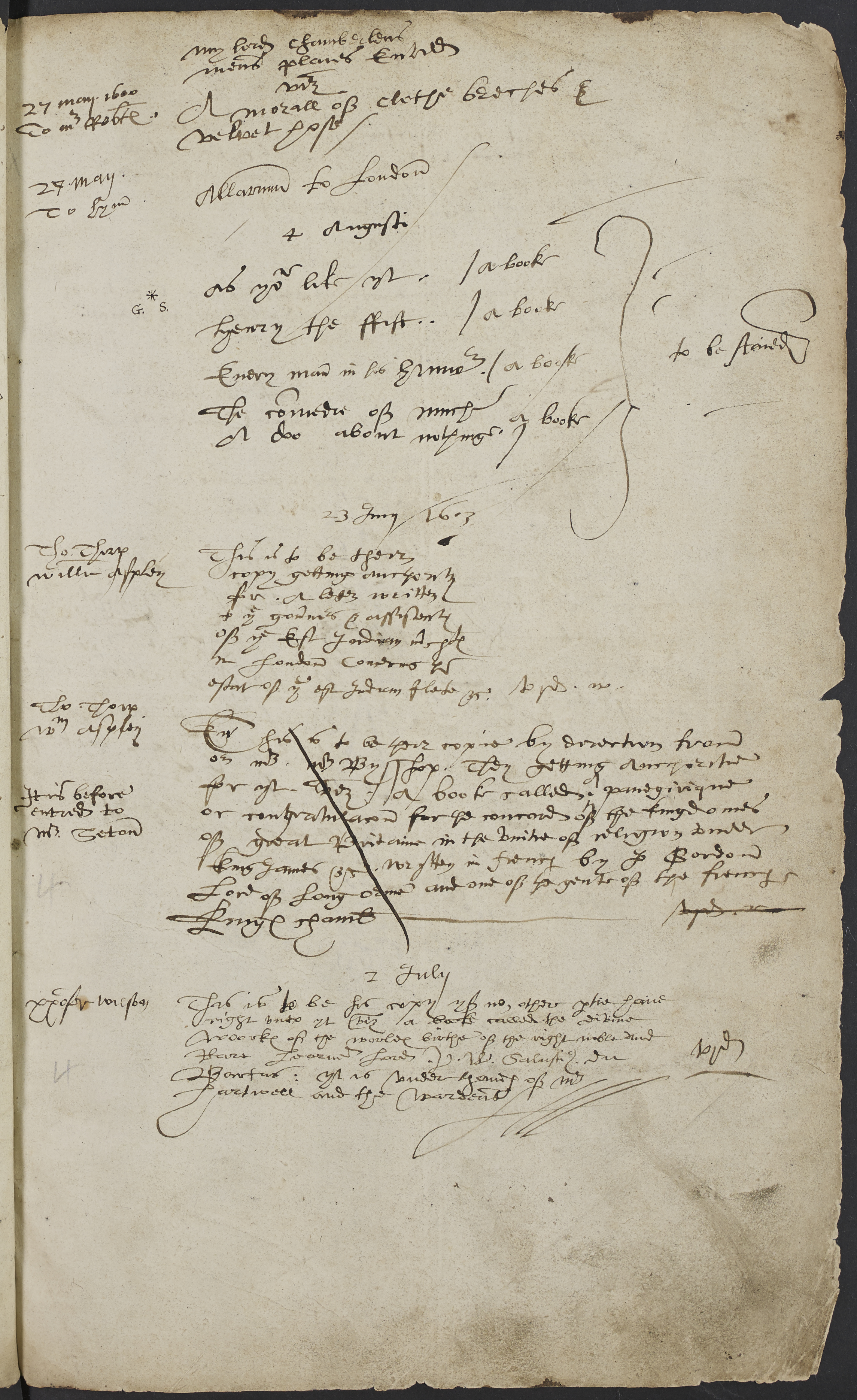
The return chronology is fixed independently: Fane reports Neville at Dover on 2 August 1600; Liber C marks the play “to be staied” on 4 August; Neville writes from London on 6 August. The register does not name the requester.
Current canonical corpus control: version 22, 168 letter records plus 3 longer documents, 138,969 normalized word tokens, SHA-256 8787d328581f4adacc3b160dcfef6eb1c04a683efbdf2e10cb7404900cdbba25.
Source-Fact Audit — 7 August 2026 (Round 3)
- The Stationers' Register memorandum of 4 August 1600 lists As You Like It, Henry V, Much Ado About Nothing, and Jonson's Every Man in His Humour “to be staied.” This dates a documentary intervention; it does not identify who requested it or explain its legal effect.
- The Neville and Folger passages quoted below preserve the correspondence in underhand, dissuade, and from with their original lineation. They are source-labelled verbal correspondences, not a source or authorship conclusion.
- Neville's singular copulative and Touchstone's plural copulatives likewise belong in the fully quoted comparison below, with grammatical number and context preserved.
- Earlier counts in this packet were produced against corpus v10 and remain historical computations. The current canonical control is v22 (168 letters plus three documents); no earlier result is silently relabelled as a v22 result.
- A negative search of the checked 1592 Rosalynde OCR/TCP text for
Amiens/Amyensis bounded by witness and spelling. It is not proof that every edition or form lacks the name.
Source-Control Summary
- Play anchor: Oliver uses
underhand meansanddissuadein one compact collocation (act 01 scene 01:193). - Neville anchor:
the King did underhand dissuade them / from peaceis the closest current letter-side control (letter 030:104). - Play anchor:
country / copulativesshould be cited with Neville'sclause copulativepassage, not as a standalone word match (act 05 scene 04:111, letter 014:126). - Guardrail: the strongest AYLI claims remain collocation/register leads after sense checking, not first-use claims.
- Direct-source upgrade: the
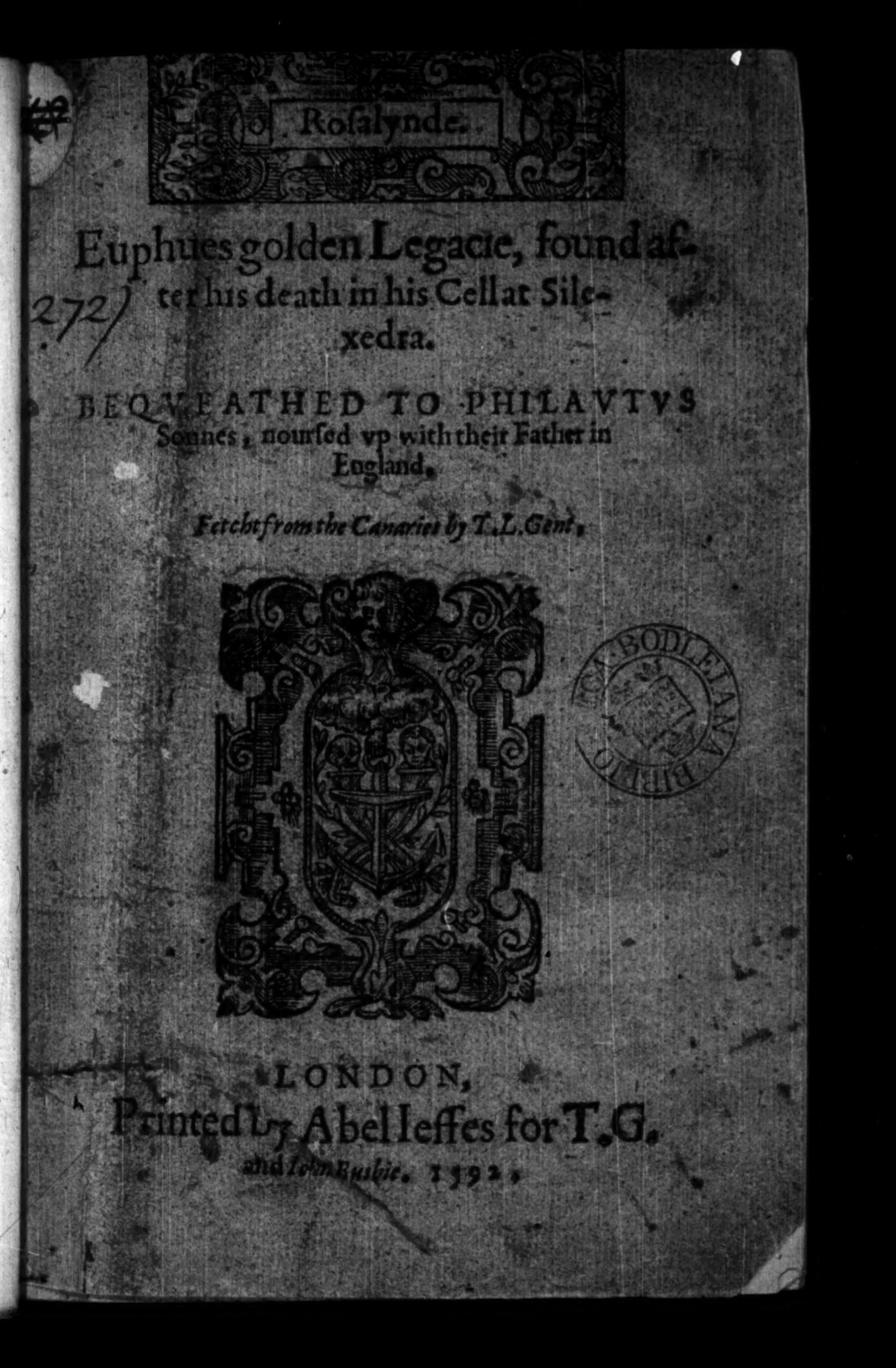
1592Archive.org EEBO image witness for Lodge's Rosalynde is now retained locally, and independent OCR/TCP checks both return noAmiensorAmyens. - Register upgrade: the full Liber C flyleaf image is now retained locally; it verifies the list and
to be staiedbracket while leaving agency unproved. - Dropped lead:
the first time that ever Iis not part of the current AYLI evidence lane because the v10 exact-phrase check did not reproduce it.
Quoted Source Passages
1. "Underhand Means" and "Dissuade"
- Source: Folger As You Like It, act 01 scene 01:193.
- Quotation:
I had
myself notice of my brother's purpose herein, and
have by underhand means labored to dissuade him
from it;
- Neville-side source:
letter_030, Paris,24 Sept. 1599O.S., letter 030:104. - Neville quotation:
the King did underhand dissuade them
from peace
- What it proves: the play and Neville letter share a compact
underhand+dissuadecollocation, though the play turns a diplomatic verb cluster into domestic comic villainy. - Limits: this is a close collocation and local-play-search lead, not an exact full-phrase borrowing proof.
2. "Country Copulatives" and Treaty Clause Logic
- Source: Folger As You Like It, act 05 scene 04:111.
- Quotation:
I
press in here, sir, amongst the rest of the country
copulatives, to swear and to forswear
- Neville-side source:
letter_014,18 July 1599O.S., letter 014:126. - Neville quotation:
King's or Admiral's passport, to such ships as you intend shall pass free: and
so to make the clause copulative, which is now disjunctive
- What it proves:
copulativeis present in the play as comic marriage/legal language and in Neville as technical treaty-clause language. - Limits: the senses are related but not identical. Use this as technical-word overlap with a sense-shift caveat.
3. "Propositions of a Lover"
- Source: Folger As You Like It, act 03 scene 02:324.
- Quotation:
It is as easy to count atomies as to resolve the
propositions of a lover.
- What it proves: the play uses
propositionsin a comic/erotic reasoning frame, which explains why the letter-alignment lane must be framed as a semantic transformation rather than a simple same-sense match. - Limits: the Neville letter evidence for diplomatic
propositionremains useful, but this quotation shows the play-side context is comic and should not be flattened into diplomacy.
4. Amiens and Forest Venison
- Source: Folger As You Like It, act 02 scene 01:7 and act 02 scene 01:36.
- Quotation:
[Enter Duke Senior, Amiens, and two or three Lords, like
foresters.]
Come, shall we go and kill us venison?
- What it proves: the play-side Amiens/forest/venison cluster is real and sourceable from the Folger chunks.
- Limits: the separate
Amiensmanuscript-note witness still needs archival shelfmark/page control before book quotation; cite the current topic's Amiens warning when using this lane.
1. Source-Control Position
This packet is no longer a single argument bucket. It has five separate evidence lanes:
- direct play text from the Folger chunks;
- dating and Stationers' Register evidence;
- Neville-letter lexical alignments;
- Cuffe / Jaques structural and character-profile evidence;
- n-gram and generated-audit leads.
The source-control result is mixed. The direct play-text anchors, the 4 August 1600 Stationers' Register note, and the local v10 vocabulary controls are solid. The larger claims about Neville return timing, authorial involvement, Cuffe access, and n-gram significance remain interpretive or candidate-level unless paired with stronger source witnesses.
Web, Archive, and Local-Search Position
- A direct 1592 Rosalynde page-image witness was located under Archive.org identifier `bim_early-english-books-1475-1640_rosalynde-euphues-golde_1592`. The full 125.8 MB PDF, OCR, and title-page derivative are retained in the NETWORK PLAY CLUSTER SOURCE PASS 2026 07 09.
- The public OCR independently returns zero
Amiens/Amyenshits while returningRosader,Saladyne, andAlinda. Because the OCR is noisy, the governing negative control remains the agreement between this public OCR and the local TCPA06173XML/FTS check. - No new external primary source in this pass upgrades the Cuffe/Jaques lane.
- Keep the play packet's useful external control as the Stationers' Register/date lane, not as proof of Cuffe borrowing.
- The next useful research is local and comparative: extract Cuffe primary passages, run EarlyPrint/play negative controls for the specific Jaques/Cuffe vocabulary, and mark each result by genre and date.
- Book-safe formulation remains: Cuffe supplies a historically plausible Essex-circle intellectual analogue for parts of the play's melancholy/political register; the packet does not yet prove a source relationship.
2. Direct Play-Text Facts
The following Folger chunk witnesses were checked directly:
1.3: Rosalind imaginesA boar-spear in my hand.1.3: Duke Frederick banishes Rosalind and gives theWithin these ten daysdeadline.2.1: Duke Senior asks,Come, shall we go and kill us venison?2.1: the wounded-stag passage containsa poor sequestered stag,from the hunter's aim, andIn piteous chase.2.1: the same scene containsSermons in stones.2.7: Jaques's seven-ages speech containsSighing like furnaceandEven in the cannon's mouth.3.1: Duke Frederick says Oliver's goods areWorth seizure.3.2: Celia says it is as easy to countatomiesas to resolvethe propositions of a lover.5.3: the page's singing preface includeswithout hawking or spitting.5.4: Touchstone says he presses in amongthe country copulatives.
These are play-text anchors only. They do not by themselves establish a Neville connection.
3. Dating And Register Lane
Shakespeare Documented's Folger page for the Stationers' Register flyleaf confirms the external documentary anchor:
- document: Stationers' Company
Liber C, flyleaf; - date on the document page:
August 4, 1600; - plays noted: Henry V, Much Ado About Nothing, As You Like It, and Jonson's Every Man in His Humor;
- the plays are bracketed together with the note
to be staied; - the page's semi-diplomatic transcription is explicitly marked as pending final vetting and based on Arber.
The full Folger/Shakespeare Documented image is now retained locally at Liber C flyleaf TSC 1 E 06 02 1595 1631 0044 pr44. Direct inspection confirms the play list and bracketed to be staied note. The image closes the witness-retention question but does not identify who requested or enforced the stay.
The local Neville wiki timeline gives Neville's return from France as 2 Aug -- Henry Neville, his wife and children arrive in Dover from France. That timeline item is now backed by the HMC Salisbury/Hatfield printed calendar, with an important distinction between Dover arrival and later London/court arrival. The timing argument should therefore be phrased as:
- verified:
4 August 1600Stationers' Register flyleaf note; - verified printed-calendar witness: HMC Salisbury/Hatfield vol. 10, printed p. 261, Sir Thomas Fane to Lord Cobham, Dover Castle,
2 August 1600, reporting Neville's arrival at Dover from Boulogne with his wife, family, Secretary Herbert, and the other treaty commissioners; - Cecil-facing bridge: Neville's later first-person statement to Cecil remembers reaching London from Boulogne around
6 August 1600; - Folger court chronology: Neville was at court on recall from France on
7 August 1600; - interpretation: the
4 August 1600stay falls inside Neville's documented return week, but it does not by itself prove authorial approval, revision, or manuscript control.
Full source-control analysis:
- AS YOU LIKE IT STATIONERS RETURN SOURCE ANALYSIS 2026 06 24
4. Vocabulary And Letter-Alignment Lane
The current controlling vocabulary work is the v10 rerun and the French diplomatic vocabulary packet, not the old wiki page by itself.
| item | play witness | Neville witness | current disposition |
|---|---|---|---|
proposition | As You Like It 3.2, propositions of a lover | v10 letter_007, 26 May 1599, repeated written diplomatic proposition contexts | Strongest As You Like It vocabulary candidate; still needs sense framing because the play use is comic/erotic and the letter use is diplomatic. |
copulative | As You Like It 5.4, country copulatives | v10 letter_014, 18 July 1599, treaty clause made copulative rather than disjunctive | High-color technical-word overlap; useful only with sense contrast clearly stated. |
material | As You Like It 3.3, Audrey's material fool | v10: 8 hits in 7 Neville letters, often war/news/commodity contexts | Keep as a supporting lead; it needs a sense argument before use as standalone evidence. |
seizure | As You Like It 3.1, Worth seizure | v10 letter_014, more in danger of seizure at home | Candidate administrative/legal overlap; keep as close-reading lead, not proof. |
sermon | As You Like It 2.1, Sermons in stones | v10 letter_036, people murmuring that Neville had a sermon in my house | The overlap is real but semantically loose; useful only as a generated close-reading lead. |
within these ten days | As You Like It 1.3 | v10 letter_077, 9 Sept. 1600 O.S. / 19 Sept. 1600 N.S., Neville to Winwood: appointed to set forward within these ten days | Source-map corrected; this is not the Hamlet cannon letter. Treat as phrase lead, not strong evidence. |
The v10 new-words rerun found 19 strict As You Like It candidate lemmas. It keeps proposition and copulative as the main book-facing vocabulary candidates and explicitly demotes the preserved wiki uncommon-word list to a finding aid unless individual terms survive the stricter Neville overlap test.
Twitter Thread Batch 01 Notes
Requested threads #16 and #22 are now represented here through the batch-1 control packet twitter thread research batch 01 france italy vocab.
Additions/corrections:
- The
copulativecomparison must include plural form control: AYLI has "country copulatives," while Nevilleletter_014has "clause copulative." Singular-only searches undercount the exact play form. - The new Kersey packet preserves the full dated local play-database control for
copulative/copulatives: The Merry Devil of Edmonton (1599), As You Like It (1599, pluralcountry copulatives), How a Man May Choose a Good Wife from a Bad (1601), The Puritan (1606), The Rape of Lucrece (1606), and A Christian Turned Turk (1609). See kersey vendible clause textile cluster. - The thread claim "underhand dissuade" should be recorded as a close collocation, not an exact phrase. AYLI
1.1has "by underhand means labored to dissuade him from it"; Nevilleletter_030,24 Sept. 1599, has "the King did underhand dissuade them from peace." A local play-context search forunderhandplusdissuadein the same1590-1615context returns AYLI. - The Stationers lane remains: Neville's Dover return on
2 August 1600and the4 August 1600"to be staied" entry are a timing/control cluster, not direct proof of agency.
Twitter Thread Batch 02 Amiens Notes
Requested thread #39 is now represented through the batch-2 source-control packet twitter thread research batch 02 networks lucan amiens windsor.
The Amiens evidence should be handled as a two-document lane:
- Separate manuscript note/annotation witness: the staged thread images include a crop of
Amiensin handwriting and a broader note image includingAmiens to London. This is the Neville-note witness and needs archival shelfmark/page control before book quotation. - Separate Cecil-letter witness:
letter_063, dated14 May 1600O.S., is the letter to Robert Cecil headed "between Amiens and Abbeville" in the local transcription, with the printed image spelling the place asAmyens.
The play-text side is real and sourceable from the Folger chunks: Amiens enters with Duke Senior in 2.1, and 2.1 has the line "Today my Lord of Amiens and myself." The preserved local blog note blog lord amiens 2018 11 29 records the inherited research claim that Amiens/Amyens is Shakespeare's addition rather than Lodge's.
Correction/control check: Lodge's Rosalynde is in the EarlyPrint/EEBO SQLite corpus as TCP A06173, dated 1592. A direct EarlyPrint corpus database XML-content check returns amiens_count=0 and amyens_count=0, while returning rosader_count=444, saladyne_count=252, and alinda_count=69. The FTS database likewise returns no Amiens/Amyens hit for A06173 and does return the source-name hits. This replaces the blog-only basis for the source-text side of the claim. Full query note: batch 02 lodge rosalynde a06173 check.
The 2026-07-09 public-image pass now provides a second, independent witness. The Archive.org 1592 OCR has zero Amiens and Amyens hits, while it contains Rosader (110 OCR hits), Saladyne (76), and Alinda (24). The counts differ from TCP because the Archive OCR is substantially noisier, but the presence/absence result agrees. The title page directly reads Rosalynde. Euphues golden Legacie and carries the 1592 imprint: Thomas Lodge Rosalynde 1592 pdfpage 001.
Staged image packet:
- twitter_thread_39_amiens_2026-06-28
Twitter Thread Batch 03 nothing / proposition Notes
Requested threads #45 and #46 are now represented through twitter thread research batch 03 hales sebastian lower four plays.
The attached Neville/Winwood image is the 28 January 1600 O.S. letter already controlled in the Twelfth Night/Sebastian packet. It contains:
the pretended SebastianI will entertaine you no longer with nothing
The AYLI play-side nothing comparison is exact in the Folger chunk, 1.1, where Orlando says nothing under him and then Besides this nothing. This is a supporting verbal-comic parallel in a dated letter, not the same kind of evidence as the added-name Sebastian/Orsino cluster.
The proposition claim has now been checked against [local source path removed]. Querying proposition / propositions by surface form returns three non-AYLI plays dated 1599 or earlier: The Glass of Government (1575), Fedele and Fortunia (1583), and The Thracian Wonder (1599). Strictly before the calendar year 1599, the database shows two. Therefore the best wording is: proposition(s) occurs in only three non-AYLI plays in the research databases dated 1599 or earlier, while Neville's v10 letter corpus has repeated proposition use beginning in May 1599.
For thread #46, this packet controls the As You Like It leg of the four-play synthesis: France setting, Amiens as an added play-name absent from Lodge's A06173 Rosalynde, Neville's May 1600 Amiens route, the 4 August 1600 Stationers' Register stay, and the embassy vocabulary cluster.
5. Cuffe / Jaques Lane
The Cuffe material belongs in the dedicated Cuffe packets, but the play packet needs a compact source-control summary:
- Bradford 1976 is strong for the structural claim that Jaques distorts the inherited seven-ages paradigm. Bradford cites Cuffe as one concise contemporary witness to the normal planetary sequence and argues that Jaques's version suppresses the solar prime, advances Mars/Jupiter, and leaves the ending Saturnine.
- Casey 2014 is a necessary control. Casey accepts the structural problem but emphasizes that Jaques's speech has no single definitive source and points to broader Ptolemaic, Raleigh, Mexia/Fortescue, proverbial, and performance traditions.
- Sparey 2015 supports Cuffe as a serious humoral age-theory comparator in Shakespeare criticism. It does not prove direct borrowing, manuscript access, or Jaques-as-Cuffe.
- The local full-play Cuffe semantic audit supports a structural/semantic atmosphere: age, wit, folly, classification, bodily change, melancholy, and ordered social pairing recur across the play. The audit itself says it does not prove source dependence and did not find strong exact verbal borrowing outside the seven-ages structure.
Book prose should therefore avoid: "Shakespeare lifted the Jaques speech from Cuffe." The defensible form is: "Jaques's speech and role become more legible against the same age-theory and classificatory culture represented by Cuffe, while direct verbal borrowing remains unproved."
Packet-routing decision: this file keeps the compact synthesis above because Cuffe affects interpretation of the play, but all detailed source, biography, seven-ages, and Jaques-character work belongs in the dedicated Cuffe packets. This avoids treating a large interpretive dossier as if it were direct AYLI documentary evidence.
6. Hunting, Forest, Furnace, And Cannon Lane
The play's forest/deer language is directly present in 2.1, and the furnace / cannon's mouth language is directly present in 2.7. These are legitimate play-text facts.
What is not yet proved in this packet:
- that As You Like It's deer material specifically encodes Neville's Berkshire/Windsor forest disputes;
- that
furnaceorcannon's mouthdirectly points to Neville's Mayfield iron or ordnance interests; - that the
hawkingline in5.3is meaningful beyond ordinary vocal clearing unless paired with another source lane.
Related forest/deer and business evidence belongs mainly in the hunting/hawking, business interests, and Merry Wives packets. No BRO transcription found in the current sweep gives a direct As You Like It source addition.
7. Claims Needing Separate Source Control
- The preserved wiki dating paragraph should not be used as a source for the Stationers' Register if the Folger/Shakespeare Documented page is available.
- The local Neville timeline's
2 Aug. 1600return date is now tied to HMC Salisbury/Hatfield vol. 10, p. 261. The remaining caution is that the source places Neville at Dover, not London, and the Stationers' entry does not identify Neville as the agent behind the stay. - Wiki-only vocabulary terms such as
quintain,cicatrice,unbashful, androynishshould stay appendix-only unless independently checked. - The selected n-gram phrase
the first time that ever Idid not reappear in the v10 XML exact phrase check and has been dropped from this packet's active evidence lane. It may return only if its source record is rebuilt reproducibly. - Generated semantic audits and n-gram tables are discovery tools. They can direct close reading, but they are not themselves final evidence.
8. Citations
- Preserved Neville Research wiki page: wiki as you like it.
- Stationers' Register control: Shakespeare Documented, Stationers' Register entry for *As You Like It*, *Henry V*, and *Much Ado About Nothing* "to be staied". DOI:
10.37078/406. - Local full image of the Liber C flyleaf: Liber C flyleaf TSC 1 E 06 02 1595 1631 0044 pr44.
- Lodge, Thomas. Rosalynde. Euphues golden Legacie. London: Abell Jeffes for T. G.,
1592; Archive.org image witness; local Thomas Lodge Rosalynde 1592 IA and Thomas Lodge Rosalynde 1592 pdfpage 001. - Local chronology lead: wiki timeline.
- Consolidated return-window analysis: AS YOU LIKE IT STATIONERS RETURN SOURCE ANALYSIS 2026 06 24.
- HMC return witness: Calendar of the Manuscripts of the Most Honourable the Marquess of Salisbury ... Preserved at Hatfield House, vol. 10, p. 261, Sir Thomas Fane to Lord Cobham, Dover Castle, 2 August 1600, HMC
(87.46.); Archive.org: calendarofmanusc10grea. - Neville to Cecil, 2 March 1600 old style / 1601 new style, O'Donnell transcription: Nevill to Cecil 1601 03 02 ODonnell transcription.
- Folger court chronology: Gristwood/Folgerpedia, The Elizabethan Court Day by Day: Prominent Foreigners and Ambassadors, p. 44, ECDbD Prominent Foreigners Ambassadors.
- Folger play chunks: act 01 scene 03, act 02 scene 01, act 02 scene 07, act 03 scene 01, act 03 scene 02, act 05 scene 03, act 05 scene 04.
- Current new-words control: new words as you like it, AYL TN NEW WORDS STUDY V10 RERUN, and as you like it new to prior folio and in neville v10.
- Vocabulary control: french diplomatic vocabulary neville letters and shakespeare.
- Batch 03 source control for the
nothing/propositiontweet: twitter thread research batch 03 hales sebastian lower four plays and staged images twitter_thread_batch_03_2026-06-28. - Neville Letters Corpus v10: Neville Letters Corpus v10.
- Close-reading leads: Top10 Letter Affinity CloseReading Draft, Evidence Bank AllPlays PASS, and CrossPlay PASS Shortlist.
- Winwood phrase-source correction: WINWOOD SOURCE MAP, Neville Letter 1600 09 19 NS, ~~page 175 / page 175~~ — both withdrawn 2026-07-24: that image is Winwood Book III printed p. 190 (English Commissioners to the Spanish and Archducal commissioners), not a September 1600 Neville-to-Winwood letter, and the OCR file does not transcribe it. See WINWOOD OCR SET INTEGRITY 2026 07 24. The local transcript is unaffected; the printed witness must be relocated in Book IV.
- Cuffe packets: cuffes differences of the ages of mans life and the jaques speech, jaques and henry cuffe character profile, and AYLI CUFFE SEMANTIC AUDIT SUMMARY.
- Scholarship controls: Bradford, Alan Taylor, "Jaques' Distortion of the Seven-Ages Paradigm," local text/PDF Bradford JaquesDistortionSevenAges 1976, Bradford JaquesDistortionSevenAges 1976; Casey, Jim, "Shaken Manhood," Casey ShakenManhoodAge 2014, Casey ShakenManhoodAge 2014; Sparey, Victoria, "Performing Puberty," SB 33.3.sparey.
9. Notes on Access
- This packet deliberately delegates detailed Cuffe scholarship to the two Cuffe subpackets. It should not duplicate every Cuffe citation.
- Shakespeare Documented gives a usable external documentary source, but the transcription note says the semi-diplomatic transcription is pending final vetting. If the book relies on the form of the entry, retain or request the flyleaf image and cite the Stationers' Company/Folger rights line correctly.
- The direct Folger text witnesses are strong enough for play-text quotation.
- The strongest current As You Like It vocabulary item is
proposition; the most distinctive single-word technical overlap iscopulative. - The packet remains
mixedbecause the direct witnesses are solid but several important Neville-facing interpretations remain unproved. Readyhere means source-controlled for future research and book drafting, not that the Hatfield manuscript image, Amiens note shelfmark, or causal Neville argument has been proved.
10. Direct Witness Images