Henry Savile, Joseph Scaliger, and the Squaring of the Circle
Topic: Henry Savile, Joseph Scaliger, and the Squaring of the Circle
Source-Control Summary
This was a real dispute, not merely an anecdote about Savile's temper.
- Joseph Justus Scaliger published Cyclometrica elementa duo at Leiden in
1594, claiming an exact solution to the ancient problem of squaring the circle. - Scaliger presented a copy to Henry Savile. The Bodleian identifies that surviving copy as Savile Ee 1(5).
- The modern critical edition of Scaliger's correspondence documents an exchange in
1595: Scaliger learned that Savile had made extensive notes on the Cyclometrica, asked to see them, and received Savile's explanation of why he agreed with the mathematical criticism of the book. - John Aubrey later recorded John Wallis's report that Savile had refuted Scaliger in the margins of the book, including a mocking Latin comment. That wording is a valuable retrieval lead, but it is not yet a visually verified transcription from Savile Ee 1(5).
- Isaac Casaubon wrote directly to Savile in
1611about Scaliger's mathematical errors and François Viète's famous judgment that not everyone was capable of “erring with Scaliger.” The printed page has been inspected directly.
The topic matters because it places Savile inside a live European controversy involving Scaliger, Casaubon, Viète, Christoph Clavius, and Ludolph van Ceulen. It also reveals a concrete working method: acquire the book, annotate its demonstrations, exchange objections by letter, and preserve mathematical books and notes institutionally.
It does not presently place Henry Neville inside the quadrature dispute. Neville's relevance is relational and intellectual: Savile was his long-term companion, correspondent, cousin, and trusted friend. The controversy therefore helps reconstruct the kind of exacting mathematical and textual criticism practiced in Neville's closest learned circle, but it is not itself evidence of Shakespearean authorship.
1. What “Squaring the Circle” Meant
The classical problem asked for a square exactly equal in area to a given circle, constructed in a finite number of steps using only an unmarked straightedge and compass. Early modern mathematicians did not regard a close numerical approximation as an adequate solution: the construction had to be exact and its proof had to conform to Euclidean geometry.
That distinction explains the violence of the response to Scaliger. He did not merely offer a convenient approximation of π. He claimed that he had solved a famous ancient construction problem and that received authorities, including Archimedes, could be corrected.
2. Scaliger's 1594 Book
The title-page record and complete scan identify the work as Joseph Justus Scaliger's Cyclometrica elementa duo, printed at Leiden by Franciscus Raphelengius in the Plantin press in 1594. The book is a lavish folio, with propositions in Latin and Greek and geometrical matter printed in red and black. It was issued with Scaliger's Mesolabium, a related attempt at the duplication of the cube.
The digitized copy inspected for this packet is not Savile's copy. It is useful for controlling the printed text and material form only.
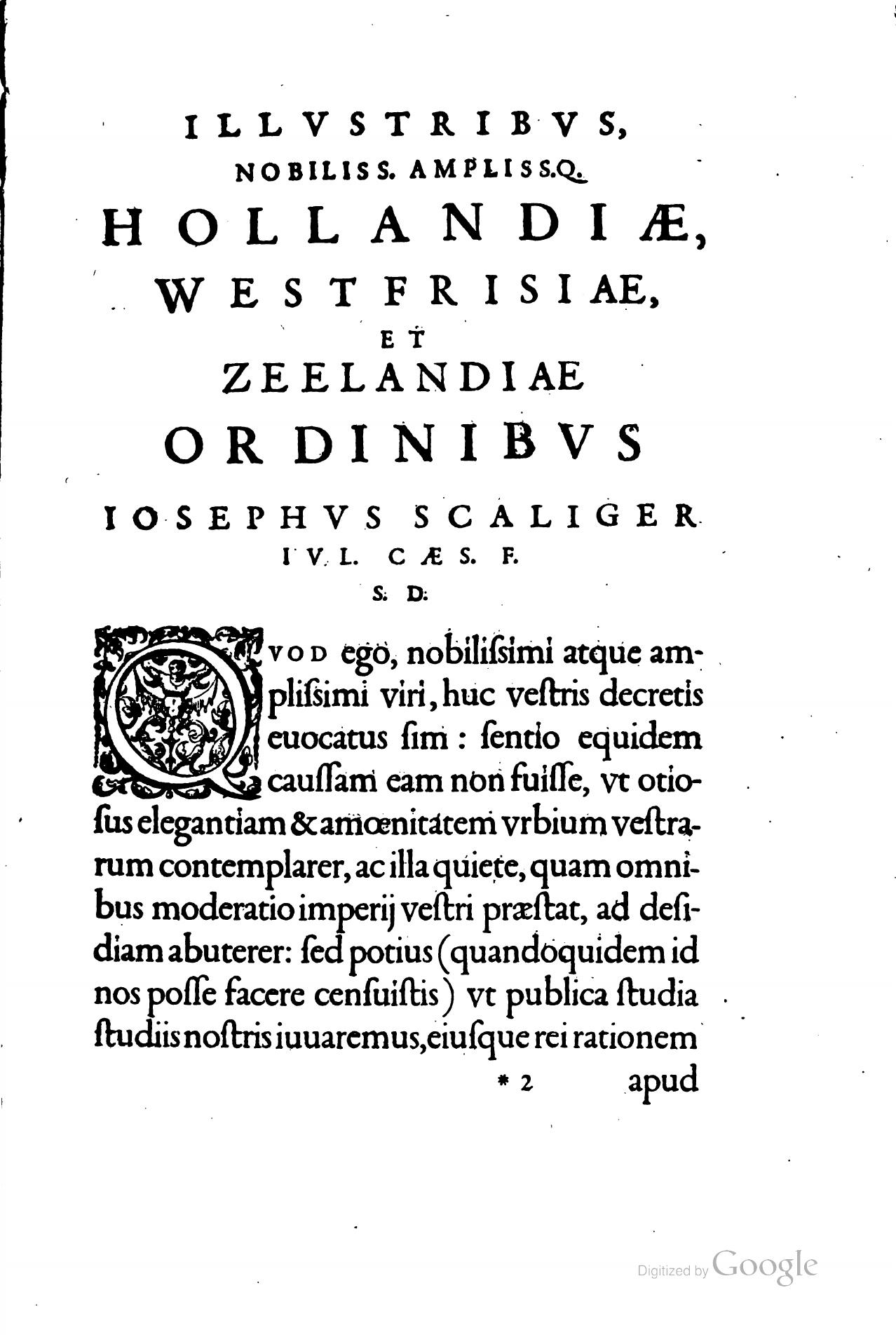
Public witnesses:
- Internet Archive complete scan
- Bayerische Staatsbibliothek / Deutsche Digitale Bibliothek record and scan
- Folger catalogue record
Scaliger followed the book with an Appendix ad Cyclometrica sua in 1595, explicitly defending the claimed quadrature against critics. The e-rara catalogue describes the appendix as asserting the quadrature “contra oblatrationes quorundam”—against the barking or railing of certain people. The language is a reminder that this was already a public and personal controversy.
3. Savile's Contemporary Objections, 1594–1595
The strongest evidence is the contemporary correspondence, not Aubrey's later story.
G. A. J. Toffanin's source-controlled account, citing Paul Botley and Dirk van Miert's critical edition of Scaliger's correspondence, identifies the pertinent records as 1595 04 05 and 1595 04-06 00. The sequence is:
- Scaliger heard that Savile had drawn up notes on the Cyclometrica, apparently substantial enough to suggest a planned book.
- Scaliger asked Savile to send the notes.
- Savile responded with his objections and explained why he accepted the widespread criticism of Scaliger's mathematical claim.
- Scaliger did not obtain the support he had hoped for, and the direct correspondence between the two men appears to have ceased after the exchange.
Toffanin writes that Savile “complied by explaining why he disagreed,” and that “Scaliger's hopes for support from that side were rebuffed.” These are modern paraphrases of the correspondence, not quotations from Savile's lost or uninspected draft. The next promotion step is to extract and translate the complete letters from the critical edition.
Source: G. A. J. Toffanin, “Henry Savile's Tacitus and the English Role on the Continent”, especially the discussion and note 20 citing the Scaliger correspondence.
4. The Surviving Presentation Copy: Bodleian Savile Ee 1(5)
The Bodleian's account of a 2013 masterclass supplies the most important material lead. It identifies books that reached Oxford as gifts from Scaliger to Savile and gives the shelfmark Savile Ee 1(5). It then states specifically that Scaliger's presentation of the Cyclometrica to Savile “backfired,” because Savile was not impressed by the claim to have squared the circle.
This sharpens the research problem considerably:
- there is a surviving, shelfmarked presentation copy;
- it was recognized by Bodleian curators in a class devoted to annotated books;
- Savile's criticism is independently documented by the contemporary correspondence;
- Aubrey's later report specifically places Savile's refutation “in the very margent of the booke.”
What remains unresolved is whether the surviving Bodleian copy preserves all the marginalia described by Aubrey, whether the writing is Savile's autograph, and whether the exact Latin joke survives there.
Public source: Bodleian Libraries, “Annotated books from Joseph Scaliger's (1540–1609) library in the Bodleian”, lines in the entry dated 29 October 2013.
5. Aubrey's Wallis Report: Important, but Later
John Aubrey recorded the following in his life of Savile:
“I have heard Dr. Wallis say, that Sir H. Savill has sufficiently confuted Joseph Scaliger de Quadratura Circuli, in the very margent of the booke: and that sometimes when J. Scaliger sayes ‘A B = C D ex constructione,’ Sir H. Savill writes sometimes in the margent, ‘Et dominatio vestra est asinus ex constructione.’”
A literal translation of the last sentence is:
“And your lordship is an ass by construction.”
The evidential chain must remain explicit: Aubrey says that he heard John Wallis say this. Aubrey was not describing a fresh inspection conducted for the Neville project, and the present research pass has not yet seen Bodleian Savile Ee 1(5). The quotation therefore documents a seventeenth-century report about the marginalia, not a verified diplomatic transcription of the surviving book.
Public source: John Aubrey, Brief Lives, ed. Andrew Clark, vol. 2, Project Gutenberg text, “Sir Henry Savile.”
5A. Structured Quoted Source Passages
Aubrey reporting John Wallis
“I have heard Dr. Wallis say, that Sir H. Savill has sufficiently confuted Joseph Scaliger de Quadratura Circuli, in the very margent of the booke.”
- What it establishes: Wallis knew a book he regarded as carrying a sufficient marginal refutation by Savile.
- Limit: Aubrey is reporting oral information; the surviving annotations remain uninspected in this pass.
Casaubon directly to Savile
“Erravit Scaliger, & fortasse consultius fecisset, si abstinuisset.”
- What it establishes: Casaubon told Savile directly in
1611that Scaliger had erred and would perhaps have done better not to enter the controversy. - Control: printed letter MXLIX, p.
610, directly checked in the page image reproduced below.
Savile directly to Camden
“all the Mathematical Books, which I had gathered in so many years and Countreys, Greek and Latin, printed and manuscripts, even to the very raw Notes”
- What it establishes: Savile transferred not only a mathematical library but unfinished working notes for institutional use.
- Limit: it does not identify the anti-Cyclometrica notes individually.
6. Casaubon to Savile, 9 December 1611
Isaac Casaubon's letter MXLIX to Henry Savile, printed on p. 610 of the 1709 correspondence, has been inspected directly in the page image. Casaubon writes:
“Erravit Scaliger, & fortasse consultius fecisset, si abstinuisset. Solebat Vieta dicere, non esse cujusvis errare cum Scaligero; cujus ipse divinum ingenium in aliis demirabatur.”
Translation:
“Scaliger erred, and perhaps he would have acted more wisely if he had abstained. Viète used to say that it is not given to everyone to err with Scaliger; he himself admired Scaliger's divine genius in other matters.”
Casaubon had known Viète personally and says, immediately before this passage, “Mihi quid magnus Vieta dixerit scio ipse”—“I myself know what the great Viète said to me.” He also invokes Clavius as Scaliger's mathematical opponent. The tone is discriminating rather than simply hostile: Scaliger's mathematical failure is admitted, while his extraordinary ability in other fields is preserved.
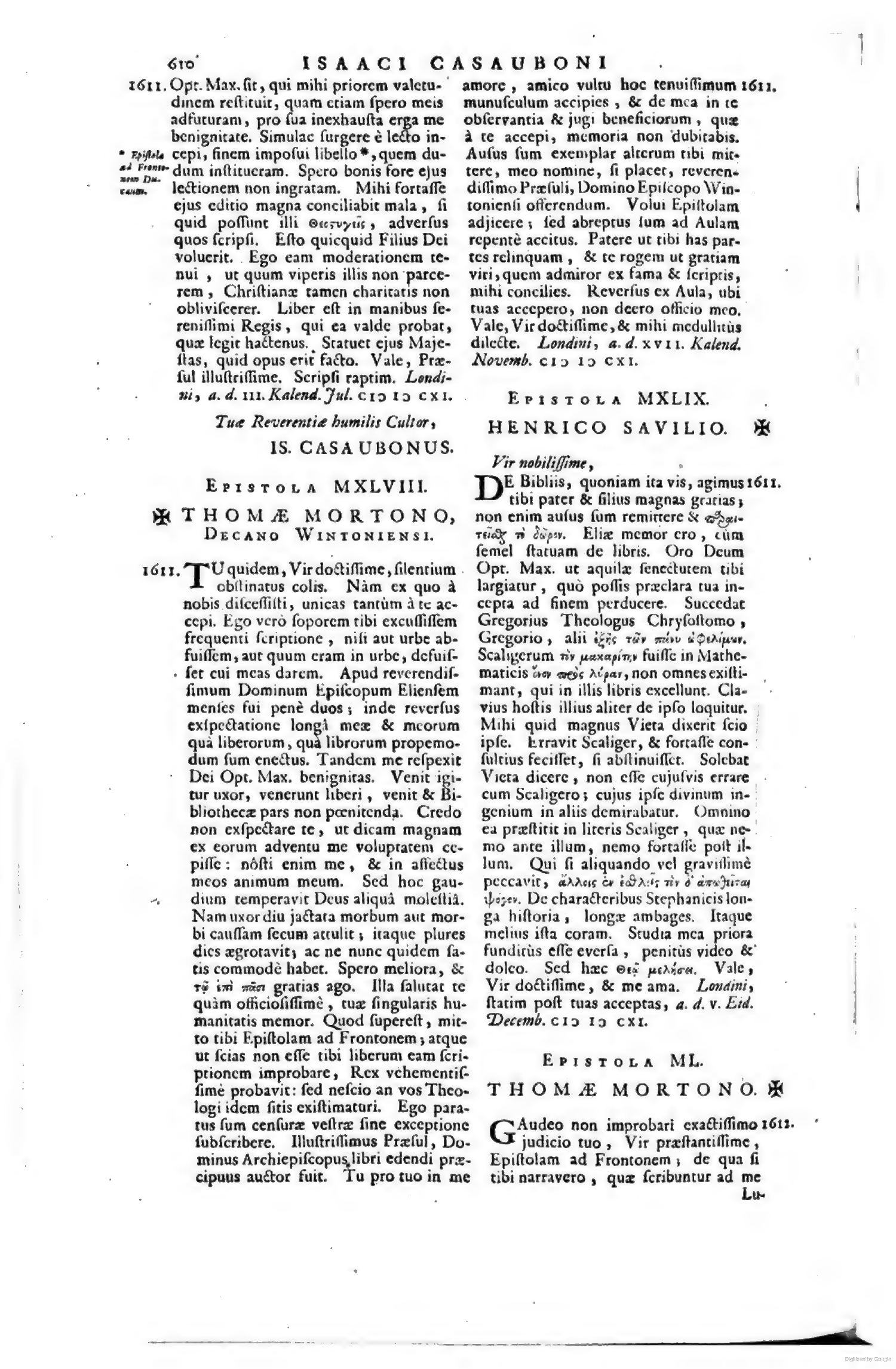
The date is printed as a. d. V. Eid. Decemb. 1611, or 9 December 1611 in the English Old Style calendar. EMLO normalizes it to 19 December 1611 Gregorian. Complete public scan: Casaubon, *Epistolae* (Rotterdam, 1709).
Casaubon's diary now establishes the Savile travel chronology directly. He wrote Ad Savilium hodie proficiscor on 12 April 1611 New Style (2 April English Old Style), arrived at Eton that day, and visited Windsor on 13 April New Style (3 April Old Style). He returned to Savile at Eton on 17 May 1613 New Style and travelled twenty-seven miles in Savile's carriage to Oxford on 18 May, lodging initially at Merton. The full reconstruction and page-controlled quotations are in isaac casaubon in england 1610 1614.
7. The Wider Mathematical Controversy
Savile was not an isolated critic. Scaliger's claim generated a European response:
- Christoph Clavius published a major refutation.
- François Viète rejected the mathematical result while continuing to admire Scaliger's intellect, as Casaubon reports.
- Ludolph van Ceulen analyzed sixteen propositions circulated by an anonymous “highly learned man,” now identified as Scaliger, and exposed the defects in the claimed quadrature.
- Scaliger defended himself in the
1595appendix and in correspondence, treating some attacks as personal affronts as well as mathematical criticism.
For the Van Ceulen exchange, see J. P. Hogendijk, “The Scholar and the Fencing Master”, Historia Mathematica 37 (2010), 345–375. For the place of quadrature in early modern learned culture, see Richard Oosterhoff, “Learned Failure and the Untutored Mind”.
The episode is intellectually important because it crosses boundaries that modern readers often keep separate. Savile and Scaliger were both celebrated classical scholars. Yet the dispute required line-by-line control of geometrical demonstrations, knowledge of Greek mathematical texts, and participation in an international correspondence network. Philology and mathematics were operating together.
8. Savile's Mathematical Books and “Raw Notes”
The quadrature story should be read beside Savile's letter to William Camden of 3 November 1621. Advising Camden to leave books for his projected readers, Savile explains his own practice:
“I for my part have cleared my study of all the Mathematical Books, which I had gathered in so many years and Countreys, Greek and Latin, printed and manuscripts, even to the very raw Notes, that I have ever made in that argument.”
He adds an express prohibition against publishing his own notes. This is highly relevant to the survival problem. Savile deliberately transferred books and working papers for institutional use while attempting to prevent unfinished notes from being printed. A critical manuscript or annotated book could therefore survive in the Savilian collections even where no formal anti-Scaliger book appeared in print.
The page image is preserved at epistolae 441; complete public scan: Camden, *Epistolae* (1691).
9. Relevance to Henry Neville Research
The strongest responsible use of this topic is contextual but substantial.
Savile was not simply a general “learned friend” of Neville. The two men travelled together on the Continent; corresponded as cousins; remained close through the Essex crisis; and participated in the same book, manuscript, political-history, and international-news networks. The quadrature dispute shows what Savile actually did inside that world:
- obtained new Continental books directly from their authors;
- scrutinized demonstrations in the margins;
- wrote substantial critical notes;
- communicated objections across borders;
- knew or corresponded with major figures including Scaliger, Casaubon, and Viète;
- preserved Greek and Latin mathematical books, manuscripts, and unfinished notes for future readers.
This deepens the portrait of Neville's immediate scholarly environment. It may inform research into mathematical metaphors, proofs, diagrams, classical scientific sources, and habits of correction in the broader Neville corpus. It does not demonstrate that Neville read the Cyclometrica, participated in Savile's objections, or used this controversy in a Shakespeare text.
10. Priority Research Actions
- Image Bodleian Savile Ee 1(5). Request the title page, presentation inscription, binding/provenance marks, every annotated leaf, and both adjacent leaves for each annotation.
- Build an annotation manifest. Record page/signature, coordinates, ink, language, exact text, and relation to Scaliger's printed proposition. Do not identify the hand from style alone.
- Compare hands under manuscript controls. Use verified Henry Savile autographs and mathematically comparable Savile notes; record disagreement rather than forcing attribution.
- Retrieve the 1595 letters. Extract the complete texts of Scaliger correspondence records
1595 04 05and1595 04-06 00, with editorial metadata, manuscript witnesses, translation, and transmission history. - *Locate the anti-Cyclometrica notes. Follow Robert Goulding's “Polemic in the Margin: Henry Savile against Joseph Scaliger's Quadrature of the Circle,” in Scientia in margine* (Geneva, 2005), pp. 241–259, into the relevant Bodleian and Savilian holdings.
- Collate Aubrey against the book. Test every part of the Wallis/Aubrey report: whether annotations are abundant enough to count as a refutation, whether the quoted
A B = C Dpassage exists, and whether the Latin insult appears verbatim. - Keep Casaubon's chronology exact. Separate his
1610arrival, the Eton/Windsor visit of12–13 April 1611New Style, the Savile letter of9 December 1611English Old Style (19 DecemberGregorian), and the Eton/Oxford visit of17 May–5 June 1613New Style.
11. Claim Audit
| Claim | Current control | Status |
|---|---|---|
| Scaliger published the Cyclometrica in 1594 | Complete public scan and library catalogues | Verified |
| Scaliger presented a copy to Savile | Bodleian public account; shelfmark Savile Ee 1(5) | Verified at catalogue/curatorial level |
| Savile sent objections to Scaliger in 1595 | Critical correspondence edition as cited by Toffanin | Verified through scholarly edition; full letter text still to extract |
| Savile prepared extensive notes, perhaps for a book | Contemporary correspondence summarized in critical scholarship | Supported; surviving draft not yet identified |
| Savile wrote the exact “ass by construction” sentence in the book | Aubrey reporting John Wallis | Unresolved until the book is imaged and the hand controlled |
| Casaubon discussed Scaliger's error and Viète's dictum with Savile in 1611 | Directly inspected printed page, letter MXLIX, p. 610 | Verified printed correspondence |
| Henry Neville participated in the quadrature dispute | No source located | Not established |
12. Citations
- Scaliger, Joseph Justus. Cyclometrica elementa duo. Leiden: Officina Plantiniana, apud Franciscum Raphelengium, 1594. Internet Archive.
- Bodleian Libraries. “Annotated books from Joseph Scaliger's (1540–1609) library in the Bodleian”. Identifies Savile Ee 1(5) and the presentation-copy controversy.
- Toffanin, G. A. J. “Henry Savile's Tacitus and the English Role on the Continent”. History of European Ideas 42 (2016). See note 20 for Scaliger correspondence records
1595 04 05and1595 04-06 00. - Casaubon, Isaac. Epistolae, ed. Theodoor Jansson van Almeloveen. Rotterdam, 1709, letter MXLIX to Henry Savile, printed p. 610. Internet Archive.
- Aubrey, John. Brief Lives, ed. Andrew Clark, vol. 2, “Sir Henry Savile.” Project Gutenberg.
- Glucker, John. “Errare cum Scaligero.” Pegasus 10 (June 1968), 4–6. Complete issue PDF.
- Hogendijk, J. P. “The Scholar and the Fencing Master: The Exchanges between Joseph Justus Scaliger and Ludolph van Ceulen on the Circle Quadrature (1594–1596)”. Historia Mathematica 37 (2010): 345–375.
- Goulding, Robert. “Polemic in the Margin: Henry Savile against Joseph Scaliger's Quadrature of the Circle.” In Scientia in margine, ed. Danielle Jacquart and Charles Burnett. Geneva: Droz, 2005, 241–259.
- Camden, William. Gulielmi Camdeni ... epistolae. London, 1691, letter CCLII, pp. 314–315. Internet Archive.
13. Notes on Access
- The complete
1594Cyclometrica and the1709Casaubon correspondence have been downloaded locally; their public Internet Archive witnesses are linked above. - The locally rendered Casaubon image is a checked image of a printed edition, not a manuscript surrogate.
- Bodleian
Savile Ee 1(5)is publicly identified by shelfmark, but no page images of that copy were obtained in this pass. Its marginalia therefore remain unresolved under the project manuscript-verification policy. - Robert Goulding's
2005chapter is bibliographically identified but was not available as an open full-text source in this pass. Its archival references should be extracted from a lawful library copy before being used to identify the marginal hand or exact leaves. - John Glucker's
1968article was downloaded and checked as a modern collation of Aubrey and Casaubon. It is a secondary source, not an independent inspection of the Bodleian annotations for this project.
Source-Fact Audit — 8 August 2026 (Round 6)
The packet now treats four different objects as four different facts: Scaliger's 1594 printed Cyclometrica; the Bodleian presentation copy catalogued as Savile Ee 1(5); the 1595 correspondence reporting Savile's objections; and Aubrey's later report of what Wallis said he saw in Savile's copy. The later anecdote cannot supply the exact wording or hand of a marginal note until the Bodleian leaves are imaged. Conversely, that source gap does not erase the contemporary fact that Savile communicated mathematical objections to Scaliger.
The evidence also bears directly on survival. Savile's 1621 bequest transferred books and working papers while forbidding publication of his unfinished notes. A missing printed refutation is therefore not evidence that no working critique existed; it is consistent with Savile's stated archival practice. Henry Neville's secure relevance remains relational—travel, kinship, correspondence, and participation in Savile's book-and-news network. No checked source places Neville inside the quadrature exchange itself.