Henry Savile's Rerum Anglicarum Scriptores (1596)
Topic: Henry Savile's Rerum Anglicarum Scriptores (1596)
Source-Control Summary
- This packet now includes the complete public-domain
1596Google Books scan from the Bavarian State Library, not merely an OCR snippet or modern description. The title page and dedication were rendered and visually checked on2026-07-10. - The documented lanes are: the 1596 BSB scan for the printed text; the CRRS copy bearing the
Sydney 1597inscription for separate title-page and provenance evidence; Roebuck for modern scholarly interpretation and publication context; BillingbearIMG 8160for the Neville-library line; the Audley End pre-1616object/email record for a separate copy-search lead; and McPherson for Jonson's later ownership of Savile's Rerum. - The photographed Audley End copy is annotated in the hand attributed almost certainly to Henry Neville. Do not reduce this to an “anonymous reader” claim. The cumulative basis is the Billingbear title entry, Audley End/Neville-family provenance, agreement with authenticated Neville handwriting across the wider annotation corpus, and the separately distinguishable hand of Henry Savile.
- Keep all copy/provenance lanes separate: CRRS/Sidney, Billingbear, Audley End, and Jonson's library are not automatically the same physical copy or the same provenance chain.
- Book prose should use Rerum as an important Savile historical-scholarship and library-network item, not merely as a Jonson footnote.
Corrected attribution of the Audley End annotations
The main annotation hand in the photographed Audley End Rerum should be identified as Henry Neville's at near-certainty. This is not an inference from a passage's resemblance to Shakespeare. It is a cumulative object-and-hand attribution:
- The Billingbear library catalogue records the exact title and edition: “Rerum Anglicarum Scriptores _____ Lond. 1596” (Berkshire Record Office, D/EN F15/3,
IMG_8160). - The surviving photographed copy is the Audley End object catalogued as
88072699, where books transferred from the Neville family's Billingbear library are preserved. - Its principal italic annotation hand belongs to the broader Audley End hand corpus identified through comparison with authenticated Henry Neville letters and drafts.
- Henry Savile's highly distinctive hand is separately documented in books from the same collection, allowing the two annotators to be distinguished rather than conflated.
The right wording is therefore “almost certainly annotated by Henry Neville.” A future blind, leaf-by-leaf paleographic publication would strengthen the public audit trail, but its absence does not make the annotator unidentified. For fol. 22r in particular, Neville almost certainly wrote Regni parte filio Ethelbaldo concedit (“He grants part of the kingdom to his son Ethelbald”) and also marked the adjacent Eadburh episode. This directly establishes his attention to those episodes. It does not, without further evidence, decide whether either passage contributed to King Lear or Cymbeline.
Public comparison context: Henry Neville annotation and authenticated-hand comparisons; Neville and Savile hands distinguished in the Audley End Tacitus; expanded Neville–Tacitus comparisons.
Overview
Savile’s Rerum Anglicarum scriptores post Bedam should be treated as a substantial historical-scholarship packet in its own right, not merely as a footnote to Jonson’s later library. The strongest current evidence shows that the book was an important editorial milestone, that it circulated among contemporaries in the 1590s, and that modern scholarship places it at the center of politics, patronage, and medieval historical scholarship in late Elizabethan England.
Direct 1596 Printed Witnesses
Google Books / Bavarian State Library full scan
Google Books volume QUlhAAAAcAAJ is a full-view, downloadable, public-domain scan of the 1596 Barker edition. Google identifies the original as the Bavarian State Library copy, digitized on 11 March 2015, and describes the volume as 1,040 pages; the downloaded PDF contains 1,113 access pages including covers and blanks.
The title page reads:
RERVM ANGLICARVM SCRIPTORES POST BEDAM PRAECIPVI, EX VETVSTISSIMIS CODICIBVS MANVSCRIPTIS NVNC PRIMVM IN LVCEM EDITI.
It lists the contents directly:
WILLIELMI Monachi Malmesburiensis de gestis regum Anglorum lib. V.
Eiusdem Historiæ Nouellæ lib. II.
Eiusdem de gestis Pontificum Angl. lib. IIII.
HENRICI Archidiaconi Huntindoniensis Historiarum lib. VIII.
ROGERI HOVEDENI Annalium pars prior & posterior.
Chronicorum ETHELWERDI lib. IIII.
INGVLPHI Abbatis Croylandensis historiarum lib. I.
The imprint is:
LONDINI, Excudebant G. BISHOP, R. NVBERIE, & R. BARKER Typographi Regij Deputati. Anno ab incarnatione, 1596.
The dedication begins SERENISSIMAE POTENTISSIMAEQVE Principi ELIZABETHE, Angliæ, Franciæ, & Hiberniæ Reginæ and ends with Savile's printed signature:
Serenissimae Ma. tuae deuotissimus
HENRICVS SAVILE.
Checked local witnesses:
- Savile Rerum Anglicarum 1596 GoogleBooks BSB
- savile google 0006
- savile google 0008
- savile google 0009
- Google Books bibliographic page
CRRS copy with a Sidney ownership inscription
The Centre for Renaissance and Reformation Studies catalogues its copy as DA170 .R47 1596, STC 21783, folio, [2], 520, [30] leaves. Its title page bears the ownership inscription Sydney 1597. CRRS attributes the copy to Sir Robert Sidney. Separately, CRRS cites Rowland Whyte's November 1596 household account:
for Mr Saviles storie of England for your Lordship
The account records a payment of 13s 6d. It is an external household record, not a purchase note written in or bound with the CRRS volume. CRRS uses the title-page inscription, this separate account, and the book's appearance in the Sidney family library catalogue of about 1665 when reconstructing the copy's provenance. This copy therefore joins the Billingbear, Audley End, and Jonson copy lanes with a fourth contemporary ownership history.
CRRS also notes that the printed Chronicle of Æthelweard became the only surviving text after the manuscript witness was destroyed in the 1731 Cotton Library fire. That fact helps explain why Savile's volume is both a late Elizabethan political-book-history object and a surviving textual witness of lasting medieval-historical importance.
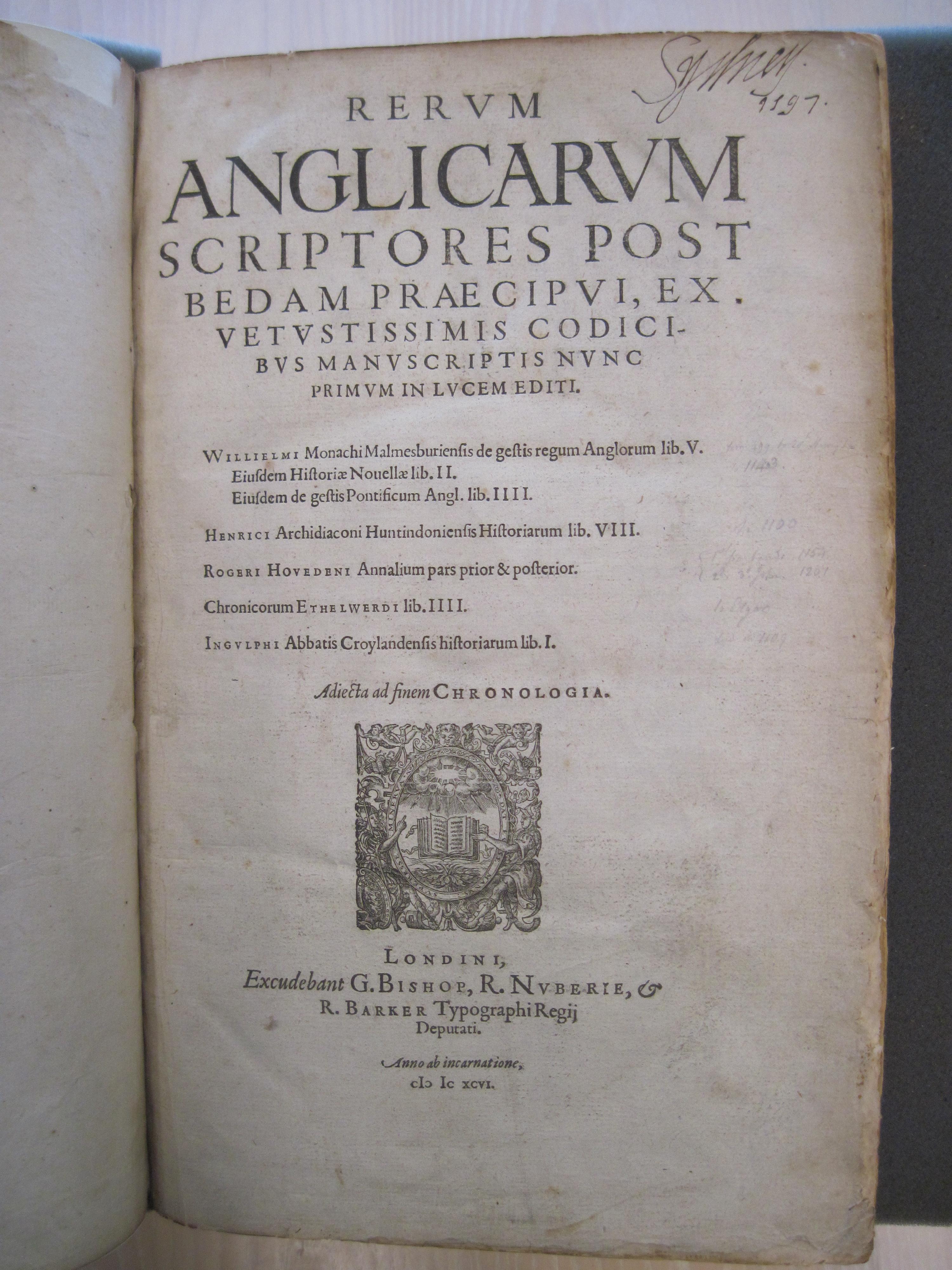
The CRRS image and the BSB scan display the same title-page setting while preserving different copy histories: the CRRS page bears the Sydney 1597 inscription; the BSB page bears a later Augsburg institutional stamp. They should not be treated as the same physical book.
Quoted Source Passages
1. Publication and Sidney-Circle Circulation
- Source: Thomas Roebuck, "Politics, Patronage and Medieval Scholarship: Henry Savile's Rerum Anglicarum scriptores post Bedam (1596) in Context," local final PDF Roebuck Savile Rerum Anglicarum 2021.
- Quotation:
"five medieval historians"
- Quotation:
"Mr Saviles storie of England"
- What it proves: Roebuck controls the basic identification of the
1596book and the Rowland Whyte / Robert Sidney circulation lead. - Limits: Roebuck is modern scholarship. A direct facsimile or catalogue witness for the printed title page remains a needed upgrade.
2. Billingbear Book-List Control
- Source: Billingbear book-list transcription and page image
IMG 8160, Billingbear Book List Transcription, IMG 8160. - Quotation:
"Rerum Anglicarum Scriptores _____ Lond. 1596"
- What it proves: The Savile Rerum line is directly present in the Billingbear book-list evidence layer.
- Limits: The line proves listing/presence in the local catalogue evidence; it does not by itself identify binding, ownership marks, or a full provenance chain.
3. Audley End Copy-Search Lead
- Source: Audley End pre-
1616books email/list record, pre 1616 books Feb 2010 Audley End from 2023 thread. - Quotation:
"ID Number: 88072699"
- Quotation:
"Title: Rerum Anglicarum Sciptores"
- Quotation:
"FR/19 Library, Case S, Shelf 10"
- What it proves: The project has a concrete Audley End object/copy lead for the
1596Savile book. - Limits: The misspelling
Sciptores, binding, shelfmark, and provenance chain need checking against the full National Trust / English Heritage catalogue and, ideally, the physical copy.
4. Jonson Afterlife Control
- Source: David McPherson, "Ben Jonson's Library and Marginalia: An Annotated Catalogue," local JSTOR text McPherson BenJonsonsLibrary 1974 1.
- Quotation:
"SAVILE, Sir Henry. Rerum Anglicarum Scriptores"
- Quotation:
"Jonson's copy: Two copies"
- What it proves: McPherson supplies the Jonson-library afterlife lane and requires copy-specific handling.
- Limits: Jonson ownership is not the same as settled Jonson annotation of every surviving copy; keep the Oxford and Philadelphia/Stratford copy distinctions as stated in the Jonson/Savile packet.
1. Verified Sourced Facts
A. Publication and circulation
- Thomas Roebuck writes:
“In 1596, Henry Savile (1549-1622) published an edition of five medieval historians, mainly writers of the twelfth century, under the title Rerum Anglicarum scriptores post Bedam”
- Roebuck also states:
“in November 1596, Rowland Whyte bought a copy of ‘Mr Saviles storie of England’”
- Roebuck further states:
“in 1601 Marnius and Aubri brought out Savile’s Scriptores in a new edition under their Pegasus”
- Roebuck's final published article identifies the publication window more tightly: the book emerged in late October or very early November
1596, shortly before Rowland Whyte obtained a copy for Robert Sidney.
- CRRS reproduces the
Sydney 1597title-page inscription and, separately, cites the independent Rowland Whyte account for the13s 6dtransaction. The payment record is not an annotation in the CRRS copy.
- The root upload article p61 61 is an exact duplicate of the already staged final article Roebuck Savile Rerum Anglicarum 2021. The final Brill citation should supersede the stale accepted-manuscript author labels in this packet.
B. Billingbear and Audley End copy evidence
- The updated Billingbear transcription gives a direct local catalog line at
IMG 8160:
“Rerum Anglicarum Scriptores _____ Lond. 1596”
- Direct PNG inspection confirms that the
Rerum Anglicarum Scriptores ... Lond. 1596line is visibly present inIMG 8160and matches the updated transcription in substance. This means the Savile Rerum volume is not only a modern-scholarship context item; it is also directly present in the Billingbear book-list evidence layer.
- A local Audley End pre-
1616books list / email record preserves a separate house-library catalogue entry for the book: ID number88072699, date made1596, object typeBOOK, titleRerum Anglicarum Sciptores, current locationAUDLEY END HOUSE, locationFR/19 Library, Case S, Shelf 10.
- This Audley End record should be treated as a concrete copy/provenance lead. It is stronger than a general "Savile book at Audley End" assertion, but the spelling
Sciptores, binding, and provenance chain still need checking against the full catalogue record and the physical copy.
C. Editorial significance
- The Roebuck manuscript states:
“Savile’s volume was, however, a decisive turning point in this long tradition.”
- Roebuck also writes:
“Savile’s is therefore the first substantially complete edition of William’s histories in print.”
- The same article states that for one of the texts in the volume:
“Savile’s edition is its only surviving witness.”
- Roebuck identifies the one-text witness as the Latin version of the Anglo-Saxon Chronicle by Aethelweard: the unique manuscript was destroyed in the Cotton Library fire of
1731, leaving Savile's printed edition as the surviving witness.
- Roebuck's account of the King's Lynn Public Library copy is important for patronage and print history: it preserves two separately printed dedications to Elizabeth, suggesting a staged presentation sequence before the final complete
1596book.
- Roebuck identifies Trinity College, Cambridge MS R.7.1, donated by Thomas Neville, Master of Trinity, as an important William of Malmesbury witness used by Savile or close to his base text for the Historia novella. This is Thomas Neville/Nevile of Trinity, not Sir Henry Neville of Billingbear.
- The direct title page confirms the work's own claim that its writers were edited
ex vetustissimis codicibus manuscriptisand broughtnunc primum in lucem. Roebuck's article explains how that claim operated in Savile's specific editorial practice.
D. Political and patronage setting
- The Accepted Manuscript version states that the book:
“needs to be situated at the centre of Elizabethan politics and patronage in the 1590s.”
- It also treats Savile’s motivations as shaped by:
“the nexus of politics and patronage from which the book emerged.”
E. Later afterlife in Jonson’s library
- David McPherson’s catalog of Jonson’s library states that Jonson owned:
“Rerum Anglicarum Scriptores, ed. Sir Henry Savile (No. 161)”
This is a later afterlife point, but it should remain secondary to the book’s original 1596 significance.
- McPherson reports two Jonson-associated copies of Savile's Rerum: one at Oxford and one at Stratford-upon-Avon. The Oxford copy is the stronger possible Jonson-annotation witness; McPherson treats the Stratford text annotations as not Jonson's despite Jonson-like ownership marks. Therefore this packet should cite Jonson ownership confidently but should not generalize Jonson annotation without specifying the copy.
2. Ken Feinstein Twitter and Blog Information
- No discrete Ken Feinstein tweet/blog layer is isolated in this packet at present.
3. Quoted Source Text
Roebuck / Accepted Manuscript
- “In 1596, Henry Savile (1549-1622) published an edition of five medieval historians”
- “in November 1596, Rowland Whyte bought a copy of ‘Mr Saviles storie of England’”
- “in 1601 Marnius and Aubri brought out Savile’s Scriptores in a new edition under their Pegasus”
- “needs to be situated at the centre of Elizabethan politics and patronage in the 1590s”
Billingbear Book List
IMG 8160: “Rerum Anglicarum Scriptores _____ Lond. 1596”
Audley End pre-1616 books list
ID Number: 88072699Title: Rerum Anglicarum SciptoresCurrent Location: AUDLEY END HOUSEFR/19 Library, Case S, Shelf 10
Direct PNG inspection
IMG 8160: theRerum Anglicarum Scriptores ... Lond. 1596line is visible on the page image.
Roebuck
- “Savile’s volume was, however, a decisive turning point in this long tradition.”
- “Savile’s is therefore the first substantially complete edition of William’s histories in print.”
- “Savile’s edition is its only surviving witness.”
McPherson
- “Rerum Anglicarum Scriptores, ed. Sir Henry Savile (No. 161)”
- “Two copies”
- “not Jonson's”
Direct 1596 title and dedication
RERVM ANGLICARVM SCRIPTORES POST BEDAM PRAECIPVIEX VETVSTISSIMIS CODICIBVS MANVSCRIPTIS NVNC PRIMVM IN LVCEM EDITISERENISSIMAE POTENTISSIMAEQVE Principi ELIZABETHEHENRICVS SAVILE
4. Citations
- Roebuck, Thomas. “Politics, Patronage and Medieval Scholarship: Henry Savile’s Rerum Anglicarum scriptores post Bedam (1596) in Context.” Erudition and the Republic of Letters 6 (2021): 61-115. DOI:
10.1163/24055069-06010005. document witnesses: Roebuck Savile Rerum Anglicarum 2021. Root upload duplicate: article p61 61. - Roebuck, Thomas. Accepted manuscript version of “Politics, Patronage and Medieval Scholarship: Henry Savile’s Rerum Anglicarum scriptores post Bedam (1596) in Context.” document witnesses: Accepted Manuscript.
- McPherson, David. “Ben Jonson’s Library and Marginalia: An Annotated Catalogue.” document witnesses: McPherson BenJonsonsLibrary 1974.
- Billingbear Book List Transcription,
IMG 8160. Working local transcription: Billingbear Book List Transcription. Page image: IMG 8160. - Audley End pre-
1616books email/list record,ID Number: 88072699,Rerum Anglicarum Sciptores. Local text witness: pre 1616 books Feb 2010 Audley End from 2023 thread. - ben jonsons library and henry savile
- henry savile
- Savile, Henry, ed. Rerum Anglicarum scriptores post Bedam praecipui. London: G. Bishop, R. Newbery, and R. Barker, 1596.
STC 21783. Google Books full-view BSB witness. Local full scan: Savile Rerum Anglicarum 1596 GoogleBooks BSB. - Centre for Renaissance and Reformation Studies. Rare Book catalogue record, DA170 .R47 1596.
- Tersigni, Elisa. “Henry Savile's *Rerum Anglicarum scriptores post Bedam* (London, 1596)”. CRRS Featured Rare Book, 23 May 2012.
5. Notes on Access
- This packet should carry the
1596book’s own significance. The narrower Jonson-library point should be left to the Jonson/Savile packet. - The earlier "Giglioni" and "Roebuck, Matthew" labels were stale cataloging errors. The governing final citation is Thomas Roebuck, Erudition and the Republic of Letters 6 (2021): 61-115.
- The direct-print gap is closed by the complete Google Books / Bavarian State Library scan. The research sources preserves the whole volume, while the CRRS image supplies a second title-page witness with the
Sydney 1597ownership inscription attributed by CRRS to Sir Robert Sidney. - The Audley End record means the book should be treated as an Audley End copy-search item as well as a Savile scholarship item. Keep the Billingbear book-list line and the Audley End object ID separate until the provenance chain is reconciled.
- Source-control position: McPherson is useful here as afterlife/provenance evidence only. Use it to say Jonson owned Savile's Rerum; do not use it to imply settled Jonson annotation of every surviving copy.
Additional Fact-Source Notes
- Folgerpedia's Jonson-library page supports the McPherson framework but does not change this packet's core hierarchy: Billingbear
IMG 8160controls the Neville-library side; the Audley End list controls a separate object-search lead; Roebuck controls the modern scholarly argument about Savile's Rerum. - The 1596 title, contents list, Elizabeth dedication, and Savile signature are now checked against page images. Further work can move from basic witness retrieval to comparison of copy-specific annotations, stop-press variants, and provenance.
- Book use: keep Billingbear, Audley End, and Jonson ownership as three separate evidence lanes until provenance is reconciled.
2026-07-15 Newbery creditor lead
RBA D/EN/F6/1/5 now supplies a possible direct financial connection between Neville and one of this book's publishers. The image-controlled line reads:
To M^r rafe newbery — 102^li 10^s — Augusti 1598
The full schedule is unsigned; first-person wording and custody in Neville's file make him the probable debtor, but the hand is not authenticated. The title page of Rerum Anglicarum independently names R. NVBERIE beside George Bishop and Robert Barker. Ralph Newbery was master of the Stationers' Company in 1598 and also had Berkshire connections. Exact name, date, book-trade prominence, and locality make him a serious candidate for the creditor.
The identification remains unproved. The schedule does not call Newbery a printer, and no £100 principal, £102 10s repayment, August 1598 bond, receipt, or account has yet been found. The numerical form suggests a £100 base plus £2 10s, potentially 2.5%, but the leaf never labels principal or interest.
If an underlying instrument confirms the publisher, the result would matter beyond generic acquaintance. It would establish a personal credit transaction between Neville and a publisher of Savile's major 1596 historical edition and the 1587 Holinshed. Until then, the correct formulation is publisher candidate, not Neville's printer-creditor. The complete analysis is in henry neville bonds due creditor schedule 1598 1599.
2026-07-14 Dedication Deep Dive: A Deliberate Historical Source Reservoir
The opening dedication does more than praise Elizabeth. Savile explains what kind of book he believed he was making. After criticizing Polydore Vergil and popular chroniclers, he says that he could not himself construct a complete history from its foundations, but did what he could:
feci tamen, quod potui, non inuitus, vt ex situ, & squalore, pulueréque eruerem, & in lucem primus emitterem vetustissimos rerum nostrarum authores ... eo consilio, vt alij, qui & otio abundarent & ingenio, hos quasi ad manum haberent rerum nostrarum commentarios, unde sumerent, quae ad tanti operis exaedificationem pertinerent.
A close working translation is:
Yet I did what I could, willingly: I drew the most ancient authors of our affairs out of neglect, squalor, and dust, and first sent them into the light ... with this purpose, that others who possessed leisure and ability might have, as it were ready to hand, these records of our affairs, from which they could take what belonged to the construction of so great a work.
The direct scan places this passage on PDF access page 8, in the dedication to Elizabeth. Its wording makes the collection explicitly instrumental: Savile is publishing ancient historians so later writers can have historical materials ready to hand and build a larger work from them.
That editorial purpose materially sharpens the Billingbear topic. A catalogue entry for Rerum Anglicarum is not just evidence of a learned Latin history volume. It points to a deliberately assembled quarry of medieval English narratives—William of Malmesbury, Henry of Huntingdon, Roger of Hoveden, Æthelweard, Ingulph, and others—published for reuse by readers with the leisure and ability to construct historical works.
No direct Shakespeare source claim follows from this statement. The new finding establishes Savile's own declared use-case for the volume and gives future play-source work a precise question: which historical episodes in the Folger histories can be traced to texts or readings distinctive to Savile's 1596 editorial collection?
Direct witness
- savile google 0008.
- savile google 0009.
- Savile Rerum Anglicarum 1596 GoogleBooks BSB.
Next research program
- Create an episode index for John, Henry III, Edward I, and the fifteenth-century material represented in the volume.
- Compare Savile's Latin readings with Holinshed and the Folger history plays, recording cases where Savile supplies facts absent from the English chronicle.
- Keep the Billingbear, Audley End, Sidney, and Jonson copies separate until object-level provenance joins them.