Filippo Pigafetta in the Billingbear Library: Le Mechaniche (1581), the 1582 Nevell Contact, and a Two-Book Translator Cluster
Topic: Filippo Pigafetta in the Billingbear Library
Source-Control Position
The best current identification of the Pigafetta who traveled from France to England in September 1582 and was called an acquaintance of young Mr. Nevell is Filippo Pigafetta of Vicenza (1533-1604), not Marc'Antonio Pigafetta. This identification rests on a joined printed and scholarly documentary sequence:
- the 21 August calendar entry calls the traveler
Philippo PigafettaofVinsentia, a philosopher, and already says he wasof young Mr Nevill's acquaintance; - the 17 September entry sends
Signor Pigafettatoward England withSignor Aragonand calls him the acquaintance ofyoung Mr. Nevell; - Anton Maria Ragona's surviving travel diary records that he and Filippo Pigafetta made precisely this France-England-Spain journey in 1582;
- Ragona records that Filippo carried letters from the English ambassador addressed to Francis Walsingham, presented them to Walsingham in England, and traveled under that documentary protection;
- modern biographies based on Ragona's diary independently reconstruct Filippo and Ragona's London journey.
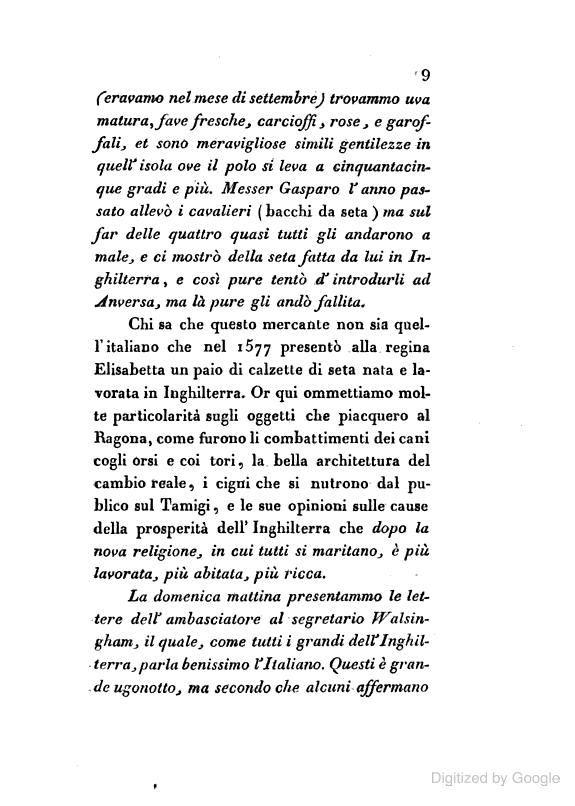
The checked 1836 excerpts add the concrete sequence: Pigafetta and Ragona left from the English ambassador's Paris residence with the courier, sailed from Dieppe, landed at Rye, and took two days to reach London. They were in England in September and presented the ambassador's letters to Walsingham on Sunday morning. Since Cobham still described them as departing on 17 September, their crossing falls most cautiously between 18 and 30 September 1582. This dates the Pigafetta-Ragona journey, not Neville's.
This does not identify young Mr. Nevell as Henry Neville of Billingbear, place him in Cobham's Paris residence, or prove he crossed with Pigafetta and Ragona. Nor does it explain why the 17 September calendar describes a Turkey-and-Judea travel book that resembles Marc'Antonio Pigafetta's later Itinerario. The original SP 78/8 letters remain necessary. Until they are collated, the joined Filippo/Ragona identification is the strongest reconstruction, not a manuscript-verified resolution.
The later Billingbear library catalogue adds a separate and striking fact: it records two Venetian translations by Filippo Pigafetta, both printed by Francesco de' Franceschi and both now represented by surviving Audley End objects:
- Guidobaldo del Monte, Le Mechaniche (Venice, 1581), Audley End object
81035047; - Leo VI, Trattato brieve dello schierare in ordinanza gli eserciti, et dell'apparecchiamento della guerra (Venice, 1586), Audley End object
81035082.
The first was published immediately before the 1582 notice linking Filippo with the man called young Mr. Nevell; the second was published after Filippo's journey through England and his collection of military and political information. The later catalogue proves that both titles entered the family library by the time of that catalogue, not that Henry Neville acquired them or that Pigafetta visited Billingbear.
1. The Two Billingbear Books
1.1 Le Mechaniche (1581)
The Billingbear catalogue transcribes the entry:
Le Mechaniche del Guido Ubaldo ____ Ven. 1581
The combined Billingbear/Audley End spreadsheet identifies it as row 8.1035047E7. The English Heritage inventory gives:
- object
81035047; - date
1581; - maker
UBALDO; - title Le Mechaniche;
- calf, quarto;
- Audley End, Library, Case M, Shelf 5.
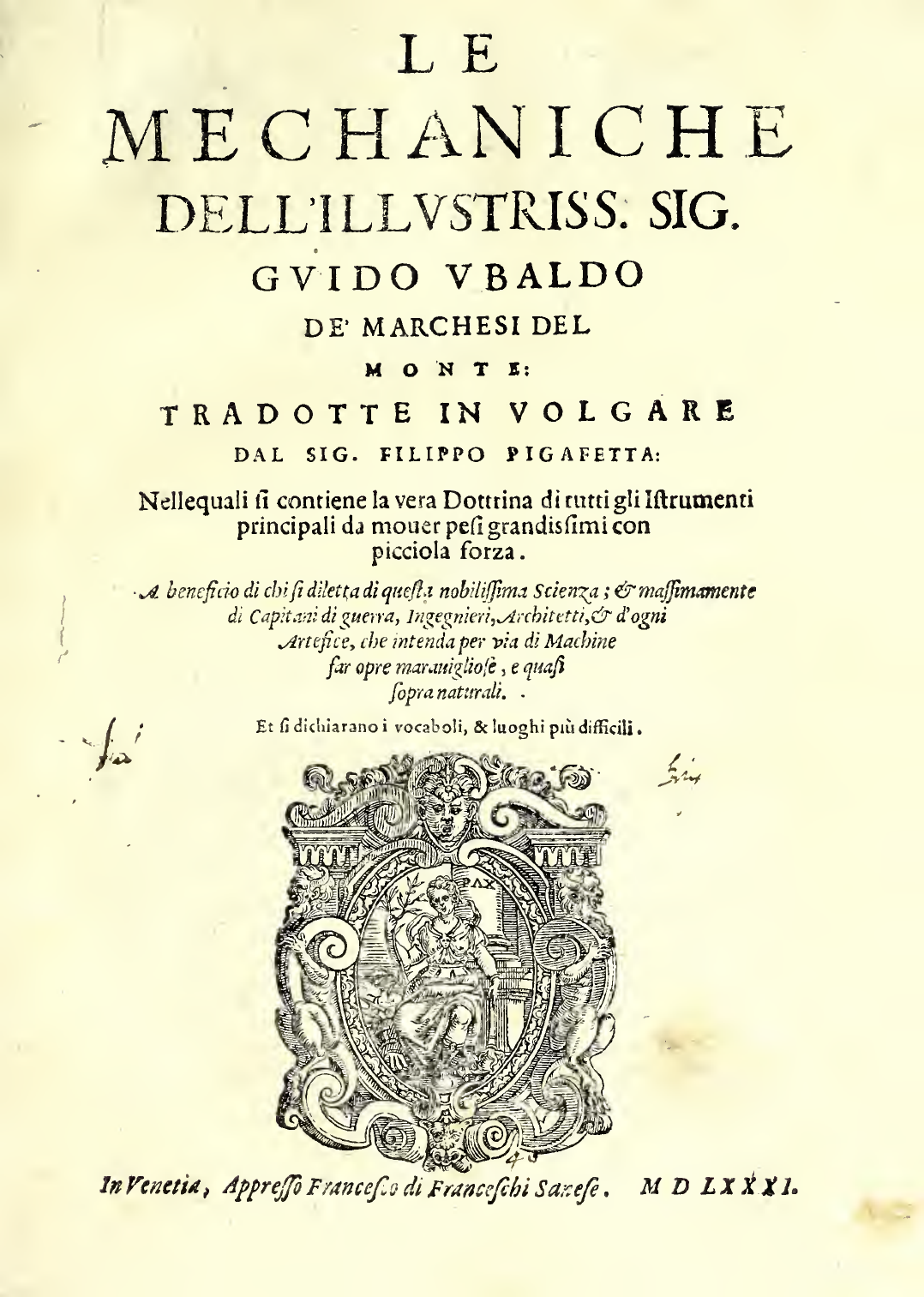
The exact 1581 edition has been collated through the Getty Research Institute copy at Internet Archive. Its title page reads:
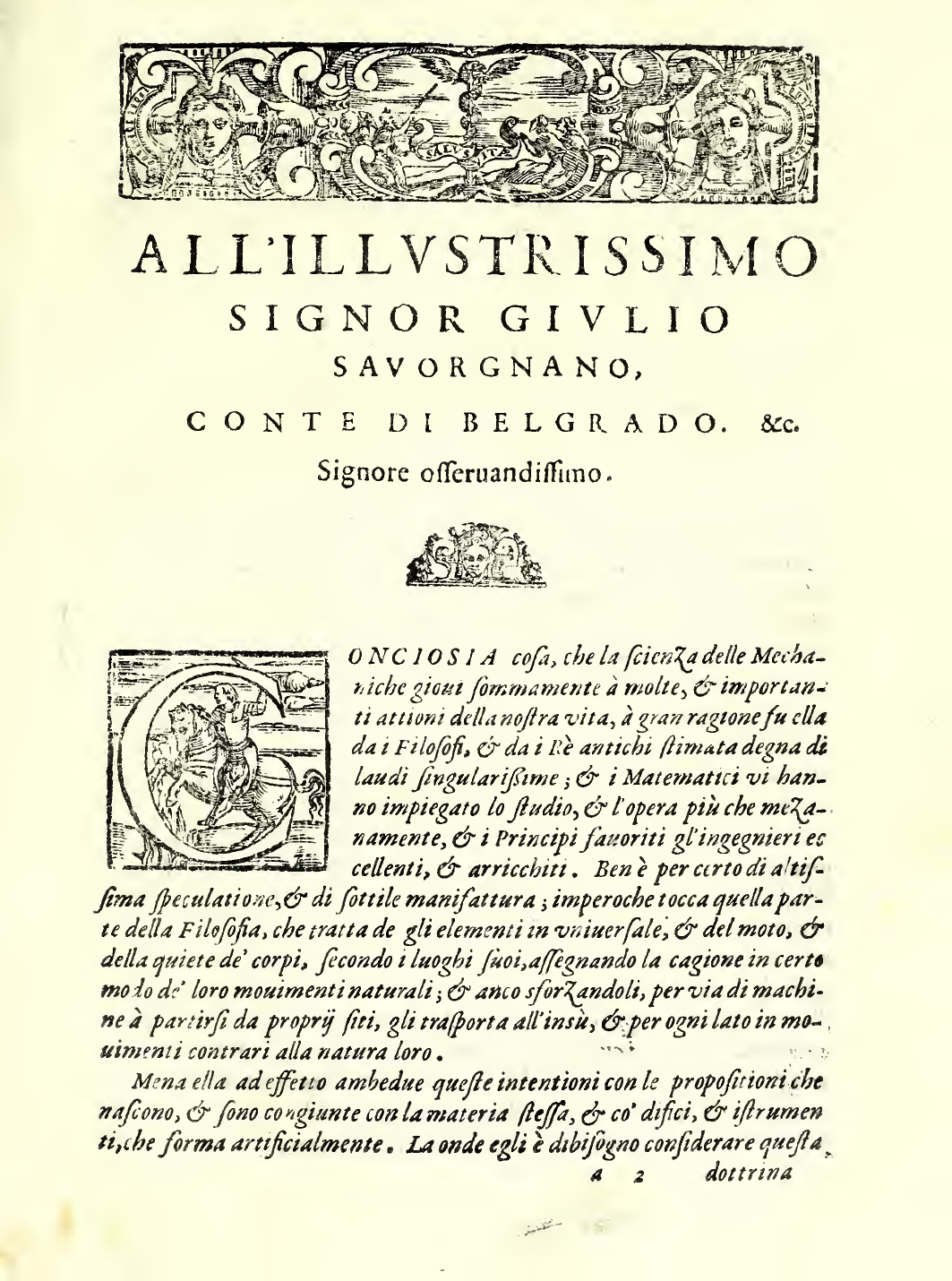
LE MECHANICHE DELL'ILLVSTRISS. SIG. GVIDO VBALDO DE' MARCHESI DEL MONTE: TRADOTTE IN VOLGARE DAL SIG. FILIPPO PIGAFETTA
It promises la vera Dottrina di tutti gli Istrumenti principali da mouer pesi grandissimi con picciola forza, for captains, engineers, architects, and artisans who wish to make opre marauigliose, e quasi sopra naturali by machines. The scan preserves extensive geometric diagrams and woodcuts. The Getty source copy has a limp-vellum binding and contains a cancel mounted over an inverted diagram on leaf 112v; those copy-specific features must not be projected onto the Audley End copy.
1.2 Leo VI's Trattato brieve (1586)
The Billingbear catalogue gives the much fuller identification:
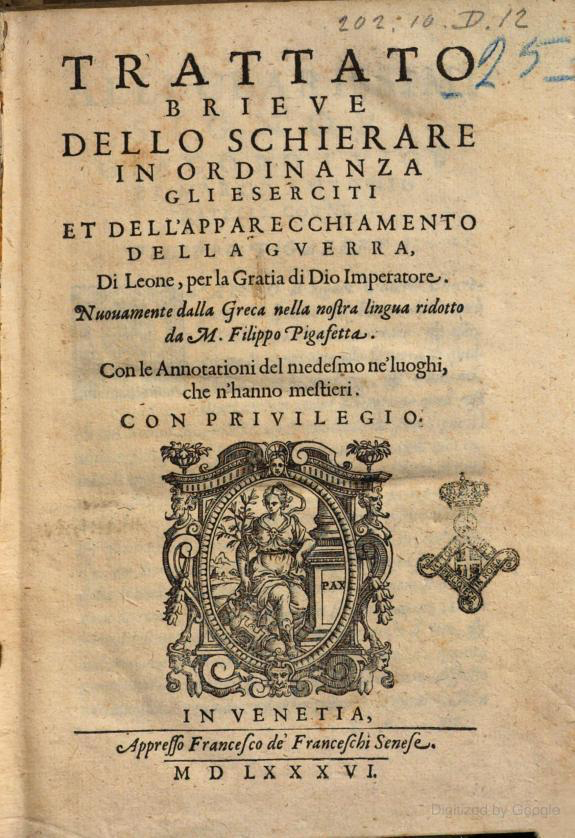
Trattato Brieve dello schierare in ordinanza gli Eserciti, et dell'apparecchiamento della Guerra di Leone Imperatore, tradotto di Pigafetta — Ven. 1586.
The combined spreadsheet identifies row 8.1035082E7 as the exact 1586 Venice edition, translated from Greek by M. Filippo Pigafetta, with a half-calf binding. The English Heritage inventory abbreviates the title to Trattato della Guerra and records:
- object
81035082; - date
1586; - half calf, quarto;
- Audley End, Library, Case M, Shelf 6.
The Folger catalogue supplies the exact title and collation: [40], 344 [i.e. 346] p., quarto, Venice, Francesco de' Franceschi, 1586, with Pigafetta's annotations and an index. This is not merely another Italian military book. It is a second work explicitly mediated by the same Filippo Pigafetta who traveled to England in 1582.
1.3 Major new source: Pigafetta used an English royal-library translation
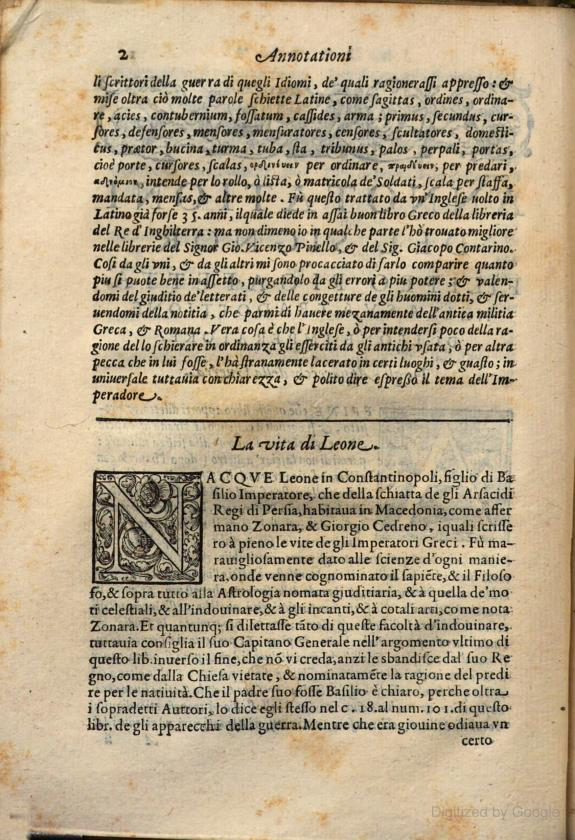
A full-view Google Books witness of the 1586 edition has now been recovered. In his printed annotations, Pigafetta explains the textual witnesses behind his translation:
Fu questo trattato da un'Inglese volto in Latino già forse 35. anni, il quale diede in assai buon libro Greco della libreria del Re d'Inghilterra: ma nondimeno io in qualche parte l'ho trovato migliore nelle librerie del Signor Gio. Vincenzo Pinello, & del Sig. Giacopo Contarino. Così da gli uni, & da gli altri mi sono procacciato di farlo comparire quanto più si puote bene in assetto, purgandolo da gli errori a più potere: & valendomi del giudicio de' letterati, & delle congetture de gli huomini dotti, & servendomi della notitia, che parimenti havea mezzanamente dell'antica militia Greca, & Romana.
Pigafetta says that an Englishman had translated the treatise into Latin perhaps thirty-five years earlier from a good Greek book in the King of England's library. He found some passages better in Greek books in the libraries of Gian Vincenzo Pinelli and Giacomo Contarini, and constructed his text by comparing these witnesses, purging errors, consulting learned judgment and conjecture, and applying his own knowledge of ancient Greek and Roman warfare.
This is a major expansion of the Billingbear book's significance. The 1586 volume is not simply an Italian military translation: it explicitly incorporates an earlier English royal-library Greek tradition and compares it with two of the most important private Italian library witnesses available to Pigafetta.
1.4 The unnamed English translator was John Cheke
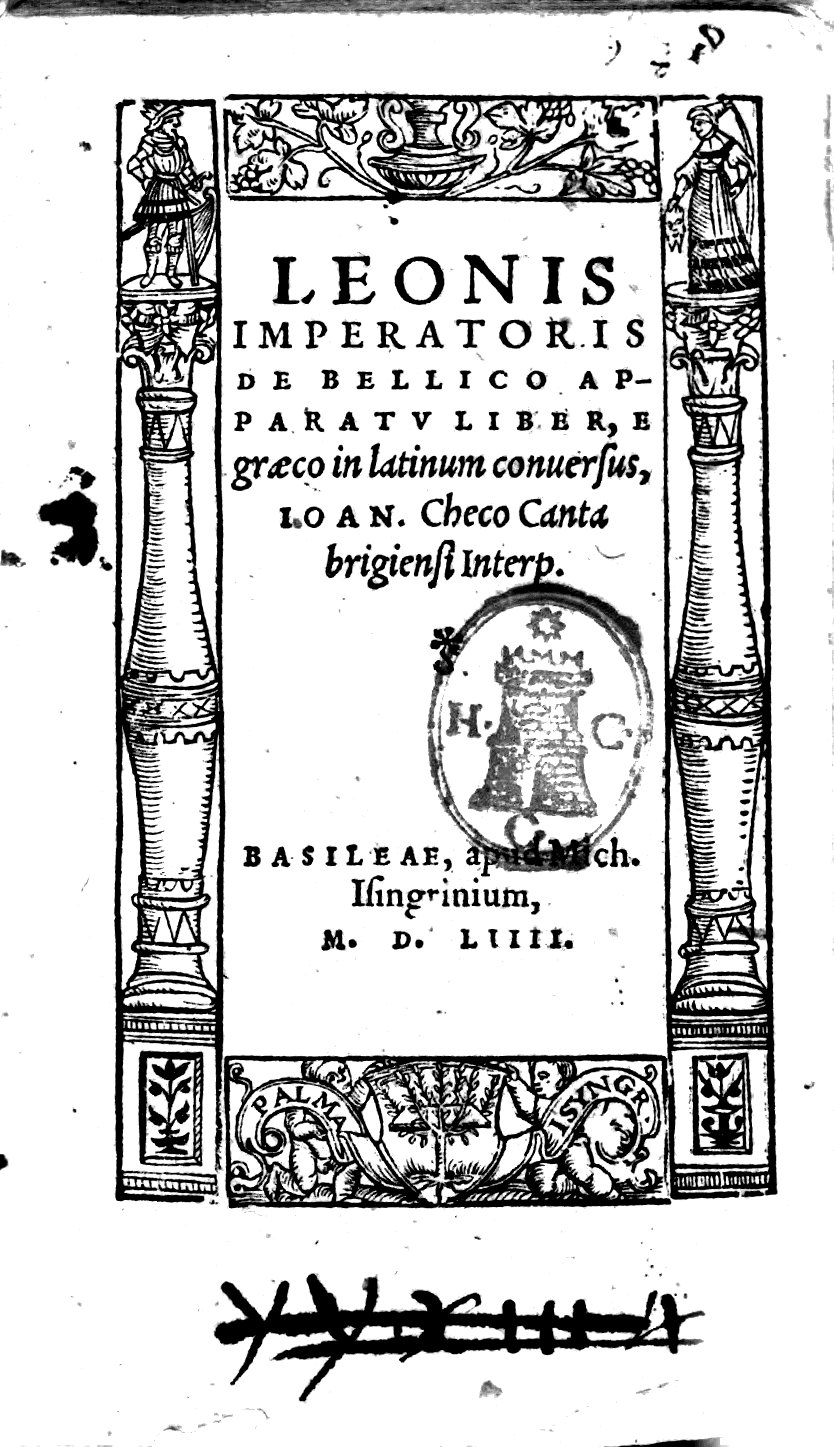
The earlier edition names the Englishman whom Pigafetta leaves unnamed. Its title page reads:
LEONIS IMPERATORIS DE BELLICO APPARATV LIBER, e graeco in latinum conversus, IOAN. Checo Cantabrigiensi Interp.
This is John Cheke's Latin translation, printed at Basel by Michael Isingrin in 1554. The date is compatible with Pigafetta's approximate 35. anni: 1554 was thirty-two years before the 1586 Italian edition, while Cheke's translation work originated in Henry VIII's reign. Pigafetta's wording about the King's Greek book should be preserved rather than over-resolved; identifying the exact Greek manuscript and its route between royal and collegiate custody remains a separate manuscript-history task.
1.5 Why Cheke and Pinelli both matter to the Neville network
The two ends of Pigafetta's collation have independent Neville-facing routes.
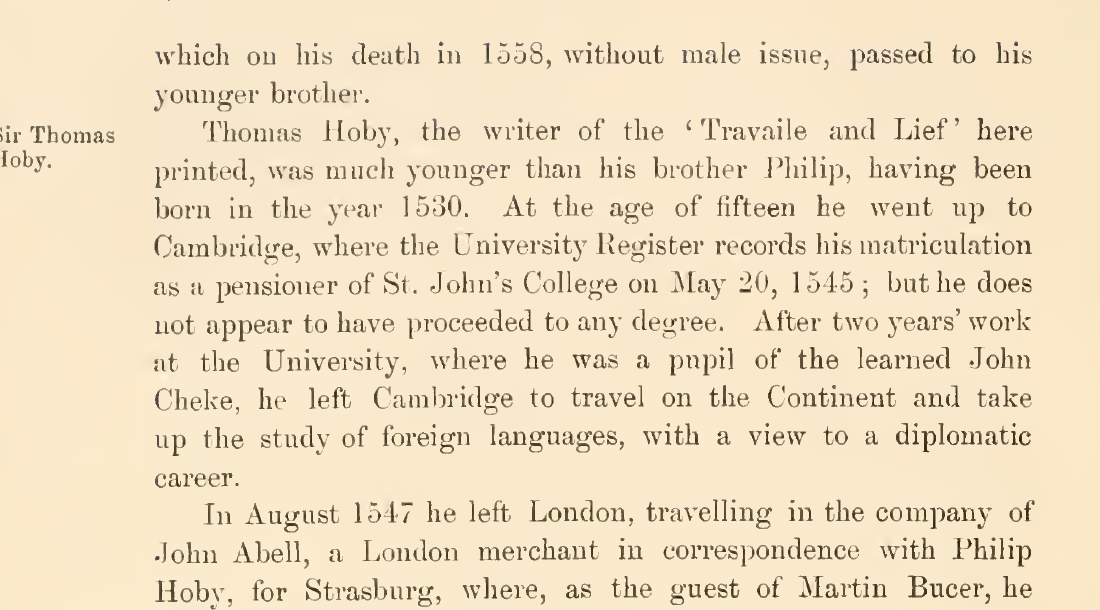
Cheke-Hoby-Cooke-Neville. Edgar Powell's preface to the printed Travels and Life of Sir Thomas Hoby states that Hoby was a pupil of the learned John Cheke. Hoby married Elizabeth Cooke. Elizabeth's sister Katherine Cooke Killigrew was the mother of Anne Killigrew Neville, Henry Neville's wife. Hoby-owned Italian books also survived through the Billingbear/Audley End collection. Thomas Hoby's own family chronicle separately records Henry Neville's mother, Lady Elizabeth Nevell, and maternal grandmother, Lady Frances Gresham, as godmothers to Hoby's daughter Elizabeth at Bisham in 1562. This documents a real social and book-provenance environment; it does not prove that the Leo volume passed through Hoby.
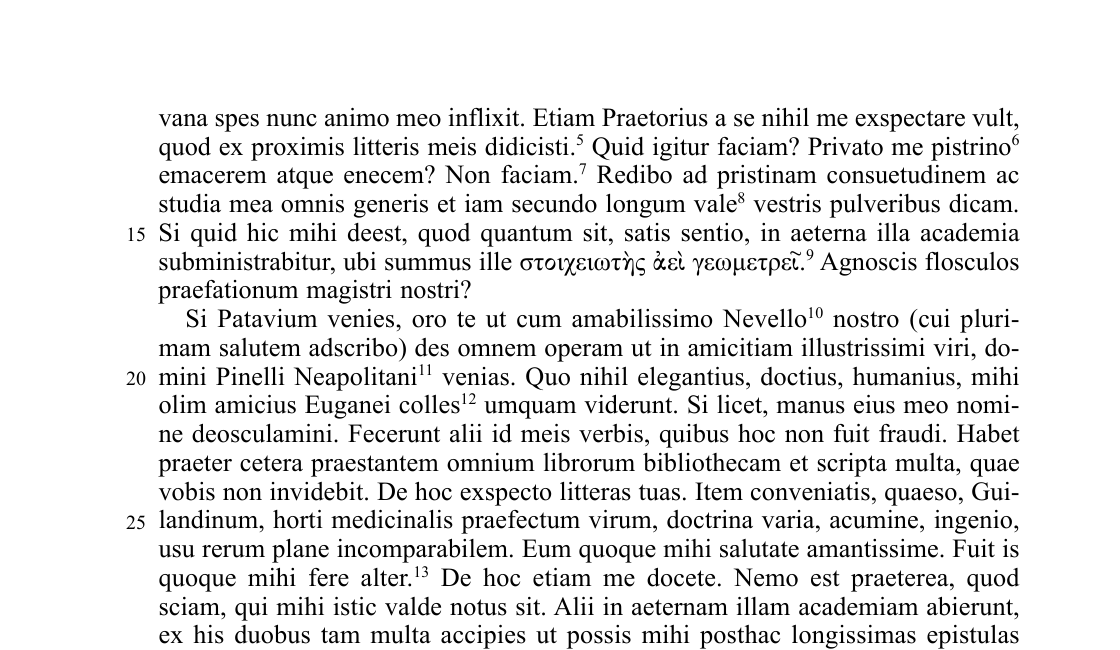
Neville-Savile-Pinelli. Dudith's letter to Henry Savile of 10 September 1581 asks Savile, if he comes to Padua, to go with amabilissimo Nevello nostro and make every effort to enter Pinelli's friendship:
Si Patavium venies, oro te ut cum amabilissimo Nevello nostro ... des omnem operam ut in amicitiam illustrissimi viri, domini Pinelli Neapolitani venias.
Dudith immediately stresses Pinelli's library:
Habet praeter cetera praestantem omnium librorum bibliothecam et scripta multa, quae vobis non invidebit.
The 2019 edition identifies the letter as no. 1084 and cites its autograph draft as Berlin, Staatsbibliothek, Depot Breslau, R 253, no. 30, f. 14r-v. The same edition preserves a fragment in a Savile-to-Pinelli letter written at Padua on 17 February 1582, Ambrosiana D 243 inf., f. 34r. These witnesses establish an actual Savile/Pinelli correspondence and an explicit Dudith plan for Nevell and Savile to use Pinelli's friendship and library. They do not prove that Neville saw the particular Greek books Pigafetta later used.
1.6 Ascham identifies the 1544 manuscript circulation
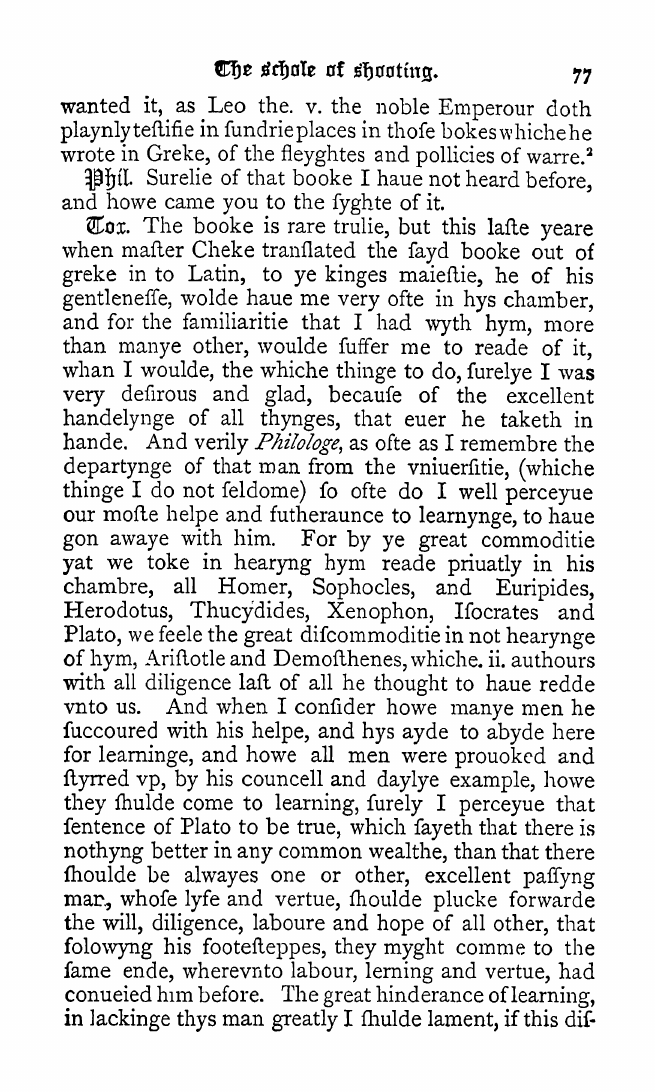
Roger Ascham's Toxophilus (1545) is a contemporary witness to Cheke's work ten years before the Basel print. On printed page 77 Ascham explains how he saw the rare Greek military book:
The booke is rare trulie, but this laste yeare when master Cheke translated the sayd booke out of greke in to Latin, to ye kinges maiestie, he of his gentlenesse, wolde haue me very ofte in hys chamber ... and woulde suffer me to reade of it, whan I woulde.
Ascham says he learned passages by heart because the book was rare, then renders Leo's instructions on compulsory archery, bows and quivers until the age of forty, military preparedness against Saracens and Turks, and a standing bow and forty shafts in every household. He concludes that he has rehearsed Leo in a maner ... woorde for woorde. Cheke's work therefore had an English vernacular military afterlife by 1545; it did not wait for the 1554 Latin print or Pigafetta's 1586 Italian edition.
1.7 Cheke's 1543 Cambridge University Library loan, not Queens' College custody
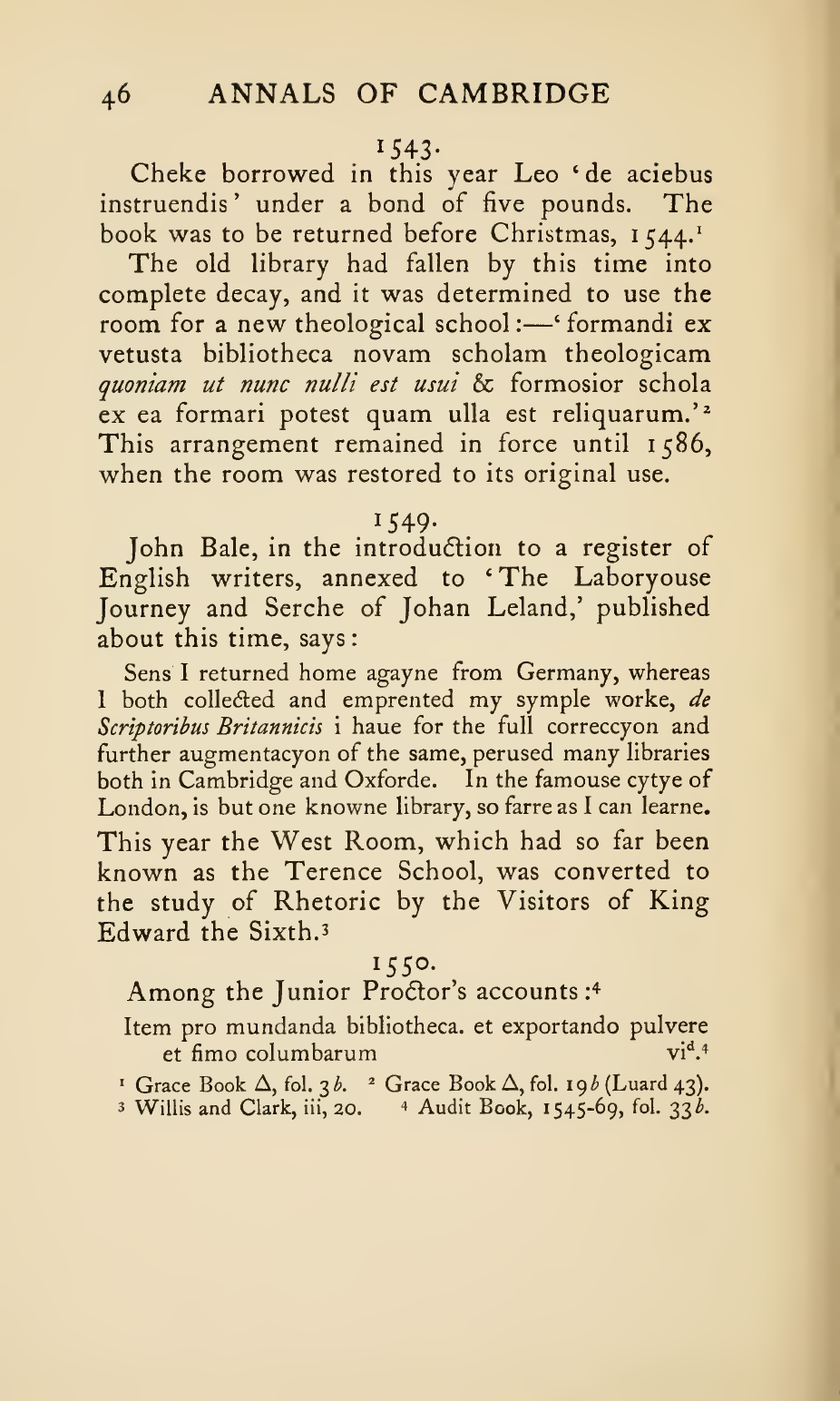
Charles Sayle's Annals of Cambridge University Library (1916), transcribing the university Grace Books, provides the controlling sequence. It records Ascham borrowing Polyaenus in 1540, Cheke borrowing Homer and Hesiod commentaries in 1541, and then:
Cheke borrowed in this year Leo 'de aciebus instruendis' under a bond of five pounds. The book was to be returned before Christmas, 1544.
Sayle cites Grace Book Delta, folio 3b. The 1543 loan and Christmas 1544 deadline align exactly with Ascham's 1545 statement that Cheke had translated the work this laste yeare. Laar's 2024 Oxford thesis, citing J. C. T. Oates, instead reconstructs a composite Polyaenus-Leo volume and suggests that Ascham passed it to Cheke. Cheke's own recorded loan makes that handoff unnecessary. Whether Polyaenus and Leo were physically one composite manuscript remains open because Sayle records distinct loan events while Laar calls them one volume.
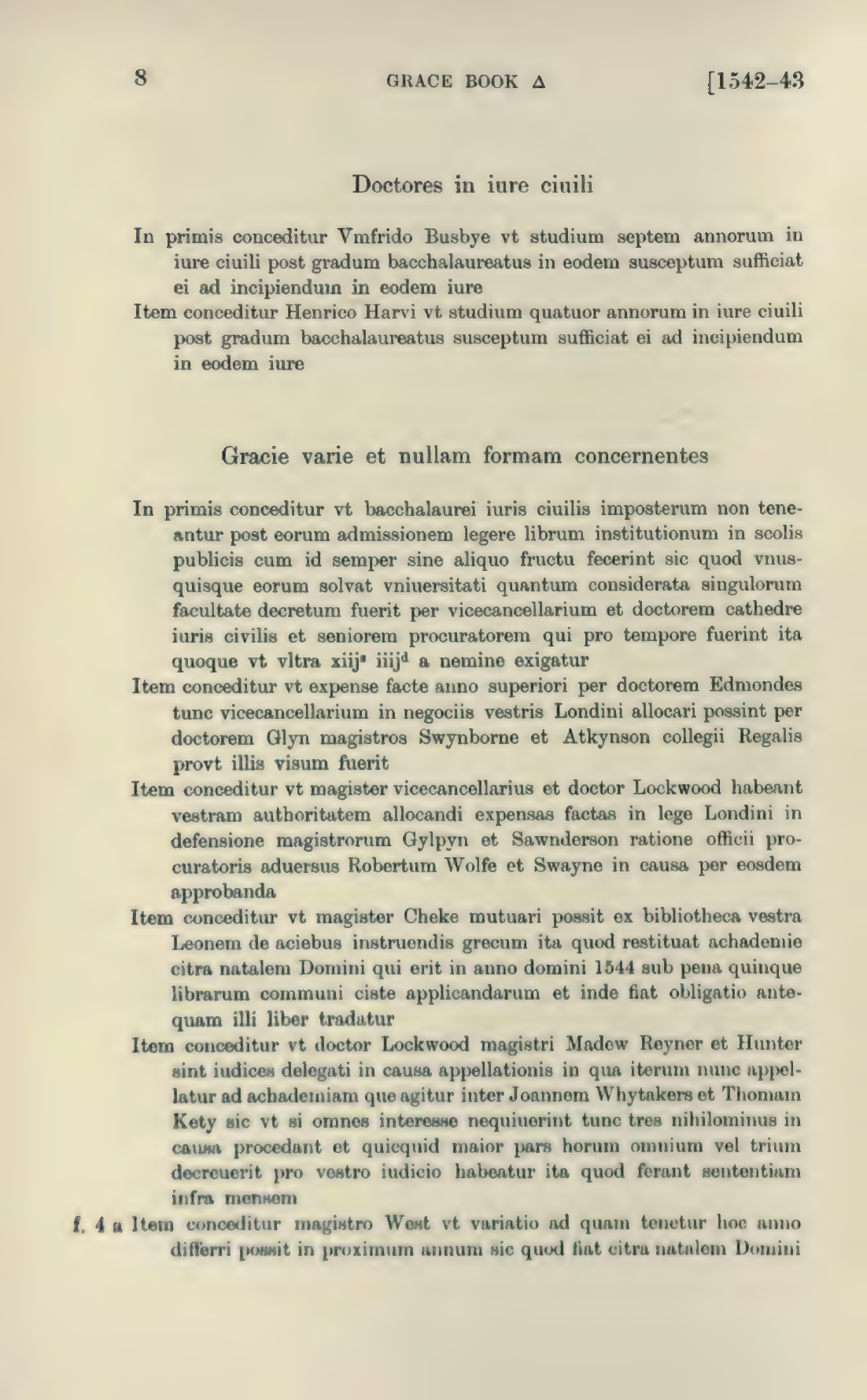
The 1910 printed edition of Grace Book Delta has now been checked independently. It gives the Latin authorization to borrow ex bibliotheca vestra Leonem de aciebus instruendis grecum, return it before Christmas 1544, and execute a five-pound obligation before delivery. The 1908 Grace Book Gamma separately gives Ascham permission to borrow Polyaenus only until All Saints for transcription. The manuscript folios themselves remain to be inspected, but the published university record confirms that Cheke's Leo access was formal and direct.
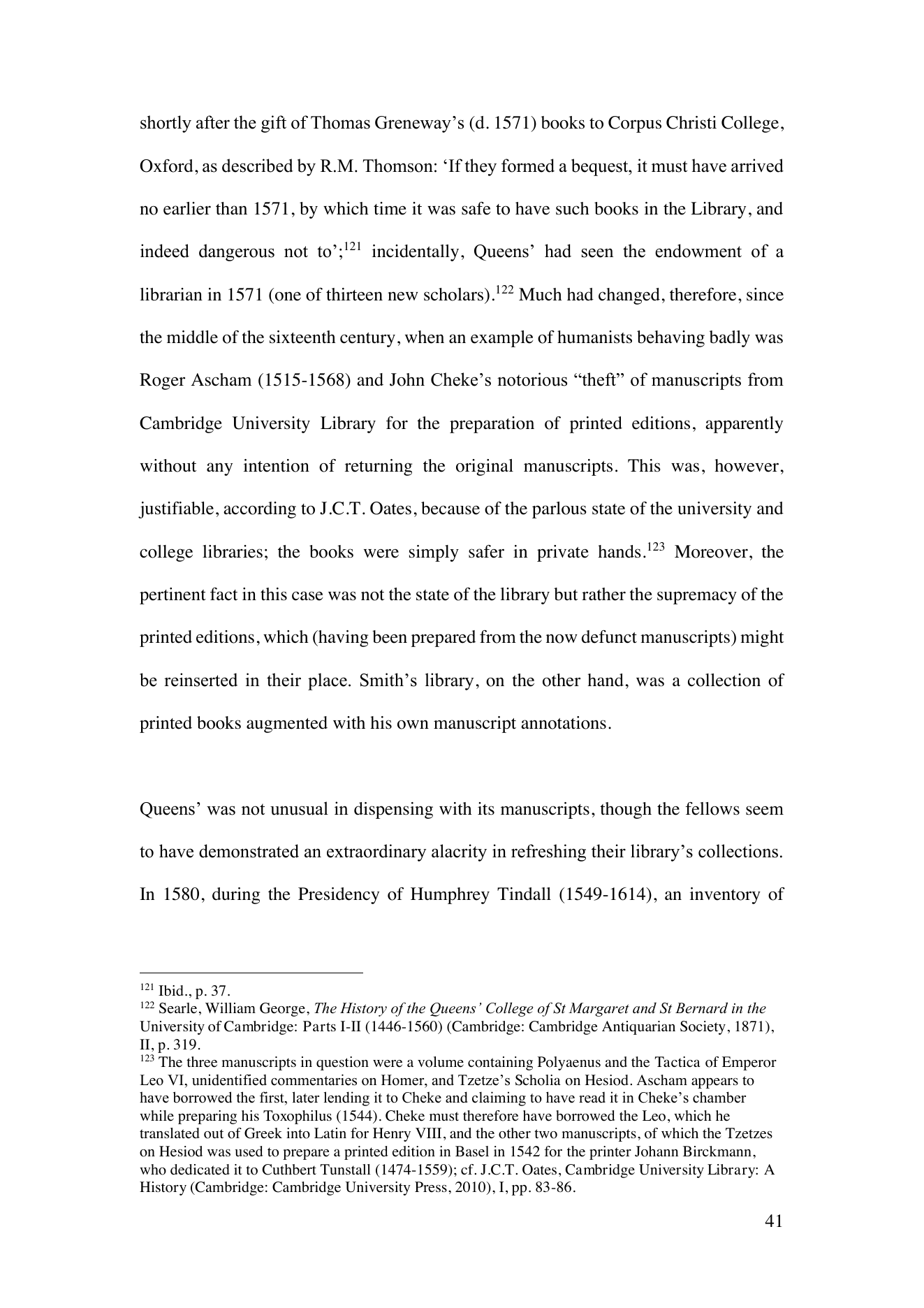
Laar's surrounding discussion concerns Queens' College, which can make an isolated search snippet misleading, but the text explicitly names Cambridge University Library. Searle's History of the Queens' College, part II, page 319, has been checked: it supports Laar's separate point about the 1571 endowment of a librarian, not the Leo manuscript history.
Laar's footnote says:
Ascham appears to have borrowed the first, later lending it to Cheke and claiming to have read it in Cheke's chamber while preparing his Toxophilus (1544). Cheke must therefore have borrowed the Leo, which he translated out of Greek into Latin for Henry VIII ...
Pigafetta's della libreria del Re d'Inghilterra should therefore not simply be converted into a Cambridge ownership statement. Ascham confirms that the translation was for Henry VIII; Sayle's Grace Book record establishes Cambridge University Library custody and Cheke's bonded loan. The original Grace Book folio and Oates I, pages 83-86, are the next controls.
1.8 A later royal manuscript excluded
British Library Royal MS 16 C XIV is a Greek military manuscript in seventy-nine chapters and is catalogued in the royal collection, but the official record dates it to 1584. It cannot be the Greek book Cheke translated in 1544. It belongs to Leo's later English royal-library reception and should not be conflated with the lost Cambridge volume.
1.9 The Cecil bridge strengthens the family-network map
The Cheke-Cooke-Neville connection is not confined to Thomas Hoby. William Cecil first married John Cheke's sister Mary in 1541. He later married Mildred Cooke, sister of Elizabeth Cooke Hoby and Katherine Cooke Killigrew. Katherine's daughter Anne Killigrew was Henry Neville's wife. Cecil therefore personally joins Cheke's family to the Cooke sisters who were Anne Killigrew Neville's mother and aunts. This is documented social and family structure, not proof that a particular manuscript passed to Neville.
2. Quoted Source Passages: How Le Mechaniche Was Made
The 1581 book is unusually well documented. Noémie Castagné and Martin Frank transcribe and analyze the surviving 1580-81 correspondence between Guidobaldo and Pigafetta in the Pinelli manuscripts at the Biblioteca Ambrosiana.
The principal witnesses include:
- BAM, Fondo Pinelli,
R 121 sup., ff. 20r-21r: Guidobaldo's corrections andAvertimenti circa il tradurre; R 121 sup., ff. 14r-15r: Pigafetta to Guidobaldo, Padua, 5 November 1580;R 121 sup., ff. 18r-19v: Guidobaldo to Pigafetta, Pesaro, 14 November 1580;- further letters in
D 34 inf.andR 121 sup.through 29 April 1581.
Guidobaldo states the problem plainly:
per esser questa una materia poco trattata in lingua italiana, e perché bisogna nominar molti termini matematici li quali non abbiamo nella nostra lingua, mi par che bisogni usar voci le quali facilitino la scienza e non la oscurino.
He insists that technical terms should have stable meanings: dove bisogna nominar i termini della scienza, mi par che si facci grande errore nominarli altremente che per il proprio termine. Pigafetta, by contrast, initially wants language intelligible to cultivated readers without Latin. He explains that he wishes the translation to be utile e piana a coloro che non sanno latino and worries that untranslated proportional terms will be understood only by the learned, il numero de' quali è picciolissimo.
This is a valuable history of technical communication, not simply a printed-book attribution. The printed annotations record the compromise. Pigafetta says that where Latin terms could not be conveniently rendered, he retained them but would explain them so they did not obstruct readers without Latin. He wanted new technical words to become famigliari, e domestiche in questa scienza, talché ognuno le possa agevolmente intendere.
The correspondence also documents experiment correcting theory. At Osoppo, Pigafetta and Giulio Savorgnano tested multi-sheave pulleys and found that actual performance did not match the ideal ratio:
non rispondeva in fatto la possanza col peso, et la sperientia con la ragione
Pigafetta proposed friction in pulleys, axles, and ropes as a cause and asked Guidobaldo for a fuller explanation. This creates a concrete intellectual setting for the book: mathematical demonstration, workshop construction, military engineering, and practical trial were being brought into dialogue.
3. Savorgnano, Osoppo, and the Military Workshop
Pigafetta dedicated the book to Giulio Savorgnano, Count of Belgrado. The dedication describes mechanics as joining natural philosophy, mathematics, and manual execution. It ranges across balances, levers, pulleys, windlasses, toothed wheels, screws, water-raising devices, mills, clocks, ships, artillery, fortification, siege engines, and devices moved by air, water, cords, and counterweights.
Castagné and Frank describe Osoppo from Pigafetta's dedication as a combined armory, cabinet of machines, and military study center where devices were collected and tested. That account should direct future research toward:
- Giulio Savorgnano's papers and inventories;
- Osoppo workshop personnel, including
mastro Faitnamed in Pigafetta's letter; - Ambrosiana correspondence with Pinelli;
- relationships between the De' Franceschi printing house, military translators, and English travelers in Venice.
4. Reconstructing the 1582 Journey
4.1 The calendar sequence
Cobham's letter dated 21 August 1582, calendar item 266, printed p. 262, gives the earlier notice in full:
“There is also one Philippo Pigafetta, of ‘Vinsentia,’ a philosopher, who has likewise given me to understand he desires to go into England, being of young Mr Nevill's acquaintance.”
The 17 September calendar entry then states:
“Il Signor Pigafetti, of whom I have written in my former letters ‘to be’ the acquaintance of young Mr. Nevell, is at present on his departure towards England, together with Signor Aragon … They are desirous to see her Majesty and the City of London … He has written a book of his ‘voyage’ passed in Turkey and Judea, which he desires her Majesty may see.”
The September wording of whom I have written in my former letters explicitly joins the entries. The manuscript must still be checked, but the printed calendar already supplies Filippo's forename and the Nevill relationship in the same sentence. An older Folger chronology summary dated this reference to 19 August; direct inspection of the printed calendar page corrects it to Cobham's letter of 21 August, item 266.
4.2 Ragona's diary identifies the travelers
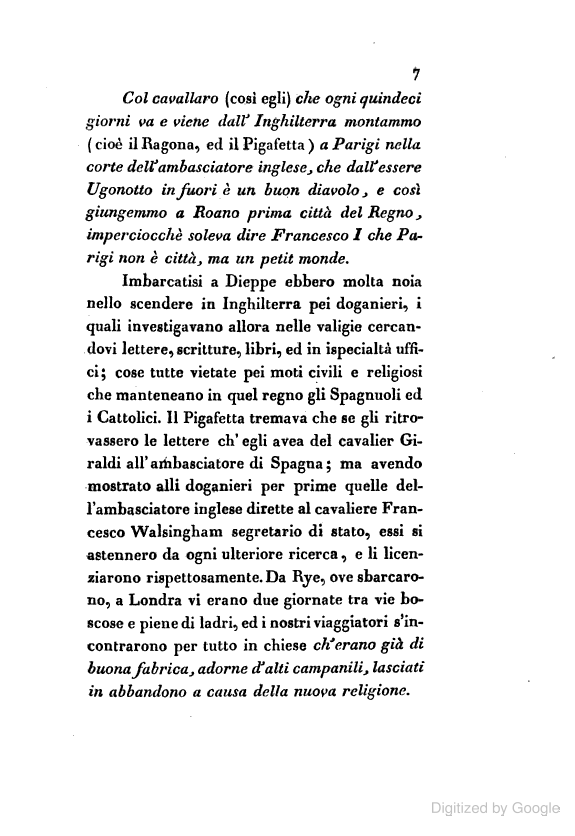
Anton Maria Ragona's diary survives as Biblioteca Ambrosiana D 90 inf. Giovanni da Schio's 1836 printed excerpts state that Ragona:
accompagnatosi col celebre Filippo Pigafetta, partì da Vicenza l'ultima festa di Pasqua dell'anno 1582.
The pair passed through France, crossed from Dieppe, landed at Rye, and proceeded to plague-stricken London. At English customs, the danger was not abstract. The printed excerpt says:
Il Pigafetta tremava che se gli ritrovassero le lettere ch'egli avea del cavalier Giraldi all'ambasciatore di Spagna; ma avendo mostrato alli doganieri per prime quelle dell'ambasciatore inglese dirette al cavaliere Francesco Walsingham segretario di stato, essi si astennero da ogni ulteriore ricerca, e li licenziarono rispettosamente.
On Sunday they presented those letters directly:
La domenica mattina presentammo le lettere dell'ambasciatore al segretario Walsingham, il quale, come tutti i grandi dell'Inghilterra, parla benissimo l'Italiano.
Ragona and Pigafetta observed Elizabeth's court, stayed with the Vicentine merchant Gasparo Gatto away from the plague, met Italians including Orazio Pallavicino and Pietro Capponi, and then returned through France toward Spain.
4.3 Why Signor Aragon probably points to Ragona
The calendar's companion is Signor Aragon. The independently preserved itinerary names Filippo's companion as Anton Maria Ragona. The resemblance is close enough to require direct manuscript collation: Aragon may represent a copyist's or editor's redivision, inversion, or normalization of Ragona's name. Until SP 78/8 is inspected, this should be documented as a strong identification question rather than silently emended.
4.4 Modern biographical confirmation
Daria Perocco's Dizionario Biografico degli Italiani life of Filippo reconstructs the same journey from Ragona's diary. It states that Filippo and Ragona began the France-England-Spain-Portugal journey at the end of June 1582. It also records the customs episode: Filippo first showed letters from the English ambassador addressed to Walsingham, concealing other letters entrusted to him for the Spanish ambassador in London.
Rita Mazzei's biography of Ragona independently describes the route through Lyon, Orléans, Paris, Rouen, and Dieppe to London, then back through Calais, Amiens, Paris, Bordeaux, and Bayonne to Spain. This paired reconstruction makes it very difficult to keep Philippo and the September Pigafetta as unrelated travelers.
5. The Marc'Antonio Itinerario Problem
Marc'Antonio Pigafetta's Itinerario was printed in London in 1585 and its dedication says that English readers, especially Richard Hakluyt, urged publication. It therefore remains important. But the 1585 book's existence cannot override the documented identity of the 1582 traveler.
The unresolved problem is narrower and more interesting:
- Why does Cobham's September entry attribute to Filippo a book of travel through Turkey and Judea?
- Was the calendar summarizing one of Filippo's own Middle Eastern travel accounts? Filippo had traveled to Constantinople in 1573 and through Egypt and Sinai in 1576-77.
- Did the editor or an earlier project note connect the passage too quickly to Marc'Antonio's Itinerario?
- Could a manuscript, title, or identity have been confused within the Pigafetta family?
The answer requires SP 78/8 and the full Ragona diary. It should not be manufactured from the later title page.
6. Shakespeare Research Avenues, with Folger Text
No direct source claim is made here. The strongest present value is the documented access network and Billingbear book cluster. Still, Le Mechaniche opens several comparison questions that can be pursued from the play texts themselves.
6.1 Contrivance, measurement, and execution
Pigafetta's dedication and correspondence repeatedly join mathematical reason, workshop trial, and military execution. In Troilus and Cressida, Ulysses contrasts the visible battering ram with the reasoning that designs and directs it:
ULYSSES
They tax our policy and call it cowardice,
Count wisdom as no member of the war,
Forestall prescience, and esteem no act
But that of hand. The still and mental parts
That do contrive how many hands shall strike
When fitness calls them on and know by measure
Of their observant toil the enemy's weight--
Why, this hath not a fingers dignity.
They call this bed-work, mapp'ry, closet war;
So that the ram that batters down the wall,
For the great swinge and rudeness of his poise,
They place before his hand that made the engine
Or those that with the fineness of their souls
By reason guide his execution.
This Folger passage supplies an exact thematic question: how do the plays distinguish handwork, the designed engine, measurement, and the reasoning that guides execution? The similarity is conceptual and belongs in a broader history of military and mechanical language.
6.2 The engineer caught by his device
Hamlet uses an exact siege-engineering image:
HAMLET
For 'tis the sport to have the enginer
Hoist with his own petard; and 't shall go hard
But I will delve one yard below their mines
And blow them at the moon. O, 'tis most sweet
When in one line two crafts directly meet.
The passage should be studied alongside the technical and military books available at Billingbear, but not treated as a fingerprint of Le Mechaniche. Enginer, petard, and mining belong to a wider military vocabulary. The research opportunity is to document the precise technical literature accessible within Neville's network and compare its explanations and metaphors against the Folger text.
6.3 Mechanical does not always mean mechanics
The Folger corpus also prevents a false shortcut. In A Midsummer Night's Dream, Robin calls the artisans:
ROBIN
A crew of patches, rude mechanicals,
That work for bread upon Athenian stalls,
Were met together to rehearse a play
Intended for great Theseus' nuptial day.
Here mechanicals denotes working artisans and their social position, not knowledge of Guidobaldo's mathematical mechanics. The passage is still relevant to the book's address to ogni Artefice, but it is not a title-word correspondence.
7. New Research Program
- Request object photography and catalogue histories for Audley End
81035047and81035082, including title pages, bindings, all inscriptions, annotations, stains, endleaves, pastedowns, and shelfmarks. - Collate SP 78/8 for both dates. Particular targets are
Philippo,Vinsentia,young Mr Nevill,Signor Aragon, and the exact description of the travel book. - Obtain Ambrosiana
D 90 inf.or a full scholarly transcription, then construct a dated route table for Filippo and Ragona against Cobham's dispatches. - Trace the two De' Franceschi books through booksellers, English collectors, and surviving copy provenances.
- Study Filippo's lost-book list in his letter to Pinelli of 19 March 1584; compare it with Billingbear holdings.
- Search the Ambrosiana Pinelli correspondence for English names, Walsingham, Neville/Nevell, Savile, Sidney, Hakluyt, Wolfe, and English ambassadors.
- Compare the Mechaniche translator's debate over plain versus technical language with early English mathematical and military translation—not just isolated vocabulary.
- Pursue the printer cluster: both Billingbear books came from Francesco de' Franceschi, and Pigafetta also contributed to De' Franceschi's 1583 Gerusalemme liberata. Determine whether Billingbear contains other De' Franceschi products.
- Identify the Greek manuscript used by Cheke and trace its royal, Cambridge, and printing history before the 1554 Basel edition.
- Collate Pigafetta's 1586 Italian text against Cheke's Latin and the surviving Greek tradition to determine where the Pinelli and Contarini witnesses altered the text.
- Search Hoby, Cooke, and Neville family inventories and correspondence for Cheke's Leo translation, Greek military manuscripts, or Pigafetta titles.
- Examine Ambrosiana
D 243 inf.and the wider Pinelli correspondence for Savile, Neville, Pigafetta, Guidobaldo, Leo VI, and the lost-book list Pigafetta sent Pinelli on 19 March 1584.
8. Citations and Local Source Witnesses
- Billingbear catalogue: Billingbear Book List Transcription:327 and the second Pigafetta entry at Billingbear Book List Transcription:458.
- Combined spreadsheet: BOOKS BRO AEH COMBINED 190830 Sheet1:127.
- English Heritage inventory extract: pre 1616 books Feb 2010 Audley End from 2023 thread:767.
- Guidobaldo del Monte, Le Mechaniche (Venice, 1581), Internet Archive/Getty: catalogue and scan; local lemechanichedell00mont and lemechanichedell00mont djvu.
- Noémie Castagné and Martin Frank, “Definizione dell'italiano scientifico nel tardo Cinquecento: la traduzione del Mechanicorum Liber di Guidobaldo dal Monte,” Laboratoire italien 13 (2013), article and letter transcriptions; local castagne 2013.
- Anton Maria Ragona, Viaggio in Inghilterra, Francia, Spagna ... nel 1582, ed. Giovanni da Schio (Venice, 1836), Google Books; locally preserved pages.
- Daria Perocco, “Pigafetta, Filippo,” Dizionario Biografico degli Italiani 83 (2015), Treccani.
- Rita Mazzei, “Ragona, Anton Maria,” Dizionario Biografico degli Italiani 86 (2016), Treccani.
- Leo VI, Trattato brieue (Venice, 1586), Folger catalogue record.
- Leo VI, Trattato brieve (Venice, 1586), Google Books Rome witness
srDvaQu0iHgC, title and annotations; Bavarian comparison witnessYiNaAAAAcAAJ, Google Books. - Leo VI, De bellico apparatu liber, trans. John Cheke (Basel, 1554), Folger catalogue record 75733, Google Books image witness.
- The Origins of Early Modern Literature, DHI, Ascham item 837, Cheke/Leo manuscript and translation context.
- Roger Ascham, Toxophilus (1545), printed pp. 77-79, local RogerAschamToxophilus1545, actual 1545 Manchester copy Special Collections 841, and Folger STC 837 record.
- Charles Sayle, Annals of Cambridge University Library, 1278-1900 (1916), pp. 45-46, Archive.org scan, for the Grace Book-based loan sequence and Cheke's 1543 bonded borrowing of Leo.
- W. G. Searle, ed., Grace Book Gamma (1908), p. 349, Archive.org, for Ascham's Polyaenus loan; John Venn, ed., Grace Book Delta (1910), p. 8, Google Books, for Cheke's Greek Leo loan and obligation.
- Alex Laar, Exploring Humanist Networks of Knowledge and Reading in Queens' College Old Library, Cambridge (Oxford DPhil, 2024), p. 41 n. 123, ORA record; local laar exploring humanist networks 2024. Laar cites Oates I, pp. 83-86, which remain to be inspected independently.
- British Library, Royal MS 16 C XIV, dated 1584 and therefore excluded as Cheke's source manuscript.
- Full manuscript-network packet: john cheke ascham leo vi greek manuscript network.
- Andreas Dudithius, Epistulae. Pars VII: 1581-1589, ed. Nicolaus Szymanski and Ida Radziejowska (2019), letter 1084, pp. 115-16; local Andreas Dudithius VII Reciti 2024 and Andreas Dudithius VII Reciti 2024:5288.
- Thomas Hoby, The Travels and Life of Sir Thomas Hoby (1902), preface p. x, local travels life sir thomas hoby 1902.
- A. J. Butler, ed., Calendar of State Papers, Foreign, Elizabeth, vol. 16 (1909), item 266, p. 262, BHO August page range, local page 262; item 339, p. 329, BHO September page range.
- Folger Shakespeare Library: *Troilus and Cressida*, 1.3; *Hamlet*, 3.4; *A Midsummer Night's Dream*, 3.2. Private lineation checks remain in the local research apparatus.
9. Evidence Images
10. Notes on Access
- The Internet Archive PDF is a complete page-image witness for the Getty copy of the 1581 book; its OCR is for navigation.
- Castagné and Frank's quoted letter text is their scholarly transcription of Ambrosiana manuscripts. The manuscript images themselves were not obtained.
- The 1836 Ragona excerpts are controlled by Google Books page images. The local Tesseract text is not the quotation witness.
- BHO supplies the printed calendar page images. SP 78/8 remains uninspected.
- Audley End object data proves survival and current identification, not acquisition by Henry Neville.
- The 1586 title and annotation images come from the Rome Google Books copy, not Audley End object
81035082; a second Bavarian title page was checked as an edition control. - The 1554 Cheke title page is a Google Books witness to the earlier Latin edition. Sayle's Grace Book-based account records Cheke himself borrowing Leo from Cambridge University Library in 1543 under a five-pound bond, due before Christmas 1544. Laar, citing Oates, calls Polyaenus-Leo one composite volume and suggests an Ascham-to-Cheke handoff; the physical-volume question remains open pending the Grace Book folios and Oates.
- The Dudith text comes from the 2019 critical edition; the cited autograph draft in Berlin has not been inspected as an image.
- The complete illustrated source dossier is FILIPPO PIGAFETTA NEVELL BILLINGBEAR MAJOR DISCOVERY REPORT 2026 07 11.