Pigafetta in 1582: Filippo, Marc'Antonio, and the Itinerario Identity Problem
Topic: Pigafetta in 1582—Filippo and Marc'Antonio
Book synchronization correction — 28 August 2026
The book chapters on Measure for Measure and The Merchant of Venice now follow this packet's identity control. Marc'Antonio's 1585 Itinerario remains a public contextual source analogue for Vienna and Ottoman-Persian material. Filippo remains the Pigafetta whom the 1582 calendar connects with young Mr Nevill. The two evidentiary lanes are separate: the calendar does not create a Neville access route to Marc'Antonio or his Itinerario.
Return chronology correction — 11 August 2026
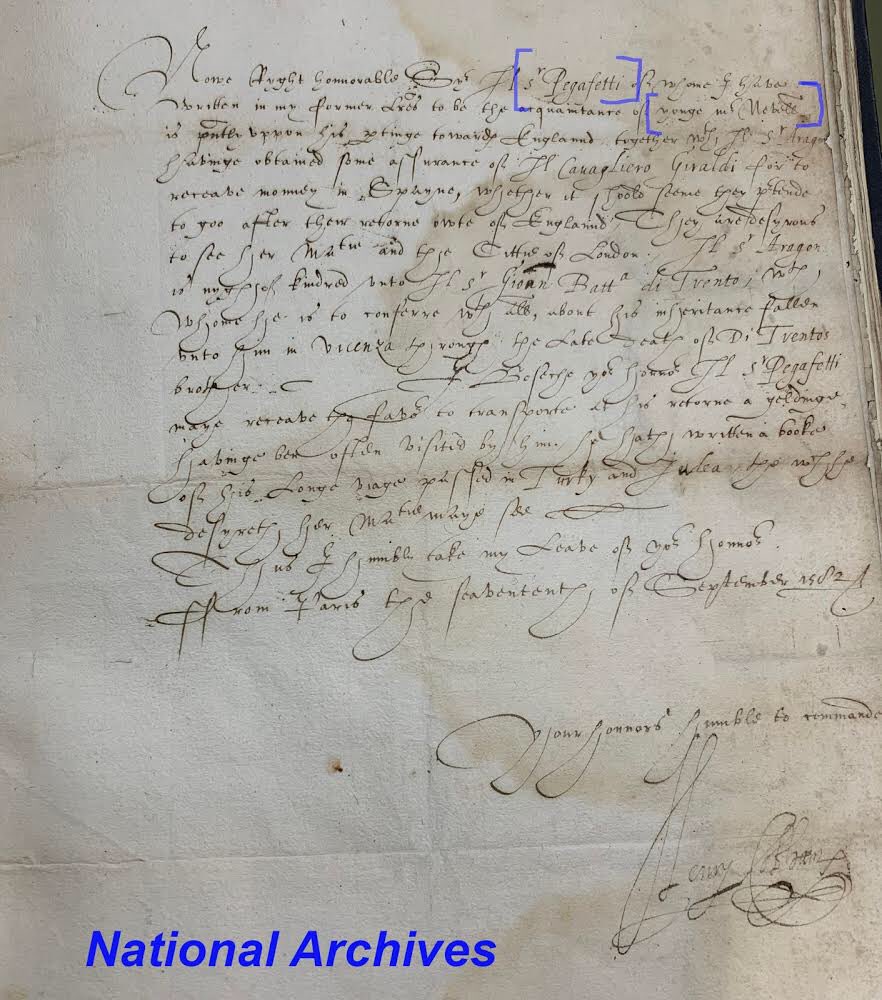
The two Pigafetta notices are Henry Cobham's letters from Paris to Walsingham, dated 21 August and 17 September 1582. The second explicitly refers back to the former letters. Neither was written by Pigafetta or Neville. Cobham's Paris dateline places the ambassador, while the 1836 Ragona excerpts separately place Filippo Pigafetta and Anton Maria Ragona at the English ambassador's Paris residence before they travelled via Rouen and Dieppe, landed at Rye, and reached London after two days on the road.
Ragona says the English visit occurred in September. Joined to Cobham's 17 September statement that they were then departing, this supports a cautious 18-30 September window for Pigafetta and Ragona's crossing. It does not put young Mr Nevill in Paris or show that Neville crossed with them. The later direct English terminus found in John Dee's diary applies to Henry Savile: Dee records Mr. Savile among visiting travaylors on 3 February 1583. Henry Neville's own crossing remains undocumented.
Source-Fact Audit — 7 August 2026 (Round 4)
- The 1582 calendar entries identify the traveller as Filippo Pigafetta; the older packet title's association with Marc'Antonio Pigafetta must not replace the name printed in the source.
- The phrase
young Mr Nevillis the calendar's wording and supplies no forename. Henry Neville is nevertheless the strong contextual identification: he was the right age, had spent the preceding years in the Savile continental party, and Graham's letter of 29 July 1582 pairs Savile with the editor-identified Neville and reports that they intended to return to England within days. Graham writes from Paris but does not locate the pair. Cobham's 21 August Paris letter then calls Filippo Pigafetta an acquaintance ofyoung Mr Nevill. - The calendar can document the proposed or reported travel arrangement and its date. It cannot on its own prove that the journey occurred, that the unnamed Neville read Pigafetta's later works, or that information moved onward to a literary text.
- Filippo's and Marc'Antonio's biographies and publications must be kept distinct even where later catalogues or secondary accounts confuse them.
- The packet therefore preserves the exact calendar language while distinguishing a strong contextual identification as Henry Neville from an explicit identification in the calendar. Any later transmission claim remains separate and unresolved.
Dudith Name in the 1585 Itinerario — image-verified 8 August 2026
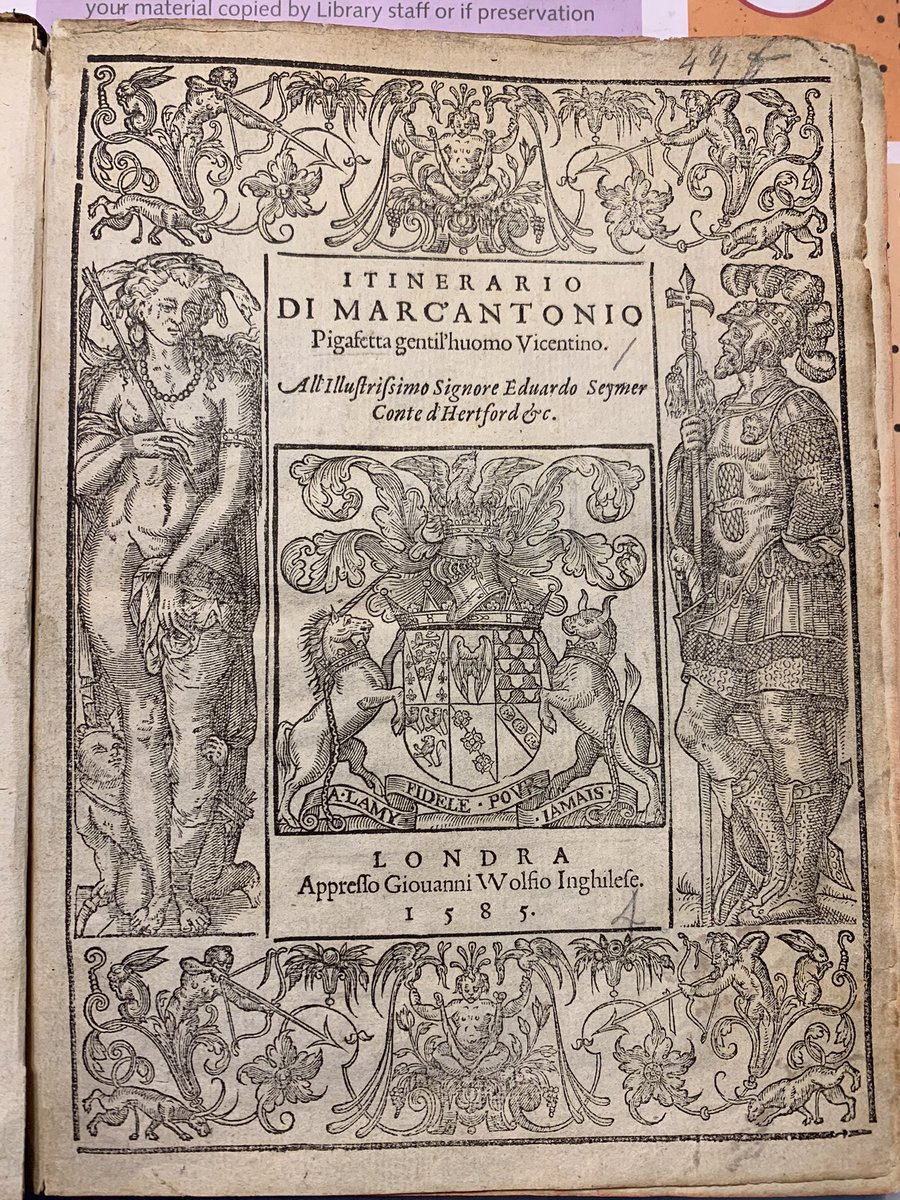
The page-image witness now confirms that Marc'Antonio Pigafetta's London edition names Dudith. In its description of the Polish-born chief dragoman, the page prints:
parente hora di Andrea Dudicio, huomo Celebre
Working translation: “now a kinsman of Andrea Dudith, a celebrated man.” The verified page is preserved in the existing Internet Archive-derived image set as page 090; the public source is the Internet Archive 1585 witness. The earlier OCR-only reading and warning are superseded.
This is secure evidence that Dudith's name appeared in an Italian-language book printed in London in 1585. It does not show that Henry Neville helped prepare, transmit, or publish Marc'Antonio's book. The Filippo/Marc'Antonio identity problem and the young Mr Nevell calendar problem remain separate.
1589 Hakluyt Sonnet — image-verified 8 August 2026
The first edition of Hakluyt's Principal Navigations directly confirms the second printed Marc'Antonio–Hakluyt link. The prefatory leaf is headed:
DI MARC' ANTONIO PIGAFETA GENTIL-HVOMO VICENTINO
After naming Ramusio, the sonnet turns to Hakluyt:
Hakluyto poi ... accolto ha insieme
The signer and the Hakluyt line are visible on the 1589 page image, leaf n9. This directly controls the fact that Marc'Antonio praised Hakluyt in print four years after Hakluyt had urged publication of the Itinerario. It does not identify Marc'Antonio as Cobham's 1582 Philippo, or connect Henry Neville to either publication.
Book candidate and location correction — 8 August 2026
Filippo's 1576–77 Egypt–Sinai relation is now the leading known candidate for Cobham's book ... passed in Turkey and Judea, because the August letter names Filippo and the relation fits the date, manuscript form, Ottoman setting and political content. It is not an exact identification: the relation concerns Egypt, Arabia and Sinai, not Judea, and contemporary English usage normally distinguishes those regions. See filippo pigafetta egypt sinai candidate book 1576 1582.
Marc'Antonio's Itinerario remains a poor match because its route is Vienna–Constantinople and its dedication calls it a journey of few miles near the doors of Christendom. But the location argument must not be overstated. Marc'Antonio is documented in London in 1580 and before the Italian church consistory on 27 March 1581; no source checked in this pass locates him in September 1582. Those London facts do not prove he could not have been in Paris seventeen months later. Filippo's identification rests on Cobham's explicit forename, the September back-reference and Ragona's matching journey.
Major Identity Correction, 11 July 2026
- The 1582 traveler acquainted with
young Mr. Nevellshould no longer be called Marc'Antonio Pigafetta without qualification. Joined calendar, diary, and biographical evidence now strongly identifies him as Filippo Pigafetta of Vicenza (1533-1604). - Cobham's 21 August calendar entry, item 266, p. 262, explicitly calls the traveler
Philippo Pigafetta, of 'Vinsentia,' a philosopherand says in the same sentence that he wasof young Mr Nevill's acquaintance. The 17 September entry refers backward to former letters and sendsSignor Pigafettato England withSignor Aragon. - Anton Maria Ragona's surviving 1582-83 diary records that he and Filippo Pigafetta made precisely this France-England-Spain journey. It records Filippo carrying English-ambassador letters addressed to Walsingham, presenting them to Walsingham in London, and concealing other letters intended for the Spanish ambassador.
Signor Aragontherefore probably points to Anton Maria Ragona; the exact manuscript reading remains to be checked in SP 78/8.- Marc'Antonio's 1585 London Itinerario and its Hakluyt dedication remain genuine and important, but the later printed book does not determine the identity of the 1582 traveler. Filippo's Egypt–Sinai relation is the leading known candidate for Cobham's Turkey/Judea description, with an unresolved and material
Judeamismatch. - See filippo pigafetta mechaniche billingbear 1581 for the complete reconstruction and the discovery that Billingbear preserved two translations by Filippo.
Status-Control Position
- Research-ready after direct collation of the British History Online calendar page, its scanned printed page, the 1585 Itinerario title page and dedication, and the critical-edition witness in which Graham, writing from Paris on 29 July 1582, reports that Savile and the editor-identified Neville intend to go to England. That witness pairs the men but does not place them in Paris.
Readymeans that explicit source wording and contextual identification remain visibly separate. - Do not say Henry Neville helped bring Marc'Antonio's manuscript to England. The traveler is now best identified as Filippo, and the calendar gives
young Mr Nevellwithout a forename. Henry Neville remains a strong contextual identification because Graham pairs him with Savile and reports their intended movement to England immediately before the Cobham notices; Graham does not supply a Paris location for them, and the calendar still does not establish a manuscript-transport or publication role. Antonio Pigafetta / Setebos belongs in a separate Tempest source lane. - Citation correction: the 17 September letter is item
339in Calendar of State Papers, Foreign, Elizabeth, vol. 16, on the page conventionally numbered329, not p.314. The scan itself accidentally prints the running page number as829; the digital sequence, image filename, surrounding pagination (328,330), and BHO page range establish that it is p.329. - Edes/Scotland source position: the adjacent Walsingham-channel claim now has its own packet. Richard Edes's Iter Boreale names a book-learned
Nevillusin Walsingham's retinue at Durham during the return from the 1583 Scotland embassy; Dana Sutton cautiously identifies him as Sir Henry Neville. This strengthens the plausibility context for Walsingham's knowledge ofyoung Mr Nevell, but it does not close the SP 78/8 Pigafetta identity problem.
Quoted Source Passages
Use these before repeating the Pigafetta/Neville source-access claim:
- Title-page line:
Pigafetta gentil'huomo Vicentino(pigafetta itinerario 1585 first 5 pages human ocr:27). - London printer line:
Appresso Giouanni Wolfio Inghilese(pigafetta itinerario 1585 first 5 pages human ocr:33). - Dedication route:
in Londra, & in Ossonia(pigafetta itinerario 1585 first 5 pages human ocr:106). - Hakluyt named in the paratext:
Ricardo Hakluyt gentilhuomo Inglese(pigafetta itinerario 1585 first 5 pages human ocr:121). - Cobham/Walsingham calendar:
Il Signor Pigafettiwas described asthe acquaintance of young Mr. Nevell; he had written a book of his voyagepassed in Turkey and Judea, which he wished Elizabeth to see. This is now controlled directly by BHO item339and the local page scan, rather than by the blog alone.
Evidence note: the printed-book and Hakluyt/Wolfe access lane is strong. The Henry Neville contact identification is also strong contextually because of the independent 29 July 1582 companionship-and-return-intention witness, but it remains uncodified in the calendar's own wording until SP 78/8 or another direct record supplies the forename.
Direct Calendar Witness: Cobham to Walsingham, 17 September 1582
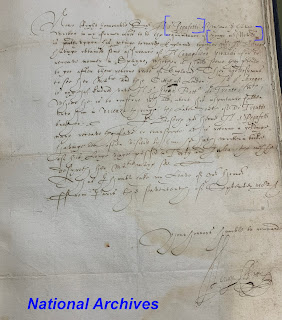
The calendar entry is a direct nineteenth-/twentieth-century printed edition of a state-paper letter, not a modern blog quotation. Item 339 reads:
“Il Signor Pigafetti, of whom I have written in my former letters ‘to be’ the acquaintance of young Mr. Nevell, is at present on his departure towards England, together with Signor Aragon … They are desirous to see her Majesty and the City of London … I beseech you that Pigafetta may receive the favour to transport at his return a gelding, having often been visited by him. He has written a book of his ‘voyage’ passed in Turkey and Judea, which he desires her Majesty may see.—Paris, 17 Sept. 1582.”
The entry is labelled Add. Endd. ½ p. [France VIII. 43.]. It proves four limited facts: a Pigafetti was going to England; Cobham called him an acquaintance of young Mr. Nevell; he had written a Turkey/Judea travel book; and he wished the queen to see it. It does not itself give Nevell's forename or say that he carried the manuscript, arranged its printing, or introduced Pigafetti to Hakluyt. Graham's independent pairing of Savile and Henry Neville, together with their stated intention to go to England, makes Billingbear a strong contextual identification rather than an arbitrary surname expansion; Graham does not prove a Paris stop.
The later London book once made Marc'Antonio seem like the natural identification. The fuller documentary sequence now changes that conclusion: the August calendar names Filippo; Ragona's diary puts Filippo and Ragona on the exact journey; and the diary places Filippo in direct contact with Walsingham. The calendar gives only the surname on 17 September, so SP 78/8 is still required, but Marc'Antonio should not be inserted into that letter.
Direct Printed-Book Publication Narrative
Pigafetta says he had composed the travel account sixteen years earlier, principally for private circulation among friends. After coming to England and showing it in London and Oxford, English gentlemen urged him to publish it:
Hora essendo io venuto in questo Regno, & hauendolo in Londra, & in Ossonia ... dimostrato ad alcuni gentil'huomini miei amici, fui da loro con non poca instanza essortato a mandarlo in palese.
He then names Hakluyt as a principal advocate:
essendo pur stato di nuovo essortato, & principalmente da messer Ricardo Hakluyt gentilhuomo Inglese, & Maestro nell'arti in Oxonia
This closes the older secondary-source question about whether Hakluyt promoted the book: the 1585 dedication says so directly. It does not identify Neville among the unnamed London or Oxford friends.
1. Verified Sourced Facts
- Direct BHO/calendar control,
2026-07-09: item339, Cobham to Walsingham, 17 September 1582, is now checked in both the BHO transcription and its scanned printed page. The navigational page is329; the scan's running head misprints829, followed normally by p.330. The packet should cite BHO's stable page-range URL plus item number, rather than repeat the incorrect project citation to p.314.
- Source-tier warning,
2026-04-28: distinguish the calendared Cobham/Walsingham material and bibliographic facts from Ken Feinstein blog/tweet interpretation. Any bullet introduced as “the same post states” should be treated as preserved local research/blog evidence unless separately tied to a primary or scholarly source in the bullet itself.
- BRO sweep, updated
2026-07-15: no directPigafetta,Pigafetti, Cobham/Walsingham/Pigafetta, Hakluyt/Pigafetta, or 1582young Mr Nevellwitness was found in the BRO transcriptions.D/EN/F8/1/13is a20 January 1665Florence letter by Henry Nevill (1619/20-1694), the ambassador's grandson. It is now documented in its own later-Henry topic and must not be imported into the Marc'Antonio Pigafetta / young Henry Neville lane.
- Corrected working identification,
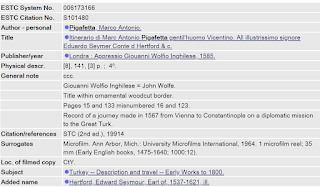
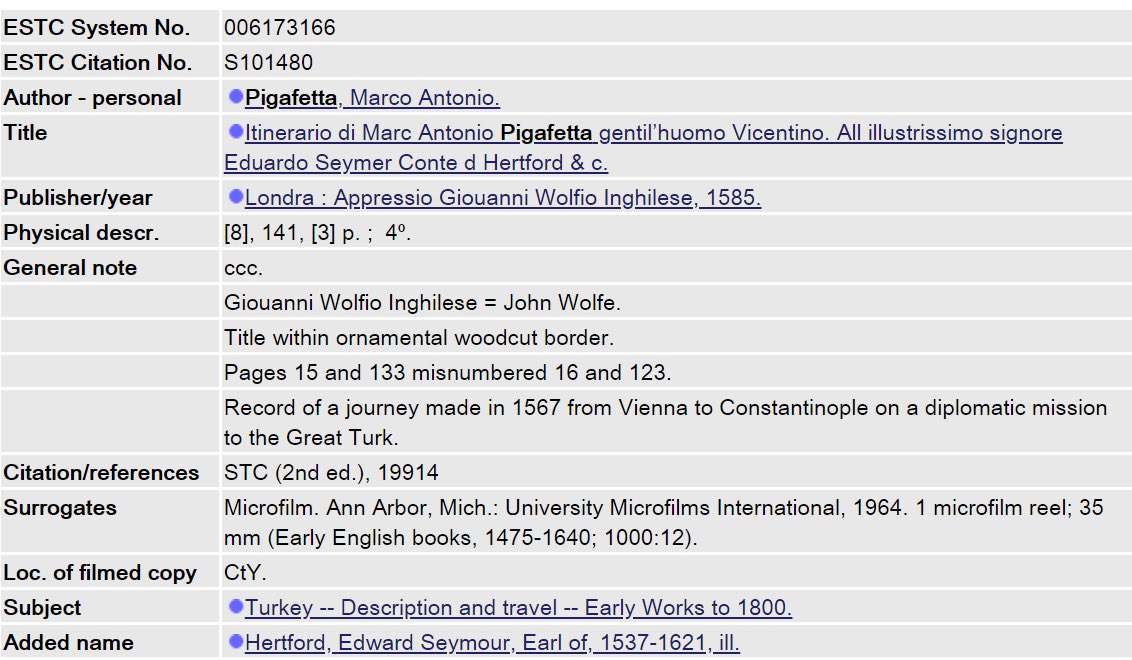
2026-07-11: Cobham'sSignor Pigafettiis best identified as Filippo Pigafetta, because the 21 August entry namesPhilippo Pigafettaand calls himof young Mr Nevill's acquaintance, the September entry points back to former letters, and Anton Maria Ragona's diary documents Filippo and Ragona taking the same route into England. Marc'Antonio's later book remains relevant to the unresolved description of a Turkey/Judea travel book: - Itinerario di Marc'Antonio Pigafetta gentil'huomo Vicentino
- London,
Appresso Giouanni Wolfio Inghilese,1585 141pages in catalog records
- The book described in the Cobham letter as a voyage through
Turkey and Judeahas often been aligned with Marc'Antonio Pigafetta's Itinerario da Vienna a Costantinopoli. That alignment is now a question, not an identity proof. Filippo had his own substantial travel experience and writings concerning Constantinople, Egypt, and Sinai.
- The modern Il Poligrafo / Daria Perocco description states that Marc'Antonio Pigafetta fled first to Germany and then to England, and that in London in
1585he published the Itinerario, a work conceived during his1567-1568journey with Antun / Antonio Vrančić's embassy to the Ottoman Porte.
- A Google Books catalog record identifies the original as:
Itinerario di Marc'Antonio Pigafetta gentil'huomo Vicentino ...
Appresso [G. Wolfio], 1585
141 pages
- A WorldCat record identifies the same original as:
Itinerario (da Vienna a Costantinopoli) di Marc'Antonio Pigafetta gentil' huomo Vicentino
Londra ... Appresso Giouanni Wolfio, 1585
- NYPL has a microform catalog lead:
Itinerario Di Marc'Antonio Pigafetta . [microform]
Londra, Appresso Giouanni Wolfio Inghilese, 1585
- Public digital image witness located,
2026-04-29: Internet Archive has an EEBO microfilm-derived page-image item for Itinerario di marcantonio... 1585, identifierbim_early-english-books-1475-1640_itinerario-di-marcantoni_pigafetta-marco-antonio_1585. The item metadata identifies: - author:
Pigafetta, Marco Antonio - publication date:
1585 - collection:
Early English Books, 1475-1640 - source:
IA40310604-36,microfilm - pages:
151 - downloadable derivatives: PDF, OCR text, DJVU XML, JP2 image zip
- Local preservation,
2026-04-29: the Internet Archive PDF, OCR text, and metadata XML have been downloaded to pigafetta_itinerario_1585.
- Human OCR / visual transcription,
2026-04-29: the dedication pages of the Internet Archive PDF have been extracted as PNGs and transcribed by visual inspection, not by Tesseract. The dedication appears complete through page 7; page 8 is blank except for bleed-through. The opening dedication confirms that Pigafetta says he had shown the travel account in London and Oxford and thatmesser Ricardo Hakluyt gentilhuomo Inglese, & Maestro nell' arti in Oxoniawas a principal person urging publication. It also frames the book as useful for geography, history, military description, customs, weapons, and understanding the Turkish Empire. See pigafetta itinerario 1585 first 5 pages human ocr.
- Tesseract OCR configuration / full-book OCR,
2026-04-29: Tesseract was configured with Homebrewtesseract-lang, addingita,ita_old,lat, and other models. A reproducible OCR pipeline now usesita_old+lat,--psm 4, page-by-page PNG rendering, light grayscale preprocessing, raw OCR output, normalized OCR output, and TSV confidence reports. The full151-page book has been OCR'd. Use this for search and navigation, not final quotation without page-image checking. See README, pigafetta ocr normalized pages 001 151, pigafetta ocr raw pages 001 151, and pigafetta ocr report pages 001 151.
- Pigafetta / Shakespeare source-study project opened,
2026-04-29: a dedicated hand-analysis folder now chunks the Itinerario by printed chapter and evaluates each unit for possible Shakespeare relevance. Units completed so far cover the dedication/publication context, Maximilian II / Hungary / Vienna, the Danube route, Rascia, arrival at Constantinople, the Grand Signior / Serraglio audience, Constantinople/Pera, the Bosphorus/Black Sea, and Ottoman origins / Janissaries / Christian children. Early comparison targets are Measure for Measure for Vienna/Habsburg/Ottoman context, Othello for Ottoman military-intelligence and Christian/Turk identity context, The Merchant of Venice for Mediterranean Jewish/Venetian city-world context, and broader court-pageantry scenes for the Serraglio audience sequence. No direct play-source claim has yet been made. See README, unit map, and candidate register.
- Pigafetta hand-reading notes: units 06-08 add several important leads that should be preserved but not overclaimed:
- Pera/Galata is described as a mixed Mediterranean city with Venetian, French, Greek, Jewish, and Ottoman presences; the Venetian bailo resides there; many Jews expelled from Spain are said to live there; the harbor/ferry traffic is compared to Venice.
- Christian slaves appear in both commercial and maritime labor contexts.
- Pigafetta says Turks do not want/use printing and depend on manuscript copying, a strong book-culture fact relevant to the source-access chapter.
- Hagia Sophia is described as converted Christian sacred space with damaged images and removed Greek inscriptions.
- The Bosphorus/Black Sea chapter supplies classical and maritime geography, including Hero/Leander and dangerous strait/sea material, but it is currently a weaker Shakespeare lead.
- The Ottoman origins chapter explains Janissaries and Spahi Oglani as Christian boys trained away from birth family and religion into loyal servants of the Sultan; this is the strongest new Othello comparison lead because it bears on Christian/Turk identity and "turn Turk" anxiety.
- The same chapter describes the Grand Signior as a Pharaoh-like absolute ruler with public and private substance subject to him, pairing conceptually with the staged sovereignty of the Serraglio audience in unit 05.
- Pigafetta hand-reading notes: units 09-13 broaden the Ottoman institutional and identity dossier:
- Unit 09 is mainly ethnographic/contextual, but preserves visible religious-identity markers: Christians wearing blue turbans and Jews yellow turbans under Ottoman rule; it also notes Pigafetta's warning that painters sometimes confuse Hungarians with Turks.
- Unit 10 materially strengthens the Janissary/devshirme evidence: Serraglio pages are described as sons of Christians, not Turks or renegades, taken from mothers in Greece, Bosnia, Croatia, and other subject provinces, sorted for beauty/nobility/usefulness, trained in letters/arms/hardship, and promoted into Ottoman court and military offices.
- Unit 10 also preserves a dramatic noble-renegade/captive cluster: the son of Cicala and the Mantuan Carlo Pavese/Paveli show noble Christian identity absorbed into Ottoman favor and turned against Christians.
- Unit 11 adds the working machinery of the Ottoman court: Chiaus as order-keepers, couriers, summons officers, and execution messengers; Dragomans as indispensable interpreters in dealings with Christian princes; and a concrete death-summons episode involving the Sangiacco of Curter.
- Unit 12 describes Janissaries as the nerve and true strength of the Sultan and his army, but also dangerous enough that the ruler must keep them content.
- Unit 13 describes Bassa Visirs as Christian-born men raised through the Serraglio into supreme authority, while the Divan system prevents conspiracy by forbidding private meetings and keeping ministers exposed to death or deposition on suspicion.
- Pigafetta hand-reading notes: units 14-16 add public procession, military-intelligence survey, and a major Othello identity lead:
- Unit 14 describes Selim II as personally less warlike and more pleasure-loving than Suleiman, while also giving a large dynastic/military procession sequence with camels, soldiers, led dynastic horses, pages, eunuchs, falconers, hunters, and road-markers.
- Unit 15 shows the Itinerario functioning as a compact Ottoman military-intelligence survey: Beglerbegs, Timariot obligations, frontier forces, tributary Christian princes, Achanzi raiders, Tartars, Persian/Sophy frontiers, Egypt tribute, Ottoman naval power, corsairs, Barbarossa, and Piali Pasha.
- Unit 16 is one of the strongest conceptual units for Othello: Pigafetta argues that Ottoman power is internally vulnerable because many soldiers are of Christian stock and because a multitude of Christian slaves and outward converts still hate the Turks, favor Christians, flee, warn Christian forces, or might betray the empire under pressure.
- Pigafetta hand-reading notes: units 17-19 move into the return-route material:
- Unit 17 is mainly route/diplomacy, but preserves a concrete Christian-slavery detail: more than two hundred chained Christian slaves working on Mahometto Pasha's caravanserai/hospital/mosque/shop complex at Berghaz, with a claim they would be freed after completion.
- Unit 17 also records Ottoman-Habsburg treaty mechanics: eight-year peace/truce, Transylvania, tribute for Hungary, disputes over friends/allies, Veszprem, borders, and tribute timing.
- Unit 18 is low-yield for Shakespeare but useful methodologically because Pigafetta openly marks uncertainty in ancient river/geographical identification rather than forcing a conclusion.
- Unit 19 is a high-value contextual chapter on the Sophy's/Persian embassy to the Grand Turk: public embassy spectacle, Dragoman translation of a Turkish intelligence letter into Italian, Turk/Persian sectarian hostility, a failed arquebus assassination attempt against the Persian ambassador by a Giamoglano who calls him a heretic, and a gift list including a Quran associated with Ali, a history book, jewels, tents, carpets, arms, and poison-detecting porcelain.
- Pigafetta hand-reading notes: units 20-23 complete the printed chapter sequence:
- Units 20-21 are mostly route and ethnographic material, but preserve Croatian captives taken despite treaty conditions, a Bulgarian village exempt from tribute of sons, and a folk-dance scene in which women perform gendered roles.
- Unit 22 gives one of the clearest religious-suppression scenes in the book: at Belgrade, Mahometto Pasha has Rascian Christian churches and Jewish synagogues destroyed, the Ragusan underground church is sought but not found, and Ragusans are forbidden under severe penalties from assembling even three together for prayer; they nevertheless perform quiet services while relying on the Christian embassy's presence.
- Unit 22 also gives a plan-like military description of Belgrade, which Pigafetta calls the principal Turkish fortress he saw.
- Unit 23 adds an important book-culture lead: at Lasco and Tolna, communities under Turkish rule follow the Augsburg Confession, maintain schools, teach Latin, Greek, Hebrew, liberal arts, rhetoric, arithmetic, and geometry, and import books from Wittenberg, Vienna, and other places.
- Unit 23 also contains a Buda/Persian-pavilion digression on bezoar, poison antidotes, and terra sigillata; this is only an open lead unless targeted searches produce a Shakespeare comparison.
- Pigafetta comparison pass 01,
2026-04-29: first Shakespeare / early modern plays / EEBO comparison data have been generated. The main result is methodological:turn Turkis common enough that Pigafetta should not be framed as a rare phrase source. However, common context does not rule Pigafetta out. The stronger Othello lead is conceptual: Shakespeare'sturned Turksand finalturbanned Turkself-punishment should be compared against Pigafetta's dense account of Ottoman power made from Christian-born boys, Christian slaves, renegades, false/outward converts, and Christian-born ministers. See pigafetta shakespeare eebo comparison pass 01, play cluster counts, shakespeare focused concordance, and eebo context counts.
- Dedicated Othello comparison note,
2026-04-29: the strongest current argument is structural rather than lexical. In Othello, the external Turkish fleet is destroyed early, but Turkishness reappears inside Christian/Venetian behavior:Are we turned Turks... For Christian shame, and finally Othello's self-identification with theturbanned Turkwho beat a Venetian and traduced the state. Pigafetta's Units 08, 10, 13, and 16 give a dense model of Christian/Turk identity instability: Christian boys remade into Ottoman servants, Christian-born ministers, noble Christian captives/renegades, and outward Turks who may inwardly favor Christians. This is a serious conceptual comparison, not proof. See othello turk identity comparison.
- Source-competitor comparison pass 02,
2026-04-29: Pigafetta is not unique for devshirme, Janissary, renegade, captivity, orturn Turkmaterial. Nicholay 1585, Saunders 1587, Hakluyt 1600, Leo/Pory 1600, and especially Knolles 1603 all preserve important parts of the same early modern Christian/Turk discourse. This does not rule Pigafetta out as a source-witness. It means the claim must be framed carefully: Pigafetta's strongest value is its combined access-and-content cluster, including 1585 London Italian publication, Hakluyt/Wolfe/London-Oxford circulation, possible Neville contact through the Cobham/Walsingham material, Ottoman military intelligence, Christian-born officials, noble Christian captives/renegades, outward/inward allegiance, and Unit 16's explicit argument that Ottoman power is vulnerable because it is built partly from coerced Christian material. A follow-up appendix now extracts the key Pigafetta, Nicholay, Saunders, and Knolles passages for side-by-side use. See source competitor comparison pass 02, othello source appendix christian turk identity, and source competitor motif snippets.
- Pigafetta image-witness controls: the key Othello comparison pages have been rendered from the IA PDF and visually checked. They confirm the printed passages for Christian boys made into Janissaries/Spahi, Ottoman elite men born Christian or of Christian stock, Serraglio pages as sons of Christians rather than Turks/renegades, and Ottoman vulnerability through Christian-stock soldiers, Christian slaves, and outward converts hostile to Turks. See README.
- Source-competitor image-witness controls: a Google Books PDF of Saunders 1587 has been downloaded and key pages rendered for the strongest forced
turn Turkpassages. Nicholay 1585 and Knolles 1603 are currently secured as local TCP/XML witnesses only; public page-image witnesses were not located in this pass and remain follow-up work. See README.
- Non-Othello candidate triage,
2026-04-29: a wider Shakespeare-term scan ranks Measure for Measure / Vienna-Hungary as the strongest non-Othello Pigafetta lead because Pigafetta gives Habsburg/Ottoman/Hungarian frontier and treaty context that may bear on the play's Vienna setting andKing of Hungaryreference. Merchant of Venice / Sophy-Persian-Solyman remains an interesting but common-context lead; Twelfth Night /renegadois background idiom only; poison/bezoar material is currently low priority. See non othello shakespeare candidate triage.
- Colthorpe's Elizabethan Court Day by Day entry for
17 Sept. 1582preserves the same episode and adds an editorial bracket connecting the described book to Marc'Antonio's 1585 Itinerario. It summarizes an earlier notice as 19 August, but direct inspection of the calendar corrects the controlling reference to Cobham's 21 August letter, item 266, p. 262:Philippo Pigafetta, of 'Vinsentia,' a philosopher ... being of young Mr Nevill's acquaintance.Ragona's diary and modern biographies independently identify Filippo and Ragona as the 1582 travelers, so the bracketed book identification must not be mistaken for the traveler's name.
- The blog identifies the figure as Marco Antonio Pigafetta. The direct 1585 title page and dedication now supersede the formerly quoted modern-source sentence for the Hakluyt publication claim.
- The blog further argues that Marc'Antonio was related to Antonio Pigafetta, the Magellan chronicler. No genealogy proving that relationship has been added here. The Antonio Pigafetta /
Setebossource history is therefore quarantined to the Tempest packet and must not be used as a fact in this contact packet.
- The same post states of Richard Edes's
Iter Boreale:
“Sutton suggests that this "Neville" might refer to Henry Neville.”
- Source-control position: Sutton's actual note is cautious. His line-440 note says the
NevillusisperhapsSir Henry Neville, a Burghley protégé and future diplomat/parliamentarian who matriculated at Merton in1577. Use walsingham scotland embassy 1583 edes iter boreale neville for the controlled Edes/Scotland formulation.
- The project blog-post catalog describes the post as:
“[RELEVANT] - Neville's early connections to Walsingham and Italian contacts”
1b. Claims Demoted or Quarantined
- The claim that Henry Neville "helped the author of this Italian book bring his manuscript to England" remains a tweet-level formulation until the original SP 78/8 Cobham/Walsingham folios are checked.
- The identification of
young Mr Nevellwith Henry Neville (c.1563-1615) is strong but not explicit in the calendar. Henry was the right age, and Graham pairs Henry Neville with Savile and says they intend to go to England on 29 July 1582, shortly before Cobham's August and September Paris notices. Graham himself writes from Paris but does not locate the pair there. The remaining task is to close the contextual identification through SP 78/8 or another independent record. - The older Antonio Pigafetta /
Setebos/ Tempest bridge is not a direct Marc'Antonio Pigafetta source claim. Keep it in the related Tempest source-history lane unless a specific textual route is established.
Folger Corpus Text for the Shakespeare Questions
The Shakespeare comparisons elsewhere in this packet must be read against the actual Folger text, not paraphrased from memory.
The Christian/Turk identity question in Othello begins with Othello's rebuke on Cyprus:
OTHELLO
Are we turned Turks, and to ourselves do that
Which heaven hath forbid the Ottomites?
For Christian shame, put by this barbarous brawl!
It ends with Othello narrating and reenacting violence against a Turk:
OTHELLO
And say besides, that in Aleppo once,
Where a malignant and a turbanned Turk
Beat a Venetian and traduced the state,
I took by th' throat the circumcised dog,
And smote him, thus.
[He stabs himself.]
The Vienna/Hungary question in Measure for Measure rests on an explicit exchange:
LUCIO If the Duke, with the other dukes, come not to
composition with the King of Hungary, why then all
the dukes fall upon the King.
FIRST GENTLEMAN Heaven grant us its peace, but not
the King of Hungary's!
The Sophy/Solyman comparison in The Merchant of Venice rests on Morocco's boast:
MOROCCO
Therefore I pray you lead me to the caskets
To try my fortune. By this scimitar
That slew the Sophy and a Persian prince,
That won three fields of Sultan Solyman,
I would o'erstare the sternest eyes that look,
These quotations establish the play language being compared. They do not establish that either Pigafetta supplied it. Local witnesses: act 02 scene 03:285, act 05 scene 02:715, act 01 scene 02:10, and act 02 scene 01:38.
2. Ken Feinstein Twitter and Blog Information
- A Ken Feinstein blog post dated
14 Nov. 2019quotes a letter from Henry Cobham to Francis Walsingham as stating:
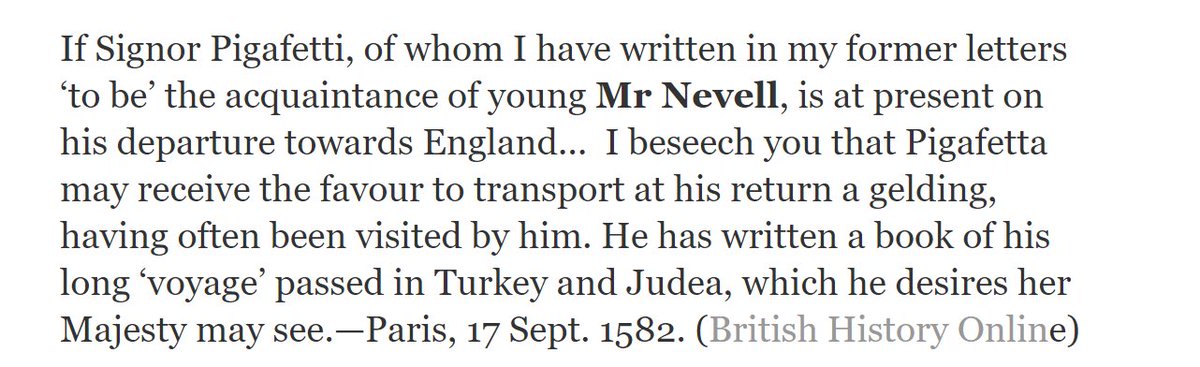
“If Signor Pigafetti, of whom I have written in my former letters 'to be' the acquaintance of young Mr Nevell, is at present on his departure towards England... I beseech you that Pigafetta may receive the favour to transport at his return a gelding, having often been visited by him. He has written a book of his long 'voyage' passed in Turkey and Judea, which he desires her Majesty may see.—Paris, 17 Sept. 1582.”
- The same blog post interprets this as:
“The "young Mr Nevell" here is almost certainly a reference to Henry Neville who was travelling in Italy at the time with his tutor and lifelong friend Henry Savile.”
- A Ken Feinstein tweet dated
3 Nov. 2020states:
“Henry Neville helped the author of this Italian book bring his manuscript to England. Marco Antonio Pigafetta was friends with Hakluyt.”
- The blog post interprets
young Mr Nevellas Henry Neville. - The blog post further argues for a Pigafetta/Hakluyt/
The Tempestsignificance.
3. Citations
- Filippo Pigafetta / Billingbear reconstruction, created
2026-07-11: filippo pigafetta mechaniche billingbear 1581. - Anton Maria Ragona, Viaggio in Inghilterra, Francia, Spagna di Anton-Maria Ragona nel 1582, ed. Giovanni da Schio (Venice, 1836), Google Books; local pages.
- Daria Perocco, “Pigafetta, Filippo,” Dizionario Biografico degli Italiani 83 (2015), Treccani.
- Rita Mazzei, “Ragona, Anton Maria,” Dizionario Biografico degli Italiani 86 (2016), Treccani.
- Butler, Arthur John, ed. Calendar of State Papers, Foreign Series, of the Reign of Elizabeth, May-December 1582. Vol. 16. London: HMSO, 1909, item
339, conventional p.329(scan misprints running head829). British History Online, Elizabeth: September 1582, 16-20. Local BHO capture: bho_cspf_vol16_pp324_335.html; local scanned page: bho cspf vol16 page329. - David Graham of Fintry to Andreas Dudith, Paris, 29 July 1582, no. 1129, in Andreas Dudithius, Epistulae, Pars VII: 1581-1589 (Budapest, 2019), pp. 251–53, open-access critical edition. The edition identifies
Signor Novielloas Henry Neville and prints the intended return to England within days; the Dresden manuscript image remains to be inspected. - Feinstein, Ken. “Young Henry Neville, Walsingham, and Marco Antonio Pigafetta.” kenfeinstein.blogspot.com, 14 Nov. 2019, https://kenfeinstein.blogspot.com/2019/11/young-henry-neville-walsingham-and.html. Local preservation: blog walsingham pigafetta 2019 11 14.
- Feinstein, Ken. X post, 3 Nov. 2020, https://twitter.com/user/status/1323496442170798082. Local archive text in tweets.js.
- Pigafetta, Marc'Antonio. Itinerario di Marc'Antonio Pigafetta gentil'huomo Vicentino. London, appresso Giovanni Wolfio Inghilese, 1585. Catalog witness: Google Books, https://books.google.com/books/about/Itinerario_di_Marc_Antonio_Pigafetta_gen.html?id=Kx1xnQEACAAJ.
- Pigafetta, Marco Antonio. Itinerario di marcantonio... 1585. Internet Archive / Early English Books, 1475-1640 microfilm item, identifier
bim_early-english-books-1475-1640_itinerario-di-marcantoni_pigafetta-marco-antonio_1585, https://archive.org/details/bim_early-english-books-1475-1640_itinerario-di-marcantoni_pigafetta-marco-antonio_1585. document witnesses: pigafetta itinerario 1585 ia. Local OCR: pigafetta itinerario 1585 ia ocr. - Pigafetta, Marco Antonio. Itinerario di marcantonio... 1585, first five pages, human visual OCR from IA PDF, created
2026-04-29: pigafetta itinerario 1585 first 5 pages human ocr. - Pigafetta, Marco Antonio. Itinerario di marcantonio... 1585, full-book Tesseract OCR from IA PDF, created
2026-04-29: pigafetta ocr normalized pages 001 151, pigafetta ocr raw pages 001 151, pigafetta ocr report pages 001 151. - Pigafetta / Othello source-competitor comparison files, created
2026-04-29: pigafetta shakespeare eebo comparison pass 01, othello turk identity comparison, source competitor comparison pass 02, othello source appendix christian turk identity, and source competitor motif snippets. - Pigafetta key page images, rendered
2026-04-29: README. - Source competitor witnesses, updated
2026-04-29: README. - Non-Othello candidate triage, created
2026-04-29: non othello shakespeare candidate triage. - Pigafetta, Marc'Antonio. Itinerario (da Vienna a Costantinopoli) di Marc'Antonio Pigafetta gentil' huomo Vicentino. WorldCat catalog record, OCLC
503982442, https://search.worldcat.org/ja/title/itinerario-da-vienna-a-costantinopoli-di-marcantonio-pigafetta-gentil-huomo-vicentino/oclc/503982442. - Pigafetta, Marc'Antonio. Itinerario da Vienna a Costantinopoli, ed. Daria Perocco. Il Poligrafo, 2008. Publisher page: https://www.poligrafo.it/itinerario-da-vienna-costantinopoli.
- Perocco, Daria, ed. Marc'Antonio Pigafetta, Itinerario da Vienna a Costantinopoli. Ca' Foscari / ARCA record, https://iris.unive.it/handle/10278/20872.
- Colthorpe, Marion E. The Elizabethan Court Day by Day: 1582. Folgerpedia PDF, entry for
17 Sept. 1582, https://folgerpedia.folger.edu/mediawiki/media/images_pedia_folgerpedia_mw/1/1d/ECDbD_1582.pdf. - New York Public Library Research Catalog subject listing,
Turkey -- Description and travel -- Early works to 1800, entry for Itinerario Di Marc'Antonio Pigafetta microform, https://www.nypl.org/research/research-catalog/browse/subjects/Turkey%20--%20Description%20and%20travel%20--%20Early%20works%20to%201800. - BRO exclusion control for later Italy material: Doc 65 Unmapped IMG 0294.
- blog post catalog, entry for
Young Henry Neville, Walsingham, and Marco Antonio Pigafetta. - traveling in europe, related travel-context packet.
- play the tempest, related play packet for the
Setebosclaim.
4. Evidence Images
Blog images
Tweet images
5. Notes on Access
- This packet is no longer anchored primarily by blog/tweet repetition. Its contact claim is controlled by BHO's calendar transcription and scanned printed page; its publication claim is controlled by the 1585 Itinerario page images and human transcription.
- The calendar witness is one editorial layer removed from Cobham's original letter. Original SP 78/8 collation remains worthwhile for spelling, forename, and context, but the direct calendar quotation is now sufficient for a carefully bounded source-map claim.
- The 1585 printed book itself is now located both bibliographically through Google Books, WorldCat, NYPL microform, and modern critical-edition records, and digitally through the Internet Archive's EEBO microfilm-derived scan.
- The Internet Archive OCR is poor and should not be used as a diplomatic transcription. Use the page images/PDF for claims about spelling, title-page wording, dedication, and paratext.
- The Marc'Antonio identification of the traveler has been displaced by the joined Filippo/Ragona evidence. The close fit between Cobham's book description and the London
1585Itinerario remains a bibliographical clue, but not a reason to rename the man whom the August calendar and Ragona diary identify as Filippo. - The Hakluyt connection is direct in Marc'Antonio's 1585 dedication. It does not identify the 1582 traveler or name Neville. Henry Neville's identification rests instead on the joined Cobham calendar plus Graham's independently dated evidence for the Savile-Neville pairing and intended return—not on a proved Paris itinerary stop. The Antonio Pigafetta/
Setebosbridge remains a separate interpretation requiring proof. - BRO source controls: no BRO transcription currently strengthens the direct Pigafetta/Neville claim. The contact lane is controlled by the Cobham calendar and Graham's 29 July companionship-and-intended-return witness; inspecting SP 78/8 could upgrade the strong contextual identification to an explicit manuscript-level one.
- Edes/Scotland note,
2026-06-21: do not use the Scotland packet as proof that Cobham'syoung Mr Nevellis Henry Neville. Use it only as an adjacent Walsingham-channel and book-learning plausibility control.