Tower Prison Access and Custody
Topic: Tower Prison Access and Custody
Source-Fact Audit — 7 August 2026 (Round 4)
- The sources document controlled access, named custody, and particular administrative permissions. They do not establish general Tower “visiting hours.”
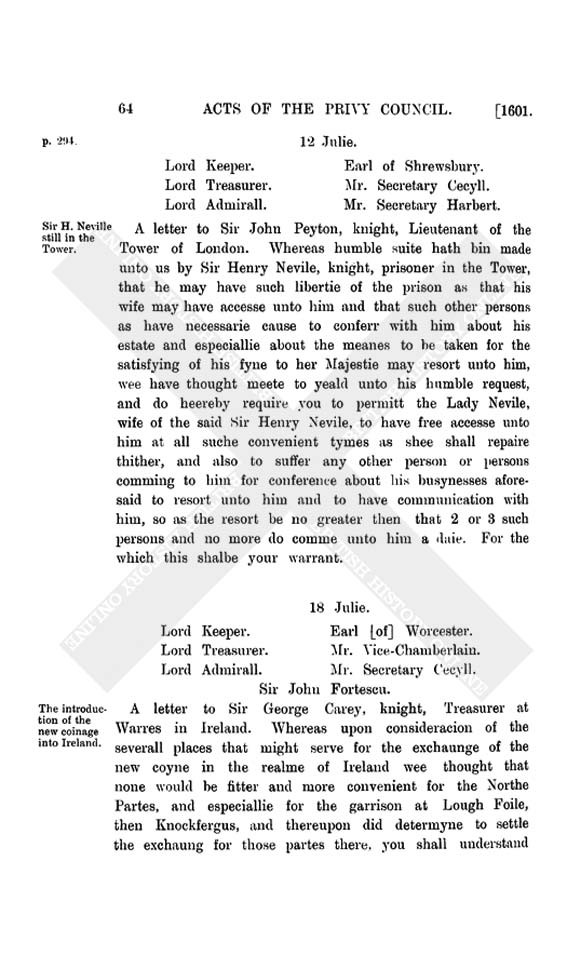
- The Privy Council material identifies Neville as still in the Tower and records Lady Neville in the access context; the scope and purpose of her permission must follow the order's exact wording.
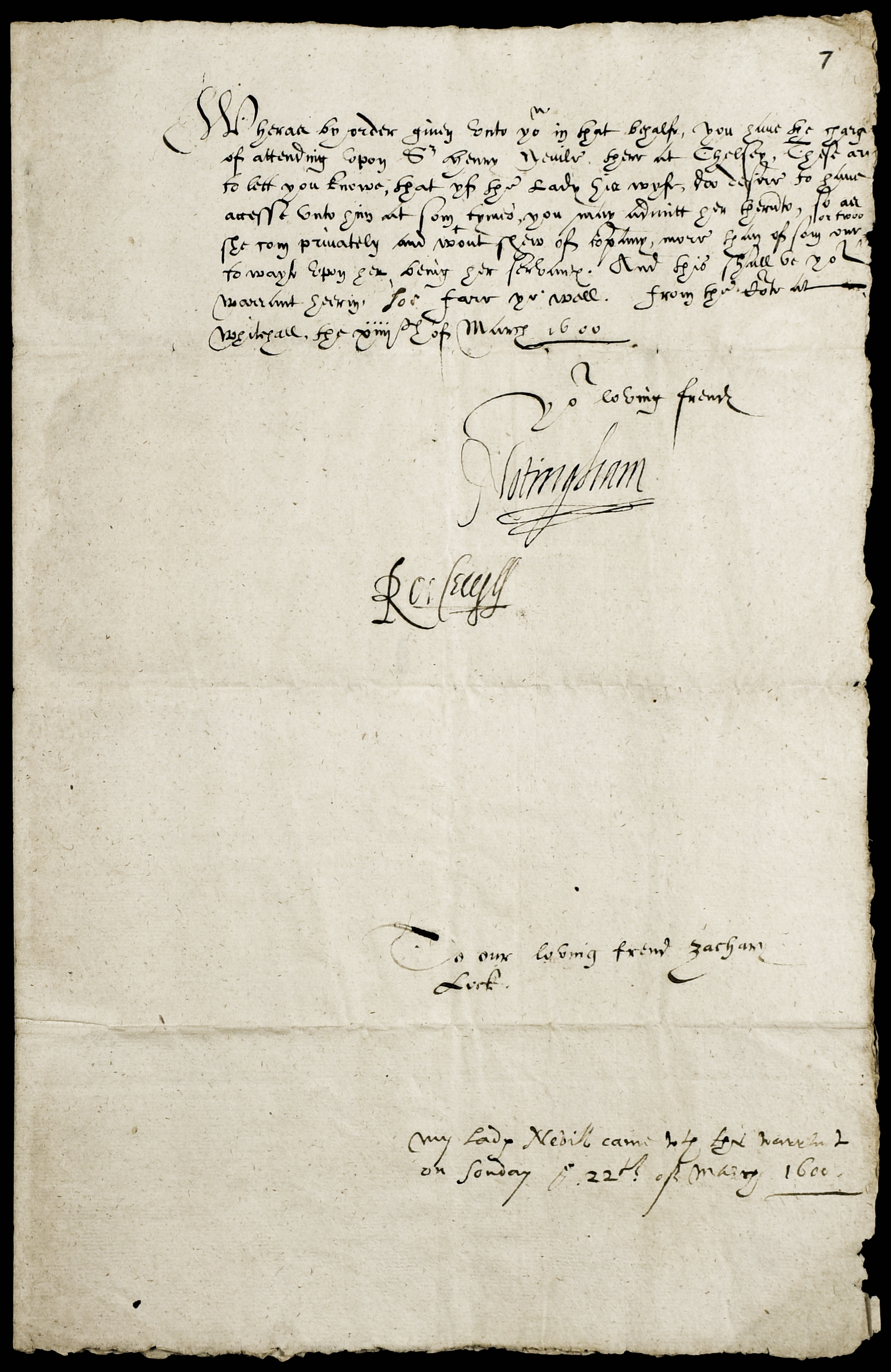
- Zachary Lock's named duty and Cecil's
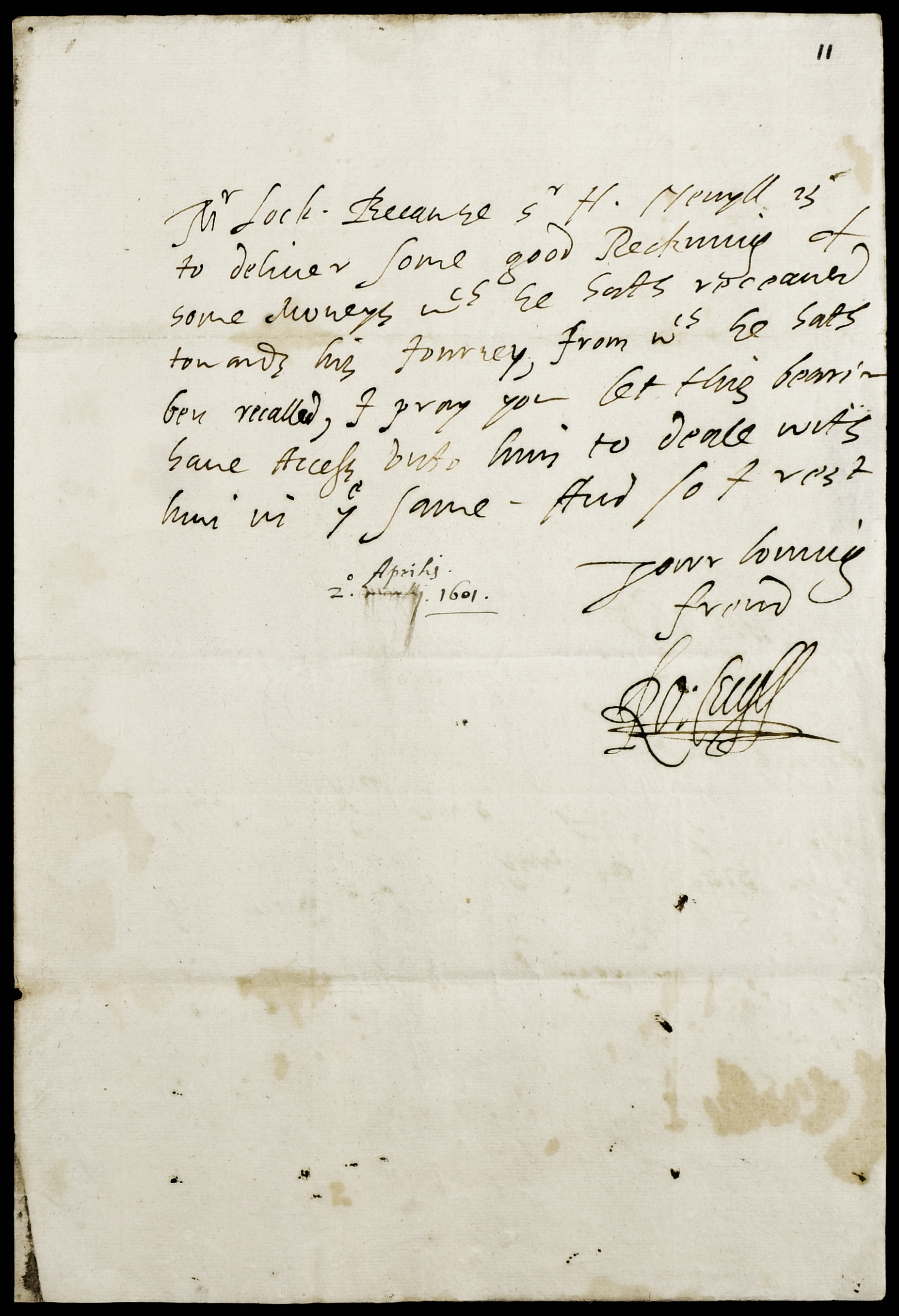
Accesse unto himinstruction establish custody administration, not an open visiting culture. - Access granted for business, estate, family, or legal matters is not evidence of literary collaboration during imprisonment.
- Uncollated PRO wording remains unresolved and is not quoted beyond the portions checked against the images.
Source-Control Summary
- APC anchor:
Sir H. Neville still in the TowerandLady Nevilecontrol the Privy Council access lane (bho apc vol32 page64 sir h neville tower access). - Custody anchor:
charge of attending upon Sr Henry NevileandTo our loving frend Zachary Lockcontrol the named keeper lane (PRO 30 50 4 010). - Access anchor: Cecil's instruction includes
Accesse unto him(PRO 30 50 4 016). - Guardrail: this proves controlled custody access, not open literary collaboration inside the Tower.
1. Overview
This packet is now a narrow access-and-visitation source map for Henry Neville's Tower and Chelsea custody conditions. It should not carry the larger Tower/Hamlet and Tower/Southampton arguments, which are covered elsewhere.
Quoted Source Passages
1. APC Vol. 32 Identifies Neville Still in the Tower
- Source: Acts of the Privy Council of England, vol. 32, p.
64; local BHO scan bho apc vol32 page64 sir h neville tower access. - Quotation:
"Sir H. Neville still in the Tower"
"Lady Nevile"
- What it proves: The Privy Council access order gives a printed administrative control for Neville's Tower custody and Lady Neville's privileged access.
- Limits: The local scan still needs line-by-line transcription before longer exact wording is used in book prose.
2. The Lock Custody Papers Name the Keeper and the Duty
- Source: PRO
30/50/4custody-access sequence, MegaLettersDoc_124; image witnesses PRO 30 50 4 010. - Quotation:
"Whereas by order given unto yo[u] in that behalf, you have the charge of attending upon Sr Henry Nevill, heere at Chelsey, These are to lett you knowe, that yf the Lady his wife, doe desire to haue accesse unto him at some tymes, you may admitt her there, so as she come privately and without shew of company, more than of one woman to wayt uppon her, being her servant."
"To our loving frend Zachary Lock."
- What it proves: The custody lane is controlled by a named access officer, Zachary Lock, and by written instructions concerning Neville, Lady Neville, and the conditions of her access.
- Limits: The MegaLetters texts remain working visual transcriptions until the whole image sequence is line-collated.
3. Cecil's Access Letter Uses Explicit Access Language
- Source: PRO
30/50/4custody-access sequence, MegaLettersDoc_126; image witnesses PRO 30 50 4 016. - Quotation:
"Mr Lock. Because Sr H. Nevyll is to deliver some good Reckoning of some moneyes wch he hath receaved towards his Jorney, From wch he hath ben recalled, I pray yo[u] let this bearer have Accesse unto him to deale with him in ye same."
"To my loving frend Mr Lock, servant to the Lord high Admirall of England."
- What it proves: Access to Neville was not informal visiting-room gossip; it was granted through written custody administration for a specified embassy-finance purpose.
- Limits: This supports controlled access, not unlimited literary or social access.
4. Chamberlain Supplies the Outside-News Release Sequence
- Source: John Chamberlain letters in McClure, Letters of John Chamberlain, vol. 1, pp.
145,192; document witnesses uc1 32106005854481 1782657835. - Quotation:
"lookes every day to come out of the Towre"
"delivered out of the Towre"
- What it proves: Chamberlain independently tracks the movement from expected release to actual delivery from the Tower.
- Limits: This is chronology and public news, not the detailed rule set for Neville's daily custody.
Access Witnesses
- The local blog's Google Books lead has been identified as Acts of the Privy Council of England, vol. 32, p.
64, corresponding to British History Online'sPages 51-76segment for the 1601-1604 volume. - The direct Google Books image endpoint for
OfVFAQAAIAAJ, p.64, returned an image-not-available placeholder. Use the British History Online scan instead. - The BHO page image is now staged locally and visibly supports the
12 July 1601Privy Council access order for Sir Henry Neville in the Tower, including Lady Nevile's access and a controlled small number of necessary business visitors.
2. Verified Sourced Facts
- Existing corpus packets already treat Neville's Tower period as central to the
1601-1603Essex aftermath, especially: - henry nevilles confession and hamlet
- henry nevilles confession and shakespeare
- henry neville and earl of southampton
- The confession packet identifies Neville's
2 March 1601confession as locally grounded in the O'Donnell transcription and inletter_135of the local letters XML. - The Gowrie, Southampton, Davies, and concealed-poets packets already preserve related Tower-era literary and political context. This packet should not duplicate those arguments.
- A direct manuscript-image packet now identifies the key custody/access figure as Zachary Lock / Locke / Lok, not Thomas Lake. See zachary lock neville custody access.
- MegaLetters
Doc_121-129preserve the current working visual transcription layer for thePRO 30/50/4custody-access sequence. The documents show supervised access by Lady Neville, access by Winwood's servant, Cecil's use of Neville to decipher a Winwood letter, financial reckoning after the recalled embassy, and controlled private travel between Chelsea and Lothbury. - MegaLetters
Doc_122should be kept distinct from the Lock custody lane: it is Robert Cecil to Thomas Lake about Winwood, Neville's passport/papers administration, and the Paris household after Neville was unlikely to return to his French charge. - The recovered British History Online page image for APC vol. 32, p.
64, adds an independent printed Privy Council control for Neville's privileged Tower access. It should be paired with, but not substituted for, thePRO 30/50/4manuscript custody-access sequence. - McClure vol. 1 adds a Chamberlain outside-news layer for the Tower chronology surrounding those access documents: p.
122reportsSir Harry Nevillin the Tower; p.145reports that he expected release after agreeing to pay his fine; p.192reports Southampton and Neville delivered from the Tower by royal warrant.
3. Ken Feinstein Twitter and Blog Information
- Ken Feinstein's
3 Dec. 2018blog post, "What were Henry Neville's Visiting Hours in Prison?", states that it preserves an observation about:
"who was allowed to visit Henry Neville when he was in prison."
- The local blog capture says the post included an embedded Google Books image, identified in the summary as
Google Books ID: OfVFAQAAIAAJ, page 64. - The Google Books volume/page lead is now identified as APC vol. 32, p.
64; the Google image route itself failed, but British History Online supplies a public page scan for the same printed page.
4. Source Text Index
- "who was allowed to visit Henry Neville when he was in prison"
- "Google Books ID: OfVFAQAAIAAJ, page 64"
- APC vol. 32, p.
64: "Sir H. Neville still in the Tower" - APC vol. 32, p.
64: "Lady Nevile" - McClure vol. 1, p.
122: "Sir Harry Nevill ... is in the Towre" - McClure vol. 1, p.
145: "lookes every day to come out of the Towre" - McClure vol. 1, p.
192: "delivered out of the Towre" PRO 30 50 4 010: "charge of attending upon Sr Henry Nevile" and "To our loving frend Zachary Lock."PRO 30 50 4 016: Cecil asks Lock to let the bearer have "Accesse unto him."
5. Evidence Images
APC / BHO Tower access control
PRO 30/50/4 custody-access manuscript controls
6. Citations
- Feinstein, Ken. "What were Henry Neville's Visiting Hours in Prison?" kenfeinstein.blogspot.com, 3 Dec. 2018. Local preservation: blog prison visiting hours 2018 12 03.
- Acts of the Privy Council of England, vol. 32, 1601-1604, ed. John Roche Dasent. London: HMSO, 1907, p. 64. British History Online segment: Pages 51-76. Local BHO scan: bho apc vol32 page64 sir h neville tower access.
- Chamberlain, John. The Letters of John Chamberlain. Edited by Norman Egbert McClure, vol. 1, American Philosophical Society, 1939, pp.
122,145,192. document witnesses: uc1 32106005854481 1782657835. - Google Books lead for APC vol. 32, p. 64: https://books.google.com/books?id=OfVFAQAAIAAJ&pg=PA64. The direct image attempt returned a placeholder; cite the BHO scan for page-image evidence.
- henry nevilles confession and hamlet, direct Tower/Hamlet packet.
- henry neville and earl of southampton, Southampton/Tower network packet.
- essex rebellion, Essex aftermath packet.
- zachary lock neville custody access, manuscript-image packet for the Lock/Cecil/Nottingham access sequence.
- MegaLetters source-routing dossier: megaletters pro 30 50 source dossier.
- MegaLetters working visual transcriptions for
PRO 30/50/4: Doc 121 PRO 30 50 4 001 003, Doc 122 PRO 30 50 4 004 006, Doc 123 PRO 30 50 4 007 009, Doc 124 PRO 30 50 4 010 012, Doc 125 PRO 30 50 4 013 015, Doc 126 PRO 30 50 4 016 018, Doc 127 PRO 30 50 4 019 021, Doc 128 PRO 30 50 4 022 025, and Doc 129 PRO 30 50 4 026 027. - Essex/Southampton/Tower image-research packet,
2026-06-20: SOURCE NOTES.
7. Notes on Access
- The Google Books lead is now resolved as a route to APC vol. 32, p.
64, but the Google Books page image itself was not usable. Cite the BHO page image and the Lock/Cecil/Nottingham manuscript sequence for verified custody-access facts. - Treat the MegaLetters
Doc_121-129texts as working visual transcriptions until a line-by-line image collation pass is complete. - Source-control result: this packet can now distinguish ordinary Tower imprisonment from controlled privileged access. It still should not infer literary-social access unless a separate source proves that specific form of contact.
2026-07-13 Full APC Collation and the 1602 Business Question
The printed Privy Council page has now been inspected directly at full available resolution. The order is dated 12 Julie 1601 and describes Neville as prisoner in the Tower. It records his request:
that he may have such libertie of the prison as that his wife may have accesse unto him and that such other persons as have necessarie cause to conferre with him about his estate and especiallie about the meanes to be taken for the satisfying of his fyne to her Majestie may resort unto him
The Council then permitted:
the Lady Nevile, wife of the said Sir Henry Nevile, to have free accesse unto him at all suche convenient tymes as shee shall repaire thither
and allowed other people to come for conference about his busynesses, subject to numerical and dining limits:
the resort be no greater then that 2 or 3 such persons and no more do comme unto him a daie. For the which this shalbe your warrant.
This is a materially stronger administrative picture than the earlier two-phrase extract. Neville was not free, but the Council expressly created a controlled channel through which his wife and a small number of other people could manage estate, fine, and other business with him.
Correction, 8 August 2026: this order is not the context for Thomas Smythe's East India Company timber letter. Both sides of that manuscript read 10 August 1609, not 1602. All earlier inferences connecting the timber covenant to Tower access, Anne Neville, a steward, or an attorney are withdrawn.
Claim audit for this update:
- image checked: the local page image of Acts of the Privy Council, vol. 32, p. 64;
- independent control: the BHO edition and page citation for the same printed order;
- related manuscript checked separately: BRO images
IMG 8298andIMG 8299; both independently date the Smythe letter to 1609; - unresolved: which specifically documented estate transactions, if any, can be connected to the Council's access regime;
- guardrail: controlled access for estate business is not evidence of literary visits, play writing, or unrestricted collaboration.
2026-07-13 What the Authorized Business Conferences Were For
The 12 July 1601 Council order becomes more informative when read beside Neville’s August appeal calendared in HMC Salisbury vol. 11, printed p. 371. The Council authorized access specifically for Neville’s estate, the means of satisfying his fine, and other business. The August letter then supplies the financial subjects under discussion:
- the degree to which his land was already conveyed to his son;
- the amount his life interest might raise;
- his statement that the embassy had forced him to sell land worth
£4,000; - annual land income of no more than
£700; - a proposed fine of
6,000marks rather than£10,000; - staged payments of
1,000,2,000, and3,000marks; - a request to sell two Yorkshire tithes.
The access order was therefore not a generic social privilege. It created a small, regulated administrative channel for calculations, conveyancing, payment plans, sales, and petitions that were necessary if Neville was to meet the financial punishment imposed on him.
The newly completed collation of RBA D/EN/F6/1/6, dated 20 July 1601, now shows one of the actual working schedules behind those conferences. It lists £384 13s. 4d. gross annual possession income and £304 13s. 4d. after Edward Neville's £80 annuity; records £4,030 in capital sales; describes the Berkshire settlement to Neville for life, trustees for daughters' portions, sons Henry and William, and later remainders; offers Woolfines and Sandall toward “my first payment of my fine”; and identifies South Cave and Otley as properties that could not be alienated without the Crown reversion. The schedule was made eight days after the Council's 12 July access order. This very close sequence connects the authorized estate consultations to a surviving piece of the fine-negotiation paperwork without identifying which visitor or clerk prepared it.
The schedule also sharpens the August request to sell “2 tithes in Yorkshire.” South Cave and Otley are the two Yorkshire rectory interests the July statement specifically marks as blocked by the Crown reversion. Hull U DDBA/4/90–91 records that the reversion was eventually granted to Neville on 11 February 1605, under James I. The later grant resolves the legal obstacle but does not show that Elizabeth accepted Neville's 1601 proposal.
A second D/EN/F6/1/8 problem
History of Parliament states that Neville agreed in March 1602 to pay £5,000. Its note cites several Hatfield calendar pages and Berkshire D/EN F6/1/8. The photographed item carrying that Berkshire shelfmark was inspected in this pass and is a Warfield copyhold slip, not a fine agreement. The March 1602 agreement can continue to be routed through the HMC Hatfield sequence, but the local D/EN/F6/1/8 photographs do not verify it.
This matters because the same note problem affects the biography’s £2,400 + £1,600 embassy-cost division. The direct human-edited Hatfield calendar independently supports Neville’s statement that the total sold because of his late service was £4,000; the locally photographed Berkshire slip supports neither the division nor the final fine.
Correction: remove the timber letter from the imprisonment packet
Thomas Smythe's East India Company letter is dated 10 August 1609 in both its dateline and docket. It was addressed to the elder Sir Henry Neville at Billingbear, but it cannot be used to reconstruct business during his earlier Tower imprisonment.
Source controls
- HMC Salisbury, vol. 11, p.
371, hmc11 printed p371 372 pdf409, Internet Archive volume. - BRO
D/EN/F6/1/8images:[local source path removed],IMG 8318,IMG 8344. - Thomas Smythe letter images:
[local source path removed]andIMG 8299. - TEN TOPIC PUBLIC LIFE DOCUMENTARY CHRONOLOGY PASS 2026 07 13.
Manuscript claim audit
- Primary images checked:
IMG_8317,IMG_8318,IMG_8344,IMG_8298, andIMG_8299. - Existing local transcriptions checked: Doc 22e D EN F6 1 8 and corrected Doc 20a D EN F6 1 16 Smythe EIC timber 1609.
- Independent non-AI controls: Acts of the Privy Council; HMC Salisbury vol. 11; Berkshire CALMView parent descriptions.
- Unresolved: the archival identity of the March
1602final agreement. The timber covenant is no longer part of this chronology. - Prior conflict recorded: History of Parliament’s
D/EN F6/1/8citation does not match the locally photographed item bearing that shelfmark.