Thomas Bodley, Ralph Winwood, Henry Savile, and the Library-Will Controversy
Topic: Thomas Bodley, Ralph Winwood, Henry Savile, and the Library-Will Controversy
Round 8 probate target and hearsay boundary — 8 August 2026
The will can now be targeted precisely as TNA PROB 11/121/575, fols. 298v–299r. Modern scholarship cites those folios for the executors/overseers and for Bodley's silver-gilt bequest to Savile. The packet's checked quotations from Winwood's Memorials remain John Chamberlain reporting to Winwood that Winwood and Savile were overseers and relaying complaints about the will.
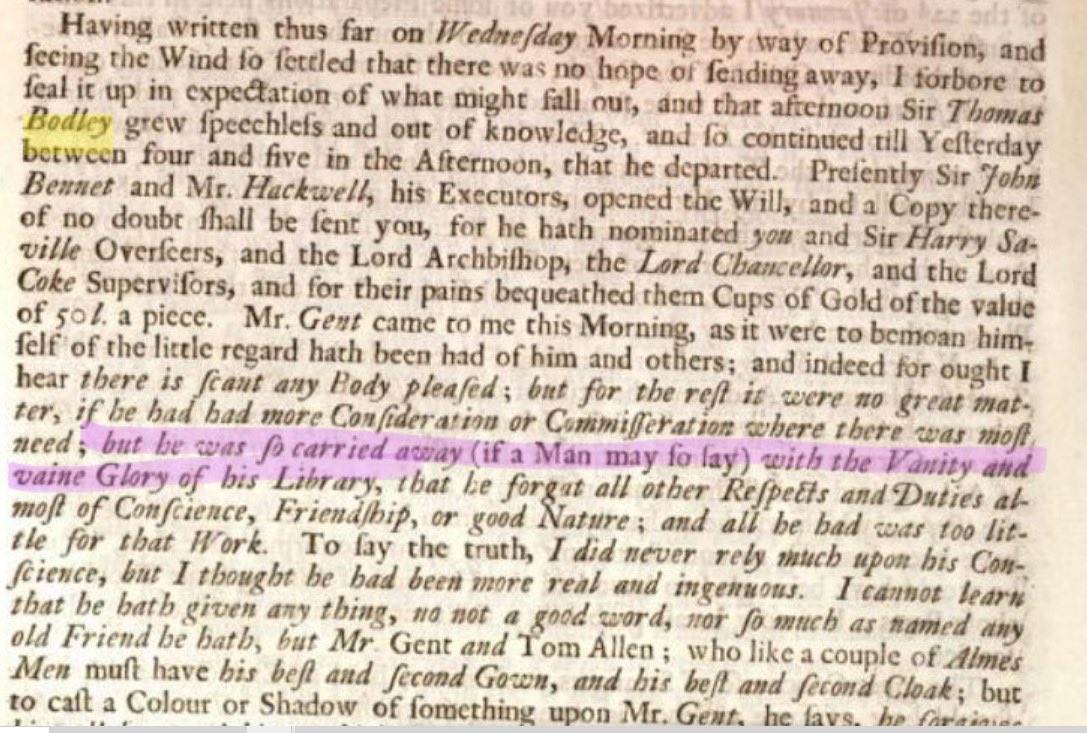
Those layers answer different questions. Chamberlain proves contemporary complaint—carried away ... with the Vanity and vaine Glory of his Library—but not the legal distribution. The probate register should control appointments and bequests. Nor should Chamberlain's letter be converted into Winwood's own opinion: recipient, reporter, complainants, and testator remain four distinct voices.
Deep Research Update: Savile's Death Notice and John More's Legal Analysis, 2026-07-13
The packet's open HMC Buccleuch question is now substantially resolved. The Archive.org scan of volume 1 has been searched, and printed pages 123-124 have been directly inspected.
On 29 January 1612/13, Henry Savile wrote to Winwood:
“I doubt not but you will understand, before the receipt of these, of the death of our dear friend, Sir Th. Bodley”
Savile says Bodley made Winwood and Savile overseers, adding in a codicil the Archbishop of Canterbury, Lord Chancellor, and Lord Coke. He also notes a legacy to Winwood's wife. The same short entry immediately turns to Savile's edition of Chrysostom: he had sent a dryfat containing 18 copies to Amsterdam, each copy comprising eight Greek volumes and selling at Eton for £8. The page is buccleuch n170.
This juxtaposition is unusually valuable. The will-overseer network and the Greek-book distribution network are not separate modern reconstructions; they occupy the same Savile letter. Winwood is simultaneously Bodley's stepfamily representative, a will overseer, and the overseas distributor whom Savile asks to direct the placement of Chrysostom sets.
John More's 6 February 1612/13 letter then gives the missing Winwood-side legal argument. More complains of Bodley's “small regard” for his wife's friends and children, says the powerful overseers and “cunning executors” made him suspect a defect in the constitution of the estate, and reports counsel that Winwood might, in his wife's right, call Bodley's executors to account for old Mr Ball's goods because Lady Bodley had died intestate. He advises delay to avoid scandal and preserve the right. This is visible on buccleuch n171.
The new material changes the interpretation from general resentment to a specific legal and familial controversy. The complaint concerns property derived through Anne Ball and the rights of her children, not simply a moral objection to spending money on a library. Chamberlain's charge about the “vaine Glory” of the library captures the rhetoric; More identifies the possible account and cause of action.
Limits: the HMC volume is a human calendar of holograph letters, not a diplomatic edition. Bodley's probate will PROB 11/121/575, the original Savile and More letters, and the underlying account of Nicholas Ball's goods still need direct examination. Until then, quote these words as HMC calendar text and keep precise testamentary holdings provisional.
Citation: Historical Manuscripts Commission, Report on the Manuscripts of the Duke of Buccleuch and Queensberry ... at Montagu House, vol. 1 (London, 1899), pp. 123-124, Internet Archive.
Source-Control Summary
- This packet is controlled by John Chamberlain's letters printed in Winwood's Memorials, vol. 3, pp.
429and432, with checked Archive.org page images and local tweet crops as discovery witnesses. - Adams supplies the best modern scholarly frame for Bodley's family/stepfamily, donor network, will conflict, Winwood's position, and Savile's role. Quote Adams sparingly; route legal/probate claims back to Bodley's will, John More's letters, and HMC Buccleuch when those are obtained.
- The safe claim is that Chamberlain, writing to Winwood, reports dissatisfaction with Bodley's will and presents the Bodleian Library as the consuming testamentary priority. Do not treat the tweet as the source layer, and do not say Winwood authored the complaint unless a Winwood-side letter is separately extracted.
1. Verified Sourced Facts
- Ralph Winwood's DNB entry identifies Winwood's wife Elizabeth as daughter and coheiress of Nicholas Ball of Totnes and stepdaughter of Sir Thomas Bodley.
- The older genealogy-source-control corpus already marked
BOD-1613-THOMASas a needed packet because Bodley connects Winwood, Savile, the Bodleian, and library-donor networks. - The user tweet
1763946820127064359, posted2 March 2024, attached two images from Winwood's Memorials and replied to Dr Liam Sims's Bodley birthday tweet. - Those two tweet images have now been matched to Memorials of Affairs of State, vol. 3, printed pp. 429 and 432, Archive.org item
memorialsofaffai03winw. - John Chamberlain's p. 429 letter to Sir Ralph Winwood says Bodley's will named Winwood and Sir Henry Savile as overseers. The same passage reports dissatisfaction over Bodley's treatment of friends, servants, and claimants, with the library as the absorbing priority.
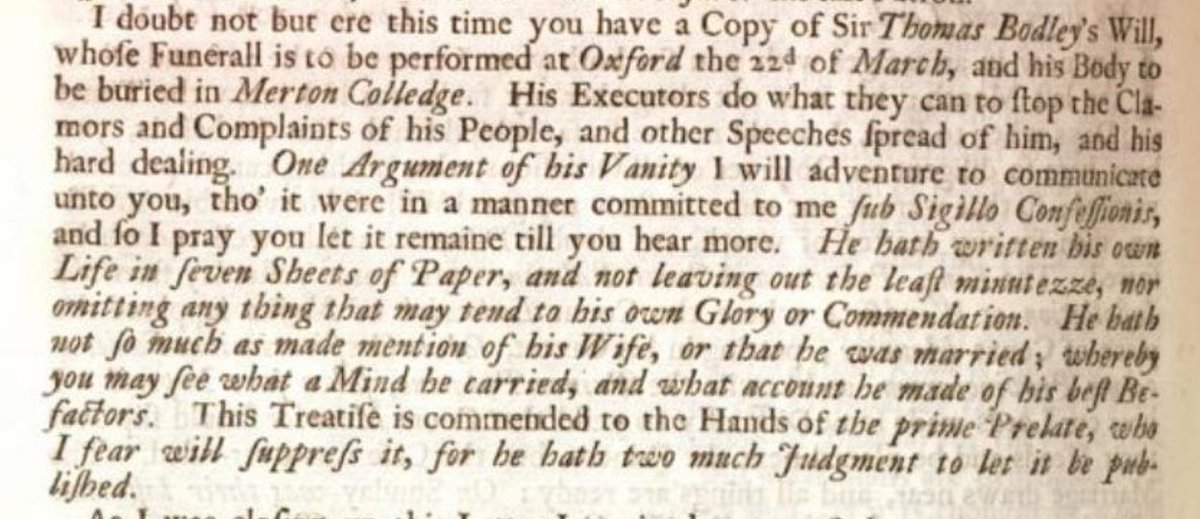
- Chamberlain's p. 432 follow-up to Winwood reports complaints about Bodley's will and says Bodley's autobiographical life failed to acknowledge his wife.
- Robyn Adams's library-network chapter supplies the modern secondary frame: Bodley's wealth had been augmented by his marriage to Anne Ball, the widow of Nicholas Ball; the contested will privileged the library over family and stepfamily; and Winwood's relationship with Bodley cooled over financial matters.
- Adams also places Winwood in the Bodleian donor network: Winwood knew Bodley from Oxford, married Bodley's stepdaughter Elizabeth, leased Mordaunt House from Bodley, donated Greek manuscripts to the Bodleian, and was linked to Henry Savile's Chrysostom manuscript-acquisition network.
Quoted Source Passages
1. Chamberlain Names Winwood and Savile as Bodley Will Overseers
- Source: John Chamberlain to Sir Ralph Winwood, Memorials of Affairs of State, vol. 3, printed p.
429; page-image checked in WINWOOD BODLEY LIBRARY WILL TWITTER SOURCE PASS 2026 06 27; stable image memorialsofaffai03winw v3 p429 n444 checked page. Quotations below are lightly normalized from the checked page-image/OCR for readability. - Quotation:
"Presently Sir John Bennet and Mr. Hackwell, his Executors, opened the Will"
Quotation:
"he hath nominated you and Sir Harry Saville Overseers"
Quotation:
"the Lord Archbishop, the Lord Chancellor, and the Lord Coke Supervisors"
- What it proves: The will controversy directly touches Winwood and Henry Savile in Chamberlain's report.
- Limits: This is a printed eighteenth-century witness to Chamberlain's letter, not Bodley's probate will image. Preserve the spelling/OCR caveat and cite the checked page image for final quotation.
2. Chamberlain Frames the Library as Bodley's Consuming Priority
- Source: Same Memorials p.
429page-image control. - Quotation:
"for ought I hear there is scant any Body pleased"
Quotation:
"if he had had more Consideration or Commiseration where there was most need"
Quotation:
"carried away ... with the Vanity and vaine Glory of his Library"
Quotation:
"he forgat all other Respects and Duties almost of Conscience, Friendship, or good nature"
- What it proves: Chamberlain reports a hostile contemporary interpretation of Bodley's testamentary priorities, including dissatisfaction among servants/friends/claimants and a charge that the library displaced ordinary obligations.
- Limits: It records complaint and rhetoric; it does not by itself prove the legal distribution of Bodley's estate.
3. Chamberlain Reports the Wife-Omission Complaint
- Source: John Chamberlain to Sir Ralph Winwood, Memorials, vol. 3, printed p.
432; stable image memorialsofaffai03winw v3 p432 n447 checked page. - Quotation:
"His Executors do what they can to stop the Clamors and Complaints of his People"
Quotation:
"One Argument of his Vanity I will adventure to communicate unto you"
Quotation:
"not so much as made mention of his Wife, or that he was married"
Quotation:
"what account he made of his best Benefactors"
- What it proves: The second Chamberlain witness records a specific complaint about Bodley's autobiographical or memorial treatment of his wife.
- Limits: The ellipsis marks a short anchor, not a full diplomatic transcription; use the page image for final context.
4. The Tweet Is a Discovery Lead, Not the Source Layer
- Source: Ken Feinstein tweet
1763946820127064359,2 March 2024, local media preserved in WINWOOD BODLEY LIBRARY WILL TWITTER SOURCE PASS 2026 06 27. - Quotation:
"People were not happy"
- What it proves: The tweet accurately preserved the project's research lead about dissatisfaction over Bodley's will.
- Limits: The tweet should route readers to Memorials and Adams, not serve as the evidentiary citation.
5. Adams Supplies the Modern Family/Stepfamily Frame
- Source: Robyn Adams, "Networks of Influence: Donations to the Bodleian Library in the Early Seventeenth Century," document witnesses ADAMS R 2023 NETWORKS OF INFLUENCE DONATIONS BODLEIAN LIBRARY EARLY SEVENTEENTH CENTURY 9789004429819 BP000015, discussed in the source pass.
- Quotation:
"executors and overseers"
Quotation:
"private affairs"
- What it proves: Adams gives a modern scholarly frame for Bodley's family, stepfamily, donor-network, and will-conflict context, including Winwood and Savile as overseers and Winwood's later recall to settle private affairs.
- Limits: Quote Adams sparingly in book prose; the stronger next controls are Bodley's probate will, John More's letters, and HMC Buccleuch.
2. Twitter / Source-Control Position
- The remembered user tweet is preserved in the local Twitter archive at
[local source path removed]. - Tweet URL:
https://x.com/FeinsteinKen/status/1763946820127064359. - Linked external tweet: Dr Liam Sims,
https://x.com/liamsims/status/1763848880968368129; oEmbed capture is saved under the dated temp folder. - Tweet media from original Twitter export:
[local source path removed](1087x733; maps to Memorials p. 429)[local source path removed](1200x519; maps to Memorials p. 432)- Staged working copies:
[local source path removed][local source path removed]- Stable source-image copies promoted
2026-06-28: [local source path removed][local source path removed]- Source-control file: WINWOOD BODLEY LIBRARY WILL TWITTER SOURCE PASS 2026 06 27.
3. Tweet Image Plates
These are stable local copies of the original Twitter-export images from tweet 1763946820127064359. They should be treated as discovery/context images; the citable witnesses are the Archive.org page images for printed pp. 429 and 432.
4. Source Hierarchy
T1/T2 printed primary witness: Winwood's Memorials, vol. 3, printed pp. 429 and 432, page-image checked against Archive.org.T2 modern scholarship: Robyn Adams, "Networks of Influence," document witnesses, especially article pp. 126, 130, 138-140, and 143.T2 biographical control: DNB/Wikisource for Ralph Winwood's marriage to Elizabeth Ball, Bodley's stepdaughter.T3 social-discovery witness: Ken Feinstein tweet1763946820127064359and Dr Liam Sims tweet1763848880968368129; useful for research-routing and preserving the project's prior public notes, but not a substitute for the underlying sources.
5. Interpretation for the Neville Book
This material is important because it adds a library, will, and inheritance tension to the already-established Winwood/Bodley/Savile corridor. Winwood is not merely Bodley's step-son-in-law: he is named in the will network, appears in Adams's donor-network analysis, and is linked to Savile's continental Chrysostom book/manuscript work. Since Winwood was Henry Neville's former secretary and correspondent, this strengthens the intellectual-political circle in which Neville, Savile, Bodley, Winwood, Chamberlain, Carleton, and Hales recur.
The strongest safe prose is: Chamberlain, writing to Winwood, reports anger at Bodley's testamentary priorities and presents the Bodleian Library as the project that displaced ordinary obligations to friends, servants, and family. Adams supplies the broader claim that the conflict involved Bodley's wife-derived/stepfamily wealth and Winwood's possible inheritance interest through Elizabeth Ball.
Avoid saying that Winwood himself authored the p. 429 or p. 432 complaint unless John More's letters or other Winwood-side manuscripts are extracted. The p. 429 and p. 432 witness is Chamberlain writing to Winwood.
6. Quote Anchors
Use short page-image-checked anchors:
- p. 429:
Vanity and vaine Glory of his Library - p. 432:
not ... made mention of his Wife - Adams p. 140:
private affairs - Tweet lead:
People were not happy
7. Citations
- Lee, Sidney. "Winwood, Ralph." Dictionary of National Biography, 1885-1900. Wikisource, https://en.wikisource.org/wiki/Dictionary_of_National_Biography,_1885-1900/Winwood,_Ralph.
- Memorials of Affairs of State in the Reigns of Q. Elizabeth and K. James I, collected from papers of Sir Ralph Winwood, vol. 3. London, 1725. Archive.org item
memorialsofaffai03winw, https://archive.org/details/memorialsofaffai03winw. - Memorials, vol. 3, printed p. 429 / Archive.org
page/n444: https://archive.org/download/memorialsofaffai03winw/page/n444_w1600.jpg. Stable local page image: memorialsofaffai03winw v3 p429 n444 checked page. - Memorials, vol. 3, printed p. 432 / Archive.org
page/n447: https://archive.org/download/memorialsofaffai03winw/page/n447_w1600.jpg. Stable local page image: memorialsofaffai03winw v3 p432 n447 checked page. - Tweet image for p. 429: 1763946820127064359 GHrMSL5asAAnLdO winwood memorials v3 p429 tweet crop.
- Tweet image for p. 432: 1763946820127064359 GHrMSL4bEAAmWB8 winwood memorials v3 p432 tweet crop.
- Adams, Robyn. "Networks of Influence: Donations to the Bodleian Library in the Early Seventeenth Century." Chapter 5 in Seventeenth-Century Libraries: Problems and Perspectives. document witnesses: ADAMS R 2023 NETWORKS OF INFLUENCE DONATIONS BODLEIAN LIBRARY EARLY SEVENTEENTH CENTURY 9789004429819 BP000015.
- Feinstein, Ken. Tweet
1763946820127064359,2 March 2024, local archive[local source path removed], public URLhttps://x.com/FeinsteinKen/status/1763946820127064359. - Sims, Liam. Tweet
1763848880968368129,2 March 2024, public URLhttps://x.com/liamsims/status/1763848880968368129; local oEmbed capture liamsims 1763848880968368129 oembed.
8. Notes on Access
- The Archive.org scan is visually checked. The OCR is useful but noisy; cite printed page and Archive image, not OCR line numbers.
- The Adams PDF is locally downloaded and searchable. Exact quoted legal/probate wording still needs the underlying TNA will and HMC Buccleuch page checks.
- The user's tweet images are now preserved both in the Twitter export and in stable
source_imagescopies. The AI topic should still cite the Memorials page images and Adams chapter for evidence.