Henry Neville's Portrait Greek Inscription
Topic: Henry Neville's Portrait Greek Inscription
Book-integration update — 29 August 2026
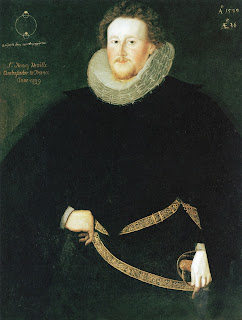
Chapter 3 now reproduces and discusses the 1599 portrait. The prose separates: (1) visible object facts; (2) the GrECI/MUSEU-HUB catalogue's cautious “Absolutely without correction” reading; and (3) the anonymous specialist interpretation publicly preserved by Feinstein, involving Ptolemaic apogee/perigee and prosthaphaeresis. Because renewed permission to name the specialist publicly has not been obtained, the book does not name Goulding. It does not claim Neville commissioned the portrait and does not print an unresolved diplomatic Greek transcription.
Source-Fact Audit — 7 August 2026 (Round 2)
The high-resolution image directly controls the sitter inscription, ambassadorial office, year 1599, age 36, and the presence of a Greek line and astronomical construction. It does not yield a secure letter-by-letter Greek transcription. MUSEU-HUB supplies a cautious public paraphrase, Absolutely without correction. Robert Goulding's expert interpretation—Absolutely without prosthaphaeresis, the Ptolemaic zero-correction geometry, and its emblem of directness—is preserved through identified private correspondence and should be cited according to its permission status.
The proposed relation to ne vile velis is Ken Feinstein's further interpretation, not Goulding's translation or a statement painted on the panel. Likewise, the blog's claim that Neville commissioned the portrait is not proved by the image or present object record. The separate Historic England dendrochronology report on Audley End panels displays no Henry Neville portrait and supplies no technical evidence for this object. The next source step is the Audley End object file and a specialist diplomatic Greek transcription.
Object-Census Guardrail, 20 July 2026
The inscription belongs specifically to the 1599 Audley End panel. A new object-level census separates that painting from the distinct 1596 panel, an unresolved 1866 Yarborough exhibition portrait, two unavailable Historic England photograph records at Audley End, and two NPG records for the 1794 reproductive engraving. See henry neville portrait object census and provenance. No inscription, age, provenance, or attribution should be transferred among these records until the physical objects or photographs are matched.
1. Verified Sourced Facts
- External object-record update,
2026-07-12: the GrECI/MUSEU-HUB catalogue identifies the portrait as Henry Neville, dates it1599, gives the creator as Marcus Geeraerts the younger with a question mark, describes it as oil on wood, and locates it at Audley End House in the private collection of Lord Braybrooke. Its GrECI image number is042_Id_17, and the digital record is licensedCC BY.
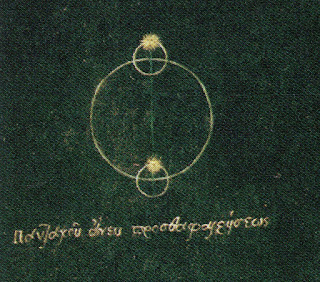
- The same GrECI record says the upper-left astronomical drawing is accompanied by a Greek inscription that appears to read “Absolutely without correction.” This is now an external catalogue reading, although the record does not provide a diplomatic Greek transcription or identify the specialist responsible for the reading.
- Historic England catalogues a photograph dated
9 Feb. 1950of a painting in the Audley End great hall described as a portrait of “Sir Henry Neville (Junior),” referenceAL0516/085/01. Braybrooke's History of Audley End, printed p.103, separately lists a panel portrait of the ambassador's son, dead1629, in Doctor-of-Laws dress and attributed to Cornelius Jansen. The son is therefore the likely sitter in the 1950Juniorrecord. Because the photograph is not displayed and its picture no.687has not been matched to Braybrooke's no.23, this remains a probable concordance. The record should not be treated as evidence for the ambassador's 1599 astronomical portrait.
- Wikimedia Commons preserves a
6,933 × 9,172image of the 1599 portrait. Its immediate stated source is The Truth Will Out (2005), so it is useful for close reading but does not replace the Audley End/GrECI object file.
- Sotheby's 2014 lot 711 is a separate Neville portrait: circle of George Gower, oil on panel, inscribed with Neville's name and
1596, provenance traced only to the Arcade Gallery by 1947. It should not be conflated with the 1599 Geeraerts-attributed Audley End portrait.
- Source-tier correction,
2026-07-13: the blog's astronomical reading is not merely blog-level speculation. Gmail correspondence identifies Robert Goulding as its expert source. Mordechai Feingold relayed Goulding's analysis in2020; Goulding directly approved publication and clarified it in2021. The exact diplomatic Greek characters remain unresolved, but the translation, Ptolemaic construction, and emblematic interpretation now have named specialist provenance in the internal source record.
- Source-control position: the packet now has the preserved blog, its expert email provenance, a high-resolution image, the GrECI object record, and Goulding's separate clarification of the term. Use Goulding for the translation and astronomical/emblematic explanation. Continue to mark the exact Greek letter-by-letter transcription and the
ne vile velisconnection separately.
- BRO transcription sweep,
2026-05-30: no BRO transcription directly verifies the portrait inscription, the Greek reading, or the astronomical diagram. BRO Neville/Savile material can contextualize relationships, but it is not evidence for the portrait text.
- The same post states:
“The portrait's top left contains astronomical symbols alongside Greek text.”
- The same post states:
“The inscription reads: "Absolutely without prosthaphaeresis"”
- The same post explains the term as:
“a term denoting the astronomical correction between mean and true celestial position.”
- The same post states:
“The diagram depicts the sun at apogee and perigee, accurately showing Ptolemy's epicycle solar model.”
- The same post states:
“At these two points, the true and mean sun positions coincide along the line of apsides, requiring no correction”
- The same post states that the historical context includes:
“Neville's European tour with tutor Henry Savile”
- The same post also states that on that tour:
“they encountered Paul Wittich, a developer of the prosthaphaeresis mathematical technique.”
2. Ken Feinstein Twitter and Blog Information
- A Ken Feinstein blog post dated
9 Jul. 2021states:
“Henry Neville commissioned a portrait from Marcus Gheeraerts the Younger before departing for France as ambassador in early 1599.”
- The same post interprets the inscription and diagram as:
“no correction needed between his apparent and true self.”
- The same post further states that this:
“represents a clever variation on his family motto, "ne vile velis"”
3. Quoted Source Text
Ken Feinstein blog post, 9 Jul. 2021
- “Henry Neville commissioned a portrait from Marcus Gheeraerts the Younger before departing for France as ambassador in early 1599.”
- “The portrait's top left contains astronomical symbols alongside Greek text.”
- “The inscription reads: "Absolutely without prosthaphaeresis"”
- “The diagram depicts the sun at apogee and perigee, accurately showing Ptolemy's epicycle solar model.”
- “At these two points, the true and mean sun positions coincide along the line of apsides, requiring no correction”
- “Neville's European tour with tutor Henry Savile”
- “they encountered Paul Wittich, a developer of the prosthaphaeresis mathematical technique.”
4. Citations
- GrECI/MUSEU-HUB, “Portrait of Sir Henry Neville”, image
042_Id_17, Audley End House, private collection of Lord Braybrooke. - Historic England Archive, “Photograph of painting in great hall showing portrait of Sir Henry Neville (Junior). No. 687”,
AL0516/085/01, 9 Feb. 1950. - Richard Griffin, third Baron Braybrooke, The History of Audley End (London, 1836), printed p. 103, Internet Archive page image.
- Wikimedia Commons, Henry Neville 1599, original file
6,933 × 9,172; immediate stated source The Truth Will Out (2005). - Sotheby's, Old Master & British Paintings, 9 July 2014, lot 711, separate 1596 portrait attributed to the circle of George Gower.

- Feinstein, Ken. “The Greek Inscription on Henry Neville's Portrait: Solved!” kenfeinstein.blogspot.com, 9 Jul. 2021, https://kenfeinstein.blogspot.com/2021/07/the-greek-inscription-on-henry-nevilles.html. Local preservation: blog greek inscription portrait 2021 07 09.
- Feingold, Mordechai, email to Ken Feinstein,
9 June 2020, relaying Robert Goulding's analysis; internal Gmail thread1729158350680033. - Goulding, Robert, emails to Ken Feinstein,
9 July 2021, approving publication, distinguishing the two senses of prosthaphaeresis, and approving the corrected Ptolemaic formulation; internal Gmail thread17a8d2d7d31bf984. - Goulding, Robert. “Henry Savile and the Tychonic World-System.” Journal of the Warburg and Courtauld Institutes 58 (
1995):152–179. Goulding Savile Tychonic World System 1995. - University of Notre Dame, “Robert Goulding”, official academic profile.
- GOULDING FABLE PORTRAIT ANALYSIS 2026 07 13.
- henry neville birthdate, related packet for the 1599 portrait and age evidence.
- henry savile, related packet for Savile and continental travel context.
5. Evidence Images
6. Notes on Access
- This packet now has an external GrECI object record, a Historic England archival-photo reference, and a high-resolution Commons image in addition to the Ken Feinstein blog and image witnesses.
- The Greek translation and astronomical interpretation derive from Robert Goulding, not from an unidentified AI or an unsupported blog inference. The blog faithfully preserves Goulding's analysis and incorporates his later correction.
- Goulding permitted publication but suggested that the blog could call him an anonymous scholar. Preserve his name in internal source control; obtain renewed permission before changing the public attribution practice.
- The
ne vile velisconnection is Ken Feinstein's interpretive extension. It is compatible with Goulding's directness/trustworthiness reading but is not part of Goulding's quoted verdict. - Claude Fable was used only to explain the mechanics and implications of Goulding's reading. Its output is quarantined from the evidence layer.
7. High-Resolution Object and Inscription Audit, 13 July 2026
The full-resolution Wikimedia file has now been downloaded and inspected directly, rather than relying on the two smaller blog crops. The local control is Henry Neville 1599 commons, 6933 × 9172 pixels.
Three things can be read securely from the object itself:
- the left-hand identifying inscription reads
Sr Henry Neville / Ambassador to France / Anno 1599; - the upper-right inscription reads
A° 1599aboveÆ 36; - the astronomical construction and a line of Greek are visibly integral parts of the painted design.
This upgrades the identity, year, office, and age inscriptions from second-hand reports to direct visual observations. It does not create a new AI transcription of the Greek. The specialist reading already existed in the project sources: Feingold's 2020 email explicitly says that he consulted Robert Goulding, and Goulding later confirmed the explanation directly. The GrECI/MUSEU-HUB object record independently offers the compatible cautious paraphrase “Absolutely without correction,” although it supplies no diplomatic Greek.
The present source separation is therefore:
| Claim | Present control |
|---|---|
| sitter, ambassadorial office, and 1599 date | directly legible in the high-resolution image |
age 36 | directly legible in the high-resolution image |
| Greek letters are present | directly visible |
| exact diplomatic Greek characters | unresolved |
| “Absolutely without prosthaphaeresis” | Robert Goulding expert translation, relayed by Feingold and later directly approved |
| Ptolemaic apogee/perigee and zero correction | Robert Goulding expert analysis |
| directness and trustworthiness emblem | Robert Goulding expert analysis |
variation on ne vile velis | Ken Feinstein interpretation, separately labeled |
The Commons provenance also needs careful wording. Commons identifies The Truth Will Out (2005) as its immediate source; it is not an institutional digitization record. The GrECI record is the stronger object-description route, while the Historic England record independently shows that a portrait identified as Sir Henry Neville was photographed at Audley End in 1950. Sotheby’s 1596 portrait attributed to the circle of George Gower is a separate object and should never be used as a witness for this inscription.
The remaining specialist task is narrower than previously stated: obtain the Greek in diplomatic and normalized Greek characters and, if possible, a renewed public-attribution permission. The translation and astronomical meaning no longer need to be rediscovered from scratch.
8. Expert Email Provenance and Detailed Interpretation, 13 July 2026
The scholar was Robert Goulding
The internal email record identifies the “anonymous scholar” in the blog as Robert Goulding. Feingold wrote that he had consulted Goulding and relayed the complete analysis. In July 2021, Goulding approved the blog's use of it and supplied a correction after reading the post.
Goulding's authority is directly relevant rather than generic. His Warburg Institute doctorate concerned Henry Savile's Oxford astronomy, and his published work includes “Henry Savile and the Tychonic World-System.” Notre Dame's official profile describes his training in classics, mathematics, and the history of science.
Goulding's controlling explanation
Goulding identifies the inscription as:
“Absolutely without prosthaphaeresis”
He explains that the portrait uses prosthaphaeresis in the astronomical sense: the correction between the sun's mean and true positions. The diagram shows the sun at apogee and perigee in Ptolemy's alternative epicyclic solar model. At those two positions, the sun, the center of its epicycle, and the observer align along the line of apsides. Mean and true direction consequently coincide and the required correction is zero.
His emblematic conclusion is equally explicit:
“Neville is clearly using this astronomical fact as an emblem of his directness and trustworthiness — that there is no ‘correction’ needed between his apparent and true self.”
Mean sun, true sun, and zero correction
| Astronomical term | Function in the diagram |
|---|---|
| mean sun | the calculated, uniformly moving direction to the epicycle's center |
| true sun | the observed direction to the sun carried on the epicycle |
| prosthaphaeresis | the angular amount added or subtracted to convert mean position into true position |
| line of apsides | the straight apogee-center-perigee axis |
| apogee and perigee | the positions where mean and true direction coincide and correction is zero |
The device is therefore not a decorative sign of “astronomy.” Its moral force depends on an exact technical construction. Correct geometry performs the sitter's claim to exact character.
Goulding's correction about the second meaning
Goulding warned that astronomical prosthaphaeresis and the later computational method are historically unrelated uses of the same word. The ancient astronomical use adds or subtracts a correction from a mean position. The sixteenth-century computational method replaces multiplication with trigonometric addition and subtraction. Wittich, Savile, and Neville intersect the histories of both, but the portrait depicts only the Ptolemaic astronomical sense. Goulding explicitly approved Ken's corrected blog formulation on this point.
Feinstein's motto reading
The connection to ne vile velis belongs to Ken Feinstein's further interpretation. The strongest statement is not that the Greek literally translates the Latin motto. It is that Neville may have re-expressed the family's canting moral identity through a learned astronomical emblem: nothing base is willed, and no moral correction separates appearance from truth. This is a coherent extension, but it should remain distinct from Goulding's translation and technical analysis.
Fable and Codex discussion
Claude Fable (claude-fable-5) analyzed the full-resolution portrait and the controlled source packet. It usefully explains the diagram-and-Greek pairing as an impresa-like construction: the diagram is the visual body, the Greek its interpretive soul, and mathematical knowledge is required to join them.
Three further interpretive points follow:
- Technical exactness is the message. A generic globe or book would merely advertise learning. This diagram has to be correct for the trustworthiness conceit to work.
- The portrait addresses two audiences. Any viewer sees a knight, ambassador, date, age, sword, and costly dress. A very small Greek-reading and mathematically trained audience sees the additional Savile-world identity.
- Diplomatic office sharpens the conceit. An ambassador professionally manages representation, report, and credibility. A claim that apparent and true positions require no correction is especially apt in a portrait identifying the sitter with the French embassy. This diplomatic application is interpretive, not a separate statement by Goulding.
The full source and model memorandum is GOULDING FABLE PORTRAIT ANALYSIS 2026 07 13.
9. A 29 March 1599 Garret bond lead
RBA D/EN/F6/1/5 introduces a new research question. An unsigned first-person schedule in Sir Henry Neville's file includes:
To my cosen garret — 220^li — 29 Martij 1599
The pixels, amount, and date were checked directly on IMG 8328. The schedule's first-person debtor is probably Neville from file provenance, but the leaf is unsigned and the hand is not authenticated.
Marcus Gheeraerts the Younger is relevant because English records rendered his name Marks Garratt, Marcus Garrard, and Marcus Garret. The GrECI catalogue dates the Neville portrait to 1599 and gives Marcus Geeraerts the younger (?) as creator. The shared name form and year make the bond an archival lead for portrait-payment research.
The present evidence does not identify the creditor as the painter. The manuscript supplies no forename or occupation and calls Garret my cosen. Moreover, the painting itself is inscribed only with the year 1599. Wikimedia Commons assigns 1 April 1599, but that exact day is not visible on the object and is not supplied by the GrECI catalogue. It must not be used to turn the 29 March maturity into a three-day commission sequence.
A family identification may be more natural. The London Visitation records a Gresham-Rowe-Garrard affinity, giving adult Garrards who could fall within Neville's broad early-modern use of cosen. The painter-Garret and family- Garrard routes should be investigated independently through portrait accounts, Garrard wills and bonds, and the Audley End object file. See henry neville bonds due creditor schedule 1598 1599.