Henry Neville Letter to an Unknown Woman (ca. 1605)
Topic: Henry Neville Letter to an Unknown Woman (ca. 1605)
1. Source-Control Summary
- Source-control note: this packet is no longer blog- or thumbnail-dependent. The full-resolution National Archives project image
PRO 30 50 3 012has been recovered at1892 x 2793pixels, and the same National Archives source folder contains a byte-identical copy of John O'Donnell's DOCX transcription. - The packet remains
mixed/needs_reviewbecause the document itself has no securely established date, named recipient, address leaf, docket, or formal item/folio citation. The recovered image confirms the photographed manuscript witness and project image sequence; it does not turn012into a formal TNA sub-item number or prove the blog'sca. 1605working date. - A five-page document witnesses,
To Lady Neville, bundles the image with a later summary and a transcription that materially conflicts with O'Donnell's. Its transcription and its proposed identification of the lady are non-controlling derivative material and must not be cited as evidence. - The phrase-comparison material is preserved as a research lead only. The local Shakespeare corpus supports controls for "joy of him" and "good construction," but not an exact contiguous Shakespeare hit for "little joy of him."
1A. Structured Quoted Source Passages
Use these entries as the controlling quotation layer for this packet. O'Donnell's human transcription remains the text-control witness; the recovered manuscript image now permits a formal line collation, but that collation is not yet complete. The date, recipient, and formal item/folio locator remain open.
1. The Letter Opens to an Unnamed Lady
- Source tier: local O'Donnell transcription controlled by a recovered full-resolution manuscript image; formal line collation remains pending.
- Source: Nevill to a lady (draft).txt.
- Quotation:
"Honble. ladye"
- What it proves: The available text addresses a lady but does not name her.
- Limits: This supports
unknown womanonly as a present-text condition. It does not identify the recipient or settle the blog'sca. 1605date.
2. The Disputed Visitor Was Presented as Neville's Nephew
- Source tier: local O'Donnell transcription.
- Source: Nevill to a lady (draft).txt.
- Quotation:
"a youth you sent vnto me by the name of my nephew"
"a nevill a brothers son of mine"
- What it proves: The letter directly concerns a young man introduced to Neville as a nephew and brother's son.
- Limits: The transcription does not name the youth.
3. Neville Identifies the Claimed Line as Francis Nevill's
- Source tier: local O'Donnell transcription.
- Source: Nevill to a lady (draft).txt.
- Quotation:
"I had but one brother that had sonnes"
"yt was francis Nevills son"
- What it proves: Neville frames the family question around his brothers and specifically Francis Nevill's alleged son.
- Limits: This proves Neville's claim in the letter, not the external genealogy of the youth.
4. The Core Issue Is Legitimacy, Kinship, and Inheritance
- Source tier: local O'Donnell transcription.
- Source: Nevill to a lady (draft).txt.
- Quotation:
"no children borne in marriadge"
"I would acknowledge no kinred"
"may concerne my posteryty in their inheritance"
- What it proves: Neville refuses the kinship claim because of legitimacy and inheritance concerns.
- Limits: The passage should be used for legal/family context, not as a free-standing Shakespeare parallel.
5. Neville Blames the Mother and Requests "Good Construction"
- Source tier: local O'Donnell transcription.
- Source: Nevill to a lady (draft).txt.
- Quotation:
"the mother ... would needes obtrude this matter vpon mee"
"for a good construction of my proceeding"
- What it proves: Neville presents the episode as a maternal maneuver and asks the lady to interpret his refusal favorably.
- Limits:
Good constructionis a short phrase. Use Shakespeare controls only as a guarded verbal lead.
2. Verified Sourced Facts
- A local O'Donnell transcription exists as Nevill to a lady (draft).txt. A duplicate file, Nevill to a lady (draft) (1).txt, is byte-identical to it in the local directory.
- The transcription opens "Honble. ladye" and gives no recipient name in the available text.
- The transcription confirms that the lady had sent Neville "a youth" by the name of his nephew, that her servant called the youth "a nevill a brothers son of mine," and that Neville responded that he had only one brother with sons.
- The transcription identifies the disputed line of descent as Francis Nevill's: "He replyed that yt was francis Nevills son."
- The transcription supports the legitimacy/inheritance issue. Neville says Francis had "no children borne in marriadge," that he would "acknowledge no kinred" to any others, and that he had reasons concerning his posterity "to disclaime him as my brothers lawfull son."
- The transcription supports the maternal-manipulation claim in a narrower form: Neville blames "the mother" for attempting to "obtrude this matter vpon mee" and later calls the episode "a devise of the mothers."
- The local blog preservation file, blog neville letter unknown woman 2019 07 28, states that the letter draft was located in The National Archives and transcribed by John O'Donnell. It also gives the letter a
ca. 1605date and describes the recipient as an unknown woman. - The full-resolution source image has now been recovered as PRO 30 50 3 012. It is
1892 x 2793pixels and has SHA-25626922e87d8428df6d9c88a0f33e01e72d4ddad58f24980d8cb46311727384af6. The earlier217 x 320blog download is only a derivative thumbnail. - The immediately adjacent project images are not continuations of this draft:
PRO 30 50 3 011is the folded/address side of another item, andPRO 30 50 3 013is a different letter numbered7and dated28 Aug. 1606. This makes image012the relevant self-contained photographed witness in the surviving project sequence. The dense draft uses the main writing field and margins, so reading order must be established during formal collation rather than inferred from the apparent bottom line alone. - The National Archives source folder also contains Nevill to a lady (draft.docx>), byte-identical to the O'Donnell DOCX in the dedicated transcription folder (SHA-256
9961928245c281f175f4f2662b1921c33967d576b8cf5b9f53f19d6ffb95ef8c). This materially strengthens the provenance chain between image and human transcription. - The National Archives Discovery API confirms the collection-level record PRO 30/50/3: "Sir Henry Neville: diplomatic correspondence," covering dates
1603-1609, with scope content "Letters to Sir Henry Neville from Sir Ralph Winwood, Sir Thomas Edmondes and others." The same API record marks the item as not digitised and as not public records. - A direct TNA API search for
PRO 30/50/3returns recordC3494086, but exact searches forPRO 30/50/3/12andPRO 30/50/3/012returned no item-level catalogue hit during this pass. - Neville Letters Corpus v22 contains the complete O'Donnell transcription as
letter_170_unknown_lady_ca_1605_draft. The record preserves1605only as the project working date, separately encodes the1603-1609collection range, names the recipient asUnknown lady, records the recovered image's filename, dimensions, and checksum, and states that formal line collation remains pending. The corpus also contains a1599-06-06letter to Queen Elizabeth, so the older "first known example of Neville's correspondence with a female recipient" wording remains unsafe unless narrowed.
3. Claims Demoted or Reframed
ca. 1605is retained as a blog/research-date lead, not as independently verified metadata from the available O'Donnell transcription or TNA API record.- "Unknown woman" is supported only in the limited sense that the available transcription opens "Honble. ladye" and contains no recipient name. The actual identity and social relation of the lady remain open.
- "First female recipient" should not be used as a settled claim. At most, this may become "first known private/non-royal female recipient in the project corpus," but only after the corpus and manuscript trail are audited.
- The Shakespeare comparison to Love's Labour's Lost should be phrased as a short verbal overlap around "joy of him," not as an exact match for "I had little joy of him."
- The Coriolanus comparison is a real phrase-control lead because the local Shakespeare text contains "A good construction," but the phrase is short and cannot carry authorship weight on its own.
4. Transcript Anchors
| Source point | Transcript anchor | Current use |
|---|---|---|
| Female or lady recipient | "Honble. ladye" | Supports a lady-addressee lead, not an identity. |
| Nephew misunderstanding | "a youth you sent vnto me by the name of my nephew" | Directly supports the blog's core narrative. |
| One brother with sons | "I had but one brother that had sonnes" | Directly supports Neville's family-clarification claim. |
| Francis Nevill line | "yt was francis Nevills son" | Identifies the disputed alleged father. |
| Legitimacy dispute | "no children borne in marriadge" | Supports the legitimacy/inheritance framing. |
| Kinship refusal | "I would acknowledge no kinred" | Supports the legal/family-reputation concern. |
| Maternal action | "the mother... would needes obtrude this matter vpon mee" | Supports the maternal-intervention claim, with wording controlled. |
| Shakespeare-side lead | "a good construction" | Matches the short phrase also present in Coriolanus. |
5. Shakespeare-Side Controls
- act 05 scene 02 contains: "God give thee joy of him! The noble lord / Most honorably doth uphold his word."
- act 05 scene 06 contains: "And my pretext to strike at him admits / A good construction."
- A local Shakespeare-chunk search for
little joy,joy of him, andgood constructionfound controls in Love's Labor's Lost, Coriolanus, Richard II, and Richard III. It did not find exact contiguouslittle joy of him. - These controls are useful for preventing overstatement: the parallels are short verbal leads requiring a wider early modern control set before they can support any stronger claim.
6. BRO / Additional Transcriptions Sweep
- A search of
[local source path removed]for direct and proxy phrases from this letter did not locate a BRO copy of the unknown-woman letter. - The search did surface Doc 50 Unmapped IMG 8437, a Bergavenny barony legal discourse with heir-male/heir-female, Dacre, La Warr, and inheritance material. That document may become contextual evidence for wider Neville-family inheritance logic, but it is not a witness to this letter, not a female-recipient control, and not evidence for the alleged nephew's identity.
7. Citations
- O'Donnell, John, transcr. Nevill to a lady (draft).txt. Local transcription file.
- O'Donnell duplicate control: Nevill to a lady (draft) (1).txt. Local duplicate, byte-identical in this pass.
- Feinstein, Ken. "New Henry Neville Letter to an Unknown Woman ca. 1605." kenfeinstein.blogspot.com, 28 Jul. 2019, https://kenfeinstein.blogspot.com/2019/07/new-henry-neville-letter-to-unknown.html. Local preservation: blog neville letter unknown woman 2019 07 28.
- Blog image preservation: image 01 787eb4c6e5, preserving source filename
PRO 30 50 3 012. - Full-resolution National Archives project image: PRO 30 50 3 012,
1892 x 2793, SHA-25626922e87d8428df6d9c88a0f33e01e72d4ddad58f24980d8cb46311727384af6. - National Archives-folder O'Donnell control: Nevill to a lady (draft.docx>), SHA-256
9961928245c281f175f4f2662b1921c33967d576b8cf5b9f53f19d6ffb95ef8c; byte-identical to the dedicated O'Donnell-folder copy. - Non-controlling local bundle: To Lady Neville. Its embedded manuscript image is useful for bundle provenance, but its later summary, incompatible transcription, and proposed recipient identification are not source evidence.
- The National Archives Discovery API: PRO 30/50/3 details; PRO 30/50/3 search.
- Neville Letters Corpus v11 recipient control: Neville Letters Corpus v11 Enriched.
- Shakespeare local controls: act 05 scene 02; act 05 scene 06.
- BRO contextual sweep result: Doc 50 Unmapped IMG 8437.
8. Evidence Image
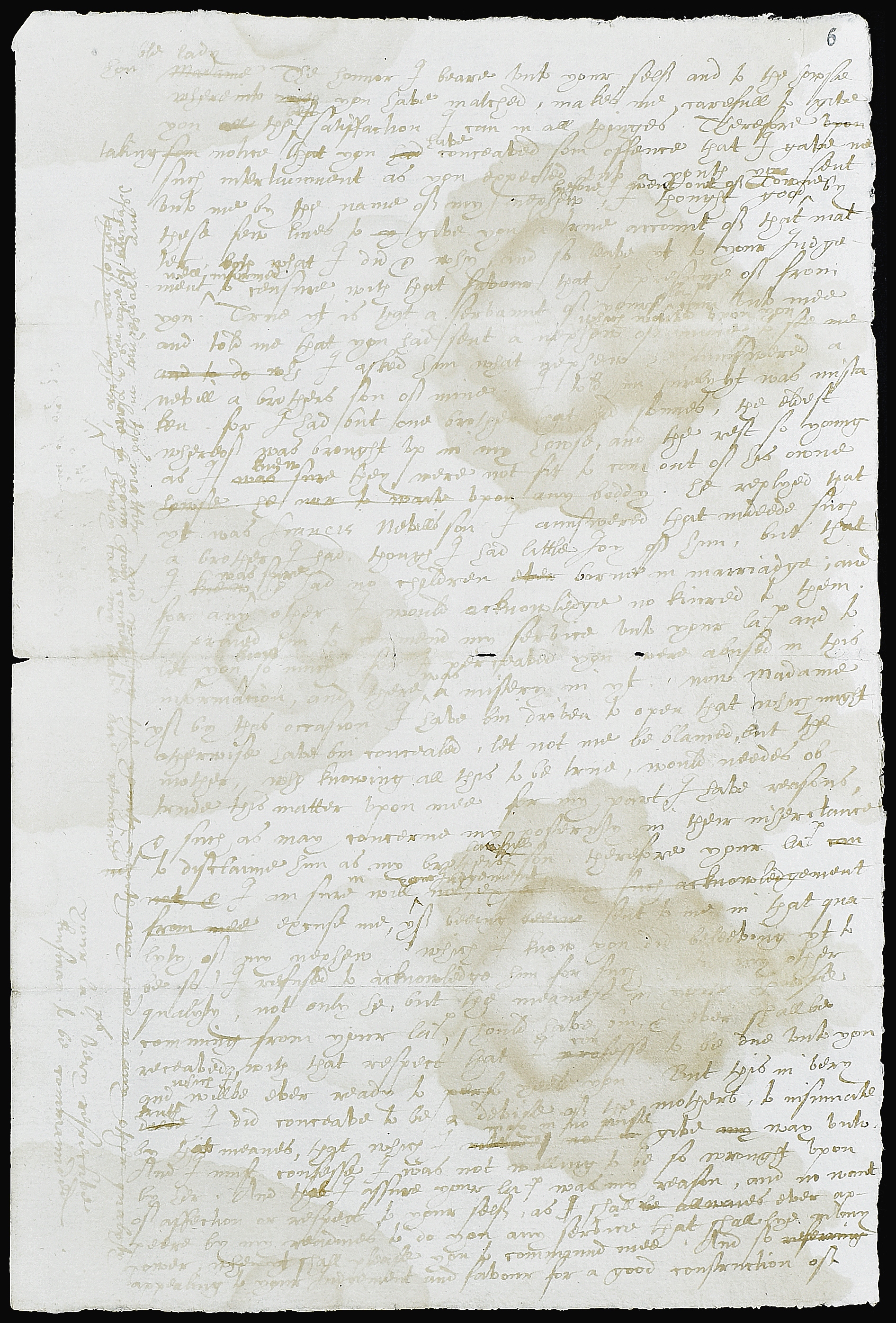
9. Notes on Access / Next Checks
- The human transcription and full-resolution image together establish a strong source-control chain for the document's existence and subject matter, but they do not settle date, hand, recipient, or formal item/folio citation.
- The TNA route verifies
PRO 30/50/3as a diplomatic-correspondence collection, and the recovered filename verifies the project's image sequence.012may be a photography sequence rather than archival foliation and should not be expanded toPRO 30/50/3/12without catalogue or folder evidence. - The letter belongs to the main corpus as an undated draft with a transparent working date, not as a securely dated item. Before it enters book prose as a final diplomatic edition, line-collate O'Donnell's text against the recovered image, recording the marginal continuations, cancellations, insertions, and any uncertain readings.
- Do not use the incompatible transcription in
To Lady Nevilleto silently alter the O'Donnell text or identify the recipient. Any proposed identification must be argued independently from the manuscript, genealogy, chronology, and external records.
Additional Fact-Source Notes
- The source route remains
PRO 30/50/3, the Sir Henry Neville diplomatic-correspondence collection for1603-1609. The exact project image is now recovered, but the formal item-level shelfmark or foliation remains unconfirmed. - The O'Donnell transcription is now paired with its full-resolution image witness and an exact duplicate of his DOCX in the National Archives source folder. The remaining task is formal collation, not image recovery.
- Claims about the unknown recipient or sonnet sentiment should remain demoted. Similar feeling or situation is not the same as shared language or direct literary dependence.
2026-07-12 Kinship and Image-Control Update
The full O'Donnell transcription resolves the immediate male identity. Neville says the woman sent a youth “by the name of my nephew,” describes the claim as “a nevill a brothers son of mine,” says that he had only one brother who had sons, and expressly states “yt was francis Nevills son.” The Francis meant here is Henry's brother, not a merely possible person of the broader Neville surname.
Foster's visually checked entry independently identifies Francis Neville as brother to Henry and Edward and records his 1596 licence to marry Margaret Farrer. That marriage record does not contradict the draft's statement that Francis had “no children borne in marriadge”: the disputed youth is alleged to have been born outside marriage.
Neville's refusal to “acknowledge” the kinship is framed as an inheritance problem that “may concerne my posteryty in their inheritance.” The document therefore belongs in the family, legitimacy, and succession lane. It does not yet identify the young man, his mother, or the female recipient.
The earlier 217 x 320 blog derivative remains too weak for independent paleography, and earlier image-model expansions of the opening or signature should not be used. The full-resolution PRO 30 50 3 012 is now recovered. O'Donnell's transcription continues to control until a formal human line collation is completed; the image filename must not be rewritten as the unverified formal reference PRO 30/50/3/12.
Image control for Francis's identity: Foster p. 1057. Full audit: 06 UNKNOWN WOMAN.
