Giacomo di Grassi at Billingbear: Fencing, Shakespeare, Churchyard, Gresham, and John Jaggard
Topic: Giacomo di Grassi at Billingbear: Fencing, Shakespeare, Churchyard, Gresham, and John Jaggard
Source-Fact Audit — 7 August 2026 (Round 3)
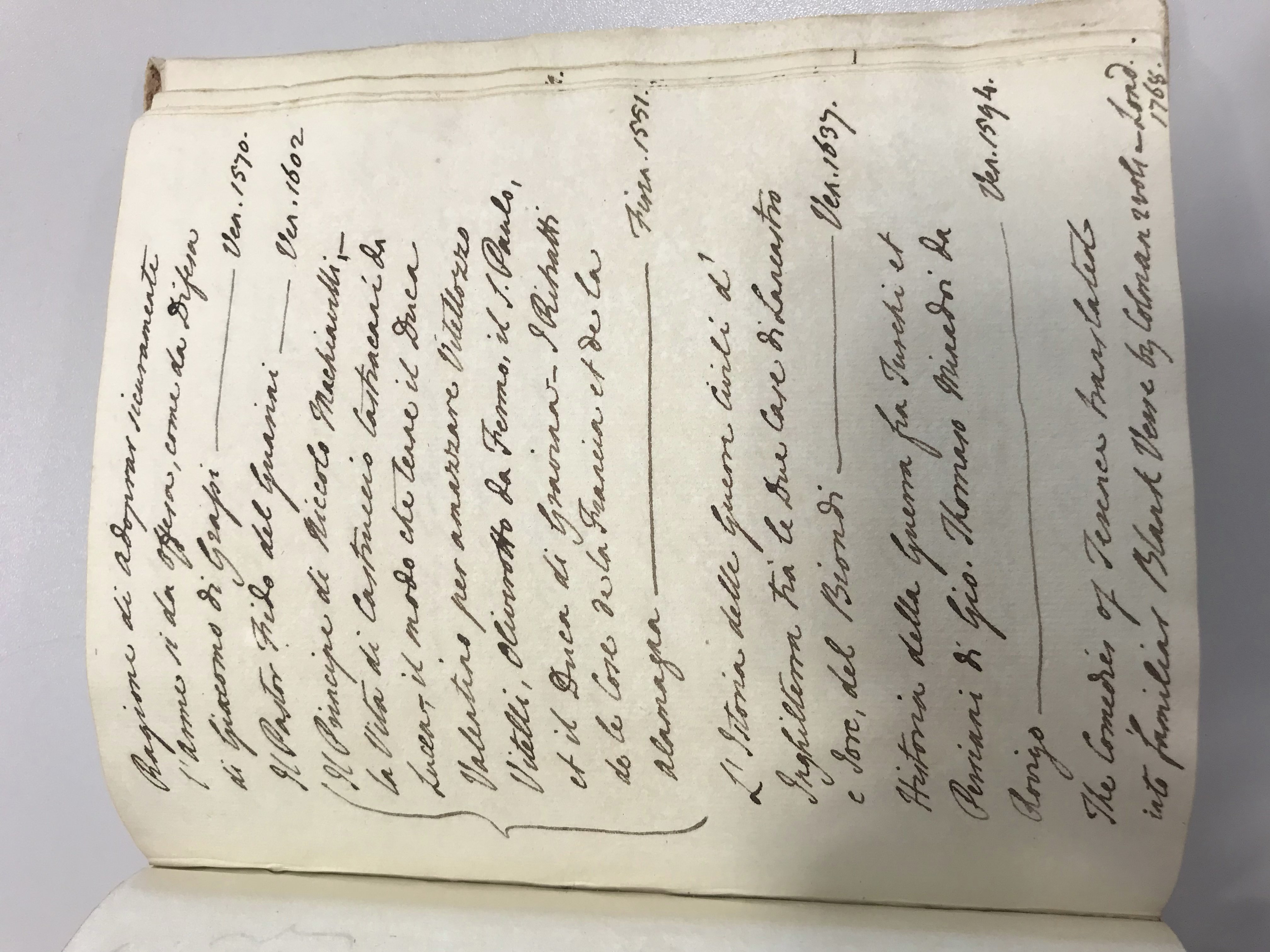
- The 1780 Billingbear catalogue directly records a 1570 Venice quarto of Giacomo di Grassi. English Heritage object
81035053independently matches author, title, place, year, and format. - That multi-field agreement is a strong candidate concordance, not yet proof that the modern object is the same physical copy listed in 1780. Binding, shelf marks, inscriptions, and provenance photographs are still required.
- The 1594 English translation directly supplies its title page, “Englished by I. G.,” Churchyard dedication, and John Jaggard imprint. John Jaggard must not be conflated with William Jaggard.
- Technical fencing language and Shakespeare passages may be compared by exact quotation; the comparison does not establish use of this particular copy.
- The packet now labels the object match as a candidate and keeps bibliography, physical provenance, print network, and verbal comparison separate.
Research Result
The 1780 Billingbear catalogue records the first edition of Giacomo di Grassi's Italian fencing manual:
Ragioni di adoprar sicuramente
l'Arme si da Offesa, come da Difesa
di Giacomo di Grassi _________________ Ven. 1570.
The local Billingbear/Audley End comparison workbook proposes English Heritage object 81035053, a Venice 1570 quarto by Giacomo di Grassi in half-calf, recorded at Audley End House in FR/19 Library, Case M, Shelf 6, as the candidate match. Author, title, place, year, and format align, but a physical collation is still needed to establish that it is the same copy and to document completeness, binding history, provenance marks, and use.
The exact book is Ragione di adoprar sicuramente l'arme si da offesa, come da difesa, Venice: Giordano Ziletti and companions, 1570. Its title announces not only offence and defence but also a treatise on deception and a method for acquiring “forza, giudicio, & prestezza”—strength, judgment, and speed. It reduces the apparent infinity of possible blows to a small number of principles; treats straight and circular lines, timing, distance, footwork, and the relative length and force of parts of a sword; and proceeds through the single sword, sword and dagger, sword and cloak, sword and buckler or targets, two swords, two-handed sword, staff weapons, feints, and physical exercises.
The book therefore opens a serious Shakespeare research avenue, especially for the fencing cultures dramatized in Romeo and Juliet, Hamlet, The Merry Wives of Windsor, and Twelfth Night. The most useful relationship is not a claim that every conspicuous Italian fencing word in Shakespeare came from Grassi. In fact, the 1594 English Grassi does not use stoccata, imbroccata, passata/passado, or punto reverso; Vincentio Saviolo's 1595 Practise does use stoccata, imbroccata, and passata. Grassi is more directly relevant to the underlying system: time, distance, the shortest line, bodily order, judgment converted into action, repeated practice, weapon combinations, and the dangerous consequences of a weapon or distance advantage.
Two newly developed social and book-trade routes deepen the topic.
First, Thomas Churchyard supplied the dedicatory epistle to the 1594 English Grassi. In Churchyards Challenge (1593), while listing his works, Churchyard remembered “the deuises of warre and a play at Awsterley, her highnes being at sir Thomas Greshams.” Sir Thomas Gresham was the paternal uncle of Henry Neville's mother and therefore Henry's maternal great-uncle. This places the editor of the English Grassi in a documented entertainment setting at the home of Neville's close Gresham kinsman. It does not yet establish that the play itself was martial: the Folger's 1593 chronology treats “the devices of war” and “a play at Osterley” as two separate works. Nor is the date certain. The Folger routes the play to the Queen's 10–12 May 1576 Osterley stay, while E. K. Chambers allowed the February 1578 visit. It does not show that Churchyard supplied Billingbear's Italian copy, but it is a concrete household link worth pursuing.
Second, the 1594 translation was published for John Jaggard, at the Hand and Star near Temple Bar. John must be kept distinct from his brother William Jaggard, the later Shakespeare publisher and First Folio printer. Yet the distinction reveals a richer cluster rather than dissolving the lead. EarlyPrint records identify John Jaggard as publisher of the English Grassi in 1594, Edward Fairfax's English Tasso in 1600, an English Botero in 1601, and Richard Carew's Survey of Cornwall in 1602. Billingbear preserves Italian works by Grassi, Tasso, and Botero, and it preserves the exact 1602 Carew/Jaggard edition. The surviving library therefore intersects John Jaggard's translation and political-geographical list at several specific points.
None of this establishes when the Grassi volume entered Billingbear or who read it. It does establish a physical source book, a surviving object, an English translation before the major Shakespeare fencing scenes, a documented Gresham-Churchyard entertainment link, and a Jaggard bookselling cluster that reaches an exact surviving Billingbear imprint.
Source-Control Summary
- Billingbear witness:
IMG_8184directly records Giacomo di Grassi, Venice,1570. - Candidate surviving-object witness: local English Heritage data align the entry with Audley End object
81035053, quarto, half calf,FR/19 Library, Case M, Shelf 6; physical provenance remains to be proved. - Edition witness: the complete Venice 1570 Ziletti scan supplies the title, preliminary matter, diagrams, weapon sections, and collation comparator.
- English print witness: EarlyPrint TCP
A02044, ESTCS103388, STC12190, and the UMass facsimile control the London 1594 translation, Churchyard dedication, and John Jaggard imprint. - Shakespeare witness: all quoted play passages come directly from Folger TXT/XML files and are linked at passage level.
- Terminology witness: EarlyPrint searches separate Grassi's doctrine from the Italian labels present in Saviolo, Florio, and wider drama.
- Gresham witness: Churchyard's
A18722lists “deuises of warre and a play” at Sir Thomas Gresham's Osterley. Folger treats these as possibly separate works and routes the play to1576; Chambers allowed1578. The exact date and the play's relation to the “devices” remain open. - Jaggard witness: EarlyPrint metadata and the Stationers' Register index distinguish publisher John Jaggard from his brother William; the exact Carew/John-Jaggard book survives in the Billingbear/Audley End library.
- Open source boundary: none of these records yet dates acquisition of the Grassi volume or identifies an early reader.
1. The Billingbear Entry and Surviving Audley End Object
The catalogue entry is on billingbear IMG 8184 grassi 1570. It appears next to other Italian literary and political books, including Guarini's Pastor Fido.
The combined workbook row records:
- English Heritage ID:
81035053; - present in the 1780 Billingbear list: yes;
- Audley End comparison flag:
1; - title: Ragioni di Adoprar sicuramente l'arme si da offera, come la Difera di Giacomo di Grassi;
- maker:
Grassi, Giacomo di; - date and place: Venice,
1570; - format: quarto;
- binding: half-calf;
- status:
LONG TERM LOAN.
The locally preserved English Heritage export/email adds the location:
AUDLEY END HOUSE
FR/19 Library, Case M, Shelf 6
The title is imperfectly entered in the modern object data (Regione di Adoprar), while date, maker, format, catalogue presence, and library location make the object a strong candidate. Those fields do not by themselves identify the same physical copy.
2. The Exact 1570 Edition
The rendered title page reads:
RAGIONE DI ADOPRAR
SICVRAMENTE L'ARME SI DA OFFESA,
COME DA DIFESA,
Con un Trattato dell'inganno, & con un modo di essercitarsi da se stesso, per acquistare forza, giudicio, & prestezza,
DI GIACOMO DI GRASSI.
In Venetia, appresso Giordano Ziletti, & compagni.
MDLXX.
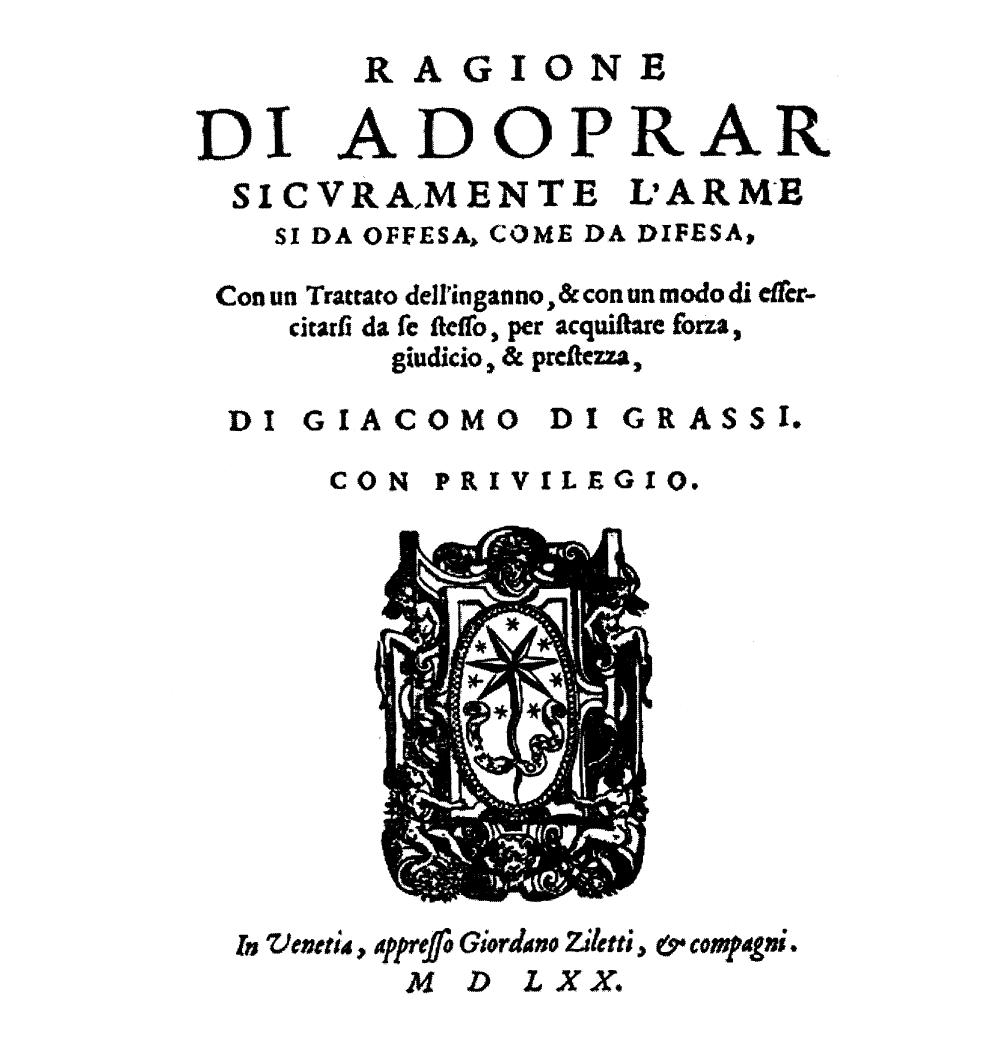
The public scan used here has 80 PDF pages, normally presenting two printed pages on each scan. A catalogue description gives [4] leaves, 151, [1] pages, illustrations, quarto. The dedication is dated Venice, 8 March 1570.
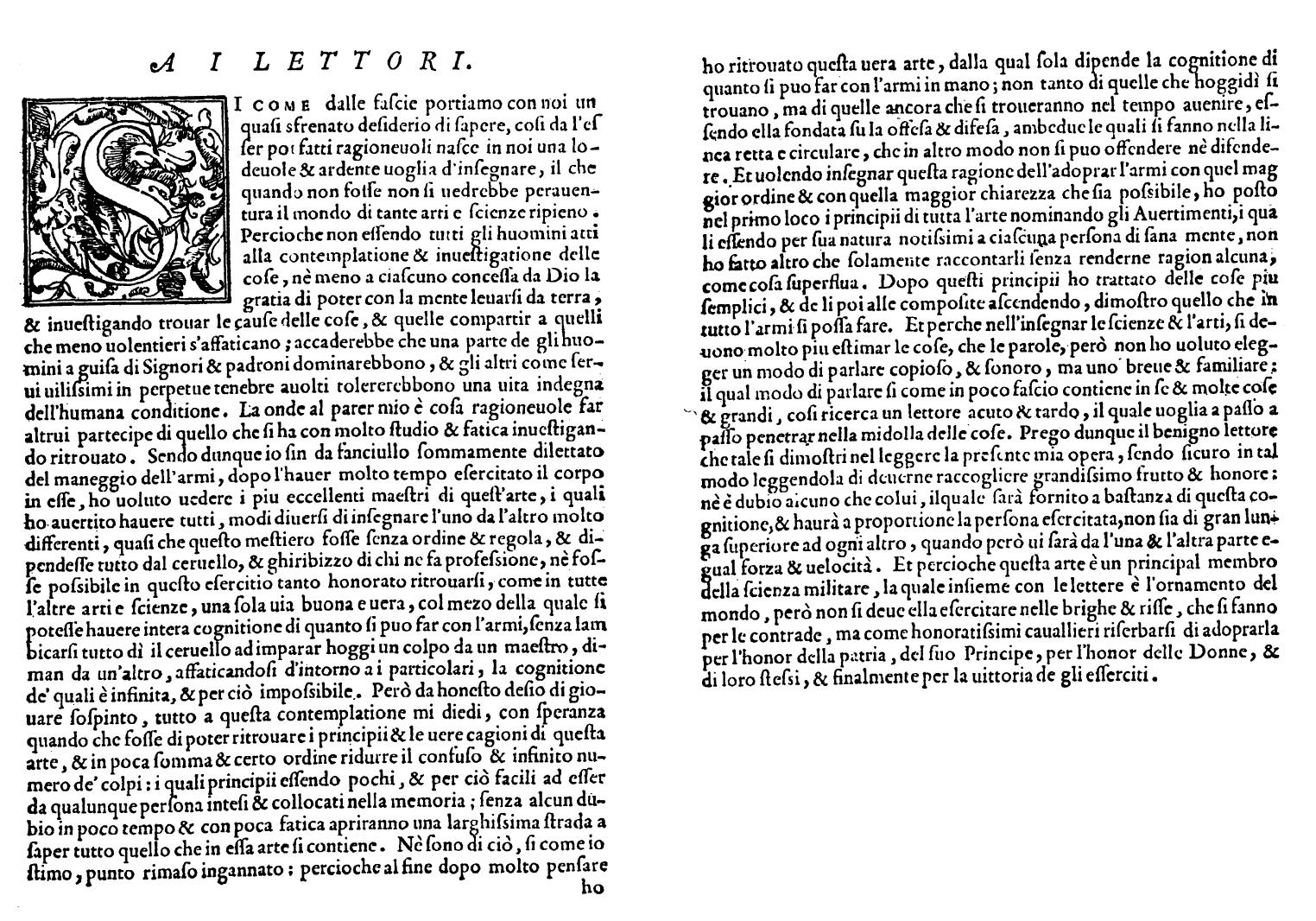
The opening Ai lettori explains the intellectual design. Di Grassi says the confused multitude of possible blows can be reduced to a few principles and bases offence and defence on straight and circular lines. The diagrams then make geometry part of bodily practice.
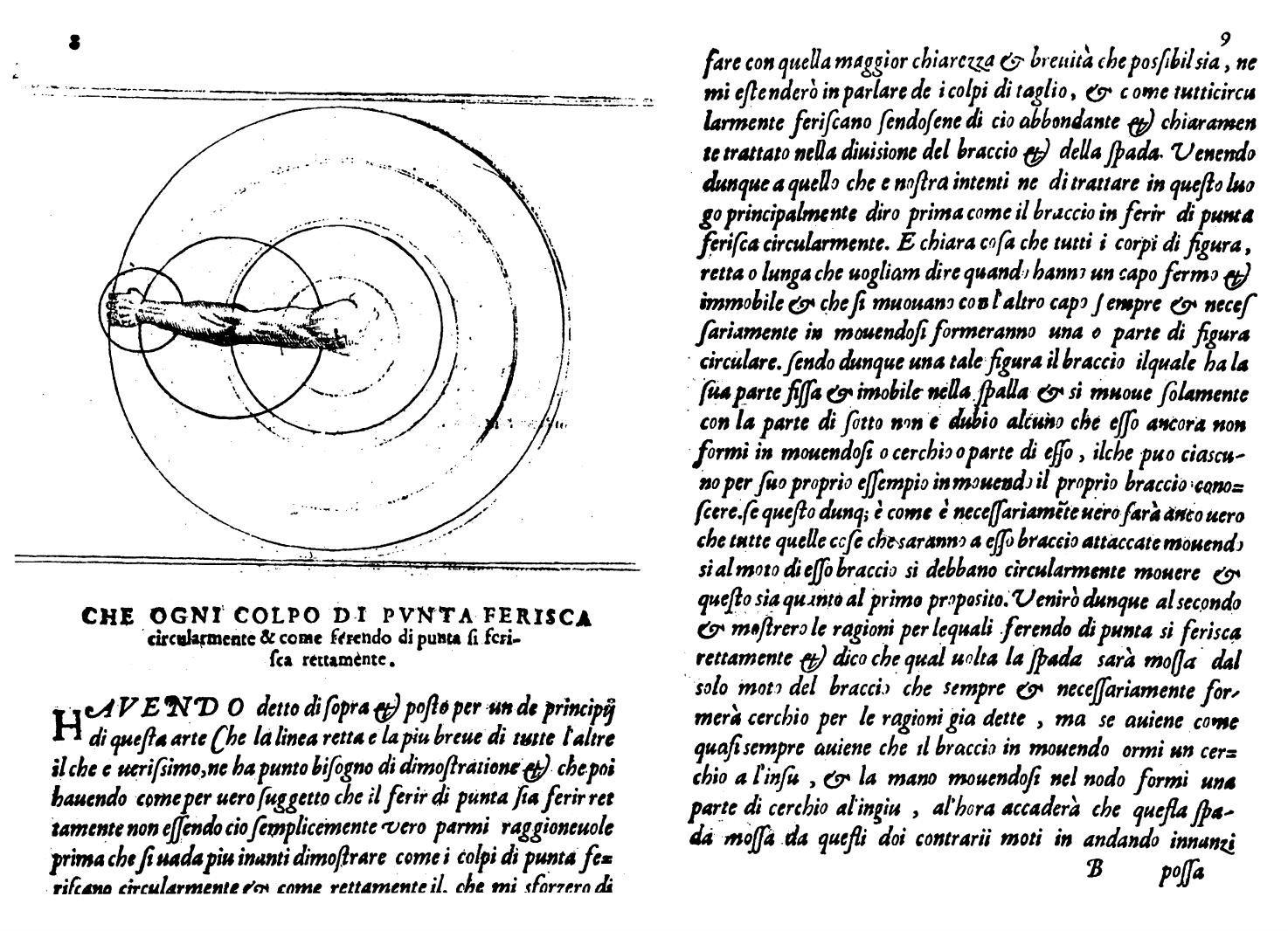
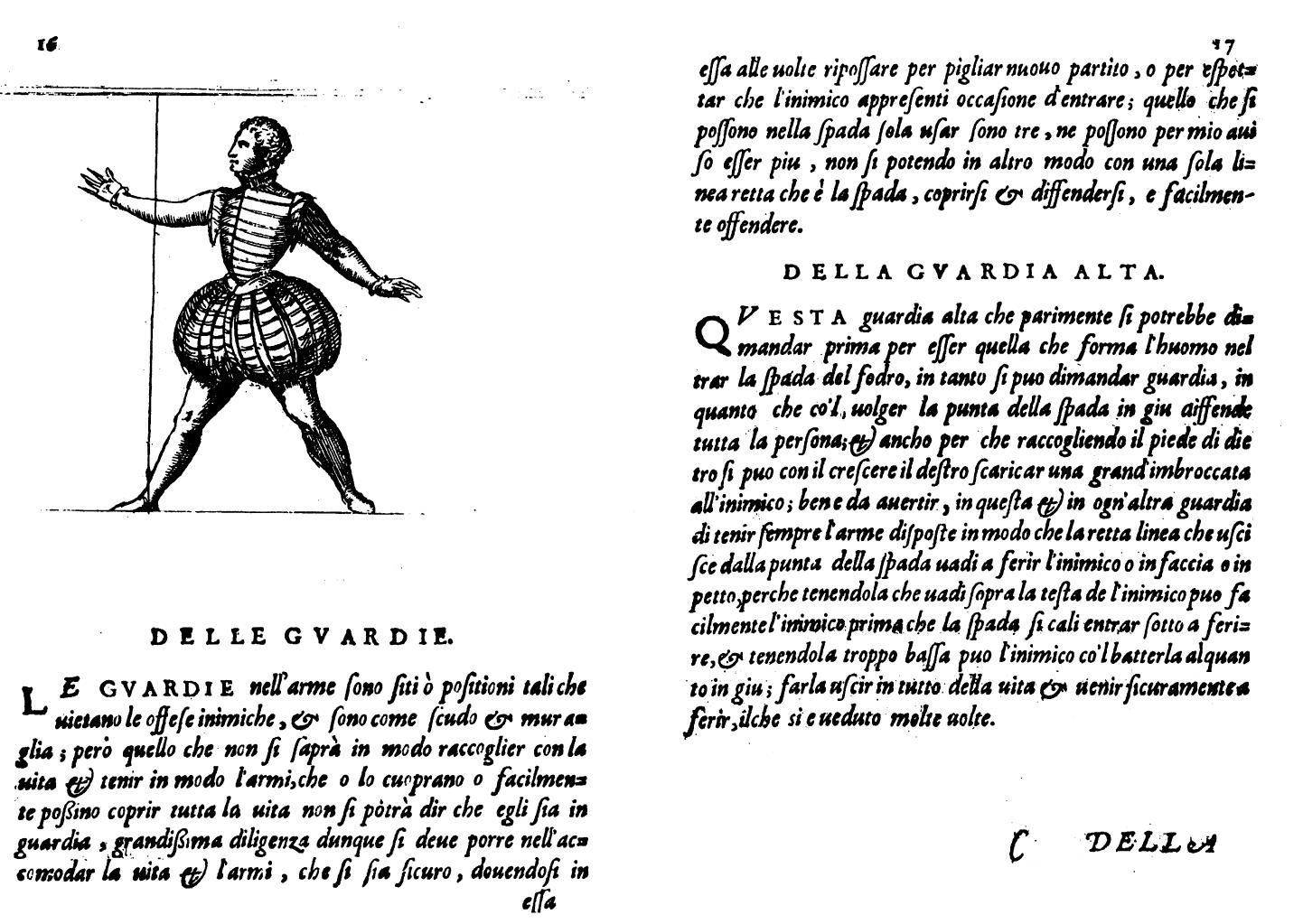
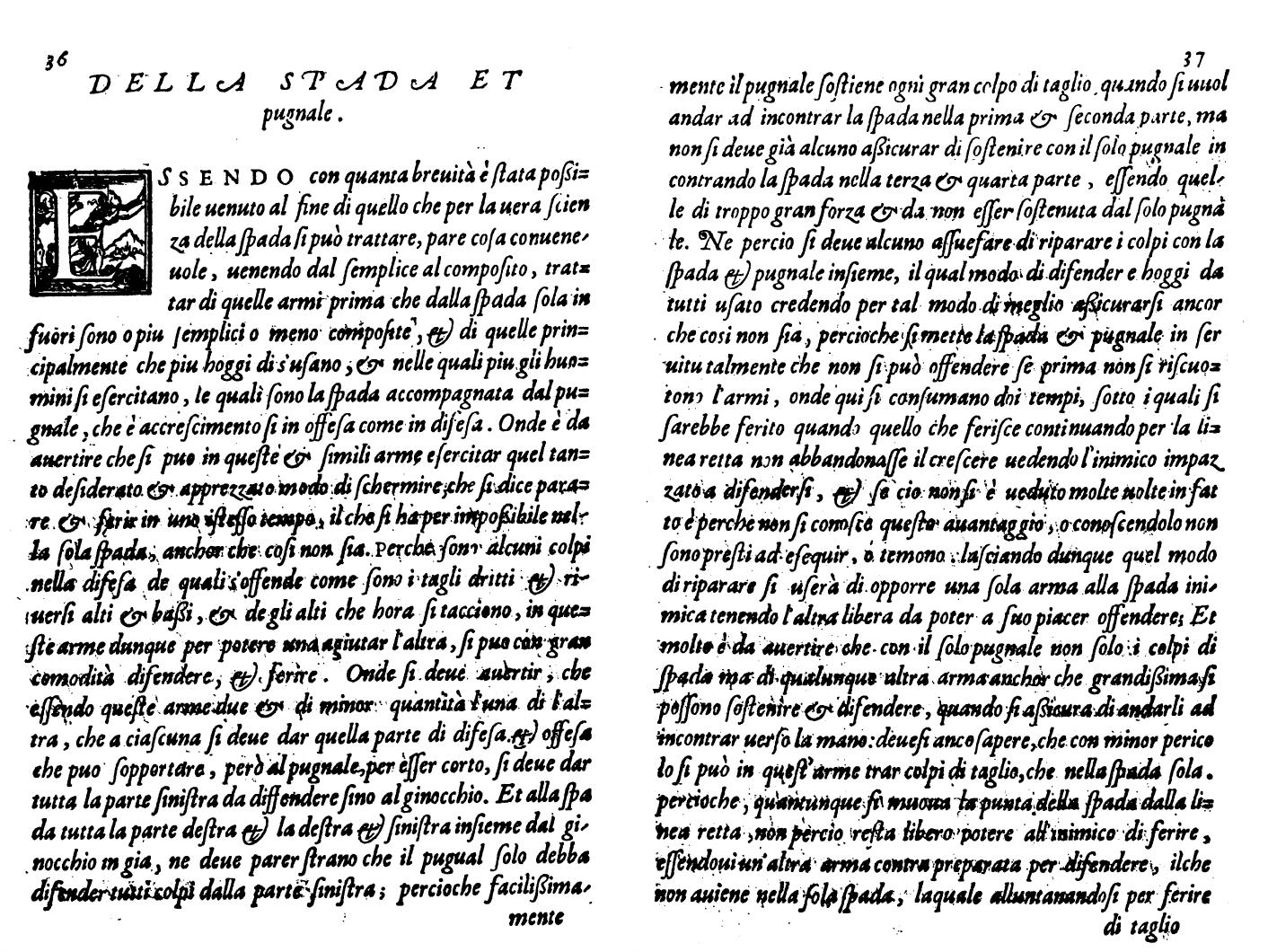
The section Della spada et pugnale confirms that sword-and-dagger fighting is integral to the original Italian book rather than an English addition.
3. The 1594 English Translation
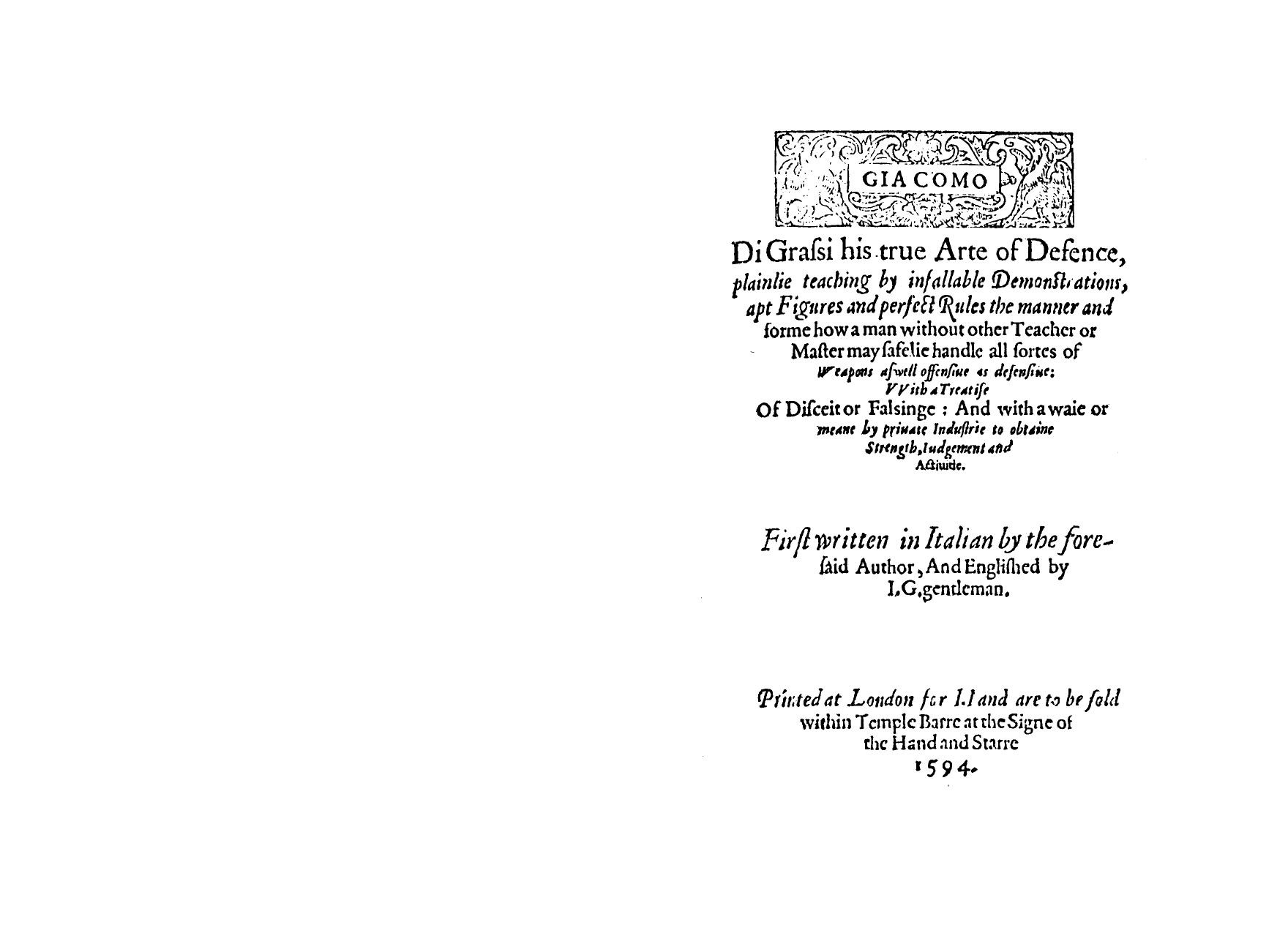
EarlyPrint TCP A02044, ESTC S103388, identifies the English edition as Giacomo di Grassi his True arte of defence, “Englished by I. G. gentleman,” London, 1594. The title page says:
Printed at London for I. I and are to be sold within Temple Barre at the Signe of the Hand and Starre 1594.
The STC/ESTC metadata expands I. I. to John Jaggard and conjectures the printer as G. Shaw. The editor's dedication is signed Thomas Churchyard. The EarlyPrint record is based on the Harvard copy; a separate public facsimile is preserved by the University of Massachusetts Amherst's Raymond J. Lord Collection.
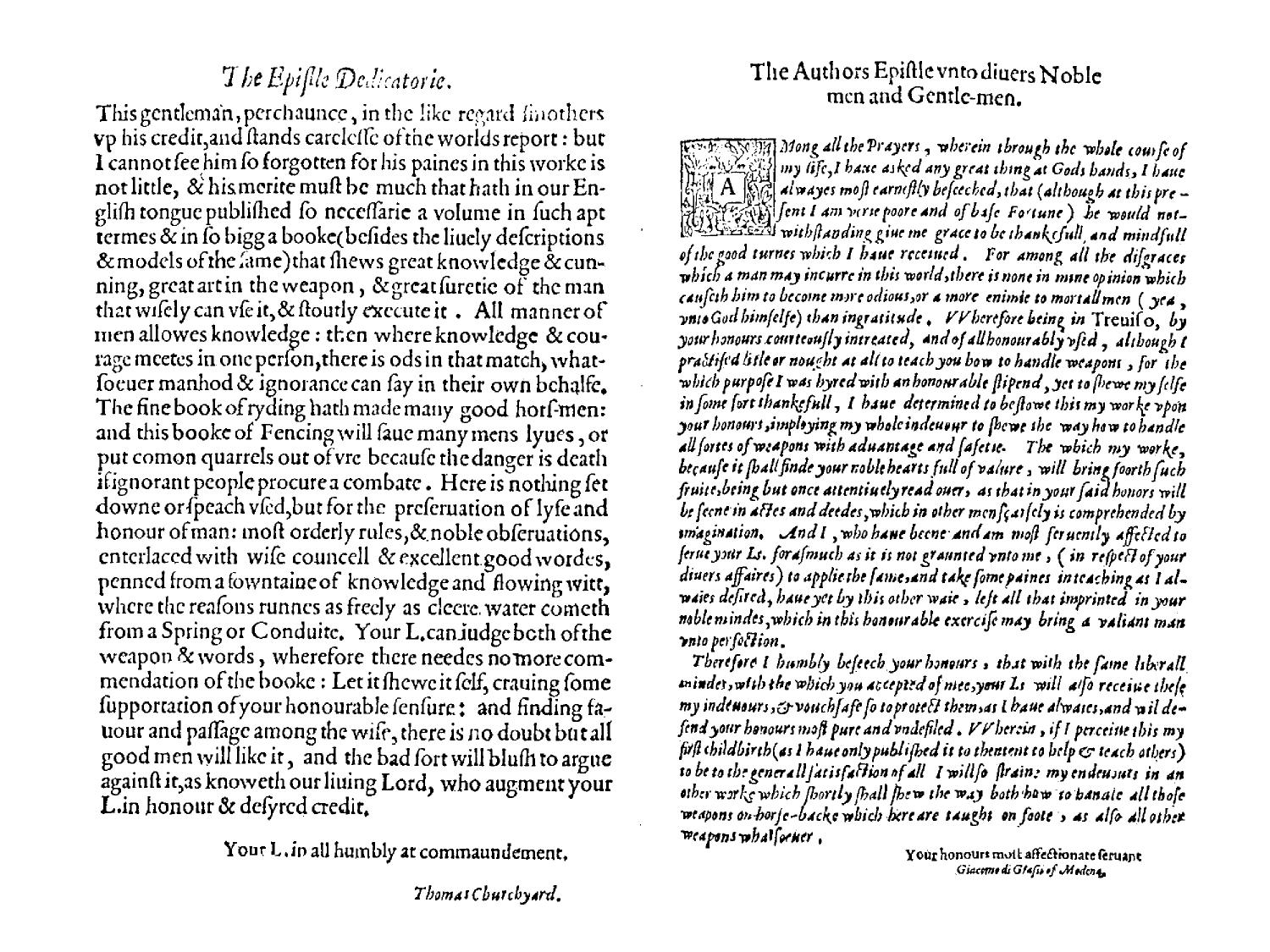
Thomas Churchyard's martial dedication
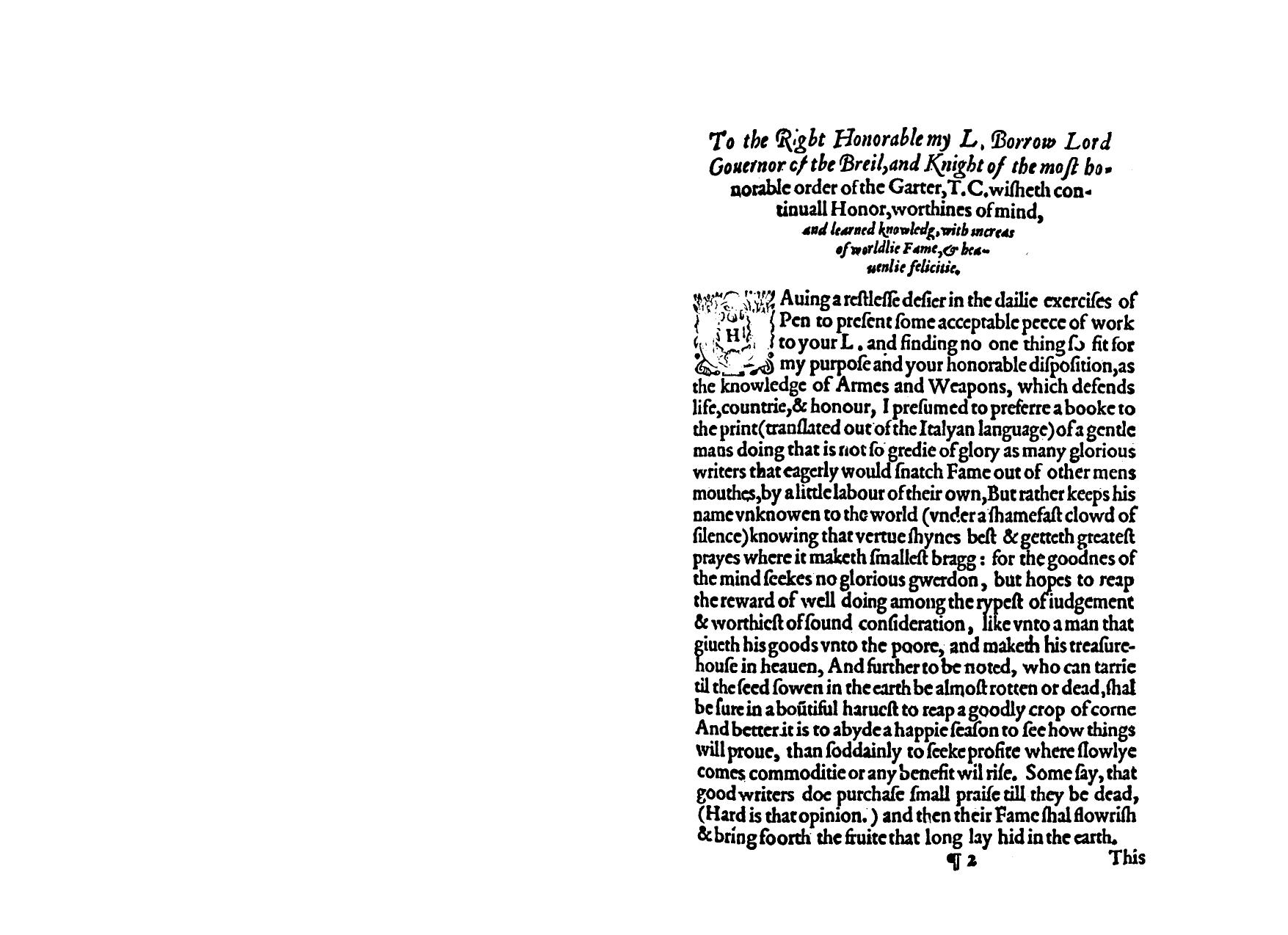
Churchyard addresses Thomas Burgh, third Baron Burgh, governor of Brill and Knight of the Garter:
To the Right Honorable my L. Borrow Lord Gouernor of the Breil, and Knight of the most honorable order of the Garter
He explains why he promoted the translated manuscript:
finding no one thing so fit for my purpose and your honorable disposition, as the knowledge of Armes and Weapons, which defends life, countrie, & honour, I presumed to preferre a booke to the print (translated out of the Italyan language)
The translator on the English rapier fashion
The preliminary note explains that Italian spada has sometimes been rendered as rapier, because rapier and dagger are commonly worn in Italy. It then describes the English change in fashion:
The Sworde and Buckler fight was long while allowed in England ... but now being layd downe, the sworde but with Seruing-men is not much regarded, and the Rapier fight generally allowed, as a wapon because most perilous, therefore most feared
The note presents the book as something to be understood in the mind and enacted in the body:
whereby he may learne not onely through reading & remembring to furnish his minde with resolute instructions, but also by practise and exercise gallantly to perfourme any conceited enterprise with a discreete and orderly carriage of his bodie
4. Grassi's Central Doctrine in Direct Quotation
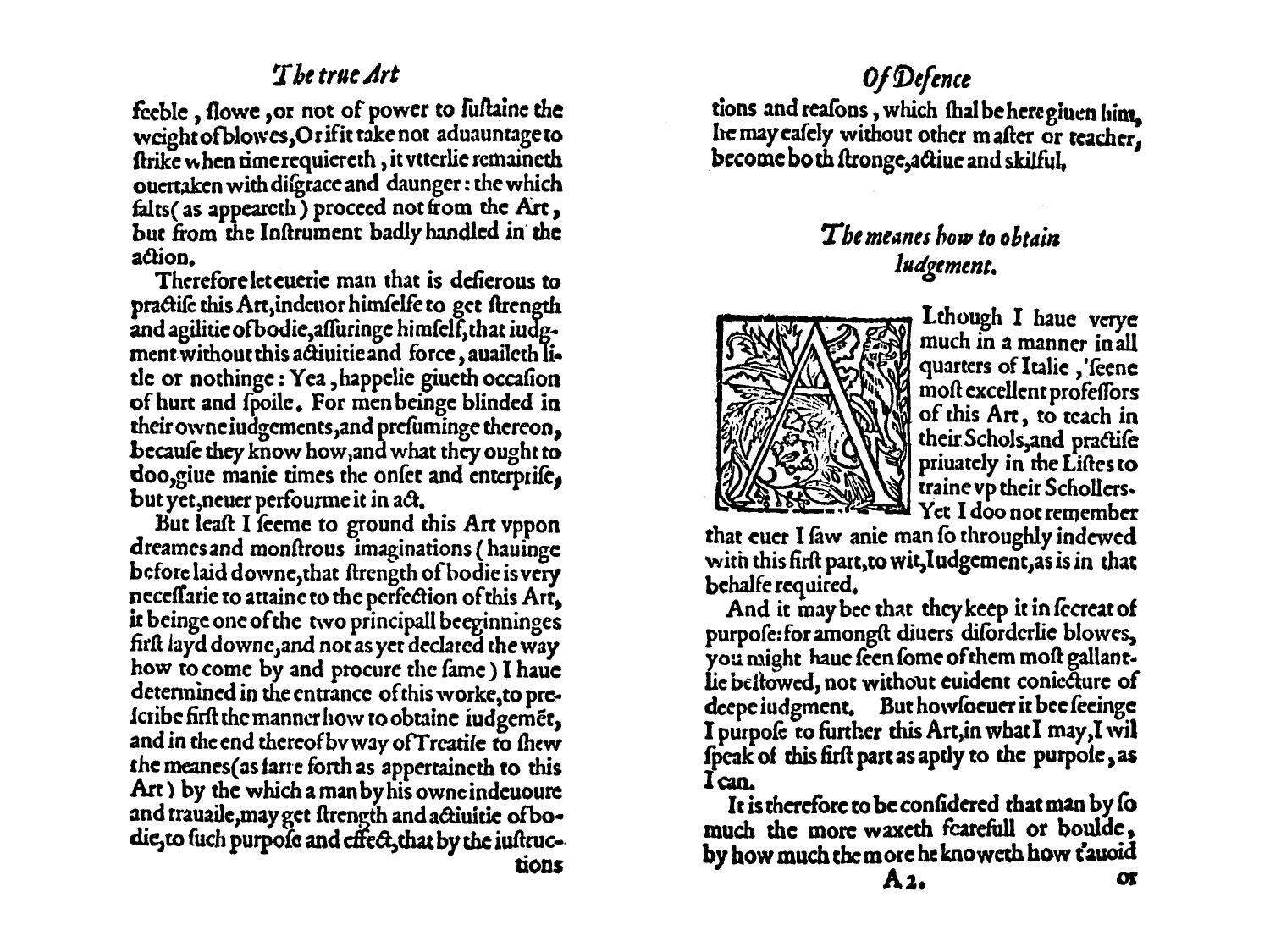
Judgment must become bodily action
The treatise begins:
the Honorable exercise of the Weapon is made right perfect by meanes of two thinges, to witt: Iudgment and Force
Judgment knows how and when to handle the weapon; force executes that judgment. Di Grassi insists that the purpose of the art is performance:
the end and scope of this Art consisteth not in reasoning, but in dooinge
He warns that knowledge without strength and activity can fail at the instant of danger:
iudgment without this actiuitie and force, auaileth litle or nothinge
Straight and circular lines
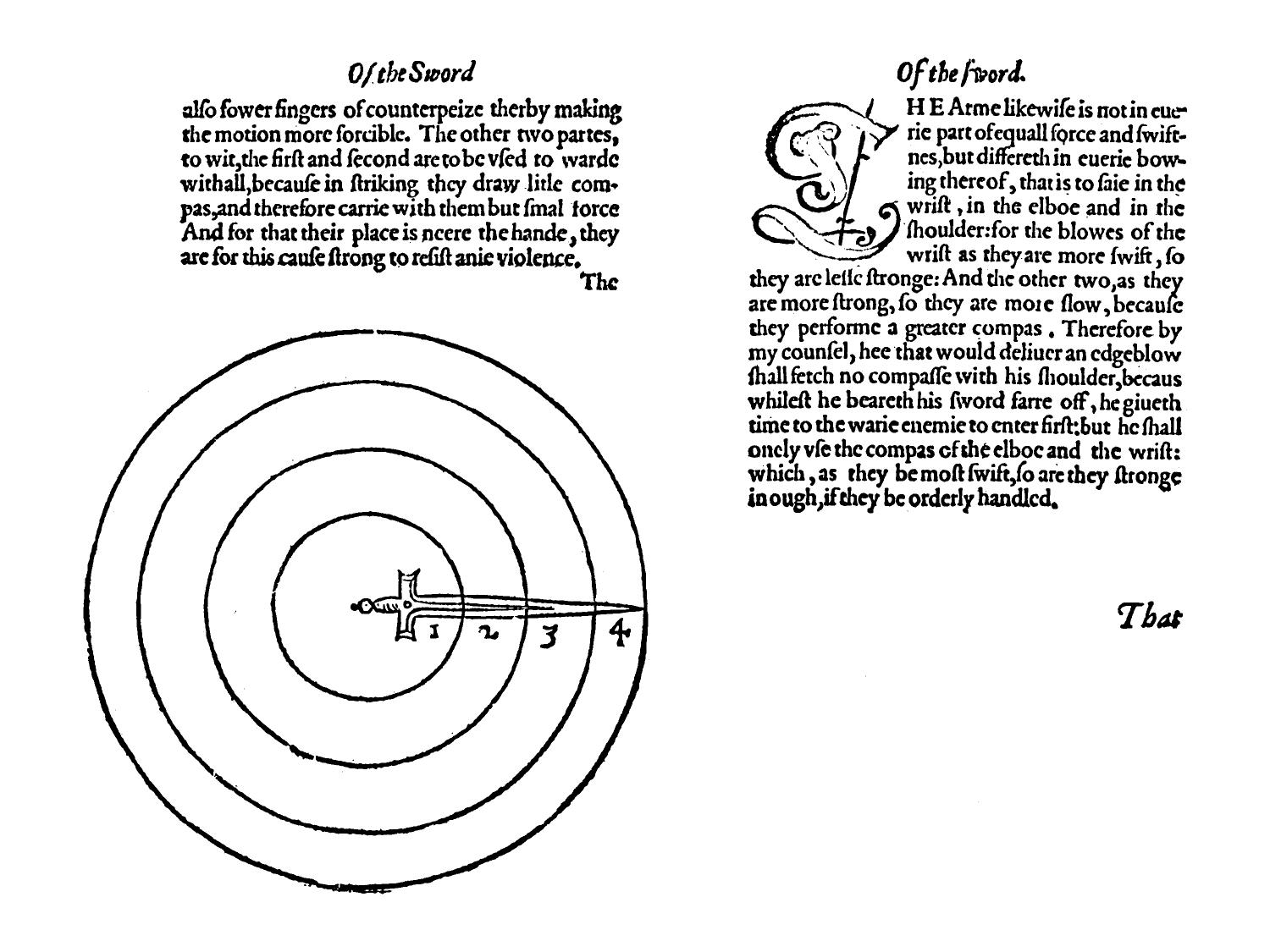
The art is presented as a general system rather than a list of tricks:
Considering this Arte is grounded vpon Offence and Defence, both the which are practised in the straight and circuler lynes, for that a man may not otherwise either strike or defend.
The geometrical figures show the sword moving from the hand as center through circles and lines. The point and thrust are privileged because the straight line reaches the opponent by the shortest route.
Distance and hitting first
The most Shakespeare-relevant tactical passage is explicit:
when a man standeth in due order ... and perceiueth that there is lesse distance from the point of his sword, vnto his enemie, then there is from his enemies sword vnto him, In that case he must nimbly force on a strong thrust to the end he may hitt home first.
This is not a verbal source claim. It documents the practical content behind early modern talk of keeping distance, having a weapon advantage, and landing the first palpable hit.
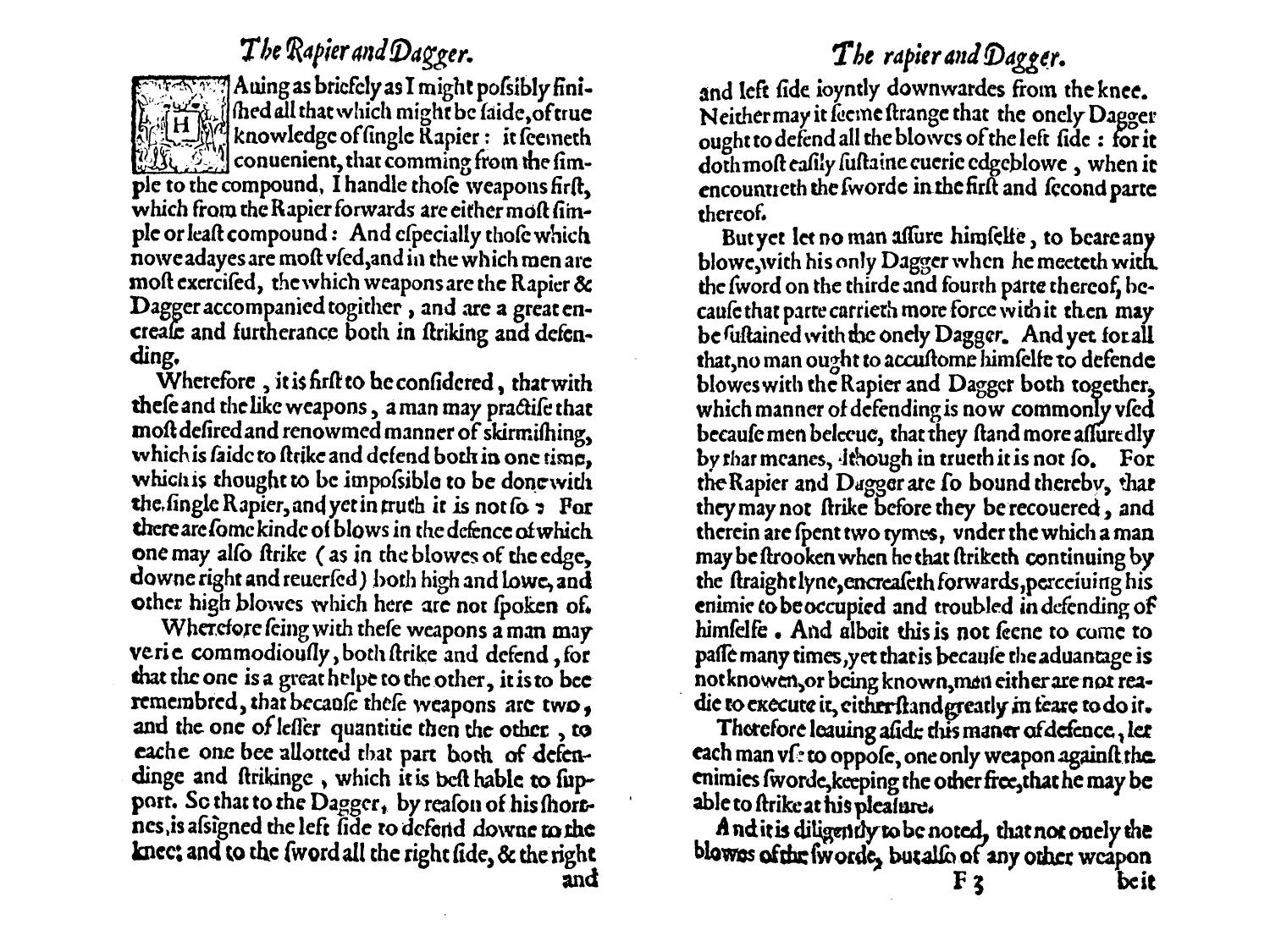
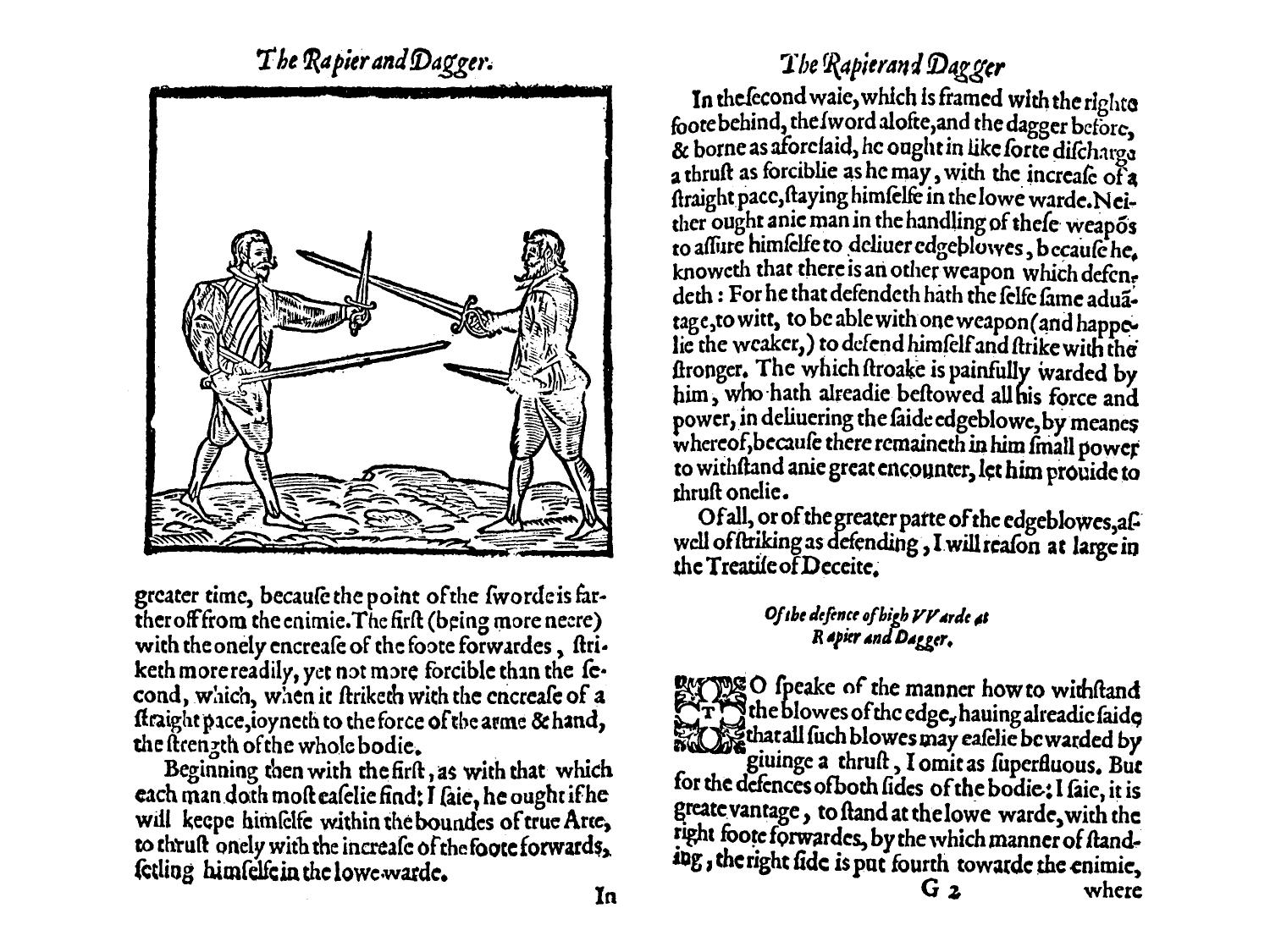
Rapier and dagger
The English section begins:
The Rapier and Dagger.
It calls the combination commonly worn and describes the weapons as mutually assisting one another in defence and offence. The dagger is not merely ornamental; it closes lines, receives blows, and creates an opportunity for the rapier's thrust.
5. Romeo and Juliet: Time, Distance, Proportion, and Italian Fashion
Every Shakespeare passage in this packet is quoted from the Folger corpus. In Romeo and Juliet 2.4, Mercutio describes Tybalt not only with exotic terms but with a system of measure:
MERCUTIO More than prince of cats. O, he's the courageous
captain of compliments. He fights as you sing
prick-song, keeps time, distance, and proportion.
He rests his minim rests, one, two, and the third in
your bosom--the very butcher of a silk button, a
duelist, a duelist, a gentleman of the very first house
of the first and second cause. Ah, the immortal
passado, the punto reverso, the hay!
Source: romeo and juliet TXT FolgerShakespeare:1870; Folger Digital Text, 2.4, FTLN 1149–1156, scene lines 20–27.
The phrase “time, distance, and proportion” belongs naturally beside Grassi's timing, distance, measure, and geometrical line. But the comic force is also social: Mercutio mocks “new tuners of accent,” fashion-mongers, and the affected jargon of the dueling gentleman. The passage therefore joins real technical knowledge with satire of fashionable performance.
When the quarrel becomes lethal, the term returns as action rather than catalogue:
ROMEO
Gentle Mercutio, put thy rapier up.
MERCUTIO Come, sir, your passado. [They fight.]
Source: romeo and juliet TXT FolgerShakespeare:2491.
The named terms point beyond Grassi
The EarlyPrint comparison is important:
| Term | Grassi, English 1594, TCP A02044 | Saviolo, 1595, TCP A11537/A11541 | Shakespeare / broader print |
|---|---|---|---|
stoccata | not found | found repeatedly | appears as stockado/stoccado in Nashe, Jonson, and later texts |
imbroccata | not found | found repeatedly | Florio defines it in 1598 |
passata | not found | found repeatedly | Shakespeare uses passado; Florio calls passata “a passado, a word in fencing” |
punto reverso | not found | exact phrase not found in this check | Folger Romeo and Juliet; Jonson later lists punto, reuerso, stoccato, imbroccato, passado |
foin | not found as a distinctive Grassi label | used | an older English word with many pre-1594 occurrences |
This means the Italian labels should not be presented as proof that Shakespeare took them from Grassi. Saviolo is a closer printed witness for several labels, while Florio and the drama show rapid circulation. Grassi's distinctive value is the coherent doctrine beneath the fashion.
6. Hamlet: Weapon Combination, Practice, Length, and the Corrupted Bout
Rapier and dagger
Osric names the weapon combination directly in Hamlet 5.2.157–166:
HAMLET What's his weapon?
OSRIC Rapier and dagger.
HAMLET That's two of his weapons. But, well--
OSRIC The King, sir, hath wagered with him six Barbary
horses, against the which he has impawned, as I
take it, six French rapiers and poniards, with their
assigns, as girdle, hangers, and so.
Source: hamlet TXT FolgerShakespeare:5627; line anchors verified in local Ham:76137.
Grassi contains a full sword/rapier-and-dagger section, and the English preliminary matter says the combination was commonly worn in Italy. This documents the technical reality of Osric's answer. It does not identify Grassi as the unique source of the phrase.
Practice must become execution
Hamlet grounds his confidence in repeated bodily training:
HAMLET I do not think so. Since he went into France, I
have been in continual practice. I shall win at the
odds; but thou wouldst not think how ill all's here
about my heart. But it is no matter.
Source: hamlet TXT FolgerShakespeare:5722; Folger 5.2.224–227, confirmed by local XML at 5.2.225.
Grassi's insistence that the art's end is “not in reasoning, but in dooinge” and that reading must be completed “by practise and exercise” supplies an exact contemporary framework for this claim. “Continual practice” is not a distinctive shared phrase proving dependence; the important point is that the scene understands fencing excellence as trained performance, not mere verbal knowledge.
Foils, length, and distance
Immediately before the bout, weapon choice and equality are made visible:
LAERTES
This is too heavy. Let me see another.
HAMLET
This likes me well. These foils have all a length?
OSRIC Ay, my good lord.
[Prepare to play.]
Source: hamlet TXT FolgerShakespeare:5808; Folger Digital Text, FTLN 4001–4003.
The question matters because Grassi repeatedly treats reach and the relative distance between sword points and bodies as determinants of who can hit first. The play's plot turns on a concealed inequality that is more serious than length: Laertes selects a sharp, poisoned weapon among blunted foils.
Claudius formulates the deception in 4.7.153–158:
And wager on your heads. He, being remiss,
Most generous, and free from all contriving,
Will not peruse the foils, so that with ease,
Or with a little shuffling, you may choose
A sword unbated, and in a pass of practice
Requite him for your father.
Source: hamlet TXT FolgerShakespeare:4851; local XML anchors 4.7.153–158.
At the end, Laertes names the moral and tactical collapse:
The treacherous instrument is in thy hand,
Unbated and envenomed. The foul practice
Hath turned itself on me.
Source: Folger Hamlet 5.2.346–349, Folger Digital Text; corresponding local text at hamlet TXT FolgerShakespeare:5935.
The scene is not simply a display of fencing vocabulary. It understands equipment inspection, matched lengths, weight preference, repeated practice, scoring, weapon substitution, and the conversion of a sporting pass into murder.
7. Fencing Culture in The Merry Wives of Windsor and Twelfth Night
The language is distributed across comedy as well as tragedy. Slender claims training with a professional in The Merry Wives of Windsor 1.1:
SLENDER I had rather walk here, I thank you. I bruised
my shin th' other day with playing at sword and
dagger with a master of fence--three veneys for a
dish of stewed prunes--and, by my troth, I cannot
abide the smell of hot meat since.
Source: the merry wives of windsor TXT FolgerShakespeare:462; Folger Digital Text, FTLN 0278–0282.
The joke assumes recognizable lesson structure: sword and dagger, a master of fence, and a numbered set of bouts or hits. It also makes technical pretension part of Slender's comic self-presentation.
In Twelfth Night 3.4, Toby terrifies Andrew with an invented account of Viola's skill:
TOBY Why, man, he's a very devil. I have not seen such
a firago. I had a pass with him, rapier, scabbard,
and all, and he gives me the stuck-in with such
a mortal motion that it is inevitable; and on the
answer, he pays you as surely as your feet hits the
ground they step on. They say he has been fencer
to the Sophy.
Andrew answers:
ANDREW Plague on 't! An I thought he had been
valiant, and so cunning in fence, I'd have seen him
damned ere I'd have challenged him.
Source: twelfth night TXT FolgerShakespeare:2823; Folger PDF, FTLN 1831–1846.
The comic mechanism depends on the same divide that Grassi emphasizes between talk and doing. Toby manufactures a verbal reputation for infallible timing and answer; neither frightened combatant possesses the performance that the rhetoric imagines.
8. Saviolo and Silver as Essential Comparators
Vincentio Saviolo's Practise appeared in 1595, one year after the English Grassi. EarlyPrint has two witnesses, TCP A11537 and A11541. Saviolo uses the Italian technical terms that Grassi's English translation lacks. One passage brings three together:
make your passata with your lefte foote towarde his right foote for if that he bee anie thing skilfull hee maie giue you a stoccata or imbroccata
Saviolo therefore deserves direct attention whenever Romeo and Juliet's Italianate vocabulary is discussed. It is chronologically close to the play and lexically closer than Grassi.
George Silver's Paradoxes of Defence (1599, TCP A12246) attacks long rapiers and Italian teaching. Silver's title promises to expose “the weakenesse and imperfection of the rapier-fights” and warns Englishmen against “false teachers of defence.” His polemic proves that this was not a neutral technical vocabulary. Rapier practice was entangled with arguments about nationality, fashion, masculinity, danger, and the displacement of older English weapons—the same social field Mercutio mocks.
The productive research design is therefore triangular:
- Grassi for system, geometry, distance, judgment, force, and weapon combinations;
- Saviolo for the conspicuous Italian labels and duel culture;
- Silver for the English reaction against Italian rapier fashion.
9. Thomas Churchyard, Osterley, and Henry Neville's Gresham Kinship
The Churchyard connection is independent of the later Grassi dedication. In TCP A18722, Churchyards Challenge (1593), Churchyard lists entertainments he had devised:
The deuises of warre and a play at Awsterley, her highnes being at sir Thomas Greshams.
Churchyard gives no date. The Folger's Elizabethan Court Day by Day places the play with Elizabeth's 10–12 May 1576 stay at Osterley, whose documentary context includes the burning of Gresham's park pale during a local enclosure protest. The Folger's separate 1593 notes call “the devices of war” and “a play at Osterley” two separate works. E. K. Chambers instead wrote that the lost device and play “may belong” to Elizabeth's February 1578 Osterley visit. The Lost Plays Database lists the title under 1579, without a developed entry explaining that placement. The event should therefore be dated cautiously as an Osterley entertainment during Gresham's lifetime, probably 1576 or 1578, rather than fixed to one year.
Historic England confirms that Gresham acquired Osterley in 1562 and rebuilt the house in the 1570s.
Sir Thomas Gresham was not literally Henry Neville's uncle. He was the younger brother of Henry's maternal grandfather, Sir John Gresham: the paternal uncle of Henry's mother Elizabeth and therefore Henry's maternal great-uncle. Henry later became Sir Thomas's heir at common law, while Mayfield and Wadhurst passed through Sir Thomas's devise and the 1581 statutory settlement.
This produces a specific sequence:
1570: Grassi publishes the Italian manual in Venice;1576or1578: a likely date for Churchyard's lost play at Sir Thomas Gresham's Osterley; whether the separately listed “deuises of warre” belonged to the same event is unresolved;1593: Churchyard records the Osterley work in print;1594: Churchyard promotes the English Grassi into print and dedicates it to the governor of Brill;1780: the Italian 1570 Grassi is recorded at Billingbear;- today: a matching volume survives in the Audley End library record.
The missing step is provenance. No source yet says that Churchyard, Gresham, or John Jaggard supplied the Billingbear copy. The newly documented relationship is nevertheless valuable because it makes Churchyard part of Henry Neville's extended family-household environment long before the English translation.
10. John Jaggard's Italian and Political Translation List
The 1594 imprint belongs to John Jaggard, not William. The Stationers' Register index identifies John and William as sons of an elder John Jaggard and as brother stationers. Their businesses and imprints must not be merged.
EarlyPrint metadata identifies these John Jaggard publications:
| Year | TCP | Work | Billingbear/Audley End intersection |
|---|---|---|---|
| 1594 | A02044 | Grassi, True arte of defence | Italian Grassi, Venice 1570, survives as object 81035053 |
| 1600 | A68799 | Tasso/Fairfax, Godfrey of Bulloigne | Italian Tasso books survive, including Il Rinaldo 1562 and Aminta 1590 |
| 1601 | A16482 | Botero, The trauellers breuiat | Italian Botero 1589, 1597, and 1600 volumes survive |
| 1602 | A17958 | Carew, The Survey of Cornwall | the exact 1602 edition survives as object 81038804 and is in the 1780 list |
The Survey of Cornwall title-page imprint is:
Printed by S. S. for Iohn Iaggard, and are to bee sold neere Temple-barre, at the signe of the Hand and Starre. 1602.
This is the same Hand and Star shop named in the English Grassi. The Carew link is especially strong for the Neville project: Billingbear preserves the exact book; Richard Carew's son later remembered being sent to France with Henry Neville to learn French; and Fitzgeoffrey's Affaniae places the younger Carew in the Neville/Trelawny French-embassy circle.
This book-trade pattern should be investigated as a reading and translation network. It should not be converted into a claim that John translated the works, that William printed all of them, or that the First Folio arose from the same project. The immediate result is narrower and firmer: one Jaggard brother built a list containing English versions of major Italian works present at Billingbear, and his exact Carew edition is still in the library.
11. What This Adds to the Neville–Shakespeare Inquiry
The Grassi volume adds several kinds of research material at once:
- A physical book: an exact 1570 Italian edition in the 1780 catalogue with a matching surviving Audley End object.
- Technical knowledge: a systematic account of time, distance, geometry, thrusting, footwork, guards, weapon length, rapier-and-dagger fighting, deception, and practice.
- English availability: a full English translation in 1594, before the first print witnesses of Romeo and Juliet, Merry Wives, Hamlet, and Twelfth Night.
- A Shakespeare comparison: Folger passages document “time, distance, and proportion,” rapier and dagger, continual practice, matched foil length, an unbated weapon, masters of fence, and comic reputations for technical skill.
- A necessary comparator: Saviolo, not Grassi, supplies several of the conspicuous Italian labels.
- A family-household route: Churchyard's lost play at Sir Thomas Gresham's Osterley, probably in
1576or1578; the separate “devices of war” may or may not have belonged to it. - A book-trade route: John Jaggard's Grassi/Tasso/Botero/Carew list and the exact Carew/Jaggard book at Billingbear.
The central question for future work is not “Does one rare word prove borrowing?” It is whether the Billingbear library preserves part of the practical, Italianate, and translated knowledge environment from which Shakespeare's unusually informed fencing scenes could be made.
12. Further Research Avenues
Examine Audley End object 81035053
Request images of:
- front and back boards, spine, edges, clasps or ties if any;
- pastedowns, flyleaves, title page, colophon, and every ownership inscription;
- bookplates, pressmarks, shelf marks, prices, booksellers' codes, and annotations;
- printed pages containing the opening principles, straight/circular diagrams, sword division, footwork, distance, sword and dagger, deceptions, and exercises;
- any missing leaves or replaced gatherings.
Compare its collation and woodcuts with the public Ziletti scan. Binding evidence may distinguish a sixteenth- or seventeenth-century acquisition from a later family purchase.
Reconstruct John Jaggard's customers and translators
The next step is to inspect Stationers' Register entries, dedications, and surviving copies of John Jaggard's Grassi, Fairfax/Tasso, Botero, and Carew publications. Particular questions are whether the same translators, patrons, booksellers, or presentation-copy practices recur and whether any copy bears Neville, Gresham, Savile, Carew, Windebank, or Killigrew provenance.
Study Churchyard's Osterley entertainment
The play is lost, but account books, progress records, Gresham estate papers, Revels material, and later descriptions may preserve its subject, performers, scenery, or audience. The first task is to establish whether “deuises of warre” names a separate work, as the Folger chronology says. No fencing content should be assigned to the Osterley play unless another document joins the two items.
Build a Folger fencing concordance
Search every Folger play for direct and figurative uses of fence, rapier, dagger, foil, pass, distance, guard, thrust, foin, veney, stoccado, practice, and hit. Each result should be quoted from the Folger corpus. Then compare the passages against Grassi, Saviolo, and Silver at the level of concepts, sequences, and vocabulary.
Examine staging feasibility
Work with a historical fencing specialist to map the Hamlet bout and Mercutio/Tybalt exchange against period rules. The goal is not to force the scenes into one manual, but to identify which stage directions and dialogue require knowledge of equipment, measure, scoring, or tactical deception.
Citations
- Giacomo di Grassi, Ragione di adoprar sicuramente l'arme si da offesa, come da difesa (Venice: Giordano Ziletti and companions, 1570). Internet Archive / Google Books witness; University of Massachusetts Raymond J. Lord Collection; local Di Grassi Ragione Arme 1570 scan.
- Giacomo di Grassi, Giacomo di Grassi his True arte of defence (London, 1594), STC
12190, ESTCS103388, TCPA02044. EarlyPrint; Folger catalogue; UMass Lord Collection; local DiGrassi True Arte 1594 UMass Lord; local A02044 header. - Billingbear Book List Transcription:639,
IMG_8184. - BOOKS_BRO_AEH_COMBINED_190830.xlsx, row for object
81035053. - Local English Heritage export/email, object
81035053, pre 1616 books Feb 2010 Audley End from 2023 thread:840. - Vincentio Saviolo, His practise (London, 1595), TCP
A11537andA11541. EarlyPrint A11537. - George Silver, Paradoxes of defence (London, 1599), TCP
A12246. EarlyPrint. - John Florio, A worlde of wordes (London, 1598), TCP
A00991. EarlyPrint. - Thomas Churchyard, Churchyards Challenge (London, 1593), TCP
A18722. EarlyPrint. - Marion E. Colthorpe, *The Elizabethan Court Day by Day: Anecdotes and Miscellaneous*, Osterley,
10–12 May 1576. - Marion E. Colthorpe, *The Elizabethan Court Day by Day: 1593*, noting that the “devices of war” and Osterley play may be two separate works.
- E. K. Chambers, *The Elizabethan Stage*, vol. 4, allowing the lost device and play to belong to the February
1578Osterley visit. - Lost Plays Database, 1579 list, placing the title under
1579without a developed explanatory entry. - Historic England, Osterley Park, list entry 1000287.
- Edward Arber, ed., A Transcript of the Registers of the Company of Stationers of London, index entry distinguishing John and William Jaggard. Columbia University scan.
- Richard Carew, The survey of Cornwall (London: S. Stafford for John Jaggard, 1602). Internet Archive `b30332941`; richard carew.
- William Shakespeare, Folger *Romeo and Juliet*; local romeo and juliet TXT FolgerShakespeare.
- William Shakespeare, Folger *Hamlet*; local hamlet TXT FolgerShakespeare and Ham.
- William Shakespeare, Folger *The Merry Wives of Windsor*; local the merry wives of windsor TXT FolgerShakespeare.
- William Shakespeare, Folger *Twelfth Night* PDF; local twelfth night TXT FolgerShakespeare.
Notes on Access and Method
- Every Shakespeare statement in this topic is accompanied by a direct quotation from the Folger corpus. Line breaks and speech prefixes are preserved from the Folger TXT files; Hamlet line anchors were checked against the Folger XML.
- EarlyPrint/TCP text was used for searchable diplomatic transcription. Page images from the UMass facsimile were used to check layout, headings, diagrams, and preliminary matter.
- The Italian public PDF is an image scan without searchable OCR. Its title, preliminary leaves, section headings, and diagrams were checked visually.
- The absence of named Italian terms from
A02044is a bounded full-text check of that TCP transcription. Variant spellings were also searched. It should be repeated against a page-image/OCR transcription if a new witness becomes available. - Acquisition and readership remain open. The 1780 list and current object record do not by themselves date the volume's entry into the Neville library or prove that Henry Neville read it.