Cannons in the Canon 2a: Bellows-Mender
Topic: Cannons in the Canon 2a: Bellows-Mender
Source-Control Position
- This packet remains
mixed, but the old "No verified sourced facts" placeholder has been replaced. The play wording, the church-organ repair examples, Greene, Florio, Breton, and the later industrial ironworks witness have all been partly checked. - The play-side fact is strong. The Folger A Midsummer Night's Dream chunks identify Francis Flute as
bellows-menderin the character list, the1.2stage direction, and Bottom's4.1speech. EarlyPrint/TCPA11989(1600 quarto) has the old-spelling stage directionBellowes mender. - The church-organ repair examples are real record evidence. BHO pages verify the
1537-8,1553, and1559examples cited by the blog. - The Greene and Florio witnesses are real, but they need exact-form handling. Greene's 1592 Quip for an Upstart Courtier witnesses have
Bellowsmenderas a compound; Florio's 1598 Worlde of Wordes hasmanticciaro, a bellowes maker. - The industrial-bellows witness in Gerard Boate's 1657 Natural History of Ireland is real and explicitly ironworks-related, but it is later than A Midsummer Night's Dream. It supports the occupational plausibility of ironworks
bellow-makers, not a direct source for Shakespeare. - The BRO corpus does not return a
bellows-menderor industrial bellows-repair witness. RBAD/EN/F43, a c.1800 copy of the 1592/3 Billingbear inventory, contains working-transcription entries for householdbellowes,billowes [=bellows], and a brewhouseFurnace of brasse. These are domestic or household inventory controls, not blast-furnace evidence; the exact object lines remain in the current image-collation queue. - The safest book wording is: Flute's
bellows-mendertrade is textually verified; early account-book examples show bellows repair in church-organ contexts; EarlyPrint supplies Greene and Florio occupational controls; a later ironworks source shows bellow-makers as part of industrial ironworks maintenance. The leap from Flute to Mayfield blast-furnace knowledge remains interpretive.
Uploaded Scholarship Notes
- New digest: MAYFIELD WEALDEN IRON UPLOADED ARTICLES DIGEST 2026 06 22.
- Crossley, Hammersley, and Awty improve the sixteenth-century Wealden blast-furnace context behind this packet's industrial-bellows question: furnaces required skilled labor, water power, fuel, and technical management.
- The update does not yet produce a sixteenth-century Wealden occupational witness for
bellows-mender. The direct play, church-organ, Greene/Florio, and later Boate controls therefore remain the evidentiary base.
1. Verified Sourced Facts
Play Text
- The Folger A Midsummer Night's Dream text identifies
FRANCIS FLUTE, bellows-menderin the character list. - The Folger
1.2stage direction introducesFlute the bellows-mender. - The Folger
1.2dialogue has Quince callFrancis Flute, the bellows-mender. - The Folger
4.1dialogue has Bottom callFlute the bellows-mender. - EarlyPrint/TCP
A11989, the 1600 quarto A midsommer nights dreame, has the old-spelling stage directionFlute, the Bellowes mender. - EarlyPrint FTS search
word_text:"bellowes mender"returnsA11989among exact returned hits. The modern-spelling searchword_text:"bellows mender"does not recover the 1600 quarto form.
Account-Book Bellows Repair Examples
- British History Online verifies the
1537-8St Stephen's Chapel account example cited by the blog: John Houghe, organmaker, was paid for mending a pair of bellows. - British History Online verifies the
1553St Mary at Hill example cited by the blog: John/Ihon Howe was paid for mending the great organs, the bellows, and the little organs. - British History Online verifies the
1559St Martin-in-the-Fields account example cited by the blog: the organ maker was paid for two new skins for the bellows and associated organ/bellows materials and labor. - These examples support bellows repair as a real early-modern craft/payment context, but they are church-organ or organ-adjacent records rather than ironworks records.
EarlyPrint Lexical and Occupational Controls
- EarlyPrint/TCP
A02159andA02160, two 1592 witnesses for Robert Greene's A quip for an vpstart courtier, have the relevant occupational list. In both checked raw contexts the word appears as the compoundBellowsmender, not as the spaced phrasebellows mender. - EarlyPrint/TCP
A00991, Florio's 1598 A worlde of wordes, verifies the blog's Italian-English dictionary witness:Manticciarois glossed as abellowes maker; the nearbyMantice, Mantici, Manticoentry glosses a pair of bellows. - EarlyPrint/TCP
A16746, Nicholas Breton's 1577 A floorish vpon fancie, verifies the blog's organ example:Organeswithbellowes burst. This is a musical/lung-like comic context, not industrial bellows evidence.
Industrial Bellows Context
- Gerard Boate's 1657 Natural History of Ireland, chapter 17, as hosted by CELT, verifies a later ironworks context: the listed ironworks labor includes wood-cutters, sawyers, carpenters, smiths, masons, and
bellow-makersneeded to erect ironworks and repair them. - Because Boate is post-Shakespeare and Irish, this is technical context rather than direct source evidence for A Midsummer Night's Dream or Mayfield.
- BRO
Doc_68verifies that the broader Neville/BRO corpus contains household bellows and a brewhouse furnace inventory, but it does not bridge Flute's occupation to Mayfield ironworks. - The related blast-furnace and Mayfield packets remain the controlling place for Neville's ironworks and ordnance evidence.
- Uploaded-scholarship source position: Crossley (
1966), Hammersley (1973), and Awty (1981) improve the broader furnace/skill/fuel context but do not supply a checked early-modern Wealdenbellows-menderwitness.
Demoted or Unchecked Claims
- The OED evidence mentioned by the blog has not been checked directly. The preserved local blog image is an ironworks photograph, not an OED screenshot.
- The Wikipedia metonymy explanation has not been treated as evidence here; it remains a useful hypothesis to check against editions and scholarship.
- This packet does not prove that Flute is an ironworks joke or that A Midsummer Night's Dream encodes Neville's Mayfield furnace knowledge.
2. Ken Feinstein Twitter and Blog Information
- A Ken Feinstein blog post dated
25 Nov. 2018states:
“I found an example of bellows mending!”
- The same post cites a
1537-8record:
“To the said John Houghe, organmaker, for mending a pair of bellows, 5s.”
- The same post cites a
1553record:
“payed to Ihon howe for mendynge the great organs & mendynge the bell'owes”
- The same post cites a
1559record including:
“for tow new skyns ... for the bellowes”
- The same post states:
“In Midsummer Night's Dream, typically dated to 1595/1596, a character is introduced as Francis Flute, the bellows-mender.”
- The same post quotes the Wikipedia explanation:
“Flute's name, like that of the other mechanicals, is metonymical”
- The same post states:
“Searching the OED gives some more context.”
- The same post cites Robert Greene:
“the sixt was a bellows mender”
- The same post states:
“giant bellows were necessary to run blast furnaces”
- The same post quotes a later ironworks description including:
“bellow-makers”
- The same post quotes Florio:
“manticciaro, a bellowes maker”
- British History Online confirms one of the church-organ examples cited by the blog: in the
1553St Mary at Hill churchwardens' accounts, payment was made to John Howe for mending the great organs, the bellows, and the little organs.
- Folger Digital Texts confirms the play-side fact that Francis Flute is identified as
bellows-menderin A Midsummer Night's Dream. This verifies the Shakespeare wording, not the industrial interpretation.
- Source check,
2026-05-29: BHO also verifies the blog's1537-8John Houghe bellows-mending example and the1559St Martin-in-the-Fields two-skins-for-the-bellows example. - Source check,
2026-05-29: EarlyPrint/TCP verifies the Greene, Florio, Breton, and 1600 Midsummer Night's Dream witnesses, with the spelling/spacing distinctions noted above. - Source check,
2026-05-29: CELT verifies the later Gerard Boate industrialbellow-makersironworks passage, but this remains contextual and later than Shakespeare.
3. Citations
- Feinstein, Ken. "Cannons in the Canon #2a: Bellows-Mender." kenfeinstein.blogspot.com, 25 Nov. 2018, https://kenfeinstein.blogspot.com/2018/11/cannons-in-canon-2a-bellows-mender.html. Local preservation: blog cannons2a bellows mender 2018 11 25.
- "Accounts: From Michaelmas 1537 to Michaelmas 1538." The Royal Hospital and Collegiate Church of St Katharine by the Tower. London Record Society, vol. 31, British History Online, https://www.british-history.ac.uk/london-record-soc/vol31/pp174-194.
- Littlehales, Henry, ed. “Churchwardens' accounts: 1553.” The Medieval Records of A London City Church St Mary At Hill, 1420-1559. London, 1905. British History Online, https://www.british-history.ac.uk/early-eng-text-soc/vol128/pp394-396.
- "Churchwardens' Accounts, 1559-60." The Accounts of the Churchwardens of St Martin-in-the-Fields, 1525-1603. British History Online, https://www.british-history.ac.uk/no-series/churchwardens-st-martin-fields/1525-1603/pp179-195.
- Shakespeare, William. A Midsummer Night's Dream. Folger Digital Texts PDF, https://www.folgerdigitaltexts.org/PDF/MND.pdf.
- Shakespeare, William. A Midsummer Night's Dream. Folger chunks: front matter, act 01 scene 02, and act 04 scene 01.
- EarlyPrint corpus database: EarlyPrint corpus database, especially
A11989,A02159,A02160,A00991, andA16746. - EarlyPrint FTS database: EarlyPrint computational index. Checks used include
word_text:"bellowes mender",word_text:"skinner the second",word_text:"manticciaro",word_text:"bellowes maker", andword_text:"bellowes burst". - Boate, Gerard. The Natural History of Ireland, chapter 17, "Of the Iron-works." CELT: Corpus of Electronic Texts, University College Cork, https://celt.ucc.ie/published/E650002-001/text018.html.
- Uploaded Mayfield / Wealden iron article digest,
2026-06-22: MAYFIELD WEALDEN IRON UPLOADED ARTICLES DIGEST 2026 06 22. - BRO household inventory bellows/furnace lead: Doc 68 Unmapped IMG 0302.
- cannons in the canon blast furnaces, related packet.
- mayfield manor and ironworks, related packet.
4. Evidence Images
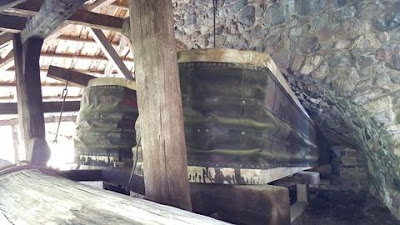
- Source-control note,
2026-05-29: this preserved image is an ironworks/bellows photograph from the blog image archive. It is not an OED screenshot and does not verify OED entry wording.
5. Notes on Access
- This is now a mixed source-control packet, not a blog-only lead packet.
- The preserved post mixes archival quotations, lexicographical context, and interpretive application to A Midsummer Night's Dream.
- The play, BHO account-book, Greene, Florio, Breton, and Boate witnesses now have direct source controls.
- The OED lane remains unchecked pending direct access.
- Web/source audit result: the bellows-mender phrase itself is verified in the play, and early records of bellows-mending are verified through BHO. The leap from Flute to blast-furnace technical knowledge remains interpretive and needs stronger sixteenth-century industrial-bellows controls.
- BRO
Doc_68is the definitely much laterD/EN/F43copy, catalogued c.1800, of an inventory representing the elder Sir Henry Neville's Billingbear household in 1592/3. It should not be cited as contemporary manuscript evidence or as industrial support; its bellows and furnace entries are transmitted household-inventory evidence only.
Source-Fact Audit — 8 August 2026 (Round 7)
Three kinds of bellows must remain separate. Flute is called “a bellows-mender” in A Midsummer Night's Dream; early occupational records show that bellows were repaired; and the c.1800 copy of the 1592/3 Billingbear inventory transmits domestic “bellowes” and a household furnace context. None of those facts by itself identifies blast-furnace machinery or specialist ironworking knowledge.
The Mayfield iron lane remains relevant because industrial bellows were essential to furnaces, but it needs a contemporary technical witness describing construction, labor, or repair before it can be joined to Flute's occupation. The comic occupation is a secure lexical fact; an industrial allusion remains an interpretation to be tested.