Lady Danvers, Henry Neville, and Richard Dollyne: the Warfield entry-fine dispute, 1610
Three Royal Berkshire Archives photographs preserve a Chancery order in which a tenant challenged a fine imposed by Sir Henry Neville. The order is important for more than the individual dispute. It shows Neville exercising prospective manorial authority while a widow, Lady Danvers, still possessed the manor; it records the tenant's claim that Neville's assessment was excessive; and it shows the Lord Chancellor ordering an evidence-based review against both the value of the land and the holding's earlier fines.
The record belongs to the Warfield tenant-dispute archive. It supplies a fourth stage after the 1606 copyhold memorandum, Neville's 1607 replevin letter, and his 1609 exposition of Warfield fines and heriots. It should therefore be read as part of a continuing argument over how Neville's claimed manorial rights operated in practice, not as an isolated lawsuit.
The archival object
The order survives in:
IMG 8467: heading, parties, prior injunction, and the tenant's objection;IMG 8468: reference to a Master, directions for valuation, stay, andIMG 8469: reverse docket and the physicalD/EN L2deposit stamp.
Laurence Washington's signature;
The Royal Berkshire Archives online catalogue places it at file level in `D/EN/L2/1/1`, “Various disputes between Sir Henry Neville and tenants of Warfield.” The file contains 27 documents dated 1577–1641. Its description says that the Staverton family supplies the principal sequence and names William Dollyn among the other tenants directly involved. The online catalogue does not expose the individual child number for this order, so D/EN/L2/1/1 is a controlled file placement rather than a claimed item-level reference.
Corrected date: Saturday 24 November 1610
The opening heading reads:
Sabb[at]o xxiiij die Novembr[is]
Anno Regni Jacobi Reg[is] Angl[ie] ffranc[ie] & Hib[er]n[ie] 8^o & Scot[ie] 44^o
The inherited transcription read xxvij, creating the date 27 November. Direct inspection of the original photograph shows xxiiij: Saturday 24 November 1610. The calendar supplies an immediate check—27 November 1610 was a Tuesday—and the official Chancery entry book supplies an independent documentary control. At the top of AALT/TNA C 33/120, `IMG 0191`, the court's heading for the same session reads Sabbato xxiiij die Novembris.
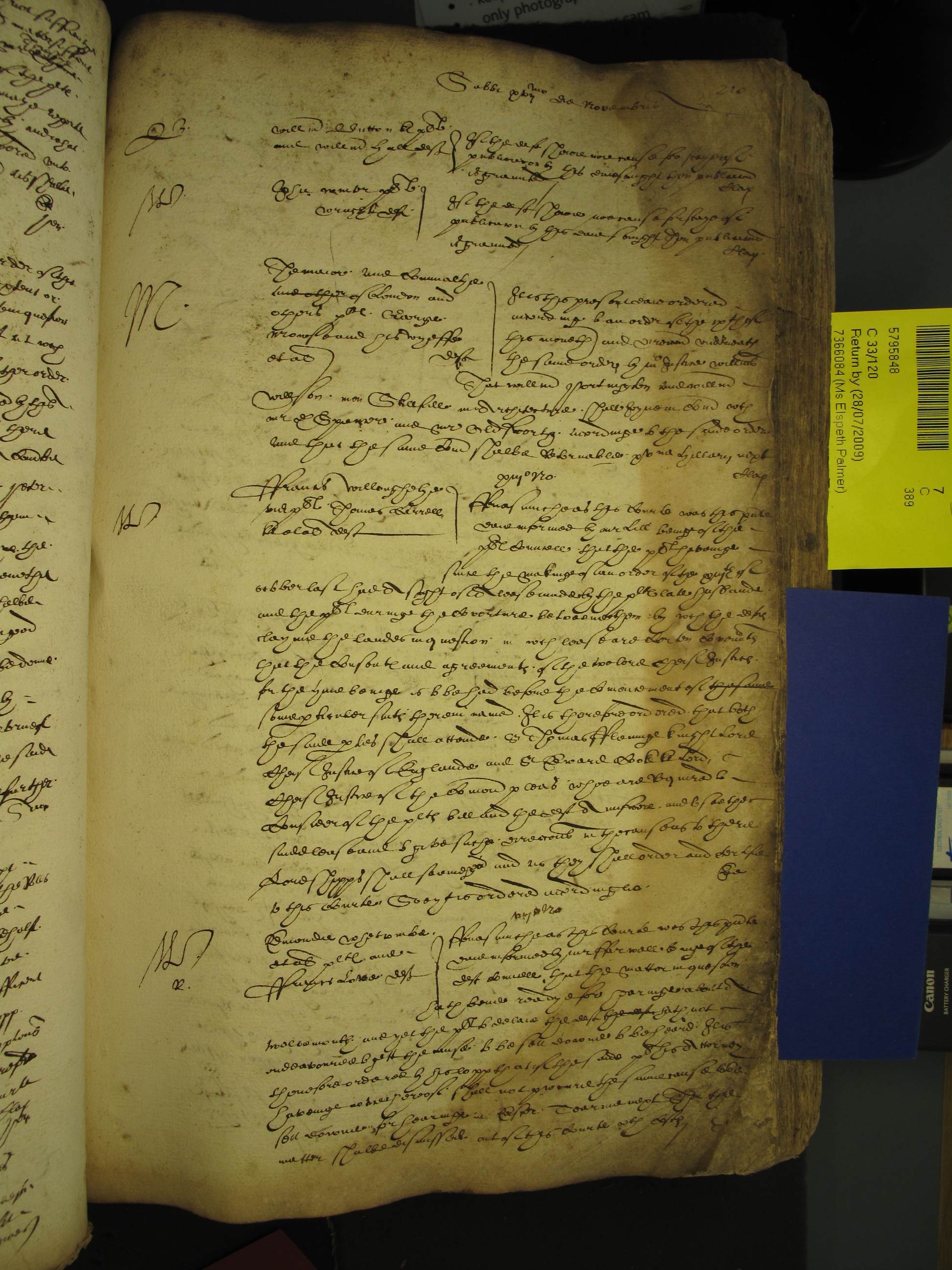
The exact Danvers–Dollyne entry has not yet been identified in that entry book. The AALT image corroborates the session heading and corrected date; it is not being claimed as a second copy of the complete order.
Parties and procedural setting
The Latin case heading identifies:
Inter Elizabetham Danuers viduam & Henricu[m] Nevill mil[item] quer[entes]
Ric[ard]um Dollyne & al[ios] def[enden]tes
In modern form, Elizabeth Danvers, widow, and Sir Henry Neville were plaintiffs; Richard Dollyne and others were defendants. The body then reconstructs two stages:
- On 4 November the court ordered an injunction against Dollyne, requiring him to
- On 24 November Dollyne's counsel challenged the amount. The Chancellor referred
pay the fine imposed upon him or show cause to the contrary.
the question to a Master and stayed contempt proceedings while the review took place.
This was not merely a private complaint delivered to Neville. It had reached the Lord Chancellor, an injunction had issued, and non-payment exposed Dollyne to process for contempt until the later order intervened.
The allegation against Neville's assessment
Mr Goldsmyth, appearing as one of the defendants' counsel, told the Chancellor that the assessment was:
a very hard and unreasonable ffyne
He supplied a specific reason for judicial caution. The fine had not been affeered by Lady Danvers:
but by the said S[ir] Henry Nevill
who is to enter into the Mannor
after the decease of the said
Lady.
Counsel asked that the amount be:
qualifyed to some easy rate.
The record therefore describes divided temporal interests. Lady Danvers possessed the manor during her life; Neville was expected to enter it after her death. Yet Neville had already imposed or assessed the fine. The word affeered is important: in manorial practice an affeerment concerned settling or moderating an amercement or financial assessment. The order itself does not explain whether Neville acted under a settlement, reversionary title, delegated authority, or some other arrangement. That title instrument is now a central research target.
The document records counsel's allegation. It does not establish that the fine was in fact unreasonable or that Neville acted unlawfully. The Chancellor ordered an inquiry rather than deciding either point on 24 November.
How Chancery proposed to test the fine
The operative passage orders Doctor Heyward, one of the court's masters, to consider:
the said ffyne, and of the value of the
lands, for the w[hi]ch the same
ffyne is to be paid, and of former
ffynes w[hi]ch haue been paid for the
same
He was to report the property's “value & nature” to the court, after which a further order would be made. Meanwhile:
all proceedinges uppon process of Contempt is stayed
The three-part test is unusually informative. The court required comparison of the present demand, the land's value, and the precedent supplied by earlier fines for the same holding. This creates several concrete archival targets: the manor court roll containing the admission, the rental or valuation, earlier admissions to the same copyhold, Heyward's report, and the final order. Any one of those records might identify the land and the legal basis of Neville's assessment.
Relationship to the other Warfield records
The order deepens a sequence already visible across the BRO papers:
| Date | Record | Contribution |
|---|---|---|
| 1606 | D/EN/F6/1/8 memorandum | A 13s 4d admission payment, best-beast heriot, small Bulbrooke and Warfield parcels, occupation without licence, and presentment by the homage. |
| 16 Mar. 1607 | Neville to Richard Staverton | “Base tenures,” an earlier open-court offer to the tenants, impounded cattle, replevin, and a proposed conference of counsel. |
| 19 July 1609 | Neville to Richard Staverton | Copyhold, a “base hold,” fines, heriots, the high lord's court, tenant oath, and competing claims to Warfield liberties. |
| 4–24 Nov. 1610 | Danvers and Neville v Dollyne | An imposed entry fine, injunction, allegation that the amount was “hard and unreasonable,” comparison with land value and former fines, and a stay of contempt. |
The four records are not evidence that one tenant or one parcel generated the entire sequence. They do establish a persistent institutional setting: Neville's Warfield lordship was contested through manor court practice, possession remedies, counsel, and central litigation over a period of at least four years.
The 1610 order also complicates any simple picture of Neville as absolute lord. His authority was temporally divided from Lady Danvers's possession, challenged by a tenant, and made reviewable by Chancery against economic and customary evidence.
People and identities still to resolve
Elizabeth Danvers
The record calls her Elizabetham Danuers viduam and the Lady Danuers. It does not name her husband, parentage, residence, or manor. Several women could answer to this name and style. She is not equated here with Elizabeth Neville, widow of Sir John Danvers and later wife of Sir Edmund Carey. A defensible identification requires a settlement or conveyance that reproduces the life-interest/reversion structure in the order.
Richard Dollyne
The Royal Berkshire Archives `wills index` records a Richard Dollin, yeoman of Warfield, in 1610 (D/A1/61/243; D/A1/15/084). This is a strong conjunction of surname, locality, and year. It remains a lead rather than an identity proof because the index also records a Richard Dollin of Wargrave in 1610, and neither abstract identifies the disputed holding. The original will and probate act should be retrieved and compared with the tenants, lands, witnesses, and debts in D/EN/L2/1/1.
Doctor Heyward
The manuscript clearly reads Doctor Heyward one of the m[aste]res of this Courte. The personal identification is unresolved. Sir John Hayward is an obvious candidate, but modern biographies ordinarily place his appointment as a Master in Chancery in 1616, six years after this order. The text is retained exactly while a contemporary office list, patent, or Chancery entry is sought; a name resemblance is not enough to override the chronological problem.
Laurence Washington
The order is signed Laur Washington, and the reverse also carries Washington. This is consistent with Laurence Washington's documented service as registrar of Chancery. His signature identifies the administrative act; it does not make him an author of the parties' allegations.
Research programme
- Search backward in
C 33/120for the 4 November injunction and forward for - Obtain an item-level RBA list or archivist's production slip for all 27 pieces in
- Retrieve both 1610 Richard Dollin probate files and compare kin, land, inventory,
- Search Warfield and Wargrave manor court rolls for the disputed admission and all
- Search Danvers, Neville, and Warfield settlements for a life estate to Elizabeth
- Identify
Mr Goldsmythfrom counsel appearances or Chancery registers. - Establish the 1610 Masters in Chancery from contemporary patents or office books
Heyward's report or final order, using parties as well as surname variants Dollyne, Dollyn, Dollin, and Dollen.
D/EN/L2/1/1; reconcile every image group with the physical order.
witnesses, and debtors with the Warfield tenant papers.
earlier fines on the same holding.
Danvers with remainder or reversion to Henry Neville.
before assigning a forename to Doctor Heyward.
Sources
- Controlled source packet:
- Royal Berkshire Archives,
- Royal Berkshire Archives,
- Anglo-American Legal Tradition / The National Archives,
C 33/120, - The National Archives,
- Victoria County History,
Doc 56 Unmapped IMG 8467.
`D/EN/L2/1/1`, “Various disputes between Sir Henry Neville and tenants of Warfield.”
wills index, Richard Dollin of Warfield and Richard Dollin of Wargrave, 1610.
Chancery equity suits after 1558.
“Parishes: Warfield”, A History of the County of Berkshire, vol. 3 (1923), pp. 184–191.
Verification record
Primary images IMG_8467, IMG_8468, and IMG_8469 were inspected directly at their original 3024 × 4032 resolution on 15 July 2026. Exact quotations above were checked line by line against those images.
Independent non-AI controls are the RBA D/EN/L2/1/1 catalogue description, the RBA probate index, and the same-day Chancery heading in AALT/TNA C 33/120. The VCH Warfield history supplies public property context but does not identify the parties.
The previous date reading xxvij / 27 November has been rejected and retained only in the private research history. The image, weekday, and official entry-book heading agree on xxiiij / 24 November. No uncertain identification of Lady Danvers, Richard Dollyne, or Doctor Heyward is promoted to fact.