Warfield copyhold administration: the 1606/1641 Bulbrooke memorandum
The 1598 freehold bargain that precedes the copyhold disputes
D/EN/F6/1/7 supplies an earlier and legally distinct Warfield transaction. On 3 December 1598, John Yonge of Poole in Warfield bargained to sell Henry Neville four freehold closes called Hermits fylde, estimated at twelve acres and priced at £12 for every acre under the statutory land measure. The bargain recites a 27 April 1595 defeasance and combines conveyance with a two-year leaseback from Midsummer at one peppercorn yearly. Neville reserved the woods and tree-felling; Yonge was not to plough.
The freehold status matters. This is a different transaction from the copyhold presentment on the 1606 Bulbrooke slip. Read together, the two papers show Neville purchasing freehold parcels through survey, staged finance, and leaseback in 1598, then administering copyhold entry, licence, heriot, and homage presentment in 1606. The full earlier transaction is documented in the Yonge bargain packet.
This small, twice-used slip opens a much larger research path into Henry Neville's Warfield administration. Its first layer records copyhold finance and a presentment in 1606. Its reverse was used again in 1641, after the ambassador's death, for a second Bulbrooke property entry. Read beside Neville's 1607 and 1609 letters to Richard Staverton, it turns a general “land dispute” into a concrete system of messuages, acreages, admittance money, heriots, licences, homage presentments, impounded cattle, replevin, fines, and competing court claims.
The physical object
The pencil shelfmark D/EN/F6/1/8 is visible on the reverse. The Royal Berkshire Archives parent record, `D/EN/F6/1`, describes 19 pieces of Sir Henry Neville's miscellaneous correspondence and memoranda, 1592–1615. The slip itself carries a clear 1606 layer and a later 1641 layer. The online parent description does not itemize /8, and its date range does not mention the later reuse. A direct request for the child URL produces the explicit catalogue message Record DEN/F/6/1/8 does not exist in this database. Thus /8 is a physical shelfmark controlled from the manuscript, not a separately exposed online record.
Six photographs document one object:
- IMG 8317: complete 1606 face;
- IMG 8318: 1641 reverse and shelfmark;
- IMG 8341 and
- IMG 8343: closer view of the 1641 text;
- IMG 8344: duplicate shelfmark view.
IMG 8342: closer views of the 1606 face;
The matching tears, folds, text blocks, and /8 mark establish that the later four frames are detail photographs, not a separate document.
The English account heading
The top of the 1606 face reads:
1 mess[uage] and 16 acres copyhold
admittance 13s 4d — heriot
best beast
The next line begins:
w[i]th the remaynder during [remainder unresolved]
It then names Robert King and Eleanor his wife. The two photographic passes agree on with the remaynder during, but the rest of the legal formula is not safely readable. It should not be silently expanded into a life-estate clause. The previous local wording “of the admittance [or surrender] of” was a false reading and is now retained only in the verification history. The financial meaning of the lines above is nevertheless direct: an admittance payment of 13s 4d and a heriot described as the best beast.
The Royal Berkshire Archives `glossary` defines a messuage as a dwelling house with its surrounding property—potentially gardens, yard, orchard, and outbuildings—and copyhold as tenure evidenced by a copy of the court roll. The National Archives' manorial-documents guide explains that copyhold transfers were made through surrender and admission in the manor court: the old tenant surrendered into the lord's hands and the next tenant was admitted, with the transaction entered on the court roll. Its companion `guide` defines a heriot as the death levy paid before an heir could take the former tenant's holding. The slip's “best beast” records the local form of that levy.
The 1606 Latin presentment
The lower block is not a polished deed. It is a compressed memorandum full of abbreviations and damaged connectors. The secure sequence is:
1606 … William Horton … two acres of land in Bulbrooke and one acre in
Westcroft and one parcel of meadow containing one and a half [acres] in
Warfield aforesaid … occupied by the said William Horton for several years
without licence and presented by the homage.
This supplies four pieces of estate information that the later correspondence alone does not:
- the dispute could concern parcels as small as one or two acres;
- arable and meadow pieces were recorded separately;
- occupation over several years did not cure the absence of manorial licence;
- the homage—tenants acting within the court—presented the breach.
The National Archives notes that manor court rolls record property transfers, occupation of land, minor disputes, agricultural regulation, and the lord's identity. That list describes the slip's working environment closely. The memorandum looks like a steward's extraction or prompt from court business rather than a tenant's formal copy of an admission.
Bulbrooke and Warfield
The manuscript spelling is Bulbrooke. The place is the Bullbrook named by the Victoria County History. The VCH Warfield history calls Bullbrook a hamlet near New Bracknell and explains that Warfield was treated as a parcel of Wargrave and generally followed the descent of Wargrave Manor. This is not a generic Berkshire place-name match: it puts the acreage inside the precise manor-and-parish complex administered through the Neville papers.
Westcroft has not yet been tied to a surviving map. It may have been a field-name or small close rather than a settlement. The best next controls are the Warfield estate maps, court rolls, rentals, and the 1843 tithe map, searched for both Westcroft and spelling variants.
The 1641 reuse
The reverse is headed 1641. Its clearest words read:
Alice Lambert, wife of George Lambert, daughter of James Daniell, formerly
deceased … houses and lands … of Bulbrooke …
The final lines refer to tenure and the lord's hand or rent, but glare, abrasion, and abbreviation prevent a defensible continuous transcription. The public reading stops at the secure wording.
The date matters. The VCH says Edward Staverton, the last male heir of his line, died in 1639. His niece Elizabeth, daughter of his predeceased brother Richard, succeeded and married Henry Neville, brother of the then lord of Warfield. The VCH describes the Staverton holding as a copyhold estate of Warfield Manor and says that the younger Henry Neville faced a heavy fine on succeeding to it. The 1641 Lambert entry is not Elizabeth Staverton's admission and should not be confused with it. It does show that Bulbrooke copyhold business was still being written onto an older estate memorandum at exactly the moment when the Staverton succession was reshaping the wider family archive.
That younger Henry Neville was the later author of Plato Redivivus. The slip thus bridges two generations of the Neville estate papers: the ambassador's active Warfield administration in 1606 and the younger family's copyhold world in 1641.
The 1606–1607 Neville–Staverton sequence
On 16 March 1607 Neville wrote to Mr Staverton about “the base tenures.” He said that the same proposal for a conference of counsel was one he had offered “almost a yeare since in open court, to the Tenants.” He refused to release cattle except upon a replevin, promised to stay the suit once replevin was brought, and nominated the first four days of the next term for counsel to meet.
The dating points back to approximately spring 1606—the date on this slip. The institutional vocabulary also overlaps: tenants, open court, customary holdings, licence, presentment, and the enforcement of the lord's claimed right. This makes the slip a strong guide to what Neville meant by the “base tenures.” It does not prove that Robert King, William Horton, or their parcels were the subject of the cattle dispute. No person named on the slip appears in the 1607 letter.
By 19 July 1609 Neville's next surviving long letter to Richard Staverton makes the system explicit. He calls Staverton a copyholder, discusses a “base hold,” the high lord's court, fines, heriots, and the tenant's oath to maintain the lord's rights. The complete bifolium has now been directly checked across IMG_8461-8464, with the available IMG_0289-0291 duplicates checked separately. The contemporary address names Richard Staverton at New Lodge, and the D/EN L2 stamp places the letter in the same Warfield-dispute series as the 1610 Chancery order.
The exact copyhold warning reads:
you are a Copyholder of that manor, and sworne to maintaine all the lawfull
rightes that belong unto the lord.
The cost argument connects the particular dispute to the economics of tenure:
you loose nothing but your fines, which are small and certaine, and your
heriottes.
Neville then contrasts those small certain incidents with the superior court:
you must fine for them and your owne both, and must know that your
[fine]s are arbitrary and not certaine.
The beginning of [fine]s is lost at a physical hole. The reading is controlled by the surviving final s, the repeated fine and fines immediately before it, and the explicit contrast between small certain fines and arbitrary uncertain fines. The older unidentified expansion should not be used.
The letter also names Doughty's assize, a base hold made in the high Court, and new encroachments undertaken Lite pendente. These are precise search terms for the other 27 papers in D/EN/L2/1/1, the manor-court records, and central common- law proceedings. The dedicated free-chase and Staverton packet sets the copyhold dispute inside Neville's larger claim to a Winchester-derived jurisdiction exempt from ordinary forest officers.
The three documents, followed by a Chancery order of 1610, establish a sequence:
| Date | Record | What it adds |
|---|---|---|
| 1606 | D/EN/F6/1/8 memorandum | acreages, admission payment, best-beast heriot, unlicensed occupation, homage presentment |
| 16 Mar. 1607 | Neville to Staverton | earlier open-court offer, impounded cattle, replevin, counsel, trial timetable, pound |
| 19 July 1609 | Neville to Richard Staverton | copyholder status, base hold, competing courts, fines, heriots, oath, and wider Warfield jurisdiction |
| 4–24 Nov. 1610 | Danvers and Neville v Dollyne | entry fine, injunction, tenant challenge, land valuation, comparison with former fines, and stay of contempt |
This is not one event documented four times. It is a developing conflict whose administrative machinery can now be reconstructed from several kinds of record.
The 1610 Danvers–Dollyne Chancery review
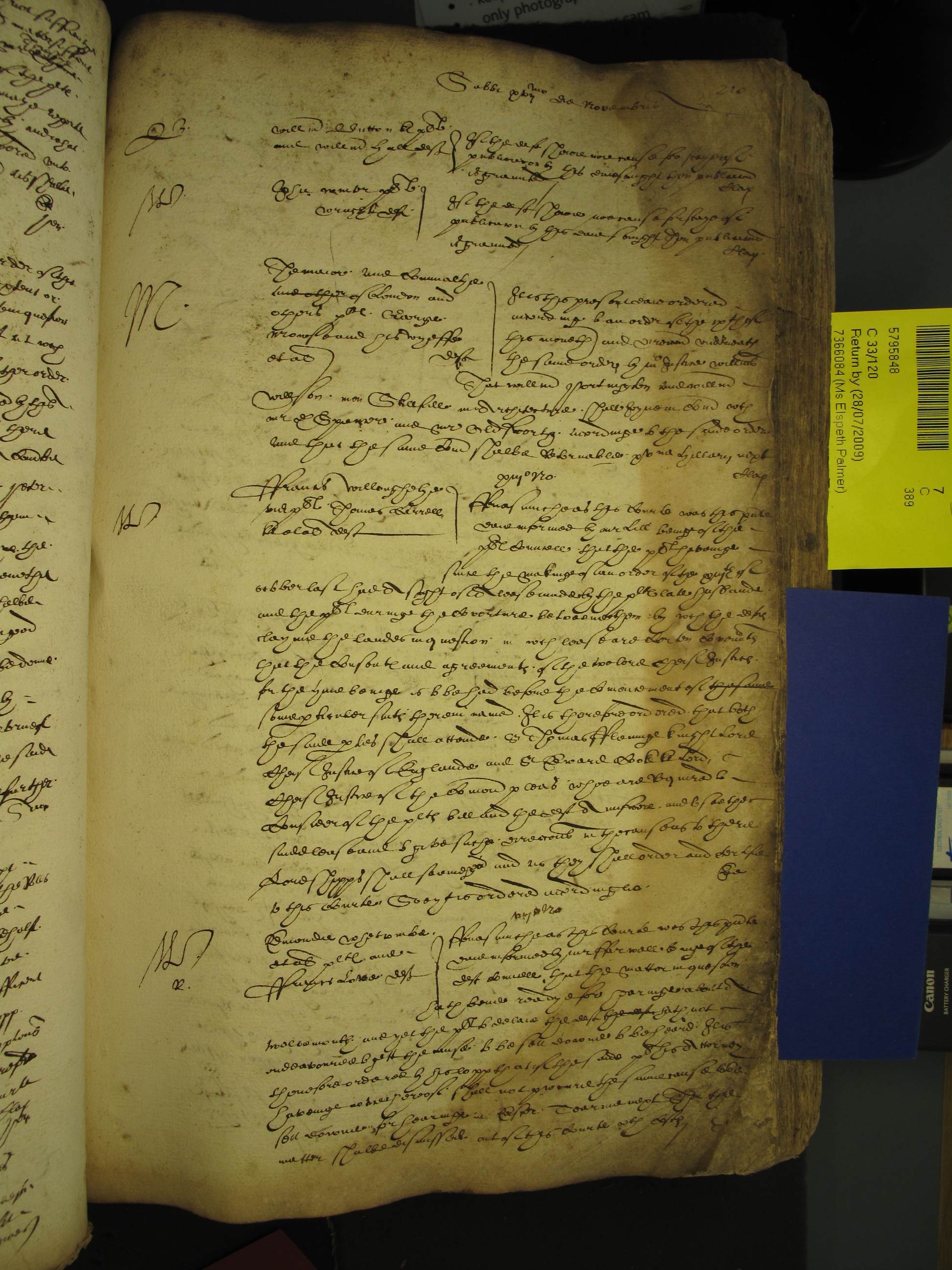
The three photographs grouped as Doc_56 extend the sequence into central equity litigation. The order is dated Saturday 24 November 1610, not 27 November as the inherited transcription stated. The manuscript heading reads Sabbato xxiiij die Novembris; the same session heading is independently preserved in AALT/TNA C 33/120, IMG_0191.
Elizabeth Danvers, widow, and Sir Henry Neville were plaintiffs against Richard Dollyne and others. An earlier order of 4 November had required Dollyne to pay the fine imposed upon him or show cause. On 24 November his counsel described it as:
a very hard and unreasonable ffyne
Counsel said the fine had not been affeered by Lady Danvers:
but by the said S[ir] Henry Nevill
who is to enter into the Mannor
after the decease of the said
Lady.
This reveals a divided temporal interest: Lady Danvers held the manor during her life, while Neville expected to enter after her death. It does not yet identify the settlement, manor, or Lady Danvers. The D/EN L2 stamp, file placement among the Warfield tenant disputes, and an RBA probate entry for Richard Dollin of Warfield in 1610 make Warfield the controlled context, while the exact personal identities and holding remain open.
The Lord Chancellor directed Doctor Heyward to consider the fine, the land's value, and former ffynes paid for the same holding. All contempt proceedings were stayed pending his report. The order therefore gives a concrete measure of reasonableness: current land value and customary precedent could both be tested against the lord's demand. It also shows a limit on Neville's practical authority—his assessment was challengeable in Chancery and temporarily unenforceable while evidence was gathered.
The complete controlled transcription, identity cautions, and retrieval plan are in the dedicated Danvers–Dollyne topic.
Genealogical and record searches
The Royal Berkshire Archives parish-register guide shows major gaps in the Warfield registers over this period but lists bishop's transcripts for christenings, marriages, and burials from 1607 to 1778. Those transcripts are the best immediate route for testing the King, Horton, Lambert, and Daniell households. They begin one year too late to control the 1606 entry directly but cover the 1641 layer.
The printed Index to Wills Proved and Administrations Granted in the Court of the Archdeacon of Berks, 1508–1652, checked through its `Archive.org witness`, contains no Warfield probate entry under Lambert, Daniell/Danyell, Horton, or Robert King that provides a direct match. That does not remove the families from the manor: the index only records surviving/proved probate in that jurisdiction. The live Royal Berkshire Archives index does independently preserve a useful locality control: Stephen Boyer, a Warfield yeoman, is entered in 1605 at Bowebroucle [Bullbrook?], references D/A1/41/195 and D/A1/14/065.
New research programme
- Retrieve the Warfield bishop's transcripts, 1607–1641. Search every spelling
- Search the remaining 27
D/EN/L2/1/1papers. The catalogue says this file is - Locate the 1606 Warfield court roll. The slip's
presented by the homage - Search common-law replevin records. Neville's insistence that the cattle be
- Map Westcroft and the 1641 lane/locality. Collate estate maps, rentals, the
- Reconstruct the 1639–1641 succession. Compare Edward Staverton's will,
- Reconstruct the 1610 fine proceeding. Locate the 4 November injunction,
of King/Kynge, Horton/Horten, Lambert/Lamberte, and Daniell/Danyell, recording complete households and witnesses rather than isolated name hits.
chiefly about Neville–Staverton tenant disputes and spans 1577–1641. The open-court offer, the missing previous letter, and the replevin may survive inside it.
formula implies a fuller court record from which the memorandum was extracted.
delivered only after replevin should have produced a writ, declaration, or county proceeding independent of the family archive.
1843 tithe award, and later field-name surveys. Do not normalize the indistinct 1641 word until a map supplies a controlled match.
Elizabeth Staverton's admission and fine, the Lambert entry, and the later Henry Neville petition. This may explain why the old 1606 slip was reused and retained.
Heyward report, and final order in C 33/120; obtain Richard Dollin's Warfield probate packet; and identify the settlement behind Lady Danvers's life interest and Neville's succeeding interest.
Sources
- Royal Berkshire Archives,
- Source-control packet:
- The National Archives,
- Royal Berkshire Archives,
- Victoria County History, [“Parishes:
- *Index to Wills Proved and Administrations Granted in the Court of the Archdeacon
- Related controlled letter topic: [Neville and the Warfield base-tenures dispute,
- Danvers and Neville v Dollyne, 24 November 1610,
- Royal Berkshire Archives,
- AALT/TNA
C 33/120,
`D/EN/F6/1`, parent catalogue record.
Doc 22e D EN F6 1 8.
Manorial documents and lordships and guide to manorial documents.
parish-register holdings for Warfield and wills index.
Warfield”](https://www.british-history.ac.uk/vch/berks/vol3/pp184-191), A History of the County of Berkshire, vol. 3 (1923), pp. 184–191.
of Berks, 1508–1652*, Internet Archive.
16 March 1607]([local source path removed]).
dedicated controlled topic and source analysis.
`D/EN/L2/1/1`, Warfield tenant-dispute file.
`IMG 0191`, 24 November session heading.
Verification record
Primary images checked: IMG_8317, IMG_8318, detail/duplicate captures IMG_8341–IMG_8344, and the three 1610 Chancery-order frames IMG_8467–IMG_8469, directly at original resolution.
Independent non-AI controls: physical D/EN/F6/1/8 mark; Royal Berkshire Archives parent catalogue; RBA D/EN/L2/1/1 file catalogue; RBA parish-register and probate catalogues; AALT/TNA C 33/120; TNA manorial-records guidance; VCH/BHO Warfield history; printed Berkshire probate index. The parent record and the explicit CALMView non-record response for /8 were saved in the dated research pass.
Existing local text compared: prior Doc_22e, Doc_23, image-grouping records, and the two Staverton letter packets.
Decisive image locations: 1606 heading and Latin fragments on IMG_8317 with IMG_8341–8342; 1641 text and shelfmark on IMG_8318 with IMG_8343–8344.
Conflicting prior readings: the English line before Robert and Eleanor King was formerly expanded as “of the admittance [or surrender] of.” Direct comparison of all six images establishes w[i]th the remaynder during but not the words that complete the clause. The 1610 order's date was formerly xxvij / 27 November. The manuscript, weekday, and official Chancery session heading establish xxiiij / 24 November. The rejected reading remains only in the private research history; uncertain final wording on the 1641 slip remains omitted.
Remaining uncertainty: the scribe; words completing the remainder formula; full syntax of both Latin blocks; the final 1641 locality; external identification of the named tenants; exact relationship between the 1606 presentment and Neville's open-court recollection.
Status: primary_image_and_independent_control for the object, dates, shelfmark, secure fragments, and Warfield context; attribution remains unresolved.
Verified by/date: Codex, 15 July 2026.