Merchant of Venice Tweet Alignments
Topic: Merchant of Venice Tweet Alignments
Source-Fact Audit — 7 August 2026 (Round 2)
The source layers must be kept separate. In the current canonical Neville Letters Corpus v17 Enriched, the normalized token text of letter_109 reads would infinitely entangle the poor remnant of my estate. John O'Donnell's controlling diplomatic transcription of the 18 April 1602 letter to Robert Cecil instead preserves the manuscript spelling:
which though I should obtaine yt at my freends hands would **infinitely
intangle** the poore remnant of my estate, with counterassurances to them.
The manuscript page visually supports intangle; it is linked below. Thus the tweet's infinitely entangled is exact in neither layer: it changes the base verb after would to the participial form entangled, while the XML also regularizes intangle to entangle and poore to poor.
Letter 44 separately reports the French king:
acknowledging himselfe infinitely beholden to her
Folger's Merchant of Venice has Bassanio say:
BASSANIO
I thank you, madam. Give welcome to my friend.
This is the man, this is Antonio,
To whom I am so infinitely bound.
These quotations document three related constructions with different grammar, speakers, and situations. The French king—not Neville—is beholden; Neville says counter-assurances would intangle the remnant of his estate; Bassanio is bound to Antonio. The pre-1601 EarlyPrint controls already recorded below show that infinitely bound was available in other print. This is therefore a factual phrase-family comparison, not a rarity or source conclusion. Public play text: Folger, 5.1.
Source-Control Position
- The historical check used the then-canonical Neville Letters Corpus v17 Enriched and its controlling witnesses. The v17 normalized token layer has
would infinitely entangle the poor remnant of my estateinletter_109(1602-04-18); O'Donnell's diplomatic transcription and the manuscript image preservewould infinitely intangle the poore remnant of my estate. The tweet'sinfinitely entangledis not an exact quotation from either layer. Corpus-wide counts require a v22 rerun, but the witness-controlled wording does not depend on that rerun. Infinitely beholdenappears in the v17 normalized text ofletter_044(1600-01-03). Winwood, p. 142, printsacknowledging himselfe infinitely beholden to her: Neville is reporting the French king's words about Elizabeth, not describing himself.- Checked EarlyPrint/TCP:
A68727(1600Merchant of Venice) andA11981(1619) both preserve Bassanio'sto whom I am so infinitely bound. - Local FTS exact phrase checks returned
infinitely tiedinA11954(First Folio Cymbeline) andinfinitely boundin multiple EEBO texts includingA68727. That means the current rarity claim is not yet hardened; it needs a defined proximity window and semantic bucket (bound,tied,beholden,entangled) before use. - BRO sweep found no direct Merchant/Neville phrase witness.
Status-Control Position
- Promoted from draft lead to source-map packet because
letter_044,A68727, andA11981now give concrete control points. - Do not cite
infinitely entangledas a Neville phrase until a witness is found, and do not repeat the rarity claim without a saved EarlyPrint/EEBO search method and results table.
1. Verified Sourced Facts and Quoted Source Passages
The “infinitely + bound/tied” construction in Shakespeare
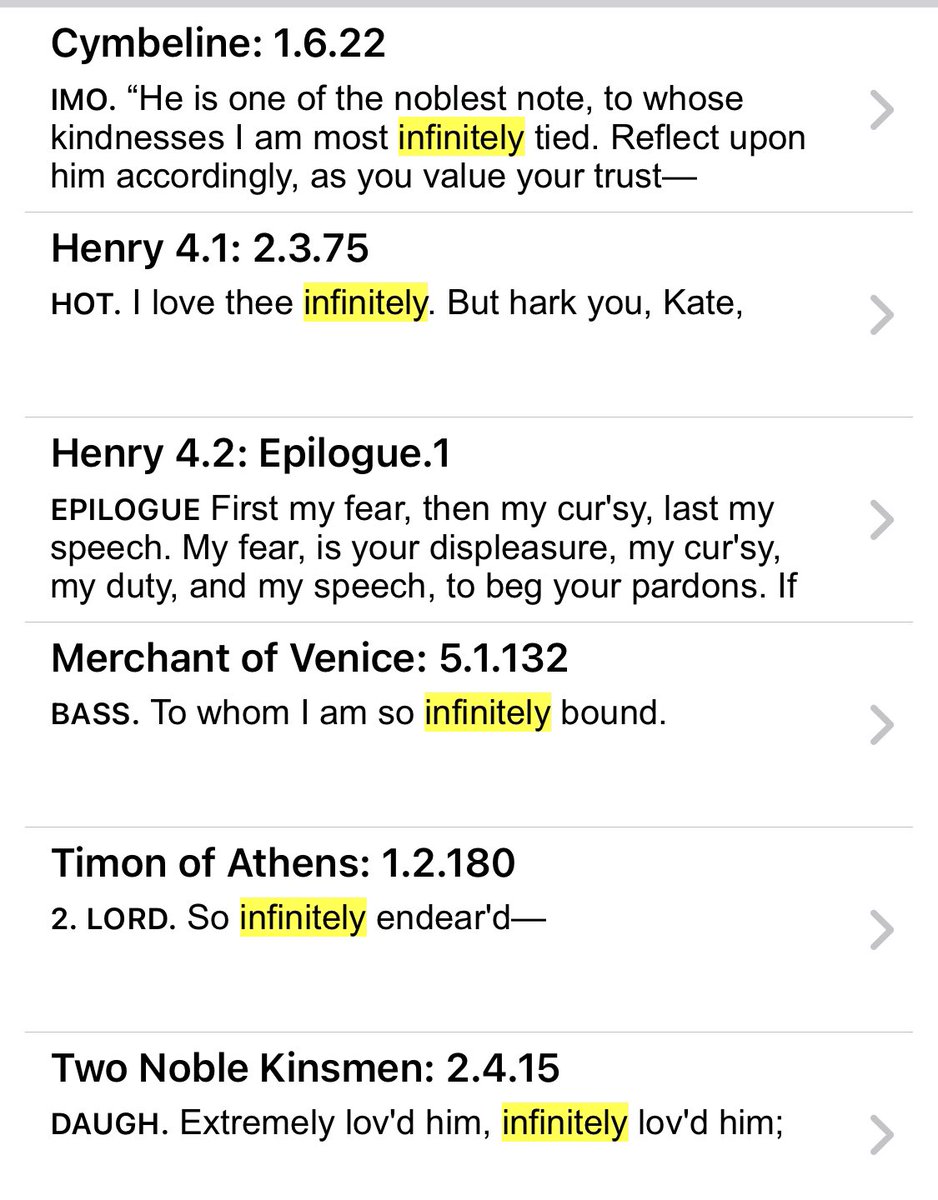
The images attached to this tweet show a concordance search for “infinitely” across Shakespeare's works. The directly visible examples are:
- Merchant of Venice 5.1.132: “BASS. To whom I am so infinitely bound.”
- Cymbeline 1.6.22: “He is one of the noblest note, to whose kindnesses I am most infinitely tied.”
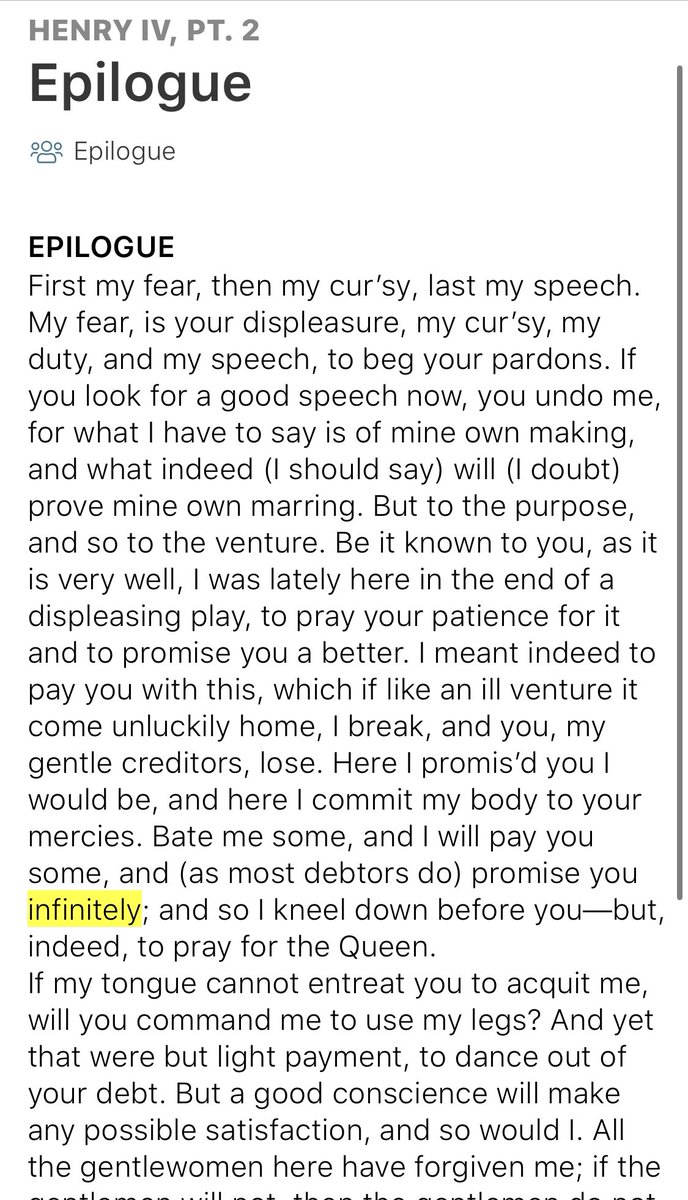
- Henry IV, Part 2, Epilogue: “...and I commit my body to your mercies. Bate me some, and (as most debtors do) promise you infinitely, and so I kneel down before you—“
- Timon of Athens 1.2.180: “So infinitely endear'd—“
- Two Noble Kinsmen 2.4.15: “Extremely lov'd him, infinitely lov'd him”
- Henry IV, Part 1, 2.3.75: “I love thee infinitely.”
The two uses with binding/tying words — Merchant of Venice (“infinitely bound”) and Cymbeline (“infinitely tied”) — are the constructions highlighted by Feinstein as distinctive.
Neville's usage
Feinstein's tweet proposes two parallel constructions in Neville's letters:
- “infinitely entangled”
- “infinitely beholden”
Current source control updates this: infinitely beholden is verified in letter_044; infinitely entangled should not be cited as an exact Neville phrase. The v17 normalized wording in letter_109 is would infinitely entangle the poor remnant of my estate; O'Donnell's diplomatic transcription and the manuscript image preserve would infinitely intangle the poore remnant of my estate.
2. Ken Feinstein Twitter and Blog Information
2 Oct. 2021
- Preserve the following as tweet wording, not as current source-controlled conclusion.
- “There are very few examples in EEBO of the word infinitely followed by a word meaning tied or bound.”
- “Shakespeare does this twice.”
- “Merchant of Venice and Cymbeline among other uses.”
- “Henry Neville does it twice.”
- “infinitely entangled”
- “infinitely beholden”
3. Citations
- Feinstein, Ken. Tweet, 2 Oct. 2021, https://twitter.com/user/status/1444327541536219140. Local preservation: twitter Merchant of Venice.
- play cymbeline, related play packet.
4. Notes on Access
- The Shakespeare-side quotations are now extracted from the tweet images and confirmed against the play texts (MV 5.1.132; Cym. 1.6.22).
- The Neville-side phrase
infinitely beholdenis verified inletter_044. The tweet'sinfinitely entangledis not exact: v17 has normalizedinfinitely entangle, while the diplomatic transcript and manuscript haveinfinitely intangle. - A direct
Play: Merchant of Venicepacket does not yet exist in the corpus. - The EEBO frequency claim ("very few examples") remains a Feinstein assertion; it would benefit from an independent EEBO/EEBO-TCP search for "infinitely" + "bound/tied/beholden/entangled."
2026-07-14 Deep-Research Update: printed witness and corpus correction
The printed Winwood witness has now been inspected directly at page-image resolution. Page 142 reads:
acknowledging himselfe infinitely beholden to her, and that he would ever remaine her Serviteur.
This is Neville's report of the French king's response after Neville pressed the queen's financial and diplomatic claims. It is not Neville calling himself beholden.
Folger's play text reads:
BASSANIO
I thank you, madam. Give welcome to my friend.
This is the man, this is Antonio,
To whom I am so infinitely bound.
PORTIA
You should in all sense be much bound to him,
For, as I hear, he was much bound for you.
A pre-1601 exact EarlyPrint surface search finds six works containing "infinitely bound": TCP A03893 (1588), A12229 (1590), A07683 (1597), A06447 (1598), A08550 (1598), and Merchant Q1, A68727 (1600). The construction was therefore available in print and is not a rare exact match. The closest functional comparator is A03893, a French political tract in which a king is "infinitely bound" to a woman for assistance in gaining his crown.
The passages document different constructions and contexts: Neville reports a king as "infinitely beholden" to Elizabeth in diplomatic prose; Bassanio says he is "infinitely bound" to Antonio and Portia immediately turns "bound" into a debt/surety pun. The tweet's "infinitely entangled" should be replaced in statements of fact with the appropriate source layer: normalized v17 infinitely entangle, or diplomatic/manuscript infinitely intangle.
Sources: Sir_Henry_Nevill_to_[Sir Rober 1602 page 1; page 127; act 05 scene 01; EarlyPrint computational index.
5. image witnesses
Book Integration Update — 2026-08-31
- Chapter 33 gives the principal plots to Il Pecorone, the casket tradition, and The Orator before assessing Neville evidence.
- The retained Neville relation is occupational: debt and restitution, bonds and counter-assurances, prizes and seizures, treaty obligations, court pleading, trade, ports, and impositions correspond to the play's legal-commercial machinery.
- Chronology limits the inference because the densest surviving French embassy record is later than the probable play.
Infinitely boundis demoted: Neville's phrases are semantic neighbors, not exact matches, and the phrase occurs in other pre-1601 print.- Marc'Antonio Pigafetta is kept distinct from Neville's documented acquaintance Filippo Pigafetta.