Lady Anne Clifford, Samuel Daniel, and the Neville-Herbert-Sonnets Network
Topic: Lady Anne Clifford, Samuel Daniel, and the Neville-Herbert-Sonnets Network
Book-integration update — 31 August 2026
Chapter 40 now keeps the three identities compactly distinct: Abergavenny's “Uncle Nevil,” the Billingbear daughter-in-law who entered Clifford's closet in 1617, and “little Sir Harry Neville,” who dined with Clifford and returned to Penshurst in 1619. It also preserves Moll Neville's readings of The Faerie Queene and Arcadia without assigning her to the Billingbear branch, and places Clifford's 1630 Herbert marriage in the later afterlife of the network.
Source-Fact Audit — 30 August 2026 (Round 4: Branch Clarification)
- Lady Anne Clifford's diary entries are direct evidence for the named people, visits, reading, and household events actually recorded there. They do not automatically identify every abbreviated Mary, Moll, Neville, or Herbert.
- Three entries must be kept distinct: Clifford's
Uncle Nevilis the Abergavenny/Sackville Sir Henry Neville;Sir H. Nevill's ladyis the wife of Henry Neville III of Billingbear; andlittle Sir Harry Nevilleis Henry Neville III, the Billingbear diplomat's eldest son. - The Billingbear identifications were explicitly preserved in the project's
14 November 2020correction thread. They are not to be overturned merely because the same diary also contains Abergavenny Nevilles. - Samuel Daniel's service and literary relations must be controlled independently from Neville-family diary appearances. Their presence in one social field does not prove that a particular sonnet moved through that field.
- CELM's Daniel record
DaS 58is a manuscript-catalogue fact. It supplies a repository and witness route, not a Neville correspondence claim. - Daniel's printed Pastor Fido material and Lady Anne's diary entries are different objects and are now quoted under separate source headings.
- Unresolved personal identifications remain visibly unresolved; a network edge is not created solely by matching a first name or family name.
CELM Control for Samuel Daniel's Correspondence
- Source: CELM, Catalogue of English Literary Manuscripts 1450–1700, Samuel Daniel author page, accessed
2026-08-03. - Primary route: `*DaS 58`.
- Finding: CELM records an autograph letter signed by Samuel Daniel to Robert Cecil, Viscount Cranborne, dated
[1605], at Hatfield House, Cecil Papers191/123; CELM notes its edition in Sellers, p.51. - Wider correspondence context: CELM groups eight Daniel letters. Named catalogue routes include
DaS 55andDaS 56to Sir Francis Walsingham (c. March 1586, TNASP 78/13/87bis; and20 May 1586, TNASP 78/15/140),DaS 57to Thomas Egerton ([1601/2], Sutherland collection),DaS 59to Charles Blount (1605, TNASP 14/11/4), andDaS 60–61to James Kirton (1608, Longleat). These should be treated as catalogue leads until the records and texts are separately checked. - Use in book:
DaS 58supplies a direct Cecil correspondence route for Daniel and can be tested against the Clifford–Herbert–Dymoke–Neville network already mapped in this topic. - Confidence: High for the CELM catalogue description and autograph status of
DaS 58; no manuscript image was inspected in this pass. - Next retrieval: Obtain the Hatfield image or Sellers transcription, then search the full eight-letter group for Clifford, Herbert, Neville, Dymoke, Waterson, and related patronage terms.
- Identity guardrail: No CELM record checked here is a Daniel letter to a Neville. Network proximity must not be converted into personal transmission of poems or manuscripts.
Samuel Daniel and the 1602 English Pastor Fido
Daniel's literary-network role now includes a direct printed contribution to Guarini's English reception. The anonymous 1602 Il pastor fido: or The faithfull shepheard, printed by Thomas Creede for Simon Waterson, opens with Daniel's commendatory sonnet to Sir Edward Dymoke. Daniel says that through the translator's hand Guarini comes to light and now speaks English.
This fact should remain distinct from Daniel's later Clifford and Herbert relationships, but it enlarges the documented field: Daniel participated directly in presenting Italian pastoral tragicomedy to English readers. The Dymoke dedication also connects independently with Neville's circle because Dymoke's aunt Frances was the wife of Thomas Windebank. See guarini pastor fido billingbear winters tale tragicomedy.
Source-Control Verdict
This is now a source-controlled network packet, but the network is narrower and more interesting than the inherited Twitter formulation.
Direct sources establish that Lady Anne Clifford was educated by Samuel Daniel; Daniel had earlier served as tutor to William Herbert; Clifford's diary repeatedly places people named Neville in her household and travelling company in 1616-1619; and one Moll Neville read The Faerie Queene and the Arcadia aloud to her. The diary's editorial note identifies Uncle Nevil as Sir Henry Neville of the Abergavenny branch, husband of Mary Sackville. Separate entries record visits by the Billingbear diplomat's family: his daughter-in-law, the wife of Henry Neville III, on 15 December 1617, and his son Henry Neville III—little Sir Harry Neville—on 29 October 1619.
These facts document both a Clifford–Sackville–Abergavenny kinship field and direct social contact with the next generation of the Billingbear family. They do not prove that the Billingbear family supplied Shakespeare's Sonnets, that Daniel transmitted texts between the households, or that Clifford's later marriage to Philip Herbert explains the 1609 Sonnets or 1623 First Folio.
Quoted Source Passages from the Direct Diary Evidence
1.1 Mary Neville in Clifford's Coach
- Source: Lady Anne Clifford, Diary, ed. V. Sackville-West (1923), printed p.
18, document witnesses page90; Lady Anne Clifford Diary 1923 IA. - Quotation:
"Upon the 8th day of February I came to London, my Lord Bishop of St. David's riding with me in the coach and Mary Neville."
- What it proves: A Mary Neville travelled in Clifford's immediate company in February 1616.
- Limit: The 1923 text does not identify this Mary at the point of mention;
Mary Nevilleshould not be silently converted into a Billingbear identity.
1.2 Cecily Neville in the Sackville Household Circle
- Source: same diary, May-June 1616, document witnesses pages
101,108, and110. - Representative quotation:
"Upon the 15th my Lord came down from London and my Coz. Cecily Neville"
- Editorial control: a nearby note identifies Cecily as daughter of Lady Abergavenny, who was sister to Robert, Earl of Dorset.
- What it proves: Cecily's Neville identity is embedded in the Sackville/Abergavenny kinship network, not an unexplained casual surname hit.
- Limit: The diary's compressed kinship language and the 1923 editor's notes should be checked against a modern pedigree before every degree of relationship is narrated.
1.3 Sir Henry Neville in the Vaux/Sackville Company
- Source: same diary,
27 May 1616, document witnesses page105. - Quotation:
"My Lord Vaux and his Uncle Sir Henry Neville and divers others came with him"
- What it proves: A Sir Henry Neville appears in the immediate aristocratic company surrounding Clifford's husband.
- Limit: Several contemporary men shared the name. The phrase alone does not establish the Billingbear Sir Henry Neville III.
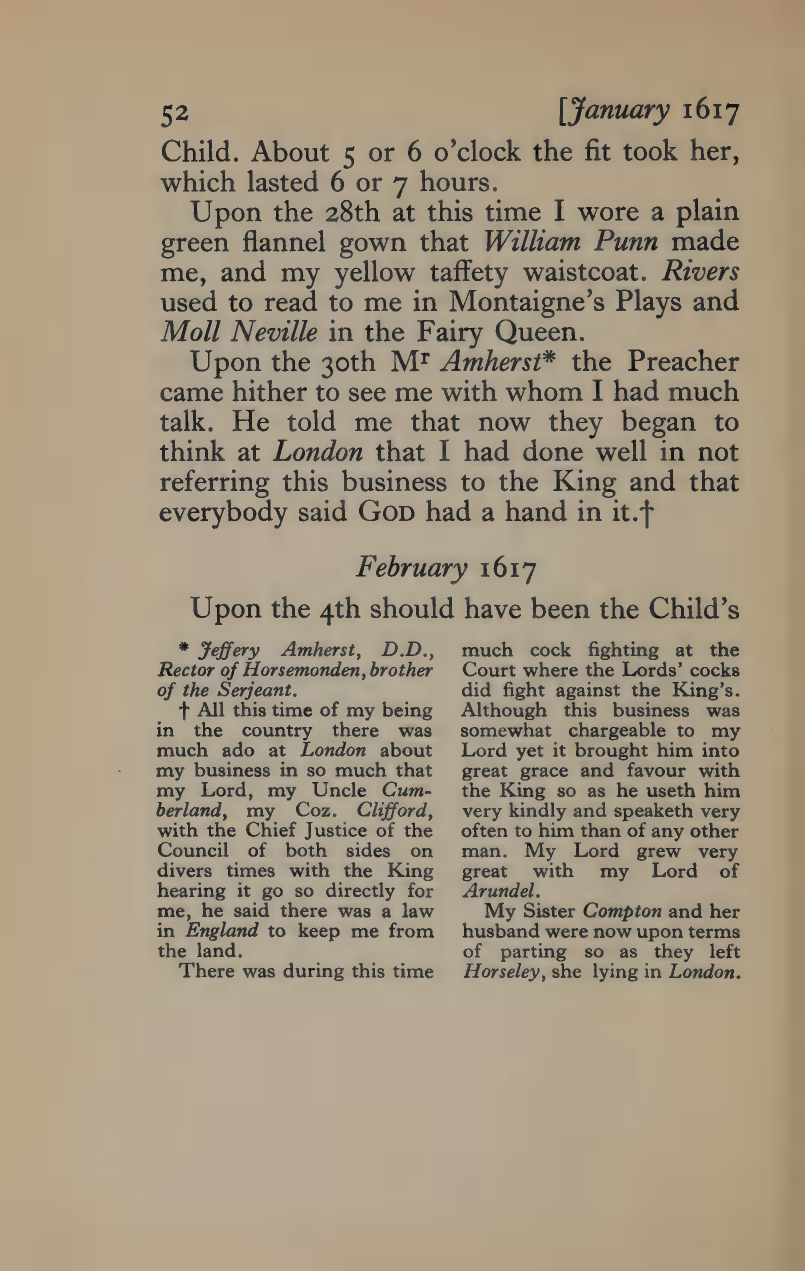
1.4 Moll Neville Reads The Faerie Queene
- Source: same diary, printed p.
52, document witnesses page126; Lady Anne Clifford Diary 1923 pdfpage 126. - Quotation:
"Rivers used to read to me in Montaigne's Plays and Moll Neville in the Fairy Queen."
- What it proves: A woman called Moll Neville participated directly in Clifford's reading culture, reading Spenser aloud while another reader supplied Montaigne.
- Why it matters: This is concrete evidence of literary practice—named reader, named book, named household—not merely a genealogical adjacency.
- Limit:
Montaigne's Playsis the wording of the 1923 edition and should not be normalized into a precise modern title without checking the manuscript/editorial apparatus.
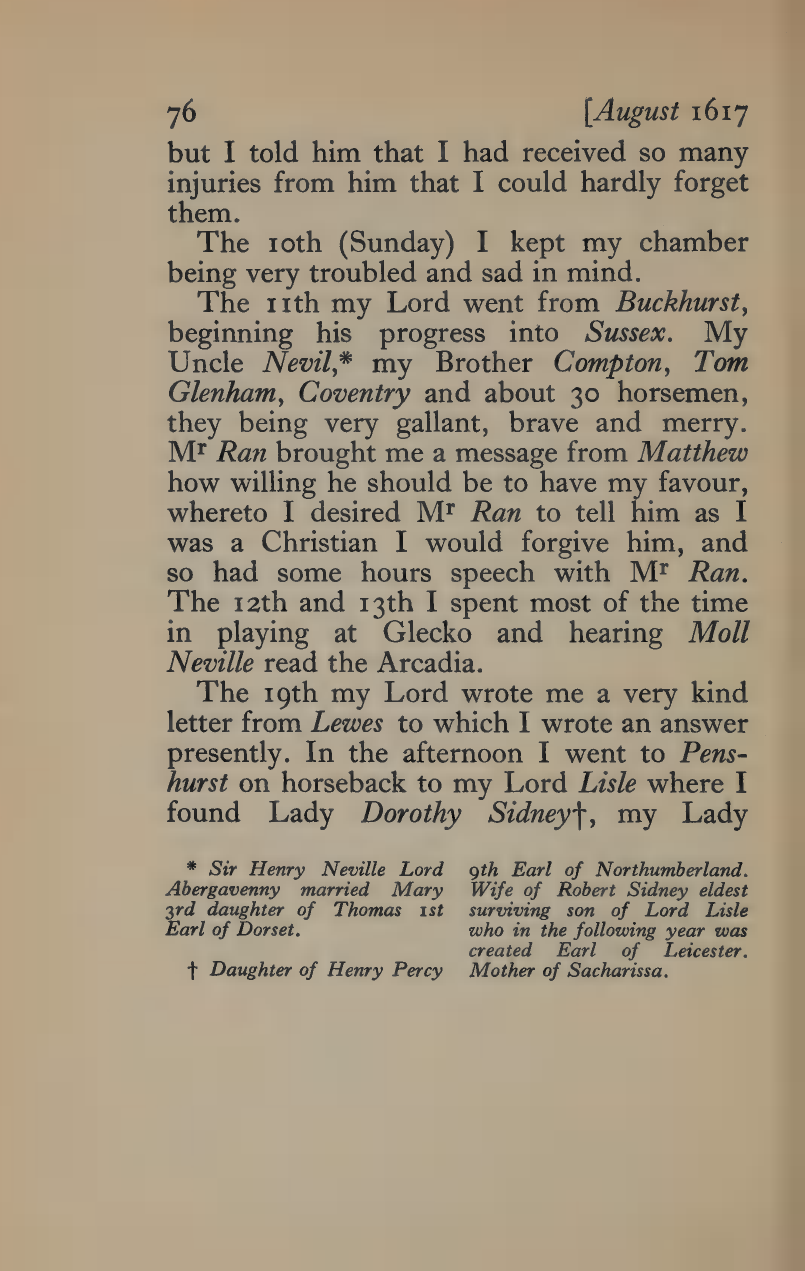
1.5 Moll Neville Reads the Arcadia
- Source: same diary,
12-13 August 1617, printed p.76, document witnesses page152; Lady Anne Clifford Diary 1923 pdfpage 152. - Quotation:
"The 12th and 13th I spent most of the time in playing at Glecko and hearing Moll Neville read the Arcadia."
- What it proves: Moll Neville also read Sidney's Arcadia to Clifford. Together with The Faerie Queene, this places her in an identifiable English literary canon and oral-reading practice.
- Limit: The entry does not identify which edition or copy of the Arcadia was used.
1.6 Uncle Nevil Is Editorially Identified with Abergavenny
- Source: same diary,
11 August 1617, printed p.76, document witnesses page152. - Quotation:
"My Uncle Nevil, my Brother Compton, Tom Glenham, Coventry and about 30 horsemen"
- The 1923 editor's footnote identifies him as:
"Sir Henry Neville Lord Abergavenny married Mary 3rd daughter of Thomas 1st Earl of Dorset."
- What it proves: At least this prominent Neville contact belongs to the Abergavenny/Sackville branch.
- Consequence: This
Uncle Nevilmust never be identified as the Billingbear diplomat or his son. It is a separate entry from Clifford's visits with the Billingbear son and daughter-in-law.
1.7 The Billingbear Daughter-in-Law Visits Clifford
- Source: same diary,
15 December 1617, printed p.82, Archive leafn158, document witnesses page158; Archive.org page image. - Quotation:
"The 15th came Sir H. Nevill's lady, I carried her up to my closet and shewed her all my things and gave her a pair of Spanish leather gloves."
- Identification: The project's contemporary
14 November 2020correction identifies this woman as the wife of Sir Henry Neville III of Billingbear, the diplomat's eldest son. Independent Billingbear family control identifies that wife as Elizabeth Smythe, whom Henry III married in1609. The diary entry itself gives only the relational formSir H. Nevill's lady, not her forename. - What it proves: Lady Anne received the Billingbear diplomat's daughter-in-law privately, showed her the objects in her closet, and gave her Spanish leather gloves.
- Branch guardrail: This woman is not Mary Sackville Neville, Lady Abergavenny. The Abergavenny peer's wife belongs to the separately identified
Uncle Nevilkinship lane.
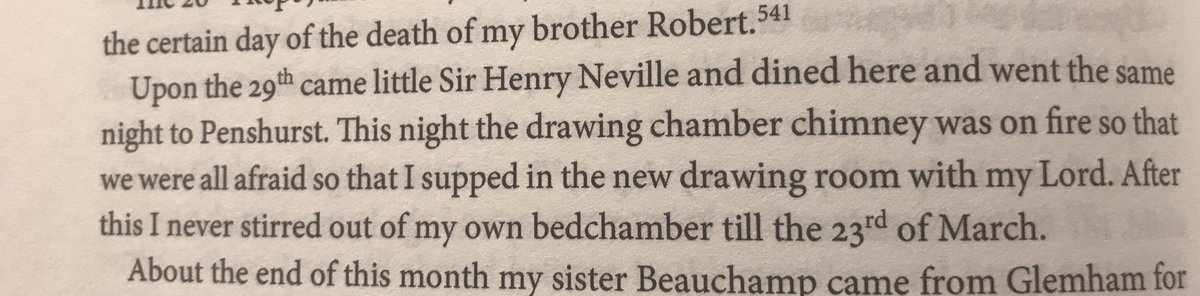
1.8 The Billingbear Son Visits and Returns to Penshurst
- Source: same diary,
29 October 1619, printed p.109, Archive leafn187, document witnesses page187; Archive.org page image. - Quotation:
"The 29th came little Sir Harry Neville and dined here and went back to Penshurst."
- Identification: The project's
14 November 2020correction explicitly identifieslittle Sir Harry Nevilleas Sir Henry Neville III of Billingbear (1588-1629), eldest son and successor of the diplomat who died in1615. It also records that some Clifford editions mistakenly assigned him to the Abergavenny line. - What it proves: The Billingbear son dined with Lady Anne Clifford and returned to Penshurst the same day. This is direct post-1615 evidence that the Billingbear–Sidney relationship continued into the next generation.
- Branch guardrail: He is not Clifford's Abergavenny
Uncle Nevil. The epithetlittleand the project's preserved identity correction distinguish the younger Billingbear knight.
1.9 Continuing Neville Company
The same diary continues to place Moll Neville in Clifford's circle: riding with her in August 1617, remaining with the child in November 1617, and sharing Clifford's Lenten discipline in 1619. These repeated appearances show continuing household intimacy rather than a single ceremonial meeting.
2. Identity Control for the Two Billingbear Visits
Two locally preserved images used in the original Twitter thread read:
"Upon the 15th came Sr Henry Nevil's Lady[:] I carried her up into my Closet & showed her all my things & gave her a pair of Spanish Leather Gloves[.]"
and:
"Upon the 29th came little Sir Henry Neville and dined here and went the same night to Penshurst."
research sources:
The cropped modern-edition photographs omit their page headings, but both passages have now been located and visually checked in the complete 1923 Archive.org witness: printed p. 82 / Archive leaf n158 and printed p. 109 / Archive leaf n187. The project archive also preserves the prior identity correction in Lady Anne Clifford, dated 14 November 2020.
| Diary wording | Date and page | Controlled identity |
|---|---|---|
My Uncle Nevil | 11 August 1617, p. 76 | Sir Henry Neville, Lord Abergavenny, husband of Mary Sackville |
Sir H. Nevill's lady | 15 December 1617, p. 82 | Elizabeth Smythe Neville, wife of Sir Henry Neville III of Billingbear; the diplomat's daughter-in-law |
little Sir Harry Neville | 29 October 1619, p. 109 | Sir Henry Neville III of Billingbear; the diplomat's eldest son |
Non-confusion rule: the Abergavenny identification of Uncle Nevil does not govern the other two entries. Conversely, the two Billingbear visits do not convert Mary, Moll, Cecily, Tom, or every other Neville reference in the diary into a Billingbear person.
3. Samuel Daniel: The Documented Clifford–Herbert Link
University of Leeds manuscript catalogue
The University of Leeds record for Samuel Daniel's c.1600 Epistle to the Lady Margaret, Countess of Cumberland is a direct manuscript-catalogue control:
- classmark:
BC MS Lt q 39; - manuscript: two folios, presumed in Daniel's hand, with revisions;
- catalogue statement: Daniel had been tutor to Margaret Clifford's daughter Anne;
- biographical history: Daniel was employed first as tutor to William Herbert and later as tutor to Lady Anne Clifford at Skipton Castle.
Source: University of Leeds Special Collections.
This establishes a real sequential link through Daniel between William Herbert and Anne Clifford. It does not establish that Daniel carried Shakespearean manuscripts, Sonnets copy, or First Folio materials between them.
CELM control
The Folger-hosted CELM introduction records Clifford's memoir and diary tradition, Daniel's place in her early journals, her extensive reading, and a library culture that included Sidney's Arcadia, Spenser, Jonson, Donne, George Herbert, Daniel, and other major writers.
Source: CELM: Lady Anne Clifford.
CELM is important because it makes Clifford a literary-document and book-ownership subject in her own right. She should not appear in the book only as a bridge between famous men.
4. Sackville, Neville, and Mayfield/Ordnance Routing
- Clifford's first husband was Richard Sackville, third Earl of Dorset.
- The 1923 diary edition embeds Neville contacts in his household and kinship language, particularly through the Abergavenny marriage to Mary Sackville.
- The separate Robert Sackville/Henry Neville business route is real but must use the corrected BRO
D/EN/O23/1595ordnance-bond lane preserved in sackville abergavenny neville family network. - The legacy
letter_119date should not control that transaction until manuscript collation is complete.
This produces a defensible network statement: Clifford's Sackville household was tied by kinship to the Abergavenny Nevilles, and the Sackville world also intersects Henry Neville's Mayfield/ordnance business records. It does not prove a single tightly coordinated literary coterie.
5. The Later Herbert Marriage
Lady Anne Clifford married Philip Herbert, Earl of Pembroke and Montgomery, in 1630. Philip was one of the two dedicatees of the 1623 First Folio.
Chronology is decisive: the marriage is seven years after the Folio and twenty-one years after the 1609 Sonnets. It is useful evidence for Clifford's long-term social location and for later book history, but it cannot serve as direct evidence for the creation, circulation, or dedication of either volume.
6. Sonnets Claim: What Can and Cannot Be Said
Supported
- Daniel was part of the formal and thematic sonnet culture within which Shakespeare's Sonnets are studied.
- Daniel taught both William Herbert and Anne Clifford at different stages.
- Clifford's household included active reading of Spenser and Sidney by a Neville woman.
- Clifford's Sackville marriage placed her amid documented Abergavenny Neville kin.
- Clifford separately received the Billingbear diplomat's daughter-in-law in December
1617and dined with his son, Sir Henry Neville III, in October1619.
Not supported by this packet
- that Daniel transmitted Shakespeare's Sonnets to or from a Neville household;
- that the Sonnets' literary relationship to Daniel proves personal collaboration;
- that William Herbert's tutorship identifies him as the Sonnets' dedicatee or addressee;
- that Clifford's 1630 marriage to Philip Herbert explains the 1609 or 1623 books;
- that every
Nevillein Clifford's diary belongs to the Billingbear branch.
7. Chronology
| Date | Event | Evidentiary use |
|---|---|---|
| c.1600 | Daniel's Clifford/Cumberland manuscript and tutoring context | Direct Daniel–Clifford literary link |
| before Clifford tutorship | Daniel served as tutor to William Herbert | Sequential Daniel–Herbert–Clifford link |
| 1609 | Shakespeare's Sonnets published | Chronological object of comparison, not explained by later links |
| 1616 | Mary, Cecily, Moll, Tom, and Sir Henry Neville references occur in Clifford's diary | Repeated Neville presence in the Sackville circle |
| 1616 | Moll Neville reads The Faerie Queene | Direct literary-practice evidence |
| 1617 | Uncle Nevil joins the Sussex progress; editor identifies Abergavenny branch | Corrects the branch identity |
| 1617 | Moll Neville reads the Arcadia | Direct literary-practice evidence |
| 1617 | Sir H. Nevill's lady, the Billingbear daughter-in-law, visits Clifford | Direct contact with the diplomat's next generation |
| 1619 | little Sir Harry Neville, the Billingbear son, dines with Clifford and returns to Penshurst | Direct Billingbear–Clifford–Penshurst contact |
| 1623 | First Folio dedicated to William and Philip Herbert | Separate Folio context |
| 1630 | Clifford marries Philip Herbert | Later network consolidation, not production evidence |
8. Book-Safe Formulation
Lady Anne Clifford provides a documented point of contact between Samuel Daniel's literary pedagogy, the Sackville/Abergavenny kinship world, and the next generation of the Billingbear Nevilles. Her diary identifies Uncle Nevil as the Abergavenny man, but in separate entries it records a private visit from the Billingbear diplomat's daughter-in-law and a dinner visit from his son, Sir Henry Neville III, who returned to Penshurst. It also records a Moll Neville reading The Faerie Queene and the Arcadia aloud, although Moll's precise identity remains unresolved. Daniel's prior tutorship of William Herbert adds a real Herbert link, and Clifford's later marriage to Philip Herbert extends that relationship into the 1630s. The evidence is valuable for reconstructing literary sociability, reading, patronage, and multigenerational social continuity. It is not direct evidence that a Neville household produced Shakespeare's Sonnets or the First Folio.
Sources
- Clifford, Anne. The Diary of the Lady Anne Clifford. Introductory note by V. Sackville-West. London,
1923. Archive.org; Lady Anne Clifford Diary 1923 IA; Lady Anne Clifford Diary 1923 IA djvu. - D. J. H. Clifford, ed. The Diaries of Lady Anne Clifford. Stroud,
1990; corrected reprint1992. Bibliographic control: Internet Archive item and CELM. Lending-restricted; represented here by the two locally preserved source crops. Their passages have been independently aligned to the complete1923witness at printed pp.82and109. - University of Leeds Special Collections, `BC MS Lt q 39`.
- CELM: Lady Anne Clifford introduction and manuscript listings.
- twitter Lady Anne Clifford, preserved research claims and image routing.
- Lady Anne Clifford, preserved
14 November 2020correction identifying the two visitors as the Billingbear son and daughter-in-law and rejecting the Abergavenny conflation. - sir henry neville iii 1588 1629, independent control for Henry III, his
1609marriage to Elizabeth Smythe, and the post-1615generational boundary. - sackville abergavenny neville family network, current Sackville/Abergavenny/BRO control.
- mayfield manor and ironworks, related Mayfield/ordnance evidence.
- herbert brothers, First Folio dedicatee packet.
- NETWORK PLAY CLUSTER SOURCE PASS 2026 07 09.
10. Images

Notes on Access and Status
Ready means this packet can now support future research and careful book prose because the direct diary evidence, source links, branch-identity rules, quotations, and negative controls are explicit. The two cropped visit references are resolved as Billingbear contacts; Uncle Nevil is separately resolved as Abergavenny. Mary/Moll Neville, Tom Neville, and other abbreviated diary identities remain open unless separately controlled.