Henry VIII Grandson Tradition: Sir Henry Neville (d. 1593) and Sir Henry Neville (d. 1615)
Purpose and identity control
This packet documents the historical tradition that Sir Henry Neville (d. 1615) may have been a grandson of Henry VIII through his father, Sir Henry Neville of Billingbear (d. 1593). It does not try to prove biological descent. It sets out the surviving statements, their dates and relationships, the resemblance tradition, and the separately documented circumstances of Sir Henry Neville (d. 1593) remaining in Henry VIII's favor after the execution of his father, Sir Edward Neville, in December 1538.
The names are kept explicit throughout:
- Sir Henry Neville (d. 1593): of Billingbear; Henry VIII's documented godson; the man called Henry VIII's bastard in the Overbury-family tradition.
- Sir Henry Neville (d. 1615): diplomat and ambassador; son of Sir Henry Neville (d. 1593); the man whom the Overbury letter calls Similis because he is, in the letter's words, “like Hen 8.”
Current source-control conclusion
Four documentary forms preserve the tradition:
- A statement printed in 1874 from British Library Add MS 15476, a book compiled by Nicholas Oldisworth about 1637–40, reporting notes taken in 1637 from his grandfather Sir Nicholas Overbury. The printed item says that the father of Sir Henry Neville (d. 1615) was “bastard to King Hen. 8th.”
- Lord Braybrooke's 1850 publication of an anecdote copied from a now-unidentified British Museum volume of Berkshire pedigrees: Elizabeth I calls Sir Henry Neville (d. 1593) “Brother Henry,” and he complains that she will make the court believe he is a bastard.
- Marion Colthorpe's Folger court chronology, which records the formal parentage, the godson fact, and the reported “base son” tradition.
- Jackie Watson's recent scholarly transcription of BL Harley MS 7002, fol. 281: Sir Henry Neville (d. 1615) is to be called Similis “because he is like Hen 8.”
These are not four independent proofs. Folger is a modern synthesis; the 1613 Similis letter and the 1637 note both belong to the Overbury milieu; the Berkshire pedigree source has not yet been identified. Together they establish that a durable, multi-form tradition existed. They do not establish its biological truth.
Dating control
- 1613: earliest datable source in the assembled tradition, but it states resemblance only: Sir Henry Neville (d. 1615) is Similis because he is “like Hen 8.”
- 1637: earliest located unambiguous paternity statement, presently controlled through the 1874 printing attributed to Add MS 15476.
- No sixteenth-century source stating the paternity rumour has yet been located. The present evidence therefore documents a Jacobean-and-later tradition about a Tudor birth.
Essential manuscript-status distinction
The actual handwritten Add MS 15476 leaf containing the “bastard to King Hen. 8th” statement has not yet been located or photographed. The source image below is the 1874 printed transcription of that manuscript item. The surviving Twitter and email images are also the printed page and a British Library catalogue capture, not the handwritten folio. The British Library catalogue record supplies the manuscript's identity, compilation, and access route but no digitized leaves.
Current British Library record: Add MS 15476, *A BOOKE touching Sir Thomas Overbury*. The record describes a volume of 94 leaves, largely in one italic hand, compiled by Nicholas Oldisworth about 1637–40, with title and contents at fol. 2r and Oldisworth's validation note at fol. 2v.
I. Add MS 15476 and the Overbury-family statement
British Library catalogue description
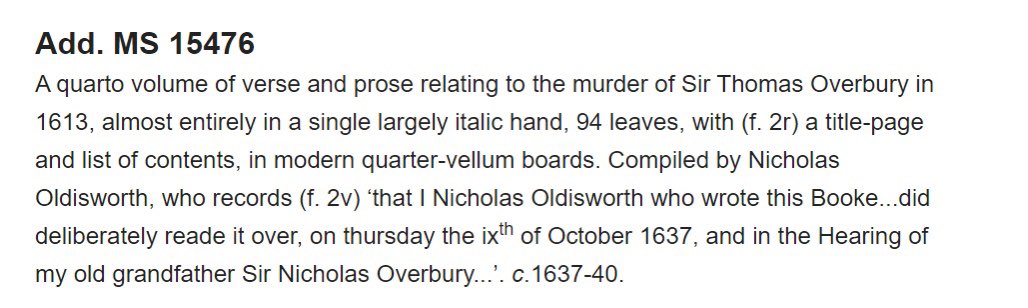
Transcription: “A quarto volume of verse and prose relating to the murder of Sir Thomas Overbury in 1613, almost entirely in a single largely italic hand, 94 leaves, with (f. 2r) a title-page and list of contents ... Compiled by Nicholas Oldisworth, who records (f. 2v) that ‘I Nicholas Oldisworth who wrote this Booke ... did deliberately read it over, on thursday the ixth of October 1637, and in the Hearing of my old grandfather Sir Nicholas Overbury’ ... c. 1637–40.”
This screenshot is a catalogue witness, not a manuscript-leaf image. The current catalogue record is the controlling public description.
Calendar discrepancy requiring manuscript collation: the catalogue transcription reads “thursday the ixth of October 1637.” Under the calendar then used in England, 9 October 1637 was Monday; Thursday was 12 October. The inconsistency may be in the manuscript, the numeral, or the catalogue transcription. Fol. 2v must be inspected before the reading is normalized.
Printed heading identifying the manuscript and memory channel
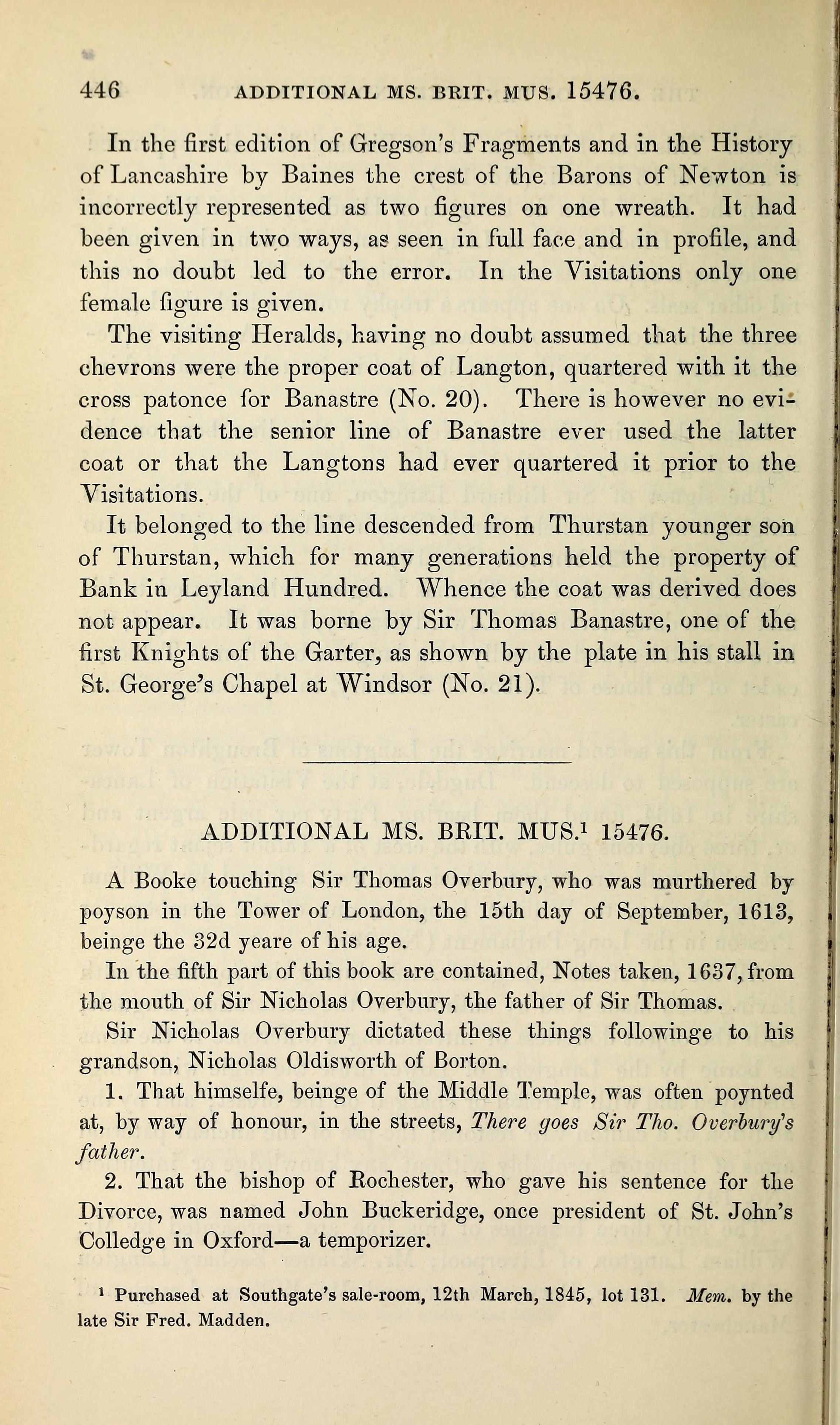
Transcription: “A Booke touching Sir Thomas Overbury, who was murthered by poyson in the Tower of London, the 15th day of September, 1613, beinge the 32d yeare of his age. In the fifth part of this book are contained, Notes taken, 1637, from the mouth of Sir Nicholas Overbury, the father of Sir Thomas. Sir Nicholas Overbury dictated these things followinge to his grandson, Nicholas Oldisworth of Borton.”
Public scan: *The Herald and Genealogist*, vol. 8, p. 446.
Printed item 25: the direct paternity statement
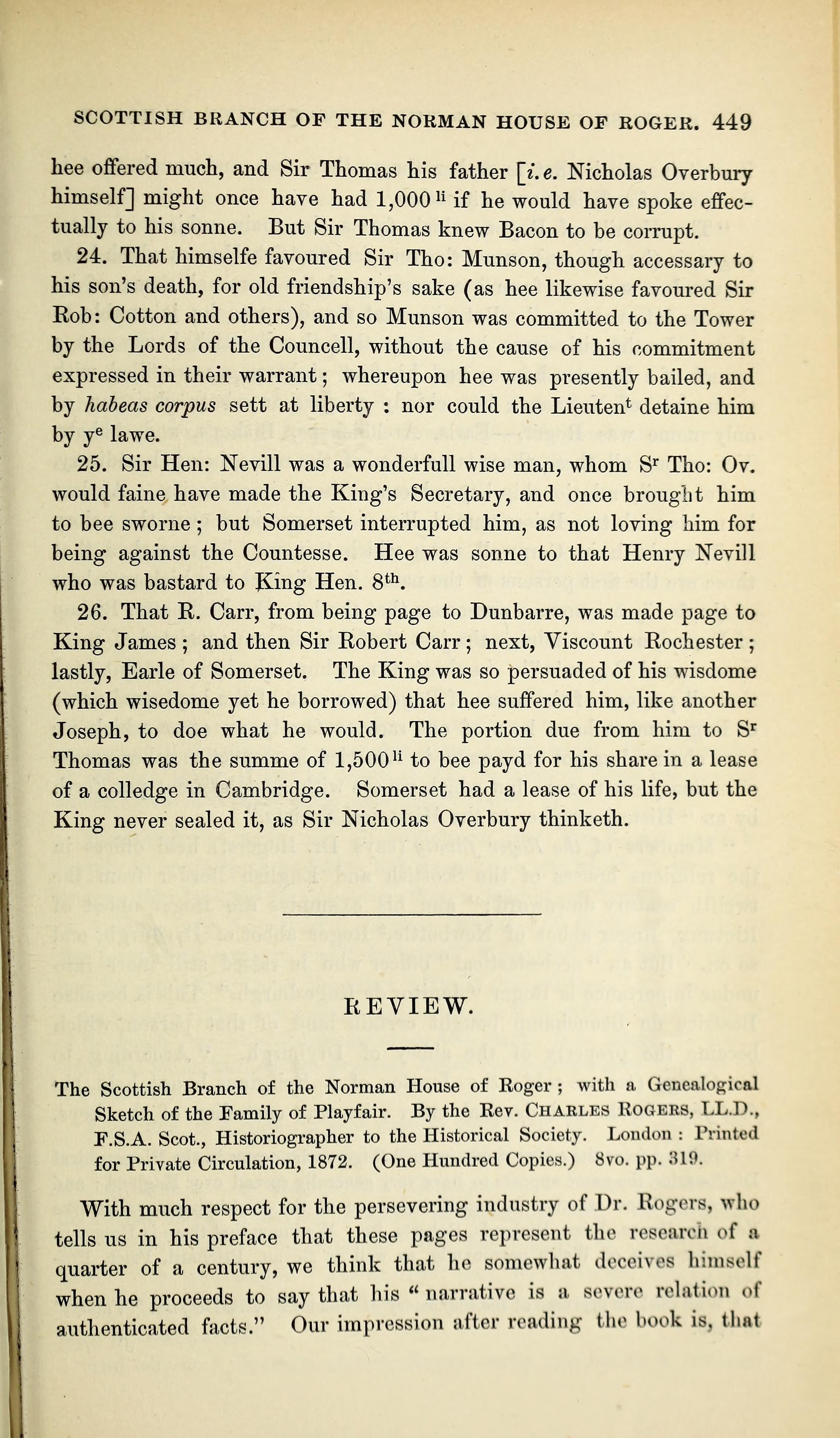
Transcription: “Sir Hen: Nevill was a wonderfull wise man, whom Sr Tho: Ov. would faine have made the King's Secretary, and once brought him to bee sworne; but Somerset interrupted him, as not loving him for being against the Countesse. Hee was sonne to that Henry Nevill who was bastard to King Hen. 8th.”
Public scan: *The Herald and Genealogist*, vol. 8, p. 449, item 25.
The secretaryship context identifies the first “Sir Hen: Nevill” as Sir Henry Neville (d. 1615). The final sentence therefore applies the paternity statement to his father, Sir Henry Neville (d. 1593). This is a printed transcription attributed to Add MS 15476, not a direct inspection of the manuscript leaf.
II. Notes and Queries: “Brother Henry” and “a bastard”
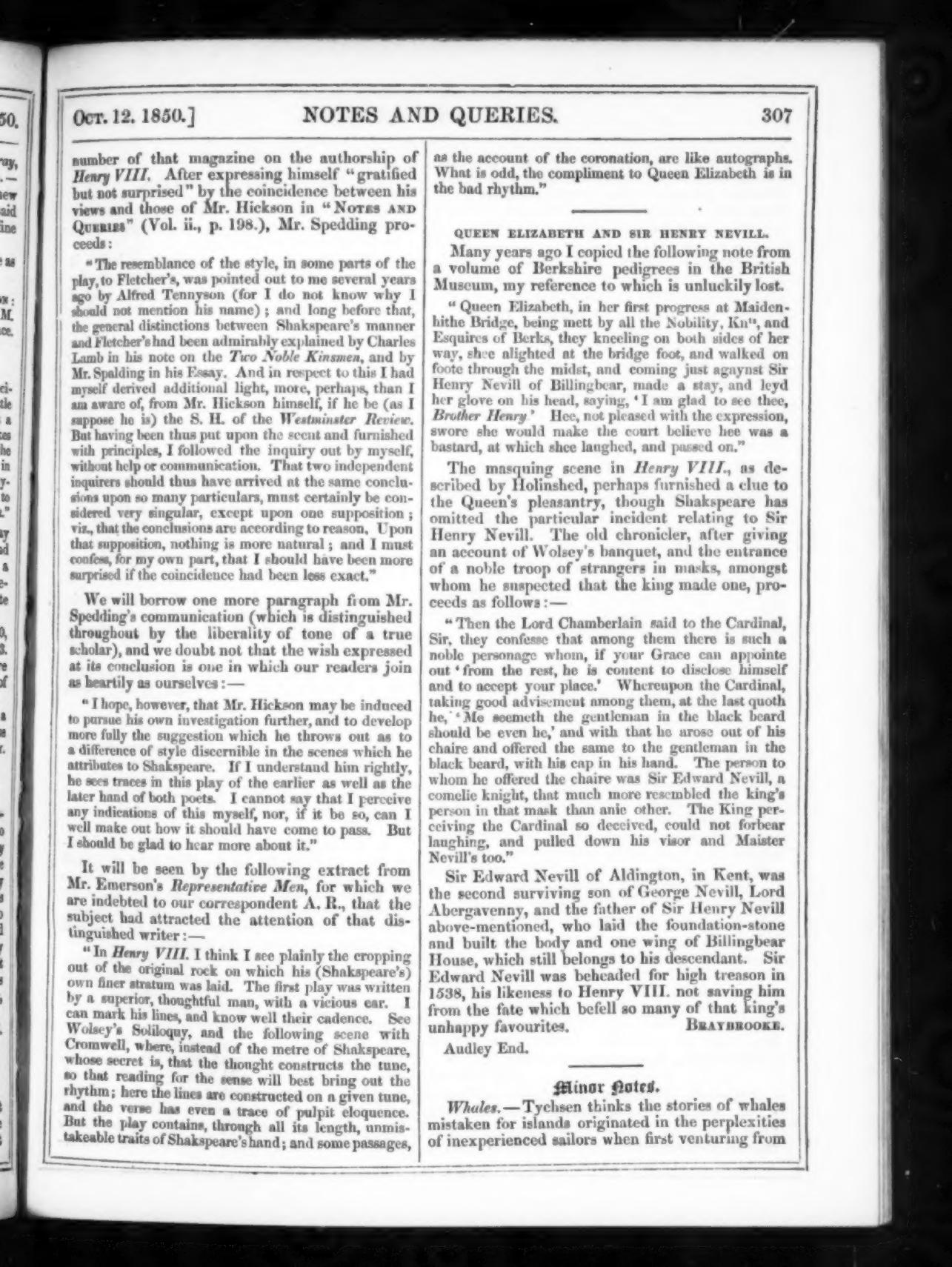
Transcription: “Many years ago I copied the following note from a volume of Berkshire pedigrees in the British Museum, my reference to which is unluckily lost. Queen Elizabeth, in her first progress at Maidenhithe Bridge ... coming just against Sir Henry Nevill of Billingbear, made a stay, and leyd her glove on his head, saying ‘I am glad to see thee, Brother Henry.’ Hee, not pleased with the expression, swore she would make the court believe hee was a bastard, at which shee laughed, and passed on.”
Public issue: Internet Archive, *Notes and Queries*, 12 October 1850. Public text witness: Project Gutenberg issue transcription.
The subject is Sir Henry Neville of Billingbear (d. 1593). The source is separate from Add MS 15476, but Braybrooke did not retain the shelfmark of the Berkshire pedigree volume, so its date and independence remain unresolved. Two further controls follow from the report:
- The anecdote says Elizabeth was on her “first progress,” normally dated to 1559, but Colthorpe places the story in her 1563 chronology. The discrepancy must be resolved before assigning the incident a firm year.
- The possibility of a migratory court anecdote remains open: a memorable royal bastardy joke can be transferred between families in later retelling. This is a folklore risk, not evidence that the story is false.
III. Folger's court chronology
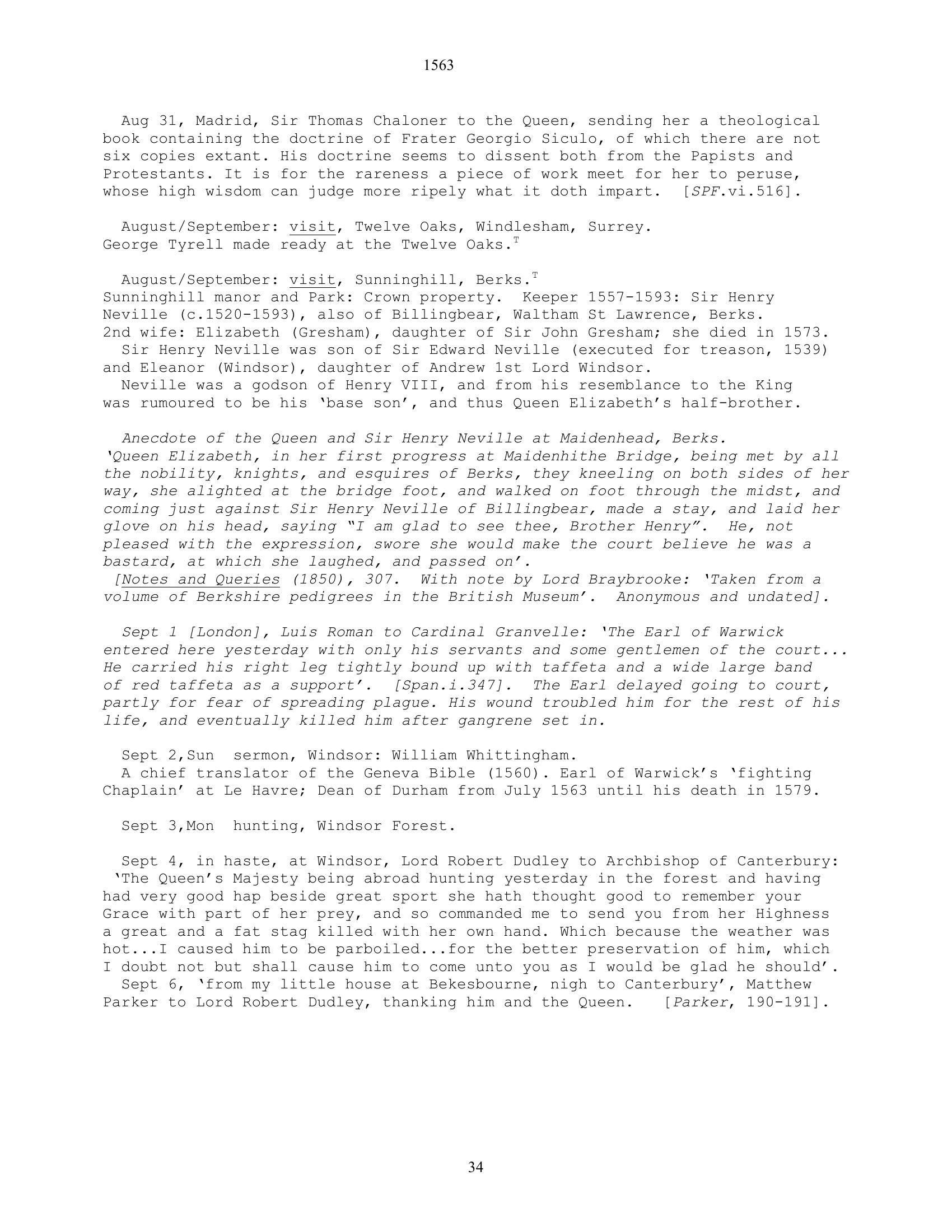
Transcription: “Sir Henry Neville was son of Sir Edward Neville (executed for treason, 1539) and Eleanor (Windsor), daughter of Andrew 1st Lord Windsor. Neville was a godson of Henry VIII, and from his resemblance to the King was rumoured to be his ‘base son’, and thus Queen Elizabeth's half-brother.” The entry then gives the “Brother Henry” anecdote and cites Notes and Queries.
Official PDF: Folger, Marion Colthorpe, *The Elizabethan Court Day by Day—1563*.
Folger is valuable as a professional modern synthesis, but it is not counted as an independent early witness to the rumor. Its “base son” sentence has no separately stated source on the page, the anecdote is explicitly routed to Notes and Queries, and the entry misdates Sir Edward Neville's execution to 1539.
IV. Similis: Sir Henry Neville (d. 1615) “like Hen 8”
Watson's discussion
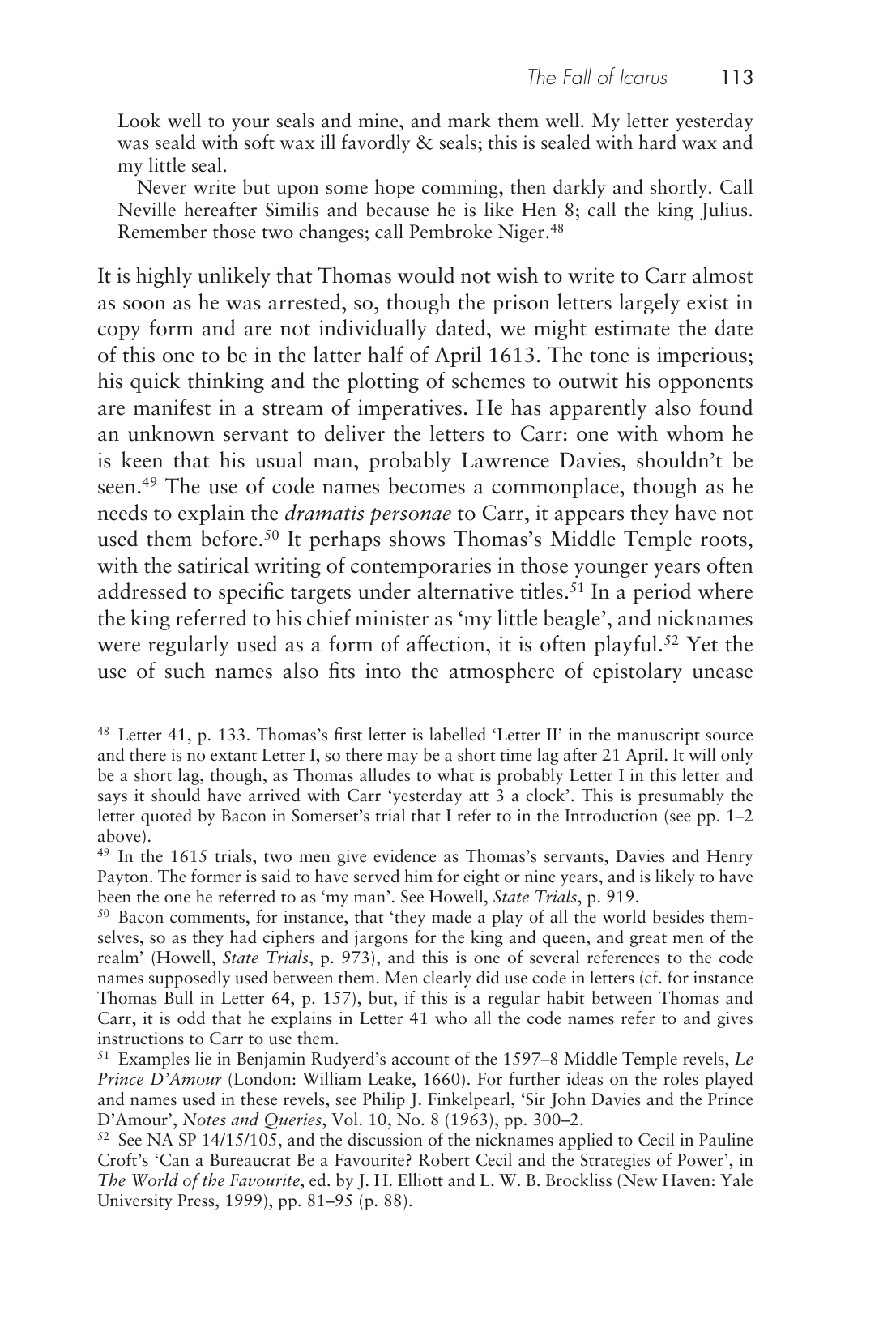
Transcription: “Never write but upon some hope comming, then darkly and shortly. Call Neville hereafter Similis and because he is like Hen 8; call the king Julius. Remember those two changes; call Pembroke Niger.”
Watson's transcription and manuscript reference
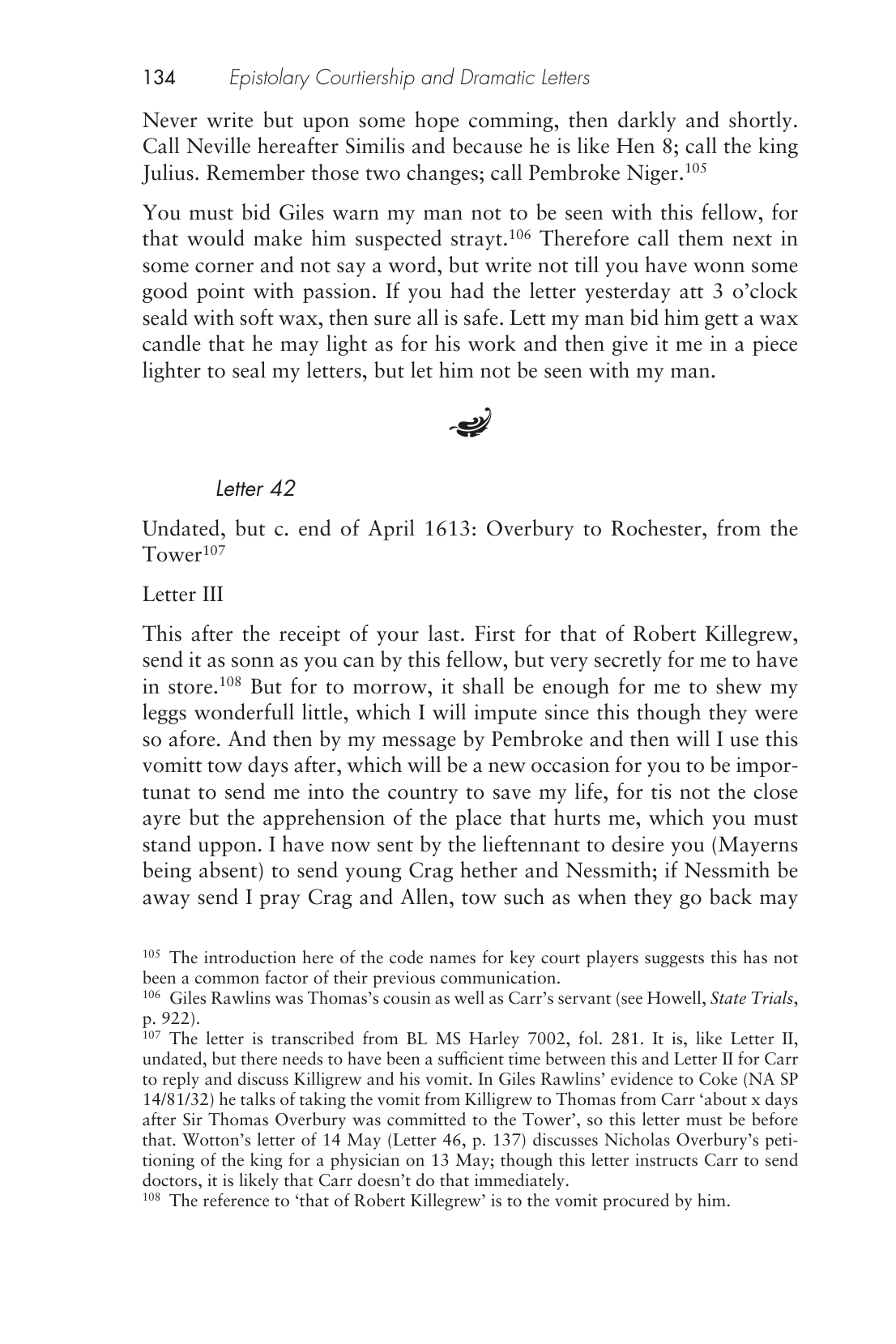
Transcription: “Never write but upon some hope comming, then darkly and shortly. Call Neville hereafter Similis and because he is like Hen 8; call the king Julius. Remember those two changes; call Pembroke Niger.” Watson's note 107 states: “The letter is transcribed from BL MS Harley 7002, fol. 281.”
Sources: Jackie Watson, *Epistolary Courtiership and Dramatic Letters* (2024), DOI; British Library catalogue, Harley MS 7002; Watson's 2026 article, DOI.
This is a near-contemporary resemblance statement about Sir Henry Neville (d. 1615), not a paternity statement. Overbury was imprisoned from 21 April 1613 until his death on 15 September; Watson places the undated letter probably in late April. Charles Whibley's 1913 printing read “Rochester” instead of “Neville,” but Watson's complete transcription and the later grammar of instructions to Rochester about Similis secure Similis as a third person. The exact manuscript folio image has not yet been obtained.
V. Family identifiers in the printed peerage record
The following pages are retained as compact identity and date controls, not as evidence for the paternity tradition.
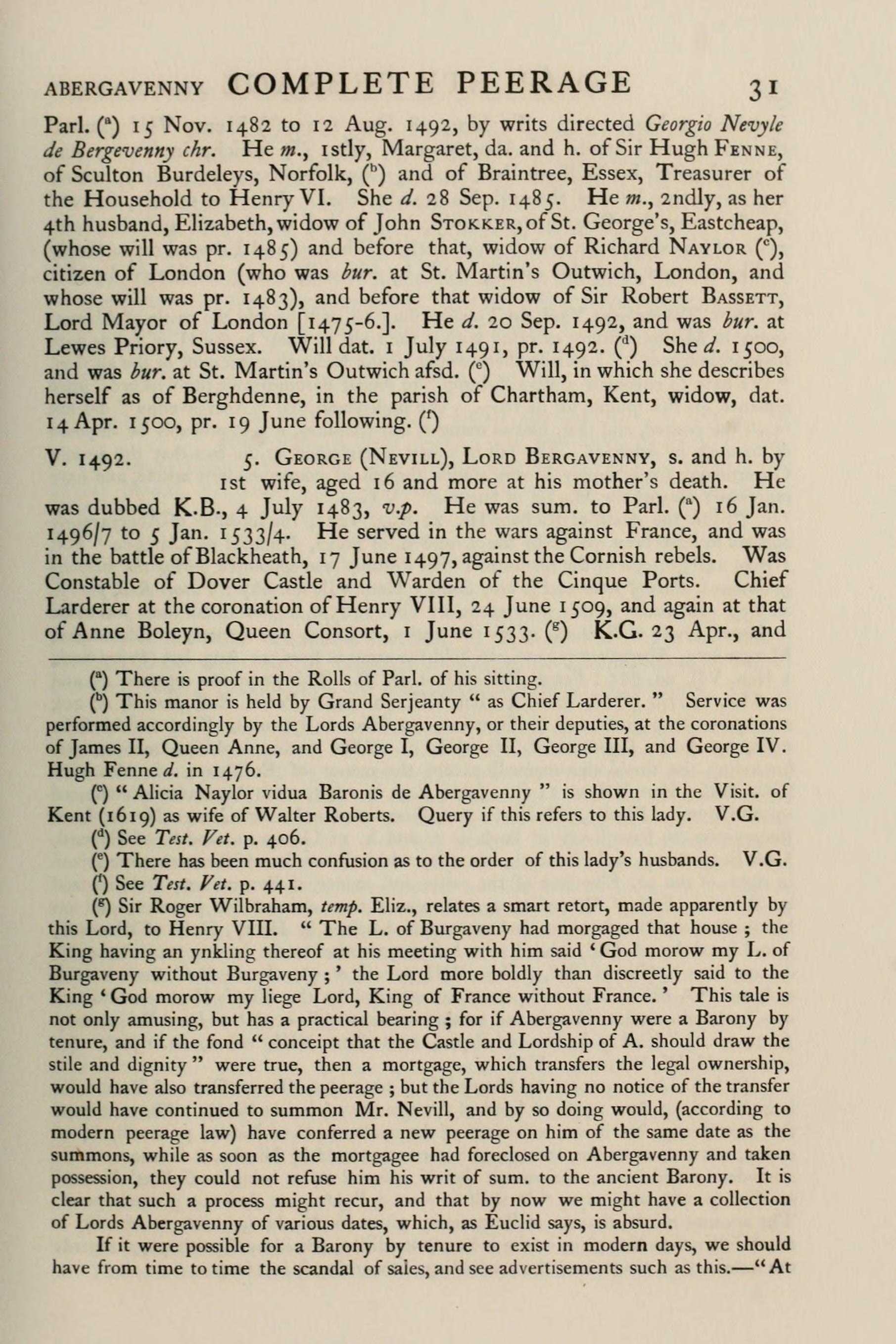
Transcription of the relevant entry: “He d. 20 Sep. 1492, and was bur. at Lewes Priory, Sussex. Will dat. 1 July 1491, pr. 1492.”
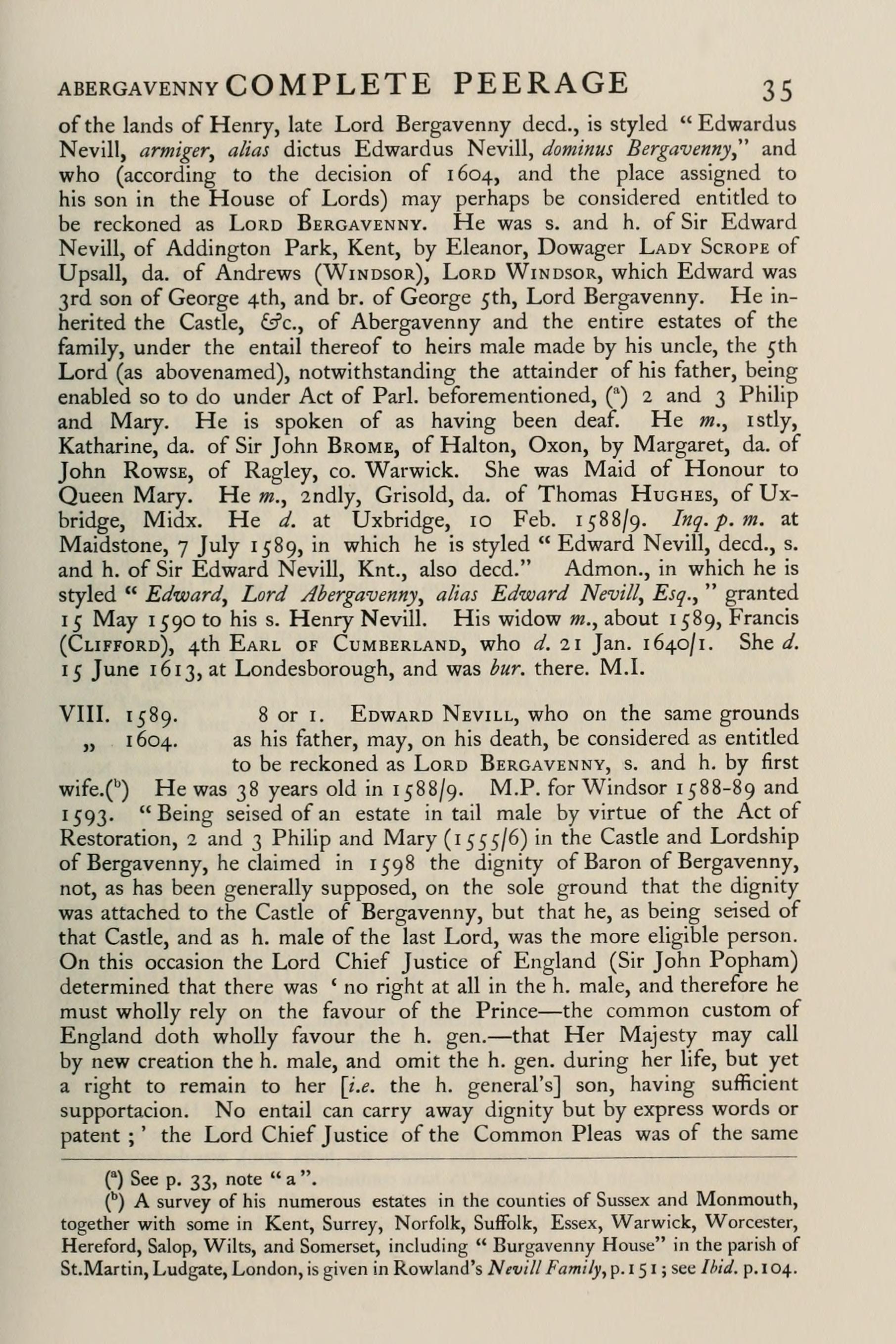
Transcription of the relevant entry: “Sir Edward Nevill, of Addington Park, Kent, by Eleanor, Dowager Lady Scrope of Upsall, da. of Andrew (Windsor), Lord Windsor, which Edward was 3rd son of George 4th, and br. of George 5th, Lord Bergavenny.”
Public volume: *The Complete Peerage*, vol. 1.
The kinship that was already real
Henry VIII and the Billingbear Nevilles shared documented Neville ancestry. Henry VIII's great-grandmother Cecily Neville was the sister of Sir Edward Neville's grandfather Edward Neville, Lord Bergavenny (d. 1476); both were children of Ralph Neville, 1st Earl of Westmorland, and Joan Beaufort. This genuine kinship is a necessary control when assessing resemblance language. It supplies a non-paternal route by which family resemblance and court kinship could be understood without treating the rumour as genealogy.
VI. Sir Edward Neville's service, fall, and execution
Sir Edward Neville's court career was long and close. The older DNB account, which supplies routes into the underlying chronicles and state papers, records him at court from the opening of Henry VIII's reign; as sewer of the household and squire of the King's body; on the French expeditions of 1512 and 1513; knighted at Tournai in 1513; in the 1514 French royal-marriage journey; gentleman of the Privy Chamber and master of the buckhounds in 1516; at the Field of the Cloth of Gold in 1520; restored after temporary exclusion in 1521; serving Charles V's visit in 1522 and commanding in France in 1523; King's standard-bearer by 1531; at Anne Boleyn's coronation in 1533; constable of Leeds Castle in 1534; and a canopy-bearer at Prince Edward's baptism in 1537.
Public biographical route: DNB, “Neville, Edward (d.1538)”). The November 1538 accusation and interrogation material is calendared in *Letters and Papers*, vol. 13, part 2, pp. 308–353.
The printed authorities conflict, but the illustrated report's calendar check resolves the leading alternatives in favor of Wriothesley. DNB gives 8 December. Wriothesley gives “the 9th day of December, beinge Mondaye.” In the Julian calendar used in England, 9 December 1538 was Monday, exactly as Wriothesley states; 8 December was Sunday. The controlled formulation is therefore: Sir Edward Neville was executed on Tower Hill on Monday 9 December 1538, with Henry Courtenay, Marquess of Exeter, and Henry Pole, Lord Montagu. DNB's 8 December is retained as a superseded printed date.
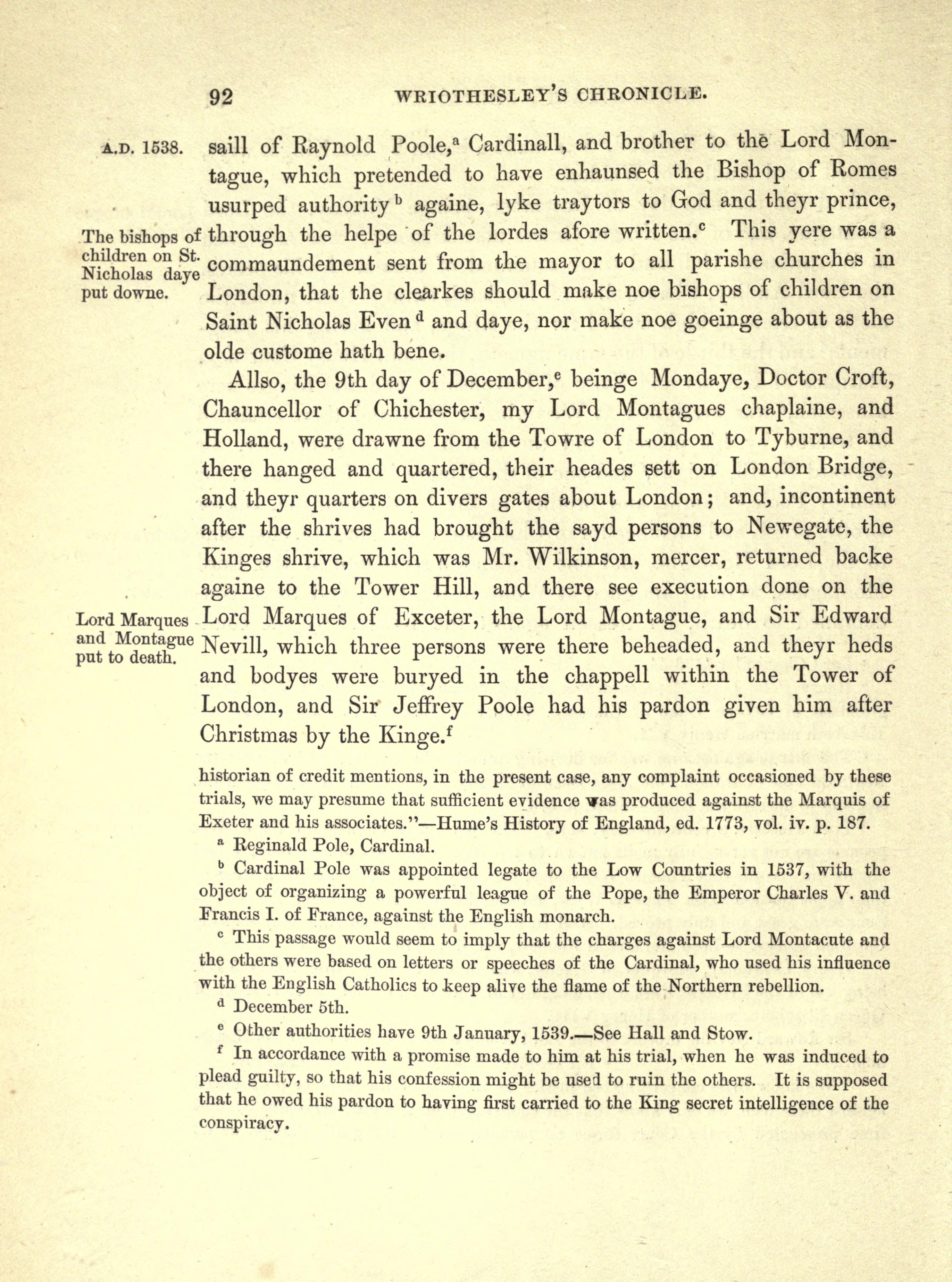
Transcription: “Allso, the 9th day of December, beinge Mondaye ... the Kinges shrive ... returned backe againe to the Tower Hill, and there see execution done on the Lord Marques of Exceter, the Lord Montague, and Sir Edward Nevill, which three persons were there beheaded, and theyr heds and bodyes were buryed in the chappell within the Tower of London.”
Public scan: Wriothesley's *Chronicle*, vol. 1, p. 92.
VII. Sir Henry Neville (d. 1593) and Henry VIII after the execution
27 October 1539: annuity because he was the King's godson
This grant was made about ten and a half months after Sir Edward Neville's execution. It identifies the recipient expressly as Sir Edward's son and gives the reason for the annuity.
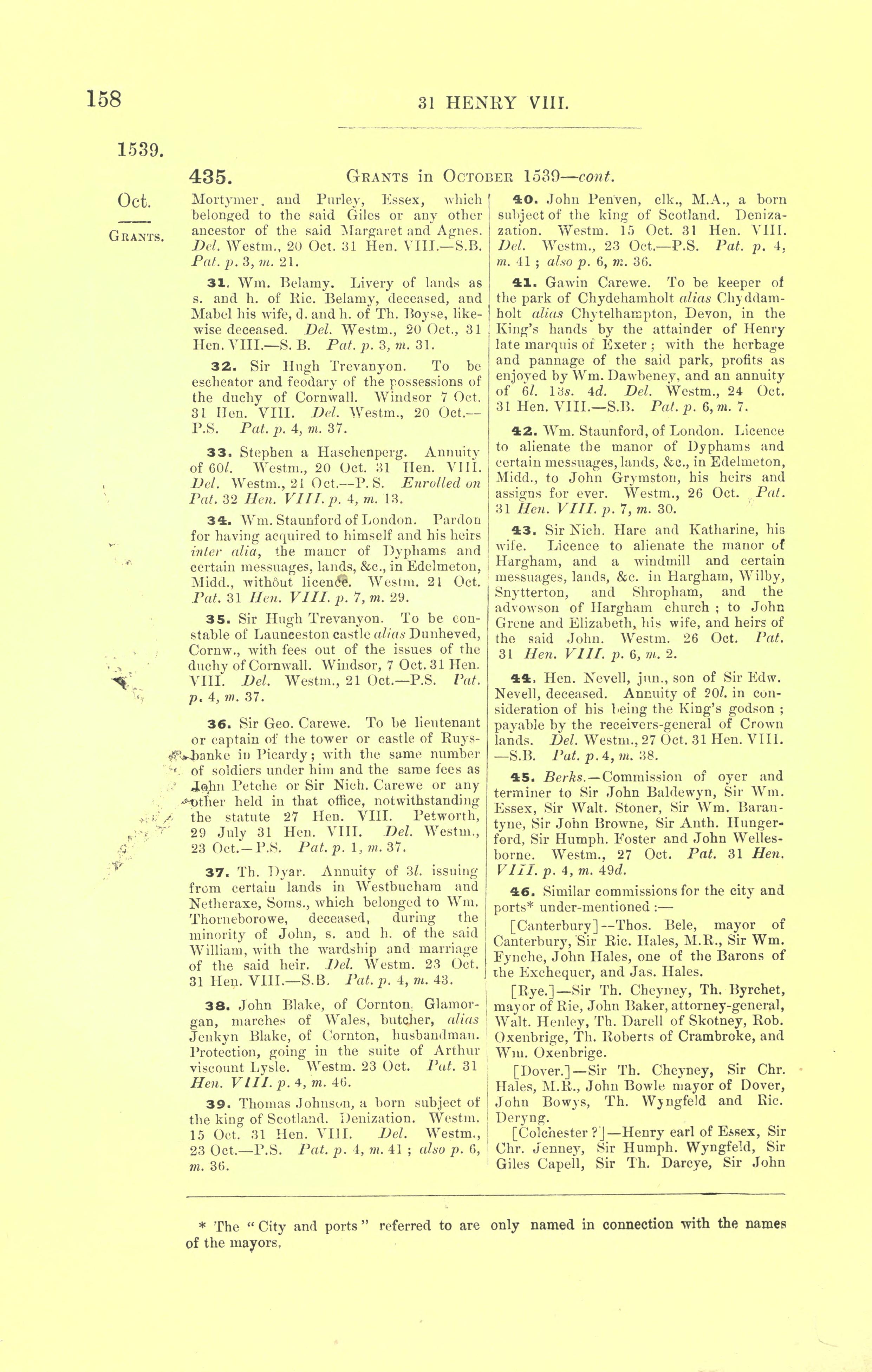
Transcription: “Hen. Nevell, jun., son of Sir Edw. Nevell, deceased. Annuity of 20l. in consideration of his being the King's godson; payable by the receivers-general of Crown lands. Del. Westm., 27 Oct. 31 Hen. VIII.—S.B. Pat. p. 4, m. 38.”
Public scan: *Letters and Papers*, vol. 14, part 2, p. 158, grant 435, item 44.
13 March 1546: second annuity marker
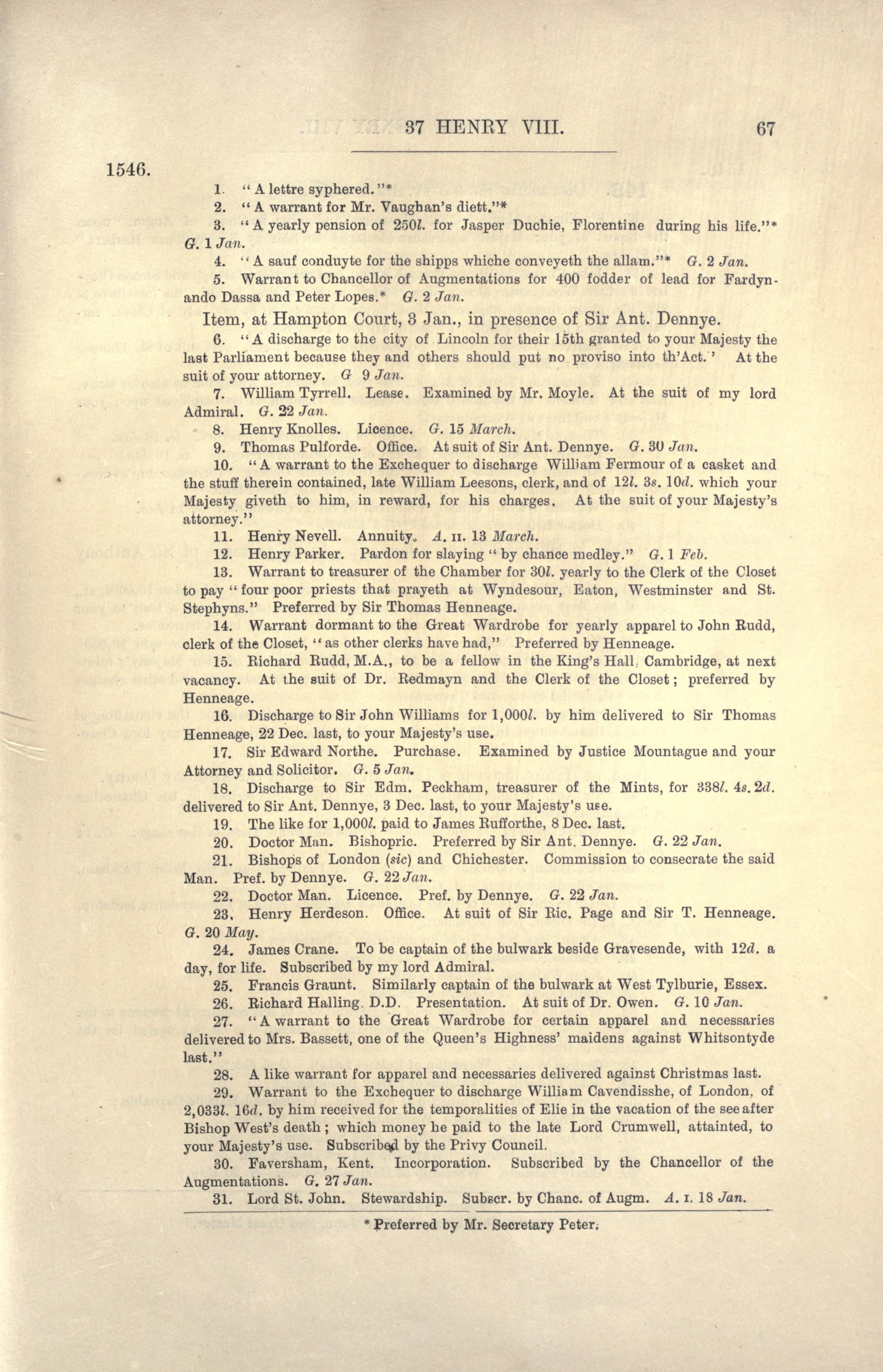
Transcription: “Henry Nevell. Annuity. A. II. 13 March.”
Public scan: *Letters and Papers*, vol. 21, part 1, p. 67, item 11.
The terse entry does not state an amount, parentage, title, or recital. It is consistent with the same Henry Neville but does not identify him on its own; the underlying instrument must be retrieved before a detailed claim is built from it.
Late 1546: Privy Chamber service
History of Parliament places Sir Henry Neville (d. 1593) as a groom of the Privy Chamber by 1546. Eric Ives also identifies “Sir Henry Nevill” as a groom of the Privy Chamber in the evidence surrounding Stephen Gardiner's exclusion from access to Henry VIII late in 1546. This places him inside the King's final household information circle.
Sources: History of Parliament, Sir Henry Neville (d.1593); Eric Ives, “Henry VIII's Will: A Forensic Conundrum,” DOI.
30 December 1546: Henry VIII's full will
The full printed will occupies Rymer, Foedera, vol. 15, pp. 110–117. The original will is The National Archives, E 23/4/1. The complete facsimile assembled for this packet is preserved here:
- Henry VIII Full Will Rymer Foedera XV pp110 117 Facsimile.
- Public scan beginning at p. 110: Rymer, *Foedera*, vol. 15.
- Public continuous calendar transcription: *Letters and Papers*, vol. 21, part 2, item 634.
- Original-will context: The National Archives, Henry VIII's will.
The complete page-image sequence is preserved as Rymer15 p110, Rymer15 p111, Rymer15 p112, Rymer15 p113, Rymer15 p114, Rymer15 p115, Rymer15 p116, and Rymer15 p117. The BHO item above supplies the continuous searchable transcription of the full document.
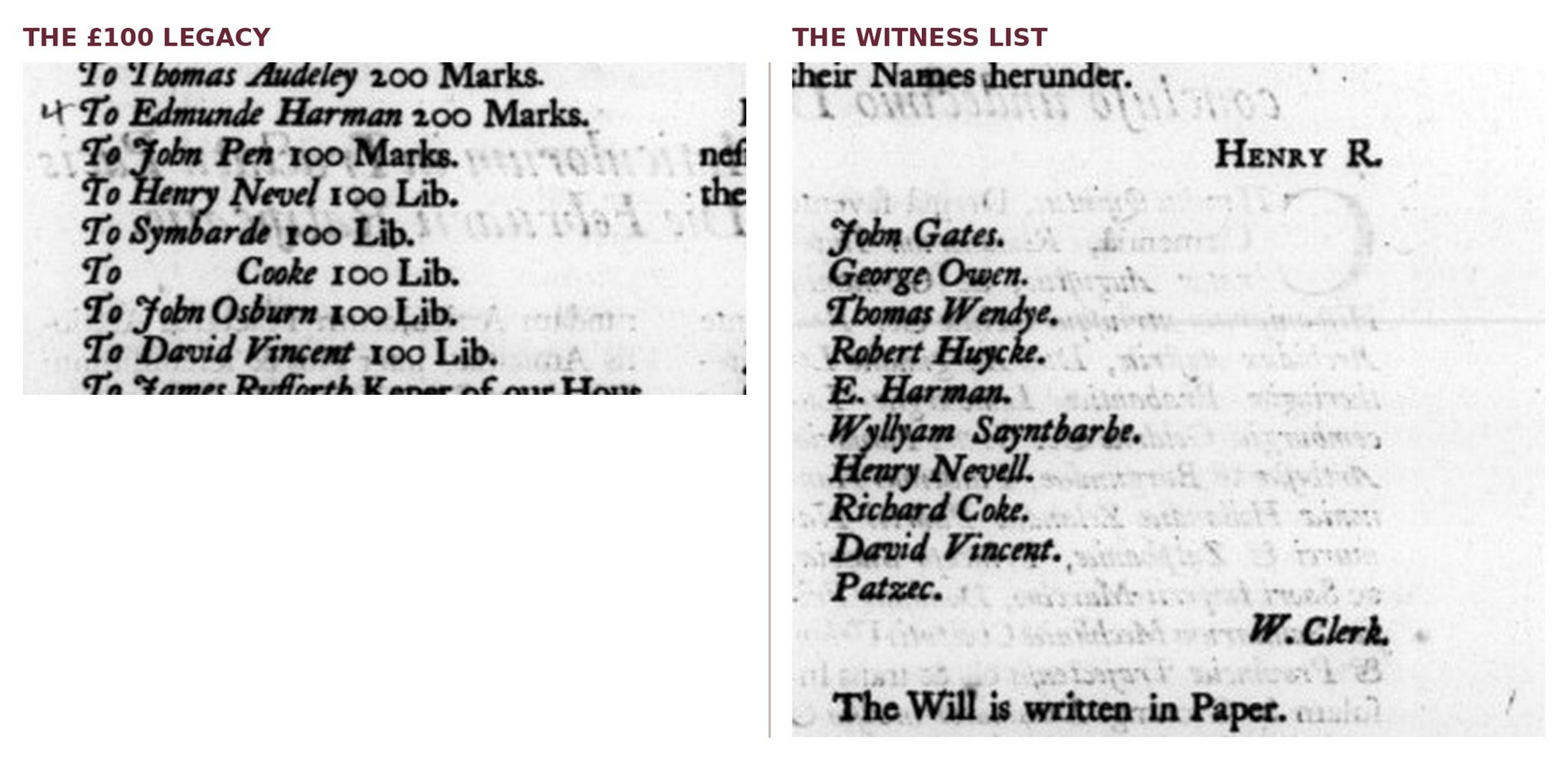
Transcription, enlarged details: Legacy: “To Henry Nevel 100 Lib.” Witness list: “HENRY R. John Gates. George Owen. Thomas Wendye. Robert Huycke. E. Harman. Wyllyam Sayntbarbe. Henry Nevell. Richard Coke. David Vincent. Patzec. W. Clerk. The Will is written in Paper.”

Transcription of the relevant calendar headings and clauses: “634. The King's will”; dated 30 December 1546. In the section introduced “In token of special love and favour,” the calendar gives “Henry Nevel, 100l.” The witness list includes “Henry Nevell.” The full continuous transcription is available at the BHO link above.
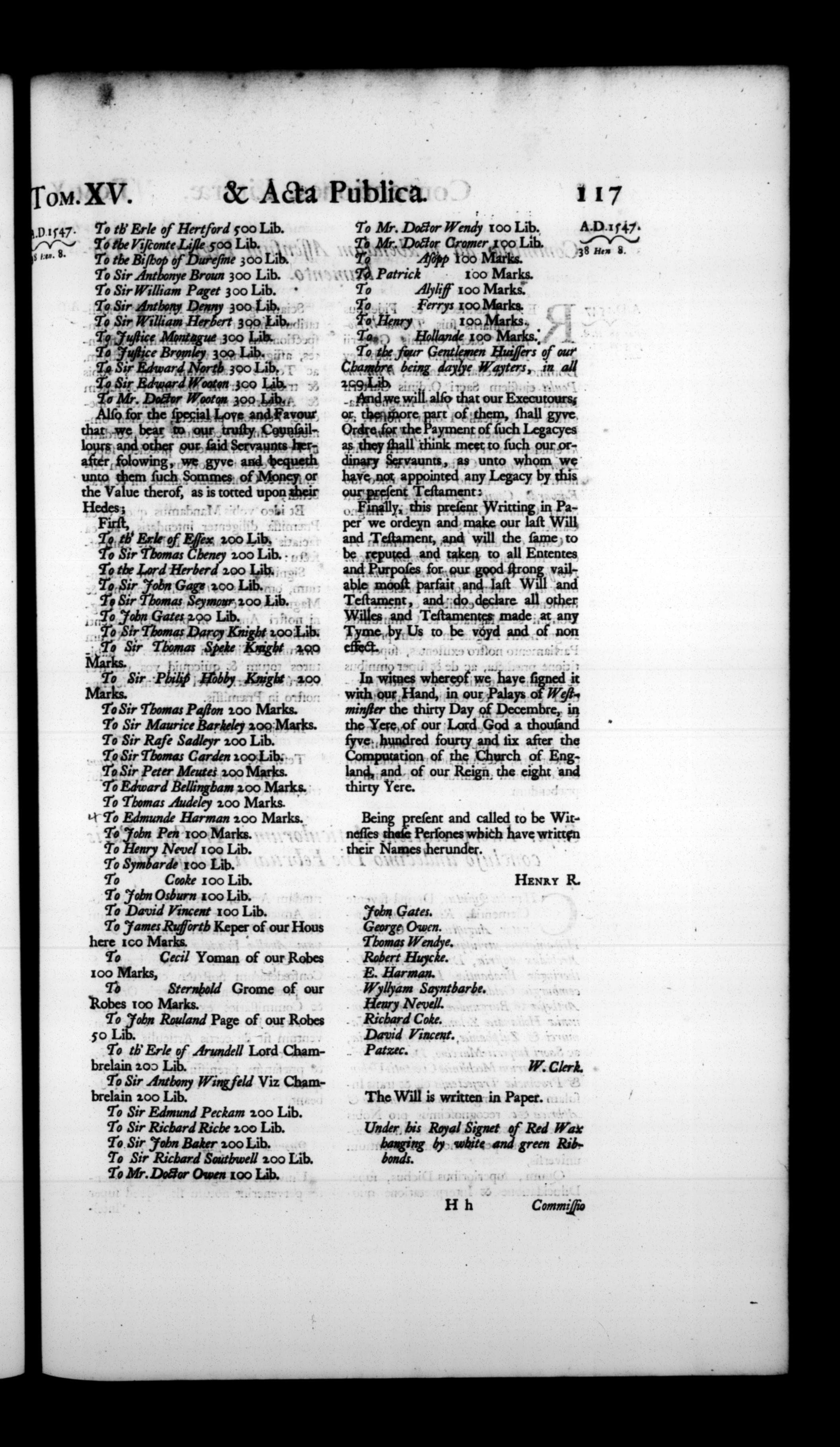
Transcription, legacy clause: “Also for the special Love and Favour that we bear to our trusty Counsaillours and other our said Servaunts hereafter folowing, we give and bequeath unto them such Sommes of Money ... To Henry Nevel 100 Lib.”
Transcription, witness clause: “Being present and called to be Witnesses these Personnes which have written their Names herunder. HENRY R. John Gates. George Owen. Thomas Wendye. Robert Huycke. E. Harman. Wyllyam Sayntbarbe. Henry Nevell. Richard Coke. David Vincent. Patzec. W. Clerk. The Will is written in Paper.”
The will therefore verifies both points: Sir Henry Neville (d. 1593) received £100 in the King's special-love-and-favour list, and Henry Nevell signed among the witnesses. Ives identifies the witness as the groom of the Privy Chamber and judges Rymer's transcription excellent apart from one significant misreading on p. 113 that does not affect the Neville passages. Owen Duncan's citation to “634” was to calendar item 634, not printed page 634.
VIII. Controlled chronology
| Date | Documented event |
|---|---|
| 1509–1537 | Sir Edward Neville's sustained body-service, military, household, revel, and ceremonial career under Henry VIII |
| November 1538 | Sir Edward arrested and examined in the Pole/Exeter purge |
| 9 December 1538 | Sir Edward executed on Tower Hill; Wriothesley's Monday is calendar-consistent |
| 27 October 1539 | His son Henry receives £20 annually because he is Henry VIII's godson |
| 13 March 1546 | “Henry Nevell. Annuity” appears among documents stamped in Sir Anthony Denny's presence |
| Late 1546 | Sir Henry Neville (d. 1593) appears as a groom of the Privy Chamber in the Gardiner-exclusion evidence |
| 30 December 1546 | Henry VIII gives Henry Nevel £100 in the special-love-and-favour list; Henry Nevell appears among the will's witnesses |
| 1613 | Overbury correspondence copied in Harley MS 7002 calls Sir Henry Neville (d. 1615) Similis because he is “like Hen 8” |
| 1637 | Nicholas Oldisworth records notes taken from Sir Nicholas Overbury, including the statement printed in 1874 that Sir Henry Neville (d. 1593) was Henry VIII's bastard |
| 1850 | Braybrooke prints the “Brother Henry” and “make the court believe ... a bastard” anecdote from a lost Berkshire pedigree source |
The court facts show a continuing and personally marked relationship between Henry VIII and Sir Henry Neville (d. 1593) after Sir Edward Neville's execution: royal godson, annuitant, Privy Chamber servant, special-love-and-favour legatee, and will witness. They do not by themselves explain why that relationship continued, and they are not biological evidence.
IX. Source dependence and restrained historical use
- The Add MS 15476 lane is the only located source lane whose printed transcription directly states the paternity proposition; the underlying manuscript leaf has not yet been inspected.
- No sixteenth-century witness stating the rumour has yet been located; the earliest source in the assembled tradition is the 1613 resemblance code, and the earliest unambiguous paternity statement is the 1637 Overbury-family note as printed in 1874.
- The Notes and Queries anecdote is separate in form and alleged provenance, but the underlying Berkshire pedigree source is lost.
- Folger assembles earlier material and should not be counted as another independent witness.
- Similis is a resemblance statement about Sir Henry Neville (d. 1615) and not a genealogical assertion.
- The Overbury note and Similis letter may preserve continuity within one social-memory network rather than independent testimony.
- The resemblance tradition may also reflect genuine Neville–York–Tudor kinship, appearance, political character, private joking, or later rumor formation.
- The annuities, Privy Chamber service, will legacy, and witness role document favor; they do not establish its cause.
Book-safe summary:
A durable early-modern tradition connected the Billingbear Nevilles with Henry VIII. Its earliest datable trace is a coded Overbury prison letter of 1613, which assigns Sir Henry Neville (d. 1615) the name Similis “because he is like Hen 8”; this is resemblance language, not a paternity statement. A statement printed in 1874 from British Library Add MS 15476, a book compiled in the Overbury family about 1637–40, says that the ambassador's father, Sir Henry Neville of Billingbear (d. 1593), was “bastard to King Hen. 8th.” A separate Berkshire-pedigree anecdote, published in 1850, has Elizabeth I call the elder Henry “Brother Henry,” prompting his complaint that she would make the court think him a bastard. These sources document a Jacobean-and-later tradition; no sixteenth-century paternity statement has yet been located, and the evidence does not prove biological descent. The surrounding court facts are separately documented: Henry VIII executed Sir Edward Neville on Monday 9 December 1538, granted his son Henry a godson annuity in 1539, retained him in the Privy Chamber, left him £100 in the will's special-love-and-favour list, and had him among the will's witnesses.
X. Twitter and email image search
The user's Twitter archive was checked as a discovery and image-preservation route. Relevant posts preserve:
- 31 May 2020, tweet
1266972448626405377: the 1874 Herald and Genealogist item 25 image. - 4 February 2020, tweet
1224809365942620161: the Folger “base son” screenshot. - 15–16 November 2020, tweets
1328125087636025344and1328125665288146944: the 1874 heading, item 25, and British Library catalogue information. - 21 April 2021, tweet
1384755598663712768: another copy of the printed item 25; its “ca. 1620” shorthand should be replaced by the controlled dates, 1637 notes and 1874 printing. - 18 May 2024, tweet
1791846291573792849: Watson book images for Similis.
The user's Gmail was searched for Gregory Thompson and the exact “bastard to King Hen. 8th” wording. The relevant 15 November 2020 email contains the same two printed 1874 images. No handwritten Add MS 15476 folio was found in the searched email or Twitter material. The search result therefore sharpens, rather than resolves, the manuscript-image target.
XI. Retrieval priorities
- Request Add MS 15476 and photograph the exact item, the title and contents at fol. 2r, and Oldisworth's validation at fol. 2v; identify the item folio, compare the handwriting with the rest of the volume, and resolve “Thursday the ixth of October 1637.”
- Obtain BL Harley MS 7002, fol. 281, and collate Watson's reading directly.
- Trace Braybrooke's Berkshire pedigree source through British Library pedigree collections and Braybrooke papers.
- Obtain the 1539 patent part 4, membrane 38, and signed bill; identify the 1546 “A. II” annuity instrument.
- Compare other royal godsons and children of executed courtiers before describing the Neville treatment as unique.
- Resolve the 1559-versus-1563 progress problem and trace Colthorpe's source for the “base son” sentence.
- Search sixteenth-century diplomatic and court-gossip sources for any Tudor-period statement of the rumour.
Public bibliography and source links
- British Library, Add MS 15476.
- John Gough Nichols, ed., “Additional MS. Brit. Mus. 15476,” The Herald and Genealogist, vol. 8 (1874), pp. 446–49: Internet Archive volume and item 25.
- Lord Braybrooke, “Queen Elizabeth and Sir Henry Nevill,” Notes and Queries, no. 50 (12 October 1850), p. 307: Internet Archive issue and Project Gutenberg text.
- Marion Colthorpe, *The Elizabethan Court Day by Day—1563*, Folger Shakespeare Library.
- Jackie Watson, *Epistolary Courtiership and Dramatic Letters* (2024); 2026 article; British Library Harley MS 7002 catalogue.
- DNB, “Neville, Edward (d.1538)”).
- Letters and Papers, vol. 13, part 2, November 1538 examination and accusation sequence.
- Wriothesley, *Chronicle*, vol. 1, p. 92.
- Letters and Papers, vol. 14, part 2, p. 158, grant 435, item 44, 1539 godson annuity.
- Letters and Papers, vol. 21, part 1, p. 67, item 11, 1546 annuity marker.
- History of Parliament, Sir Henry Neville of Billingbear (d.1593) and Sir Henry Neville (1564–1615).
- Eric Ives, “Henry VIII's Will: A Forensic Conundrum”.
- Henry VIII's will: The National Archives context, Rymer complete scan, and BHO item 634 continuous transcription.
- The Complete Peerage, vol. 1.
Research-process note
Claude Opus was consulted as a skeptical source critic, as requested. Its useful contributions were to insist on source dependence, direct manuscript collation, comparative controls, and testing Duncan's “634” as an item number rather than a printed page. Those suggestions were checked independently. Claude is not an historical authority and is not cited as evidence for any fact in this packet.
Round 9 fact/source audit — 8 August 2026
The tradition has a recoverable chronology but not four independent proofs. The earliest assembled datable witness, the 1613 Similis instruction, says the ambassador is like Hen 8; the explicit paternity statement appears in a 1637 family note presently known through an 1874 printed transcription; Braybrooke's “Brother Henry” anecdote was printed in 1850 from a now-unidentified pedigree volume; and Folger's court chronology is a modern synthesis. The resemblance statement and the paternity allegation must not be made synonymous.
Quoted Source Passages
The 1874 printing of Oldisworth's Overbury-family note says:
Hee was sonne to that Henry Nevill who was bastard to King Hen. 8th.
The separately transmitted court anecdote has Elizabeth say I am glad to see thee, Brother Henry, after which Neville fears that she will make the court think him a bastard. The Harley Similis instruction instead says to call Neville Similis ... because he is like Hen 8. These quotations document a Jacobean-and-later tradition; no located sixteenth-century witness states the paternity claim.
Notes on Access
The actual Add MS 15476 leaf and Harley MS 7002, fol. 281 remain uninspected. The packet controls them through identified printed transcriptions and scholarship, and it preserves the missing Berkshire-pedigree shelfmark. Add MS 15476 catalogue; 1874 printed item.