The Biographical Mirrour 1795, Henry VIII, and Sir Edward Nevill
Topic: The Biographical Mirrour 1795, Henry VIII, and Sir Edward Nevill
Source-Control Summary: Direct Printed Witness
This packet is now source-controlled through a direct page-image/OCR witness, not only through HathiTrust metadata and preserved Twitter images.
The controlling witness is the Internet Archive item biographicalmir00hardgoog, a Google-digitized New York Public Library copy of the 1795 S. and E. Harding volume. The relevant page sequence is visible directly: page n174 is the Sir Henry Neville portrait plate, and page n175 is printed page 90, the beginning of the Sir Henry Neville entry.
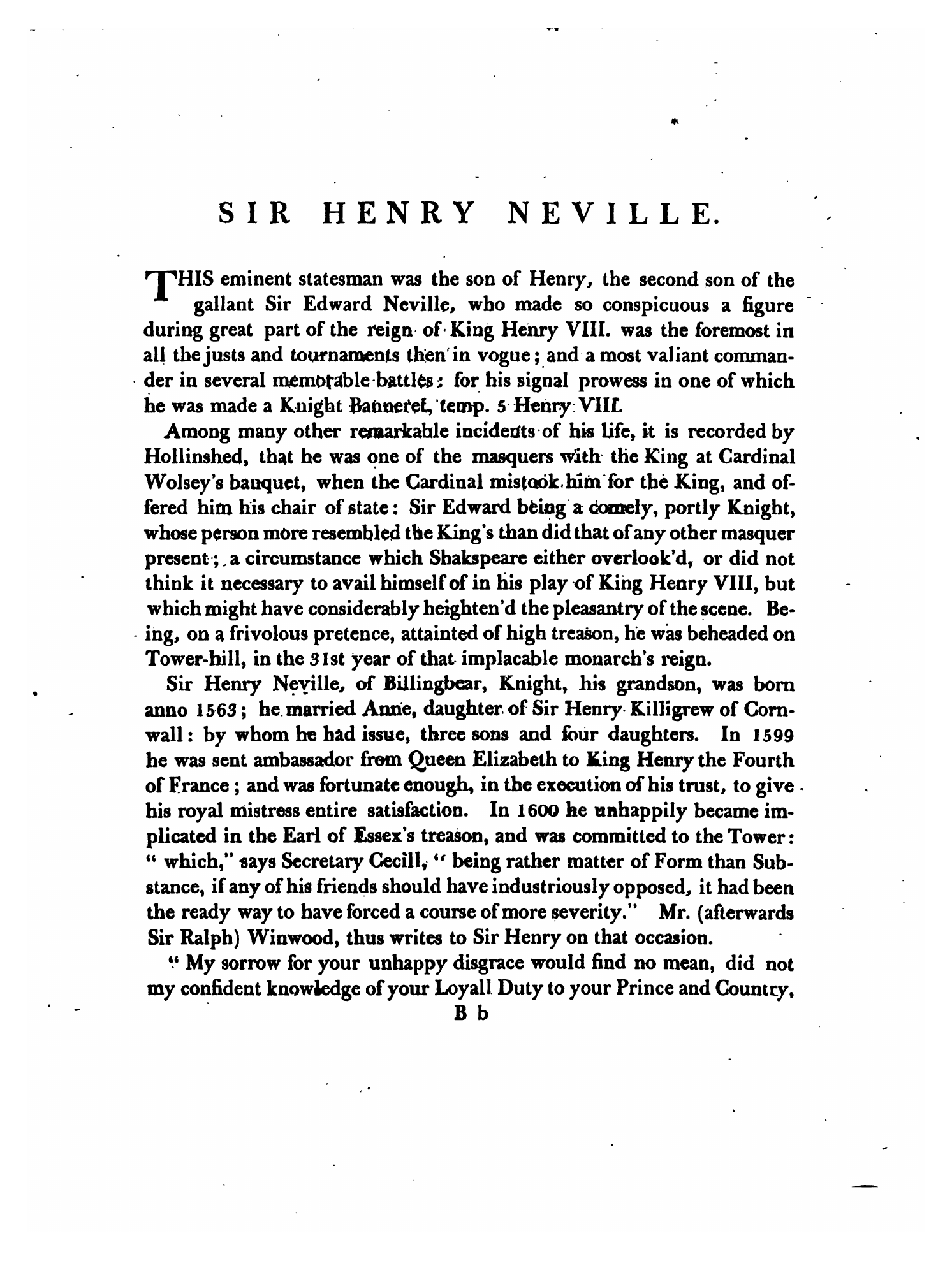
The Sir Henry Neville entry moves from Sir Edward Nevill and Holinshed's Wolsey-banquet anecdote to a comment on Shakespeare's handling of the same scene in Henry VIII. It is an early antiquarian/reception witness for the Neville-family resonance that a late eighteenth-century editor saw in the play, followed by a substantial biographical account of the ambassador, Essex affair, imprisonment, release, later political expectations, death, dispatches, and reputation.
Direct IA / Google / NYPL Witness Lane
Verified directly from the IA metadata, OCR, and page images:
- The item identifier is
biographicalmir00hardgoog. - The volume is Google-digitized from a New York Public Library copy and preserved at Internet Archive.
- The publication data for this witness is London, S. and E. Harding, 1795.
- IA metadata gives the Google Books source URL as
http://books.google.com/books?id=qq0EAAAAYAAJ&oe=UTF-8. - IA metadata notes that volumes 2-3 have a longer title variant; this packet uses the 1795 volume containing the Sir Henry Neville entry.
- IA page
n174is the portrait plate identifying Sir Henry Neville as ambassador to France in 1599 and deriving the image from a portrait in Richard Aldworth Neville's collection. - IA page
n175, printed page 90, begins the entry headedSIR HENRY NEVILLE. - The page sequence was downloaded, rendered, and visually checked on
2026-07-10: PDF p. 174 is the portrait plate; PDF pp. 175-178 contain printed pp. 90-93. - The local source bundle preserves IA metadata, the public-domain PDF, DjVu OCR, and high-resolution checked renders.
HathiTrust remains useful as a cross-record for the multi-volume bibliographic description, but it is no longer the controlling text witness for this packet.
What the 1795 Entry Actually Says
The opening genealogical and masque passage on printed p. 90 reads:
THIS eminent statesman was the son of Henry, the second son of the gallant Sir Edward Neville, who made so conspicuous a figure during great part of the reign of King Henry VIII. was the foremost in all the justs and tournaments then in vogue; and a most valiant commander in several memorable battles.
It then names Holinshed and makes the Shakespeare comparison directly:
Among many other remarkable incidents of his life, it is recorded by Hollinshed, that he was one of the masquers with the King at Cardinal Wolsey's banquet, when the Cardinal mistook him for the King, and offered him his chair of state: Sir Edward being a comely, portly Knight, whose person more resembled the King's than did that of any other masquer present; a circumstance which Shakspeare either overlook'd, or did not think it necessary to avail himself of in his play of King Henry VIII, but which might have considerably heighten'd the pleasantry of the scene.
The entry then turns explicitly to Billingbear Neville:
Sir Henry Neville, of Billingbear, Knight, his grandson, was born anno 1563; he married Anne, daughter of Sir Henry Killigrew of Cornwall: by whom he had issue, three sons and four daughters. In 1599 he was sent ambassador from Queen Elizabeth to King Henry the Fourth of France.
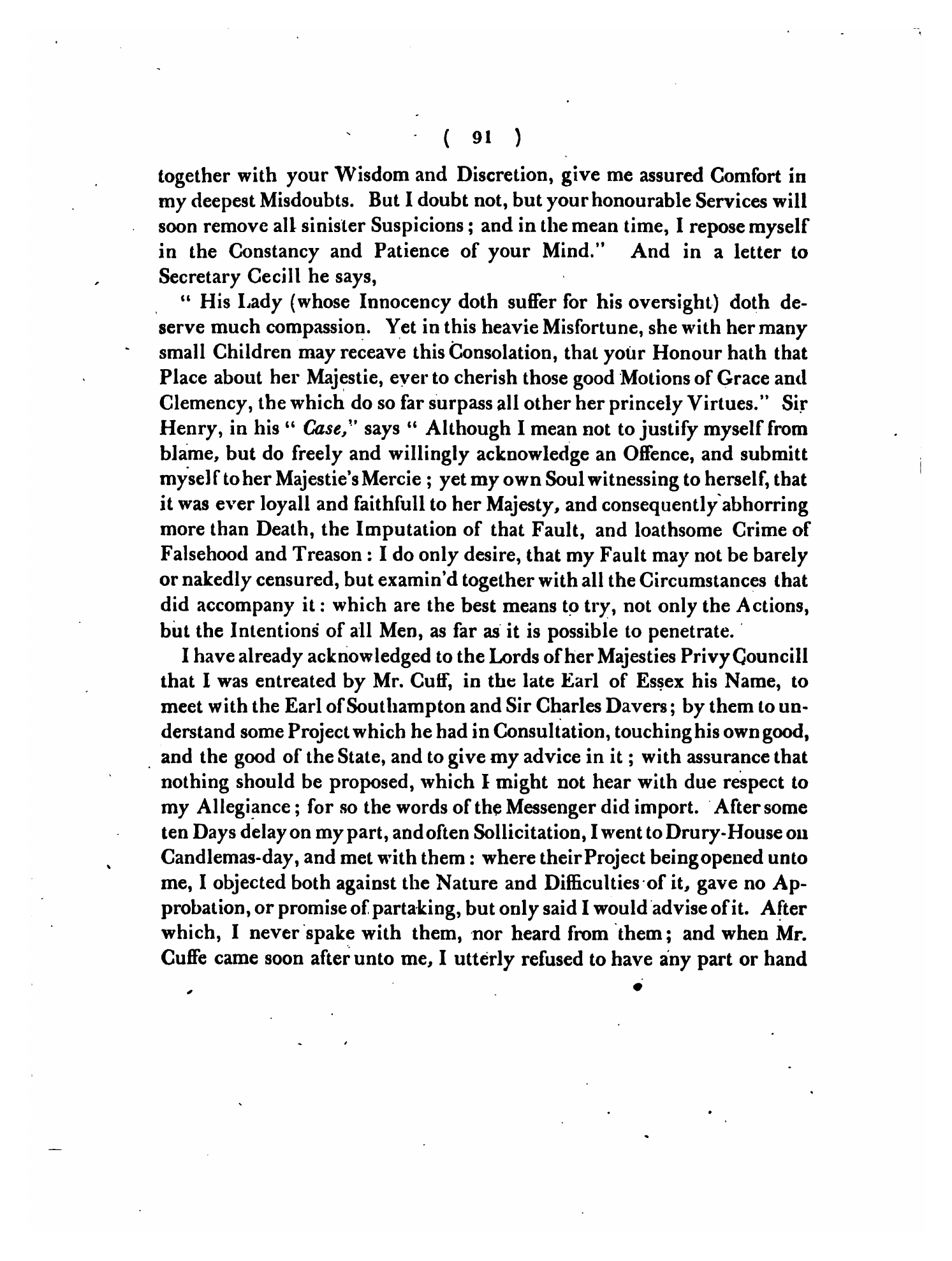
Printed pp. 91-92 reproduce a long passage from Neville's Case. The first portion states:
Although I mean not to justify myself from blame, but do freely and willingly acknowledge an Offence, and submitt myself to her Majestie's Mercie; yet my own Soul witnessing to herself, that it was ever loyall and faithfull to her Majesty, and consequently abhorring more than Death, the Imputation of that Fault, and loathsome Crime of Falsehood and Treason.
The account names the Drury House meeting and Neville's response:
I have already acknowledged to the Lords of her Majesties Privy Councell that I was entreated by Mr. Cuff, in the late Earl of Essex his Name, to meet with the Earl of Southampton and Sir Charles Davers ... I objected both against the Nature and Difficulties of it, gave no Approbation, or promise of partaking.
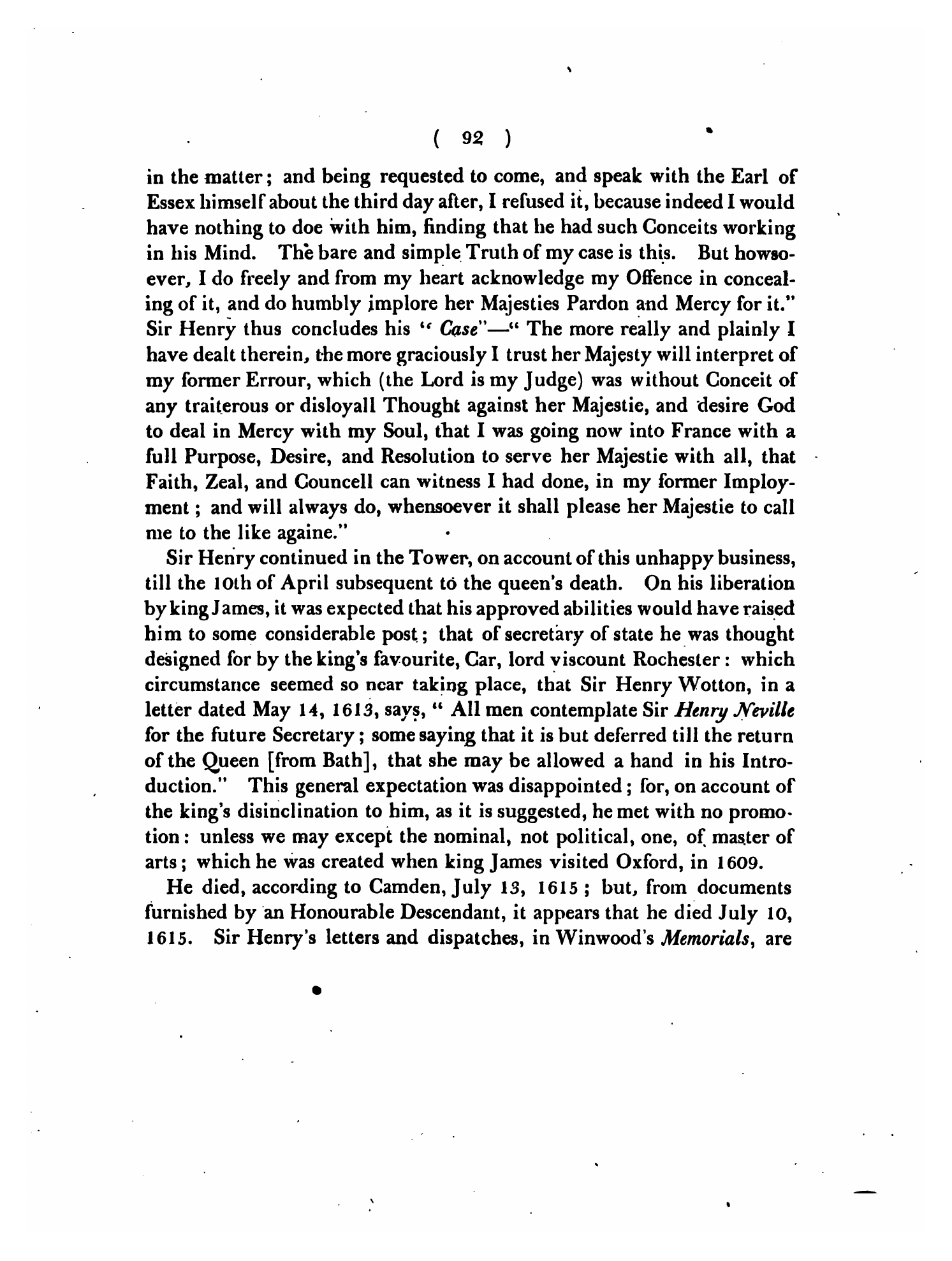
On printed p. 92, the entry records his release and the later secretaryship expectation:
Sir Henry continued in the Tower ... till the 10th of April subsequent to the queen's death.
All men contemplate Sir Henry Neville for the future Secretary; some saying that it is but deferred till the return of the Queen [from Bath], that she may be allowed a hand in his Introduction.
It also preserves a date correction attributed to family documents:
He died, according to Camden, July 13, 1615; but, from documents furnished by an Honourable Descendant, it appears that he died July 10, 1615.
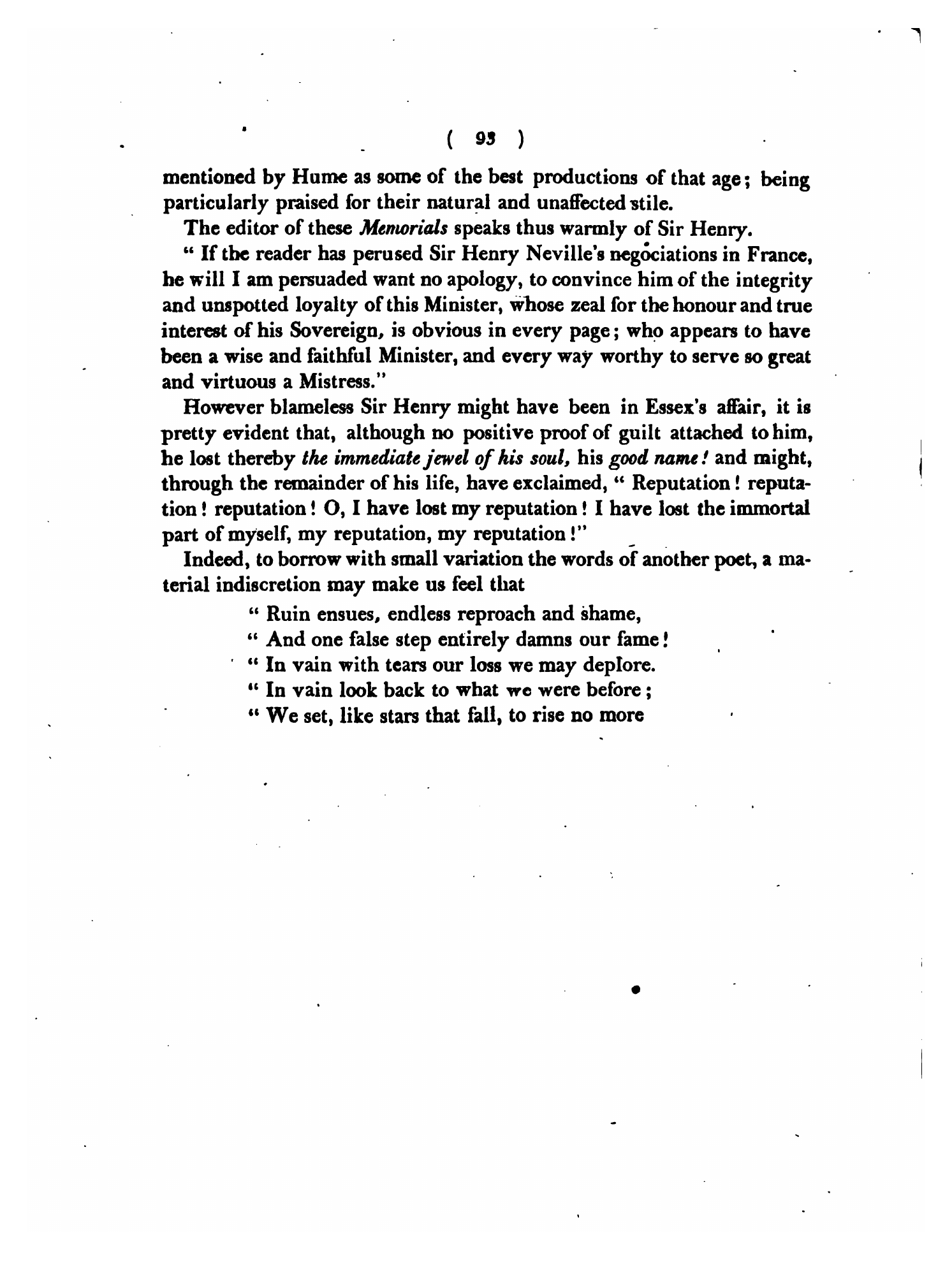
Finally, printed p. 93 praises the Winwood's Memorials dispatches as natural and unaffected in style and moralizes the political aftermath through Iago's Reputation! reputation! reputation! speech from Othello. That is part of the source's own late-eighteenth-century construction of Neville's life and literary reputation, and is worth recording independently of the Henry VIII comparison.
Sir Edward Nevill / Holinshed Masque Lane
The entry begins by routing Sir Henry Neville through Sir Edward Nevill. The page calls Sir Henry the grandson of Sir Edward; for book prose, treat this as the 1795 source's relationship claim until a generation-by-generation pedigree is attached.
The Holinshed basis has been checked locally in the 1587 Chronicles, volume 3, EEBO-TCP A68202. In that witness, Cardinal Wolsey is asked to identify the king among the masked visitors. Wolsey chooses the man with the blacke beard; Holinshed then identifies him as Sir Edward Neuill/Neill and says that, in that mask, he resembled Henry VIII more than the other masquers.
The 1795 entry does not cite a specific Holinshed edition. The current controlled citation for the anecdote is the local 1587 TCP extraction until page-image comparison is completed.
Shakespeare Comparison Lane
The Shakespeare claim in the 1795 entry is specific and limited. The entry says Shakespeare either overlooked the Sir Edward Nevill incident or judged it unnecessary, though the incident could have sharpened the scene's humor.
This is a reception/source-comparison claim. It proves that an eighteenth-century antiquarian source noticed a Nevill-specific detail in Holinshed's banquet scene and compared it with Shakespeare's Henry VIII. It does not prove that Shakespeare knew the Neville family history for personal reasons, and it does not prove Henry Neville's authorship.
Quoted Source Passages
- IA/Google/NYPL OCR confirms the entry heading:
SIR HENRY NEVILLE(IA text). - The 1795 entry calls him
the son of Henryand links the family toSir Edward Neville; treat this as a source claim, not final genealogy proof. - Its Shakespeare comparison turns on
Shakspeare either overlook'dthe incident or did not need it for Henry VIII (IA page n175). - Holinshed's controlled local wording identifies
the gentleman with the blacke beardassir Edward Neuill, whoresembled the kings person(A68202 Holinshed 1587 Wolsey masque Sir Edward Neuill excerpt:1).
Evidence note: this packet is an early reception/source-comparison witness. It should not be used to prove authorship, paternity rumor, or the Sir Edward-to-Billingbear genealogy without separate controls.
Sir Henry Neville Biography Lane
After the Sir Edward Nevill and Shakespeare comparison, the entry summarizes Sir Henry Neville of Billingbear:
- born in 1563;
- married Anne Killigrew;
- sent as ambassador to Henry IV of France in 1599;
- implicated in Essex's treason in 1600;
- committed to the Tower;
- later framed through reputation, including a quoted passage from Othello.
The Othello quotation is a second Shakespeare reception lane inside the same 1795 biography. The entry uses it to moralize Neville's political fall rather than to discuss a source for the play. Both references should be documented, but they perform different work in the biography.
Checked Page Images
Portrait plate (PDF p. 174 / Archive n174)
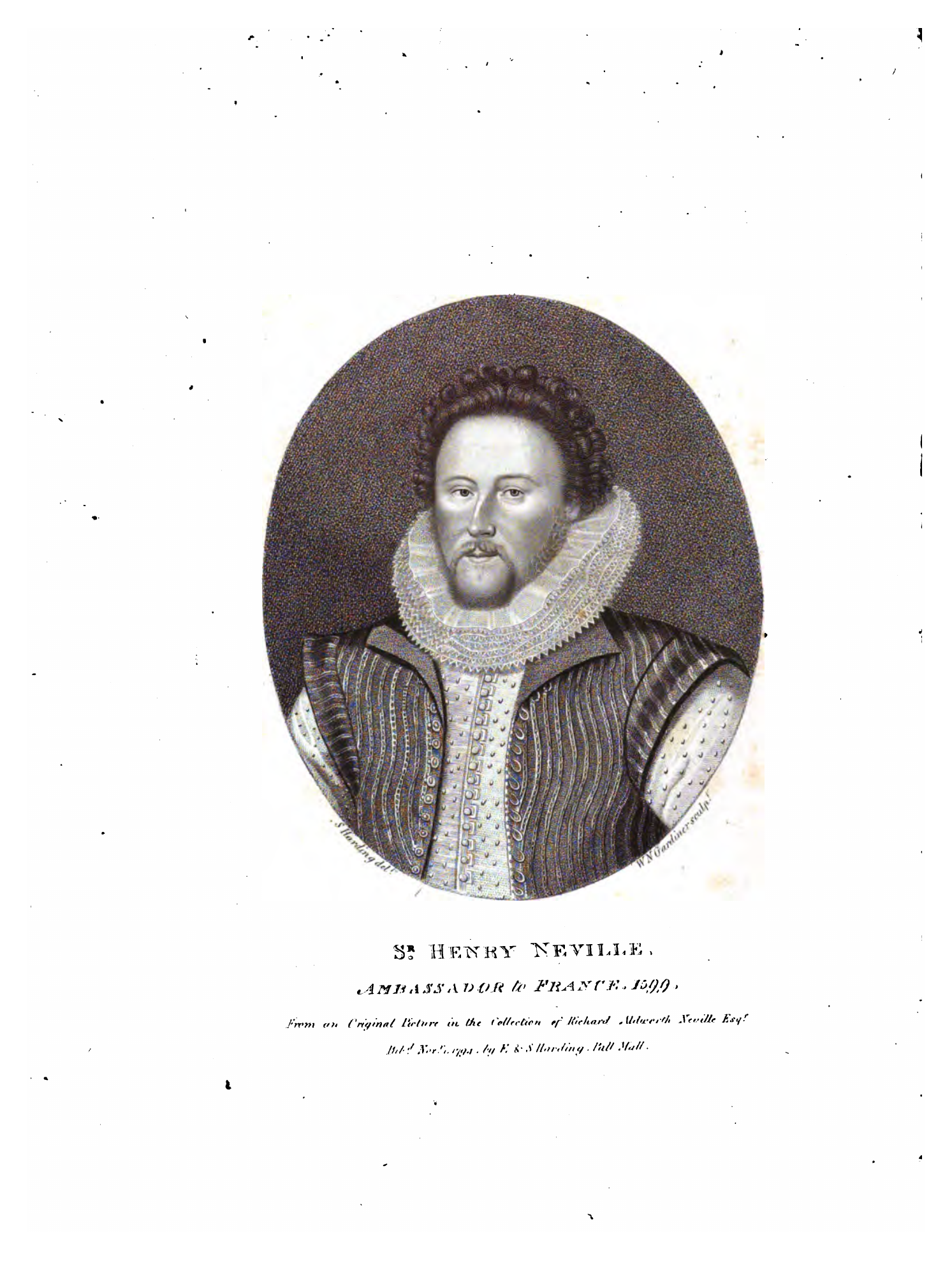
The plate caption reads Sr HENRY NEVILLE, AMBASSADOR to FRANCE. 1599 and says the image was taken from an original picture in the collection of Richard Aldworth Neville, Esq.
Entry opening, printed p. 90 (PDF p. 175 / Archive n175)
Neville's Case, printed p. 91
Release, secretaryship expectation, and death date, printed p. 92
Dispatches and Othello reception, printed p. 93
Notes and Queries 1850 Comparator Lane
Lord Braybrooke's 1850 Notes and Queries note is a later comparator, not the primary source for the 1795 packet.
The 1850 note preserves the Elizabeth / Sir Henry Nevill Brother Henry anecdote and then turns to the Wolsey masque scene. It quotes the Holinshed black-beard / Sir Edward Nevill passage and says Shakespeare omitted the particular incident. The note's wording is slightly unstable for modern use because it introduces the omission as relating to Sir Henry Nevill, while the Holinshed anecdote itself identifies Sir Edward Nevill.
Book use should therefore separate the roles:
- Sir Henry Nevill of Billingbear: Elizabeth anecdote and later family memory;
- Sir Edward Nevill: Holinshed masque incident;
- Shakespeare's Henry VIII: later dramatization of the Wolsey banquet without the Sir Edward Nevill recognition detail.
The Add MS 15476 paternity-rumor witness belongs in a different packet. It is a direct rumor statement about Sir Henry Neville of Billingbear's alleged paternity, whereas this 1795 packet is a reception witness for the Sir Edward Nevill / Wolsey masque / Shakespeare comparison.
Henry VIII Play-Text Boundary
The Folger Henry VIII controls the play-text lane:
- Lord Abergavenny appears in the dramatis personae as Buckingham's son-in-law.
- Lord Abergavenny is present in
1.1. 1.2reports Buckingham's speech to his son-in-law, Lord Abergavenny.- The Wolsey banquet and masked visitors appear in
1.4.
These are distinct from the Holinshed Sir Edward Nevill anecdote. Abergavenny in Shakespeare is a play character/titleholder lane; Sir Edward Nevill in Holinshed is the omitted recognition-detail lane; Sir Henry Neville of Billingbear in the 1795 entry is the portrait-biography lane.
Ken Feinstein Twitter Trail
Ken Feinstein's 2 June 2019 tweet remains important as the discovery trail. It linked the source to HathiTrust record 001964490 and preserved images of the title page, portrait plate, and Sir Henry Neville biography page.
The tweet's interpretation should be cited as Ken's interpretation unless repeated from checked primary witnesses. The checked primary witnesses now confirm the narrow basis: a 1795 Sir Henry Neville entry compares Holinshed's Sir Edward Nevill masque anecdote with Shakespeare's Henry VIII.
Distinctions to Preserve
- Do not describe the source as The Mirrour of Maiestie; the controlled source is The Biographical Mirrour.
- Do not say the packet depends only on screenshots. The direct IA/Google/NYPL page witness is now checked.
- The 1795 source documents an early reception comparison between a Nevill-specific Holinshed detail and Shakespeare's Henry VIII; the packet records that comparison without making it answer the authorship question by itself.
- Do not treat the 1795
grandsonwording as final genealogy proof until the Sir Edward Nevill -> Billingbear path is keyed from direct pedigree, peerage, or archival witnesses. - Do not collapse Sir Edward Nevill in Holinshed, Lord Abergavenny in the Shakespeare play, and Sir Henry Neville of Billingbear in the portrait biography into one undifferentiated Neville claim.
- Do not use this 1795 source as evidence that Sir Henry Neville of Billingbear was Henry VIII's son. That paternity-rumor lane is controlled separately through Add MS 15476, Notes and Queries, and Folger ECDbD.
- Do not use the Othello reputation quotation as part of the Henry VIII source argument. Keep it as a separate reception/disgrace motif unless later source work justifies more.
- Do not use BRO
Doc_50,Doc_54, orDoc_66as proof for this 1795 printed source. They are separate genealogy controls for the broader Abergavenny/Billingbear path;Doc_66is specifically the 1833 printed pedigree now identified as RBAD/EN/F41.
Book-Safe Formulation
Book-safe version:
A 1795 portrait-biography entry for Sir Henry Neville in The Biographical Mirrour links Neville family biography to the Wolsey banquet scene in Henry VIII through Sir Edward Nevill. The checked Internet Archive/Google/NYPL witness shows the entry summarizing Holinshed's anecdote in which Wolsey mistakes Sir Edward Nevill for the king among the masquers, then commenting that Shakespeare either overlooked the incident or did not need it for the play. This is useful early reception evidence: it shows that before modern authorship debate, an antiquarian source had already noticed a Nevill-specific detail in Holinshed and compared it with Shakespeare's handling of the Wolsey scene. It should be used as source-reception evidence, not as proof of authorship or as a substitute for a keyed Neville genealogy.
Citations
- Waldron, F. G. The Biographical Mirrour, comprising a series of ancient and modern English portraits, of eminent and distinguished persons, from original pictures and drawings. London: S. and E. Harding, 1795. Internet Archive / Google / NYPL witness: biographicalmir00hardgoog.
- Sir Henry Neville portrait plate: IA page n174.
- Sir Henry Neville entry, printed p. 90: IA page n175.
- HathiTrust cross-record:
https://catalog.hathitrust.org/Record/001964490. - Local public-domain PDF: biographicalmir00hardgoog.
- Local IA OCR: biographicalmir00hardgoog djvu.
- Local IA metadata: biographicalmir00hardgoog meta.
- Ken Feinstein. Tweet, 2 June 2019: X/Twitter status 1135285906120646656.
- Local Twitter image witnesses:
- 1135285906120646656 D8FYgiGUIAAOR c
- 1135285906120646656 D8FYgiKUcAAH2Py
- 1135285906120646656 D8FYgiGUYAA hqF
- Lord Braybrooke. "Queen Elizabeth and Sir Henry Nevill." Notes and Queries, No. 50, 12 Oct. 1850, p. 307. Project Gutenberg preservation: 13551-h.htm. Local HTML: notes_and_queries_issue_50_1850.html.
- Dedicated paternity-rumor source-control packet: henry viii paternity rumor sir henry neville elder.
- Holinshed, Raphael. The first and second volumes of Chronicles. [vol. 3]. London, 1587. EEBO-TCP
A68202. Local extraction: - A68202 Holinshed 1587 vol3
- A68202 Holinshed 1587 Wolsey masque Sir Edward Neuill excerpt
- Shakespeare, William. Henry VIII. Folger Shakespeare Library text witness:
- front matter
- act 01 scene 01
- act 01 scene 02
- act 01 scene 04
Notes on Access
- The direct text witness is the IA/Google/NYPL scan. Future work can collate this copy against HathiTrust, ESTC/Folger, and a British Library copy for copy-specific variants.
- The IA OCR is good enough for orientation, but final quotation should still be checked against the page image because the long-s and apostrophe OCR is uneven.
- The source is valuable because it makes two Shakespeare references inside a Henry Neville portrait-biography entry: the Sir Edward Nevill / Wolsey masque comparison with Henry VIII, and the use of Iago's reputation speech to characterize Neville's political disgrace.
- The direct Holinshed extraction currently uses the 1587 volume 3 witness (
A68202). A quick local search of the 1577 TCP witness (A03448) did not surface the sameblacke beard/sir Edward Neuillwording, so the 1587 witness should be the cited source until a page-image comparison is completed.