Dudley Digges
Topic: Dudley Digges
Hadfield 2020 source mining — 31 August 2026
Andrew Hadfield's “Shakespeare and the Digges Brothers,” Reformation 25.1 (2020), 2–17, DOI 10.1080/13574175.2020.1743554, has been read in full. It is important because it treats Dudley and Leonard as a family network rather than as isolated names. For Dudley, it develops three leads:
- his signed contribution to Coryats Crudities places him in the same large
- it restates the hypothesis that Dudley's Virginia Company position could have
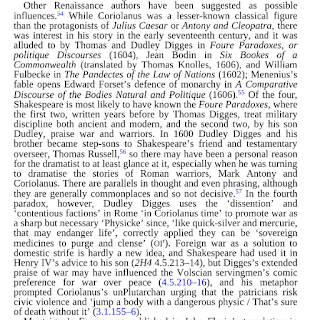
- following Kenneth Muir, it compares Dudley's 1604 sections of Foure Paradoxes
prefatory-verse volume as Henry Neville, Donne, Jonson, Inigo Jones, and others;
supplied access to Strachey's True Reportory, but does not produce a document showing that he transmitted it;
with the militarism, idleness, effeminacy, and civic conflict of Coriolanus.
The first point is a direct printed-network fact. The second and third are research hypotheses requiring their own primary controls. Hadfield also contains a birth-order error: Dudley (1583–1639) was Leonard's elder brother, not his younger brother. This correction is now explicit wherever the article is mined.
Source-Control Summary
- Dudley Digges is important through four distinct lanes: the signed
6 November 1615Overbury-related examination naming Neville/Rochester/Overbury/Mansell; the1614parliamentary-defense lead for Neville; the Virginia/East India company evidence; and the Digges family/literary network through Leonard, Coryate, and Hadfield. - Keep the document types separate. The Overbury witness is a signed examination/deposition preserved through the blog/O'Donnell transcription route, not Dudley's printed
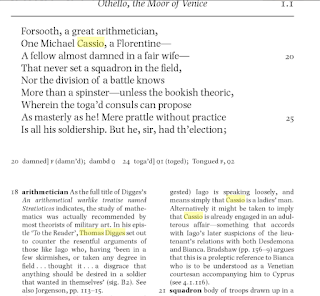
1615East India trade letter. The printed letter isA20442, The defence of trade, and belongs to company/public-trade politics. - Keep the First Folio correction in force: Leonard Digges, not Dudley Digges, wrote the First Folio prefatory poem. Dudley remains relevant to the family and network ecology, not as a Folio poet.
- The examination is now controlled at manuscript folio
SP 14/83 f.12, Gale `MC4323683782`, scans20-22. The6 November 1615entry is printed in the Calendar of State Papers, Domestic, James I, 1611-1618, p.325, vol. LXXXIII, item9. The earlier project formSP 14/83/9conflated that calendar item number with the manuscript locator. John O'Donnell's transcription remains the textual ground truth until a line-by-line image collation records any disagreements.
ODNB Source-Control Position
- Sean Kelsey's ODNB article for Sir Dudley Digges is locally downloaded at odnb 9780198614128 e 7635.
- Use it as T2 biographical context for Dudley's parentage as son of Thomas Digges and brother of Leonard Digges, his Coryate contribution, Virginia/East India/Muscovy trade lanes, 1614 impositions/parliament profile, 1615 Overbury-investigation context, and later anti-Buckingham parliamentary career.
- Direct source controls remain separate: the 1609 Virginia charter and
A14521for Virginia Company evidence; Jansson p.246/ parliamentary records for the 1614 Neville-defense lead; and the Overbury examination route for the 1615 Neville/Rochester claim. - Keep the First Folio correction in force: Leonard Digges, not Dudley Digges, wrote the First Folio prefatory poem.
Blog Witness Importance Note
- The user re-flagged the January
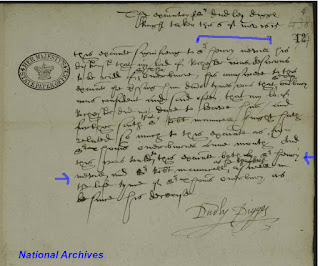
2020blog item as an important Dudley Digges "letter." Treat that correction as an importance signal: this is one of the strongest direct Digges/Neville documentary witnesses in the file and should not be buried as a mere blog summary. - Live-page recheck confirms the page's own document-type wording is "legal examination" and "Dudley Digges Examination"; final scholarly prose should therefore call it a signed examination/deposition or witness statement. If draft prose uses "letter" as project shorthand, add the document-type correction in the same note.
- The evidence value is high because the blog-preserved transcription says Digges was "signifieng to Sr henry nevill" his distrust of Rochester's intentions toward Overbury, and then says the matter was told to Digges by Neville and Mauncell both during Overbury's life and after his death.
- The source ceiling remains active: the blog image is
320x266, so final diplomatic quotation still needs the exact National Archives shelfmark and a high-resolution manuscript image.
1. Verified Sourced Facts
- Ken Feinstein's
7 January 2020blog post preserves a National Archives image and a John O'Donnell transcription of a signed Dudley Digges examination, dated6 November 1615, concerning Neville, Rochester, Sir Thomas Overbury, and Sir Thomas Mansell. The local blog image is only320x266, so it is discovery-grade, but AGY/Gemini visual inspection on2026-06-30confirmed the visible names and document type. - Andrew Hadfield writes:
“It is also likely that Leonard’s younger brother Dudley (1583–1639) knew many of the same people.”
Birth-order correction: the phrase “Leonard's younger brother Dudley” is wrong. Dudley (1583-1639) was the elder surviving son; Leonard (1588-1635) was his younger brother. Retain the quotation only as Hadfield's network inference, not as genealogical evidence.
- Hadfield writes:
“Dudley Digges’ contribution suggests that he might have been part of the circle who met in the famous Mermaid Tavern”
- Julian T. S. Neuhauser writes:
“Of the next 12 contributors listed in the ‘Panegyricke Verses’, eight were associated with the circles at the Mitre (Cranfield), the Mermaid (Whitaker), or both (Donne, Martin, Brooke, Holland, Jones and Hoskins).”
- Hadfield writes:
“both Dudley Digges and Shakespeare had connections which valued intricate verbal play, wit, a common interest”
- Hadfield writes:
“Dudley could have been the source for the Strachey letter, which Shakespeare almost certainly used for The Tempest”
- Hadfield writes:
“a work by Dudley did serve as a source for a Shakespeare play”
- Hadfield writes:
“Kenneth Muir argued that Coriolanus had been influenced by Dudley Digges, his sonne”
- A
2026-05-29Google Books search-within-volume extraction from Jansson, Proceedings in Parliament, 1614 (House of Commons), p.246, supports the local source trail that Dudley Digges defended the principle that a private man could move the King for the good of the country. The official History of Parliament biography independently contextualizes that intervention and cites Jansson pp.67-68,76,122-23, and246; the exact Jansson page remains snippet-level pending a full page image/OCR. - A
2026-05-29Virginia Company source check upgrades Dudley's company role from Twitter-level lead to direct source control: the 23 May 1609 Second Charter names Sir Dudley Diggs in the resident council for the Company of Adventurers and Planters in Virginia, and EarlyPrint/TCPA14521confirms a 1620 paid adventurer entry for Sir Dudley Diggs. - A
2026-05-29First Folio source check keeps the Digges/Folio family link but corrects the person: EarlyPrint/TCPA11954supports Leonard Digges as the First Folio prefatory poet and does not support Dudley,D. Digges, orD. Diggsin the checked front-matter witness. - EarlyPrint/TCP
A20442, Dudley Digges's1615The defence of trade. In a letter to Sir Thomas Smith, is a separate printed-letter source lane. It matters for Dudley's East India Company / public-trade identity, but it is not the same witness as the blog-preserved Overbury examination.
Career and Parliamentary Control from the History of Parliament
The official History of Parliament biography materially widens this packet beyond the isolated Neville references. It supplies a chronological control for four overlapping Dudley Digges careers:
| Lane | Directly useful control | Research implication |
|---|---|---|
Commons, 1610 | 17 committee appointments and 6 recorded speeches | Digges was already an active parliamentary operator before the Addled Parliament. |
Commons, 1614 | 24 committee appointments and 36 recorded speeches | His defense of approaching the king belongs to a very high-activity session, not an incidental appearance. |
| Overseas companies | Virginia Company board from 1609; North-West Passage, Bermuda, East India, and later Muscovy activity | Company membership should be treated as a sustained commercial-policy career, not a single Virginia name-hit. |
| Overbury circle | The biography calls Digges intimate with Overbury and places him in attempts to persuade Overbury to accept a foreign posting | This supplies biographical context for the later examination, while manuscript SP 14/83 f.12 remains the direct Neville witness. |
The 1614 evidence also needs more nuance than the shorthand “Digges defended Neville.” The biography reports that Digges admitted he had been an “undertaker” only in the limited sense of advising that Parliament be called to address grievances and supply. On 2 May he called the undertaking story a “false rumour spread to hinder the great businesses now in hand.” On 14 May, invoking his father’s precedent, he argued that:
“a private man might go and move the king for the good of the country, uncalled”
This supports a procedural and constitutional defense of unsolicited counsel to the crown. It does not by itself prove that Digges endorsed every part of Neville’s negotiation or belonged to a formally organized parliamentary bloc.
The company chronology is equally important. Digges joined the Virginia Company board in 1609, backed Henry Hudson’s last voyage and a North-West Passage company, joined a Bermuda syndicate, lost the East India Company governorship contest to Sir Thomas Smythe in July 1614, published The Defence of Trade in 1615, and went to Moscow in 1618 seeking an East India trade route. The result is a firmer research model: Parliament, overseas projects, and print controversy were mutually reinforcing parts of his public career.
Quoted Source Passages
1. The Signed Dudley Digges Examination Names Neville, Rochester, and Overbury
- Source: Ken Feinstein, "New Discovery: Dudley Digges, Henry Neville, and Shakespeare,"
7 January 2020, with National Archives image and John O'Donnell transcription; local preservation blog dudley digges discovery 2020 01 07; image witnesses image 01 5b07271f52; visual check DUDLEY DIGGES BLOG IMAGE AGY CHECK. - Quotation:
"The examination of Sr Dudley Digges knight taken the 6 of nov 1615"
- What it proves: The blog preserves a signed Digges examination witness, not merely a later narrative about Digges and Neville.
- Limits: The image witnesses is a low-resolution blog derivative; the TNA high-resolution image or exact shelfmark still needs retrieval before treating the transcription as final diplomatic text.
2. The Calendar Summary Gives the Core Neville/Rochester/Overbury Claim
- Source: Mary Anne Everett Green, ed., Calendar of State Papers, Domestic, James I, 1611-1618 (London,
1858), p.325, vol.LXXXIII, item9; underlying manuscriptSP 14/83 f.12, GaleMC4323683782. - Quotation:
"Examination of Sir Dud. Diggs. On expressing to Sir Hen. Neville his fear that Rochester was desirous to be rid of Overbury, both he and Sir Thos. Mansell told him, from Overbury's own mouth, that he was confident Rochester would not dare to abandon him."
- What it proves: The calendared summary directly connects Neville, Digges, Rochester, Mansell, and Overbury; State Papers Online independently identifies the manuscript as
SP 14/83 f.12. - Limits: A calendar summary is edited evidence; it should be checked against the full manuscript examination.
3. O'Donnell's Transcription Gives the Direct Neville-Digges Conversation
- Source: Same blog post, John O'Donnell transcription.
- Quotation:
"this examinate signifieng to Sr henry nevill his dystrust that my lord of Rochester was desirous to be ridd of Sr Tho: Ouerburie"
- What it proves: The transcription presents Digges as reporting his own communication to Sir Henry Neville about Rochester and Overbury.
- Limits: Because the extant image witnesses is too small for full independent collation, use this as an O'Donnell/blog-controlled transcription until the TNA image is obtained.
4. The Same Transcription Brings in Mansell and Overbury's Own Words
- Source: Same blog post, John O'Donnell transcription.
- Quotation:
"Sr Robert mauncell knight hath related so much to this examinate as from Sr Thomas Ouerburies owne mouth"
- What it proves: The examination does not only name Neville and Digges; it also routes the Overbury information through Mansell and Overbury's reported speech.
- Limits: The name appears as
mauncellin the transcription; reconcile with the topic'sSir Thomas Mansellwording after high-resolution manuscript collation.
5. The Fuller O'Donnell Transcription Gives the Reported Overbury Answer
- Source: Live-blog extraction of John O'Donnell's transcription, now preserved in blog dudley digges discovery 2020 01 07:24.
- Quotation:
"Sr Tho: Ouerbury was confident and said often, that my lo: of Rochester did not dare to leave him"
- What it proves: The blog transcription preserves the substantive reported answer: Overbury allegedly believed Rochester would not dare abandon him.
- Limits: This is still O'Donnell/blog transcription evidence until collated against a high-resolution TNA image.
6. The Blog Transcription Gives the Life/Death Timing Frame
- Source: Same live-blog extraction and local source note; image-control caveat in DUDLEY DIGGES BLOG IMAGE AGY CHECK:36.
- Quotation:
"this was tould to this examinate both by Sr henry nevill, and Sr Robert mauncell as he thinketh as well in the life tyme of Sr Tho: Ouerbury as since his decease"
- What it proves: The fuller transcription makes the timing lane explicit: Digges says the information was told to him by Neville and Mansell, with a cautious
as he thinketh, both during Overbury's life and after his death. - Limits: Do not quote the older low-resolution visual phrase
before his deathas final text; use the live-blog transcription wording above unless the high-resolution manuscript changes it.
7. Digges's 1614 Parliamentary Defense of Neville Has a Specific Quotation
- Source: Same blog post quoting Maija Jansson, ed., Proceedings in Parliament, 1614 (House of Commons), p.
246snippet route. - Quotation:
"a private man might go and move the King for the good of the country, uncalled"
- What it proves: The local parliamentary-defense lead has a concrete quoted proposition attributed to Dudley Digges in defense of Neville's access to the king.
- Limits: This still needs the full Jansson p.
246page image or OCR before being treated as fully hardened parliamentary evidence.
8. Virginia Company Print Evidence Names Dudley Digges and Henry Neville Separately
- Source: EarlyPrint/TCP
A14521, A declaration of the state of the colonie and affaires in Virginia,1620; local extraction A14521. - Quotation:
"Sir Dudley Diggs 37. 10"; "Sir Henry Neuill, of Barkshire 37. 10"
- What it proves: A printed Virginia Company list gives direct company-adventurer controls for both Dudley Digges and Sir Henry Neville.
- Limits: The entries establish shared company context, not personal friendship or manuscript circulation.
9. Dudley Digges Also Has a Separate Printed 1615 Trade Letter
- Source: EarlyPrint/TCP
A20442, Dudley Digges, The defence of trade. In a letter to Sir Thomas Smith Knight, gouernour of the East-India Companie, &c. From one of that societie (1615); extracted sidecar A20442 defence of trade. - Quotation:
"TO THE RIGHT WORSHIPFVLL , SIR THOMAS SMITH , KNIGHT , &c."
- What it proves: Dudley's printed
1615"letter" is explicitly addressed to Sir Thomas Smith/Smythe in the East India Company orbit. - Limits: This printed policy pamphlet is not the
6 November 1615Overbury examination and should not be used as evidence of the Neville/Rochester/Overbury conversation.
10. The Printed Trade Letter Casts the East India Company as State Service
- Source: Same EarlyPrint/TCP
A20442extraction. - Quotation:
"against the East-Indian Trade"; "with good seruice to the State"
- What it proves: Dudley's printed-letter lane belongs to merchant-company politics, public trade, shipping, and service-to-state rhetoric.
- Limits: It supports Dudley's company-world profile; it does not prove a Shakespeare publication route or a direct Neville relationship.
2. Ken Feinstein Twitter and Blog Information
- A Ken Feinstein blog post dated
7 Jan. 2020identifies aNovember 1615legal examination in which Dudley Digges is said to have reported remarks by Henry Neville about Overbury and Rochester.
- The preserved
7 Jan. 2020Ken Feinstein blog post is the current local source trail for: - the
1615Overbury-related examination summary - the
1614parliamentary-defense note - the St. Leger / Neville / Russell family-link claim
- the Pantometria / Volpone / Coryate's Crudities linkage
- The same blog post identifies the Neville family connection through Ursula Neville: Anne St. Leger (Thomas Digges's wife and Dudley's mother) was the daughter of Ursula Neville. This is now independently reconstructed from public peerage and biographical sources. Ursula was a daughter of George Neville, Lord Bergavenny; George's brother Sir Edward Neville was father of Sir Henry Neville of Billingbear and grandfather of the ambassador. The exact degrees are therefore: Ursula Neville and the elder Sir Henry Neville of Billingbear were first cousins; Ursula was the ambassador's first cousin once removed; Anne St. Leger and the ambassador Henry Neville were second cousins; Dudley and Leonard Digges were Henry Neville's second cousins once removed.
- Ken Feinstein's Twitter layer emphasizes three narrower leads: Dudley Digges defended Neville in the 1614 Parliament with John Hoskyns; Dudley was tied to the Virginia Company; and Dudley's brother Leonard later wrote for the First Folio.
- The company-role component is now directly sourced through the 1609 charter and 1620
A14521; the parliamentary-defense and First Folio family-link components remain separate source lanes. - The
1614parliamentary-defense lead is partially upgraded: the Digges defense appears in Google Books snippet extraction from Jansson p.246, but full page verification is still pending.
3. Source-Control Guardrail
- Do not describe Dudley Digges as a First Folio prefatory poet. That wording appears in older local matrices and drafts but is not supported by the checked
A11954First Folio witness. - Do not normalize the blog-preserved
1615Overbury witness as a private "letter" in final prose. The present source controls identify it as a signed Digges examination/deposition; the separate printed1615Dudley Digges letter isA20442, The defence of trade, and belongs to the East India Company lane. - Dudley's book-facing literary lane is Coryate / Mermaid / Jonson-adjacent commendatory culture, plus the reported influence/source claims discussed by Hadfield. Leonard Digges is the Digges brother in the First Folio prefatory-material lane.
- The Thomas Russell identification is supported by converging compiled and modern biographical sources, but those sources must not be described as three independent primary controls. Phillimore's 1888 Worcester chart, printed p. 119, places Thomas under Sir Thomas Russell and Margaret Lygon, joins Thomas to Anne, and labels the man on Anne's other side
Diggs, 1 husband.It does not call Anne a daughter of Digges. Because this marriage occurred long after 1569, the relevant material is a later continuation or editorial addition to the visitation pedigree, not a contemporary 1569 witness. Leonard Digges's ODNB biography identifies Thomas Digges's widow as the woman who married Thomas Russell of Alderminster; Shakespeare Documented follows the modern identification of that Russell as Leonard's stepfather and transcribes the appointment of aThomas Russell, Esquireas overseer of Shakespeare's will. TNA separately catalogues the 1634 will of Thomas Russell of Rushock asPROB 11/165/424. The resulting Digges-Berkeley-Stratford connection is strongly supported, but Shakespeare's will alone does not establish Russell's parentage or marriage. Public controls: edited Worcestershire pedigree; Leonard Digges, ODNB; Shakespeare Documented will record; TNA, PROB 11/165/424.
2026-07-15 Genealogical Recheck: the Neville cousin identified
The remembered Neville cousin was Ursula Neville, Dudley and Leonard Digges's maternal grandmother. The chain is:
George Neville, Lord Bergavenny -> Ursula Neville -> Anne/Agnes St. Leger -> Dudley and Leonard Digges
The corresponding Billingbear line is:
Sir Edward Neville, George's brother -> Sir Henry Neville of Billingbear -> Sir Henry Neville the ambassador
The old Dictionary of National Biography article on Sir Warham St. Leger explicitly states that his first wife Ursula was a daughter of George Neville and that their daughter Anne married Thomas Digges and became mother of Sir Dudley Digges. The Complete Peerage independently identifies Sir Edward Neville as George's brother. The DNB entries on Sir Edward and the ambassador then carry the Billingbear descent through the elder Sir Henry. Numbering of the Bergavenny barony differs between older and modern sources, so the relationship should be expressed through names and parentage rather than an unsupported ordinal alone.
This is more precise than “a Neville connection.” Anne/Agnes St. Leger and the ambassador were second cousins. Dudley and Leonard were his second cousins once removed. The relationship documents a collateral family route; it does not by itself establish the frequency or closeness of personal contact.
Public controls: DNB, Sir Warham St. Leger, printed p. 168; *Complete Peerage*, vol. 1, printed p. 35; DNB, Sir Edward Neville); DNB, Sir Henry Neville).
Twitter Thread Batch 02 Crosswalk
- Requested thread
#32is now represented in the batch-2 source map: twitter thread research batch 02 networks lucan amiens windsor. - The thread's Dudley point has two separate controls: Jansson p.
246is the current route for Dudley defending Neville in the 1614 parliamentary dispute, and leonard digges controls Leonard, not Dudley, as the First Folio prefatory poet. - The current source position preserves the network claim: Dudley matters through Parliament, Coryate/Mermaid literary culture, Virginia Company, and family proximity to Leonard. It should still not be phrased as "Dudley wrote a First Folio poem."
4. Evidence Images
State Papers calendar and manuscript controls for SP 14/83 f.12
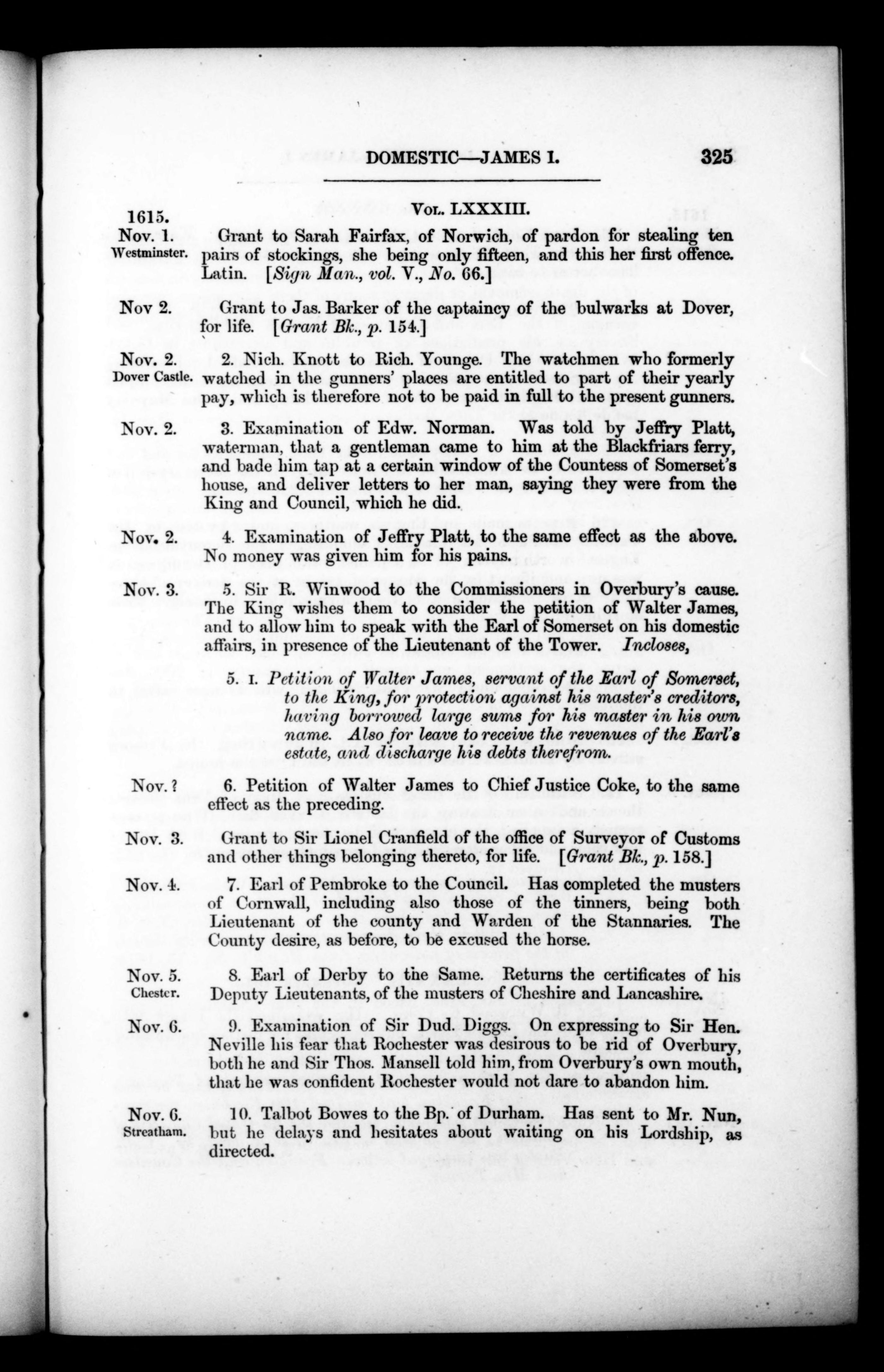
1615 Dudley Digges examination and related local evidence
5. Citations
- Feinstein, Ken. “New Discovery: Dudley Digges, Henry Neville, and Shakespeare.” Ken Feinstein (blog), 7 Jan. 2020, https://kenfeinstein.blogspot.com/2020/01/new-discovery-dudley-digges-henry.html.
- Green, Mary Anne Everett, ed. Calendar of State Papers, Domestic Series, of the Reign of James I, 1611-1618. London: Longman, Brown, Green, Longmans, & Roberts,
1858, p.325, vol.LXXXIII, item9; underlying manuscriptSP 14/83 f.12. Archive.org calendar page; State Papers Online manuscript record. - Thrush, Andrew. “DIGGES, Sir Dudley (1583-1639), of Chilham Castle, Kent.” History of Parliament Online, The House of Commons 1604-1629. Official biography, accessed
9 July 2026. - Hadfield, Andrew. “Shakespeare and the Digges Brothers.” Reformation, vol. 25, no. 1, 2020, pp. 2-17. Taylor & Francis, https://doi.org/10.1080/13574175.2020.1743554.
- Neuhauser, Julian T. S. “Sirenaicks, Guilds and a New Coryate Manuscript.” The Review of English Studies, vol. 74, no. 313, 2023, pp. 31-46. DOI: https://doi.org/10.1093/res/hgac061.
- “Dudley Digges.” Neville Research Wiki source note, mirrored locally at
[local source path removed]. - “Work in Parliament.” Neville Research Wiki source note, mirrored locally at
[local source path removed]. - England and Wales. Parliament. House of Commons, and Maija Jansson, ed. Proceedings in Parliament, 1614 (House of Commons). Philadelphia: American Philosophical Society,
1988, p.246snippet located by Google Books search-within-volume. Metadata path: https://books.google.com/books/about/Proceedings_in_Parliament_1614_House_of.html?id=L9GqTX0uoT8C. - work in parliament, hardened parliamentary source-map packet.
- James I / Virginia Company. "The Second Charter, May 23, 1609." In The Three Charters of the Virginia Company of London, edited by Samuel M. Bemiss. Virginia 350th Anniversary Celebration Corporation,
1957. Project Gutenberg eBook #36181: https://www.gutenberg.org/cache/epub/36181/pg36181-images.html. - Counseil for Virginia / Virginia Company of London. A declaration of the state of the colonie and affaires in Virginia with the names of the aduenturors, and summes aduentured in that action. London: Thomas Snodham and Felix Kingston,
1620.TCP A14521;ESTC S111563. EarlyPrint header: A14521 header. - Digges, Dudley. The defence of trade In a letter to Sir Thomas Smith Knight, gouernour of the East-India Companie, &c. From one of that societie. London,
1615.TCP A20442; EarlyPrint header: A20442 header; local extraction: A20442 defence of trade. - leonard digges, for the First Folio correction lane and the EarlyPrint/TCP
A11954,A12034, andA18337controls.
6. Notes on Access
- The
1615Overbury-related examination is represented at three levels: John O'Donnell's human transcription preserves manuscript wording; the official1858calendar page controls the edited date and summary as vol. LXXXIII, item9; and State Papers Online supplies the underlying manuscript atSP 14/83 f.12, GaleMC4323683782, scans20-22. These levels agree in substance but should not be conflated. - The separate
1615printed Dudley Digges letter, A20442 defence of trade, should be cited for East India Company/trade-policy context only. - I did not locate a separate full transcript file for the
1615examination inside Neville Book. The project’s fuller wording currently survives in the January 2020 Ken Feinstein blog post and the local Dudley Digges wiki stub. - The
1614parliamentary-defense item is presently cited through the local source note wiki parliament, which points to Proceedings in Parliament, 1614 (House of Commons). 2026-05-29update: the parliamentary-defense item is no longer only wiki/blog-preserved; Google Books search-within-volume for Jansson p.246independently locates the Digges wording, though the full page image/OCR still needs capture.2026-05-29update: the Virginia Company role is no longer only matrix/blog-preserved. It is controlled by the 1609 charter council list and the 1620A14521adventurer list. This does not prove Hadfield's stronger Strachey-source suggestion; manuscript circulation remains a separate open question.2026-05-29update: the older Dudley-First-Folio-poem claim has been quarantined. Any surviving occurrence outside this packet should be corrected or treated as stale project prose.- Hadfield is used here for literary and biographical statements about Dudley Digges. It is not a Neville-focused article.
- Several literary-network claims still depend on Hadfield and the Ken Feinstein blog rather than direct correspondence. The packet is
readyas a controlled research base, but it is not a completed diplomatic edition of the examination. - Local Twitter files with Dudley Digges leads include twitter Parliament and Politics, twitter Southampton, twitter Virginia Company, and TWITTER BOOK ADDITIONS.
Additional Fact-Source Notes
- Project Gutenberg's Bemiss text supplies a public control for the Virginia Company route by naming
Sir Dudley DiggsandChristopher Brookein the company list. - This strengthens Dudley's Virginia Company evidence, but it does not affect the corrected First Folio point: Leonard Digges, not Dudley Digges, is the First Folio prefatory poet.
- Book use: keep Dudley's lanes separate: 1614 parliament, 1615 Overbury examination/Neville blog-source lead, Virginia Company, and literary-biographical context through Hadfield. Do not merge them into a direct Folio-production claim.
Round 9 fact/source audit — 8 August 2026
The 6 November 1615 object is a signed legal examination, not an ordinary letter. Its manuscript locator is SP 14/83 f.12; the old form SP 14/83/9 incorporated the printed calendar's item number. The examination directly reports Digges communicating with Neville about Rochester and Overbury and attributes information to Neville and Mansell. Its evidentiary value is high, but each statement remains Digges's testimony in an inquiry.
Dudley's other lanes stay separate. His 1615 Defence of Trade is a printed letter to Thomas Smythe; his Virginia and East India roles are company evidence; and the First Folio poem is by his younger brother Leonard. The History of Parliament biography supports sustained parliamentary and company activity, while Leonard's Folio authorship prevents family-name slippage.