*Coryats Crudities* (1611) and “Henricus Nevill de Abergevenny”
Topic: Coryats Crudities (1611) and “Henricus Nevill de Abergevenny”
Hadfield 2020 family-network note — 31 August 2026
Andrew Hadfield's “Shakespeare and the Digges Brothers,” Reformation 25.1 (2020), 2–17, has been read in full. Hadfield emphasizes that Dudley Digges supplied one of the Crudities prefatory poems and lists Henry Neville among the volume's contributors, using the book to place Dudley in a broad literary-sociable company that also included Donne, Jonson, Inigo Jones, and others. This strengthens the importance of the Dudley–Neville co-presence in one printed project.
Identity control remains essential: Hadfield calls the Neville contributor the diplomat and courtier Henry Neville, but the direct page image of the relevant Latin poem prints Henricus Nevill de Abergevenny. Hadfield's modern identification cannot override that wording. Cite the article for the Digges-family and sociability analysis, not as proof that the Billingbear ambassador wrote the Abergavenny poem.
Citation: Andrew Hadfield, “Shakespeare and the Digges Brothers,” Reformation 25, no. 1 (2020): 2–17, DOI 10.1080/13574175.2020.1743554.
Source-Fact Audit — 7 August 2026 (Round 2)
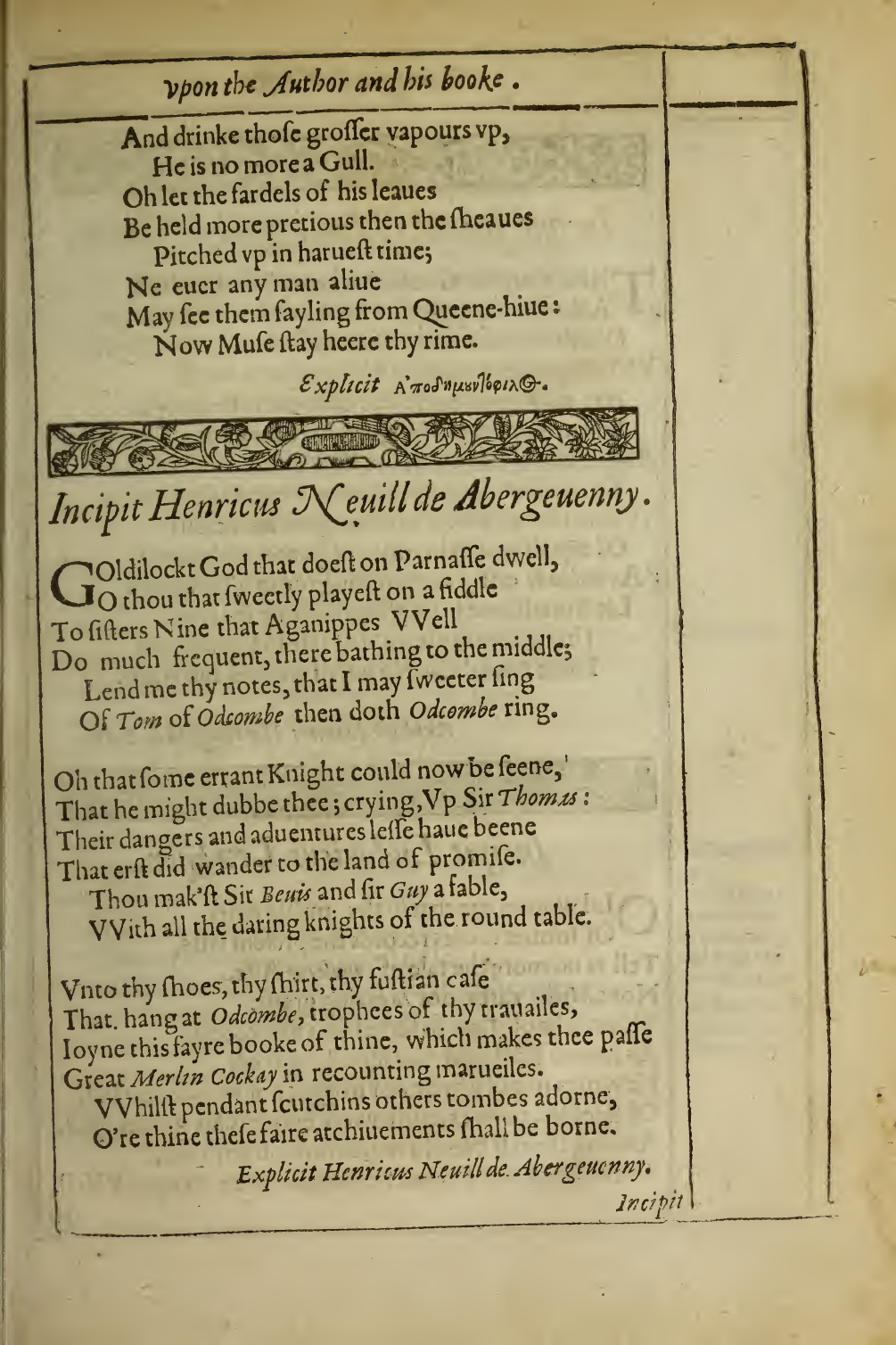
The 1611 page image is the controlling witness. It prints both Incipit Henricus Nevill de Abergevenny and Explicit Henricus Nevill de Abergevenny around a complete independent poem. Internet Archive OCR mangles the name, so the checked image—not OCR or a modern index—controls attribution and lineation.
The source therefore attributes the poem to an Abergavenny Henry Neville. A Billingbear identification is a modern contextual proposal and must not replace the printed wording. Neuhauser's research establishes organized Sireniac literary production and the placement of a Sir Henry Neville among the initial knightly contributors, but it does not reassign this poem. The separate Convivium Ne vile pun has its own unresolved two-candidate identity problem. The two witnesses may be compared as social evidence, but they cannot be collapsed into one authorial identification.
1. Verified Sourced Facts
- The Folger catalog record identifies the 1611 book as:
“Coryats crudities [electronic resource] : hastily gobled vp in five moneths trauells in France, Sauoy, Italy, Rhetia ...”
- The same record gives:
“(STC) 5808”
- Julian T. S. Neuhauser writes of the commendatory poems:
“Coryate grouped the contributors to the ‘Panegyricke Verses’ together with intention, beginning with the 14 knights that wrote for him, a group that included Sir Robert Phelips, Sir Henry Goodere and Sir Henry Neville.”
- The same image witness ends:
“Explicit Henricus Nevill de Abergevenny.”
- Neuhauser's open-access article argues that the Sireniacal Gentlemen should be understood not merely as a loose tavern circle but as a mock-guild organized around literary production.
- Neuhauser specifically treats the
Panegyricke Versesas intentionally grouped literary/social production rather than a random heap of commendatory matter. This strengthens the significance of Neville's placement among the initial14 knights, but it does not identify which Neville wrote the poem headedHenricus Nevill de Abergevenny. - Neuhauser treats the Latin Convivium Philosophicum as a likely Sirenaick function and states that, if so, additional possible Sirenaicks include:
“knights Sir Henry Neville and Sir Henry Goodere, the businessmen Lionel Cranfield and Arthur Ingram, John West ... and Richard Connock”
- Neuhauser's framework strengthens the social-literary context around Coryate, but it does not override the printed Crudities attribution of the poem to
Henricus Nevill de Abergevenny. - Web/Archive.org source controls: the local Twitter-image witness has now been collated against the full public 1611 Boston Public Library scan on Internet Archive, identifier
coryatscrudities00cory. - The IA metadata identifies the contributor as
Boston Public Library, the date as1611, William Stansby as printer, Henry Frederick Prince of Wales as dedicatee, and includes Thomas Coryate, George Coryate, Hermann Kirchner, Ben Jonson, and William Hole among associated names. - The poem is on access-PDF page
63, corresponding to Archive leafn63. The page image was rendered at high resolution and checked visually on2026-07-10. It prints bothIncipit Henricus Nevill de AbergevennyandExplicit Henricus Nevill de Abergevennyon the same page. - IA OCR locates the poem but mangles the name (
Henricm/Henrim Keuill). The page image, not the OCR, controls the spelling and lineation.
Direct 1611 Page-Image Collation (2026-07-10)
- Full scan: Internet Archive item.
- Exact page route: Archive leaf n63.
- Local full scan: coryatscrudities00cory.
- Visually checked render: coryat 063.
The checked page preserves the whole poem in one view. Above it is the end of the preceding contribution; below that conclusion appears a floral rule and then the Neville heading. The sequence therefore confirms that the Neville poem is an independent signed item within the commendatory apparatus, not a name supplied by a modern index or OCR layer.
The opening stanza reads:
GOldilockt God that doest on Parnasse dwell,
O thou that sweetly playest on a fiddle
To sisters Nine that Aganippes Well
Do much frequent, there bathing to the middle;
Lend me thy notes, that I may sweeter sing
Of Tom of Odcombe then doth Odcombe ring.
The closing stanza turns Coryate's travel clothes and shoes into heraldic funeral achievements:
Vnto thy shoes, thy shirt, thy fustian case
That hang at Odcombe, trophees of thy trauailes,
Ioyne this fayre booke of thine, which makes thee passe
Great Merlin Cockay in recounting marueiles.
VVhilst pendant scutchins others tombes adorne,
O're thine these faire atchiuements shall be borne.
The scan documents the attribution exactly as printed. The separate question of which Henry Neville the printed form refers to remains open and should be researched through Coryate's contributor network, Abergavenny genealogy, and the Billingbear social context without silently changing the 1611 wording.
2. Ken Feinstein Twitter and Blog Information
- A image witnesses witness from the Twitter archive shows a poem headed:
“Incipit Henricus Nevill de Abergevenny.”
- Ken Feinstein's Twitter layer argues that the Convivium/Coryate social context is more closely connected with Henry Neville of Billingbear than with the Abergavenny branch, while also acknowledging that the printed attribution itself says
Abergevenny. - This packet should preserve that as an interpretive identification problem, not a verified correction of the printed attribution.
Twitter Thread Batch 02 Crosswalk
- Requested thread
#32asks which Henry Neville wrote in Coryate's apparatus. It is now routed through twitter thread research batch 02 networks lucan amiens windsor. - The thread's question remains valuable because Neuhauser shows that the Coryate apparatus was organized social-literary production, not random filler. At the same time, the printed poem witness still says
Henricus Nevill de Abergevenny. - Current source-control status: preserve the Billingbear-context argument as a research interpretation; cite the printed attribution exactly unless a new bibliographic or manuscript witness changes the identification.
Quoted Source Passages
Follow SOURCE QUOTATION STANDARD. The controlling direct witness is the printed 1611 Coryats Crudities page image/local crop, not the unreliable IA OCR.
Printed attribution
- Source: Thomas Coryate, Coryats Crudities (London, 1611),
STC 5808; Boston Public Library / Internet Archive scancoryatscrudities00cory, Archive leafn63, access-PDF p. 63. - Quotation:
"Incipit Henricus Nevill de Abergevenny."
"Explicit Henricus Nevill de Abergevenny."
- Documentation: The 1611 page attributes the poem to
Henricus Nevill de Abergevenny. Any proposed identification with Billingbear Neville should be presented alongside, rather than substituted for, that printed form.
Poem's Coryate praise
- Source: Same 1611 page-image witness.
- Quotation:
"Of Tom of Oldcombe then doth Odcumbe ring."
"Vnto thy shoes, thy shirt, thy fustian case"
- Documentation: The poem praises Coryate through Odcombe, errant-knight, travel-trophy, and mock-heraldic imagery.
3. Quoted Source Text
Bibliographic witness
- “Coryats crudities”
- “hastily gobled vp in five moneths trauells”
STC 5808
Heading and colophon of the Neville poem
- “Incipit Henricus Nevill de Abergevenny.”
- “Explicit Henricus Nevill de Abergevenny.”
Neuhauser on Sirenaick sociality
- “right Worshipful Fraternitie of Sireniacal Gentlemen”
- “mock-guild”
- “Panegyricke Verses”
- “Sir Henry Neville and Sir Henry Goodere”
- “businessmen Lionel Cranfield and Arthur Ingram”
Diplomatic transcription from the image witnesses witness
Incipit Henricus Nevill de Abergevenny.
GOldilockt God that doest on Parnasse dwell,
O thou that sweetly playest on a fiddle
To sisters Nine that Aganippes Well
Do much frequent, there bathing to the middle;
Lend me thy notes, that I may sweeter sing
Of Tom of Oldcombe then doth Odcumbe ring.
Oh that some errant Knight could now be seene,
That he might dubbe thee; crying, Vp Sir Thomas:
Their dangers and aduentures lesse haue beene
That erst did wander to the land of promise.
Thou mak'st Sir Beuis and sir Guy a fable,
VVith all the daring knights of the round table.
Vnto thy shoes, thy shirt, thy fustian case
That hang at Odcombe, trophees of thy trauailes,
Ioyne this fayre booke of thine, which makes thee passe
Great Merlin Cockay in recounting maruailes.
VVhilst pendant scutchins others tombes adorne,
O're thine these faire atchiuements shall be borne.
Explicit Henricus Nevill de Abergevenny.
4. Evidence Images
Neville poem image witness
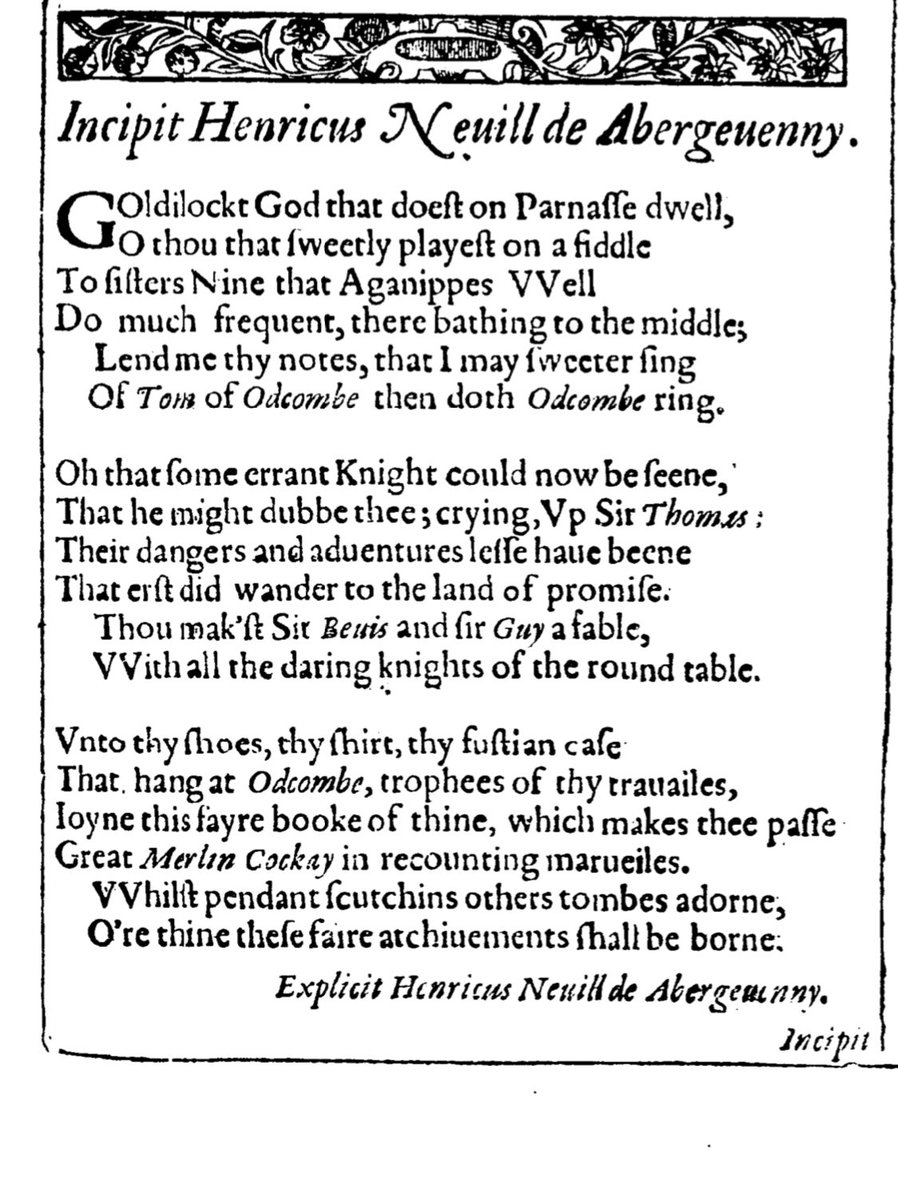
Full Boston Public Library / Internet Archive page
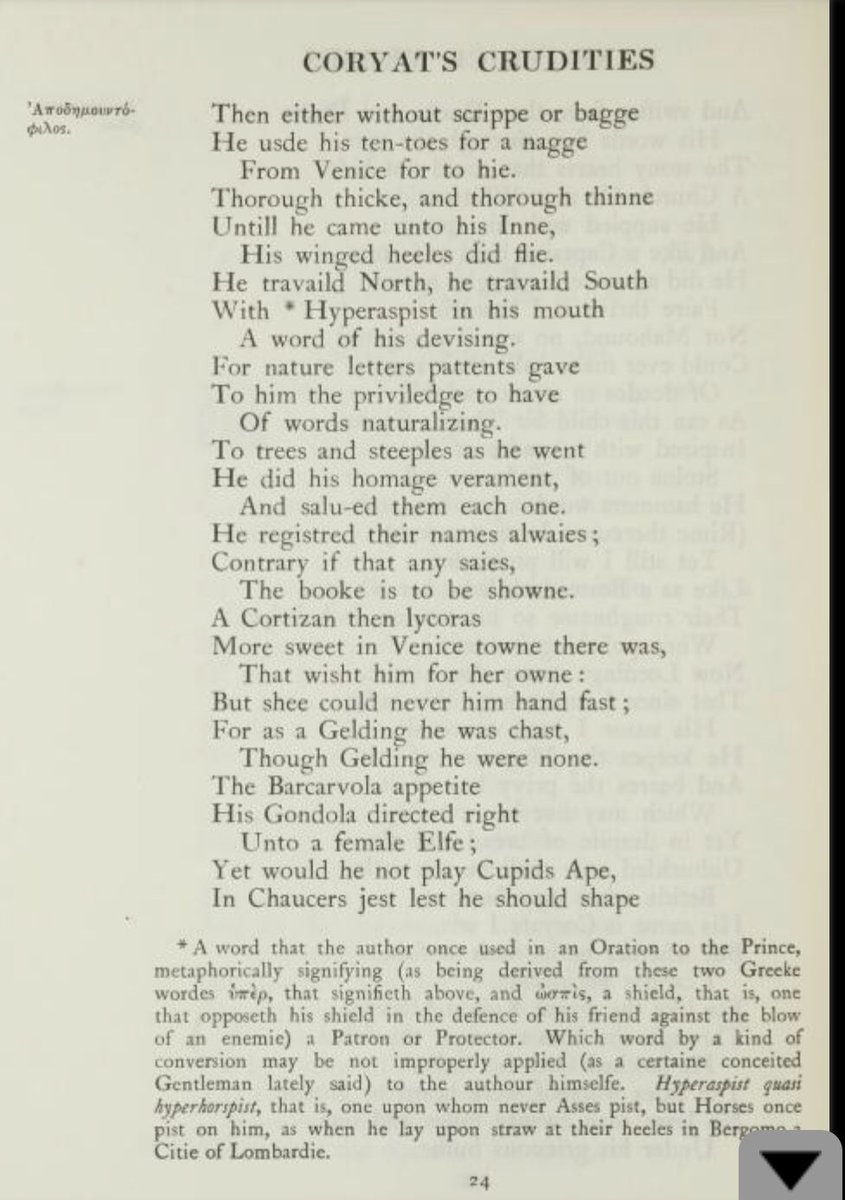
Preceding anonymous poem image witness
5. Citations
- Coryate, Thomas. Coryats crudities: hastily gobled vp in five moneths trauells in France, Sauoy, Italy, Rhetia ... [London], [printed by William Stansby for the author], 1611.
STC 5808. Folger Shakespeare Library, https://catalog.folger.edu/record/162993?ln=en. - Coryate, Thomas. Coryats crudities : hastily gobled vp in five moneths trauells... Boston Public Library scan. Internet Archive identifier
coryatscrudities00cory. Archive.org item. - Internet Archive OCR text for the Boston 1611 scan: DjVu text.
- Neuhauser, Julian T. S. “Sirenaicks, Guilds and a New Coryate Manuscript.” The Review of English Studies, vol. 74, no. 313, 2023, pp. 31-46. Open access, Oxford Academic, https://academic.oup.com/res/article/74/313/31/6718147. DOI: https://doi.org/10.1093/res/hgac061.
- Thomas_Coryate.html, local Twitter archive page with image witnesses and source-note text.
- John_Donne.html, local Twitter archive page preserving the “Henricus Nevill de Abergavenny” post in context with other
Coryats Cruditiescontributors.
6. Notes on Access
- This packet preserves two direct witness layers:
- the printed-book bibliographic witness for Coryats Crudities
- the image witnesses witness centered on the poem attributed to
Henricus Nevill de Abergevenny - The transcription above has now been checked against both the earlier image witnesses and the full Boston Public Library / Internet Archive page image. It is not derived from IA OCR.
- The
2026-07-10check closes the earlier visual-collation task: access-PDF p. 63 / Archive leafn63is the relevant page. - The heading and colophon identify the poem with
Abergevenny. This packet therefore treats the printed attribution as Abergavenny unless and until a stronger bibliographic argument is added elsewhere. - The Neuhauser article is now the best open-access scholarly control for the broader Sirenaick/Coryate social-literary setting. It supports the importance of Neville, Goodere, Cranfield, Ingram, Hoskins, Donne, Jonson, and related figures as a literary-sociable network, but it does not identify the
Henricus Nevill de Abergevennypoem as Billingbear Neville. - Neuhauser supports a reading of the Crudities apparatus as organized literary-social production around Coryate. The direct page continues to name
Henricus Nevill de Abergevenny; the Billingbear-context proposal and the printed attribution should both be documented while the identity question remains open. - The preceding anonymous poem image is preserved as an adjacent witness, but this packet does not turn local discussion about its significance into fact.
- For the separate evidence that Abergavenny Nevilles patronized provincial acting companies, see lord abergavennys men neville acting company patronage. That evidence strengthens the broader Abergavenny theater-network context, but it does not by itself identify the author of the Coryats Crudities poem.
- Local Twitter/context leads include twitter Convivium Philosophicum, twitter Parliament and Politics, and the archived local HTML pages cited above.
Additional Fact-Source Notes
- Archive.org's Boston Public Library scan now supplies the public full-book image route for Coryats Crudities: publication date
1611, William Stansby printer, associated names including Thomas Coryate, Ben Jonson, William Hole, Prince Henry, and bibliographic/copy notes. - The full 1611 page image now controls the poem heading, lineation, and colophon; the earlier local crop remains a useful duplicate witness.
- Book use: keep the attribution exactly as printed,
Henricus Nevill de Abergevenny, unless a new bibliographic witness proves a different identification.