Thomas Vicars
Topic: Thomas Vicars
Source-Control Position
- document witnesses checks confirm Schurink's transcription/discussion of the 1628 Shakespeare name-pun passage and the Philological Museum biographical framing. A newly retained Internet Archive facsimile now directly controls printed pp.
70-72; p.70confirms the complete Latin circumlocution. - EarlyPrint checks confirm
A04766(1622) and recover the dedication list namingThe Lady Anne Neuill, Wife to the Right Honourable, Lo. B. of Chichester; a newly retained Internet Archive page image now confirms the full dedication layout and wording. The same local check found no Shakespeare reference inA04766. - A scoped BRO sweep for
Thomas Vicars/Vicarsfound no direct BRO transcription hit. - Corrected family identification: Thomas Vicars married Anne Carleton, daughter of Bishop George Carleton and his first wife, Avis Weston. This is not an unresolved choice between competing modern accounts. The decisive control is the contemporary Guy Carleton monument at Holy Trinity, Cuckfield, which names infant George and Anne as children of Thomas Vicars and “Anne his wife, the daughter of Byshop Carleton.” Wood's early biography, Cox's county history, the old DNB, and Cooper's printed pedigree agree with the monument.
- The two Annes must remain distinct: Anne Carleton was Vicars's wife. Anne Killigrew Neville Carleton was George Carleton's second wife, Henry Neville's widow, Anne Carleton's stepmother, and the
1622dedicatee whom Vicars calls “The Lady Anne Neuill, Wife to ... [the] B. of Chichester.”
1. Verified Sourced Facts
- F. Schurink writes:
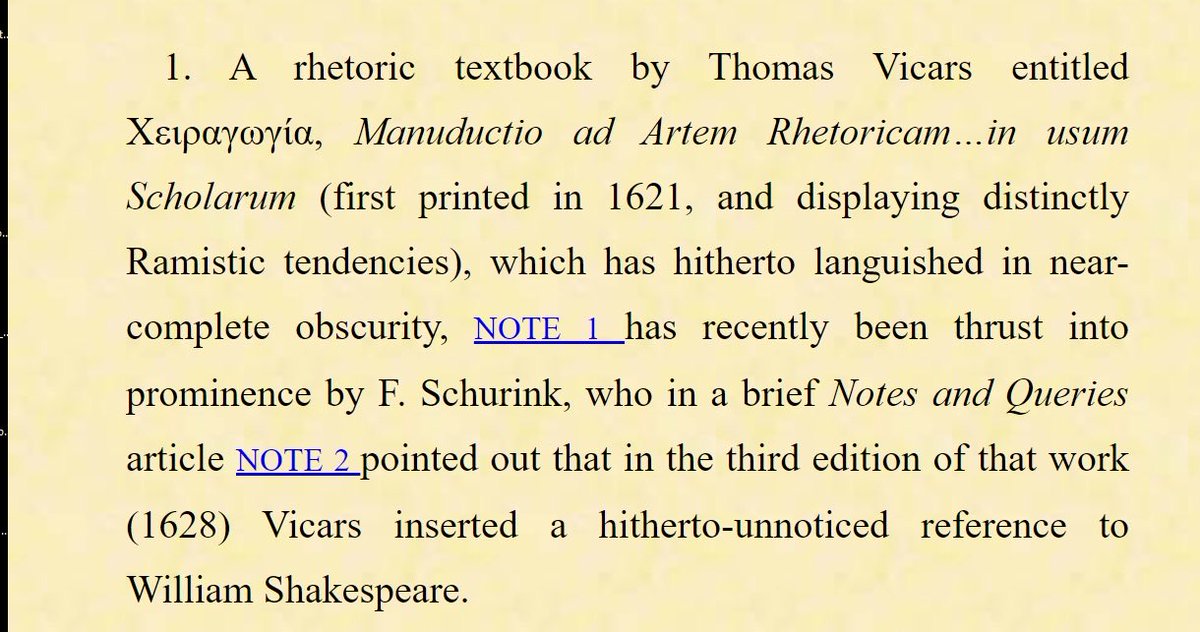
“in the third edition of the manual, published in 1628, Vicars added a short passage in which he punningly alludes to Shakespeare’s name.”
- Schurink quotes the 1628 Latin wording:
“Istis annumerandos censeo, celebrem illum poetam qui a quassatione & hasta nomen habet, Ioan. Davisium, & cognominem meum, poetam pium & doctum Ioan. Vicarsium”
- Schurink translates the Shakespeare allusion as:
“To these I believe should be added that famous poet who takes his name from ‘shaking’ and ‘spear’, John Davies, and my namesake, the pious and learned poet John Vicars.”
- The Philological Museum introduction states:
“Thomas Vicars [1589 - 1638]”
- The same introduction states:
“In later life he followed the career of clergyman, serving variously as chaplain to his father-in-law George Carleton, Bishop of Llandaff and latterly of Chichester”
- The same introduction states that the rhetoric manual was:
“first printed in 1621”
- Vicars studied at Queen's College, Oxford (not merely “Oxford”). Foster and the old DNB give his matriculation as 19 June 1607, BA as 16 December 1611, and MA as 17 June 1615; he was elected fellow in 1616. The packet's former
1610/1613dates were erroneous. - In addition to his chaplaincy to Carleton, Vicars held the vicarage of Cowfold (Sussex) and subsequently of Cuckfield (Sussex). He also held a prebend of Chichester Cathedral. These Sussex ecclesiastical positions place him inside the same regional network as Carleton's Chichester bishopric and connect him more firmly to the Sussex-adjacent Neville family world.
- The Philological Museum edition gives the full English translation:
“To these, I think, should be added that famous poet who takes his name from the shaking of a spear, John Davies, and a pious and learned poet who shares my surname, John Vicars.”
- The EEBO/TCP XML witness for
A04766(Ouranognōsia. Heauenly knowledge. A manuduction to theologie, 1622) contains a dedication reading:
“TO THE SERVICE AND GOOD OF THE Church of God, vnder the Patronage and Protection of the thrice worthy and religious, his much honoured Friends, The Lady Anne Neuill, Wife to the Right Honourable, Lo. B. of Chichester ... T.V. Consecrateth himselfe, and his labours in this Translation.”
2. Ken Feinstein Twitter and Blog Information
- No Ken Feinstein Twitter/blog material is isolated in this packet at present.
3. Quoted Source Text
Schurink on the 1628 Shakespeare allusion
- “Istis annumerandos censeo, celebrem illum poetam qui a quassatione & hasta nomen habet, Ioan. Davisium, & cognominem meum, poetam pium & doctum Ioan. Vicarsium”
- “To these I believe should be added that famous poet who takes his name from ‘shaking’ and ‘spear’, John Davies, and my namesake, the pious and learned poet John Vicars.”
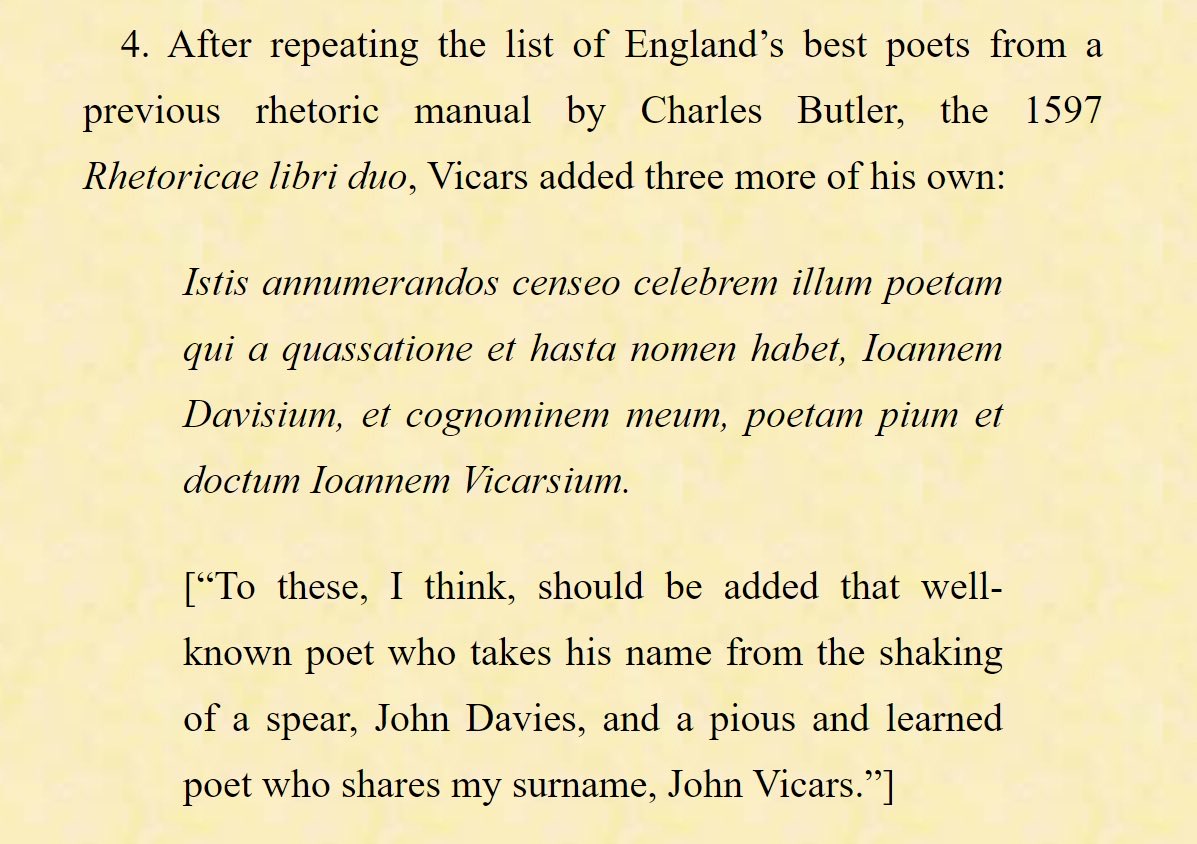
Philological Museum introduction
- “Thomas Vicars [1589 - 1638]”
- “chaplain to his father-in-law George Carleton, Bishop of Llandaff and latterly of Chichester”
- “first printed in 1621”
EEBO/TCP dedication to Anne Neville
- “TO THE SERVICE AND GOOD OF THE Church of God, vnder the Patronage and Protection of the thrice worthy and religious, his much honoured Friends, The Lady Anne Neuill, Wife to the Right Honourable, Lo. B. of Chichester ... T.V. Consecrateth himselfe, and his labours in this Translation.”
3A. Direct Page-Image Collation, 2026-07-09
The 1628 Shakespeare circumlocution
- Internet Archive: Χειραγωγία. Manuductio ad artem rhetoricam (1628).
- Local full PDF: Thomas Vicars Manuductio 1628 IA.
- Direct render: Thomas Vicars Manuductio 1628 printed p70 pdfpage92.
The page confirms the Schurink transcription in its original context. Vicars cites Butler's list of Chaucer, Spenser, Drayton, and Wither, then adds:
Istis annumerandos censeo, celebrem illum poetam qui a quassatione & hasta nomen habet, Ioan. Davisium, & cognominem meum, poetam pium & doctum Ioan. Vicarsium.
The page proves that Vicars chose a Latin descriptive etymology for Shakespeare while naming Davies and John Vicars directly. It does not prove that he believed Shakespeare was a pseudonym; that is an interpretation requiring argument.
The 1622 Anne Neville dedication
- Internet Archive: A manuduction to theologie (1622).
- Local direct image: Keckermann Vicars Ouranognosia 1622 Anne Neville dedication IA n2.
The image directly confirms The Lady Anne Neuill, Wife to the Right Honourable, Lo. B. of Chichester and the closing T. V. Consecrateth himselfe, and his labours in this Translation. It is a direct publication/patronage connection to Anne Killigrew Neville Carleton, not a marriage record for Vicars.
Marriage identity: Anne Carleton, not Anne Neville
The former “conflict” formulation in this packet is superseded. It gave too much weight to a modern genealogical error and failed to use the contemporary family monument.
1. Contemporary monumental statement
J. H. Cooper transcribed the inscription on the monument of Guy Carleton at Holy Trinity, Cuckfield. The monument commemorates Guy, who died in 1628, and the infant children buried near him:
“Neere to His body lyeth George Vicars and Anne his sister, the children of Thomas Vicars B. of D. Vicar of this Church, and of Anne his wife, the daughter of Byshop Carleton.”
Cooper introduces Guy as Vicars's “brother-in-law.” The monument therefore identifies both sides of the relationship within the Carleton family's own memorial setting: Guy was the bishop's son; Anne, Vicars's wife, was the bishop's daughter; their children were Guy's nephew and niece. The monument survives in the north chapel at Holy Trinity and is independently catalogued as the Guy Carleton monument.
- Cooper 1902, printed p. 17: monument transcription
- cooper1902 n60
- Holy Trinity, Cuckfield: church and monument description
2. Pedigree identifies her mother and the step-relationship
Cooper's printed pedigree places Ann. b. 1605 among the children of George Carleton and his first wife Avis Weston, then joins her to Thos. Vicars. It separately records George's second wife as Ann, wid. of Sir H. Nevill.
The correct relationship is therefore:
George Carleton + Avis Weston -> Anne Carleton (b. 1605) = Thomas Vicars
After Avis Weston's death, George Carleton married Henry Neville's widow, Anne Killigrew Neville. Anne Neville Carleton became Anne Carleton's stepmother. Anne Carleton did not become Carleton's stepdaughter. A modern Chichester-diocese thesis reverses that relation when it calls Vicars's wife “Carleton's step-daughter,” even though its footnote cites Cooper, whose pedigree says the opposite.
3. Anthony Wood distinguishes the two Annes in one entry
Anthony Wood's Athenae Oxonienses (1691) says Vicars was taken into Bishop Carleton's household and preferred:
“after he had married his Daughter Anne”
Later in the same entry Wood describes Vicars's 1622 book as carrying a dedication:
“to Anne the Wife of Dr. Carleton B. of Chichester.”
Wood's wording is internally unambiguous. “His Daughter Anne” is Vicars's wife, Anne Carleton. “Anne the Wife of Dr. Carleton” is the bishop's second wife, Anne Killigrew Neville Carleton.
4. Later biographical and county-history statements agree
Thomas Cox wrote in 1720 that Bishop Carleton took Vicars into his family and, “having marry'd his Daughter to him,” preferred him to Cuckfield. The old Dictionary of National Biography states: “In that year [1622] he married Anne, daughter of George Carleton.”
- Cox, *Magna Britannia et Hibernia*, vol. 5 (1720), p. 512
- cox1720 n542
- Old DNB life of Thomas Vicars
The precise day and place of the marriage remain to be recovered. The identity does not. Wood says the episcopal preferment followed the marriage, and Vicars was collated to Cuckfield on 19 December 1622; the marriage had therefore occurred by that date. The old DNB's statement that it occurred “in that year” is consistent with this sequence.
5. How the modern confusion arose
Two same-named women occupied the same household:
- Anne Carleton — George Carleton's daughter by Avis Weston; wife of Thomas Vicars.
- Anne Killigrew Neville Carleton — widow of Sir Henry Neville; second wife of George Carleton; stepmother of Anne Carleton; Vicars's
1622dedicatee.
The modern ODNB life of Sir Henry Neville assigns one of Neville's six daughters, “Anne,” to Thomas Vicars. That statement conflicts with the Cuckfield monument and the early biographies. The likely mechanism is conflation of Vicars's wife with his dedicatee and stepmother-in-law. The Chichester thesis makes a different but related inversion by calling Anne Carleton the bishop's stepdaughter. Neither modern formulation supplies evidence capable of displacing the named contemporary monument.
4. Citations
- Schurink, Fred. “An Unnoticed Early Reference to Shakespeare.” Notes and Queries, vol. 53, no. 1, Mar. 2006, pp. 72-73. Schurink Unnoticed Early Reference to Shakespeare 2006.
- Sutton, Dana F., ed. “Thomas Vicars, Extract from Χειραγωγία, Manuductio ad Artem Rhetoricam (1628 edition).” The Philological Museum:
- Introduction
- Latin text
- Translation
- Philological Museum Vicars Shakespeare Allusion Intro.
- astrologomania 1624 george carleton john chamber thomas vicars, separate packet for the 1624 Carleton book.
- Keckermann, Bartholomaeus. Ouranognōsia. Heauenly knowledge. A manuduction to theologie. Done into English by T.V., 1622. TCP A04766. EEBO/TCP XML witness in
[local source path removed]. - Cooper, J. H. “The Vicars and Parish of Cuckfield in the Seventeenth Century.” Sussex Archaeological Collections
45(1902),1-33, especially14-16. Local OCR control: Sussex Archaeological Collections v45 1902 djvu. - Wood, Anthony. Athenae Oxonienses. London,
1691, vol. 1, pp.449-50. Internet Archive page image. - Cox, Thomas. Magna Britannia et Hibernia, vol. 5: Sussex. London,
1720, p.512. Internet Archive page image. - Carlyle, Edward Irving. “Vicars, Thomas.” Dictionary of National Biography, vol. 58 (
1899), p.281. Wikisource text and scan. - Foster, Joseph. Alumni Oxonienses: The Members of the University of Oxford, 1500-1714, vol. 4. Oxford,
1892, p.1574, s.v. “Vicars, Thomas.” Internet Archive. - Clergy of the Church of England Database, Thomas Vicars record, including the
1626domestic-chaplain note and Chichester appointments: https://theclergydatabase.org.uk/jsp/persons/DisplayPerson.jsp?PersonID=15889.
5. Notes on Access
- This packet is for Thomas Vicars, the clergyman tied to George Carleton and the 1628 Shakespeare allusion.
- John Vicars is a separate figure and is quoted here only where Thomas Vicars explicitly names him.
- The
A04766witness directly confirms a dedication to Anne Neville as wife to the Bishop of Chichester. - The George Carleton / Anne Neville family connection should be tracked through george carleton and direct family records, not inferred from the local archive layer.
Additional Fact-Source Notes
- Philological Museum controls Thomas Vicars's rhetoric-book lane: the work first appeared in 1621, and the 1628 third edition contains the Shakespeare allusion.
- Keep Thomas Vicars separate from John Vicars. The Shakespeare allusion and George Carleton connection belong to Thomas Vicars, the clergyman tied to Carleton.
- EEBO/TCP
A04766remains a direct dedication witness to Anne Neville as wife to the Bishop of Chichester. - Full work log and source manifest: PUBLICATION RECEPTION CLUSTER SOURCE PASS 2026 07 09.
2026-07-15 Marriage-Identity Correction Audit
Corrected conclusion: Thomas Vicars's wife was Anne Carleton, daughter of Bishop George Carleton and Avis Weston. The prior “identity unresolved” conclusion is withdrawn because it omitted the contemporary Cuckfield monument.
A modern thesis on the Chichester diocese says:
Vicars married Carleton’s step-daughter, became an episcopal chaplain and was collated to a canonry and the rich living of Cuckfield.
Its footnote cites J. H. Cooper’s 1902 article. Cooper’s printed Carleton pedigree places an Ann, born 1605, under George Carleton and his first wife Avis Weston, and joins that Ann to Thos. Vicars. The thesis has reversed the step-relationship: Anne Carleton was the stepdaughter of the bishop's second wife, Anne Neville, not the stepdaughter of George Carleton.
The 1622 Keckermann dedication proves that Vicars addressed Lady Anne Neville, wife of the Bishop of Chichester. It does not call her Vicars's wife. Wood makes the same distinction within a single biography, separately naming Vicars's wife as the bishop's daughter Anne and the dedicatee as the bishop's wife Anne.
The contemporary monumental wording closes the question:
“Anne his wife, the daughter of Byshop Carleton”
Source chain now controlled
- Chichester thesis extraction: chichester diocese thesis, at the sentence calling her Carleton’s stepdaughter.
- J. H. Cooper, “The Vicars and Parish of Cuckfield in the Seventeenth Century,” Sussex Archaeological Collections 45 (1902), 1–33: Sussex Archaeological Collections v45 1902 djvu, with the pedigree entries
Ann. b. 1605.andThos. Vicars. - Old DNB life of Thomas Vicars: public text.
- Project genealogical guardrail: README, which does not treat the Vicars/Anne Neville claim as established.
Remaining documentary targets
The marriage licence or parish register would still establish the exact day and place, and Carleton/Vicars probate material may add settlement or inheritance detail. These are chronology and household-history questions, not an unresolved identity question. The packet should consistently say Anne Carleton, daughter of Bishop George Carleton and Avis Weston; stepdaughter of Anne Killigrew Neville Carleton.
Source-Fact Audit — 8 August 2026 (Round 6)
The corrected family relationship is now the controlling form throughout this packet: Thomas Vicars married Anne Carleton, daughter of Bishop George Carleton and Avis Weston. After Avis's death, Carleton married Anne Killigrew Neville, making her the younger Anne's stepmother. The recurring “Anne Neville” formulation collapsed a step-relationship into a birth identity and is not supported by the checked genealogical sources.
This correction sharpens rather than removes the network fact. Vicars was connected by marriage to George Carleton, author of the 1603 book addressed to Henry Neville, and through Carleton's second marriage to Anne Killigrew Neville. Vicars's 1622 dedication and 1628 printed reference to Shakespeare remain direct printed facts. What is not established is that the kinship caused either publication or transmitted a particular text.