Sir Henry Neville to Dacre House Letter
Topic: Sir Henry Neville to Dacre House Letter
Overview
This packet preserves the staged Sir Henry Neville to Dacre House from the Sent-email audit. The file title is misleading: the manuscript letter is written from Dacre House to Robert Cecil / the Earl of Salisbury, not to Dacre House.
Source-Control Position
- This packet has been moved from
leadtomixed. The PDF itself remains image-only underpdftotext, but the same document is now controlled through local extracted images, extracted-image OCR, an O'Donnell transcription, the localletter_134image packet, and Neville Letters Corpus v22. - The current corpus analysis identifies the letter as
letter_134,date_ns: 1608-01-01, recipientRobert Cecil, filenameNeville Letter 1608 01 01. - The manuscript body dates itself
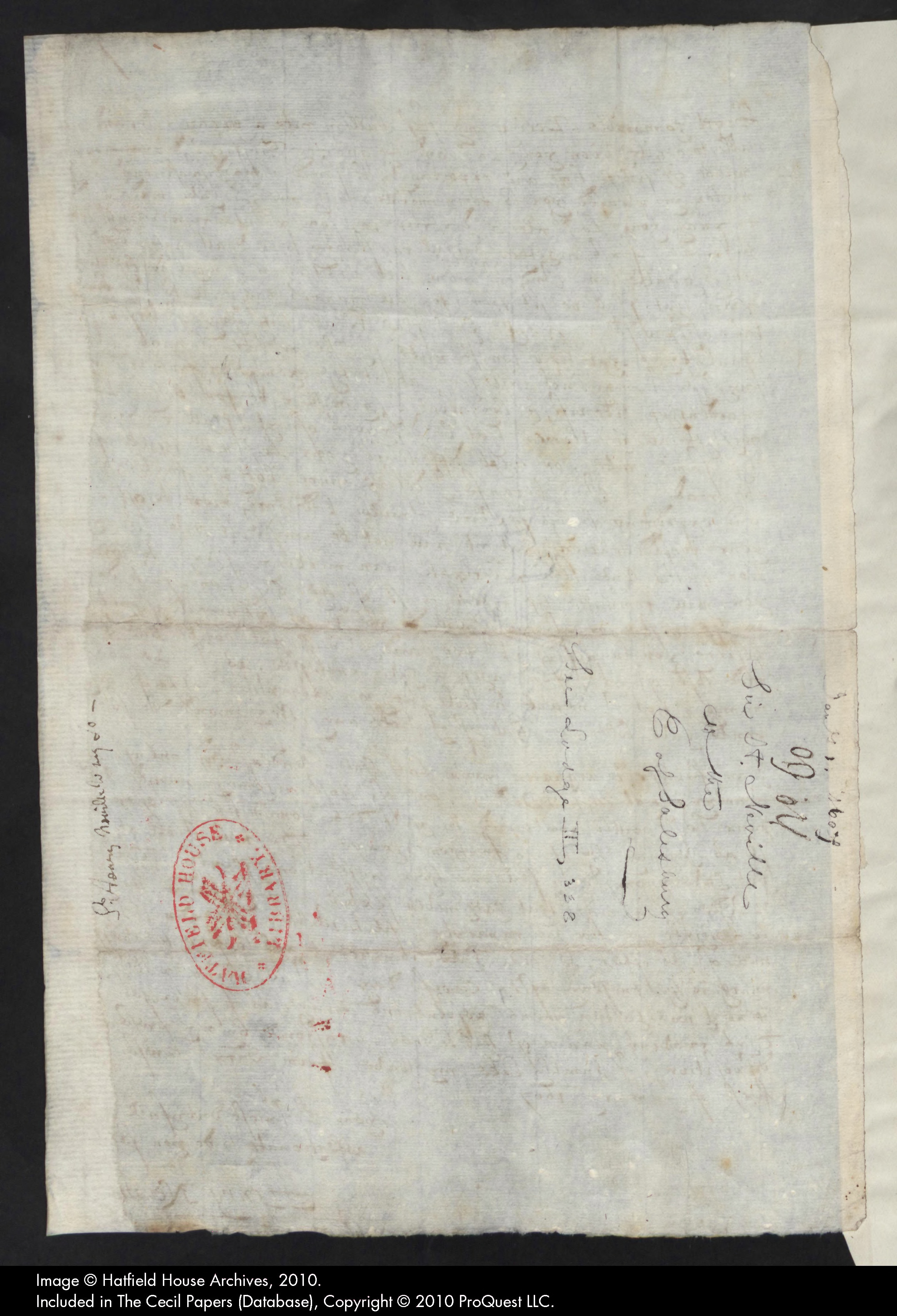
from Dacre House this first of January 1607. This is Old Style dating; the corpus analysis normalizes it to1608-01-01. - The verso endorsement identifies the correspondent and recipient lane:
S[i]r Hi: NevilltoE. of Salisbure, with a Hatfield House Library stamp. - The content concerns a Quarter Sessions / exemption / patent business involving rates for gentlemen and lower-status persons, a proposed gratis exemption for a principal man in every shire, and Mr. Weldon/Welden's offer of ten pounds. No direct Merry Wives of Windsor relevance has been extracted from the body.
- The sender is now controlled as the main Sir Henry Neville of the local letters corpus, not an unknown later Sir Henry. BHO now identifies the Hatfield/Cecil calendar reference as Cecil Papers
120/1; the remaining task is image/catalogue collation and follow-up inspection of probable related item124/100. - Worker D BRO sweep,
2026-05-30: no direct Royal Berkshire Archives / BRO transcription was found for this Dacre House letter. The onlyWeldon-like hit in BRO was an unrelated inventory entry for a gelding calleddunne Weldon; Dacre hits belonged to the separate Bergavenny barony-by-writ discourse. Keep this packet in the Hatfield/Cecil Papers lane.
Online Dacre House Identity Research
The dateline identity is now a source-controlled but unresolved place-name problem. See the dedicated research note:
dacre house online research note 2026 06 05
Deep Sackville update:
- Follow-up note: dacre house sackville deep research note 2026 06 05.
- Archive.org follow-up note: archive org dacre sackville followup 2026 06 05.
- Exact public calendar control: BHO,
Calendar of the Cecil Papers in Hatfield House: Volume 20, 1608, calendars this letter as1607-8, Jan. 1, Sir Henry Neville to the Earl of Salisbury, Cecil Papers120/1, with the datelineFrom Dacre House. A probable follow-up on Welden/Day exemptions and patent form is Cecil Papers124/100. - Archive.org now adds an older printed witness to the identification problem. Lodge's
Illustrations of British History, vol. 3, prints this letter and supplies a note identifying Dacre House with the Abergavenny/Sackville/Tothill line: Sir Henry Neville of the Abergavenny family, Mary Sackville, Anne Dacre, and Tothill Fields. This is secondary printed apparatus, not deed proof, but it strongly aligns with the current Sackville/Tothill working identification. - Current leading identification: the Westminster/Tothill Dacre House. TNA/ESBHRO Danny Archives control Lady Anne Dacre's will copy at
DAN/1126/fos. 122r-127r, and TNA controls the PCC registered will atPROB 11/86/47. The will separates the Chelsea property from the Tothill/Westminster Dacre House: Chelsea moves through Burghley/Cecil, while the Tothill house goes, after an executor term, to Robert Sackville and his heirs. - Why this matters for Neville: Robert Sackville was Mary Sackville's brother; Mary Sackville married Sir Henry Nevill of the Abergavenny line; and Billingbear Henry Neville's local Mayfield ordnance papers place him in business with Robert Sackville and Lord Abergavenny in
1595, with another Robert Sackville/Buckhurst letter to Neville in1606. - Main remaining proof gap: no retrieved document yet proves Robert Sackville's continued ownership/use of the Tothill Dacre House in January
1607/8, or names Neville as lodging there. The best new continuity target is Robert Sackville's will and the Sackville College papers: TNA's public record for West Sussex Record OfficeAdd Mss 17826 - 18013says his will, dated10 February 1608, charged his Sussex and London estates for the college. Search the will, IPM, Sackville/Dorset estate papers, Sackville College deeds, and Hatfield/Cecil estate papers before making a final book assertion. - Important distinction: London
Sackville House/Sackville Place/Dorset Houseappears to belong to the Fleet Street / Salisbury Court lane. ECDbD 1600 and London topographical sources control that house-name, but quick catalogue searches found no bridge making it a synonym for Dacre House. Keep it separate from the Westminster/Tothill Dacre House unless deed evidence joins them. - Control candidate now demoted: the Strand/Carlisle Rents Dacre house that Robert Cecil acquired in
1599and replaced with Salisbury House. Survey of London controls the property chain, and Guerci's Salisbury House article gives a 1606 evidence-book lane for the property as Salisbury House. Unless a post-1602 Cecil/Hatfield document proves continuedDacre Houseusage for that site, it is less natural for a1607/8dateline. - Weaker Dacre/Cecil candidate: the Chelsea/Beaufort House line. Survey of London confirms Lady Dacre left the Chelsea house to Burghley/Cecil interests and Robert Cecil took possession in
1597, but Cecil sold it in1599, making it less likely for a1607/8Neville dateline unless separate lodging evidence appears.
Do not identify Dacre House definitively in book prose yet. The book-safe version is that the Sackville/Tothill candidate is now the strongest working identification, while the Strand/Salisbury House site remains a necessary control.
1. Verified Sourced Facts
- A PDF titled
Sir Henry Neville to Dacre Housewas sent in the user's Sent mail on9 December 2021in a thread titledRe: The Merry Wives of Windsor.
- The file is now staged in the Sent Email PDF Audit folder.
pdftotextoutput for the staged PDF is effectively blank, confirming that the PDF itself is image-only for ordinary text extraction.- Two local manuscript page images are available under
[local source path removed]:Sir Henry Neville to Dacre House page 1andSir Henry Neville to Dacre House page 2. - The same two page images are also staged in the local Neville letters interactive tree under
letter_images/cecil_letters/letter_134/. - The
letters image manifestentry forletter_134labels both images asCecil Papers local extractionandhigh-confidence filename/date/text match. - The local
letter 134packet preserves the same two image paths, the O'Donnell transcription, extracted-image OCR, and the normalized corpus transcription. - Neville Letters Corpus v10 and v11 both include
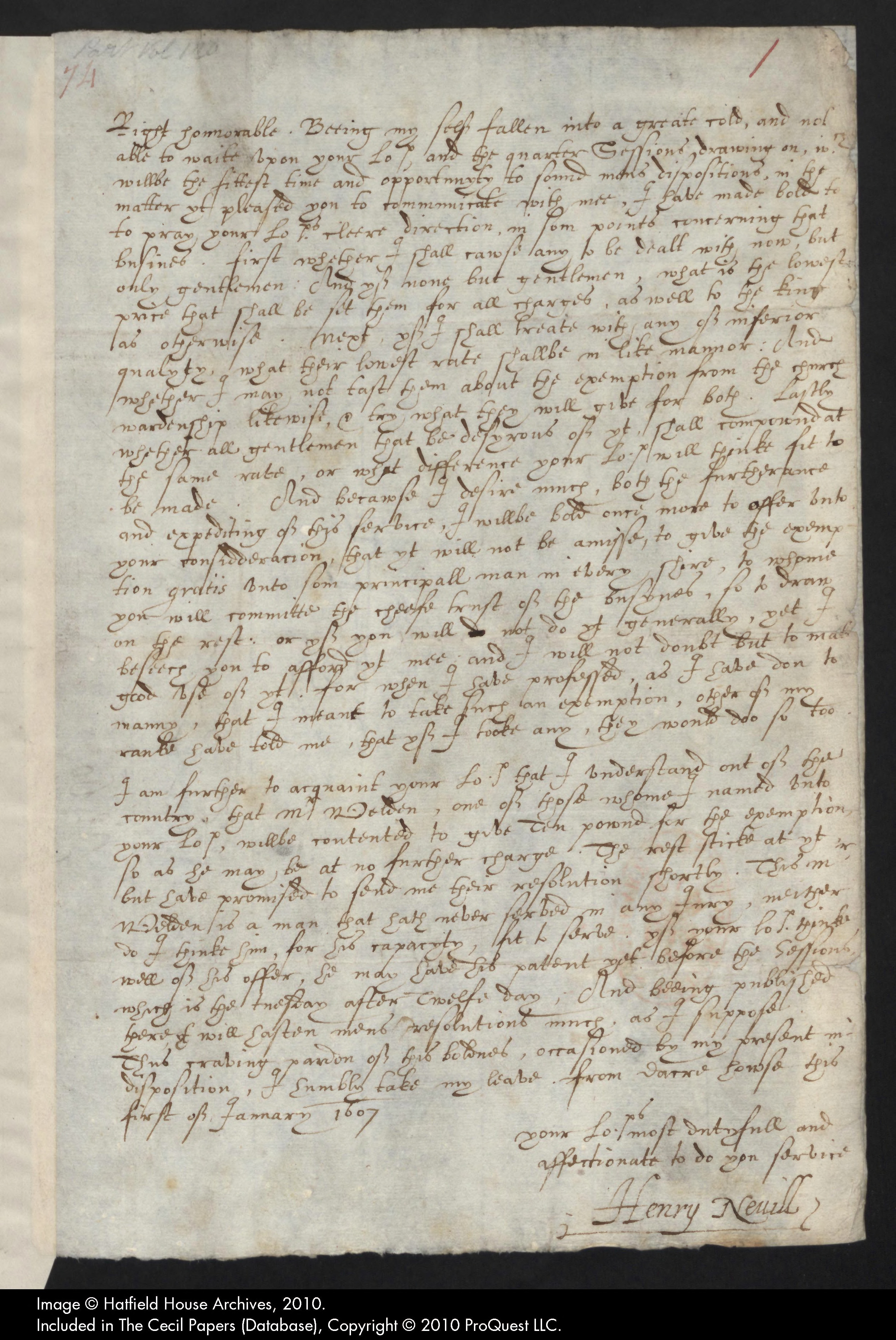
letter_134asdate_ns="1608-01-01", filenameNeville Letter 1608 01 01, recipientRobert Cecil. - The visible page 1 manuscript supports the opening illness/Quarter Sessions context, the Dacre House dateline, and the
Henry Nevillsignature. - The visible page 2 manuscript supports the endorsement cluster:
1 Jan 1607,S[i]r Hi: Nevill,E. of Salisbure,S[i]r Henry Nevill to my L[ord], and a Hatfield House Library stamp. - The O'Donnell transcription gives a cleaner reading than the extracted-image OCR for several body words and should be the first transcription witness, pending image collation.
- The current extracted content does not support using this packet as a Merry Wives localism witness. The sent-email thread title is the only current Merry Wives connection.
2. Ken Feinstein Twitter and Blog Information
- No Ken Feinstein Twitter/blog material is isolated in this packet at present. The only current context is the Sent-email thread title.
3. Quoted Source Text
- Limited anchors safe for source mapping, pending full collation:
from Dacre howse this first of January 1607your Lops most dutyfull and affectionate to do you serviceHenry Nevill- Endorsement:
S[i]r Hi: Nevill ... E. of Salisbure
Do not quote the body at length until the O'Donnell transcription has been line-collated against the two page images.
4. Citations
Sir Henry Neville to Dacre House. Staged image PDF: Sir Henry Neville to Dacre House.- Blank
pdftotextextraction: Sir Henry Neville to Dacre House. - Extracted manuscript page image 1: Sir Henry Neville to Dacre House page 1.
- Extracted manuscript page image 2: Sir Henry Neville to Dacre House page 2.
- Extracted-image OCR page 1: Sir Henry Neville to Dacre House page 1 transcript.
- Extracted-image OCR page 2: Sir Henry Neville to Dacre House page 2 transcript.
- O'Donnell/local transcription: [Neville to Cecil 1607 [= 1608].01.01](<[local source path removed]].01.01>).
- Local letter image packet: letter 134.
- Neville Letters Corpus v10/v11 XML witnesses: Neville Letters Corpus v10 and Neville Letters Corpus v11.
- image witnesses manifest: letters image manifest.
5. Evidence Images
6. Notes on Access
pdftotextproduced no usable text for the staged PDF, but local extracted images and transcripts now exist.- The extracted-image OCR is useful but imperfect. The O'Donnell transcription and the manuscript images should control future quotation.
- The image witnesses footer says the images are Hatfield House Archives / Cecil Papers Database / ProQuest images. BHO now controls the main letter as Cecil Papers
120/1; capture image/catalogue metadata and inspect probable follow-up124/100before treating the archival citation as fully collated. - This is a Neville correspondence source-control packet. Its Merry Wives relevance remains unproven.
- The BRO exclusion check found no copy of the letter. Do not cite BRO for this packet unless a new D/EN witness is identified.
2026-07-12 Complete-Letter Research
The complete O'Donnell transcription establishes that this is a substantial administrative letter, not merely a lodging/address lead. Written from Dacre House on 1 January 1607 Old Style (1 January 1608 in modern year numbering), it says Neville's “great could” prevents him from waiting on Salisbury but then develops a county-level plan.
Neville treats the approaching Quarter Sessions as the best opportunity to “sound mens dispositions.” He asks whether the operation should include only gentlemen or “inferior people,” what the lowest prices should be, whether it should be combined with “exemption from the church wardenship,” and whether rates should be uniform. He proposes giving the exemption gratis to the principal man in each shire to “draw on the rest,” records Mr Welden's offer of £10, and presses the timing of a patent before the Tuesday after Twelfth Day.
This proves Neville's practical role in designing or refining a distributed county mechanism that depended on local rank, incentives, price-setting, and administrative timing. The exact wider scheme is not yet identified.
Location control
The strongest candidate is Lady Dacre's “Dacre House near Tothill in Westminster,” bequeathed in 1595 to Robert Sackville. A separate Strand Dacre-house tradition associated with the Salisbury/Russell House property history prevents a definitive assignment. Use “probably the Tothill/Westminster house” only as a working hypothesis.
Sources: Westminster conservation audit; Salisbury House study. Full audit: 05 DACRE HOUSE.
2026-08-07 Corpus and Place Synthesis
The controlling corpus is now Neville Letters Corpus v17 Enriched, in which this is letter_134, dated 1608-01-01 New Style. The complete text begins with Neville fallen into a greate cold and unable to wait on Salisbury, but shows him actively designing a county rollout through Quarter Sessions: testing gentlemen and inferior qualyty, setting rates, combining exemptions, giving one principal man in each shire a free grant so to draw on the rest, and using Welden's £10 offer and an early patent to accelerate decisions. Illness, lodging, patronage, pricing, and county administration belong to the same event.
The Tothill/Westminster Dacre House is the strong leading location. Lady Anne Dacre's will distinguishes it from the Chelsea property and passes it toward Robert Sackville; Robert was Mary Sackville Neville's brother and already belonged to Henry Neville's documented Sussex, game, and ordnance network. Lodge's printed note independently makes the same Abergavenny–Sackville–Tothill connection. The Strand/Salisbury House history remains a genuine control, but no equal 1607/8 chain has yet been found for it. Book prose can therefore say probably the Tothill Dacre House, with the ownership/use link in January 1608 still to be completed.