Hugh Myddelton, Henry Neville, and the Salisbury Close waterworks, 1610–1614
Source-Control Summary
Three Royal Berkshire Archives documents reveal a sustained Salisbury waterworks project involving Sir Henry Neville and Hugh Myddelton. The project remains geographically and institutionally distinct from the New River, but the corrected signatures establish that Hugh—not a previously unknown Henry Myddelton—participated in both enterprises.
The sequence is unusually concrete:
| Date | Document | What it establishes |
|---|---|---|
| 26 November 1610 | Myddelton receipt to Neville | Neville had an adventure in the cost of bringing water from the conduit wall to the North Gate of Sarum |
| 29 July 1613 | Myddelton letter from Sarum | construction of banks; a proposed watercourse through the Cathedral Close; episcopal warrant; alternative routes by the Postern Gate or highway; resistance by the Close men; fountain, cistern and lead pipes |
| 28 April 1614 | Myddelton rent receipt to John Aldworth | Aldworth of Billingbear paid half a year's rent for his house in Salisbury Close; the receipt does not identify it as Neville's house |
The 1610 receipt and 1613 letter have been inspected directly at original resolution. The later parent catalogue supplies public archival identity but compresses all five documents into a New River description. The content of these three Salisbury items requires a separate evidentiary lane.
Latest BRO transcription audit: four documents, three subjects
The latest transcription pass separates the photographed D/EN/O24 material into four documentary units. This matters because the public catalogue groups the file under the New River, while the manuscripts themselves concern three different transactions:
| Working unit | Date | Documentary subject |
|---|---|---|
47a | 28 April 1614 | £5 half-year rent for John Aldworth's house in Salisbury Close |
47b | 29 July 1613 | Hugh Myddelton's construction report on the Salisbury Close watercourse |
47c | 26 November 1610 | Neville's £200 Salisbury waterworks adventure |
47d | 18 May 1612 and 2 December 1613 | two £50 receipts for the separate Chadwell-and-Amwell New River undertaking |
The revised pass also corrects the sender of the Salisbury papers from Henry Myddelton to Hugh Myddelton. The correction is controlled by the subscriptions across the group, the 2 December 1613 instrument's body text (Hugh Middelton Citizen and goldsmyth of London), and the Royal Berkshire Archives catalogue's express description of the 1613 letter as a letter from Hugh Myddelton.
This produces a new chronology. Neville's relationship with Hugh in water-infrastructure finance did not begin with the New River instrument of May 1612. It is documented in Salisbury in November 1610, continues during active Close construction in July 1613, and remains visible in a Salisbury property receipt in April 1614.
Quoted Source Passages: Neville's 1610 “adventure”
The project begins in the surviving record with a receipt signed by Hugh Myddelton:
Receaued of S[i]r Henry Nevell Knight
vpon his aduenture of the rate of
the charges of bringing the water
from the conditt wall vnto
the North gate of the Cittie of
Sarum. witnes my hand this 26 of No: 1610
Hugh: Myddelton
Adventure is significant. The receipt describes Neville not simply as a householder paying an ordinary plumbing bill but as bearing a share or rated portion of the charges of a water-bringing enterprise. The exact financial structure is not stated: the receipt does not give the sum in its body, although its docket calls it Myddelton's acquittance for £200.
The destination is equally specific: the North gate of the Cittie of Sarum. The project therefore had a civic or precinct-scale route before the 1613 works inside the Close are considered.
Quoted Source Passages: the July 1613 progress report
Myddelton opens with active construction and an explicit standard of economical execution:
I haue sett men a worke to make the banckes in
the close, the w[hi]ch I hope shalbe don to yo[u]r mind
& in good husbandry.
Neville is being treated as someone whose approval of both result and expenditure matters.
Myddelton then introduces ecclesiastical authority:
The b[isho]p mean while hath made
provision of some warrant to drawe a wa-
ter course through the close
The bishop in July 1613 was Henry Cotton, whose Salisbury episcopate ran from 1598 to 1615. The letter does not preserve the warrant itself, but it indicates that lawful authority to cross the Close was being prepared or obtained. The Clergy of the Church of England Database confirms Cotton's tenure.
Route engineering: Close, Postern Gate or highway
The letter compares at least two routes:
vnlesse yow will
haue yt carried by the Posterne gate, w[hi]ch I fynde
will be a worke of more charge and difficultie
by reason of the walles w[hi]ch must be broken
through.
Myddelton continues:
But if yow please to haue yt carried by
the highe way, I hope there wilbe little opposition
This is not abstract hydraulic language. It is a route decision balancing:
- construction cost;
- physical difficulty;
- wall penetration;
- authority to cross the ecclesiastical precinct;
- anticipated resistance;
- Neville's preference.
The Cathedral Close was enclosed by walls and controlled gates. The High Street Gate was the principal northern entrance and included a lock-up for offences within the Liberty of the Close. That institutional geography helps explain why breaking through walls or choosing a highway was not merely a technical alteration. See the Salisbury Cathedral Close Preservation Society's histories of the High Street Gate and the development of the Close.
The “Close men” and local opposition
One of the letter's most revealing phrases is:
The close men already mutiny
The surrounding compressed syntax is not fully resolved, but Myddelton says that he hopes by his letters to quiet the trouble and opposition. Mutiny need not mean armed revolt. In this administrative context it records collective resistance by people associated with the Close to the proposed works or route.
The phrase opens several distinct archival searches:
- Chapter acts may record formal objection, consent or conditions.
- Fabric and property accounts may identify damaged walls, trenches and
- Liberty or gate records may identify officers responsible for access and
- Episcopal registers may preserve the proposed warrant.
- City minutes may record disputes where the route touched the highway or
reinstatement costs.
enforcement.
North Gate.
Salisbury Cathedral's public archive description confirms that its holdings include Chapter meeting records from 1329 onward, repair and maintenance records, and medieval deeds and leases relating to Salisbury property: Salisbury Cathedral Archive.
Why the 1612 charter matters as context
The Victoria County History describes more than three centuries of conflict between Salisbury's citizens and its episcopal overlord. Under Bishop Cotton, the citizens complained of divided jurisdiction and sought fuller powers of administration. After negotiations involving bishop, dean and chapter, the city finally obtained its charter in 1612.
The waterworks letter was written the next year. That proximity does not prove that the mutiny was a charter dispute. It does, however, prevent the route problem from being treated as a purely private plumbing matter. In 1613, episcopal authority, city highway space and the separately governed Cathedral Close belonged to a recently renegotiated jurisdictional landscape.
The construction programme
The controlled lower portion of the letter names or securely preserves:
- a projected interval of
xiii or xiiii dayes; - making the
water coursethrough the Close; - building the
fountayne; - the
pypes and cesterne; - a promised
full declaracionof the whole business.
The fountain belongs to the construction programme that Myddelton expects to advance rapidly.
The works therefore combined open or banked channel engineering with a storage-and-distribution system involving a cistern and pipes. The text does not establish the available hydraulic head, whether every pipe was of lead, or whether the final arrangement was pressurized in any modern technical sense. The exact relationship among conduit wall, North Gate, Close watercourse, fountain, cistern and house remains to be reconstructed.
A contemporary visual control: John Speed's 1611 plan
John Speed's proof atlas includes a plan of Salisbury compiled in 1611, precisely between the November 1610 receipt and the July 1613 letter. The Cambridge University Library witness shows a rectilinear street system crossed by blue-green channels, with small bridges at important junctions and the walled cathedral precinct at the south.
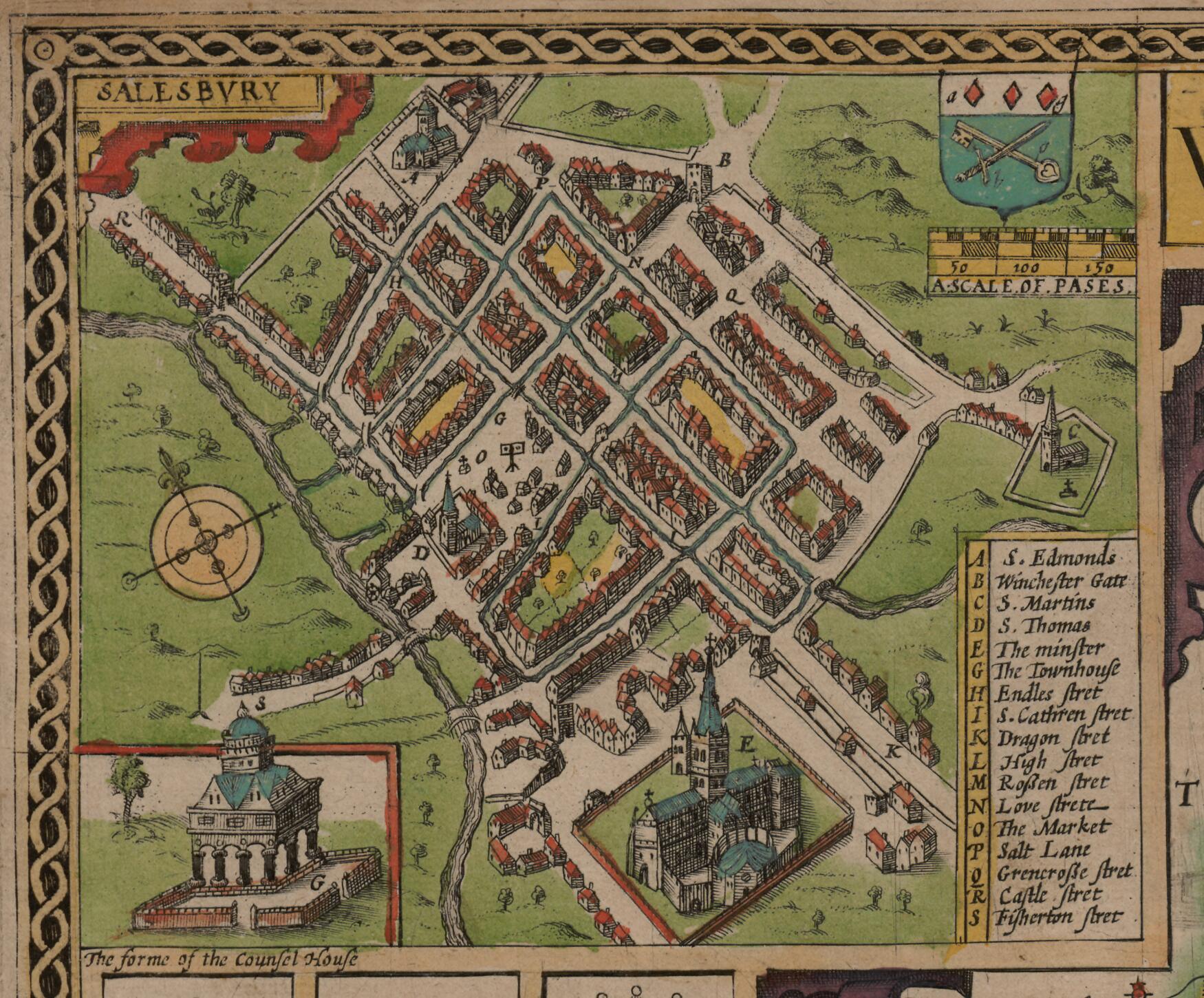
John Speed, Salisbury inset on the map of Wiltshire, proof atlas, 1611. Cambridge University Library Digital Library.
Wessex Archaeology independently explains that Speed's stylized plan shows bridging points in Salisbury's complex channel network. Excavation in the Market Place has found a substantial foundation that may have belonged to one such watercourse crossing. See “Salisbury Sites 14: Salisbury Market Place”.
The plan is a powerful topographical control, but it is not a project drawing. It does not identify the conditt wall, label Myddelton's fountain, or trace the 1613 works. It establishes the physical setting in which his route choices made sense: water channels, highways, bridge points, a walled Close and a dense built environment were superimposed on one another.
Route reconstruction: established points and unresolved joins
The two Salisbury documents preserve consecutive portions of a possible system, but they do not themselves say that every named element belonged to a single continuous line.
| Element | What the record says | What remains unresolved |
|---|---|---|
| Conduit wall | the 1610 adventure concerned bringing water from the conditt wall | its exact site, source and construction |
| North Gate | the stated 1610 destination was the North gate of the Cittie of Sarum | whether this is exactly the Close's High Street/North Gate or another civic usage |
| Banks in the Close | men were at work making banks in July 1613 | line, dimensions, material and whether these contained or protected the channel |
| Route through the Close | the bishop was providing a warrant to draw a watercourse through it | terms of the warrant and the property or jurisdiction crossed |
| Postern route | more costly and difficult because walls would have to be broken | the identity of this Postern Gate and the walls intended |
| Highway route | Myddelton expected less opposition | which highway and whose consent it required |
| Fountain | expected to be built with the watercourse within a short projected interval | site, users and whether it was completed |
| Cistern and pipes | named in the working report | material, capacity, route, source of head and consumers |
The modern High Street Gate is also called the North Gate in public Close histories. That makes it a serious candidate for the 1610 wording, not a settled identification. Likewise, online and antiquarian searches for Postern Gate repeatedly produce gates at Old Sarum. Those passages cannot simply be imported into a letter about banks and a watercourse in the Cathedral Close. The 1613 Postern remains unidentified in this research pass.
Cathedral Archivist Emily Naish notes that before the Close wall was licensed in 1327, much of the boundary followed the Avon and a deep Close Ditch. Her essay also prints William Small's later recollection that he had seen fish in a small stream running under a Close gate. These are valuable evidence for the long water history of the precinct, but neither proves that the remembered stream was Myddelton's 1613 work. See Emily Naish, “The Changing Close: Landscape and Use Reflected in the Cathedral Archives”.
Salisbury's wider water environment
Running watercourses were a defining part of Salisbury's urban design. Wiltshire Community History explains that water was diverted from the Avon, carried through the town and returned to the river, influencing even the shape of the city's street blocks: Salisbury community history.
Wessex Archaeology likewise describes a medieval network serving both fresh water and drainage functions: “Salisbury Sites 2: Belle Vue House and United Kingdom House”.
The Neville–Myddelton project was therefore not the invention of water circulation in Salisbury. Its novelty lies more likely in the extension, rerouting, improvement or controlled distribution of an established urban water system into and through the Cathedral Close.
John Aldworth's house in the Close
The 1614 receipt records £5 for half a year's rent paid by M^r John Aldworth of Billingbeare for his house in the Close of Sarum. The grammar identifies the tenant or payer as Aldworth. It does not call the property Neville's house, say that Neville occupied it, or connect it explicitly to the watercourse.
Aldworth's Billingbear description keeps the property within Neville's administrative orbit, so the house remains an important lead. It may have served Aldworth personally, Neville's business, visiting members of the household, or another purpose. The document does not choose among them. Neither should it be used to shrink a scheme involving a civic gate, a bishop's warrant, Close-wide routing, a fountain and collective opposition into an ordinary domestic plumbing job.
The next task is to identify the house:
- its landlord;
- exact Close location;
- whether Neville or other members of the Billingbear household occupied it;
- whether the proposed water route approached it;
- whether rent, repair or household accounts survive before or after 1614.
The Cathedral Archive's deed series for Close properties is now an exact retrieval target: PI/1/1, *Deeds Concerning Close Properties and Land, 1285–1800s*. Its later boxes contain item-level cards recording dates, summaries and personal names. Searching Aldworth, Myddelton, Neville and the £10 annual rent may identify the house without assuming its ownership in advance.
A parallel watercourse dispute: the clothworkers' petition
The Cathedral catalogue contains an undated petition assigned broadly to 1600–1640. Salisbury clothworkers say they are “greatly impoverished by reason of the great want of milling of their cloth” and ask the Dean and Chapter to “graunt the water course now in question to Mr Bee.” The catalogue identifies Matthew Bee as a Salisbury mayor in 1600 and 1632: CH/20/48, *Petition of the Clothworkers*.
The broad date prevents identification of this petition with the Neville–Myddelton undertaking. It nevertheless demonstrates that in the same general period:
- the Dean and Chapter could be asked to grant a disputed watercourse;
- water access affected Salisbury's cloth-milling economy;
- rival claimants and civic arguments could form around a proposed route;
- watercourse questions crossed economic, municipal and ecclesiastical
interests.
This is exactly the kind of local conflict that makes The close men already mutiny intelligible, while remaining a separate archival lead until a date, route or participant connects the two records.
Exact Cathedral Archive retrieval programme
The deep search has reduced a generic archival recommendation to six catalogued targets:
| Reference | Public catalogue description | Question to test |
|---|---|---|
| CH/13/1 | Contracts Register, 1608–1636; 468 pages and 238 items | warrant, easement, route consent, Close property agreement |
| FA/1/1/50 | clerks-of-works annual accounts, 1612–13 | banks, wall-breaking, trenching, fountain, cistern, pipes, labour |
| FA/1/1/51 | clerks-of-works annual accounts, 1613–14 | construction and reinstatement during and after the July 1613 report |
| FI/1/1/1614_3 | Communar's and Incerti accounts covering parts of 1613–14 | receipts, rents, contributions or institutional charges |
| PI/1/1 | Close property deeds, 1285–1800s | Aldworth's house, rent, landlord, lease and location |
| CH/20/48 | clothworkers' petition concerning a watercourse, 1600–1640 | date, route, parties and any connection with 1610–13 works |
The first examination should be chronological, not merely name-based. Accounts may describe banks, lead, pipes, masons, plumbers, labourers or wall repairs without naming Neville or Myddelton. The contracts register should also be checked for the bishop, dean, chapter, Close tenants and highway language. Bishop Henry Cotton's episcopal register and Salisbury civic records remain separate necessary searches because the July letter distinguishes the bishop's warrant from anticipated highway opposition.
Hugh Myddelton identification and corrected signature reading
The earlier packet invented an unresolved adult Henry Myddelton by misreading the highly compressed given name in the subscriptions. That reading is withdrawn.
The original-color photographs were rechecked together on 17 July 2026. In the subscriptions to the 1610 Salisbury receipt, 1613 Salisbury letter, 1613 New River receipt, and 1614 rent receipt, the stroke formerly taken as part of Henrie is the descending g of Hugh. The controlled 18 May 1612 New River receipt supplies a comparison signature already read as Hugh: Myddelton. The 2 December 1613 receipt independently names Hugh Middelton Citizen and goldsmyth of London in its body.
The public archive control is equally decisive. The Royal Berkshire Archives catalogue describes D/EN/O24 as New River papers concerning the venture floated by Hugh Myddelton and expressly identifies a letter from Hugh Mydelton, 1613. The corrected sender identification therefore rests on the primary images, cross-document signature comparison, an explicit body-text naming clause, and the archive catalogue—not on resemblance alone.
This correction changes the historical question. The problem is no longer to identify an unknown Henry, but to understand Hugh Myddelton's earlier and continuing Salisbury role. A targeted search should compare these records with:
- Salisbury civic and Chapter accounts;
- London livery-company and freeman records;
- Myddelton family wills;
- property deeds for the Close house;
- Hugh Myddelton's business correspondence and account books.
Distinct projects, one identified participant
The parent bundle also contains genuine New River evidence: receipts for Neville's payments toward bringing water from Chadwell and Amwell to London. Those documents belong in the New River topic.
The Salisbury papers do not. Their place names, gates, walls, institutional actors and structures are local to Sarum. Keeping the lanes separate makes both arguments stronger:
| Salisbury waterworks | New River |
|---|---|
| conduit wall and North Gate of Sarum | Chadwell and Amwell toward London |
| Cathedral Close, Postern Gate and highway | long-distance metropolitan aqueduct |
| Bishop's warrant and Close-men opposition | private shares, covenants and London supply |
| fountain, cistern and lead pipes | river cut, reservoirs and metropolitan distribution |
The connection is now direct: Neville dealt with Hugh Myddelton in both the Salisbury and New River records. That does not make the two works one project. It establishes a continuing Neville–Hugh Myddelton water-infrastructure relationship from at least November 1610 through April 1614.
Research priorities
- Search Salisbury Cathedral Chapter acts for 1610–14 for
water,conduit, - Search Bishop Henry Cotton's register for the warrant mentioned in July
- Map all early seventeenth-century gates and highways around the Close to
- Locate the conduit wall and North Gate endpoint named in 1610.
- Identify John Aldworth's rented Close house from leases, rentals and
- Search Salisbury city records for the 1610 payment and any 1613 highway
- Trace Hugh Myddelton's Salisbury activity through city, Chapter, property,
- Determine whether the fountain or cistern survived into later plans,
fountain, cistern, pipe, trench, wall, Postern, Myddelton, Neville and objections by inhabitants of the Close.
1613.
identify the two proposed routes.
Aldworth's accounts; then test, rather than assume, Neville's use.
consent or dispute.
Goldsmiths' Company, account-book and correspondence records.
antiquarian descriptions or archaeological reports.
Sources
- Royal Berkshire Archives,
- Elizabeth Crittall, ed.,
- Clergy of the Church of England Database,
- Salisbury Cathedral,
- Salisbury Cathedral Close Preservation Society,
- Wiltshire Council,
- Wessex Archaeology,
- Cambridge University Library Digital Library,
- Emily Naish,
- Salisbury Cathedral Archive catalogue:
- William Dodsworth,
- John Britton and James Hatcher,
- Dictionary of Welsh Biography,
“Salisbury: Relations with the bishops, to 1612,” A History of the County of Wiltshire, vol. 6 (London, 1962).
“List of the bishops of Salisbury”.
“High Street Gate” and “SCCPS History”.
“Salisbury Sites 2: Belle Vue House and United Kingdom House” and “Salisbury Sites 14: Salisbury Market Place”.
John Speed, proof atlas, Wiltshire map and Salisbury inset, 1611.
“The Changing Close: Landscape and Use Reflected in the Cathedral Archives” (2023).
CH/13/1, FA/1/1/50, FA/1/1/51, FI/1/1/1614_3, PI/1/1, and CH/20/48.
*An Historical Account of the Episcopal See and Cathedral Church of Sarum or Salisbury* (Salisbury, 1814).
*An Historical and Descriptive Account of Old and New Sarum or Salisbury* (Salisbury, 1834).
Manuscript Claim Audit
- Primary images checked: original-color photographs of the 26 November
- Signature comparison: the full subscriptions were compared across all
- Body-text control: the 2 December 1613 receipt names `Hugh Middelton
- Independent non-AI control: Royal Berkshire Archives public
- Prior conflict: all
Henry/Henrieidentifications in the Salisbury - Unresolved readings: several compressed clauses in the middle and lower
- Status:
primary_image_and_independent_control.
1610 Salisbury receipt, 29 July 1613 Salisbury letter and address leaf, 18 May 1612 and 2 December 1613 New River receipts, and 28 April 1614 rent receipt in Royal Berkshire Archives D/EN/O24, inspected 17 July 2026.
five records. The capital, compressed u, descending g, colon, surname construction, and underline recur across the group.
Citizen and goldsmyth of London`; the companion New River record independently names Hugh Middleton.
D/EN/O24 catalogue, expressly identifying the 1613 letter as from Hugh Myddelton.
and 2 December 1613 records are superseded and retained only in internal correction history.
portions of the 1613 letter remain unresolved and have not been silently completed.
Notes on Access
The Royal Berkshire Archives public record is a file-level description, not a public page-image edition of each child document. The quoted manuscript text was checked against the complete photographed witnesses. The VCH page was available as public body text through British History Online. Cathedral, Close, Wiltshire and Wessex pages were publicly accessible.
The manuscript transcript remains deliberately partial where the handwriting is compressed.
2026-08-07 Two-Project Relationship Finding
The dated papers establish more than a single investment. On 26 November 1610 Hugh Myddelton acknowledged Neville's adventure toward bringing water from the conduit wall to Salisbury's North Gate. Separate receipts of 18 May 1612 and 2 December 1613 record £50 payments in the New River undertaking. Myddelton's 29 July 1613 letter then reported men at work on Close banks, compared the Postern Gate and highway routes, explained the extra cost and difficulty of breaking walls, and warned that The close men already mutiny. On 28 April 1614, Neville's Aldworth transaction concerned rent in Salisbury Close.
These records document a repeated Neville–Myddelton relationship across two distinct water projects: Salisbury's local watercourse and London's New River. Neville appears both as a financial participant and as the recipient of a technical-progress report involving route choice, cost, earthworks, legal warrant, and local opposition. The unresolved task is to reconstruct each project's complete account and outcome, not to reduce the relationship to an isolated name or receipt.